lock VOLVO S60 2009 Owner´s Manual
[x] Cancel search | Manufacturer: VOLVO, Model Year: 2009, Model line: S60, Model: VOLVO S60 2009Pages: 254, PDF Size: 6.17 MB
Page 126 of 254
06 Starting and drivingStarting the vehicle
06126
WARNING
Never switch off the ignition (turn the ignition
key to position 0) or remove the key from the
ignition switch while the vehicle is in motion.
This could cause the steering wheel to lock,
which would make the vehicle impossible to
steer.
Page 129 of 254
06 Starting and driving
Manual transmission
06
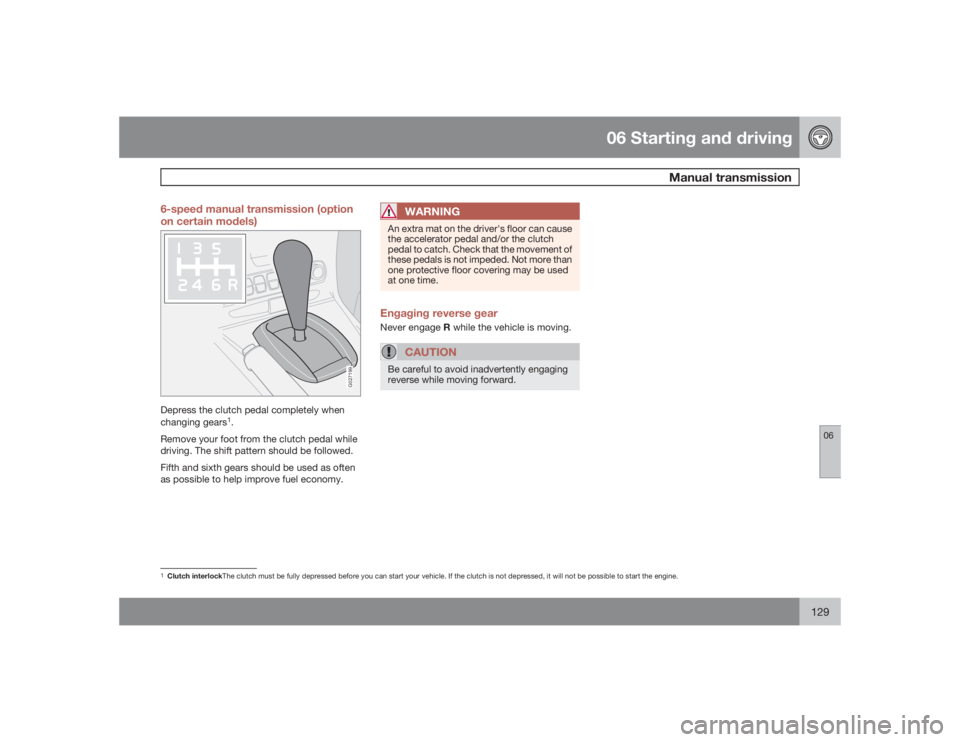
129 6-speed manual transmission (option
on certain models)
G027199
Depress the clutch pedal completely when
changing gears
1.
Remove your foot from the clutch pedal while
driving. The shift pattern should be followed.
Fifth and sixth gears should be used as often
as possible to help improve fuel economy.
WARNING
An extra mat on the driver's floor can cause
the accelerator pedal and/or the clutch
pedal to catch. Check that the movement of
these pedals is not impeded. Not more than
one protective floor covering may be used
at one time.Engaging reverse gearNever engage R while the vehicle is moving.
CAUTION
Be careful to avoid inadvertently engaging
reverse while moving forward.
1Clutch interlockThe clutch must be fully depressed before you can start your vehicle. If the clutch is not depressed, it will not be possible to start the engine.
Page 130 of 254
06 Starting and drivingAutomatic transmission (option)
06130
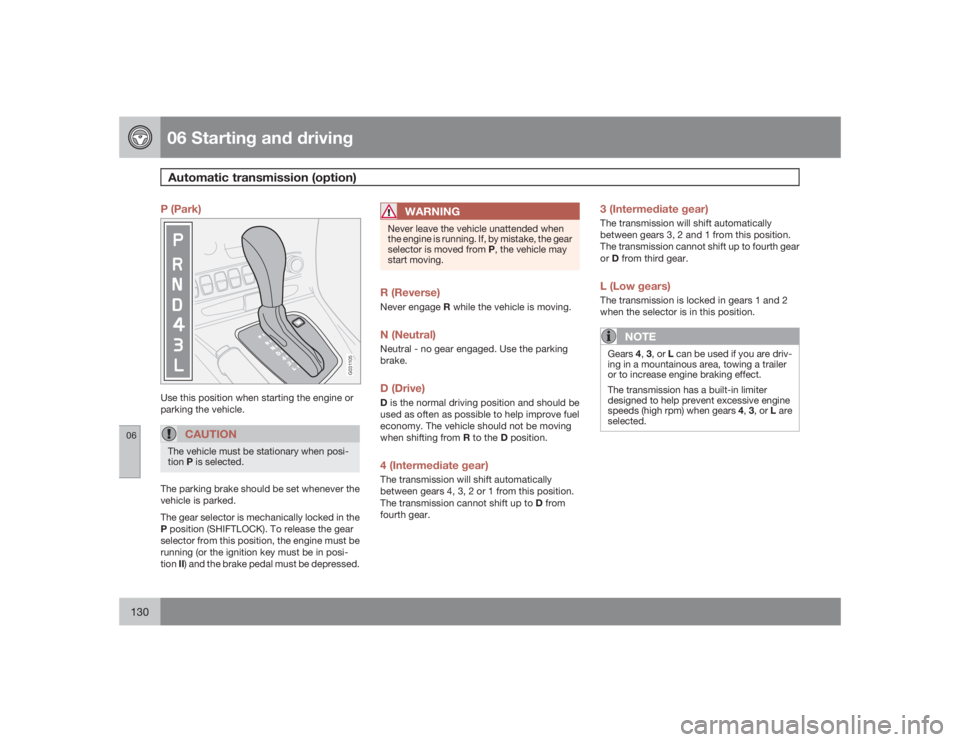
P (Park)
G031105
Use this position when starting the engine or
parking the vehicle.
CAUTION
The vehicle must be stationary when posi-
tionP is selected.The parking brake should be set whenever the
vehicle is parked.
The gear selector is mechanically locked in the
P position (SHIFTLOCK). To release the gear
selector from this position, the engine must be
running (or the ignition key must be in posi-
tionII) and the brake pedal must be depressed.
WARNING
Never leave the vehicle unattended when
the engine is running. If, by mistake, the gear
selector is moved from P, the vehicle may
start moving.R (Reverse)Never engage R while the vehicle is moving.N (Neutral)Neutral - no gear engaged. Use the parking
brake.D (Drive)D is the normal driving position and should be
used as often as possible to help improve fuel
economy. The vehicle should not be moving
when shifting from R to the D position.4 (Intermediate gear)The transmission will shift automatically
between gears 4, 3, 2 or 1 from this position.
The transmission cannot shift up to D from
fourth gear.
3 (Intermediate gear)The transmission will shift automatically
between gears 3, 2 and 1 from this position.
The transmission cannot shift up to fourth gear
orD from third gear.L (Low gears)The transmission is locked in gears 1 and 2
when the selector is in this position.
NOTE
Gears4,3, or L can be used if you are driv-
ing in a mountainous area, towing a trailer
or to increase engine braking effect.
The transmission has a built-in limiter
designed to help prevent excessive engine
speeds (high rpm) when gears 4,3, or L are
selected.
Page 132 of 254
06 Starting and drivingAutomatic transmission (option)
06132
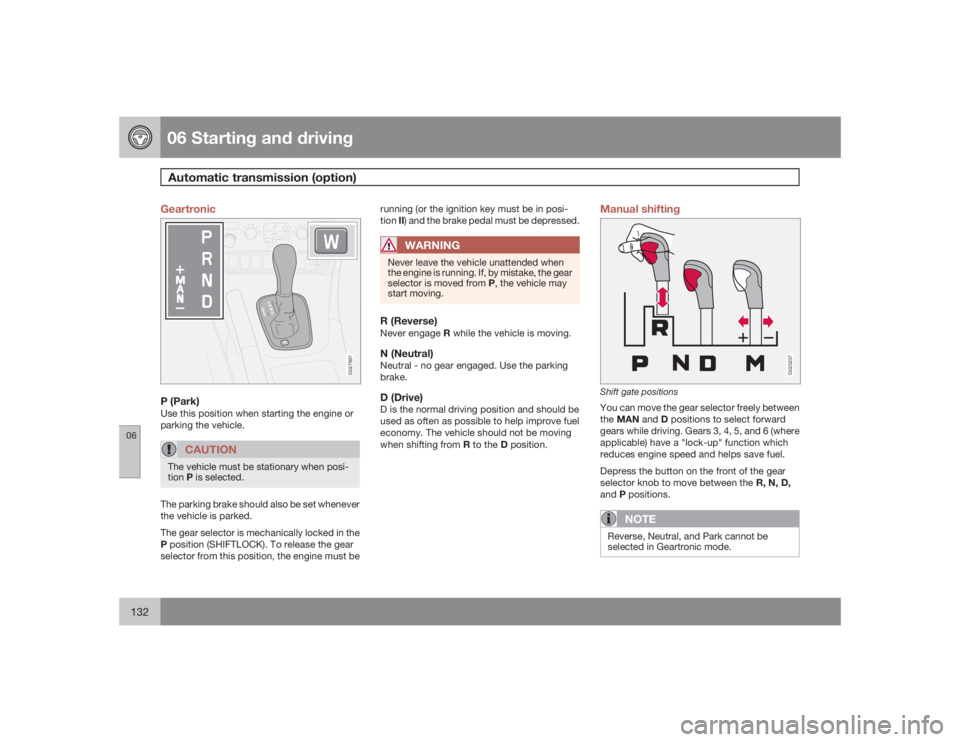
Geartronic
G027997
P (Park)Use this position when starting the engine or
parking the vehicle.
CAUTION
The vehicle must be stationary when posi-
tionP is selected.The parking brake should also be set whenever
the vehicle is parked.
The gear selector is mechanically locked in the
P position (SHIFTLOCK). To release the gear
selector from this position, the engine must berunning (or the ignition key must be in posi-
tionII) and the brake pedal must be depressed.
WARNING
Never leave the vehicle unattended when
the engine is running. If, by mistake, the gear
selector is moved from P, the vehicle may
start moving.R (Reverse)Never engage R while the vehicle is moving.N (Neutral)Neutral - no gear engaged. Use the parking
brake.D (Drive)D is the normal driving position and should be
used as often as possible to help improve fuel
economy. The vehicle should not be moving
when shifting from R to the D position.
Manual shifting
G020237
Shift gate positionsYou can move the gear selector freely between
theMAN and D positions to select forward
gears while driving. Gears 3, 4, 5, and 6 (where
applicable) have a "lock-up" function which
reduces engine speed and helps save fuel.
Depress the button on the front of the gear
selector knob to move between the R, N, D,
andP positions.
NOTE
Reverse, Neutral, and Park cannot be
selected in Geartronic mode.
Page 136 of 254
06 Starting and drivingBrake system
06136
Anti-lock brakes (ABS)
If the warning lamp lights up there
is a malfunction of the ABS system
(the standard braking system will
however function) and the vehicle
should be driven cautiously to a
trained and qualified Volvo service technician
for inspection. The Anti-lock Braking System
(ABS) helps to improve vehicle control (stop-
ping and steering) during severe braking con-
ditions by limiting brake lockup. When the
system "senses" impending lockup, braking
pressure is automatically modulated in order to
help prevent lockup, which could lead to a skid.
The system performs a self-diagnostic test
when the engine is started and when the
vehicle first reaches a speed of approxi-
mately 12 mph (20 km/h). The brake pedal will
pulsate several times and a sound may be
audible from the ABS control module. This is
normal.
To obtain optimal effect from the ABS system,
constant pressure should be kept on the brake
pedal. Do not pump the brake pedal.
The switching of the ABS modulator will be
audible and the brake pedal will pulsate during
braking. Please be aware that ABS does not
increase the absolute braking potential of the
vehicle. While control will be enhanced, ABSwill not shorten stopping distances on slippery
surfaces.
ABS with EBD (Electronic Brake Force
Distribution)EBD is an integrated part of the ABS system.
EBD regulates the hydraulic pressure to the
rear brakes to help provide optimal braking
capacity. The brake pedal will pulsate during
braking, which is normal.
If the BRAKEandABS warning lights come on
at the same time, this could indicate a fault in
the brake system.
1. Stop the vehicle in a suitable place and
switch off the engine.
2. Restart the engine.
3. If both warning lights go off, no further
action is required.
WARNING
If the fluid level is below the MIN mark in the
reservoir or if a "
Brake failure - Service
urgent
" message is displayed in the text
window:DO NOT DRIVE
. Have the vehicle
towed to a trained and qualified Volvo serv-
ice technician and have the brake system
inspected.
4. If both lights are still on after the engine has
been restarted, switch off the engine again
and check the brake fluid level (see
page 193 for the location of the brake fluid
reservoir).
5.
If the brake fluid level is above the MIN
mark, drive carefully to a trained and quali-
fied Volvo service technician and have the
brake system inspected.Emergency Brake Assistance (EBA)The EBA function is designed to provide full
brake effect immediately in the event of sud-
den, hard braking. The system is activated by
the speed with which you depress the brake
pedal.
Page 140 of 254
06 Starting and drivingTowing
06140
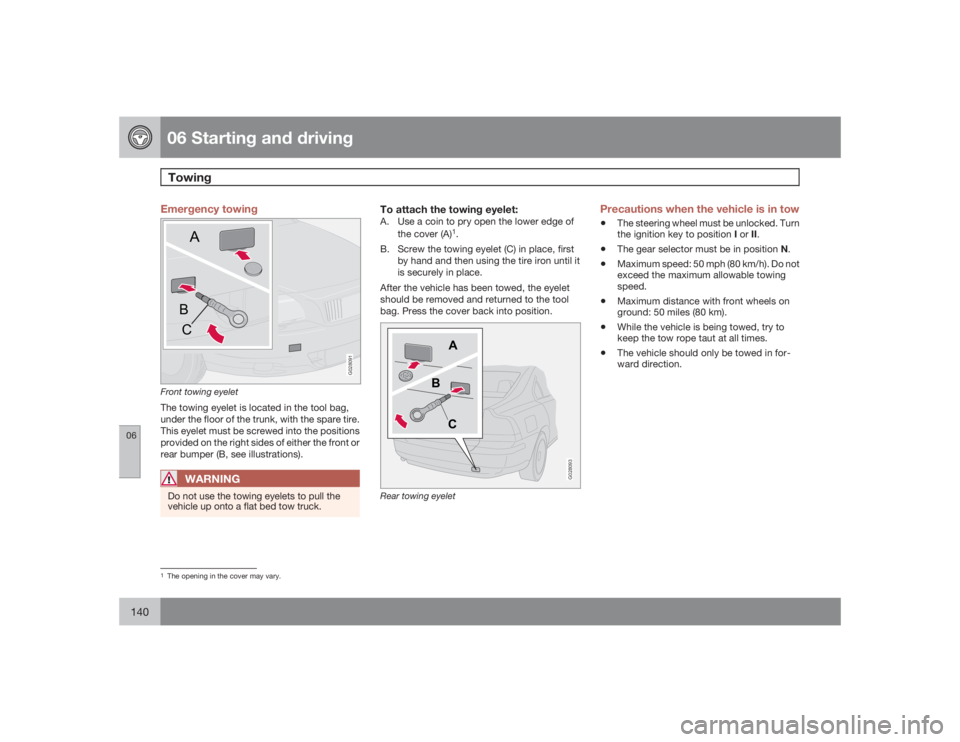
Emergency towing
ABC
G028091
Front towing eyeletThe towing eyelet is located in the tool bag,
under the floor of the trunk, with the spare tire.
This eyelet must be screwed into the positions
provided on the right sides of either the front or
rear bumper (B, see illustrations).
WARNING
Do not use the towing eyelets to pull the
vehicle up onto a flat bed tow truck.
To attach the towing eyelet:A. Use a coin to pry open the lower edge of
the cover (A)
1.
B. Screw the towing eyelet (C) in place, first
by hand and then using the tire iron until it
is securely in place.
After the vehicle has been towed, the eyelet
should be removed and returned to the tool
bag. Press the cover back into position.A
B
C
G028093
Rear towing eyelet
Precautions when the vehicle is in tow•
The steering wheel must be unlocked. Turn
the ignition key to position I or II.
•
The gear selector must be in position N.
•
Maximum speed: 50 mph (80 km/h). Do not
exceed the maximum allowable towing
speed.
•
Maximum distance with front wheels on
ground: 50 miles (80 km).
•
While the vehicle is being towed, try to
keep the tow rope taut at all times.
•
The vehicle should only be towed in for-
ward direction.
1The opening in the cover may vary.
Page 145 of 254
06 Starting and driving
Detachable trailer hitch
06
145
AC
E
D
B
G010496
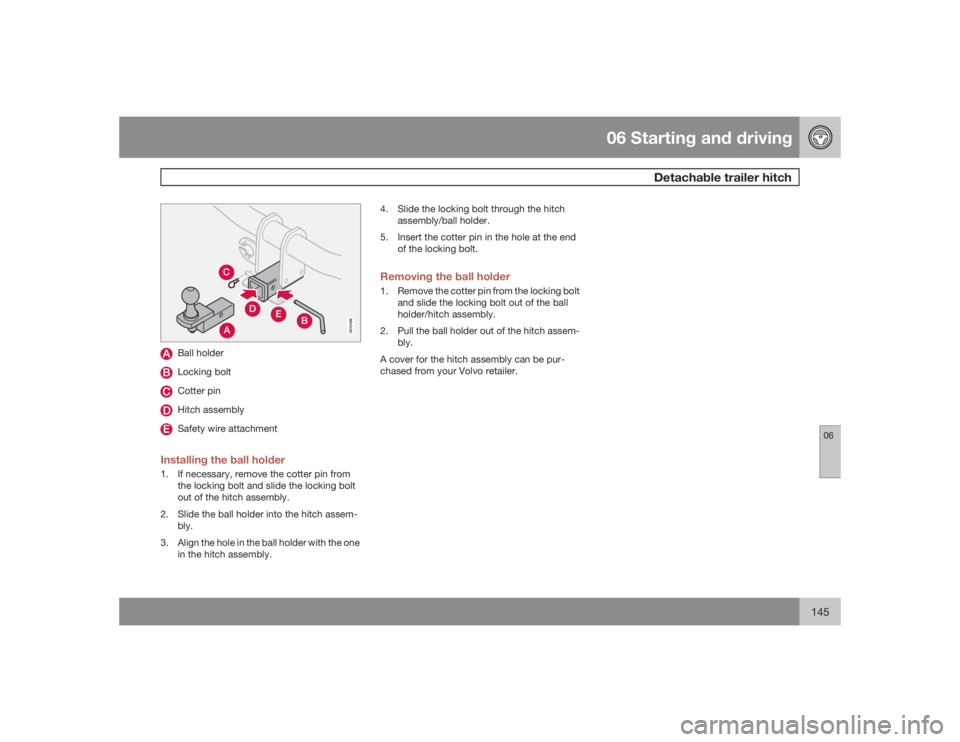
Ball holderLocking boltCotter pinHitch assemblySafety wire attachment
Installing the ball holder1. If necessary, remove the cotter pin from
the locking bolt and slide the locking bolt
out of the hitch assembly.
2. Slide the ball holder into the hitch assem-
bly.
3. Align the hole in the ball holder with the one
in the hitch assembly.4. Slide the locking bolt through the hitch
assembly/ball holder.
5. Insert the cotter pin in the hole at the end
of the locking bolt.
Removing the ball holder1. Remove the cotter pin from the locking bolt
and slide the locking bolt out of the ball
holder/hitch assembly.
2. Pull the ball holder out of the hitch assem-
bly.
A cover for the hitch assembly can be pur-
chased from your Volvo retailer.
Page 148 of 254
06 Starting and drivingCold weather precautions
06148
If you wish to check your vehicle before the
approach of cold weather, the following advice
is worth noting:•
Make sure that the engine coolant contains
50 percent antifreeze. Any other mixture
will reduce freeze protection. This gives
protection against freezing down to -31 °F
(-35 °C). See section "Coolant". The use of
"recycled" antifreeze is not approved by
Volvo. Different types of antifreeze must
not be mixed.
•
Volvo recommends using only genuine
Volvo antifreeze in your vehicle's radiator.
•
Try to keep the fuel tank well filled - this
prevents the formation of condensation in
the tank. In addition, in extremely cold
weather conditions it is worthwhile to add
fuel line de-icer before refueling.
•
The viscosity of the engine oil is important.
Oil with low viscosity (thinner oil) improves
cold-weather starting as well as decreas-
ing fuel consumption while the engine is
warming up. For winter use, 5W-30 oil, par-
ticularly the synthetic type
1, is recom-
mended. Be sure to use good quality oil but
do not use cold-weather oil for hard driving
or in warm weather. See section "Engine
oil" for more information.
•
The load placed on the battery is greater
during the winter since the windshield wip-ers, lighting, etc. are used more often.
Moreover, the capacity of the battery
decreases as the temperature drops. In
very cold weather, a poorly charged bat-
tery can freeze and be damaged. It is there-
fore advisable to check the state of charge
more frequently and spray an antirust oil on
the battery posts.
•
Volvo recommends the use of snow tires
on all four wheels for winter driving - see
section "Wheels and tires."
•
To prevent the washer fluid reservoir
from freezing, add washer solvents con-
taining antifreeze (see page 192 for the
location of the washer fluid reservoir). This
is important since dirt is often splashed on
the windshield during winter driving,
requiring the frequent use of the washers
and wipers. Volvo Washer Solvent should
be diluted as follows:
•
Use Volvo Teflon Lock Spray in the locks.NOTE
Avoid the use of de-icing sprays as they can
cause damage to the locks.
1Synthetic oil is not used when the oil is changed at the normal maintenance service intervals.
Page 166 of 254
07 Wheels and tiresSnow chains, snow tires, studded tires
07166
Snow chainsSnow chains can be used on your Volvo with
the following restrictions:•
Snow chains should be installed on front
wheels only. Use only Volvo approved
snow chains.
•
If accessory, aftermarket or "custom" tires
and wheels are installed and are of a size
different than the original tires and wheels,
chains in some cases CANNOT be used.
Sufficient clearances between chains and
brakes, suspension and body components
must be maintained.
•
Some strap-on type chains will interfere
with brake components and therefore
CANNOT be used.
•
All Wheel Drive models: Snow chains
should only be installed on the front
wheels. Only chains adapted for AWD
models should be used.
Consult your Volvo retailer for additional snow
chain information.
CAUTION
•
Check local regulations regarding the
use of snow chains before installing.
•
Always follow the chain manufacturer's
installation instructions carefully. Install
chains as tightly as possible and
retighten periodically.
•
Never exceed the chain manufacturer's
specified maximum speed limit. (Under
no circumstances should you exceed
31 mph (50 km/h)).
•
Avoid bumps, holes or sharp turns
when driving with snow chains.
•
The handling of the vehicle can be
adversely affected when driving with
chains. Avoid fast or sharp turns as well
as locked wheel braking.
Snow tires, studded tires
1
Tires for winter use:•
Owners who live in or regularly commute
through areas with sustained periods of
snow or icy driving conditions are strongly
advised to fit suitable winter tires to help
retain the highest degree of traction.
•
It is important to install winter tires on all
four wheels to help retain traction duringcornering, braking, and accelerating. Fail-
ure to do so could reduce traction to an
unsafe level or adversely affect handling.
•
Do not mix tires of different design as this
could also negatively affect overall tire road
grip.
•
Winter tires wear more quickly on dry roads
in warm weather. They should be removed
when the winter driving season has ended.
•
Studded tires should be run-in
300-600 miles (500-1000 km) during which
the vehicle should be driven as smoothly
as possible to give the studs the opportu-
nity to seat properly in the tires. The tires
should have the same rotational direction
throughout their entire lifetime.NOTE
Please consult state or provincial regula-
tions restricting the use of studded winter
tires before installing such tires.
1Where permitted
Page 169 of 254
07 Wheels and tires
Changing wheels
07``169
G020331
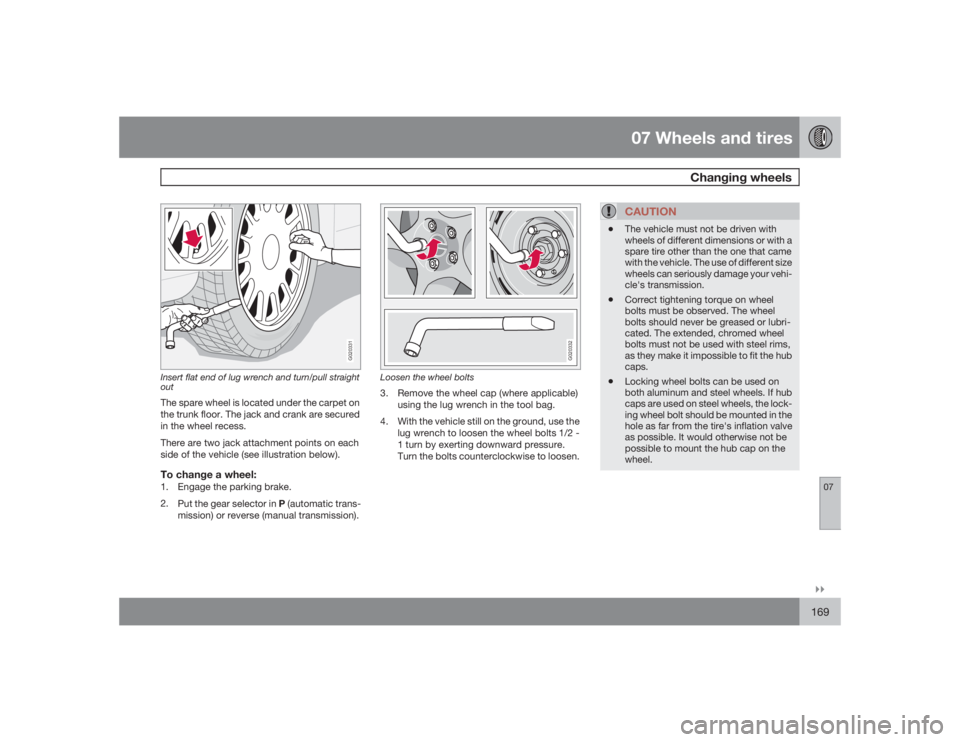
Insert flat end of lug wrench and turn/pull straight
outThe spare wheel is located under the carpet on
the trunk floor. The jack and crank are secured
in the wheel recess.
There are two jack attachment points on each
side of the vehicle (see illustration below).To change a wheel:1. Engage the parking brake.
2.
Put the gear selector in P (automatic trans-
mission) or reverse (manual transmission).
G020332
Loosen the wheel bolts3. Remove the wheel cap (where applicable)
using the lug wrench in the tool bag.
4. With the vehicle still on the ground, use the
lug wrench to loosen the wheel bolts 1/2 -
1 turn by exerting downward pressure.
Turn the bolts counterclockwise to loosen.
CAUTION
•
The vehicle must not be driven with
wheels of different dimensions or with a
spare tire other than the one that came
with the vehicle. The use of different size
wheels can seriously damage your vehi-
cle's transmission.
•
Correct tightening torque on wheel
bolts must be observed. The wheel
bolts should never be greased or lubri-
cated. The extended, chromed wheel
bolts must not be used with steel rims,
as they make it impossible to fit the hub
caps.
•
Locking wheel bolts can be used on
both aluminum and steel wheels. If hub
caps are used on steel wheels, the lock-
ing wheel bolt should be mounted in the
hole as far from the tire's inflation valve
as possible. It would otherwise not be
possible to mount the hub cap on the
wheel.