service VOLVO S60 2013 Owner´s Manual
[x] Cancel search | Manufacturer: VOLVO, Model Year: 2013, Model line: S60, Model: VOLVO S60 2013Pages: 366, PDF Size: 6.85 MB
Page 306 of 366
09 Maintenance and specifications
Volvo maintenance 09
304
Introduction
Volvo advises you to follow the maintenance
program outlined in the Warranty and Service
Records Information booklet. This mainte-
nance program contains inspections and serv-
ices necessary for the proper function of your
vehicle. The maintenance services contain
several checks that require special tools and
training, and therefore must be performed by a
qualified technician. To keep your Volvo in top
condition, specify time-tested and proven
Genuine Volvo Parts and Accessories.
The Federal Clean Air Act – U.S.The Federal Clean Air Act requires vehicle
manufacturers to furnish written instructions to
the ultimate purchaser to assure the proper
servicing and function of the components that
control emissions. These services, which are
listed in the "Warranty and Service Records
Information" booklet, are not covered by the
warranty. You will be required to pay for labor
and material used.
MaintenanceYour Volvo passed several major inspections
before it was delivered to you, in accordance
with Volvo specifications. The maintenance
procedures outlined in the Warranty and Serv-
ice Records Information booklet, many of
which will positively affect your vehicle's emis-
sions, should be performed as indicated. It isrecommended that receipts for vehicle emis-
sion maintenance be retained in case ques-
tions arise concerning maintenance. Inspec-
tion and maintenance should also be per-
formed anytime a malfunction is observed or
suspected.
Applicable warranties – U.S./CanadaIn accordance with applicable U.S. and Cana-
dian regulations, the following list of warranties
is provided.
•New Vehicle Limited Warranty
•Parts and Accessories Limited Warranty
•Corrosion Protection Limited Warranty
•Seat Belt and Supplemental Restraint Sys-
tems Limited Warranty
•Emission Design and Defect Warranty
•Emission Performance Warranty
These are the federal warranties; other warran-
ties are provided as required by state/provin-
cial law. Refer to your separate Warranty and
Service Records Information booklet for
detailed information concerning each of the
warranties.
Periodic maintenance helps minimize
emissions
Periodic maintenance will help keep your vehi-
cle running well. Your Warranty and Service
Records Information booklet provides a com-prehensive periodic maintenance schedule up
to 150,000 miles (240,000 km) of vehicle main-
tenance. The schedule includes components
that affect vehicle emissions. This page
describes some of the emission-related com-
ponents.
Page 307 of 366
09 Maintenance and specifications
Maintaining your car09
305 Owner maintenance
Periodic maintenance requirements and inter-
vals are described in your vehicle's Warranty
and Service Records Information booklet.
The following points can be carried out
between the normally scheduled maintenance
services.
Each time the car is refueled:
•Check the engine oil level.
•Clean the windshield, windshield wipers,
headlights, and taillights.
Monthly:
•Check cold tire pressure in all tires. Inspect
the tires for wear.
•Check that engine coolant and other fluid
levels are between the indicated "min" and
"max" markings.
•Clean interior glass surfaces with a glass
cleaner and soft paper towels.
•Wipe driver information displays with a soft
cloth.
•Visually inspect battery terminals for cor-
rosion. Corrosion may indicate a loose ter-
minal connector, or a battery near the end
of its useful service life. Consult your Volvo
retailer for additional information.
As needed:Wash the car, including the undercarriage, to
reduce wear that can be caused by a buildup
of dirt, and corrosion that can be caused by salt
residues.
Clean leaves and twigs from air intake vents at
the base of the windshield, and from other pla-
ces where they may collect.
NOTE
Complete service information for qualified
technicians is available online for purchase
or subscription at www.volvotechinfo.com.
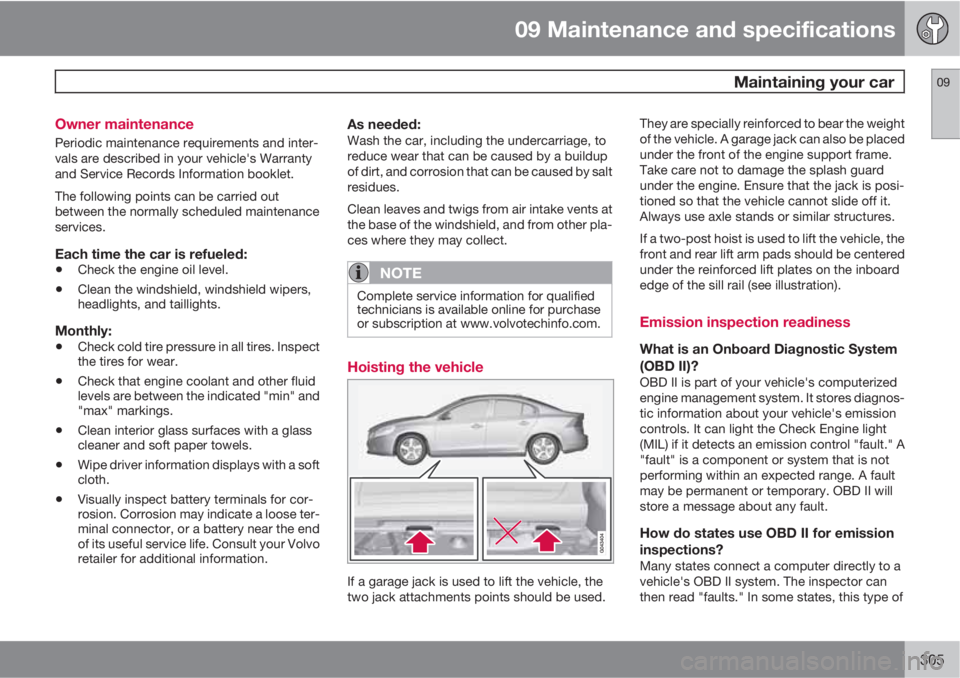
Hoisting the vehicle
If a garage jack is used to lift the vehicle, the
two jack attachments points should be used.They are specially reinforced to bear the weight
of the vehicle. A garage jack can also be placed
under the front of the engine support frame.
Take care not to damage the splash guard
under the engine. Ensure that the jack is posi-
tioned so that the vehicle cannot slide off it.
Always use axle stands or similar structures.
If a two-post hoist is used to lift the vehicle, the
front and rear lift arm pads should be centered
under the reinforced lift plates on the inboard
edge of the sill rail (see illustration).
Emission inspection readiness
What is an Onboard Diagnostic System
(OBD II)?
OBD II is part of your vehicle's computerized
engine management system. It stores diagnos-
tic information about your vehicle's emission
controls. It can light the Check Engine light
(MIL) if it detects an emission control "fault." A
"fault" is a component or system that is not
performing within an expected range. A fault
may be permanent or temporary. OBD II will
store a message about any fault.
How do states use OBD II for emission
inspections?
Many states connect a computer directly to a
vehicle's OBD II system. The inspector can
then read "faults." In some states, this type of
Page 308 of 366
09 Maintenance and specifications
Maintaining your car 09
306
inspection has replaced the tailpipe emission
test.
How can my vehicle fail OBD II emission
inspection?
Your vehicle can fail OBD II emission inspec-
tion for any of the following reasons.
•If your Check Engine (MIL) light is lit, your
vehicle may fail inspection.
•If your vehicle's Check Engine light was lit,
but went out without any action on your
part, OBD II will still have a recorded fault.
Your vehicle may pass or fail, depending
on the inspection practices in your area.
•If you had recent service that required dis-
connecting the battery, OBD II diagnostic
information may be incomplete and "not
ready" for inspection. A vehicle that is not
ready may fail inspection.
How can I prepare for my next OBD II
emission inspection?
•If your Check Engine (MIL) light is lit – or
was lit but went out without service, have
your vehicle diagnosed and, if necessary,
serviced by a qualified Volvo technician.
•If you recently had service for a lit Check
Engine light, or if you had service that
required disconnecting the battery, a
period of driving is necessary to bring the
OBD II system to "ready" for inspection. A
half-hour trip of mixed stop-and-go/high-way driving is typically needed to allow
OBD II to reach readiness. Your Volvo
retailer can provide you with more infor-
mation on planning a trip.
•Maintain your vehicle in accordance with
your vehicle's maintenance schedule.
Page 310 of 366
09 Maintenance and specifications
Engine oil 09
308
Checking the engine oil
The oil level should be checked at regular inter-
vals, particularly during the period up to the
first scheduled maintenance service.
•See page 346 for oil specifications.
•Refer to the Warranty and Service Records
Information booklet for information on the
oil change intervals.
CAUTION
•Not checking the oil level regularly can
result in serious engine damage if the oil
level becomes too low.
•Oil that is lower than the specified qual-
ity can damage the engine.
•Volvo does not recommend the use of
oil additives.
•Always add oil of the same type and
viscosity as already used.
•Never fill oil above the MAX mark. This
could cause an increase in oil consump-
tion.
•Oil changes should be carried out by a
trained and qualified Volvo service tech-
nician.
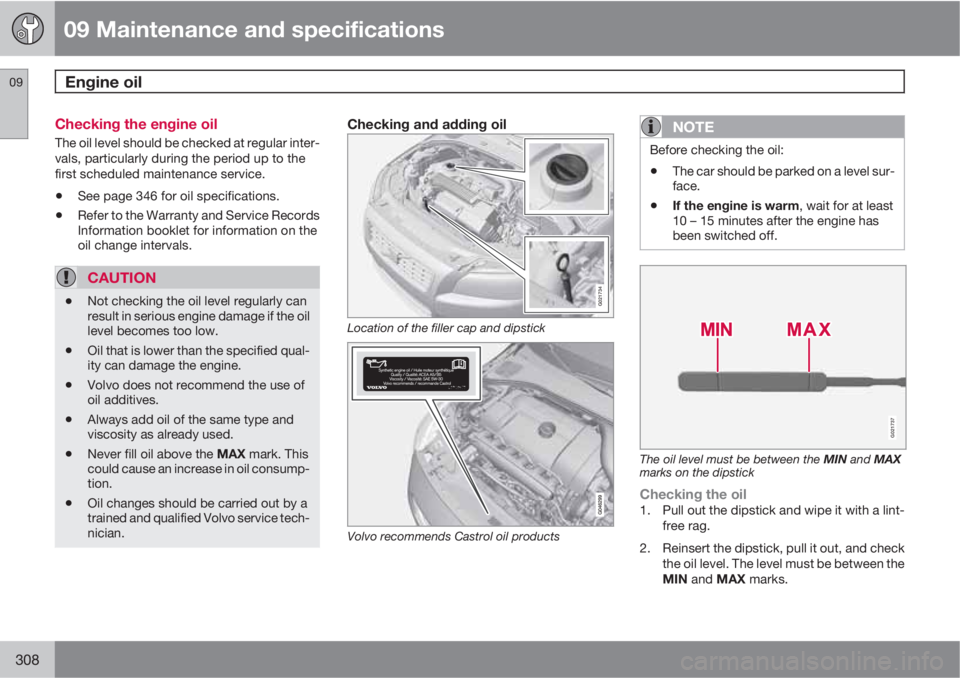
Checking and adding oil
G021734
Location of the filler cap and dipstick
Volvo recommends Castrol oil products
NOTE
Before checking the oil:
•The car should be parked on a level sur-
face.
•If the engine is warm, wait for at least
10 – 15 minutes after the engine has
been switched off.
G021737
The oil level must be between the MIN and MAX
marks on the dipstick
Checking the oil1. Pull out the dipstick and wipe it with a lint-
free rag.
2. Reinsert the dipstick, pull it out, and check
the oil level. The level must be between the
MIN and MAX marks.
Page 312 of 366
09 Maintenance and specifications
Fluids 09
310
Coolant
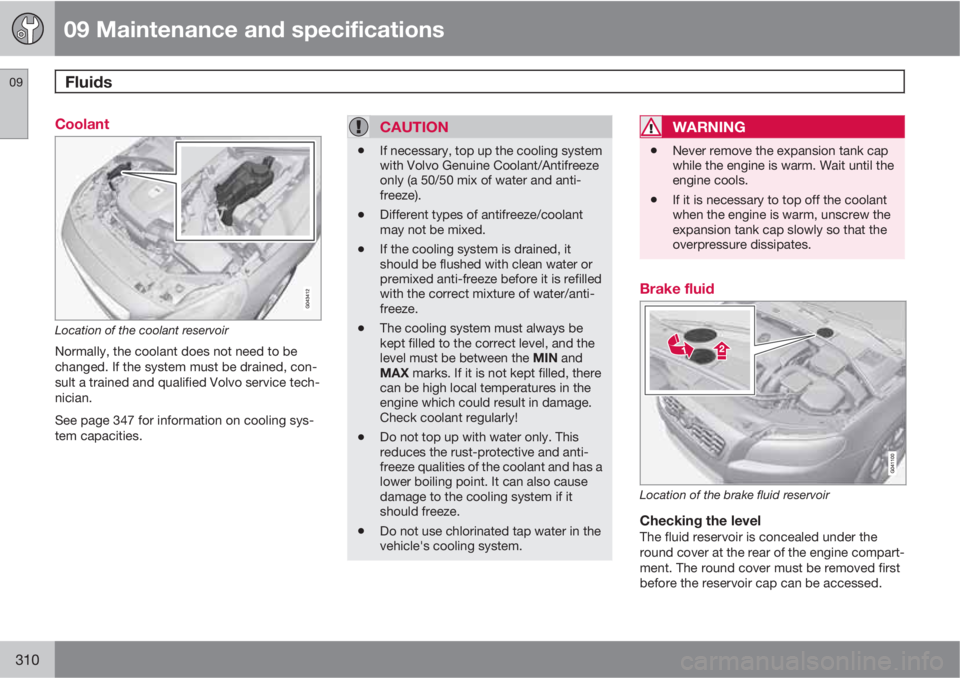
Location of the coolant reservoir
Normally, the coolant does not need to be
changed. If the system must be drained, con-
sult a trained and qualified Volvo service tech-
nician.
See page 347 for information on cooling sys-
tem capacities.
CAUTION
•If necessary, top up the cooling system
with Volvo Genuine Coolant/Antifreeze
only (a 50/50 mix of water and anti-
freeze).
•Different types of antifreeze/coolant
may not be mixed.
•If the cooling system is drained, it
should be flushed with clean water or
premixed anti-freeze before it is refilled
with the correct mixture of water/anti-
freeze.
•The cooling system must always be
kept filled to the correct level, and the
level must be between the MIN and
MAX marks. If it is not kept filled, there
can be high local temperatures in the
engine which could result in damage.
Check coolant regularly!
•Do not top up with water only. This
reduces the rust-protective and anti-
freeze qualities of the coolant and has a
lower boiling point. It can also cause
damage to the cooling system if it
should freeze.
•Do not use chlorinated tap water in the
vehicle's cooling system.
WARNING
•Never remove the expansion tank cap
while the engine is warm. Wait until the
engine cools.
•If it is necessary to top off the coolant
when the engine is warm, unscrew the
expansion tank cap slowly so that the
overpressure dissipates.
Brake fluid
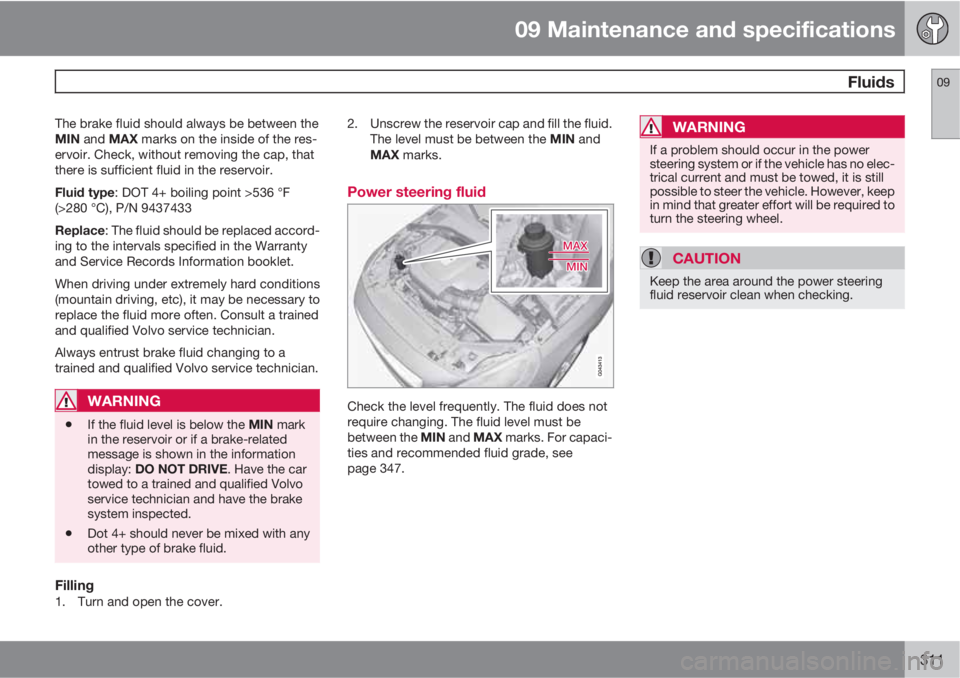
Location of the brake fluid reservoir
Checking the levelThe fluid reservoir is concealed under the
round cover at the rear of the engine compart-
ment. The round cover must be removed first
before the reservoir cap can be accessed.
Page 313 of 366
09 Maintenance and specifications
Fluids09
311
The brake fluid should always be between the
MIN and MAX marks on the inside of the res-
ervoir. Check, without removing the cap, that
there is sufficient fluid in the reservoir.
Fluid type: DOT 4+ boiling point >536 °F
(>280 °C), P/N 9437433
Replace: The fluid should be replaced accord-
ing to the intervals specified in the Warranty
and Service Records Information booklet.
When driving under extremely hard conditions
(mountain driving, etc), it may be necessary to
replace the fluid more often. Consult a trained
and qualified Volvo service technician.
Always entrust brake fluid changing to a
trained and qualified Volvo service technician.
WARNING
•If the fluid level is below the MIN mark
in the reservoir or if a brake-related
message is shown in the information
display: DO NOT DRIVE. Have the car
towed to a trained and qualified Volvo
service technician and have the brake
system inspected.
•Dot 4+ should never be mixed with any
other type of brake fluid.
Filling1. Turn and open the cover.2. Unscrew the reservoir cap and fill the fluid.
The level must be between the MIN and
MAX marks.
Power steering fluid
Check the level frequently. The fluid does not
require changing. The fluid level must be
between the MIN and MAX marks. For capaci-
ties and recommended fluid grade, see
page 347.
WARNING
If a problem should occur in the power
steering system or if the vehicle has no elec-
trical current and must be towed, it is still
possible to steer the vehicle. However, keep
in mind that greater effort will be required to
turn the steering wheel.
CAUTION
Keep the area around the power steering
fluid reservoir clean when checking.
Page 314 of 366
09 Maintenance and specifications
Replacing bulbs 09
312* Option/accessory, for more information, see Introduction.
Introduction
All bulb specifications are listed on page 317.
The following bulbs should only be replaced by
a trained and qualified Volvo service techni-
cian:
•Dome lighting
•Reading lights
•Glove compartment lighting
•Footwell lighting
•Turn signals in the door mirrors
•Approach lighting in the door mirrors
•Active Bending Lights and LED bulbs
NOTE
For information regarding any other bulbs
not mentioned in this section, please con-
tact your Volvo retailer or a trained and
authorized Volvo service technician.
WARNING
•The engine should not be running when
changing bulbs.
•If the engine has been running just prior
to replacing bulbs in the headlight hous-
ing, please keep in mind that compo-
nents in the engine compartment will be
hot.
WARNING
•Active Bending Lights* – due to the high
voltage used by these headlights, these
bulbs should only be replaced by a
trained and qualified Volvo service tech-
nician.
•Turn off the lights and remove the
remote key from the ignition before
changing any bulbs.
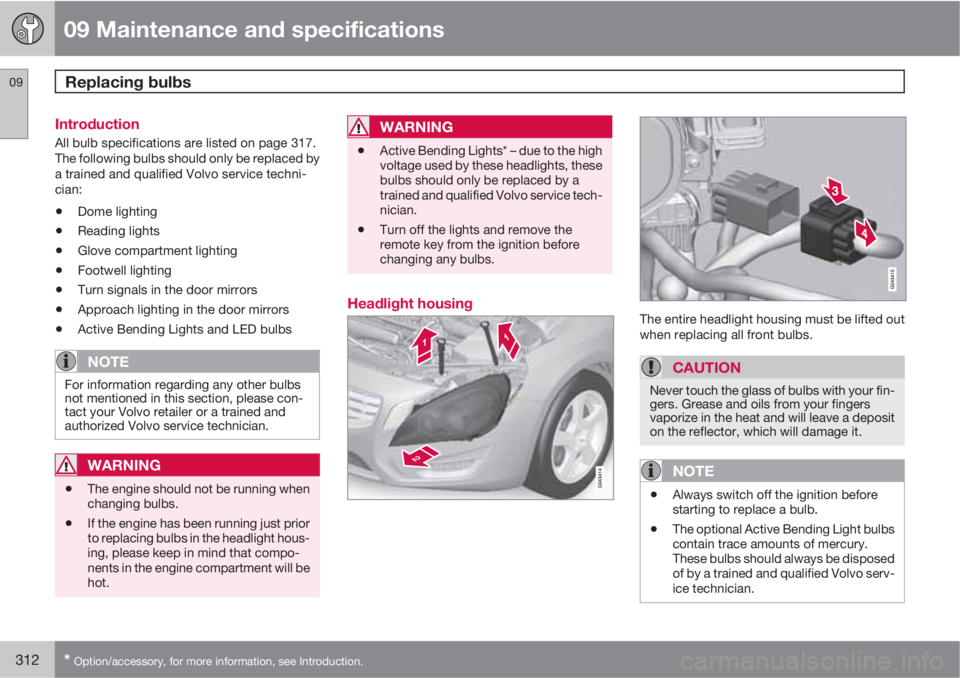
Headlight housingThe entire headlight housing must be lifted out
when replacing all front bulbs.
CAUTION
Never touch the glass of bulbs with your fin-
gers. Grease and oils from your fingers
vaporize in the heat and will leave a deposit
on the reflector, which will damage it.
NOTE
•Always switch off the ignition before
starting to replace a bulb.
•The optional Active Bending Light bulbs
contain trace amounts of mercury.
These bulbs should always be disposed
of by a trained and qualified Volvo serv-
ice technician.
Page 320 of 366
09 Maintenance and specifications
Wiper blades and washer fluid 09
318
Wiper blades
The windshield wiper blades are different
lengths. The blade on the driver’s side is longer
than the one on the passenger side.
Service position
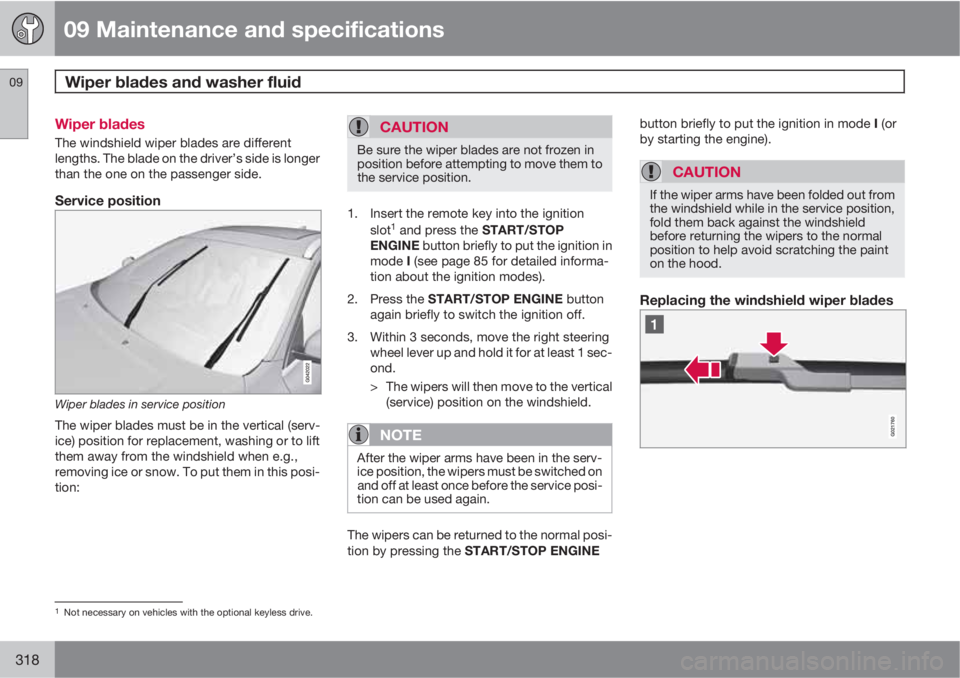
Wiper blades in service position
The wiper blades must be in the vertical (serv-
ice) position for replacement, washing or to lift
them away from the windshield when e.g.,
removing ice or snow. To put them in this posi-
tion:
CAUTION
Be sure the wiper blades are not frozen in
position before attempting to move them to
the service position.
1. Insert the remote key into the ignition
slot1 and press the START/STOP
ENGINE button briefly to put the ignition in
mode I (see page 85 for detailed informa-
tion about the ignition modes).
2.
Press the START/STOP ENGINE button
again briefly to switch the ignition off.
3. Within 3 seconds, move the right steering
wheel lever up and hold it for at least 1 sec-
ond.
> The wipers will then move to the vertical
(service) position on the windshield.
NOTE
After the wiper arms have been in the serv-
ice position, the wipers must be switched on
and off at least once before the service posi-
tion can be used again.
The wipers can be returned to the normal posi-
tion by pressing the START/STOP ENGINEbutton briefly to put the ignition in mode I (or
by starting the engine).
CAUTION
If the wiper arms have been folded out from
the windshield while in the service position,
fold them back against the windshield
before returning the wipers to the normal
position to help avoid scratching the paint
on the hood.
Replacing the windshield wiper blades
1Not necessary on vehicles with the optional keyless drive.
Page 321 of 366
09 Maintenance and specifications
Wiper blades and washer fluid09
319
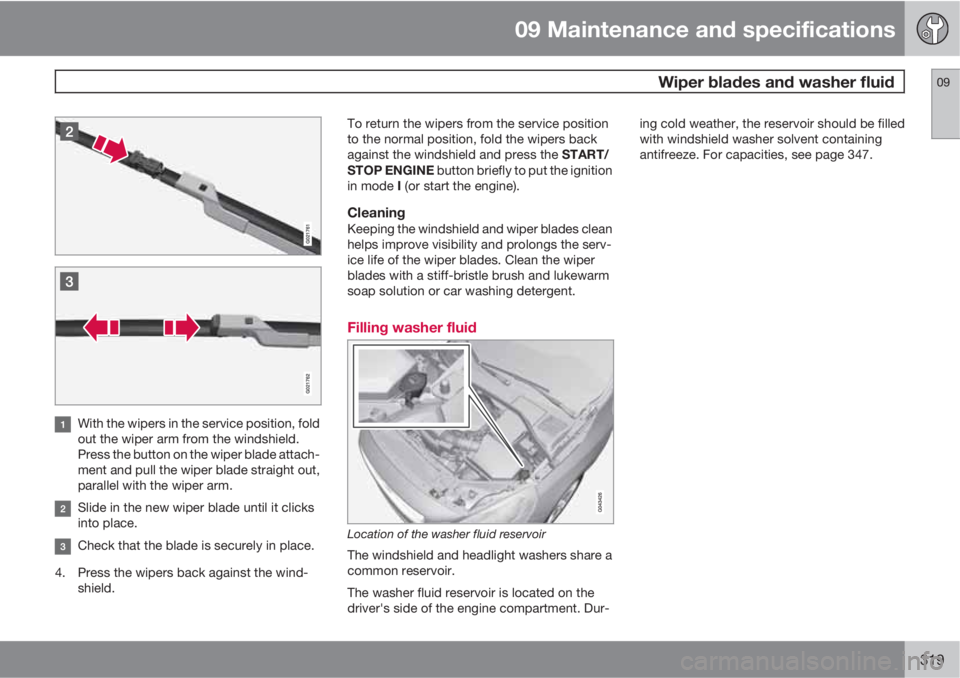
With the wipers in the service position, fold
out the wiper arm from the windshield.
Press the button on the wiper blade attach-
ment and pull the wiper blade straight out,
parallel with the wiper arm.
Slide in the new wiper blade until it clicks
into place.
Check that the blade is securely in place.
4. Press the wipers back against the wind-
shield.To return the wipers from the service position
to the normal position, fold the wipers back
against the windshield and press the START/
STOP ENGINE button briefly to put the ignition
in mode I (or start the engine).
CleaningKeeping the windshield and wiper blades clean
helps improve visibility and prolongs the serv-
ice life of the wiper blades. Clean the wiper
blades with a stiff-bristle brush and lukewarm
soap solution or car washing detergent.
Filling washer fluid
Location of the washer fluid reservoir
The windshield and headlight washers share a
common reservoir.
The washer fluid reservoir is located on the
driver's side of the engine compartment. Dur-ing cold weather, the reservoir should be filled
with windshield washer solvent containing
antifreeze. For capacities, see page 347.
Page 322 of 366
09 Maintenance and specifications
Battery 09
320
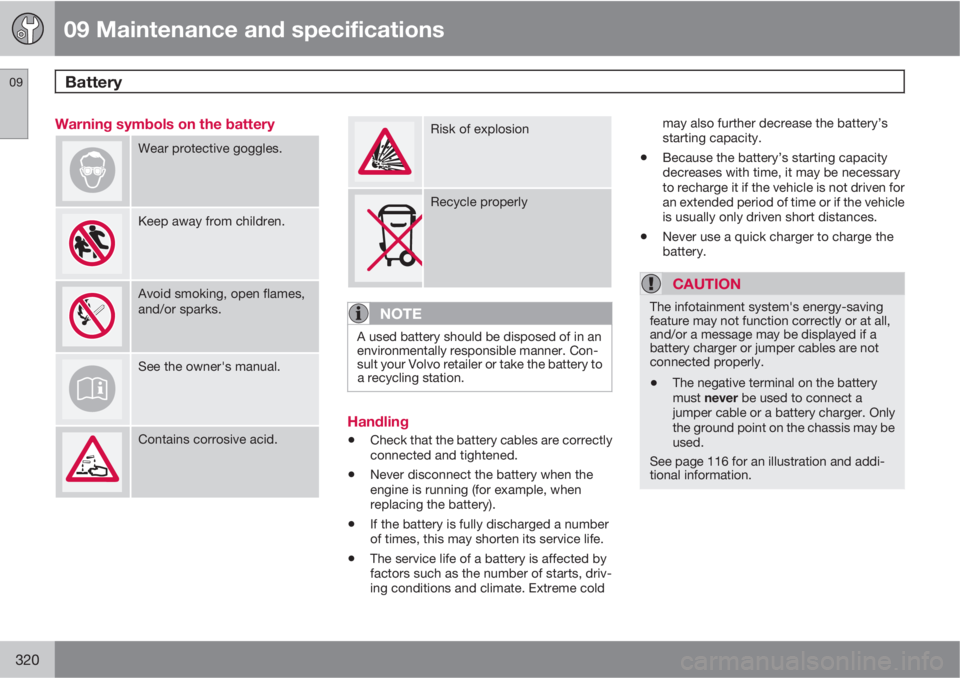
Warning symbols on the battery
Wear protective goggles.
Keep away from children.
Avoid smoking, open flames,
and/or sparks.
See the owner's manual.
Contains corrosive acid.
Risk of explosion
Recycle properly
NOTE
A used battery should be disposed of in an
environmentally responsible manner. Con-
sult your Volvo retailer or take the battery to
a recycling station.
Handling
•Check that the battery cables are correctly
connected and tightened.
•Never disconnect the battery when the
engine is running (for example, when
replacing the battery).
•If the battery is fully discharged a number
of times, this may shorten its service life.
•The service life of a battery is affected by
factors such as the number of starts, driv-
ing conditions and climate. Extreme coldmay also further decrease the battery’s
starting capacity.
•Because the battery’s starting capacity
decreases with time, it may be necessary
to recharge it if the vehicle is not driven for
an extended period of time or if the vehicle
is usually only driven short distances.
•Never use a quick charger to charge the
battery.
CAUTION
The infotainment system's energy-saving
feature may not function correctly or at all,
and/or a message may be displayed if a
battery charger or jumper cables are not
connected properly.
•The negative terminal on the battery
must never be used to connect a
jumper cable or a battery charger. Only
the ground point on the chassis may be
used.
See page 116 for an illustration and addi-
tional information.