child lock VOLVO S60 2014 Owner´s Manual
[x] Cancel search | Manufacturer: VOLVO, Model Year: 2014, Model line: S60, Model: VOLVO S60 2014Pages: 386, PDF Size: 11.24 MB
Page 53 of 386
01 Safety
Child safety locks01
51
Child safety locks
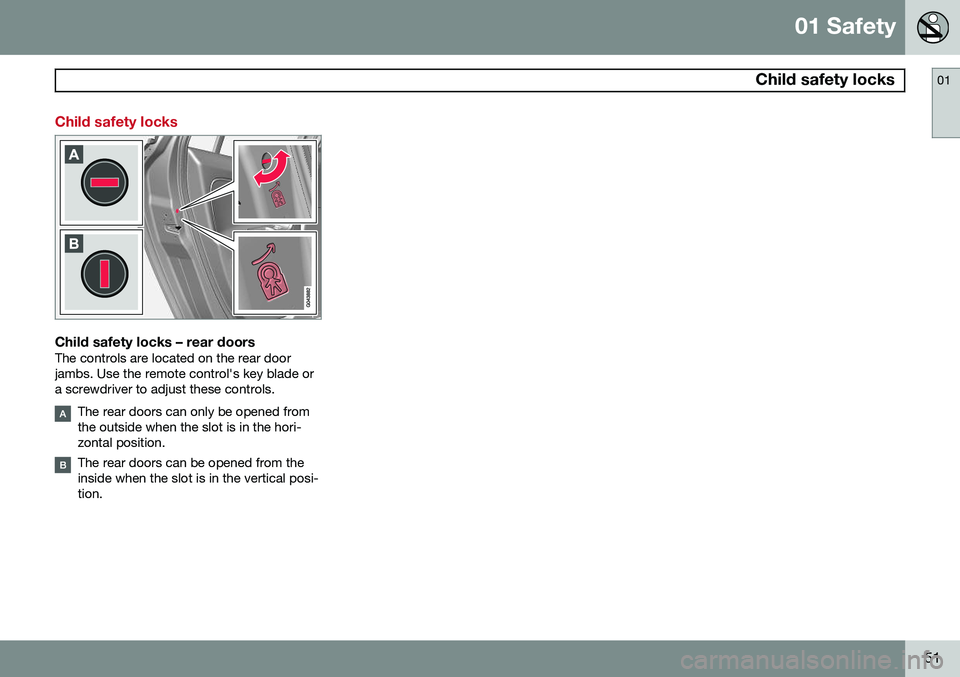
Child safety locks – rear doorsThe controls are located on the rear door jambs. Use the remote control's key blade ora screwdriver to adjust these controls.
The rear doors can only be opened from the outside when the slot is in the hori-zontal position.
The rear doors can be opened from the inside when the slot is in the vertical posi-tion.
Page 56 of 386
02 Locks and alarm
Remote key and key blade
02
54
Introduction
Two remote keys or optional Personal Car Communicators (PCC) are provided with yourvehicle. They enable you to unlock the doorsand trunk, and also function as ignition keysto start the vehicle or operate electrical com-ponents. The remote keys contain detachablemetal key blades for manually locking orunlocking the driver's door and the glovecompartment. The visible ends of these keyblades are unique to make it easier to identify"your" remote key. Up to six remotes can beprogrammed for use on the same vehicle. The PCCs have enhanced functionality com- pared with the standard remote key.
NOTE
In the remainder of this chapter, all refer- ences to the remote key also pertain to thePCC unless otherwise stated.
WARNING
Never leave the remote key in the ignition slot if children are to remain in the vehicle.
See page 86 for more information on the various ignition modes.
Detachable key bladeEach remote key or PCC contains a detacha-ble metal key blade for mechanically lockingor unlocking the driver's door and the glovecompartment, and to enable the valet lockingfunction. See page 60 for more informationon the key blade and see page 63 for infor-mation on the valet locking function. The keyblades have a unique code, which is used ifnew ones need to be produced. This code isavailable at an authorized Volvo retailer. The visible ends of these key blades are unique to make it easier to identify "your"remote key.
Loss of a remote keyIf either of the remote keys is lost, the othershould be taken with the car to a Volvoretailer. As an anti-theft measure, the code ofthe lost remote key must be erased from thesystem.
NOTE
Additional or duplicate remote control keys can be obtained from any AuthorizedVolvo Retailer. You can also obtain additional or duplicate remote control keys from certain inde-pendent repair facilities and locksmithsthat are qualified to make remote controlkeys. Each key must be programmed towork with your vehicle. California Only: A list of independent repair facilities and/or locksmiths known to Volvo that can cutand code replacement keys can be found:
• on the Volvo website at http://www.volvocars.com/us/keys
• by calling Volvo Customer Care at1-800-458-1552
The number of registered keys for the vehicle can be found by pressing
MY CAR and going
into
SettingsInformationNumber of
keys. See page 197 for a description of the
menu system. USA-5WK49264FCC ID:KR55WK49264 + Siemens VDO 5WK49236 FCC ID:KR55WK49236, 5WK49266
Page 69 of 386
02 Locks and alarm
Locks
02
67
Locking and unlocking the vehicle
From outside the vehicleThe remote key locks and unlocks all of the doors and the trunk. Before the vehicle can be locked from the outside with the remote key, the driver's doormust be closed. Any other door/trunk that isopen will be locked and the alarm will bearmed.
NOTE
Be sure the remote key is outside of the vehicle before the other doors/trunk areclosed to help avoid locking the remoteinside the vehicle.
If the vehicle is equipped with the optional keyless drive system, all doors/trunk must beclosed before the vehicle can be locked. The first press on the unlock button unlocks the driver's door and a second press unlocksthe other doors and the trunk (see also page57). This setting can be changed in the menusystem. See page 197 for a description. If the locks repeatedly do not react when the unlock button is pressed, it may be necessaryto replace the batteries in the remote, seepage 57. In this case the vehicle can beunlocked with the detachable key blade. Seepage 61.
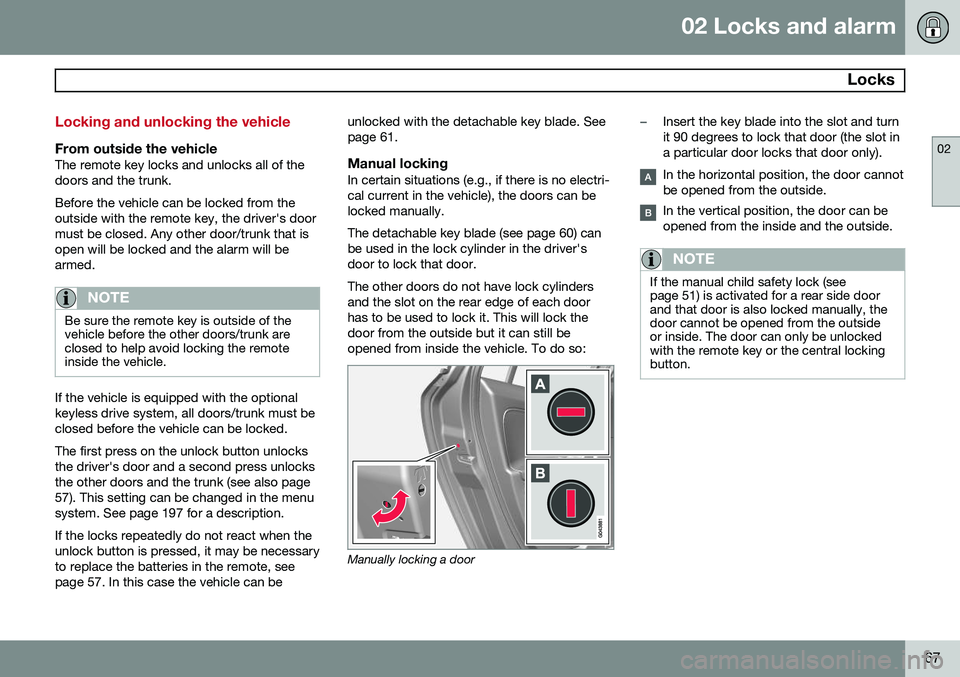
Manual lockingIn certain situations (e.g., if there is no electri-cal current in the vehicle), the doors can belocked manually. The detachable key blade (see page 60) can be used in the lock cylinder in the driver'sdoor to lock that door. The other doors do not have lock cylinders and the slot on the rear edge of each doorhas to be used to lock it. This will lock thedoor from the outside but it can still beopened from inside the vehicle. To do so:
Manually locking a door
–Insert the key blade into the slot and turn it 90 degrees to lock that door (the slot ina particular door locks that door only).
In the horizontal position, the door cannot be opened from the outside.
In the vertical position, the door can be opened from the inside and the outside.
NOTE
If the manual child safety lock (see page 51) is activated for a rear side doorand that door is also locked manually, thedoor cannot be opened from the outsideor inside. The door can only be unlockedwith the remote key or the central lockingbutton.
Page 73 of 386
02 Locks and alarm
Locks
02
71
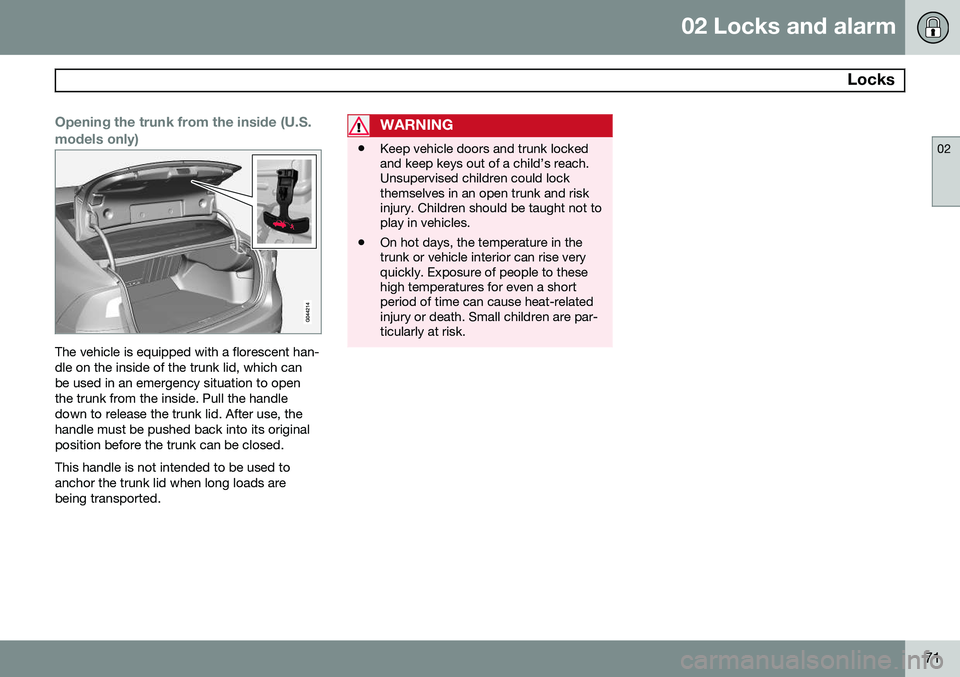
Opening the trunk from the inside (U.S. models only)
The vehicle is equipped with a florescent han- dle on the inside of the trunk lid, which canbe used in an emergency situation to openthe trunk from the inside. Pull the handledown to release the trunk lid. After use, thehandle must be pushed back into its originalposition before the trunk can be closed. This handle is not intended to be used to anchor the trunk lid when long loads arebeing transported.
WARNING
•Keep vehicle doors and trunk locked and keep keys out of a child’s reach.Unsupervised children could lockthemselves in an open trunk and riskinjury. Children should be taught not toplay in vehicles.
• On hot days, the temperature in thetrunk or vehicle interior can rise veryquickly. Exposure of people to thesehigh temperatures for even a shortperiod of time can cause heat-relatedinjury or death. Small children are par-ticularly at risk.
Page 93 of 386
03 Your driving environment
Seats
03
* Option/accessory, for more information, see Introduction.91
NOTE
• The seat will move to this position even if someone else has moved it to adifferent position and locked the vehi-cle with a
different remote key.
• This feature will work in the same waywith all of the remote keys that youuse with your vehicle.
Emergency stop
WARNING
•
Because the driver's seat can be adjusted with the ignition off, childrenshould never be left unattended in thevehicle.
• Movement of the seat can be STOP-PED at any time by pressing any but-ton on the power seat control panel.
• Do not adjust the seat while driving.The seat should be adjusted so thatthe brake pedal can be depressedfully. In addition, position the seat asfar rearward as comfort and controlallow.
• The seat rails on the floor must not beobstructed in any way when the seat isin motion.
Heated seats*See page 207.
Rear seats
Rear center head restraint
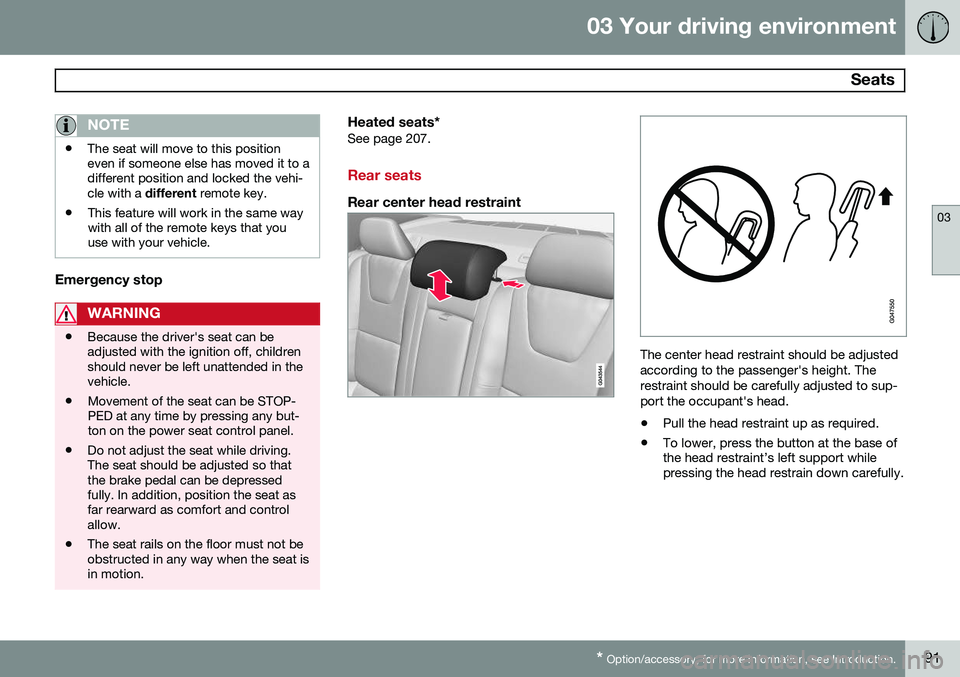
The center head restraint should be adjusted according to the passenger's height. Therestraint should be carefully adjusted to sup-port the occupant's head.
• Pull the head restraint up as required.
• To lower, press the button at the base of the head restraint’s left support whilepressing the head restrain down carefully.
Page 95 of 386
03 Your driving environment
Seats
03
93
CAUTION
To help avoid damage to the upholstery, there should be no objects on the rear seatand the seat belt should not be buckledwhen the backrest is folded down.
WARNING
•Keep vehicle doors and trunk locked and keep keys out of a child’s reach.Unsupervised children could lockthemselves in an open trunk and riskinjury. Children should be taught not toplay in vehicles.
• On hot days, the temperature in thetrunk or vehicle interior can rise veryquickly. Exposure of people to thesehigh temperatures for even a shortperiod of time can cause heat-relatedinjury or death. Small children are par-ticularly at risk.
WARNING
•When one or more sections of the backrest is returned to the uprightposition, check that it is properlylocked in place by pushing and pullingit. The red indicators should also notbe visible.
• Return the outboard head restraints tothe upright position.
• Long loads should always be securelyanchored to help avoid injury in theevent of a sudden stop.
• Always turn the engine off and applythe parking brake when loading/unloading the vehicle.
• Place the transmission in the Park (
P)
position to help prevent inadvertentmovement of the gear selector.
• On hot days, the temperature in thevehicle interior can rise very quickly.Exposure of people to these high tem-peratures for even a short period oftime can cause heat-related injury ordeath. Small children are particularly atrisk.
Page 116 of 386
03 Your driving environment
Power moonroof
03
114* Option/accessory, for more information, see Introduction.
WARNING
• During manual closing, if the moonroof is obstructed, immediately open itagain.
• Never open or close the moonroof if itis obstructed in any way.
• Never allow a child to operate themoonroof.
• Never leave a child alone in a vehicle.
• When leaving the vehicle, ensure thatthe ignition is in mode
0 (see page 86
for information about the various igni-tion modes) to disable the moonroof.Never leave the remote key/PCC* inthe vehicle.
• Never extend any object or body partthough the open moonroof, even if thevehicle's ignition is completelyswitched off.
Tilt position
G028899
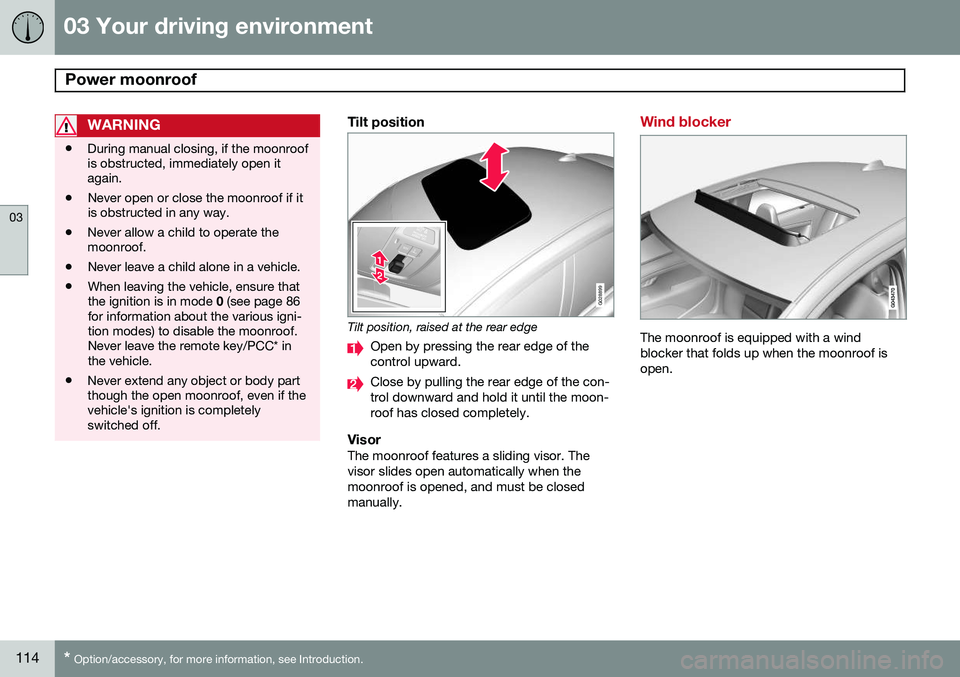
Tilt position, raised at the rear edge
Open by pressing the rear edge of the control upward.
Close by pulling the rear edge of the con- trol downward and hold it until the moon-roof has closed completely.
VisorThe moonroof features a sliding visor. Thevisor slides open automatically when themoonroof is opened, and must be closedmanually.
Wind blocker
The moonroof is equipped with a wind blocker that folds up when the moonroof isopen.
Page 313 of 386
08 Wheels and tires
Tire Sealing System*
08
* Option/accessory, for more information, see Introduction.311
Inflating tires
The tire sealing system can be used to inflate the tires. To do so:
1. Park the car in a safe place.
2. The compressor should be switched off.
Ensure that the on/off switch is in position0 (the 0 side of the switch should be
pressed down).
3. Take out the electrical wire and hose.
4. Remove the valve cap from the tire’s inflation valve and screw the hose con- nector onto the valve as tightly as possi-ble by hand.
5. Connect the electrical wire to the nearest 12-volt socket in the vehicle.
6. Start the vehicle’s engine.WARNING
• The vehicle’s engine should be running when the tire sealing system is used toavoid battery drain. Therefore, be surethe vehicle is parked in a well ventilatedplace, or outdoors, before using thesystem. The parking brake should besecurely applied and the gear selectorshould be in the
P (park) position.
• Children should never be left unatten-ded in the vehicle when the engine isrunning.
7. Check the tire’s inflation pressure on the
gauge. Switch off the compressor briefly to get a clear reading from the pressuregauge.
8. Refer to the tire inflation table in this chapter for the correct inflation pressure.If the tire needs to be inflated, start thetire sealing system’s compressor (pressthe on/off switch to position I). If neces-sary, release air from the tire by turningthe air release knob counterclockwise.
CAUTION
The compressor should not be used for more than 10 minutes at a time to avoidoverheating.
9. Turn off the compressor (press the on/off switch to position 0) when the correct
inflation pressure has been reached.
10. Unscrew the hose from the tire’s inflation valve and reinstall the valve cap.
CAUTION
•After pumping the tires, always reinstall the valve cap to help avoid damage tothe valve from dirt, gravel, etc.
• Use plastic valve caps only. Metal capscould corrode and become difficult toremove.
11. Disconnect the electrical wire from the
12-volt socket.
Page 377 of 386

11 Index
11
375
Bulbs
headlights........................... 330, 331, 332
introduction......................................... 330
license plate lights.............................. 334
specifications...................................... 335
trunk lighting....................................... 335
C
Camera, Park Assist................................ 182
Capacity weight....................................... 301
Catalytic converter................................... 277
Cell phone, hands-free connection......... 254
Cell phone voice control.......................... 263
Central locking system, introduction......... 54
Chains...................................................... 304
Check engine light..................................... 79
Check Engine warning light....................... 80Child restraintsrecalls and registration......................... 40
Child restraint systems.............................. 41 booster cushions.................................. 47
convertible seats.................................. 45
infant seats........................................... 43 ISOFIX/LATCH anchors........................ 48
top tether anchors................................ 50
Child safety................................................ 38 booster cushions.................................. 47
child restraint systems.......................... 41
convertible seats.................................. 45
infant seats........................................... 43
Child safety locks...................................... 51
City Safety™............................................ 158
Climate system........................................ 209 air distribution............................. 204, 211
air vents.............................................. 205
Interior Air Quality System.................. 204
introduction......................................... 203
passenger compartment filter............ 204
refrigerant........................................... 203
Clock, setting............................................. 85
Cold weather driving................................ 272
Collision warning system................. 164, 165
Compass in rearview mirror..................... 111
Conserving electrical current................... 271
Controls, center console.......................... 227
Convertible seats....................................... 45
Coolant............................................ 328, 367
Cooling system, general information....... 271 Corner Traction Control........................... 138
Courtesy lighting...................................... 102
Crash event data......................................... 9
Crash mode............................................... 36
Cruise control.................................. 142, 143
adaptive.............................................. 144
Curb weight............................................. 301
Current, conserving................................. 271
D
Daytime running lights............................... 96
Defroster.................................................. 209
Detachable key blade.......................... 60, 63Disconnecting the front passenger’s air-
bag....................................................... 27, 28
Dome lighting........................................... 102
Door mirrors............................................. 108
Driver alert............................................... 172
Driver distraction warning.......................... 13
Driving economically................................ 270
Driving in cold weather............................ 272
Driving through water.............................. 271
Page 380 of 386
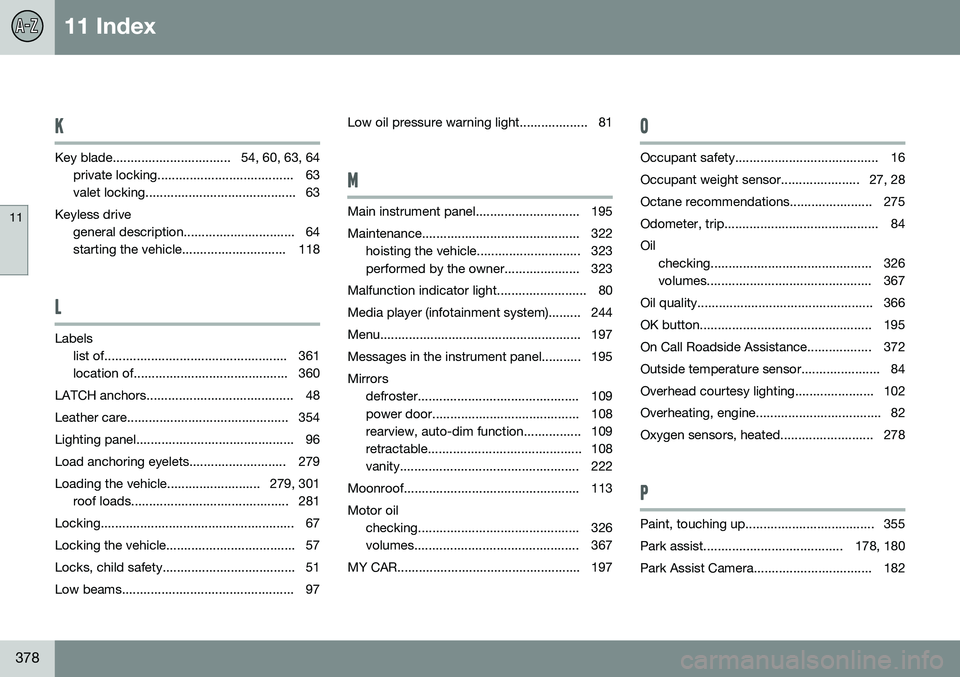
11 Index
11
378
K
Key blade................................. 54, 60, 63, 64private locking...................................... 63
valet locking.......................................... 63
Keyless drive general description............................... 64
starting the vehicle............................. 118
L
Labelslist of................................................... 361
location of........................................... 360
LATCH anchors......................................... 48
Leather care............................................. 354
Lighting panel............................................ 96
Load anchoring eyelets........................... 279
Loading the vehicle.......................... 279, 301 roof loads............................................ 281
Locking...................................................... 67
Locking the vehicle.................................... 57
Locks, child safety..................................... 51
Low beams................................................ 97 Low oil pressure warning light................... 81
M
Main instrument panel............................. 195
Maintenance............................................ 322
hoisting the vehicle............................. 323
performed by the owner..................... 323
Malfunction indicator light......................... 80
Media player (infotainment system)......... 244
Menu........................................................ 197
Messages in the instrument panel........... 195Mirrors defroster............................................. 109
power door......................................... 108
rearview, auto-dim function................ 109
retractable........................................... 108
vanity.................................................. 222
Moonroof................................................. 113 Motor oil checking............................................. 326
volumes.............................................. 367
MY CAR................................................... 197
O
Occupant safety........................................ 16
Occupant weight sensor...................... 27, 28
Octane recommendations....................... 275
Odometer, trip........................................... 84Oil checking............................................. 326
volumes.............................................. 367
Oil quality................................................. 366
OK button................................................ 195
On Call Roadside Assistance.................. 372
Outside temperature sensor...................... 84
Overhead courtesy lighting...................... 102
Overheating, engine................................... 82
Oxygen sensors, heated.......................... 278
P
Paint, touching up.................................... 355
Park assist....................................... 178, 180
Park Assist Camera................................. 182