fog light VOLVO S60 2014 Owner´s Manual
[x] Cancel search | Manufacturer: VOLVO, Model Year: 2014, Model line: S60, Model: VOLVO S60 2014Pages: 386, PDF Size: 11.24 MB
Page 209 of 386
05 Comfort and driving pleasure
Climate system
05
* Option/accessory, for more information, see Introduction.207
Climate system controls
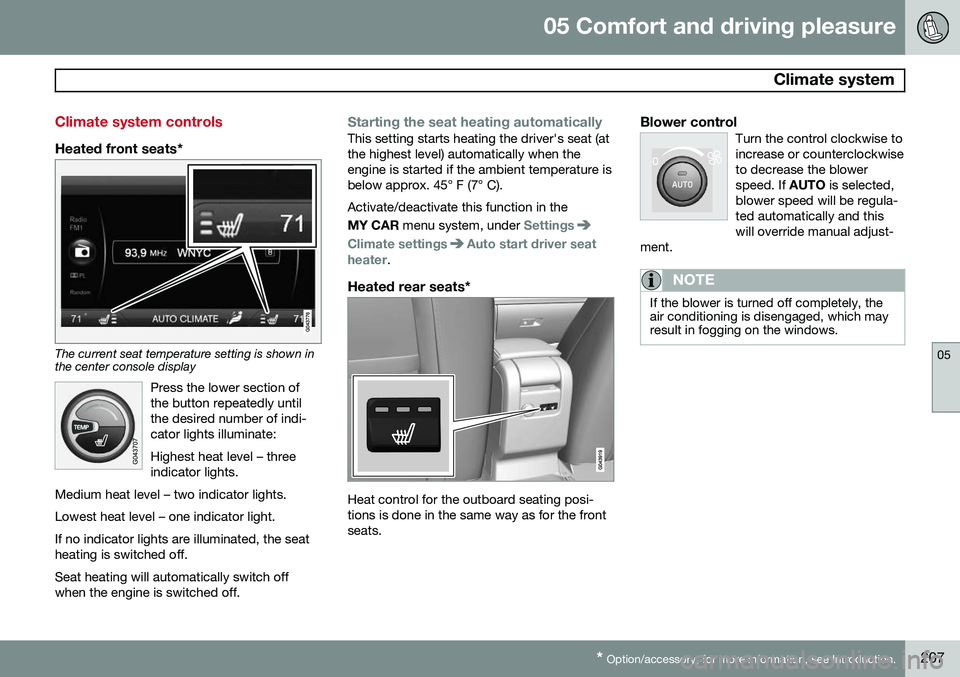
Heated front seats*
The current seat temperature setting is shown in the center console display
Press the lower section of the button repeatedly untilthe desired number of indi-cator lights illuminate: Highest heat level – three indicator lights.
Medium heat level – two indicator lights. Lowest heat level – one indicator light.If no indicator lights are illuminated, the seat heating is switched off.
Seat heating will automatically switch off when the engine is switched off.
Starting the seat heating automaticallyThis setting starts heating the driver's seat (at the highest level) automatically when theengine is started if the ambient temperature isbelow approx. 45° F (7° C). Activate/deactivate this function in the MY CAR menu system, under
Settings
Climate settingsAuto start driver seat
heater.
Heated rear seats*
Heat control for the outboard seating posi- tions is done in the same way as for the frontseats.
Blower controlTurn the control clockwise toincrease or counterclockwiseto decrease the blowerspeed. If AUTO is selected,
blower speed will be regula-ted automatically and thiswill override manual adjust-
ment.
NOTE
If the blower is turned off completely, the air conditioning is disengaged, which mayresult in fogging on the windows.
Page 212 of 386

05 Comfort and driving pleasure
Climate system
05
210* Option/accessory, for more information, see Introduction.
NOTE
• Triangular areas at the far sides of the windshield are not heated electricallyand will take slightly longer todefrost/de-ice.
• The heated windshield may affect theperformance/range of e.g., transpond-ers used to automatically pay highwaytolls or other communication equip-ment.
The following occurs when the defroster/ windshield heating functions have been acti-vated: •
Blower speed increases automatically and the air conditioning will switch on (ifnot already on and if the passenger com-partment blower is not turned off) todehumidify the air in the passenger com-partment. Air conditioning can beswitched off by pressing the
AC button.
• Recirculation will not function whiledefrost is engaged.
The climate system will return to its previous settings when the defroster/windshield heat-ing function is switched off. See also page 109 for additional information.
Recirculation/air quality system
RecirculationThis function can be used to shut out exhaust fumes,smoke, etc., from the pas-senger compartment. The airin the passenger compart-ment is then recirculated,i.e., no air from outside the
car is taken into the car when this function isactivated. The indicator light in the button willilluminate when recirculation is selected. If the air in the car recirculates for too long, there is a risk of condensation forming on theinsides of the windows, especially in winter.
TimerThe timer function minimizes the risk of fog- ging, or stale air when the recirculation func-tion is selected by automatically switching offthe function after a certain length of time,depending on the ambient temperature. Acti-vate/deactivate the function under
Climate
settings
Recirculation timer. See page
197 for a description of the menu system.
NOTE
When Defroster is selected, recirculation is always deactivated.
Interior Air Quality System–IAQS*This system consists of a multifilter and an air quality sensor. The filter helps remove gasesand particles from the incoming air, therebyreducing the amounts of odors and contami-nants entering the vehicle. The air quality sen-sor detects increased levels of contaminantsin the outside air. When the air quality sensordetects contaminated outside air, the airintake closes and the air inside the passengercompartment is recirculated, i.e., no outsideair enters the vehicle. The filter also cleansrecirculated passenger compartment air.When the AUTO button is depressed the air
quality sensor is always engaged. Activate or deactivate this function in
Climate
settings
Interior air quality system.
NOTE
• The air quality sensor should always be engaged in order to obtain the bestair in the passenger compartment.
• Recirculation is limited in cold weatherto avoid fogging.
• If the insides of the windows start fog-ging, disengage the air quality sensor.Use the defroster function to increaseairflow to the front, side, and rear win-dows.
Page 332 of 386
09 Maintenance and specifications
Replacing bulbs 09
330* Option/accessory, for more information, see Introduction.
Introduction
All bulb specifications are listed on page 335. The following bulbs should only be replacedby a trained and qualified Volvo service tech-nician:
• Active Bending Lights
• Front parking lights
• Front side marker lights
• Cornering lights
• Turn signals in the door mirrors
• Approach lighting in the door mirrors
• Interior lighting
• Glove compartment lighting
• Rear parking lights
• LED bulbsNOTE
• For information regarding any bulbs not mentioned in this section, pleasecontact your Volvo retailer or a trainedand authorized Volvo service techni-cian.
• Always switch off the ignition beforestarting to replace a bulb.
• If an error message remains in the dis-play after a faulty bulb has beenreplaced, contact an authorized Volvoworkshop.
• Condensation may form temporarily onthe inside of the lenses of exteriorlights such as headlights, fog lights, ortaillights. This is normal and the lightsare designed to withstand moisture.Normally, condensation will dissipateafter the lights have been on for ashort time.
• The optional Active Bending Lightbulbs contain trace amounts of mer-cury. These bulbs should always bedisposed of by a trained and qualifiedVolvo service technician.
CAUTION
Never touch the glass of bulbs with your fingers. Grease and oils from your fingersvaporize in the heat and will leave adeposit on the reflector, which will damageit.
WARNING
•The engine should not be running when changing bulbs.
• If the engine has been running justprior to replacing bulbs in the head-light housing, please keep in mind thatcomponents in the engine compart-ment will be hot.
WARNING
•Active Bending Lights* – due to the high voltage used by these headlights,these bulbs should only be replacedby a trained and qualified Volvo serv-ice technician.
• Turn off the lights and remove theremote key from the ignition beforechanging any bulbs.
Page 336 of 386
09 Maintenance and specifications
Replacing bulbs 09
334
4. Insert a new bulb, press it in slightly andturn it clockwise.
5. Press the bulb holder back into place and reinstall the cover.
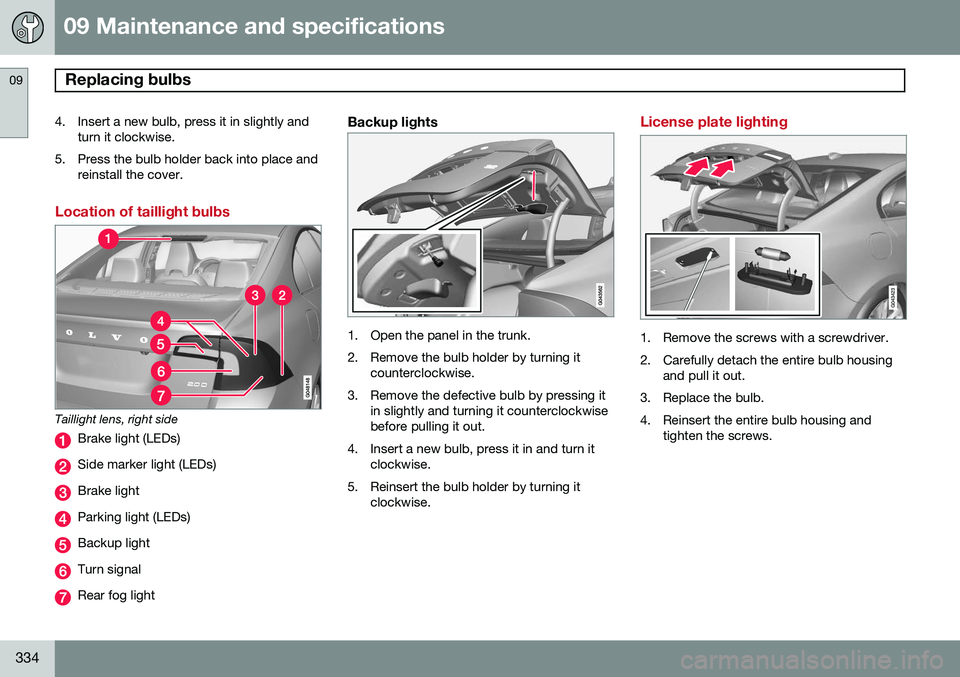
Location of taillight bulbs
Taillight lens, right side
Brake light (LEDs)
Side marker light (LEDs)
Brake light
Parking light (LEDs)
Backup light
Turn signal
Rear fog light
Backup lights
1. Open the panel in the trunk.
2. Remove the bulb holder by turning itcounterclockwise.
3. Remove the defective bulb by pressing it in slightly and turning it counterclockwise before pulling it out.
4. Insert a new bulb, press it in and turn it clockwise.
5. Reinsert the bulb holder by turning it clockwise.
License plate lighting
1. Remove the screws with a screwdriver.
2. Carefully detach the entire bulb housing and pull it out.
3. Replace the bulb.
4. Reinsert the entire bulb housing and tighten the screws.
Page 337 of 386
09 Maintenance and specifications
Replacing bulbs09
}}
* Option/accessory, for more information, see Introduction.335
Trunk lighting
G021758
The trunk lighting is located on opposite sides of the trunk.
1. Insert a screwdriver and gently turn so
that the bulb housing comes loose.
2. Replace the bulb.
3. Check that the bulb illuminates and press it back into the bulb housing.
Vanity mirror lighting
Removing the lens
1. Insert a screwdriver underneath the sideof the lens and carefully pry up the lug on the edge.
2. Carefully detach and lift out the lens.
3. Use needle nose pliers to pull the bulb straight to the side. Replace the bulb. Do not exert too much pressure on the bulbwith the pliers to help avoid damaging it.
Reinstalling the lens1. Put the lens back into position.
2. Press it into place.
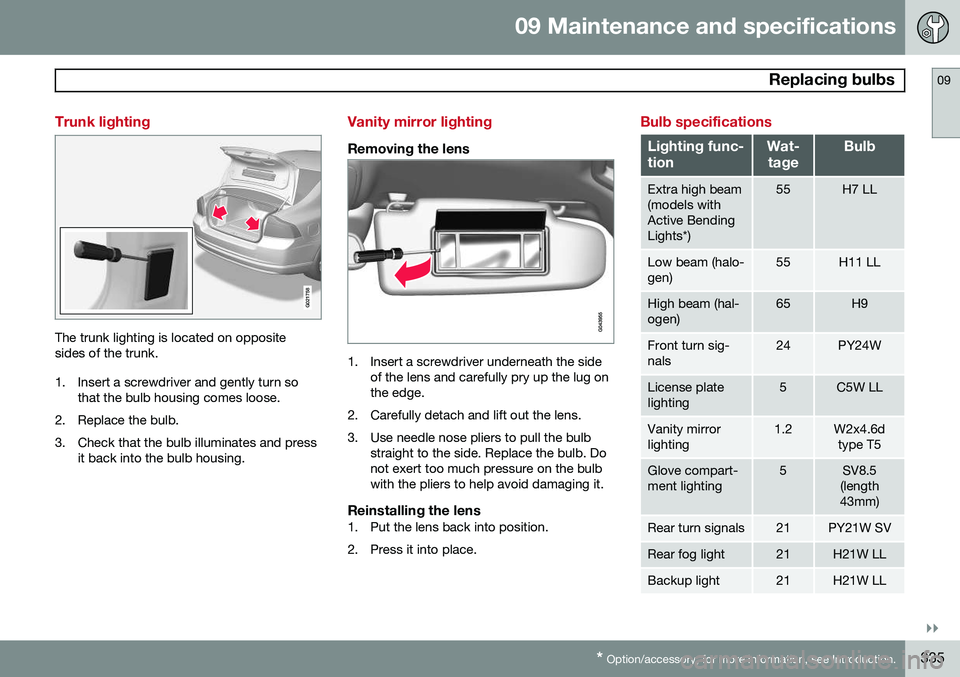
Bulb specifications
Lighting func- tionWat-
tageBulb
Extra high beam (models withActive BendingLights*)55H7 LL
Low beam (halo- gen)55H11 LL
High beam (hal- ogen)65H9
Front turn sig- nals24PY24W
License plate lighting5C5W LL
Vanity mirror lighting1.2W2x4.6d type T5
Glove compart- ment lighting5SV8.5
(length
43mm)
Rear turn signals21PY21W SV
Rear fog light21H21W LL
Backup light21H21W LL
Page 355 of 386
09 Maintenance and specifications
Vehicle care09
353
washers do not have facilities for washing the underbody.
NOTE
Condensation may form temporarily on the inside of the lenses of exterior lights suchas headlights, fog lights, or taillights. Thisis normal and the lights are designed towithstand moisture. Normally, condensa-tion will dissipate after the lights have beenon for a short time.
CAUTION
•
Before driving into an automatic car wash, turn off the optional rain sensorto avoid damaging the windshield wip-ers.
• Make sure that side view mirrors, aux-iliary lamps, etc, are secure, and thatany antenna(s) are retracted orremoved. Otherwise there is risk of themachine dislodging them.
• Chromed wheels:
Clean chrome-
plated wheels using the same deter-gents used for the body of the vehicle.Aggressive wheel-cleaning agents canpermanently stain chrome-platedwheels.
WARNING
• When the vehicle is driven immediately after being washed, apply the brakes,including the parking brake, severaltimes in order to remove any moisturefrom the brake linings.
• Engine cleaning agents should not beused when the engine is warm. Thisconstitutes a fire risk.
Polishing and waxing
•
Normally, polishing is not required during the first year after delivery, however, wax-ing may be beneficial.
• Before applying polish or wax the vehiclemust be washed and dried. Tar spots canbe removed with kerosene or tar remover.Difficult spots may require a fine rubbingcompound.
• After polishing use liquid or paste wax.
• Several commercially available productscontain both polish and wax.
• Waxing alone does not substitute for pol-ishing a dull surface.
• A wide range of polymer-based waxescan be purchased today. These waxesare easy to use and produce a long-last-ing, high-gloss finish that protects the bodywork against oxidation, road dirt andfading.
• Do not polish or wax your vehicle in directsunlight (the surface of the vehicle shouldnot be warmer than 113 °F (45 °C).
CAUTION
Volvo does not recommend the use of long-life or durable paint protection coat-ings, some of which may claim to preventpitting, fading, oxidation, etc. These coat-ings have not been tested by Volvo forcompatibility with your vehicle's clear coat.Some of them may cause the clear coat tosoften, crack, or cloud. Damage caused byapplication of paint protection coatingsmay not be covered under your vehicle'spaint warranty.
Cleaning the interior
Only use cleaning agents and car care prod- ucts recommended by Volvo. Clean regularlyand follow the instructions included with thecar care product.
Upholstery care
FabricClean with soapy water or a detergent. For more difficult spots caused by oil, ice cream,shoe polish, grease, etc., use a clothing/
Page 371 of 386
10 Specifications
Overview of information and warning symbols
10
* Option/accessory, for more information, see Introduction.369
Introduction
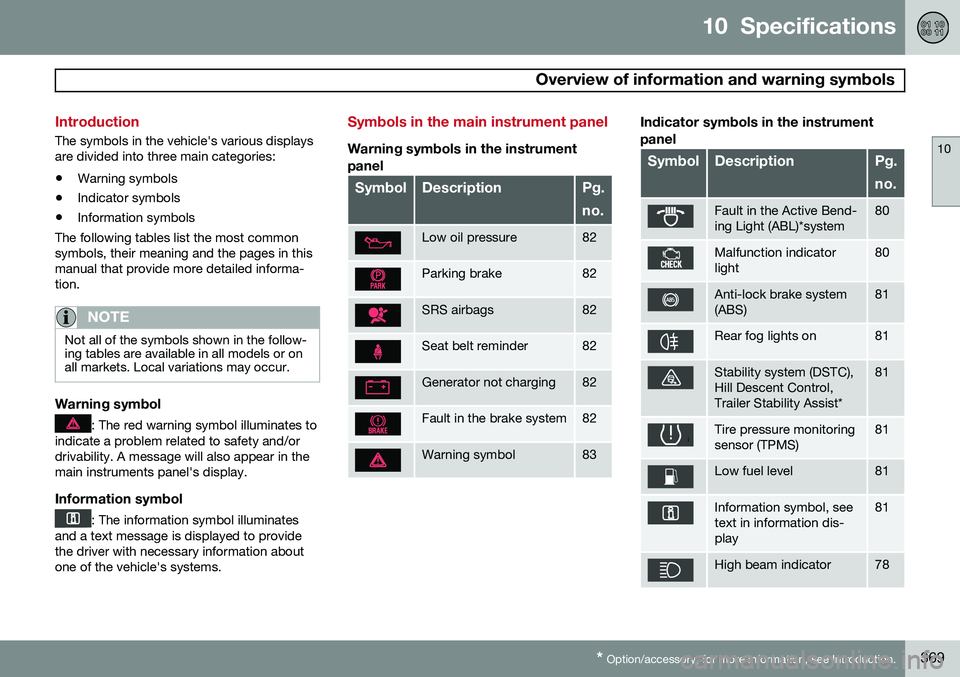
The symbols in the vehicle's various displays are divided into three main categories:
• Warning symbols
• Indicator symbols
• Information symbols
The following tables list the most commonsymbols, their meaning and the pages in thismanual that provide more detailed informa-tion.
NOTE
Not all of the symbols shown in the follow- ing tables are available in all models or onall markets. Local variations may occur.
Warning symbol
: The red warning symbol illuminates to
indicate a problem related to safety and/or drivability. A message will also appear in themain instruments panel's display.
Information symbol
: The information symbol illuminates
and a text message is displayed to provide the driver with necessary information aboutone of the vehicle's systems.
Symbols in the main instrument panel
Warning symbols in the instrument
panel
SymbolDescriptionPg. no.
Low oil pressure82
Parking brake82
SRS airbags82
Seat belt reminder82
Generator not charging82
Fault in the brake system82
Warning symbol83
Indicator symbols in the instrument panel
SymbolDescriptionPg. no.
Fault in the Active Bend- ing Light (ABL)*system80
Malfunction indicator light80
Anti-lock brake system (ABS)81
Rear fog lights on81
Stability system (DSTC), Hill Descent Control,Trailer Stability Assist*81
Tire pressure monitoring sensor (TPMS)81
Low fuel level81
Information symbol, see text in information dis-play81
High beam indicator78
Page 378 of 386
11 Index
11
376
E
ECC................................................. 208, 210
Eco guide................................................. 127
Economical driving.................................. 270
Electrically heated steering wheel............. 95
Electric parking brake.............................. 132
Electronic Climate Control....... 206, 208, 210air distribution table............................ 211
Interior Air Quality System.................. 210
Emergency locking retractor...................... 39
Emergency starting.................................. 121
Emergency towing................................... 285
Emission inspection readiness................ 323Engine overheating........................................... 82
specifications...................................... 365
starting................................................ 118
switching off....................................... 121
Engine compartment overview................ 325
Engine Drag Control (EDC)...................... 138
Engine oil................................................. 366 checking............................................. 326
low pressure warning light.................... 81
volumes.............................................. 367 Engine remote start (ERS)........................ 120
Environment............................................... 12
Eyelets for anchoring loads..................... 279
F
Federal Clean Air Act............................... 322 Flat tires
repairing with tire sealing system....... 306
Floor mats cleaning.............................................. 355
placing correctly................................. 118
Fluid specifications.................................. 367
Fog lights................................................... 81 rear...................................................... 100
Four C (active chassis system)................ 219
Front airbags.............................................. 23 disconnecting passenger’s side air-
bag.................................................. 27, 28
Front park assist.............................. 178, 180
Front seats........................................... 88, 90
Fuel filler cap........................................... 277
Fuel filler door, opening........................... 276
Fuel level warning light.............................. 81 Fuel requirements............................ 274, 275
Fuel tank volume..................................... 367
Fuses....................... 343, 344, 347, 350, 351
G
Garage door opener
HomeLink ®
Wireless Control System. 115
Gasoline requirements............................. 275
Gas tank volume...................................... 367
Gauges...................................................... 77
Geartronic................................................ 124
Geartronic automatic transmission.......... 124
Generator warning light............................. 82
Glossary of tire terminology..................... 300
Grocery bag holder.................................. 280
Gross vehicle weight............................... 301
H
Hazard warning flashers.......................... 101
HD digital radio........................................ 237
Page 381 of 386

11 Index
11
379
Parking brake
electric, applying/releasing................. 132
warning light......................................... 81
Parking lights........................................... 100 Personal Car Communicator, unique
functions.................................................... 59
Polishing.................................................. 353Power front seat memory function................................... 89
with keyless drive................................. 90
Power meter............................................ 127
Power mirrors.......................................... 108 defroster............................................. 109
Power moonroof...................................... 113Power steering fluid..................................................... 329
speed-dependent............................... 219
Power steering fluid................................. 367
Power windows....................................... 106
Pregnancy, using seat belts during........... 21
Private locking........................................... 63
PROPOSITION 65 WARNING.. 121, 342, 368
R
Radio SiriusXM ™ satellite radio.................... 239
Radio functions........................................ 235 HD digital radio................................... 237
Rain sensor.............................................. 104
Rear fog lights.......................................... 100
Rear park assist............................... 178, 180Rear seats center head restraint............................. 91
folding................................................... 91
heated................................................. 207
Rearview mirror auto-dim function............................... 109
compass............................................. 111
Rear window defroster............................ 109
Recalls, child restraints.............................. 40
Refrigerant............................................... 367
Refueling.......................................... 274, 275 fuel filler cap....................................... 277
fuel filler door...................................... 276
fuel tank volume................................. 367
Registering child restraints........................ 40 Remote control
private locking...................................... 63
Remote key................................................ 54 approach lighting.................................. 57
immobilizer........................................... 56
key blade.................................. 54, 60, 63
locking the vehicle................................ 57
Personal Car Communicator.......... 57, 59
replacing the battery............................. 61
unlocking the vehicle............................ 57
Remote key/PCC common functions................................ 57
Reporting safety defects............................ 17
Roadside Assistance............................... 372
Road sign information (RSI)..................... 140
Roof loads............................................... 281
S
Safety, occupant........................................ 16
Safety defects, reporting........................... 17Seat belt reminder................................................ 20