ECU VOLVO S60 2014 Owner´s Manual
[x] Cancel search | Manufacturer: VOLVO, Model Year: 2014, Model line: S60, Model: VOLVO S60 2014Pages: 386, PDF Size: 11.24 MB
Page 313 of 386
08 Wheels and tires
Tire Sealing System*
08
* Option/accessory, for more information, see Introduction.311
Inflating tires
The tire sealing system can be used to inflate the tires. To do so:
1. Park the car in a safe place.
2. The compressor should be switched off.
Ensure that the on/off switch is in position0 (the 0 side of the switch should be
pressed down).
3. Take out the electrical wire and hose.
4. Remove the valve cap from the tire’s inflation valve and screw the hose con- nector onto the valve as tightly as possi-ble by hand.
5. Connect the electrical wire to the nearest 12-volt socket in the vehicle.
6. Start the vehicle’s engine.WARNING
• The vehicle’s engine should be running when the tire sealing system is used toavoid battery drain. Therefore, be surethe vehicle is parked in a well ventilatedplace, or outdoors, before using thesystem. The parking brake should besecurely applied and the gear selectorshould be in the
P (park) position.
• Children should never be left unatten-ded in the vehicle when the engine isrunning.
7. Check the tire’s inflation pressure on the
gauge. Switch off the compressor briefly to get a clear reading from the pressuregauge.
8. Refer to the tire inflation table in this chapter for the correct inflation pressure.If the tire needs to be inflated, start thetire sealing system’s compressor (pressthe on/off switch to position I). If neces-sary, release air from the tire by turningthe air release knob counterclockwise.
CAUTION
The compressor should not be used for more than 10 minutes at a time to avoidoverheating.
9. Turn off the compressor (press the on/off switch to position 0) when the correct
inflation pressure has been reached.
10. Unscrew the hose from the tire’s inflation valve and reinstall the valve cap.
CAUTION
•After pumping the tires, always reinstall the valve cap to help avoid damage tothe valve from dirt, gravel, etc.
• Use plastic valve caps only. Metal capscould corrode and become difficult toremove.
11. Disconnect the electrical wire from the
12-volt socket.
Page 314 of 386
08 Wheels and tires
Changing a wheel
08
312* Option/accessory, for more information, see Introduction.
Removing a wheel
Location of jack and tools
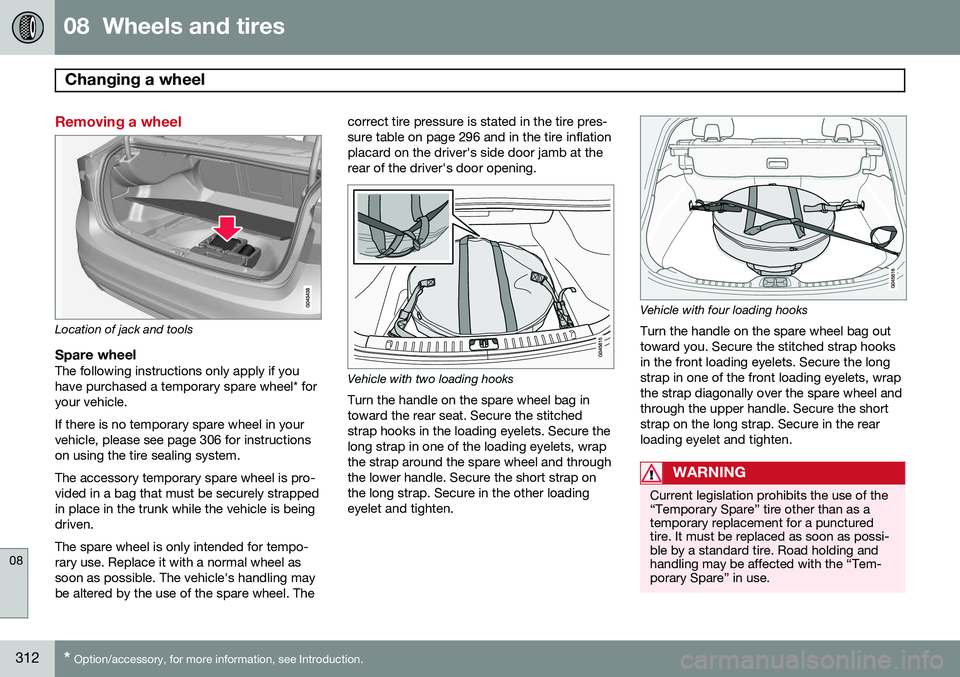
Spare wheelThe following instructions only apply if you have purchased a temporary spare wheel* foryour vehicle. If there is no temporary spare wheel in your vehicle, please see page 306 for instructionson using the tire sealing system. The accessory temporary spare wheel is pro- vided in a bag that must be securely strappedin place in the trunk while the vehicle is beingdriven. The spare wheel is only intended for tempo- rary use. Replace it with a normal wheel assoon as possible. The vehicle's handling maybe altered by the use of the spare wheel. The correct tire pressure is stated in the tire pres-sure table on page 296 and in the tire inflationplacard on the driver's side door jamb at therear of the driver's door opening.Vehicle with two loading hooks Turn the handle on the spare wheel bag in toward the rear seat. Secure the stitchedstrap hooks in the loading eyelets. Secure thelong strap in one of the loading eyelets, wrapthe strap around the spare wheel and throughthe lower handle. Secure the short strap onthe long strap. Secure in the other loadingeyelet and tighten.
Vehicle with four loading hooks Turn the handle on the spare wheel bag out toward you. Secure the stitched strap hooksin the front loading eyelets. Secure the longstrap in one of the front loading eyelets, wrapthe strap diagonally over the spare wheel andthrough the upper handle. Secure the shortstrap on the long strap. Secure in the rearloading eyelet and tighten.
WARNING
Current legislation prohibits the use of the “Temporary Spare” tire other than as atemporary replacement for a puncturedtire. It must be replaced as soon as possi-ble by a standard tire. Road holding andhandling may be affected with the “Tem-porary Spare” in use.
Page 315 of 386
08 Wheels and tires
Changing a wheel
08
* Option/accessory, for more information, see Introduction.313
CAUTION
The vehicle must never be driven with more than one temporary spare wheel.
Taking out the spare wheel1. Release the bag's retaining straps.
2. Lift the bag out of the vehicle and remove
the spare wheel from the bag.
3. Fold up the floor hatch in the trunk.
4. Remove the jack* and tools* from the foam block and change the wheels (see the instructions in the following section"Changing a wheel").
5. After changing wheels, return the jack and tools to the foam block and close thefloor hatch.
6. If possible, place the wheel with the punctured tire in the bag.
7. If there is a wheel in the bag, strap the bag securely in place in the trunk.
WARNING
•If there is a wheel in the bag, the bag must be securely restrained using itsstraps and the load anchoring eyelets inthe trunk. Carefully follow the instruc-tions on page 312
• If the wheel with the punctured tire istoo big to fit in the bag, it should besecurely restrained in the trunk usingsuitable straps, a net for anchoringcargo, etc.
Changing a wheel1. Apply the parking brake and put the gear
selector in P.
2. Take out the jack*, lug wrench*, the tow- ing eyelet and the wheel cover removal tool* stowed under the floor of the trunk.
3. Remove the wheel cover (where applica- ble) using the removal tool or remove thewheel cover by hand.
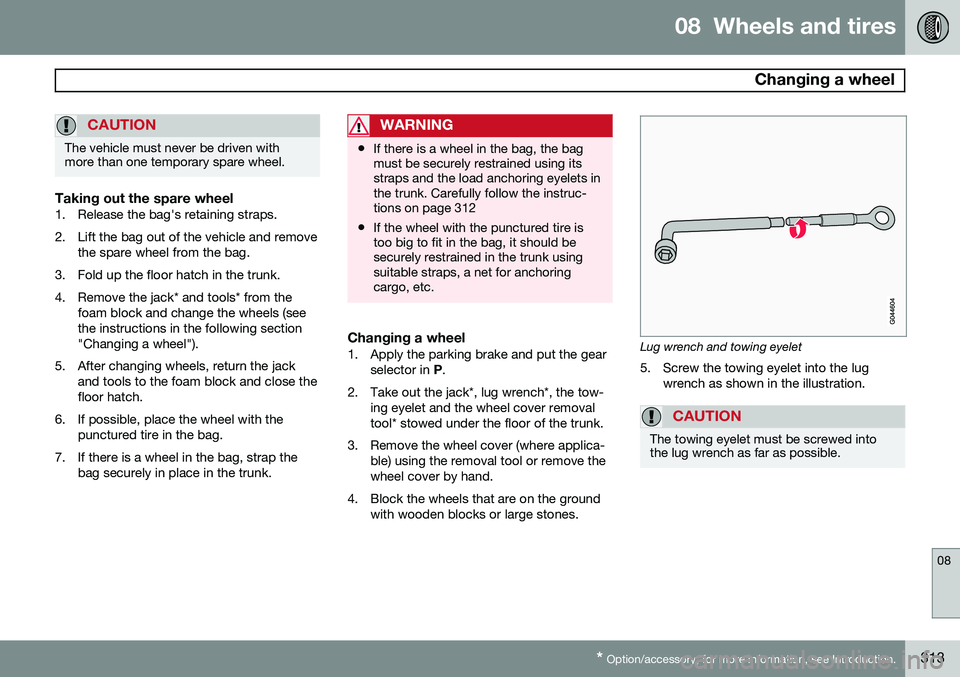
4. Block the wheels that are on the ground with wooden blocks or large stones.Lug wrench and towing eyelet
5. Screw the towing eyelet into the lug wrench as shown in the illustration.
CAUTION
The towing eyelet must be screwed into the lug wrench as far as possible.
Page 334 of 386
09 Maintenance and specifications
Replacing bulbs 09
332
NOTE
Before starting to replace a bulb, see page 330.
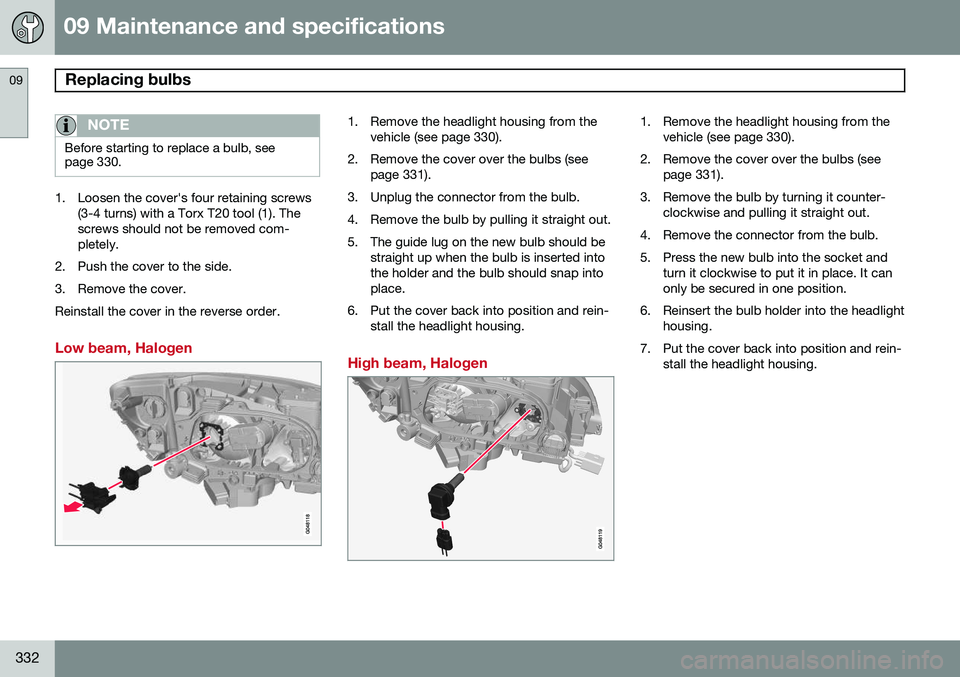
1. Loosen the cover's four retaining screws(3-4 turns) with a Torx T20 tool (1). The screws should not be removed com-pletely.
2. Push the cover to the side.
3. Remove the cover.Reinstall the cover in the reverse order.
Low beam, Halogen
1. Remove the headlight housing from the vehicle (see page 330).
2. Remove the cover over the bulbs (see page 331).
3. Unplug the connector from the bulb.
4. Remove the bulb by pulling it straight out.
5. The guide lug on the new bulb should be straight up when the bulb is inserted into the holder and the bulb should snap intoplace.
6. Put the cover back into position and rein- stall the headlight housing.
High beam, Halogen
1. Remove the headlight housing from the vehicle (see page 330).
2. Remove the cover over the bulbs (see page 331).
3. Remove the bulb by turning it counter- clockwise and pulling it straight out.
4. Remove the connector from the bulb.
5. Press the new bulb into the socket and turn it clockwise to put it in place. It can only be secured in one position.
6. Reinsert the bulb holder into the headlight housing.
7. Put the cover back into position and rein- stall the headlight housing.
Page 335 of 386
09 Maintenance and specifications
Replacing bulbs09
333
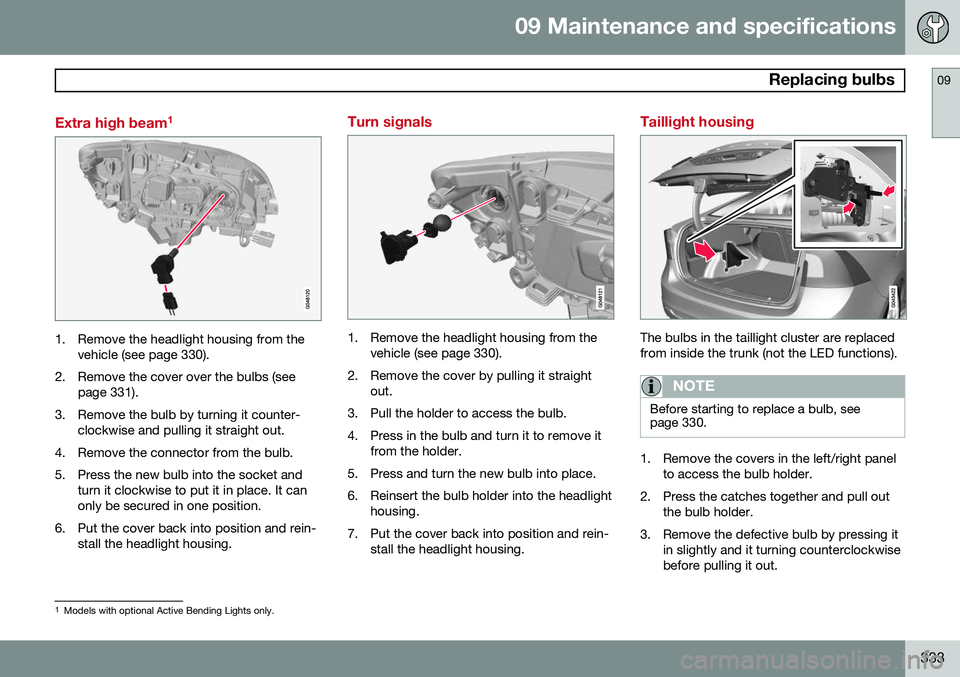
Extra high beam1
1. Remove the headlight housing from the
vehicle (see page 330).
2. Remove the cover over the bulbs (see page 331).
3. Remove the bulb by turning it counter- clockwise and pulling it straight out.
4. Remove the connector from the bulb.
5. Press the new bulb into the socket and turn it clockwise to put it in place. It can only be secured in one position.
6. Put the cover back into position and rein- stall the headlight housing.
Turn signals
1. Remove the headlight housing from thevehicle (see page 330).
2. Remove the cover by pulling it straight out.
3. Pull the holder to access the bulb.
4. Press in the bulb and turn it to remove it from the holder.
5. Press and turn the new bulb into place.
6. Reinsert the bulb holder into the headlight housing.
7. Put the cover back into position and rein- stall the headlight housing.
Taillight housing
The bulbs in the taillight cluster are replaced from inside the trunk (not the LED functions).
NOTE
Before starting to replace a bulb, see page 330.
1. Remove the covers in the left/right panel to access the bulb holder.
2. Press the catches together and pull out the bulb holder.
3. Remove the defective bulb by pressing it in slightly and it turning counterclockwise before pulling it out.
1Models with optional Active Bending Lights only.
Page 340 of 386
09 Maintenance and specifications
Wiper blades and washer fluid 09
338
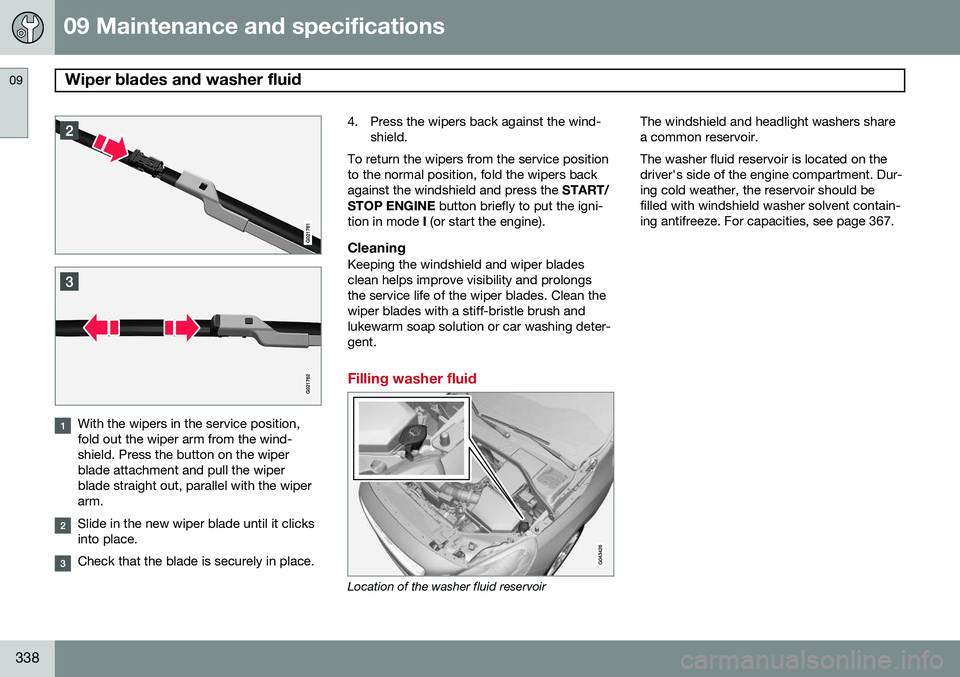
With the wipers in the service position, fold out the wiper arm from the wind-shield. Press the button on the wiperblade attachment and pull the wiperblade straight out, parallel with the wiperarm.
Slide in the new wiper blade until it clicks into place.
Check that the blade is securely in place.4. Press the wipers back against the wind-
shield.
To return the wipers from the service position to the normal position, fold the wipers backagainst the windshield and press the START/
STOP ENGINE button briefly to put the igni-
tion in mode I (or start the engine).
CleaningKeeping the windshield and wiper bladesclean helps improve visibility and prolongsthe service life of the wiper blades. Clean thewiper blades with a stiff-bristle brush andlukewarm soap solution or car washing deter-gent.
Filling washer fluid
Location of the washer fluid reservoir The windshield and headlight washers share a common reservoir. The washer fluid reservoir is located on the driver's side of the engine compartment. Dur-ing cold weather, the reservoir should befilled with windshield washer solvent contain-ing antifreeze. For capacities, see page 367.
Page 342 of 386
09 Maintenance and specifications
Battery 09
340
WARNING
•Never expose the battery to open flame or electric spark.
• Do not smoke near the battery.
• Battery fluid contains sulfuric acid. Donot allow battery fluid to contact eyes,skin, fabrics or painted surfaces. Ifcontact occurs, flush the affected areaimmediately with water. Obtain medi-cal help immediately if eyes are affec-ted.
NOTE
The life of the battery is shortened if it becomes discharged repeatedly.
Maintenance
•
Use a screw driver to open the caps or cover and a flashlight to inspect the level.
• If necessary, add distilled water. The levelshould never be above the indicator.
• The fluid level should be checked if thebattery has been recharged.
• After inspection, be sure the cap overeach battery cell or the cover is securelyin place.
• Check that the battery cables are cor-rectly connected and properly tightened. •
Never disconnect the battery when theengine is running, or when the key is inthe ignition. This could damage the vehi-cle's electrical system.
• The battery should be disconnected fromthe vehicle when a battery charger isused directly on the battery.
• To help keep the battery in good condi-tion, the vehicle should be driven for atleast 15 minutes a week or connected toa charger with an automatic chargingfunction.
• If the battery is fully discharged a numberof times, this may shorten its service life.Keeping the battery fully charged helpsprolong its service life.
• The service life of a battery is affected byfactors such as driving conditions and cli-mate. Extreme cold may also furtherdecrease the battery’s starting capacity.
• Because the battery’s starting capacitydecreases with time, it may be necessaryto recharge it if the vehicle is not drivenfor an extended period of time or if thevehicle is usually only driven short dis-tances.
CAUTION
•Always use distilled or deionized water (battery water).
• Never fill above the level mark in thecell.
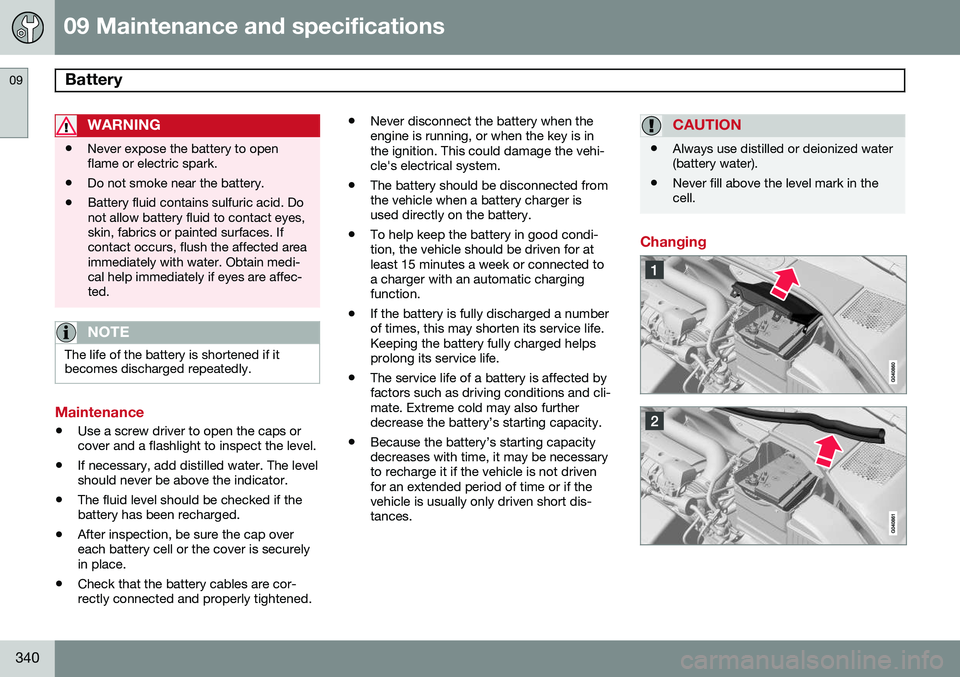
Changing
Page 344 of 386
09 Maintenance and specifications
Battery 09
342
(pry them up carefully with a plastic knife or similar object).
2. Remove the screw on each side of the engine compartment holding the rally barin place.
3. Lift out the rally bar. > The battery can now be removed (seethe instructions in the previous sec-tion).
• After a new battery has been installed (see the following section), reinstall therally bar in the reverse order.
NOTE
When reinstalling the rally bar, tighten the screws to 22 ft lbs (30 Nm).
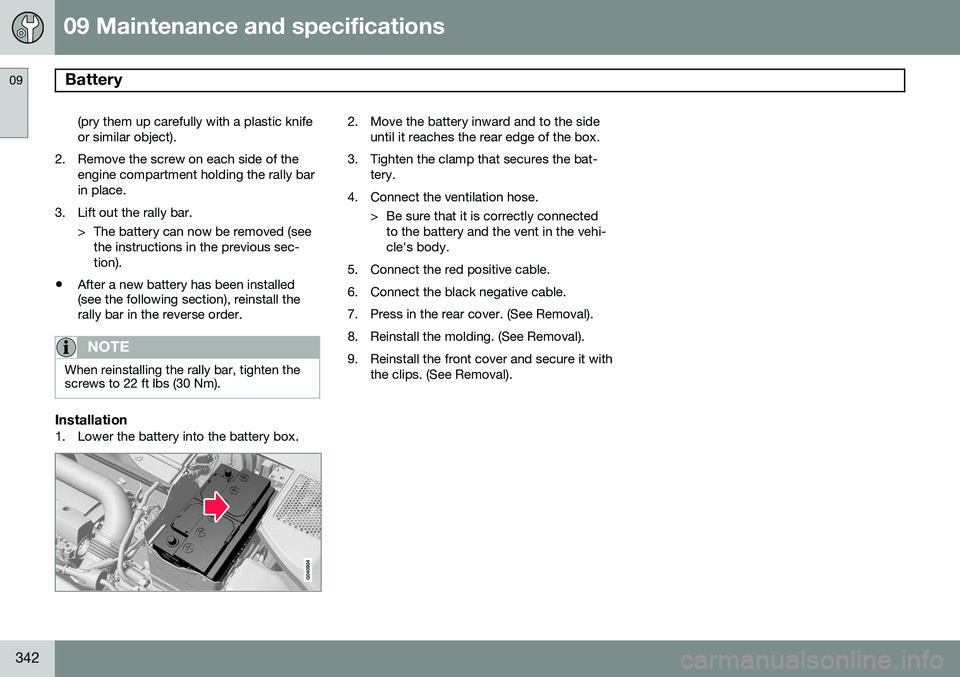
Installation1. Lower the battery into the battery box.
2. Move the battery inward and to the side
until it reaches the rear edge of the box.
3. Tighten the clamp that secures the bat- tery.
4. Connect the ventilation hose. > Be sure that it is correctly connectedto the battery and the vent in the vehi- cle's body.
5. Connect the red positive cable.
6. Connect the black negative cable.
7. Press in the rear cover. (See Removal).
8. Reinstall the molding. (See Removal).
9. Reinstall the front cover and secure it with the clips. (See Removal).
Page 355 of 386
09 Maintenance and specifications
Vehicle care09
353
washers do not have facilities for washing the underbody.
NOTE
Condensation may form temporarily on the inside of the lenses of exterior lights suchas headlights, fog lights, or taillights. Thisis normal and the lights are designed towithstand moisture. Normally, condensa-tion will dissipate after the lights have beenon for a short time.
CAUTION
•
Before driving into an automatic car wash, turn off the optional rain sensorto avoid damaging the windshield wip-ers.
• Make sure that side view mirrors, aux-iliary lamps, etc, are secure, and thatany antenna(s) are retracted orremoved. Otherwise there is risk of themachine dislodging them.
• Chromed wheels:
Clean chrome-
plated wheels using the same deter-gents used for the body of the vehicle.Aggressive wheel-cleaning agents canpermanently stain chrome-platedwheels.
WARNING
• When the vehicle is driven immediately after being washed, apply the brakes,including the parking brake, severaltimes in order to remove any moisturefrom the brake linings.
• Engine cleaning agents should not beused when the engine is warm. Thisconstitutes a fire risk.
Polishing and waxing
•
Normally, polishing is not required during the first year after delivery, however, wax-ing may be beneficial.
• Before applying polish or wax the vehiclemust be washed and dried. Tar spots canbe removed with kerosene or tar remover.Difficult spots may require a fine rubbingcompound.
• After polishing use liquid or paste wax.
• Several commercially available productscontain both polish and wax.
• Waxing alone does not substitute for pol-ishing a dull surface.
• A wide range of polymer-based waxescan be purchased today. These waxesare easy to use and produce a long-last-ing, high-gloss finish that protects the bodywork against oxidation, road dirt andfading.
• Do not polish or wax your vehicle in directsunlight (the surface of the vehicle shouldnot be warmer than 113 °F (45 °C).
CAUTION
Volvo does not recommend the use of long-life or durable paint protection coat-ings, some of which may claim to preventpitting, fading, oxidation, etc. These coat-ings have not been tested by Volvo forcompatibility with your vehicle's clear coat.Some of them may cause the clear coat tosoften, crack, or cloud. Damage caused byapplication of paint protection coatingsmay not be covered under your vehicle'spaint warranty.
Cleaning the interior
Only use cleaning agents and car care prod- ucts recommended by Volvo. Clean regularlyand follow the instructions included with thecar care product.
Upholstery care
FabricClean with soapy water or a detergent. For more difficult spots caused by oil, ice cream,shoe polish, grease, etc., use a clothing/
Page 382 of 386

11 Index
11
380
Seat beltsAutomatic locking retractor/Emer-
gency locking retractor......................... 39
buckling................................................ 18
maintenance......................................... 19
pretensioners........................................ 18
reminder................................................ 19
reminder warning light.......................... 82securing child restraint
systems.................................... 43, 45, 47
unbuckling............................................ 19
use during pregnancy........................... 21
using..................................................... 18
Seats, front.......................................... 88, 89
Sensus..................................................... 194
Shiftlock....................................................... 9 override............................................... 126
Side door mirrors..................................... 108
Side impact airbags................................... 31
Sign information (RSI).............................. 140SiriusXM ™ satellite radio......................... 239
Snow chains............................................ 304
Snow tires................................................ 304
Spare tire................................................. 305
Speed-dependent steering...................... 219 Spin control............................................. 138
SRS............................................................ 22
Stability system............................... 138, 139
Corner Traction Control (CTC)............ 138
Engine Drag Control (EDC)................. 138
indicator light........................................ 81
Starting the engine.................................. 118 remote start........................................ 120
with keyless drive............................... 118
Starting the vehicle after a crash (crash mode).................... 36
Start inhibitor (immobilizer)........................ 56 Steering wheel adjusting............................................... 94
heated................................................... 95
horn....................................................... 94
keypad.................................. 94, 197, 227
Steering wheel paddles............................. 94
Stone chips, touching up......................... 355
Storage spaces........................................ 220
Studded tires........................................... 304
Sunroof (moonroof).................................. 113
Sun shade........................................ 106, 107
Supplemental restraint system.................. 22 warning light......................................... 82 Symbols, overview................................... 369
T
Temperature sensor
ambient................................................. 84
Temporary spare tire............................... 305
Three-way catalytic converter................. 277
Tire designations..................................... 298
Tire inflation pressure.............................. 296
Tire Pressure Monitoring System.... 316, 317 indicator light........................................ 81
Tires......................................................... 290 age...................................................... 290
changing from summer to winter........ 291
glossary of terms................................ 300
improving economy............................ 291
inflation pressure................................ 293
inflation pressure table....................... 296
load ratings......................................... 295
rotation............................................... 290
Self-supporting run flat tires (SST)..... 318
snow................................................... 304
spare................................................... 305
specifications...................................... 294
speed ratings...................................... 294