parking brake VOLVO S60 2014 Owner´s Manual
[x] Cancel search | Manufacturer: VOLVO, Model Year: 2014, Model line: S60, Model: VOLVO S60 2014Pages: 386, PDF Size: 11.24 MB
Page 313 of 386
08 Wheels and tires
Tire Sealing System*
08
* Option/accessory, for more information, see Introduction.311
Inflating tires
The tire sealing system can be used to inflate the tires. To do so:
1. Park the car in a safe place.
2. The compressor should be switched off.
Ensure that the on/off switch is in position0 (the 0 side of the switch should be
pressed down).
3. Take out the electrical wire and hose.
4. Remove the valve cap from the tire’s inflation valve and screw the hose con- nector onto the valve as tightly as possi-ble by hand.
5. Connect the electrical wire to the nearest 12-volt socket in the vehicle.
6. Start the vehicle’s engine.WARNING
• The vehicle’s engine should be running when the tire sealing system is used toavoid battery drain. Therefore, be surethe vehicle is parked in a well ventilatedplace, or outdoors, before using thesystem. The parking brake should besecurely applied and the gear selectorshould be in the
P (park) position.
• Children should never be left unatten-ded in the vehicle when the engine isrunning.
7. Check the tire’s inflation pressure on the
gauge. Switch off the compressor briefly to get a clear reading from the pressuregauge.
8. Refer to the tire inflation table in this chapter for the correct inflation pressure.If the tire needs to be inflated, start thetire sealing system’s compressor (pressthe on/off switch to position I). If neces-sary, release air from the tire by turningthe air release knob counterclockwise.
CAUTION
The compressor should not be used for more than 10 minutes at a time to avoidoverheating.
9. Turn off the compressor (press the on/off switch to position 0) when the correct
inflation pressure has been reached.
10. Unscrew the hose from the tire’s inflation valve and reinstall the valve cap.
CAUTION
•After pumping the tires, always reinstall the valve cap to help avoid damage tothe valve from dirt, gravel, etc.
• Use plastic valve caps only. Metal capscould corrode and become difficult toremove.
11. Disconnect the electrical wire from the
12-volt socket.
Page 315 of 386
08 Wheels and tires
Changing a wheel
08
* Option/accessory, for more information, see Introduction.313
CAUTION
The vehicle must never be driven with more than one temporary spare wheel.
Taking out the spare wheel1. Release the bag's retaining straps.
2. Lift the bag out of the vehicle and remove
the spare wheel from the bag.
3. Fold up the floor hatch in the trunk.
4. Remove the jack* and tools* from the foam block and change the wheels (see the instructions in the following section"Changing a wheel").
5. After changing wheels, return the jack and tools to the foam block and close thefloor hatch.
6. If possible, place the wheel with the punctured tire in the bag.
7. If there is a wheel in the bag, strap the bag securely in place in the trunk.
WARNING
•If there is a wheel in the bag, the bag must be securely restrained using itsstraps and the load anchoring eyelets inthe trunk. Carefully follow the instruc-tions on page 312
• If the wheel with the punctured tire istoo big to fit in the bag, it should besecurely restrained in the trunk usingsuitable straps, a net for anchoringcargo, etc.
Changing a wheel1. Apply the parking brake and put the gear
selector in P.
2. Take out the jack*, lug wrench*, the tow- ing eyelet and the wheel cover removal tool* stowed under the floor of the trunk.
3. Remove the wheel cover (where applica- ble) using the removal tool or remove thewheel cover by hand.
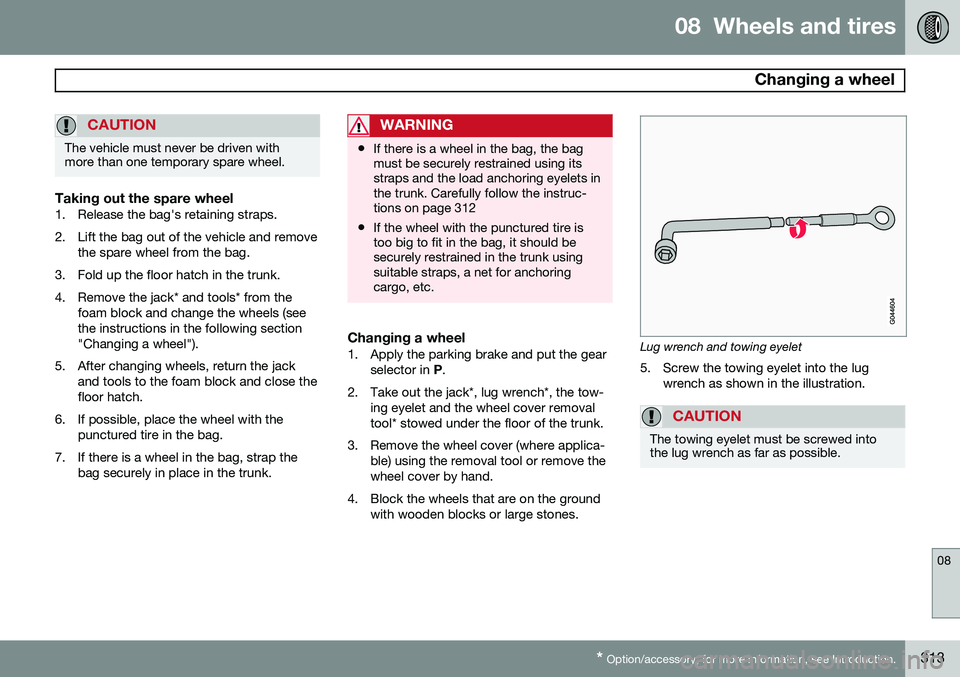
4. Block the wheels that are on the ground with wooden blocks or large stones.Lug wrench and towing eyelet
5. Screw the towing eyelet into the lug wrench as shown in the illustration.
CAUTION
The towing eyelet must be screwed into the lug wrench as far as possible.
Page 316 of 386

08 Wheels and tires
Changing a wheel
08
314
6. With the vehicle still on the ground, usethe lug wrench/towing eyelet to loosen the wheel nuts ½ – 1 turn by exertingdownward (counterclockwise) pressure.
Jack attachment points
7. There are two jack attachment points on each side of the vehicle. Position the jack correctly in the attachment (see the illus-tration) and crank while simultaneouslyguiding the base of the jack to theground. The base of the jack must be flaton a level, firm, non-slippery surface.Before raising the vehicle, check that thejack is still correctly positioned in theattachment.
8. Raise the vehicle until the wheel to be changed is lifted off the ground.
9. Unscrew the wheel nuts completely and remove the wheel.
WARNING
•The jack must correctly engage the jack attachment.
• Be sure the jack is on a firm, level,non-slippery surface.
• Never allow any part of your body tobe extended under a vehicle suppor-ted by a jack.
• Use the jack intended for the vehiclewhen changing a tire. For any otherjob, use stands to support the vehicle.
• Apply the parking brake and put thegear selector in the Park (
P) position.
• Block the wheels standing on theground, use rigid wooden blocks orlarge stones.
• The jack should be kept well-greasedand clean, and should not be dam-aged.
• No objects should be placed betweenthe base of jack and the ground, orbetween the jack and the attachmentbar on the vehicle.
Page 336 of 386
09 Maintenance and specifications
Replacing bulbs 09
334
4. Insert a new bulb, press it in slightly andturn it clockwise.
5. Press the bulb holder back into place and reinstall the cover.
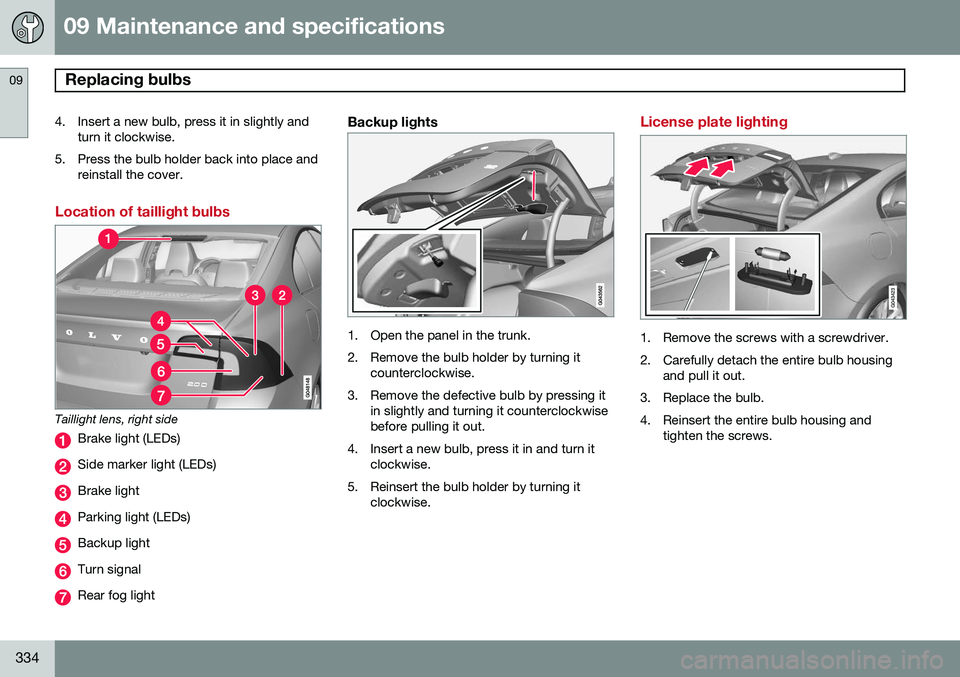
Location of taillight bulbs
Taillight lens, right side
Brake light (LEDs)
Side marker light (LEDs)
Brake light
Parking light (LEDs)
Backup light
Turn signal
Rear fog light
Backup lights
1. Open the panel in the trunk.
2. Remove the bulb holder by turning itcounterclockwise.
3. Remove the defective bulb by pressing it in slightly and turning it counterclockwise before pulling it out.
4. Insert a new bulb, press it in and turn it clockwise.
5. Reinsert the bulb holder by turning it clockwise.
License plate lighting
1. Remove the screws with a screwdriver.
2. Carefully detach the entire bulb housing and pull it out.
3. Replace the bulb.
4. Reinsert the entire bulb housing and tighten the screws.
Page 352 of 386

09 Maintenance and specifications
Fuses 09
350* Option/accessory, for more information, see Introduction.
Cargo area
Located behind the upholstery on the left side of the trunk
Positions
PosRear fuse boxA
Electric parking brake (left side)30
Electric parking brake (right side)30
Heated rear window30
Trailer socket 2*15
PosRear fuse boxA
-
12-volt socket in trunk15
-
-
-
-
PosRear fuse boxA
Trailer socket 1*40
-
NOTE
Please consult a Volvo retailer’s Parts department for the most up-to-date speci-fications.
Page 353 of 386

09 Maintenance and specifications
Fuses09
* Option/accessory, for more information, see Introduction.351
Cargo area
Located behind the upholstery on the left side of the trunk
Positions
PosRear fuse boxA
Electric parking brake (left side)30
Electric parking brake (right side)30
Heated rear window30
Trailer socket 2*15
PosRear fuse boxA
-
12-volt socket in trunk15
-
-
-
-
PosRear fuse boxA
Trailer socket 1*40
-
NOTE
Please consult a Volvo retailer’s Parts department for the most up-to-date speci-fications.
Page 355 of 386
09 Maintenance and specifications
Vehicle care09
353
washers do not have facilities for washing the underbody.
NOTE
Condensation may form temporarily on the inside of the lenses of exterior lights suchas headlights, fog lights, or taillights. Thisis normal and the lights are designed towithstand moisture. Normally, condensa-tion will dissipate after the lights have beenon for a short time.
CAUTION
•
Before driving into an automatic car wash, turn off the optional rain sensorto avoid damaging the windshield wip-ers.
• Make sure that side view mirrors, aux-iliary lamps, etc, are secure, and thatany antenna(s) are retracted orremoved. Otherwise there is risk of themachine dislodging them.
• Chromed wheels:
Clean chrome-
plated wheels using the same deter-gents used for the body of the vehicle.Aggressive wheel-cleaning agents canpermanently stain chrome-platedwheels.
WARNING
• When the vehicle is driven immediately after being washed, apply the brakes,including the parking brake, severaltimes in order to remove any moisturefrom the brake linings.
• Engine cleaning agents should not beused when the engine is warm. Thisconstitutes a fire risk.
Polishing and waxing
•
Normally, polishing is not required during the first year after delivery, however, wax-ing may be beneficial.
• Before applying polish or wax the vehiclemust be washed and dried. Tar spots canbe removed with kerosene or tar remover.Difficult spots may require a fine rubbingcompound.
• After polishing use liquid or paste wax.
• Several commercially available productscontain both polish and wax.
• Waxing alone does not substitute for pol-ishing a dull surface.
• A wide range of polymer-based waxescan be purchased today. These waxesare easy to use and produce a long-last-ing, high-gloss finish that protects the bodywork against oxidation, road dirt andfading.
• Do not polish or wax your vehicle in directsunlight (the surface of the vehicle shouldnot be warmer than 113 °F (45 °C).
CAUTION
Volvo does not recommend the use of long-life or durable paint protection coat-ings, some of which may claim to preventpitting, fading, oxidation, etc. These coat-ings have not been tested by Volvo forcompatibility with your vehicle's clear coat.Some of them may cause the clear coat tosoften, crack, or cloud. Damage caused byapplication of paint protection coatingsmay not be covered under your vehicle'spaint warranty.
Cleaning the interior
Only use cleaning agents and car care prod- ucts recommended by Volvo. Clean regularlyand follow the instructions included with thecar care product.
Upholstery care
FabricClean with soapy water or a detergent. For more difficult spots caused by oil, ice cream,shoe polish, grease, etc., use a clothing/
Page 371 of 386
10 Specifications
Overview of information and warning symbols
10
* Option/accessory, for more information, see Introduction.369
Introduction
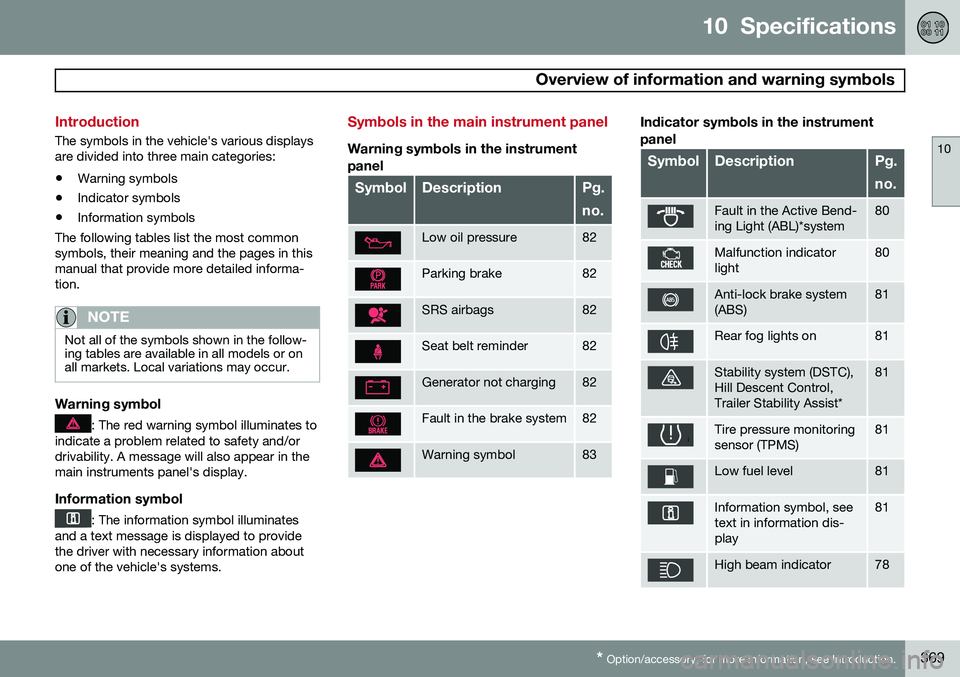
The symbols in the vehicle's various displays are divided into three main categories:
• Warning symbols
• Indicator symbols
• Information symbols
The following tables list the most commonsymbols, their meaning and the pages in thismanual that provide more detailed informa-tion.
NOTE
Not all of the symbols shown in the follow- ing tables are available in all models or onall markets. Local variations may occur.
Warning symbol
: The red warning symbol illuminates to
indicate a problem related to safety and/or drivability. A message will also appear in themain instruments panel's display.
Information symbol
: The information symbol illuminates
and a text message is displayed to provide the driver with necessary information aboutone of the vehicle's systems.
Symbols in the main instrument panel
Warning symbols in the instrument
panel
SymbolDescriptionPg. no.
Low oil pressure82
Parking brake82
SRS airbags82
Seat belt reminder82
Generator not charging82
Fault in the brake system82
Warning symbol83
Indicator symbols in the instrument panel
SymbolDescriptionPg. no.
Fault in the Active Bend- ing Light (ABL)*system80
Malfunction indicator light80
Anti-lock brake system (ABS)81
Rear fog lights on81
Stability system (DSTC), Hill Descent Control,Trailer Stability Assist*81
Tire pressure monitoring sensor (TPMS)81
Low fuel level81
Information symbol, see text in information dis-play81
High beam indicator78
Page 372 of 386
10 Specifications
Overview of information and warning symbols
10
370* Option/accessory, for more information, see Introduction.
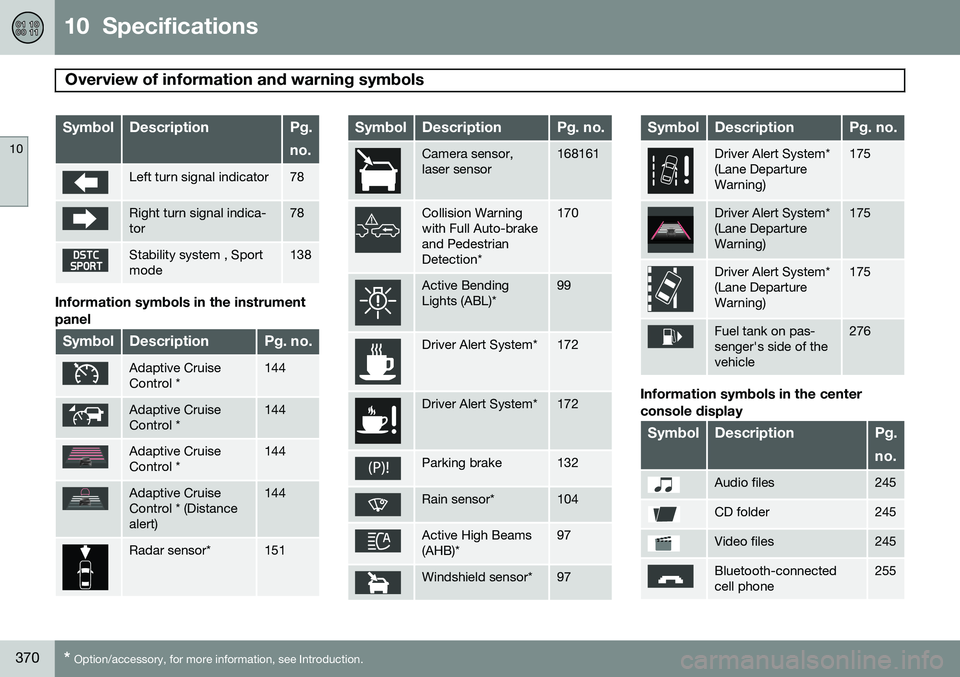
SymbolDescriptionPg. no.
Left turn signal indicator78
Right turn signal indica- tor78
Stability system , Sport mode138
Information symbols in the instrument panel
SymbolDescriptionPg. no.
Adaptive Cruise Control *144
Adaptive Cruise Control *144
Adaptive Cruise Control *144
Adaptive Cruise Control * (Distancealert)144
Radar sensor*151
SymbolDescriptionPg. no.
Camera sensor, laser sensor168161
Collision Warning with Full Auto-brakeand PedestrianDetection*170
Active Bending Lights (ABL)*99
Driver Alert System*172
Driver Alert System*172
Parking brake132
Rain sensor*104
Active High Beams (AHB)*97
Windshield sensor*97
SymbolDescriptionPg. no.
Driver Alert System* (Lane DepartureWarning)175
Driver Alert System* (Lane DepartureWarning)175
Driver Alert System* (Lane DepartureWarning)175
Fuel tank on pas- senger's side of thevehicle276
Information symbols in the center console display
SymbolDescriptionPg. no.
Audio files245
CD folder245
Video files245
Bluetooth-connected cell phone255
Page 378 of 386
11 Index
11
376
E
ECC................................................. 208, 210
Eco guide................................................. 127
Economical driving.................................. 270
Electrically heated steering wheel............. 95
Electric parking brake.............................. 132
Electronic Climate Control....... 206, 208, 210air distribution table............................ 211
Interior Air Quality System.................. 210
Emergency locking retractor...................... 39
Emergency starting.................................. 121
Emergency towing................................... 285
Emission inspection readiness................ 323Engine overheating........................................... 82
specifications...................................... 365
starting................................................ 118
switching off....................................... 121
Engine compartment overview................ 325
Engine Drag Control (EDC)...................... 138
Engine oil................................................. 366 checking............................................. 326
low pressure warning light.................... 81
volumes.............................................. 367 Engine remote start (ERS)........................ 120
Environment............................................... 12
Eyelets for anchoring loads..................... 279
F
Federal Clean Air Act............................... 322 Flat tires
repairing with tire sealing system....... 306
Floor mats cleaning.............................................. 355
placing correctly................................. 118
Fluid specifications.................................. 367
Fog lights................................................... 81 rear...................................................... 100
Four C (active chassis system)................ 219
Front airbags.............................................. 23 disconnecting passenger’s side air-
bag.................................................. 27, 28
Front park assist.............................. 178, 180
Front seats........................................... 88, 90
Fuel filler cap........................................... 277
Fuel filler door, opening........................... 276
Fuel level warning light.............................. 81 Fuel requirements............................ 274, 275
Fuel tank volume..................................... 367
Fuses....................... 343, 344, 347, 350, 351
G
Garage door opener
HomeLink ®
Wireless Control System. 115
Gasoline requirements............................. 275
Gas tank volume...................................... 367
Gauges...................................................... 77
Geartronic................................................ 124
Geartronic automatic transmission.......... 124
Generator warning light............................. 82
Glossary of tire terminology..................... 300
Grocery bag holder.................................. 280
Gross vehicle weight............................... 301
H
Hazard warning flashers.......................... 101
HD digital radio........................................ 237