replacing battery VOLVO S60 2016 Owner´s Manual
[x] Cancel search | Manufacturer: VOLVO, Model Year: 2016, Model line: S60, Model: VOLVO S60 2016Pages: 392, PDF Size: 10.04 MB
Page 6 of 392
Contents
4* Option/accessory, for more information, see Introduction.
04
04 Climate
Climate – general information................. 118
Climate – sensors................................... 119
Air quality................................................ 119
Interior Air Quality System (IAQS)*.......... 120
Climate – menu settings......................... 120
Air distribution – general......................... 121
Electronic climate control (ECC)............. 122
Heated seats........................................... 123
Temperature and blower control............ 124
Automatic climate control....................... 124
Air conditioning....................................... 125Max. defroster and electrically heated
windshield*.............................................. 125
Air distribution – function........................ 126
Air distribution – recirculation................. 127
Air distribution – table............................. 128
05
05 Loading and storage
Storage spaces....................................... 131
Tunnel console........................................ 133
Tunnel console – 12-volt sockets........... 133
Glove compartment................................ 134
Vanity mirror............................................ 134
12-volt socket in the trunk*..................... 134
Loading – general................................... 135
Ski hatch................................................. 135
Loading – roof load carriers.................... 136
Load anchoring eyelets........................... 137
Grocery bag holder................................. 137
06
06 Locks and alarm
Remote key and key blade..................... 139
Remote key – loss................................... 139
Key memory............................................ 140
Locking/unlocking confirmation.............. 140
Immobilizer (start inhibitor)...................... 141
Remote key – functions.......................... 142
Remote key – range................................ 143Detachable key blade – general informa-
tion.......................................................... 144 Detachable key blade – detaching/rein-
serting..................................................... 144
Detachable key blade – unlocking.......... 145
Valet locking............................................ 145
Remote key – replacing the battery........ 146
Keyless drive*– locking/unlocking.......... 148Keyless drive* – unlocking with key
blade....................................................... 149
Keyless drive* – key memory.................. 149
Keyless drive* – messages..................... 150
Keyless drive* – antenna locations......... 151
Locking/unlocking – from the outside..... 152
Manual locking........................................ 153
Locking/unlocking – from inside............. 153
Locking/unlocking – glove compartment 155
Page 147 of 392
06 Locks and alarm
06
}}
145
Detachable key blade – unlocking
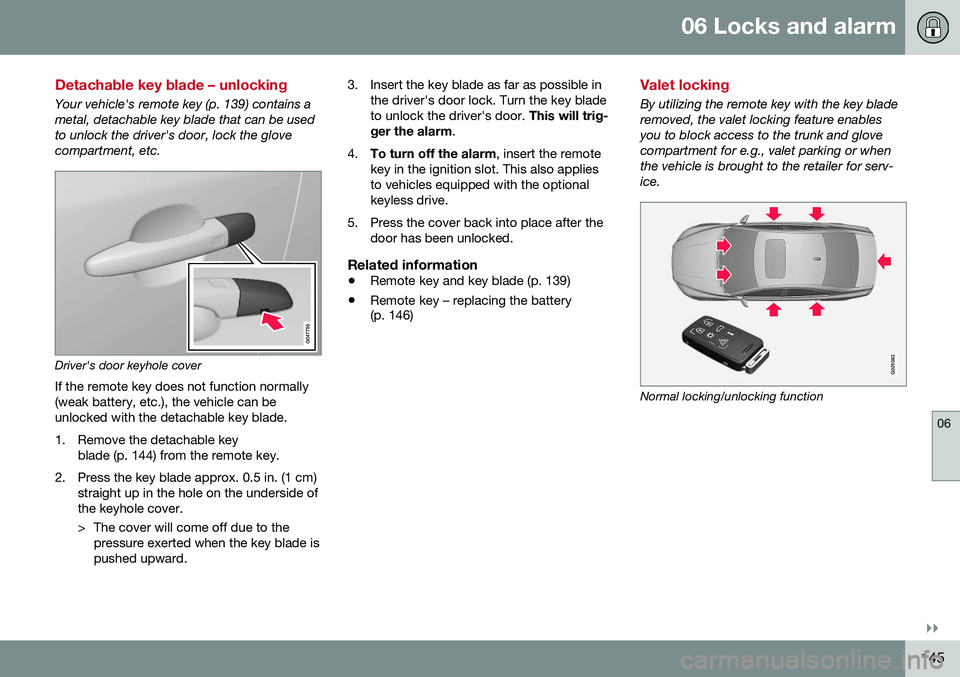
Your vehicle's remote key (p. 139) contains a metal, detachable key blade that can be usedto unlock the driver's door, lock the glovecompartment, etc.
Driver's door keyhole coverIf the remote key does not function normally (weak battery, etc.), the vehicle can beunlocked with the detachable key blade.
1. Remove the detachable key blade (p. 144) from the remote key.
2. Press the key blade approx. 0.5 in. (1 cm) straight up in the hole on the underside of the keyhole cover.
> The cover will come off due to thepressure exerted when the key blade is pushed upward. 3. Insert the key blade as far as possible in
the driver's door lock. Turn the key bladeto unlock the driver's door. This will trig-
ger the alarm .
4. To turn off the alarm , insert the remote
key in the ignition slot. This also appliesto vehicles equipped with the optionalkeyless drive.
5. Press the cover back into place after the door has been unlocked.
Related information
• Remote key and key blade (p. 139)
• Remote key – replacing the battery (p. 146)
Valet locking
By utilizing the remote key with the key blade removed, the valet locking feature enablesyou to block access to the trunk and glovecompartment for e.g., valet parking or whenthe vehicle is brought to the retailer for serv-ice.
G021083
Normal locking/unlocking function
Page 148 of 392
||
06 Locks and alarm
06
146
G021084
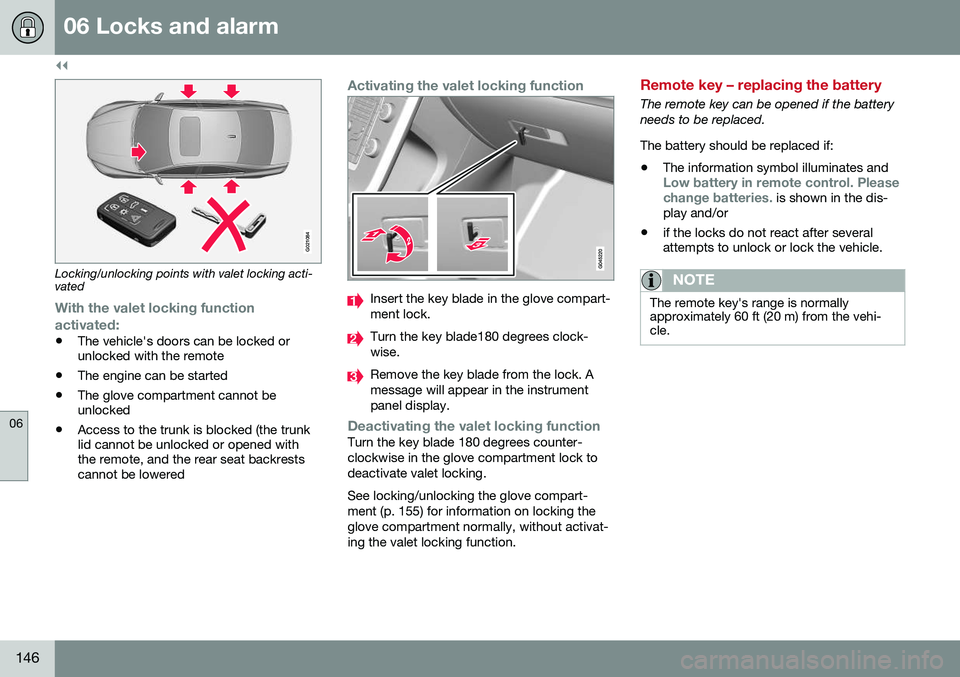
Locking/unlocking points with valet locking acti- vated
With the valet locking function
activated:
• The vehicle's doors can be locked or unlocked with the remote
• The engine can be started
• The glove compartment cannot beunlocked
• Access to the trunk is blocked (the trunklid cannot be unlocked or opened withthe remote, and the rear seat backrestscannot be lowered
Activating the valet locking function
Insert the key blade in the glove compart- ment lock.
Turn the key blade180 degrees clock- wise.
Remove the key blade from the lock. A message will appear in the instrumentpanel display.
Deactivating the valet locking functionTurn the key blade 180 degrees counter- clockwise in the glove compartment lock todeactivate valet locking. See locking/unlocking the glove compart- ment (p. 155) for information on locking theglove compartment normally, without activat-ing the valet locking function.
Remote key – replacing the battery
The remote key can be opened if the battery needs to be replaced. The battery should be replaced if:
• The information symbol illuminates and
Low battery in remote control. Please change batteries. is shown in the dis-
play and/or
• if the locks do not react after several attempts to unlock or lock the vehicle.
NOTE
The remote key's range is normally approximately 60 ft (20 m) from the vehi-cle.
Page 154 of 392
||
06 Locks and alarm
06
152* Option/accessory, for more information, see Introduction.
WARNING
People with implanted pacemakers should not allow the pacemaker to come closerthan 9 inches (22 cm) to any of the keylessdrive system's antennas. This is to helpprevent interference between the pace-maker and the keyless drive system.
Related information
• Keyless drive*– locking/unlocking (p. 148)
Locking/unlocking – from the outside
The remote key (p. 139) is used to lock/unlock all of the doors and the trunk at the sametime. Different settings for unlocking the vehi-cle can be selected, see Remote key – func-tions (p. 142). Before the vehicle can be locked from the outside with the remote key, the driver's doormust be closed. If the trunk or any other dooris open, it will be locked and the alarm will bearmed.
NOTE
Be sure the remote key is outside of the vehicle before the other doors/trunk areclosed to help avoid locking the remoteinside the vehicle.
If the vehicle is equipped with the optional keyless drive system, all doors/trunk must beclosed before the vehicle can be locked. The first press on the unlock button unlocks the driver's door and a second press unlocksthe other doors and the trunk (see alsoremote key and key blade (p. 139)). This set-ting can be changed in the menu system. SeeMY CAR
(p. 70) for a description.
If the locks repeatedly do not react when theunlock button is pressed, it may be necessaryto replace the battery in the remote, seeRemote key – replacing the battery (p. 146). In this case the vehicle can be unlocked withthe detachable key blade (p. 145).
Related information
•
Locking/unlocking – from inside (p. 153)
Page 155 of 392
06 Locks and alarm
06
}}
153
Manual locking
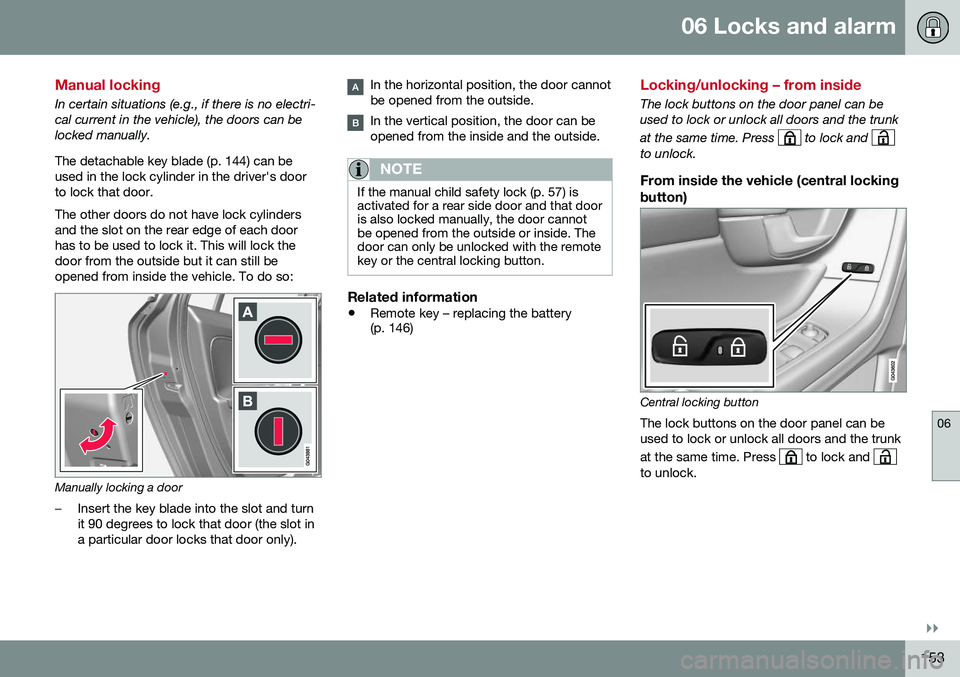
In certain situations (e.g., if there is no electri- cal current in the vehicle), the doors can belocked manually. The detachable key blade (p. 144) can be used in the lock cylinder in the driver's doorto lock that door. The other doors do not have lock cylinders and the slot on the rear edge of each doorhas to be used to lock it. This will lock thedoor from the outside but it can still beopened from inside the vehicle. To do so:
Manually locking a door
–Insert the key blade into the slot and turn it 90 degrees to lock that door (the slot ina particular door locks that door only).
In the horizontal position, the door cannot be opened from the outside.
In the vertical position, the door can be opened from the inside and the outside.
NOTE
If the manual child safety lock (p. 57) is activated for a rear side door and that dooris also locked manually, the door cannotbe opened from the outside or inside. Thedoor can only be unlocked with the remotekey or the central locking button.
Related information
•Remote key – replacing the battery (p. 146)
Locking/unlocking – from inside
The lock buttons on the door panel can be used to lock or unlock all doors and the trunk at the same time. Press
to lock and to unlock.
From inside the vehicle (central locking button)
Central locking button
The lock buttons on the door panel can be used to lock or unlock all doors and the trunk at the same time. Press
to lock and to unlock.
Page 161 of 392
06 Locks and alarm
06
159
Disarming the alarm–Press the Unlock button on the remote key.
> Two short flashes from the car's direc-tion indicators confirm that the alarm has been deactivated and that alldoors are unlocked.
Related information
• Alarm indicator (p. 158)
• Alarm signal (p. 159)
• Alarm – turning off (p. 159)
• Alarm-related functions (p. 160)
Alarm signal
An audible (p. 157) signal is given by a battery powered siren. The alarm cycle lasts for30 seconds. The visual alarm signal is given by flashing all turn signals for approximately 5 minutes oruntil the alarm is turned off.
Related information
•Alarm indicator (p. 158)
• Alarm – arming/disarming (p. 158)
• Alarm – turning off (p. 159)
Alarm – turning off
The alarm system provides a warning if an attempt is made to break into the vehicle. If the alarm is sounding, it can be stopped by pressing the Unlock button on the remote keyor by inserting the remote key in the ignitionslot. Two short flashes from the car's turn sig-nals confirm that the alarm has been turnedoff.
Related information
• Alarm indicator (p. 158)
• Alarm – arming/disarming (p. 158)
• Remote key – replacing the battery (p. 146)
Page 249 of 392
08 Starting and driving
08
* Option/accessory, for more information, see Introduction.247
Switching off the engine
Switch off the engine by pressing the START/
STOP ENGINE button.
If the gear selector is not in the P position or
if the vehicle is moving, press the START/
STOP ENGINE button twice or press and
hold it in until the engine switches off.
Related information
• Ignition modes (p. 73)
Engine Remote Start (ERS)* – introduction
ERS is a feature that makes it possible to remotely start the engine using the remotekey to cool or heat the passenger compart-ment before driving. The climate/ and infotainment systems will start using the same settings as when theengine was switched off. When the engine is started using ERS, it will run for a maximum of 15 minutes beforeautomatically switching off again. After 2 ERSstarts, the engine must be started in the nor-mal way before ERS can be used again.
NOTE
•Always adhere to applicable State, Province and/or Local laws regardingengine idling when using ERS.
• The service life of the remote key'sbattery is affected by ERS use. If thisfeature is used frequently, the batteryshould be replaced once a year, seeRemote key – replacing the battery(p. 146).
WARNING
Keep the following in mind before using ERS:
• The vehicle should be in view.
• The vehicle should be unoccupied.
• The vehicle must not be parked indoors or in an enclosed area.Exhaust fumes are harmful to thehealth.
Related information
•
Engine Remote Start (ERS)* – starting the engine (p. 248)
• Engine Remote Start (ERS)* – switchingoff the engine (p. 248)
Page 326 of 392
10 Maintenance and servicing
10
324
Engine compartment – overview
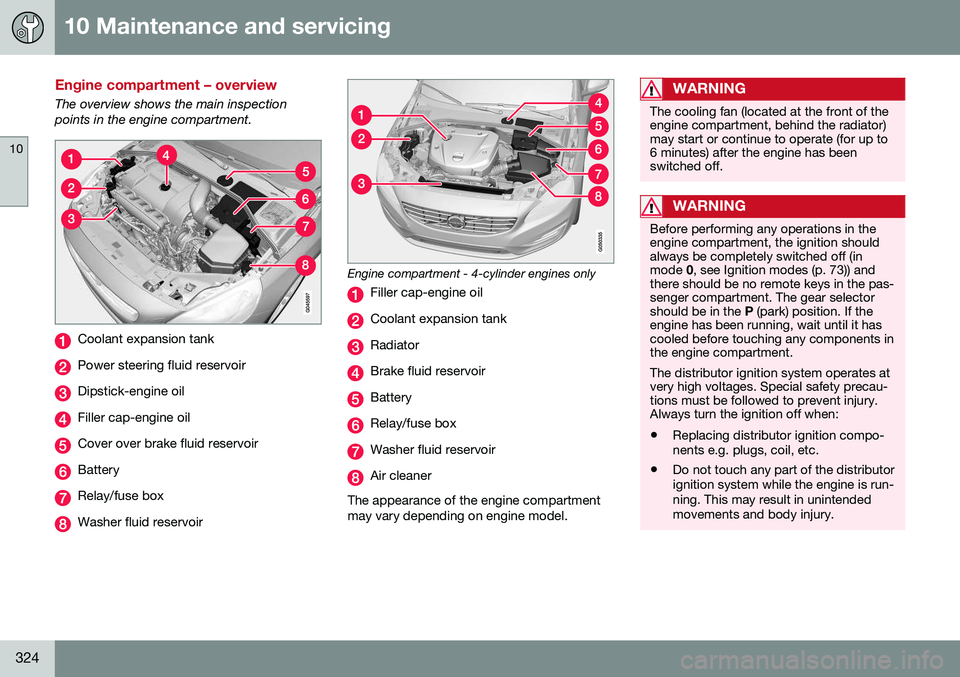
The overview shows the main inspection points in the engine compartment.
Coolant expansion tank
Power steering fluid reservoir
Dipstick-engine oil
Filler cap-engine oil
Cover over brake fluid reservoir
Battery
Relay/fuse box
Washer fluid reservoir
Engine compartment - 4-cylinder engines only
Filler cap-engine oil
Coolant expansion tank
Radiator
Brake fluid reservoir
Battery
Relay/fuse box
Washer fluid reservoir
Air cleaner
The appearance of the engine compartment may vary depending on engine model.
WARNING
The cooling fan (located at the front of the engine compartment, behind the radiator)may start or continue to operate (for up to6 minutes) after the engine has beenswitched off.
WARNING
Before performing any operations in the engine compartment, the ignition shouldalways be completely switched off (inmode 0, see Ignition modes (p. 73)) and
there should be no remote keys in the pas-senger compartment. The gear selectorshould be in the P (park) position. If the
engine has been running, wait until it hascooled before touching any components inthe engine compartment. The distributor ignition system operates at very high voltages. Special safety precau-tions must be followed to prevent injury.Always turn the ignition off when:
• Replacing distributor ignition compo- nents e.g. plugs, coil, etc.
• Do not touch any part of the distributorignition system while the engine is run-ning. This may result in unintendedmovements and body injury.
Page 343 of 392
10 Maintenance and servicing
10
}}
341
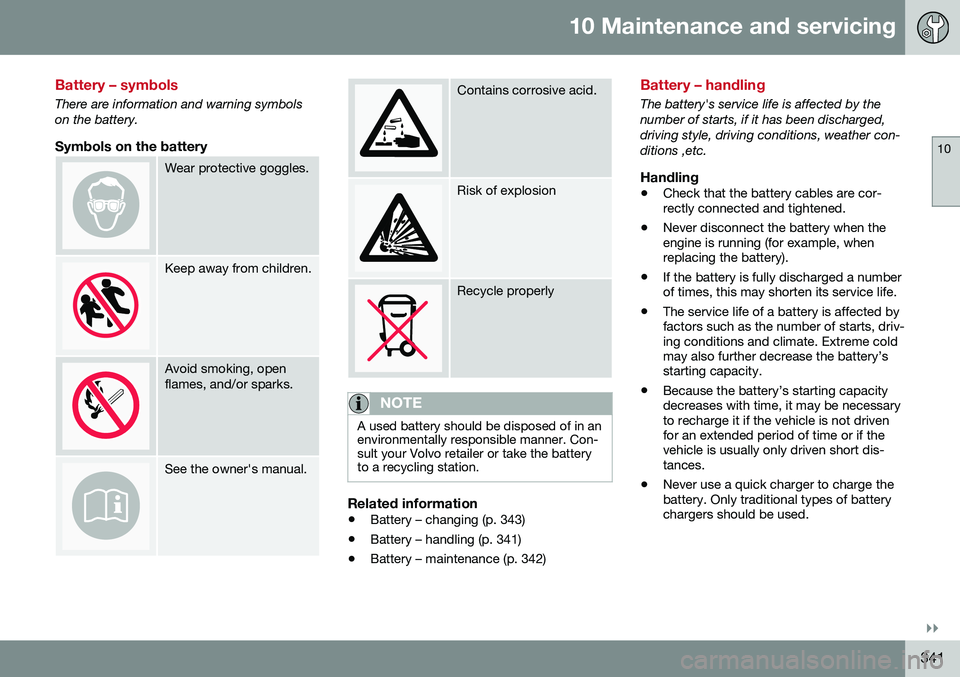
Battery – symbols
There are information and warning symbols on the battery.
Symbols on the battery
Wear protective goggles.
Keep away from children.
Avoid smoking, open flames, and/or sparks.
See the owner's manual.
Contains corrosive acid.
Risk of explosion
Recycle properly
NOTE
A used battery should be disposed of in an environmentally responsible manner. Con-sult your Volvo retailer or take the batteryto a recycling station.
Related information
•Battery – changing (p. 343)
• Battery – handling (p. 341)
• Battery – maintenance (p. 342)
Battery – handling
The battery's service life is affected by the number of starts, if it has been discharged,driving style, driving conditions, weather con-ditions ,etc.
Handling
• Check that the battery cables are cor- rectly connected and tightened.
• Never disconnect the battery when theengine is running (for example, whenreplacing the battery).
• If the battery is fully discharged a numberof times, this may shorten its service life.
• The service life of a battery is affected byfactors such as the number of starts, driv-ing conditions and climate. Extreme coldmay also further decrease the battery’sstarting capacity.
• Because the battery’s starting capacitydecreases with time, it may be necessaryto recharge it if the vehicle is not drivenfor an extended period of time or if thevehicle is usually only driven short dis-tances.
• Never use a quick charger to charge thebattery. Only traditional types of batterychargers should be used.
Page 382 of 392
12 Index
12
380
A
ABS (anti-lock brake system).................. 264
Accessory installation warning.................. 23
Active chassis system............................. 162
Active high beams..................................... 84Active yaw control........................... 162, 163
Adaptive brake lights............................... 265
Adaptive cruise control.................... 172, 173Airbags disconnecting the front passenger’s
side....................................................... 36
front...................................................... 33
inflatable curtain................................... 41
side impact........................................... 39
Air conditioning................................ 124, 125
Air distribution.................................. 121, 126
Air distribution table................................. 128
Air vents................................................... 121
Alarm................................ 157, 158, 159, 160
All Wheel Drive......................................... 262
Ambient temperature sensor..................... 71
Anti-freeze....................................... 272, 327Anti-lock brake system warning light......................................... 67
Anti-lock Brake System (ABS)................. 264 Approach lighting.............................. 91, 142
Auto-dim rearview mirror........................... 98
Automatic locking retractor....................... 47Automatic transmission
Eco (driving function).......................... 260
Geartronic........................................... 252
general description..................... 250, 252
oil........................................................ 373
shiftlock override................................ 254
Axle weight.............................................. 298
B
Battery maintenance............................... 342, 343
remote key, replacing......................... 147
replacing............................................. 343
specifications...................................... 375
start/stop............................................ 375
warning symbols................................. 341
Blind Spot Information System (BLIS)..... 238 Cross Traffic Alert (CTA)..................... 240
Booster cushions....................................... 54
Brake lights.............................................. 265Brake system ABS..................................................... 264
Brake pad inspection.......................... 263 checking fluid level............................. 328
emergency brake assistance.............. 265
fluid..................................................... 373
general information............................. 262
Bulbs headlights........... 330, 331, 332, 333, 334
introduction......................................... 330
license plate lights.............................. 336
specifications...................................... 337
taillight................................................ 335
trunk lighting....................................... 337
C
Camera, Park Assist................................ 234
Capacity weight....................................... 298
Catalytic converter................................... 277
Central locking system, introduction 139, 140, 143, 146
Chains...................................................... 301
Check Engine warning light....................... 67Child restraints recalls and registration......................... 47
Child restraint systems.............................. 47 booster cushions.................................. 54
convertible seats.................................. 51
infant seats........................................... 49