roof VOLVO S60 2016 Owner´s Manual
[x] Cancel search | Manufacturer: VOLVO, Model Year: 2016, Model line: S60, Model: VOLVO S60 2016Pages: 392, PDF Size: 10.04 MB
Page 137 of 392
05 Loading and storage
05
}}
135
Loading – general
The load carrying capacity of your vehicle is determined by factors such as the number ofpassengers, the amount of cargo, the weightof any accessories that may be installed, etc. To increase loading space, the rear seat backrests can be folded down, see Rearseats – folding backrest (p. 80). When loading the trunk, keep the following in mind:The trunk lid can be unlocked anpopped open slightly via the buttonlocated on the lighting panel, see
Locking/unlocking – trunk (p. 155).
• Load objects in the trunk against the backrest whenever possible.
• Unstable loads can be secured to theload anchoring eyelets with straps or weblashings to help keep them from shifting.
• Stop the engine and apply the parkingbrake when loading or unloading longobjects. The gear selector can beknocked out of position by long loads,which could set the vehicle in motion.
WARNING
• Stop the engine, put the gear selector in
P, and apply the parking brake
when loading or unloading longobjects.
• The vehicle's driving characteristicsmay change depending on the weightand distribution of the load.
• A 44-pound (20 kg) object produces aforce of 2,200 pounds (1,000 kg) in ahead-on collision at 30 mph (50 km/h).
• The rear seat should not be loaded toa level higher than 2 in. (5 cm) belowthe upper edge of the rear side win-dows. Objects placed higher than thislevel could impede the function of theVolvo Inflatable Curtain.
Related information
•
Load anchoring eyelets (p. 137)
• Loading – roof load carriers (p. 136)
Ski hatch
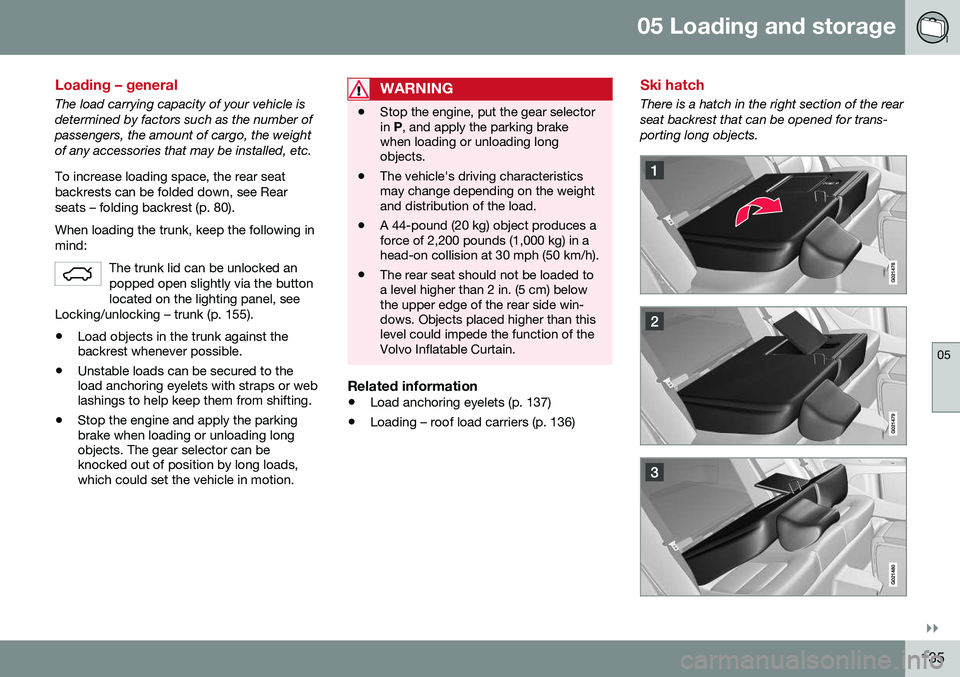
There is a hatch in the right section of the rear seat backrest that can be opened for trans-porting long objects.
Page 138 of 392
||
05 Loading and storage
05
136
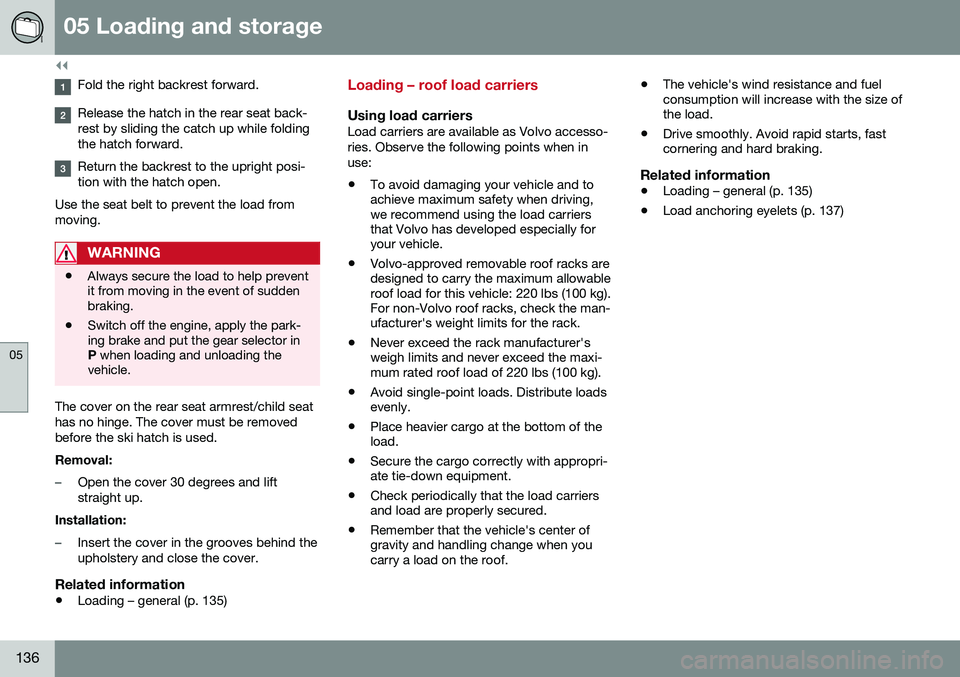
Fold the right backrest forward.
Release the hatch in the rear seat back- rest by sliding the catch up while foldingthe hatch forward.
Return the backrest to the upright posi- tion with the hatch open.
Use the seat belt to prevent the load frommoving.
WARNING
• Always secure the load to help prevent it from moving in the event of suddenbraking.
• Switch off the engine, apply the park-ing brake and put the gear selector inP
when loading and unloading the
vehicle.
The cover on the rear seat armrest/child seat has no hinge. The cover must be removedbefore the ski hatch is used. Removal:
–Open the cover 30 degrees and lift straight up.
Installation:
–Insert the cover in the grooves behind the upholstery and close the cover.
Related information
• Loading – general (p. 135)
Loading – roof load carriers
Using load carriersLoad carriers are available as Volvo accesso- ries. Observe the following points when inuse:
• To avoid damaging your vehicle and to achieve maximum safety when driving,we recommend using the load carriersthat Volvo has developed especially foryour vehicle.
• Volvo-approved removable roof racks aredesigned to carry the maximum allowableroof load for this vehicle: 220 lbs (100 kg).For non-Volvo roof racks, check the man-ufacturer's weight limits for the rack.
• Never exceed the rack manufacturer'sweigh limits and never exceed the maxi-mum rated roof load of 220 lbs (100 kg).
• Avoid single-point loads. Distribute loadsevenly.
• Place heavier cargo at the bottom of theload.
• Secure the cargo correctly with appropri-ate tie-down equipment.
• Check periodically that the load carriersand load are properly secured.
• Remember that the vehicle's center ofgravity and handling change when youcarry a load on the roof. •
The vehicle's wind resistance and fuelconsumption will increase with the size ofthe load.
• Drive smoothly. Avoid rapid starts, fastcornering and hard braking.
Related information
• Loading – general (p. 135)
• Load anchoring eyelets (p. 137)
Page 194 of 392
07 Driver support
07
192
City Safety – operation
Using City Safety™
NOTE
The City Safety™ function is activated automatically each time the engine hasbeen switched off and restarted.
On and OffIn certain situations, it may be desirable to switch City Safety™ off, such as when drivingin close quarters where leaves, branches, etc.may obscure the hood and windshield. When the engine is running, City Safety™ can be switched off as follows: Press My Car in the center console control
panel and go to
SettingsCar settings
Driver support systemsCity Safety.
Select
Off.
If the engine is switched off, City Safety™ will reactivate when the engine is restarted.
WARNING
The laser sensor emits light when the igni- tion is in mode II or higher, even if City
Safety™ has been switched off.
To switch City Safety™ on again:
• Follow the same procedure as for switch- ing City Safety™ off but select
On.
Related information
•City Safety – introduction (p. 190)
• City Safety – function (p. 191)
• City Safety – limitations (p. 192)
• City Safety – troubleshooting (p. 193)
• City Safety – symbols and messages (p. 195)
• City Safety – Laser sensor (p. 196)
• My Car – introduction (p. 70)
City Safety – limitations
Limitations
WARNING
The laser sensor has certain limitations and its function may be reduced (or it maynot function at all) in conditions such asheavy rain or snowfall, or by dense fog orthick, blowing dust or snow. Condensa-tion, dirt, ice or snow on the windshieldmay also interfere with the sensor’s func-tion.
The sensor used by City Safety™ is designed to detect cars and other larger motor vehiclesahead of your vehicle in both daylight anddarkness. Objects such as warning flags hanging from long objects on the roof or accessories suchas auxiliary lights or protective arches on thefront of the vehicle that are higher than thehood may also impede the sensor’s function. Braking distance to the vehicle ahead increa- ses on slippery road surfaces, which mayreduce City Safety’s capacity to avoid a colli-sion. In situations like this, the stability sys-tem (see Stability system – introduction(p. 162)) will help provide the best possiblebraking capacity and stability. City Safety™ emits a laser beam and meas- ures the way in which the light is reflected.
Page 280 of 392
||
08 Starting and driving
08
278* Option/accessory, for more information, see Introduction.
•
Using the transmission's Sport mode 14
may increase fuel consumption some- what. Use the transmission's Drive ( D)
position as often as possible. For addi-tional information about Sport mode, seeTransmission – Geartronic (p. 252).
• Using the engine's optional Eco func- tion15
can help improve fuel economy. For
additional information, see ECO* (p. 260).
• Do not exceed posted speed limits.
• Avoid carrying unnecessary items (extra load) in the vehicle.
• Maintain correct tire pressure. Check tirepressure regularly (when tires are cold).
• Remove snow tires when threat of snowor ice has ended.
• Note that roof racks, ski racks, etc,increase air resistance and also fuel con-sumption.
• At highway driving speeds, fuel consump-tion will be lower with the air conditioningon and the windows closed than with theair conditioning off and the windowsopen.
• Using the onboard trip computer's fuelconsumption modes can help you learnhow to drive more economically.
Other factors that decrease gas mileage are: •
Dirty air cleaner
• Dirty engine oil and clogged oil filter
• Dragging brakes
• Incorrect front end alignment
Some of the above mentioned items and oth-ers are checked at the standard maintenanceintervals.
WARNING
Driving with the trunk open: Driving with
the trunk open could lead to poisonous exhaust gases entering the passengercompartment. If the trunk must be keptopen for any reason, proceed as follows:
• Close the windows
• Set the ventilation system control to air flow to floor, windshield and side win-dows and the blower control to itshighest setting.
Handling and roadholdingAt the specified curb weight your vehicle has a tendency to understeer, which means thatthe steering wheel has to be turned morethan might seem appropriate for the curva-ture of a bend. This ensures good stabilityand reduces the risk of rear wheel skid.Remember that these properties can alterwith the vehicle load. The heavier the load in the trunk, the less the tendency to under-steer. •
Vehicle load, tire design and inflation pressure all affect vehicle handling.Therefore, check that the tires are inflatedto the recommended pressure accordingto the vehicle load. Loads should be dis-tributed so that capacity weight or maxi-mum permissible axle loads are notexceeded.
• At the specified curb weight your vehiclehas a tendency to understeer, whichmeans that the steering wheel has to beturned more than might seem appropriatefor the curvature of a bend. This ensuresgood stability and reduces the risk of rearwheel skid. Remember that these proper-ties can alter with the vehicle load. Theheavier the load in the trunk, the less thetendency to understeer.
Related information
• Climate – general information (p. 118)
14
Certain models only.
15 Available on certain 4-cyl. engines
Page 353 of 392
10 Maintenance and servicing
10
}}
* Option/accessory, for more information, see Introduction.351
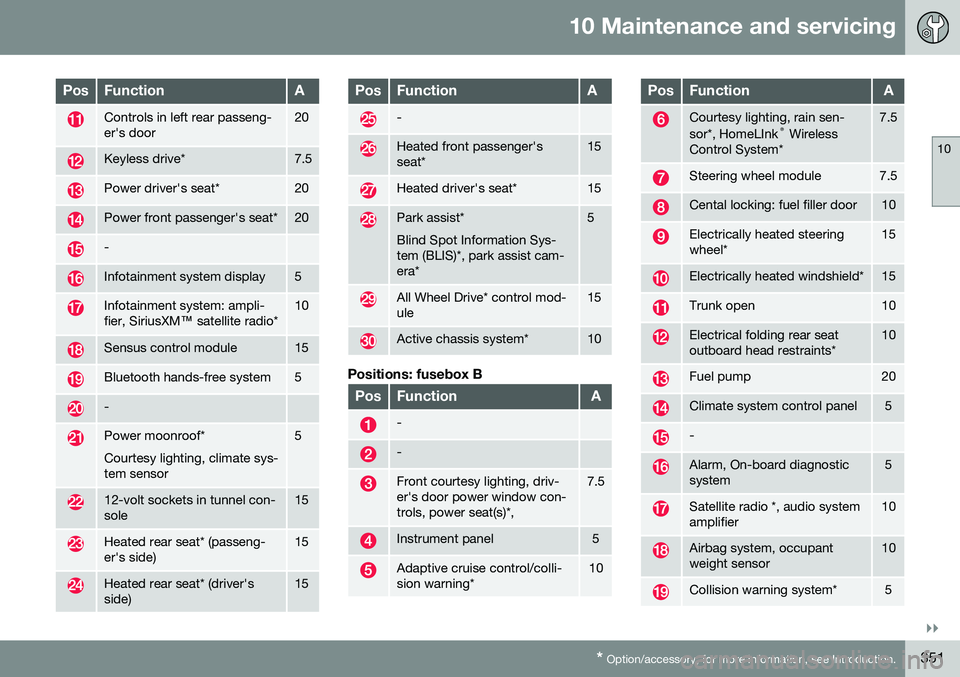
PosFunctionA
Controls in left rear passeng- er's door20
Keyless drive*7.5
Power driver's seat*20
Power front passenger's seat*20
-
Infotainment system display5
Infotainment system: ampli- fier, SiriusXM ™ satellite radio*10
Sensus control module15
Bluetooth hands-free system5
-
Power moonroof* Courtesy lighting, climate sys- tem sensor5
12-volt sockets in tunnel con- sole15
Heated rear seat* (passeng- er's side)15
Heated rear seat* (driver's side)15
PosFunctionA
-
Heated front passenger's seat*15
Heated driver's seat*15
Park assist* Blind Spot Information Sys- tem (BLIS)*, park assist cam-era*5
All Wheel Drive* control mod- ule15
Active chassis system*10
Positions: fusebox B
PosFunctionA
-
-
Front courtesy lighting, driv- er's door power window con-trols, power seat(s)*,7.5
Instrument panel5
Adaptive cruise control/colli- sion warning*10
PosFunctionA
Courtesy lighting, rain sen- sor*, HomeLInk ®
Wireless
Control System*7.5
Steering wheel module7.5
Cental locking: fuel filler door10
Electrically heated steering wheel*15
Electrically heated windshield*15
Trunk open10
Electrical folding rear seat outboard head restraints*10
Fuel pump20
Climate system control panel5
-
Alarm, On-board diagnostic system5
Satellite radio *, audio system amplifier10
Airbag system, occupant weight sensor10
Collision warning system*5
Page 354 of 392
||
10 Maintenance and servicing
10
352* Option/accessory, for more information, see Introduction.
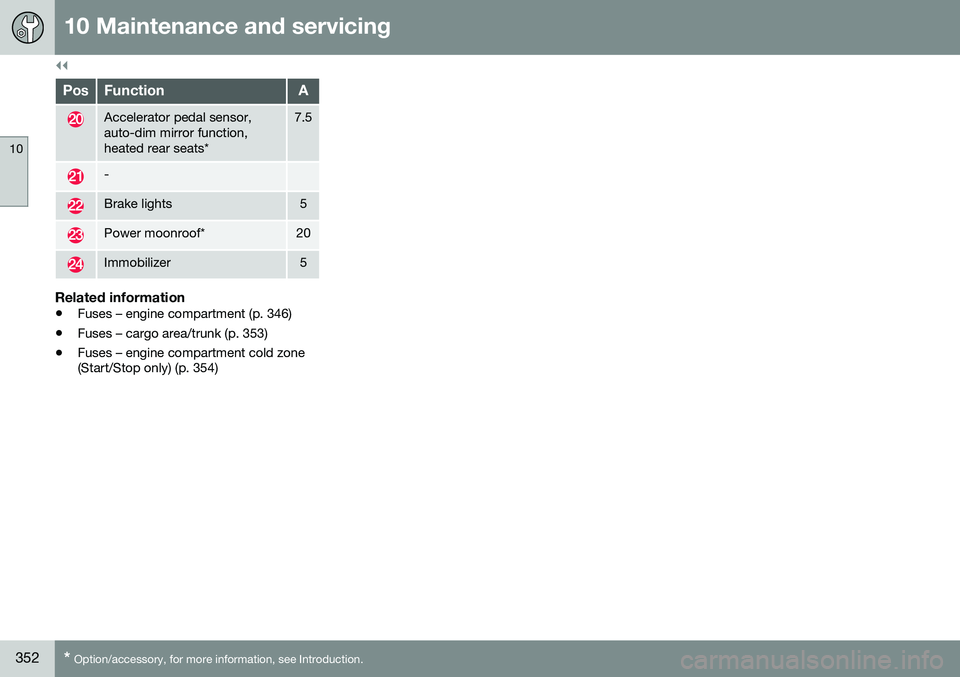
PosFunctionA
Accelerator pedal sensor, auto-dim mirror function,heated rear seats*7.5
-
Brake lights5
Power moonroof*20
Immobilizer5
Related information
• Fuses – engine compartment (p. 346)
• Fuses – cargo area/trunk (p. 353)
• Fuses – engine compartment cold zone (Start/Stop only) (p. 354)
Page 358 of 392
10 Maintenance and servicing
10
356
Washing the car
The vehicle should be washed at regular inter- vals since dirt, dust, insects and tar spotsadhere to the paint and may cause damage.To help prevent corrosion, it is particularlyimportant to wash the car frequently in thewintertime. The following points should be kept in mind when washing and cleaning the car: •Avoid washing your car in direct sunlight. Doing so may cause detergents and waxto dry out and become abrasive. To avoidscratching, use lukewarm water to softenthe dirt before you wash with a softsponge, and plenty of sudsy water.
• Bird droppings
: Remove from paintwork
as soon as possible. Otherwise the finishmay be permanently damaged.
• A detergent can be used to facilitate thesoftening of dirt and oil.
• Dry the car with a clean chamois andremember to clean the drain holes in thedoors and rocker panels.
• Tar spots can be removed with tarremover after the car has been washed.
• A stiff-bristle brush and lukewarm soapywater can be used to clean the wiperblades. Frequent cleaning of the wind-shield and wiper blades improves visibilityconsiderably and also helps prolong theservice life of the wiper blades. •
Wash off the dirt from the underside(wheel housings, fenders, etc).
• In areas of high industrial fallout, morefrequent washing is recommended.
NOTE
When washing the car, remember to remove dirt from the drain holes in thedoors and sills.
CAUTION
• During high pressure washing, the spray mouthpiece must never becloser to the vehicle than 13" (30 cm).Do not spray into the locks.
• Dirt, snow, etc., on the headlights canreduce lighting capacity considerably.Clean the headlights regularly, forexample when refueling.
Special moonroof cautions:
• Always close the moonroof and sunshade before washing your vehicle.
• Never use abrasive cleaning agents onthe moonroof.
• Never use wax on the rubber sealsaround the moonroof.
Exterior componentsVolvo recommends the use of special clean- ing products, available at your Volvo retailer, for cleaning colored plastic, rubber, or orna-mental components such as chromed stripson the exterior of your vehicle. The instruc-tions for using these products should be fol-lowed carefully. Solvents or stain removersshould not be used.
CAUTION
•
Avoid waxing or polishing plastic or rubber components
• Polishing chromed strips can wearaway or damage the surface
• Polishes containing abrasive sub-stances should not be used
Related information
•
Polishing and waxing (p. 357)
• Cleaning the interior (p. 358)
Page 370 of 392
11 Specifications
11
368
Weights
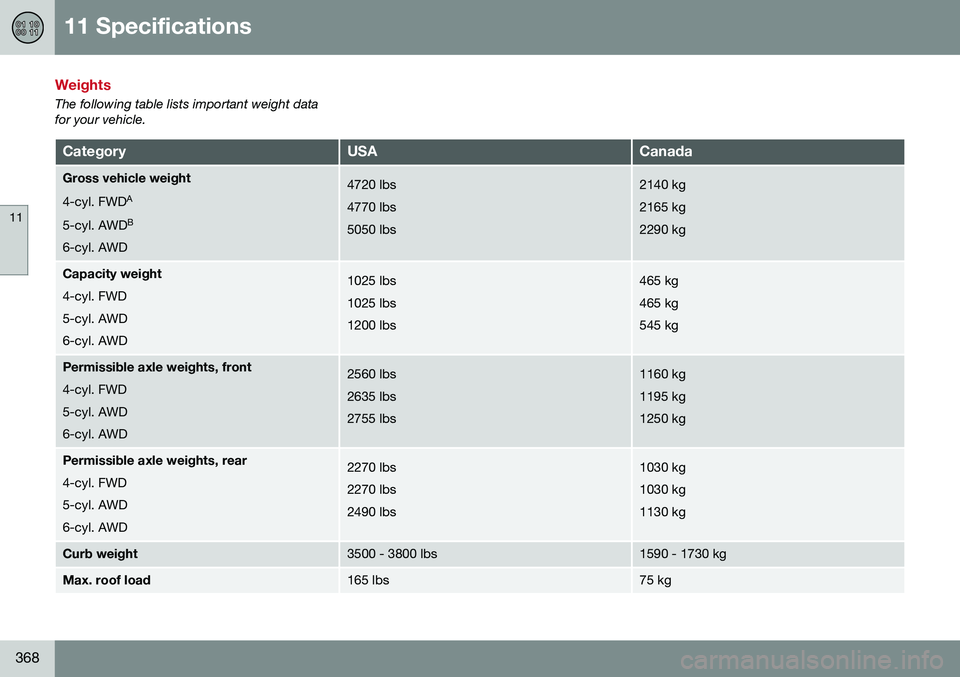
The following table lists important weight data for your vehicle.
CategoryUSACanada
Gross vehicle weight 4-cyl. FWDA
5-cyl. AWD B
6-cyl. AWD4720 lbs 4770 lbs5050 lbs2140 kg 2165 kg2290 kg
Capacity weight 4-cyl. FWD 5-cyl. AWD6-cyl. AWD1025 lbs 1025 lbs1200 lbs465 kg 465 kg545 kg
Permissible axle weights, front 4-cyl. FWD 5-cyl. AWD6-cyl. AWD2560 lbs 2635 lbs2755 lbs1160 kg 1195 kg1250 kg
Permissible axle weights, rear 4-cyl. FWD 5-cyl. AWD6-cyl. AWD2270 lbs 2270 lbs2490 lbs1030 kg 1030 kg1130 kg
Curb weight3500 - 3800 lbs1590 - 1730 kg
Max. roof load165 lbs75 kg
Page 385 of 392
12 Index
12
383
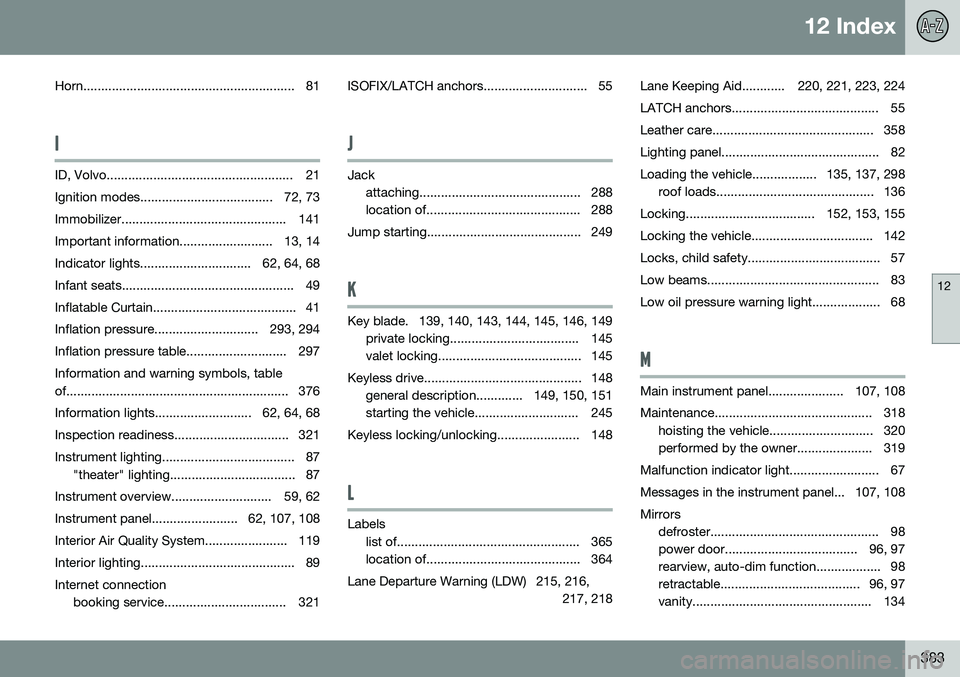
Horn........................................................... 81
I
ID, Volvo.................................................... 21
Ignition modes..................................... 72, 73
Immobilizer.............................................. 141
Important information.......................... 13, 14
Indicator lights............................... 62, 64, 68
Infant seats................................................ 49
Inflatable Curtain........................................ 41
Inflation pressure............................. 293, 294
Inflation pressure table............................ 297Information and warning symbols, table
of.............................................................. 376
Information lights........................... 62, 64, 68
Inspection readiness................................ 321
Instrument lighting..................................... 87
"theater" lighting................................... 87
Instrument overview............................ 59, 62
Instrument panel........................ 62, 107, 108
Interior Air Quality System....................... 119
Interior lighting........................................... 89Internet connection booking service.................................. 321 ISOFIX/LATCH anchors............................. 55
J
Jack
attaching............................................. 288
location of........................................... 288
Jump starting........................................... 249
K
Key blade. 139, 140, 143, 144, 145, 146, 149 private locking.................................... 145
valet locking........................................ 145
Keyless drive............................................ 148 general description............. 149, 150, 151
starting the vehicle............................. 245
Keyless locking/unlocking....................... 148
L
Labels list of................................................... 365
location of........................................... 364
Lane Departure Warning (LDW) 215, 216, 217, 218Lane Keeping Aid............ 220, 221, 223, 224
LATCH anchors......................................... 55
Leather care............................................. 358
Lighting panel............................................ 82
Loading the vehicle.................. 135, 137, 298
roof loads............................................ 136
Locking.................................... 152, 153, 155
Locking the vehicle.................................. 142
Locks, child safety..................................... 57
Low beams................................................ 83
Low oil pressure warning light................... 68
M
Main instrument panel..................... 107, 108
Maintenance............................................ 318 hoisting the vehicle............................. 320
performed by the owner..................... 319
Malfunction indicator light......................... 67
Messages in the instrument panel... 107, 108Mirrors defroster............................................... 98
power door..................................... 96, 97
rearview, auto-dim function.................. 98
retractable....................................... 96, 97
vanity.................................................. 134
Page 386 of 392
12 Index
12
384
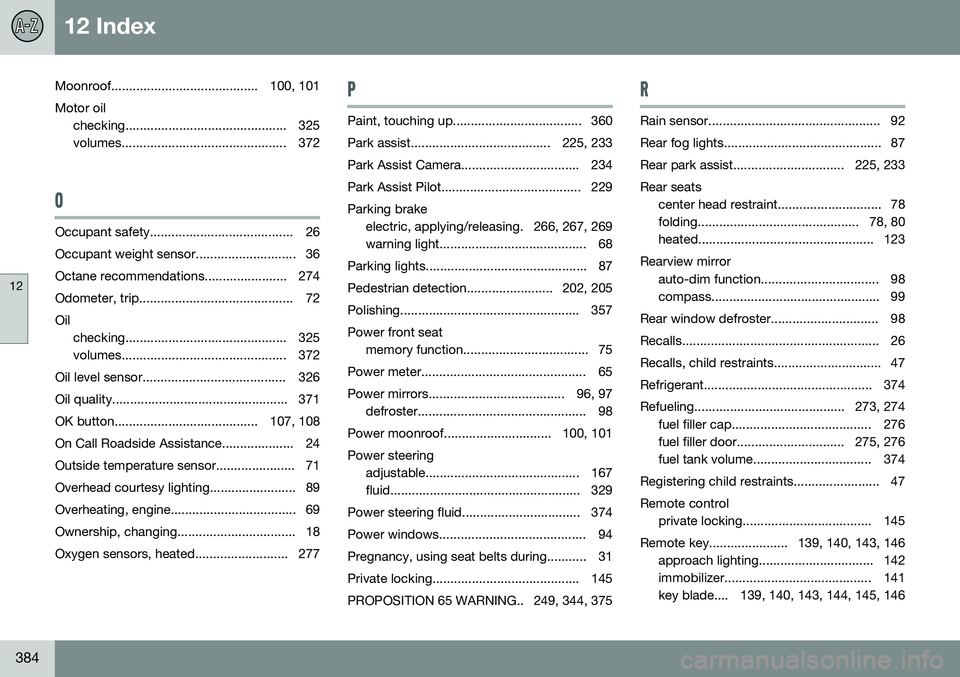
Moonroof......................................... 100, 101Motor oil checking............................................. 325
volumes.............................................. 372
O
Occupant safety........................................ 26
Occupant weight sensor............................ 36
Octane recommendations....................... 274
Odometer, trip........................................... 72Oilchecking............................................. 325
volumes.............................................. 372
Oil level sensor........................................ 326
Oil quality................................................. 371
OK button........................................ 107, 108
On Call Roadside Assistance.................... 24
Outside temperature sensor...................... 71
Overhead courtesy lighting........................ 89
Overheating, engine................................... 69
Ownership, changing................................. 18
Oxygen sensors, heated.......................... 277
P
Paint, touching up.................................... 360
Park assist....................................... 225, 233
Park Assist Camera................................. 234
Park Assist Pilot....................................... 229Parking brake electric, applying/releasing. 266, 267, 269
warning light......................................... 68
Parking lights............................................. 87
Pedestrian detection........................ 202, 205
Polishing.................................................. 357Power front seat memory function................................... 75
Power meter.............................................. 65
Power mirrors...................................... 96, 97 defroster............................................... 98
Power moonroof.............................. 100, 101Power steering adjustable........................................... 167
fluid..................................................... 329
Power steering fluid................................. 374
Power windows......................................... 94
Pregnancy, using seat belts during........... 31
Private locking......................................... 145
PROPOSITION 65 WARNING.. 249, 344, 375
R
Rain sensor................................................ 92
Rear fog lights............................................ 87
Rear park assist............................... 225, 233Rear seats center head restraint............................. 78
folding............................................. 78, 80
heated................................................. 123
Rearview mirror auto-dim function................................. 98
compass............................................... 99
Rear window defroster.............................. 98
Recalls....................................................... 26
Recalls, child restraints.............................. 47
Refrigerant............................................... 374
Refueling.......................................... 273, 274 fuel filler cap....................................... 276
fuel filler door.............................. 275, 276
fuel tank volume................................. 374
Registering child restraints........................ 47 Remote control private locking.................................... 145
Remote key...................... 139, 140, 143, 146 approach lighting................................ 142
immobilizer......................................... 141
key blade.... 139, 140, 143, 144, 145, 146