parking brake VOLVO S60 2016 Owner´s Manual
[x] Cancel search | Manufacturer: VOLVO, Model Year: 2016, Model line: S60, Model: VOLVO S60 2016Pages: 392, PDF Size: 10.04 MB
Page 313 of 392
09 Wheels and tires
09
* Option/accessory, for more information, see Introduction.311
WARNING
• After using the tire sealing system, the vehicle should not be driven fartherthan approximately 120 miles (200km).
• Have the tire inspected by a trainedand qualified Volvo service technicianas soon as possible to determine if itcan be permanently repaired or mustbe replaced.
• The vehicle should not be driven fasterthan 50 mph (80 km/h) while using atire that has been temporarily repairedwith the tire sealing system.
• After using the tire sealing system,drive carefully and avoid abrupt steer-ing maneuvers and sudden stops.
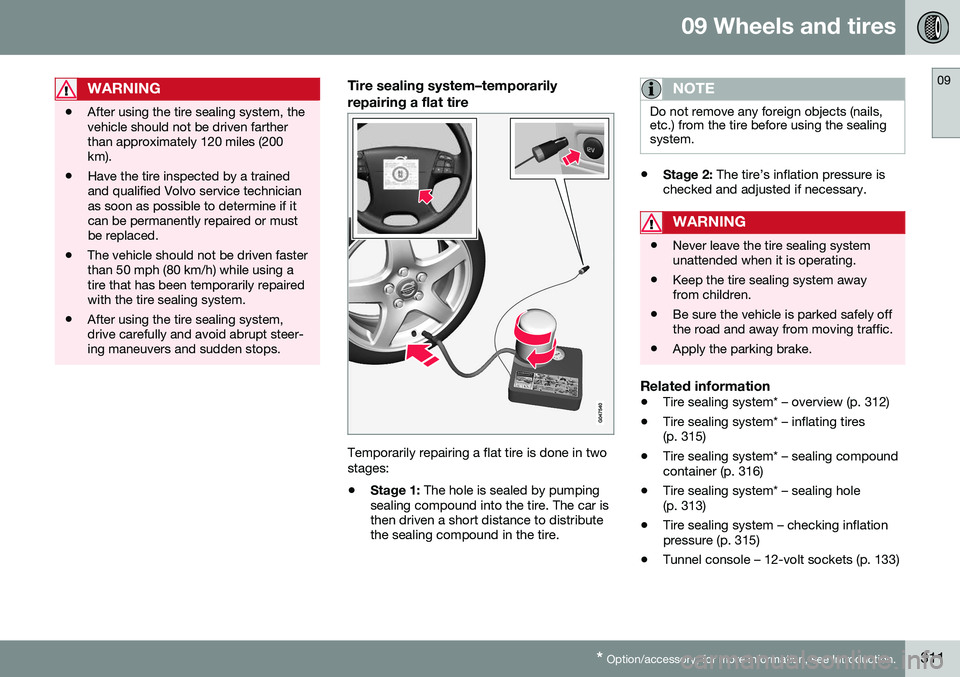
Tire sealing system–temporarily repairing a flat tire
Temporarily repairing a flat tire is done in two stages:
• Stage 1:
The hole is sealed by pumping
sealing compound into the tire. The car is then driven a short distance to distributethe sealing compound in the tire.
NOTE
Do not remove any foreign objects (nails, etc.) from the tire before using the sealingsystem.
• Stage 2:
The tire’s inflation pressure is
checked and adjusted if necessary.
WARNING
• Never leave the tire sealing system unattended when it is operating.
• Keep the tire sealing system awayfrom children.
• Be sure the vehicle is parked safely offthe road and away from moving traffic.
• Apply the parking brake.
Related information
•
Tire sealing system* – overview (p. 312)
• Tire sealing system* – inflating tires (p. 315)
• Tire sealing system* – sealing compoundcontainer (p. 316)
• Tire sealing system* – sealing hole(p. 313)
• Tire sealing system – checking inflationpressure (p. 315)
• Tunnel console – 12-volt sockets (p. 133)
Page 317 of 392

09 Wheels and tires
09
}}
* Option/accessory, for more information, see Introduction.315
Tire sealing system – checking inflation pressure
The tire sealing system can also be used to check the tires' inflation pressure.
Stage 2: Checking inflation pressure1. Connect the tire sealing system as
described in stage 1, see Tire sealing
system* – sealing hole (p. 313).
2. Refer to the inflation pressure table in this chapter for the correct inflation pressure.If the tire needs to be inflated, start thetire sealing system’s compressor. If nec-essary, release air from the tire by turningthe air release knob counterclockwise.
CAUTION
The compressor should not be used for more than 10 minutes at a time to avoidoverheating.
WARNING
If you interrupt your trip for more than 1 hour, check the inflation pressure in thedamaged tire again before continuing.
Tire sealing system* – inflating tires
The tire sealing system can be used to inflate the tires. To do so:
1. Park the car in a safe place.
2. The compressor should be switched off.Ensure that the on/off switch is in position0 (the 0 side of the switch should be
pressed down).
3. Take out the electrical wire and hose.
4. Remove the valve cap from the tire’s inflation valve and screw the hose con- nector onto the valve as tightly as possi-ble by hand.
5. Connect the electrical wire to the nearest 12-volt socket in the vehicle.
6. Start the vehicle’s engine.WARNING
• The vehicle’s engine should be running when the tire sealing system is used toavoid battery drain. Therefore, be surethe vehicle is parked in a well ventilatedplace, or outdoors, before using thesystem. The parking brake should besecurely applied and the gear selectorshould be in the
P (park) position.
• Children should never be left unatten-ded in the vehicle when the engine isrunning.
7. Check the tire’s inflation pressure on the
gauge. Switch off the compressor briefly to get a clear reading from the pressuregauge.
8. Refer to the tire inflation table in this chapter for the correct inflation pressure.If the tire needs to be inflated, start thetire sealing system’s compressor (pressthe on/off switch to position I). If neces-sary, release air from the tire by turningthe air release knob counterclockwise.
Page 337 of 392
10 Maintenance and servicing
10
335
Related information
•Bulbs – specifications (p. 337)
Bulbs – location of taillight bulbs
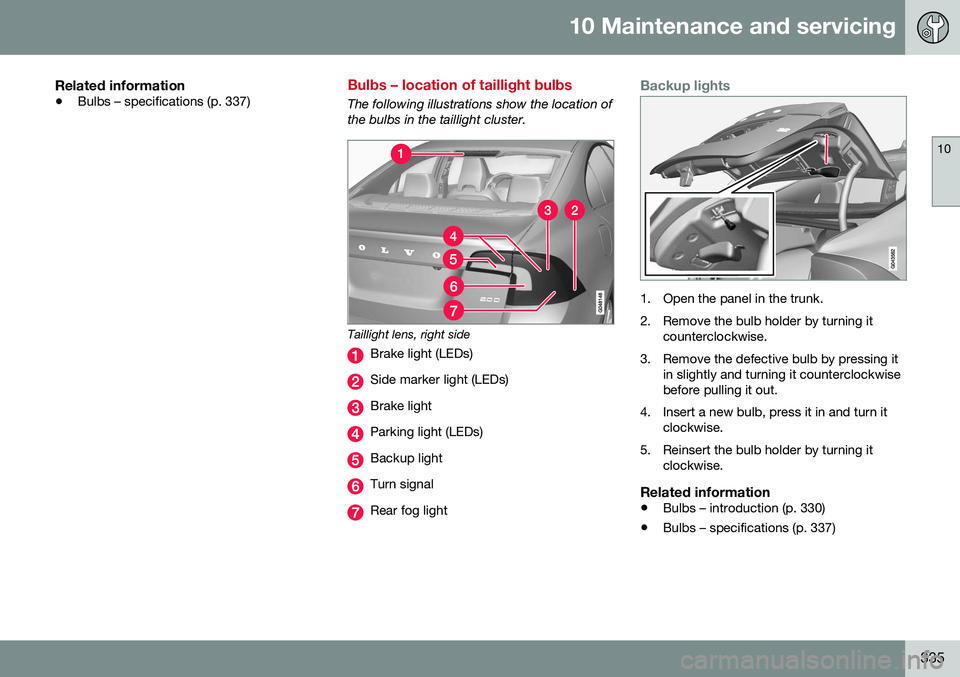
The following illustrations show the location of the bulbs in the taillight cluster.
Taillight lens, right side
Brake light (LEDs)
Side marker light (LEDs)
Brake light
Parking light (LEDs)
Backup light
Turn signal
Rear fog light
Backup lights
1. Open the panel in the trunk.
2. Remove the bulb holder by turning it
counterclockwise.
3. Remove the defective bulb by pressing it in slightly and turning it counterclockwise before pulling it out.
4. Insert a new bulb, press it in and turn it clockwise.
5. Reinsert the bulb holder by turning it clockwise.
Related information
• Bulbs – introduction (p. 330)
• Bulbs – specifications (p. 337)
Page 355 of 392
10 Maintenance and servicing
10
* Option/accessory, for more information, see Introduction.353
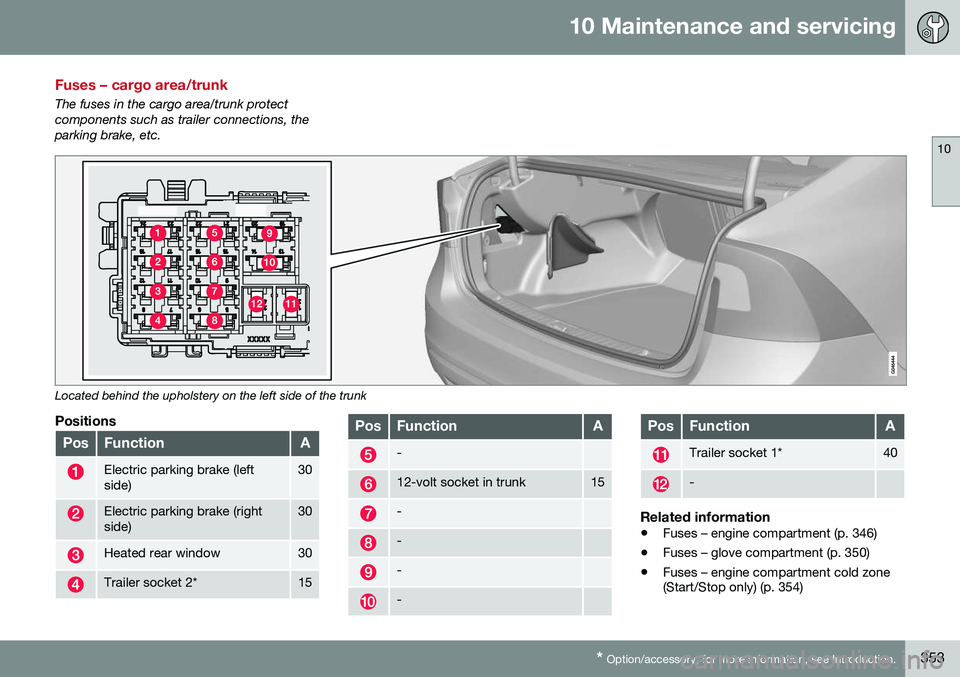
Fuses – cargo area/trunk
The fuses in the cargo area/trunk protect components such as trailer connections, theparking brake, etc.
Located behind the upholstery on the left side of the trunk
Positions
PosFunctionA
Electric parking brake (left side)30
Electric parking brake (right side)30
Heated rear window30
Trailer socket 2*15
PosFunctionA
-
12-volt socket in trunk15
-
-
-
-
PosFunctionA
Trailer socket 1*40
-
Related information
• Fuses – engine compartment (p. 346)
• Fuses – glove compartment (p. 350)
• Fuses – engine compartment cold zone (Start/Stop only) (p. 354)
Page 359 of 392
10 Maintenance and servicing
10
}}
357
Automatic car wash
The vehicle should be washed at regular inter- vals since dirt, dust, insects and tar spotsadhere to the paint and may cause damage.To help prevent corrosion, it is particularlyimportant to wash the car frequently in thewintertime.• We do NOT recommend washing your car in an automatic wash during the firstfew months (because the paint will nothave hardened sufficiently).
• An automatic wash is a simple and quickway to clean your car, but it is worthremembering that it may not be as thor-ough as when you yourself go over thecar with sponge and water. Keeping theunderbody clean is most important, espe-cially in the winter. Some automaticwashers do not have facilities for washingthe underbody.
NOTE
Condensation may form temporarily on the inside of the lenses of exterior lights suchas headlights, fog lights, or taillights. Thisis normal and the lights are designed towithstand moisture. Normally, condensa-tion will dissipate after the lights have beenon for a short time.
CAUTION
• Before driving into an automatic car wash, turn off the optional rain sensorto avoid damaging the windshield wip-ers.
• Make sure that side view mirrors, aux-iliary lamps, etc, are secure, and thatany antenna(s) are retracted orremoved. Otherwise there is risk of themachine dislodging them.
• Chromed wheels:
Clean chrome-
plated wheels using the same deter-gents used for the body of the vehicle.Aggressive wheel-cleaning agents canpermanently stain chrome-platedwheels.
WARNING
• When the vehicle is driven immediately after being washed, apply the brakes,including the parking brake, severaltimes in order to remove any moisturefrom the brake linings.
• Engine cleaning agents should not beused when the engine is warm. Thisconstitutes a fire risk.
Related information
•
Polishing and waxing (p. 357)
• Cleaning the interior (p. 358)
• Washing the car (p. 356)
Polishing and waxing
Normally, polishing is not required during the first year after delivery, however, waxing maybe beneficial.
• Before applying polish or wax the vehicle must be washed and dried. Tar spots canbe removed with kerosene or tar remover.Difficult spots may require a fine rubbingcompound.
• After polishing use liquid or paste wax.
• Several commercially available productscontain both polish and wax.
• Waxing alone does not substitute for pol-ishing a dull surface.
• A wide range of polymer-based waxescan be purchased today. These waxesare easy to use and produce a long-last-ing, high-gloss finish that protects thebodywork against oxidation, road dirt andfading.
• Do not polish or wax your vehicle in directsunlight (the surface of the vehicle shouldnot be warmer than 113 °F (45 °C).
Page 379 of 392
11 Specifications
11
* Option/accessory, for more information, see Introduction.377
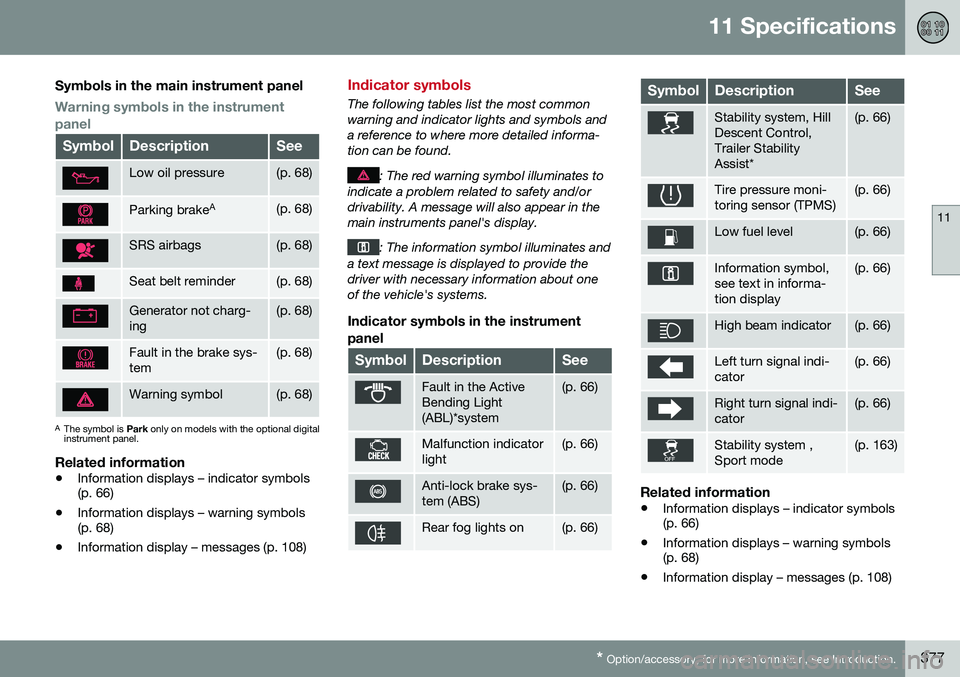
Symbols in the main instrument panel
Warning symbols in the instrument panel
SymbolDescriptionSee
Low oil pressure(p. 68)
Parking brake A(p. 68)
SRS airbags(p. 68)
Seat belt reminder(p. 68)
Generator not charg- ing(p. 68)
Fault in the brake sys- tem(p. 68)
Warning symbol(p. 68)
A
The symbol is Park only on models with the optional digital
instrument panel.
Related information
• Information displays – indicator symbols (p. 66)
• Information displays – warning symbols(p. 68)
• Information display – messages (p. 108)
Indicator symbols
The following tables list the most common warning and indicator lights and symbols anda reference to where more detailed informa-tion can be found.
: The red warning symbol illuminates to
indicate a problem related to safety and/or drivability. A message will also appear in themain instruments panel's display.
: The information symbol illuminates and
a text message is displayed to provide the driver with necessary information about oneof the vehicle's systems.
Indicator symbols in the instrument
panel
SymbolDescriptionSee
Fault in the Active Bending Light(ABL)*system(p. 66)
Malfunction indicator light(p. 66)
Anti-lock brake sys- tem (ABS)(p. 66)
Rear fog lights on(p. 66)
SymbolDescriptionSee
Stability system, Hill Descent Control,Trailer StabilityAssist*(p. 66)
Tire pressure moni- toring sensor (TPMS)(p. 66)
Low fuel level(p. 66)
Information symbol, see text in informa-tion display(p. 66)
High beam indicator(p. 66)
Left turn signal indi- cator(p. 66)
Right turn signal indi- cator(p. 66)
Stability system , Sport mode(p. 163)
Related information
• Information displays – indicator symbols (p. 66)
• Information displays – warning symbols(p. 68)
• Information display – messages (p. 108)
Page 380 of 392
11 Specifications
11
378* Option/accessory, for more information, see Introduction.
Information symbols
The following tables list the most common warning and indicator lights and symbols anda reference to where more detailed informa-tion can be found.
: The red warning symbol illuminates to
indicate a problem related to safety and/or drivability. A message will also appear in themain instruments panel's display.
: The information symbol illuminates and
a text message is displayed to provide the driver with necessary information about oneof the vehicle's systems.
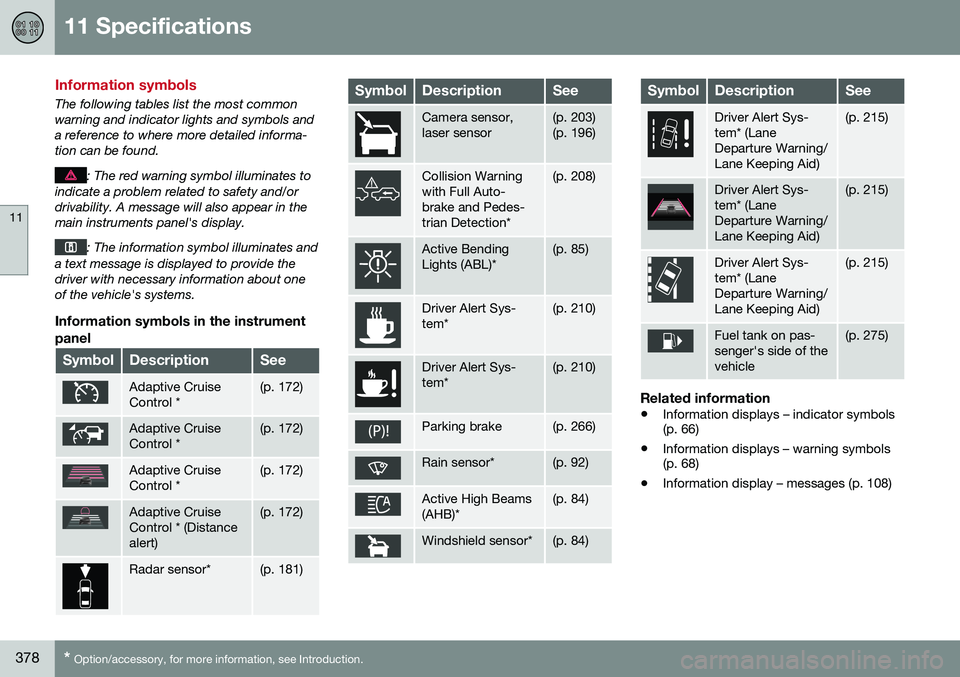
Information symbols in the instrument
panel
SymbolDescriptionSee
Adaptive Cruise Control *(p. 172)
Adaptive Cruise Control *(p. 172)
Adaptive Cruise Control *(p. 172)
Adaptive Cruise Control * (Distancealert)(p. 172)
Radar sensor*(p. 181)
SymbolDescriptionSee
Camera sensor, laser sensor(p. 203) (p. 196)
Collision Warning with Full Auto-brake and Pedes-trian Detection*(p. 208)
Active Bending Lights (ABL)*(p. 85)
Driver Alert Sys- tem*(p. 210)
Driver Alert Sys- tem*(p. 210)
Parking brake(p. 266)
Rain sensor*(p. 92)
Active High Beams (AHB)*(p. 84)
Windshield sensor*(p. 84)
SymbolDescriptionSee
Driver Alert Sys- tem* (LaneDeparture Warning/Lane Keeping Aid)(p. 215)
Driver Alert Sys- tem* (LaneDeparture Warning/Lane Keeping Aid)(p. 215)
Driver Alert Sys- tem* (LaneDeparture Warning/Lane Keeping Aid)(p. 215)
Fuel tank on pas- senger's side of thevehicle(p. 275)
Related information
• Information displays – indicator symbols (p. 66)
• Information displays – warning symbols(p. 68)
• Information display – messages (p. 108)
Page 383 of 392
12 Index
12
381
ISOFIX/LATCH anchors........................ 55
top tether anchors................................ 56
Child safety................................................ 46 booster cushions.................................. 54
child restraint systems.......................... 47
convertible seats.................................. 51
infant seats........................................... 49
Child safety locks...................................... 57
City safety........................................ 190, 191
Climate system........................................ 125 air distribution..................... 121, 126, 128
air vents.............................................. 121
Interior Air Quality System.................. 119
introduction......................................... 118
passenger compartment filter............ 119
refrigerant........................................... 118
Clock, setting............................................. 72
Cold weather driving................................ 272
Collision warning system.. 197, 199, 202, 203, 205, 206
Compass in rearview mirror....................... 99
Connected service booking..................... 321
Conserving electrical current................... 271
Convertible seats....................................... 51
Coolant............................................ 327, 373
Cooling system, general information....... 271
Corner traction control............................. 163 Courtesy lighting........................................ 89
Crash event data....................................... 18
Crash mode......................................... 44, 45
Cruise control.................................. 169, 171
adaptive.............................................. 172
Curb weight............................................. 298
Current, conserving................................. 271
Cyclist detection.............................. 201, 205
D
Daytime running lights............................... 82
Defroster.................................................. 125
Detachable key blade...................... 144, 145Disconnecting the front passenger’s air-
bag............................................................. 36
Distance Alert.......................................... 186
Dome lighting............................................. 89
Door mirrors......................................... 96, 97
Driver alert....................... 210, 211, 212, 213 Lane Departure Warning..... 215, 216,
217, 218Lane Keeping Aid....... 220, 221, 223, 224
Driver distraction warning.......................... 23
Driving economically................................ 277 Driving in cold weather............................ 272
Driving through water.............................. 270
E
ECC................................................. 123, 124
Eco (driving function)............................... 260
Eco coast................................................. 260
Eco guide................................................... 65
Economical driving.................................. 277
Electrically heated steering wheel............. 82
Electrical sockets..................................... 133
Electric parking brake.............. 266, 267, 269
Electronic Climate Control............... 122, 124
air distribution table............................ 128
Interior Air Quality System.................. 120
Electronic oil level sensor........................ 326
Electronic stability control....................... 162
Emergency locking retractor...................... 47
Emergency starting.................................. 249
Emergency towing................... 281, 282, 283
Emission inspection readiness................ 321Engine overheating........................................... 69
specifications...................................... 370
Page 386 of 392
12 Index
12
384
Moonroof......................................... 100, 101Motor oil checking............................................. 325
volumes.............................................. 372
O
Occupant safety........................................ 26
Occupant weight sensor............................ 36
Octane recommendations....................... 274
Odometer, trip........................................... 72Oilchecking............................................. 325
volumes.............................................. 372
Oil level sensor........................................ 326
Oil quality................................................. 371
OK button........................................ 107, 108
On Call Roadside Assistance.................... 24
Outside temperature sensor...................... 71
Overhead courtesy lighting........................ 89
Overheating, engine................................... 69
Ownership, changing................................. 18
Oxygen sensors, heated.......................... 277
P
Paint, touching up.................................... 360
Park assist....................................... 225, 233
Park Assist Camera................................. 234
Park Assist Pilot....................................... 229Parking brake electric, applying/releasing. 266, 267, 269
warning light......................................... 68
Parking lights............................................. 87
Pedestrian detection........................ 202, 205
Polishing.................................................. 357Power front seat memory function................................... 75
Power meter.............................................. 65
Power mirrors...................................... 96, 97 defroster............................................... 98
Power moonroof.............................. 100, 101Power steering adjustable........................................... 167
fluid..................................................... 329
Power steering fluid................................. 374
Power windows......................................... 94
Pregnancy, using seat belts during........... 31
Private locking......................................... 145
PROPOSITION 65 WARNING.. 249, 344, 375
R
Rain sensor................................................ 92
Rear fog lights............................................ 87
Rear park assist............................... 225, 233Rear seats center head restraint............................. 78
folding............................................. 78, 80
heated................................................. 123
Rearview mirror auto-dim function................................. 98
compass............................................... 99
Rear window defroster.............................. 98
Recalls....................................................... 26
Recalls, child restraints.............................. 47
Refrigerant............................................... 374
Refueling.......................................... 273, 274 fuel filler cap....................................... 276
fuel filler door.............................. 275, 276
fuel tank volume................................. 374
Registering child restraints........................ 47 Remote control private locking.................................... 145
Remote key...................... 139, 140, 143, 146 approach lighting................................ 142
immobilizer......................................... 141
key blade.... 139, 140, 143, 144, 145, 146