roof VOLVO S60 2018 Owner´s Manual
[x] Cancel search | Manufacturer: VOLVO, Model Year: 2018, Model line: S60, Model: VOLVO S60 2018Pages: 396, PDF Size: 9.4 MB
Page 140 of 396
LOADING AND STORAGE
138
Loading – general
The load carrying capacity of your vehicle is determined by factors such as the number ofpassengers, the amount of cargo, the weight ofany accessories that may be installed, etc.
To increase loading space, the rear seat back- rests can be folded down, see Rear seats – fold-
ing backrest (p. 81).
When loading the trunk, keep the following in
mind:
The trunk lid can be unlocked an pop-ped open slightly via the button locatedon the lighting panel, see Locking/
unlocking – trunk (p. 160).
• Load objects in the trunk against the back- rest whenever possible.
• Unstable loads can be secured to the loadanchoring eyelets with straps or web lash-ings to help keep them from shifting.
• Stop the engine and apply the parking brakewhen loading or unloading long objects. Thegear selector can be knocked out of positionby long loads, which could set the vehicle inmotion.
WARNING
• Stop the engine, put the gear selector in P
, and apply the parking brake when
loading or unloading long objects.
• The vehicle's driving characteristics may change depending on the weight and dis-tribution of the load.
• A 44-pound (20 kg) object produces aforce of 2,200 pounds (1,000 kg) in ahead-on collision at 30 mph (50 km/h).
• The rear seat should not be loaded to alevel higher than 2 in. (5 cm) below theupper edge of the rear side windows.Objects placed higher than this levelcould impede the function of the VolvoInflatable Curtain.
Related information
• Load anchoring eyelets (p. 140)
• Loading – roof load carriers (p. 139)
Ski hatch
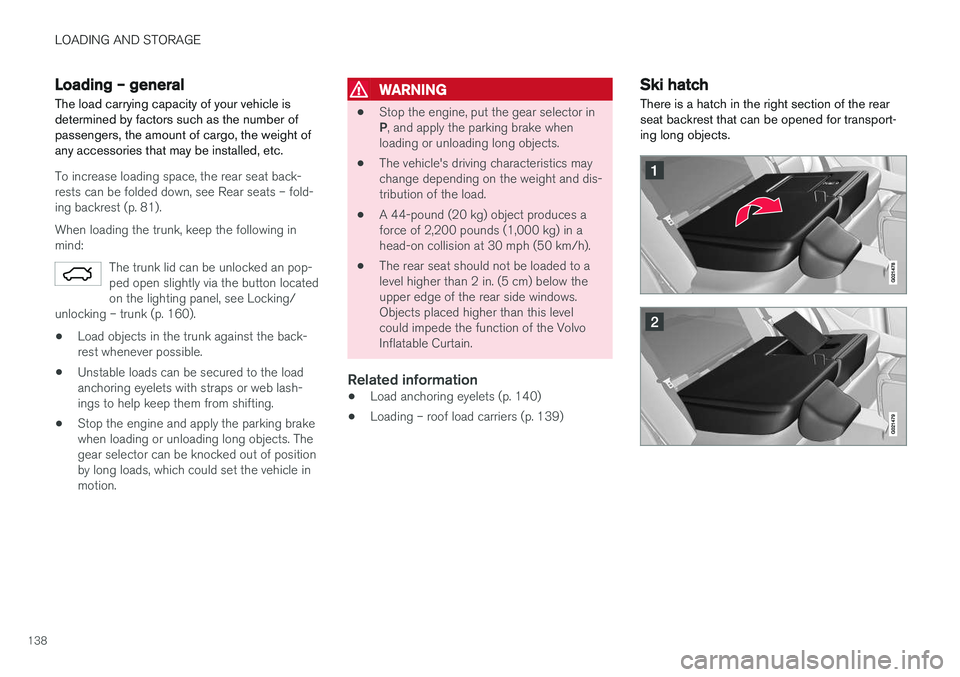
There is a hatch in the right section of the rear seat backrest that can be opened for transport-ing long objects.
Page 141 of 396
LOADING AND STORAGE
}}
139
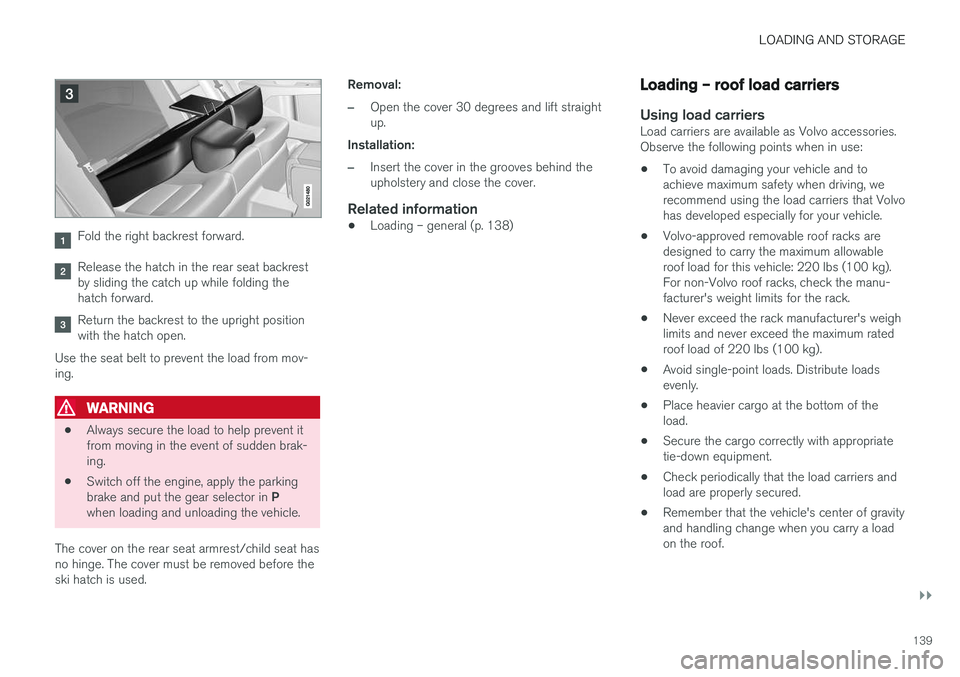
Fold the right backrest forward.
Release the hatch in the rear seat backrest by sliding the catch up while folding thehatch forward.
Return the backrest to the upright position with the hatch open.
Use the seat belt to prevent the load from mov-ing.
WARNING
• Always secure the load to help prevent it from moving in the event of sudden brak-ing.
• Switch off the engine, apply the parking brake and put the gear selector in
P
when loading and unloading the vehicle.
The cover on the rear seat armrest/child seat has no hinge. The cover must be removed before theski hatch is used. Removal:
–Open the cover 30 degrees and lift straight up.
Installation:
–Insert the cover in the grooves behind the upholstery and close the cover.
Related information
• Loading – general (p. 138)
Loading – roof load carriers
Using load carriersLoad carriers are available as Volvo accessories. Observe the following points when in use:
• To avoid damaging your vehicle and toachieve maximum safety when driving, werecommend using the load carriers that Volvohas developed especially for your vehicle.
• Volvo-approved removable roof racks aredesigned to carry the maximum allowableroof load for this vehicle: 220 lbs (100 kg).For non-Volvo roof racks, check the manu-facturer's weight limits for the rack.
• Never exceed the rack manufacturer's weighlimits and never exceed the maximum ratedroof load of 220 lbs (100 kg).
• Avoid single-point loads. Distribute loadsevenly.
• Place heavier cargo at the bottom of theload.
• Secure the cargo correctly with appropriatetie-down equipment.
• Check periodically that the load carriers andload are properly secured.
• Remember that the vehicle's center of gravityand handling change when you carry a loadon the roof.
Page 284 of 396
||
STARTING AND DRIVING
* Option/accessory.
282 nents, altering emission system components or location or removing components, and/orrepeated use of leaded fuel.
NOTE
Unleaded fuel is required for vehicles with three-way catalytic converters.
Heated oxygen sensorsThe heated oxygen sensors monitor the oxygen content of the exhaust gases. Readings are fedinto a control module that continuously monitorsengine functions and controls fuel injection. Theratio of fuel to air into the engine is continuouslyadjusted for efficient combustion to help reduceharmful emissions.
Related information
•
Information displays – warning symbols(p. 69)
• Engine and cooling system (p. 275)
Economical driving
Better driving economy may be obtained by thinking ahead, avoiding rapid starts and stopsand adjusting the speed of your vehicle to imme-diate traffic conditions.
Economical driving conserves natural
resources
Observe the following rules: • Bring the engine to normal operating tem- perature as soon as possible by driving witha light foot on the accelerator pedal for thefirst few minutes of operation. A cold engineuses more fuel and is subject to increasedwear.
• Whenever possible, avoid using the vehiclefor driving short distances. This does notallow the engine to reach normal operatingtemperature.
• Drive carefully and avoid rapid accelerationand hard braking.
• Use the transmission's Drive (
D) position as
often as possible and avoid using kick-down.
• Using the transmission's Sport mode 13
may
increase fuel consumption somewhat. Use the transmission's Drive ( D) position as often
as possible. For additional information about Sport mode, see Transmission – Geartronic(p. 257). •
Using the engine's optional Eco function canhelp improve fuel economy. For additional information, see ECO
* (p. 265).
• Do not exceed posted speed limits.
• Avoid carrying unnecessary items (extra load) in the vehicle.
• Maintain correct tire pressure. Check tirepressure regularly (when tires are cold).
• Remove snow tires when threat of snow orice has ended.
• Note that roof racks, ski racks, etc, increaseair resistance and also fuel consumption.
• At highway driving speeds, fuel consumptionwill be lower with the air conditioning on andthe windows closed than with the air condi-tioning off and the windows open.
• Using the onboard trip computer's fuel con-sumption modes can help you learn how todrive more economically.
Other factors that decrease gas mileage are:
• Dirty air cleaner
• Dirty engine oil and clogged oil filter
• Dragging brakes
• Incorrect front end alignment
13
Certain models only.
Page 356 of 396
||
MAINTENANCE AND SERVICING
* Option/accessory.
354
Pos Function A
Controls in left rear passenger's door20
Keyless drive
* 7.5
Power driver's seat
*20
Power front passenger's seat
*20
-
Infotainment system display 5
Infotainment system: amplifier, Sir- iusXM
™ satellite radio * 10
Sensus control module 15
Bluetooth hands-free system 5
-
Power moonroof
*
Courtesy lighting, climate system sensor 5
12-volt sockets in tunnel console 15
Heated rear seat
* (passenger's
side) 15
Heated rear seat
* (driver's side) 15
Pos
Function A
-
Heated front passenger's seat*15
Heated driver's seat
*15
Park assist
*
Blind Spot Information System (BLIS) *, park assist camera *5
All Wheel Drive
* control module 15
Active chassis system
*10
Positions: fusebox B
Pos
Function A
-
-
Front courtesy lighting, driver's door power window controls, power seat(s)*, 7.5
Instrument panel 5
Adaptive cruise control/collision warning
* 10
Pos
Function A
Courtesy lighting, rain sensor*,
HomeLInk ®
Wireless Control Sys-
tem * 7.5
Steering wheel module 7.5
Cental locking: fuel filler door 10
Electrically heated steering wheel
*15
Electrically heated windshield
*15
Trunk open 10
Electrical folding rear seat out- board head restraints
*10
Fuel pump 20
Climate system control panel 5
-
Alarm, On-board diagnostic sys- tem
5
Satellite radio
*, audio system
amplifier 10
Airbag system, occupant weight sensor
10
Collision warning system
*5
Page 357 of 396
MAINTENANCE AND SERVICING
* Option/accessory.355
PosFunction A
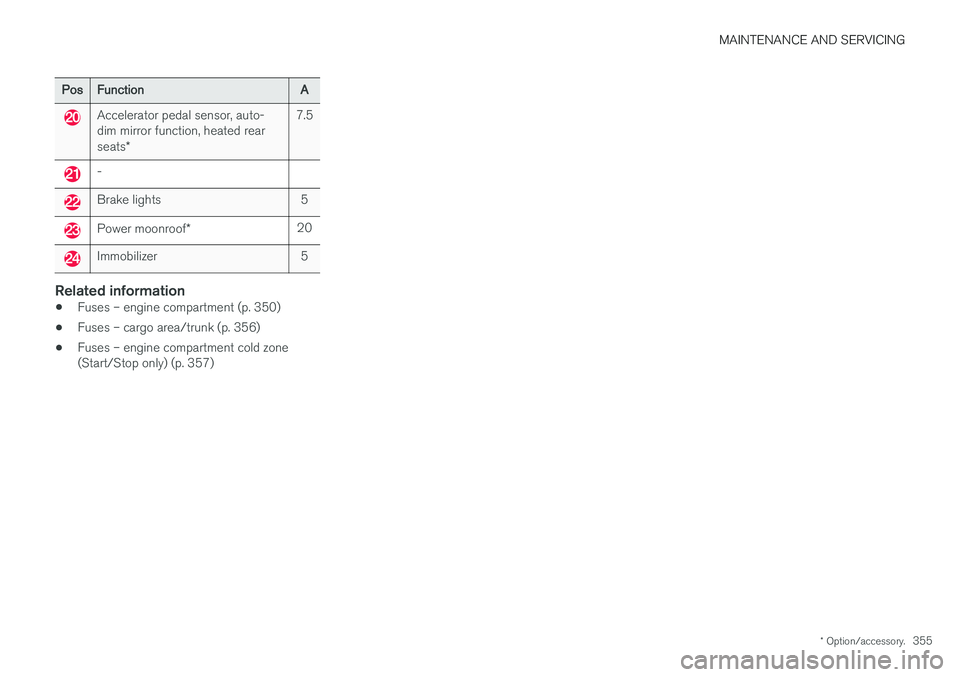
Accelerator pedal sensor, auto- dim mirror function, heated rear seats* 7.5
-
Brake lights 5
Power moonroof
* 20
Immobilizer 5
Related information
•Fuses – engine compartment (p. 350)
• Fuses – cargo area/trunk (p. 356)
• Fuses – engine compartment cold zone (Start/Stop only) (p. 357)
Page 361 of 396
MAINTENANCE AND SERVICING
}}
* Option/accessory.359
Washing the vehicle
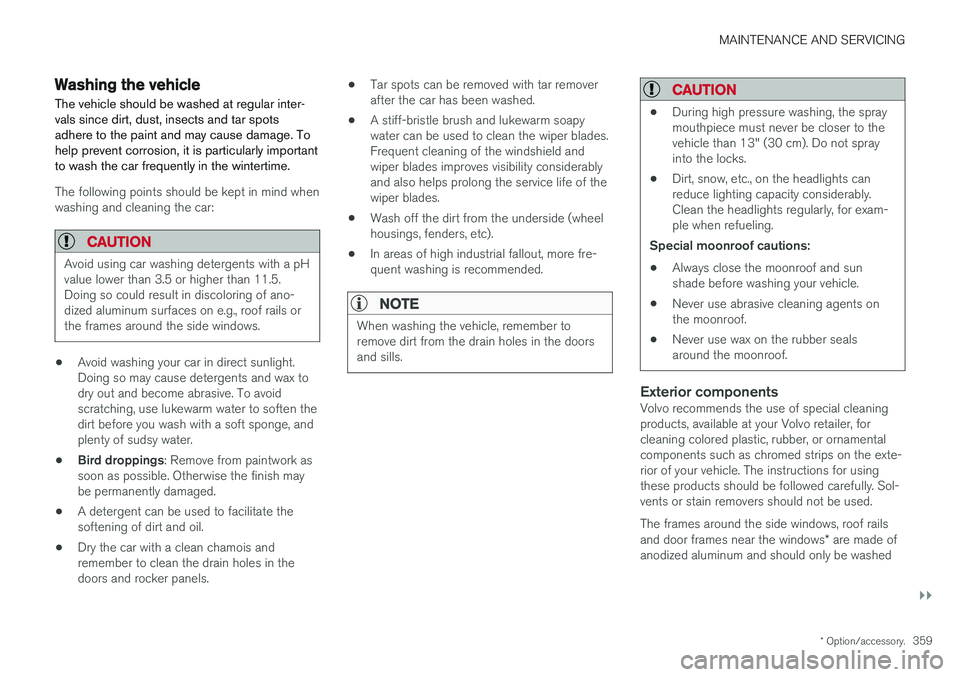
The vehicle should be washed at regular inter- vals since dirt, dust, insects and tar spotsadhere to the paint and may cause damage. Tohelp prevent corrosion, it is particularly importantto wash the car frequently in the wintertime.
The following points should be kept in mind when washing and cleaning the car:
CAUTION
Avoid using car washing detergents with a pH value lower than 3.5 or higher than 11.5.Doing so could result in discoloring of ano-dized aluminum surfaces on e.g., roof rails orthe frames around the side windows.
• Avoid washing your car in direct sunlight. Doing so may cause detergents and wax todry out and become abrasive. To avoidscratching, use lukewarm water to soften thedirt before you wash with a soft sponge, andplenty of sudsy water.
• Bird droppings
: Remove from paintwork as
soon as possible. Otherwise the finish maybe permanently damaged.
• A detergent can be used to facilitate thesoftening of dirt and oil.
• Dry the car with a clean chamois andremember to clean the drain holes in thedoors and rocker panels. •
Tar spots can be removed with tar removerafter the car has been washed.
• A stiff-bristle brush and lukewarm soapywater can be used to clean the wiper blades.Frequent cleaning of the windshield andwiper blades improves visibility considerablyand also helps prolong the service life of thewiper blades.
• Wash off the dirt from the underside (wheelhousings, fenders, etc).
• In areas of high industrial fallout, more fre-quent washing is recommended.
NOTE
When washing the vehicle, remember to remove dirt from the drain holes in the doorsand sills.
CAUTION
•
During high pressure washing, the spray mouthpiece must never be closer to thevehicle than 13" (30 cm). Do not sprayinto the locks.
• Dirt, snow, etc., on the headlights canreduce lighting capacity considerably.Clean the headlights regularly, for exam-ple when refueling.
Special moonroof cautions:
• Always close the moonroof and sunshade before washing your vehicle.
• Never use abrasive cleaning agents onthe moonroof.
• Never use wax on the rubber sealsaround the moonroof.
Exterior componentsVolvo recommends the use of special cleaning products, available at your Volvo retailer, forcleaning colored plastic, rubber, or ornamentalcomponents such as chromed strips on the exte-rior of your vehicle. The instructions for usingthese products should be followed carefully. Sol-vents or stain removers should not be used. The frames around the side windows, roof rails and door frames near the windows
* are made of
anodized aluminum and should only be washed
Page 373 of 396
SPECIFICATIONS
}}
371
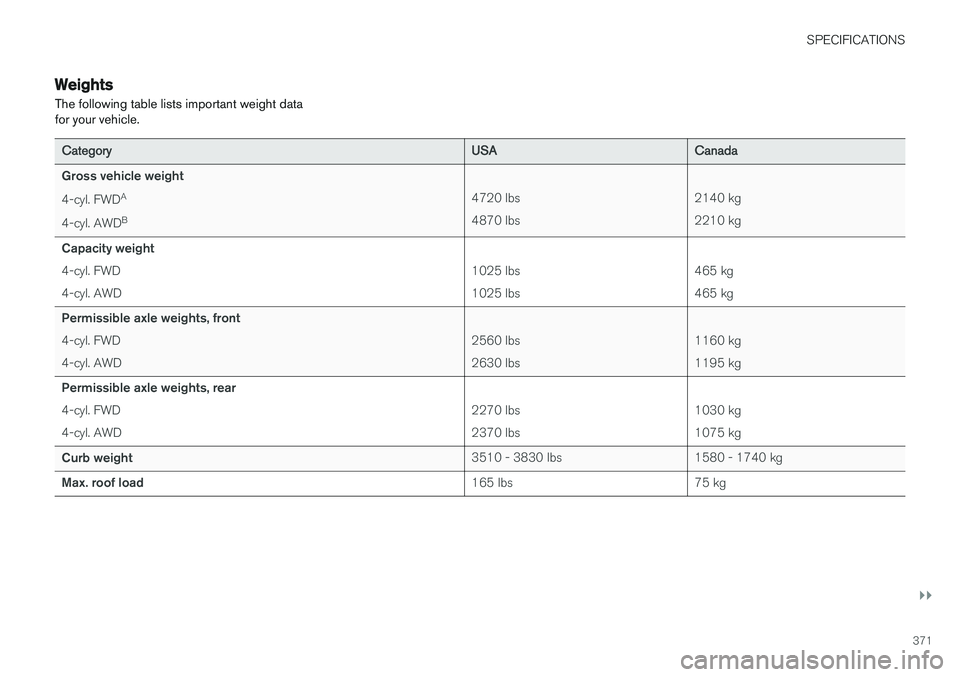
Weights The following table lists important weight data for your vehicle.
CategoryUSACanada
Gross vehicle weight 4-cyl. FWD A
4-cyl. AWD B 4720 lbs 4870 lbs2140 kg2210 kg
Capacity weight 4-cyl. FWD 4-cyl. AWD 1025 lbs1025 lbs465 kg465 kg
Permissible axle weights, front 4-cyl. FWD 4-cyl. AWD 2560 lbs2630 lbs1160 kg1195 kg
Permissible axle weights, rear 4-cyl. FWD 4-cyl. AWD 2270 lbs2370 lbs1030 kg1075 kg
Curb weight 3510 - 3830 lbs 1580 - 1740 kg
Max. roof load 165 lbs 75 kg
Page 390 of 396
INDEX
388Horn
82
I
ID, Volvo 20
Ignition modes 73, 74
Immobilizer 146
Important information 13
Indicator lights 63, 65, 69
Infant seats 49
Inflatable Curtain 41
Inflation pressure 298, 299
Inflation pressure table 378
Information and warning symbols, table of 379
Information lights 63, 65, 69
Inspection readiness 325
Instrument lighting 88
"theater" lighting 88
Instrument overview 60, 63
Instrument panel 63, 108, 109
Interior Air Quality System 121
Interior lighting 91Internet connection booking service 325
ISOFIX/LATCH anchors 55
J
Jack attaching 293
location of 293
Jump starting 254
K
Key blade 144, 145, 146, 148, 149, 150, 151, 154
private locking 150
valet locking 150
Keyless drive 153 general description 155, 156
starting the vehicle 250
Keyless locking/unlocking 153
L
Labels list of 367
location of 367
Lane Departure Warning (LDW) 220, 221, 222, 223
Lane Keeping Aid 225, 226, 228, 229
LATCH anchors 55
Leather care 362
Lighting panel 83
Loading the vehicle 138, 140, 302 roof loads 139
Locking 157, 158, 160
Locking the vehicle 147
Locks, child safety 58
Low beams 84
Low coolant level 332
Low oil pressure warning light 69
M
Main instrument panel 108, 109
Maintenance 322 hoisting the vehicle 324
performed by the owner 323
Malfunction indicator light 68
Messages in the instrument panel 108, 109Mirrors defroster 99
power door 97, 98
rearview, auto-dim function 99
retractable 97, 98
vanity 137
Moonroof 101, 102
Page 391 of 396
INDEX
389
Motor oil
checking 329
volumes 375
O
Occupant safety 26
Occupant weight sensor 36
Octane recommendations 278
Odometer, trip 73Oil checking 329
volumes 375
Oil level sensor 330
Oil quality 374
OK button 108, 109
Option/accessory 13
Outside temperature sensor 72
Overhead courtesy lighting 91
Overheating, engine 70
Ownership, changing 17
Oxygen sensors, heated 281
P
Paint, touching up 363
Park assist 230, 238
Park Assist Camera 239
Park Assist Pilot 234Parking brake electric, applying/releasing 271, 272, 274
warning light 69
Parking lights 88
Pedestrian detection 206, 209
Polishing 361Power front seat memory function 76
Power meter 66
Power mirrors 97, 98 defroster 99
Power moonroof 101, 102Power steering adjustable 170
fluid 333
Power steering fluid 377
Power windows 96
Pregnancy, using seat belts during 31
Private locking 150
PROPOSITION 65 WARNING 254, 348, 379
R
Rain sensor 94
Rear fog lights 89
Rear park assist 230, 238Rear seats center head restraint 79
folding 79, 81
heated 126
Rearview mirror auto-dim function 99
compass 100
Rear window defroster 99
Recalls 26
Recalls, child restraints 47
Refrigerant 379
Refueling 277, 278 fuel filler cap 281
fuel filler door 280, 281
fuel tank volume 377
Registering child restraints 47 Remote control private locking 150
Remote key 144, 145, 146, 148, 151 approach lighting 147
immobilizer 146
Page 392 of 396

INDEX
390key blade 144, 145, 146, 148, 149, 150
, 151
locking the vehicle 147
replacing the battery 152
unlocking the vehicle 147
Reporting safety defects 27
Roadside Assistance 23
Road sign information (RSI) 170
Roof loads 139
S
Safety, occupant 26
Safety defects, reporting 27
Safety mode 44Seat belt reminder 30
Seat belts Automatic locking retractor/Emergency
locking retractor 47
buckling 29
maintenance 29
pretensioners 28
reminder 30
reminder warning light 69
securing child restraint systems 49, 52, 54
unbuckling 29
use during pregnancy 31
using 28
Seats, front 75, 76
Sensus 107Service connected service booking 325
Shiftlock 13 override 259
Side door mirrors 97, 98
Side impact airbags 39
Sign information (RSI) 170
Snow chains 305
Snow tires 305, 306
Spare tire 296
Spin control 166, 167SRS 31
Stability system 166, 167, 168 Corner Traction Control (CTC) 166
Engine Drag Control (EDC) 166
indicator light 68
Start/Stop (engine function) 260, 261, 262, 263, 264
Starting the engine 250 remote start 252
with keyless drive 250Starting the vehicleafter a crash (crash mode) 44, 45
Start inhibitor (immobilizer) 146 Steering wheel adjusting 82
heated 83
horn 82
keypad 82
Steering wheel paddles 82
Stone chips, touching up 363
Storage spaces 134
Studded tires 305, 306
Sunroof (moonroof) 101, 102
Sun shade 96, 97
Supplemental restraint system 31 warning light 69
Symbols, overview 379
T
Tailgate wiper/washer 95
Taillights, changing bulbs 339 Temperature sensor ambient 72
Temporary spare tire 296