brake sensor VOLVO S60 2018 Owner´s Manual
[x] Cancel search | Manufacturer: VOLVO, Model Year: 2018, Model line: S60, Model: VOLVO S60 2018Pages: 396, PDF Size: 9.4 MB
Page 284 of 396
||
STARTING AND DRIVING
* Option/accessory.
282 nents, altering emission system components or location or removing components, and/orrepeated use of leaded fuel.
NOTE
Unleaded fuel is required for vehicles with three-way catalytic converters.
Heated oxygen sensorsThe heated oxygen sensors monitor the oxygen content of the exhaust gases. Readings are fedinto a control module that continuously monitorsengine functions and controls fuel injection. Theratio of fuel to air into the engine is continuouslyadjusted for efficient combustion to help reduceharmful emissions.
Related information
•
Information displays – warning symbols(p. 69)
• Engine and cooling system (p. 275)
Economical driving
Better driving economy may be obtained by thinking ahead, avoiding rapid starts and stopsand adjusting the speed of your vehicle to imme-diate traffic conditions.
Economical driving conserves natural
resources
Observe the following rules: • Bring the engine to normal operating tem- perature as soon as possible by driving witha light foot on the accelerator pedal for thefirst few minutes of operation. A cold engineuses more fuel and is subject to increasedwear.
• Whenever possible, avoid using the vehiclefor driving short distances. This does notallow the engine to reach normal operatingtemperature.
• Drive carefully and avoid rapid accelerationand hard braking.
• Use the transmission's Drive (
D) position as
often as possible and avoid using kick-down.
• Using the transmission's Sport mode 13
may
increase fuel consumption somewhat. Use the transmission's Drive ( D) position as often
as possible. For additional information about Sport mode, see Transmission – Geartronic(p. 257). •
Using the engine's optional Eco function canhelp improve fuel economy. For additional information, see ECO
* (p. 265).
• Do not exceed posted speed limits.
• Avoid carrying unnecessary items (extra load) in the vehicle.
• Maintain correct tire pressure. Check tirepressure regularly (when tires are cold).
• Remove snow tires when threat of snow orice has ended.
• Note that roof racks, ski racks, etc, increaseair resistance and also fuel consumption.
• At highway driving speeds, fuel consumptionwill be lower with the air conditioning on andthe windows closed than with the air condi-tioning off and the windows open.
• Using the onboard trip computer's fuel con-sumption modes can help you learn how todrive more economically.
Other factors that decrease gas mileage are:
• Dirty air cleaner
• Dirty engine oil and clogged oil filter
• Dragging brakes
• Incorrect front end alignment
13
Certain models only.
Page 357 of 396
MAINTENANCE AND SERVICING
* Option/accessory.355
PosFunction A
Accelerator pedal sensor, auto- dim mirror function, heated rear seats* 7.5
-
Brake lights 5
Power moonroof
* 20
Immobilizer 5
Related information
•Fuses – engine compartment (p. 350)
• Fuses – cargo area/trunk (p. 356)
• Fuses – engine compartment cold zone (Start/Stop only) (p. 357)
Page 362 of 396
||
MAINTENANCE AND SERVICING
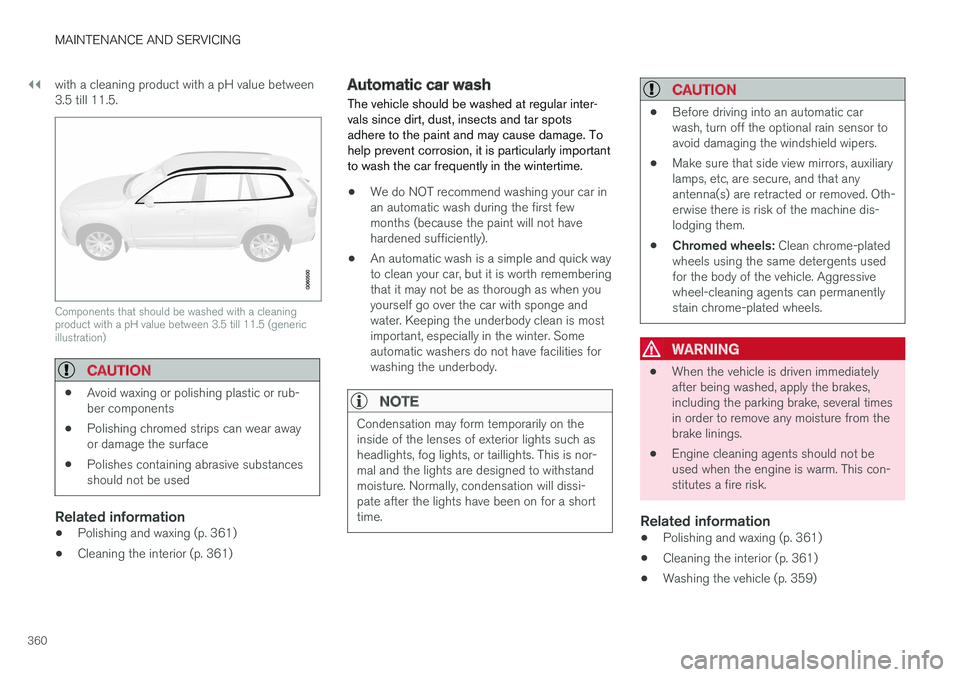
360with a cleaning product with a pH value between 3.5 till 11.5.
Components that should be washed with a cleaning product with a pH value between 3.5 till 11.5 (genericillustration)
CAUTION
•
Avoid waxing or polishing plastic or rub- ber components
• Polishing chromed strips can wear awayor damage the surface
• Polishes containing abrasive substancesshould not be used
Related information
• Polishing and waxing (p. 361)
• Cleaning the interior (p. 361)
Automatic car wash
The vehicle should be washed at regular inter- vals since dirt, dust, insects and tar spotsadhere to the paint and may cause damage. Tohelp prevent corrosion, it is particularly importantto wash the car frequently in the wintertime.
• We do NOT recommend washing your car in an automatic wash during the first fewmonths (because the paint will not havehardened sufficiently).
• An automatic wash is a simple and quick wayto clean your car, but it is worth rememberingthat it may not be as thorough as when youyourself go over the car with sponge andwater. Keeping the underbody clean is mostimportant, especially in the winter. Someautomatic washers do not have facilities forwashing the underbody.
NOTE
Condensation may form temporarily on the inside of the lenses of exterior lights such asheadlights, fog lights, or taillights. This is nor-mal and the lights are designed to withstandmoisture. Normally, condensation will dissi-pate after the lights have been on for a shorttime.
CAUTION
•
Before driving into an automatic car wash, turn off the optional rain sensor toavoid damaging the windshield wipers.
• Make sure that side view mirrors, auxiliarylamps, etc, are secure, and that anyantenna(s) are retracted or removed. Oth-erwise there is risk of the machine dis-lodging them.
• Chromed wheels:
Clean chrome-plated
wheels using the same detergents usedfor the body of the vehicle. Aggressivewheel-cleaning agents can permanentlystain chrome-plated wheels.
WARNING
• When the vehicle is driven immediately after being washed, apply the brakes,including the parking brake, several timesin order to remove any moisture from thebrake linings.
• Engine cleaning agents should not beused when the engine is warm. This con-stitutes a fire risk.
Related information
•
Polishing and waxing (p. 361)
• Cleaning the interior (p. 361)
• Washing the vehicle (p. 359)
Page 383 of 396
SPECIFICATIONS
}}
* Option/accessory.381
Indicator symbols
The following tables list the most common warn- ing and indicator lights and symbols and a refer-ence to where more detailed information can befound.
: The red warning symbol illuminates to
indicate a problem related to safety and/or driva- bility. A message will also appear in the maininstruments panel's display.
: The information symbol illuminates and a
text message is displayed to provide the driver with necessary information about one of thevehicle's systems.
Indicator symbols in the instrument panel
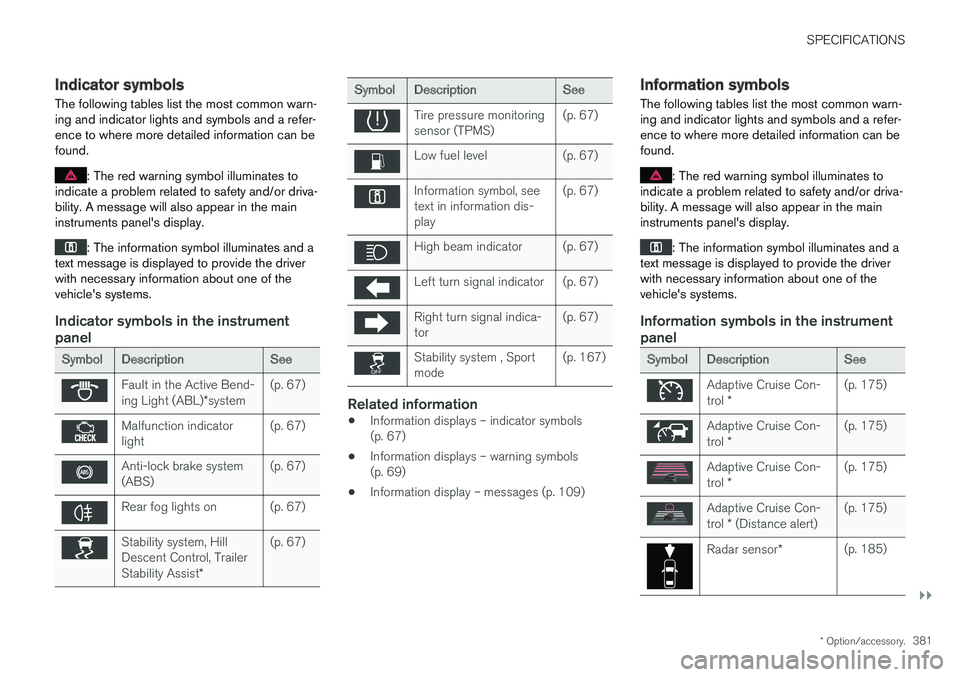
Symbol Description See
Fault in the Active Bend- ing Light (ABL)*system (p. 67)
Malfunction indicator light
(p. 67)
Anti-lock brake system (ABS)(p. 67)
Rear fog lights on (p. 67)
Stability system, Hill Descent Control, Trailer Stability Assist
*(p. 67)
Symbol
Description See
Tire pressure monitoring sensor (TPMS)(p. 67)
Low fuel level (p. 67)
Information symbol, see text in information dis-play(p. 67)
High beam indicator (p. 67)
Left turn signal indicator (p. 67)
Right turn signal indica- tor
(p. 67)
Stability system , Sport mode(p. 167)
Related information
•
Information displays – indicator symbols (p. 67)
• Information displays – warning symbols(p. 69)
• Information display – messages (p. 109)
Information symbols
The following tables list the most common warn- ing and indicator lights and symbols and a refer-ence to where more detailed information can befound.
: The red warning symbol illuminates to
indicate a problem related to safety and/or driva- bility. A message will also appear in the maininstruments panel's display.
: The information symbol illuminates and a
text message is displayed to provide the driver with necessary information about one of thevehicle's systems.
Information symbols in the instrument panel
Symbol Description See
Adaptive Cruise Con- trol * (p. 175)
Adaptive Cruise Con- trol
* (p. 175)
Adaptive Cruise Con- trol
* (p. 175)
Adaptive Cruise Con- trol
* (Distance alert) (p. 175)
Radar sensor
*(p. 185)
Page 384 of 396
||
SPECIFICATIONS
* Option/accessory.
382
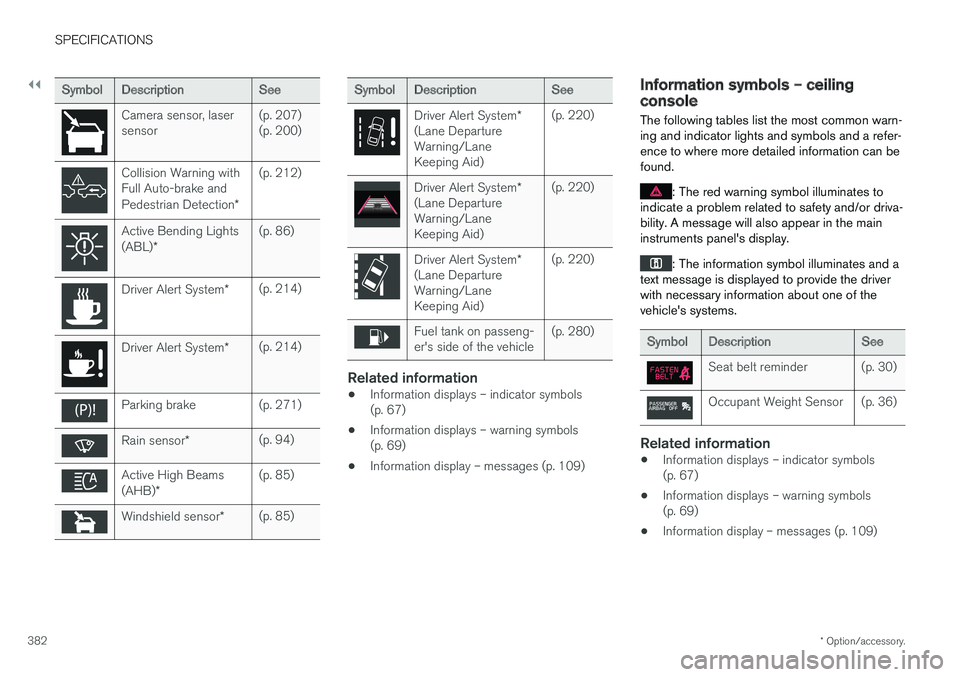
Symbol Description See
Camera sensor, laser sensor(p. 207)(p. 200)
Collision Warning with Full Auto-brake and Pedestrian Detection
*(p. 212)
Active Bending Lights (ABL)
* (p. 86)
Driver Alert System
*(p. 214)
Driver Alert System
*(p. 214)
Parking brake (p. 271)
Rain sensor
* (p. 94)
Active High Beams (AHB)
* (p. 85)
Windshield sensor
*(p. 85)
Symbol
Description See
Driver Alert System*
(Lane Departure Warning/LaneKeeping Aid) (p. 220)
Driver Alert System
*
(Lane Departure Warning/LaneKeeping Aid) (p. 220)
Driver Alert System
*
(Lane Departure Warning/LaneKeeping Aid) (p. 220)
Fuel tank on passeng- er's side of the vehicle
(p. 280)
Related information
•
Information displays – indicator symbols (p. 67)
• Information displays – warning symbols(p. 69)
• Information display – messages (p. 109)
Information symbols – ceiling console
The following tables list the most common warn- ing and indicator lights and symbols and a refer-ence to where more detailed information can befound.
: The red warning symbol illuminates to
indicate a problem related to safety and/or driva- bility. A message will also appear in the maininstruments panel's display.
: The information symbol illuminates and a
text message is displayed to provide the driver with necessary information about one of thevehicle's systems.
Symbol Description See
Seat belt reminder (p. 30)
Occupant Weight Sensor (p. 36)
Related information
•Information displays – indicator symbols (p. 67)
• Information displays – warning symbols(p. 69)
• Information display – messages (p. 109)
Page 391 of 396
INDEX
389
Motor oil
checking 329
volumes 375
O
Occupant safety 26
Occupant weight sensor 36
Octane recommendations 278
Odometer, trip 73Oil checking 329
volumes 375
Oil level sensor 330
Oil quality 374
OK button 108, 109
Option/accessory 13
Outside temperature sensor 72
Overhead courtesy lighting 91
Overheating, engine 70
Ownership, changing 17
Oxygen sensors, heated 281
P
Paint, touching up 363
Park assist 230, 238
Park Assist Camera 239
Park Assist Pilot 234Parking brake electric, applying/releasing 271, 272, 274
warning light 69
Parking lights 88
Pedestrian detection 206, 209
Polishing 361Power front seat memory function 76
Power meter 66
Power mirrors 97, 98 defroster 99
Power moonroof 101, 102Power steering adjustable 170
fluid 333
Power steering fluid 377
Power windows 96
Pregnancy, using seat belts during 31
Private locking 150
PROPOSITION 65 WARNING 254, 348, 379
R
Rain sensor 94
Rear fog lights 89
Rear park assist 230, 238Rear seats center head restraint 79
folding 79, 81
heated 126
Rearview mirror auto-dim function 99
compass 100
Rear window defroster 99
Recalls 26
Recalls, child restraints 47
Refrigerant 379
Refueling 277, 278 fuel filler cap 281
fuel filler door 280, 281
fuel tank volume 377
Registering child restraints 47 Remote control private locking 150
Remote key 144, 145, 146, 148, 151 approach lighting 147
immobilizer 146