transmission VOLVO S60 2018 Owner´s Manual
[x] Cancel search | Manufacturer: VOLVO, Model Year: 2018, Model line: S60, Model: VOLVO S60 2018Pages: 396, PDF Size: 9.4 MB
Page 278 of 396
STARTING AND DRIVING
276
Conserving electrical current
Keep the following in mind to help minimize bat- tery drain:
• When the engine is not running, avoid using ignition mode
II. Many electrical systems (the
audio system, the optional navigation system, power windows, etc) will function in ignition modes 0 and I. These modes reduce drain
on the battery.
• Please keep in mind that using systems, accessories, etc., that consume a great dealof current when the engine is not runningcould result in the battery being completelydrained. Driving or having the engine runningfor approximately 15 minutes will help keepthe battery charged.
• The optional 12-volt socket in thetrunk (p. 137) area provides electrical currenteven with the ignition switched off, whichdrains the battery.
Before a long distance trip
It is always worthwhile to have your vehicle checked by a trained and qualified Volvo servicetechnician before driving long distances. Yourretailer will also be able to supply you with bulbs,fuses, spark plugs and wiper blades for your usein the event that problems occur.
As a minimum, the following items should be checked before any long trip:
• Check that engine runs smoothly and thatfuel consumption is normal.
• Check for fuel, oil, and fluid leakage.
• Have the transmission oil level checked.
• Check condition of drive belts.
• Check state of the battery's charge.
• Examine tires carefully (the spare tire aswell), and replace those that areworn (p. 292). Check tire pressure (p. 299).
• The brakes, front wheel alignment, and steer-ing gear should be checked by a trained andqualified Volvo service technician only.
• Check all lights, including high beams.
• Reflective warning triangles are legallyrequired in some states/provinces.
• Have a word with a trained and qualifiedVolvo service technician if you intend to drivein countries where it may be difficult toobtain the correct fuel. •
Consider your destination. If you will be driv-ing through an area where snow or ice arelikely to occur, consider snow tires (p. 306).
Related information
•
Changing a wheel – removing wheel (p. 293)
• Bulbs – introduction (p. 334)
Page 284 of 396
||
STARTING AND DRIVING
* Option/accessory.
282 nents, altering emission system components or location or removing components, and/orrepeated use of leaded fuel.
NOTE
Unleaded fuel is required for vehicles with three-way catalytic converters.
Heated oxygen sensorsThe heated oxygen sensors monitor the oxygen content of the exhaust gases. Readings are fedinto a control module that continuously monitorsengine functions and controls fuel injection. Theratio of fuel to air into the engine is continuouslyadjusted for efficient combustion to help reduceharmful emissions.
Related information
•
Information displays – warning symbols(p. 69)
• Engine and cooling system (p. 275)
Economical driving
Better driving economy may be obtained by thinking ahead, avoiding rapid starts and stopsand adjusting the speed of your vehicle to imme-diate traffic conditions.
Economical driving conserves natural
resources
Observe the following rules: • Bring the engine to normal operating tem- perature as soon as possible by driving witha light foot on the accelerator pedal for thefirst few minutes of operation. A cold engineuses more fuel and is subject to increasedwear.
• Whenever possible, avoid using the vehiclefor driving short distances. This does notallow the engine to reach normal operatingtemperature.
• Drive carefully and avoid rapid accelerationand hard braking.
• Use the transmission's Drive (
D) position as
often as possible and avoid using kick-down.
• Using the transmission's Sport mode 13
may
increase fuel consumption somewhat. Use the transmission's Drive ( D) position as often
as possible. For additional information about Sport mode, see Transmission – Geartronic(p. 257). •
Using the engine's optional Eco function canhelp improve fuel economy. For additional information, see ECO
* (p. 265).
• Do not exceed posted speed limits.
• Avoid carrying unnecessary items (extra load) in the vehicle.
• Maintain correct tire pressure. Check tirepressure regularly (when tires are cold).
• Remove snow tires when threat of snow orice has ended.
• Note that roof racks, ski racks, etc, increaseair resistance and also fuel consumption.
• At highway driving speeds, fuel consumptionwill be lower with the air conditioning on andthe windows closed than with the air condi-tioning off and the windows open.
• Using the onboard trip computer's fuel con-sumption modes can help you learn how todrive more economically.
Other factors that decrease gas mileage are:
• Dirty air cleaner
• Dirty engine oil and clogged oil filter
• Dragging brakes
• Incorrect front end alignment
13
Certain models only.
Page 285 of 396
STARTING AND DRIVING
}}
283
Some of the above mentioned items and others are checked at the standard maintenance inter-vals.
WARNING
Driving with the trunk open:
Driving with the
trunk open could lead to poisonous exhaust gases entering the passenger compartment. Ifthe trunk must be kept open for any reason,proceed as follows:
• Close the windows
• Set the ventilation system control to air flow to floor, windshield and side windowsand the blower control to its highest set-ting.
Handling and roadholdingAt the specified curb weight your vehicle has atendency to understeer, which means that thesteering wheel has to be turned more than mightseem appropriate for the curvature of a bend.This ensures good stability and reduces the riskof rear wheel skid. Remember that these proper-ties can alter with the vehicle load. The heavierthe load in the trunk, the less the tendency toundersteer. • Vehicle load, tire design and inflation pres- sure all affect vehicle handling. Therefore,check that the tires are inflated to the rec-ommended pressure according to the vehicleload. Loads should be distributed so that capacity weight or maximum permissible axleloads are not exceeded.
• At the specified curb weight your vehicle hasa tendency to understeer, which means thatthe steering wheel has to be turned morethan might seem appropriate for the curva-ture of a bend. This ensures good stabilityand reduces the risk of rear wheel skid.Remember that these properties can alterwith the vehicle load. The heavier the load inthe trunk, the less the tendency to under-steer.
Related information
•Climate – general information (p. 120)
Towing a trailer When towing a trailer, always observe the legal requirements of the state/province.
NOTE
For the maximum trailer and tongue weights recommended by Volvo, see Weights (p. 371)
•
All Volvo models are equipped with energy- absorbing shock-mounted bumpers. Trailerhitch installation should not interfere with theproper operation of this bumper system.
Trailer towing does not normally present any par-ticular problems, but take into consideration:
• Increase tire pressure to recommended fullpressure, see the tire inflation decal on thedriver's door opening.
• When your vehicle is new, avoid towing heavytrailers during the first 620 miles (1,000 km).
• Maximum speed when towing a trailer:50 mph (80 km/h).
• Engine and transmission are subject toincreased loads. Therefore, engine coolanttemperature should be closely watched whendriving in hot climates or hilly terrain. Use alower gear and turn off the air conditioner ifthe temperature gauge needle enters the redrange.
Page 286 of 396
||
STARTING AND DRIVING
284•
If the automatic transmission begins to over- heat, a message will be displayed in the textwindow.
• Avoid overload and other abusive operation.
• Hauling a trailer affects handling, durability,and economy.
• It is necessary to balance trailer brakes withthe towing vehicle brakes to provide a safestop (check and observe state/local regula-tions).
• Do not connect the trailer's brake systemdirectly to the vehicle's brake system.
• More frequent vehicle maintenance isrequired.
• Remove the ball holder when the hitch is notbeing used.
NOTE
• When parking the vehicle with a trailer on a hill, apply the parking brake before put- ting the gear selector in
P. Always follow
the trailer manufacturer's recommenda- tions for wheel chocking.
• When starting on a hill, put the gear selector in
D before releasing the parking
brake.
• If you use the manual (Geartronic) shift positions while towing a trailer, make surethe gear you select does not put toomuch strain on the engine (using toohigh a gear).
• The drawbar assembly/trailer hitch maybe rated for trailers heavier than the vehi-cle is designed to tow. Please adhere toVolvo's recommended trailer weights.
• Avoid driving with a trailer on inclines ofmore than 15%.
CAUTION
The maximum trailer weights listed are only applicable for altitudes up to 3,280 ft(1000 m) above sea level. With increasingaltitude the engine power and therefore thecar's climbing ability are impaired because ofthe reduced air density, so the maximumtrailer weight has to be reduced accordingly.The weight of the vehicle and trailer must bereduced by 10% for every further 3,280 ft(1,000 m) (or part thereof). When towing5,000 lbs (2,250 kg) hill inclination is restric-ted to 14%.
Page 288 of 396
STARTING AND DRIVING
286
Towing the vehicle Always check with state and local authorities before attempting to tow another vehiclebecause this type of towing is subject to regula-tions regarding maximum towing speed, lengthand type of towing device, lighting, etc.
1. With the remote key fully pressed into theignition slot 14
, press START/STOP ENGINE
for approximately 2 seconds to activate igni- tion mode II.
2. The remote key must remain in the ignition slot15
for the entire time that the vehicle is
being towed.
3. Keep the tow rope taut when the towing vehicle slows down by applying light pressure on the brake pedal. This will help prevent jar-ring movements of the vehicle being towed.
4. Be prepared to apply the brakes to stop the vehicle being towed.
CAUTION
General towing precautions:
• Please check with state and local author- ities before attempting this type of tow-ing, as vehicles being towed are subjectto regulations regarding maximum towingspeed, length and type of towing device,lighting, etc.
• If the vehicle's battery is dead, see Jumpstarting (p. 254) to provide current forreleasing the electric parking brake and to move the gear selector from the
P
position to N. If this is not possible, see
Transmission – shiftlock override (p. 259) for information about manually overridingthe shiftlock system to move the gear selector from P to N.
• Maximum speed: 50 mph (80 km/h). Do not exceed the maximum allowable tow-ing speed.
• Maximum distance with front wheels onground: 50 miles (80 km).
• The vehicle should only be towed in theforward direction.
Related information
• Towing eyelet (p. 286)
• Remote key – functions (p. 147)
Towing eyelet
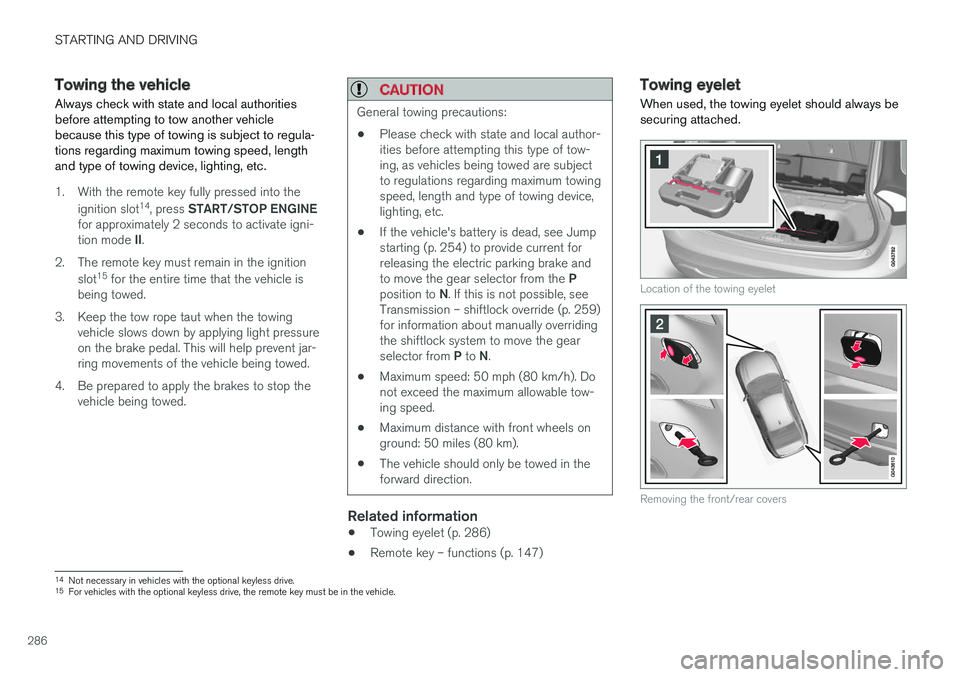
When used, the towing eyelet should always be securing attached.
Location of the towing eyelet
Removing the front/rear covers
14 Not necessary in vehicles with the optional keyless drive.
15 For vehicles with the optional keyless drive, the remote key must be in the vehicle.
Page 353 of 396
MAINTENANCE AND SERVICING
}}
* Option/accessory.351
Engine compartment, upper
Engine compartment, front
Engine compartment, lower
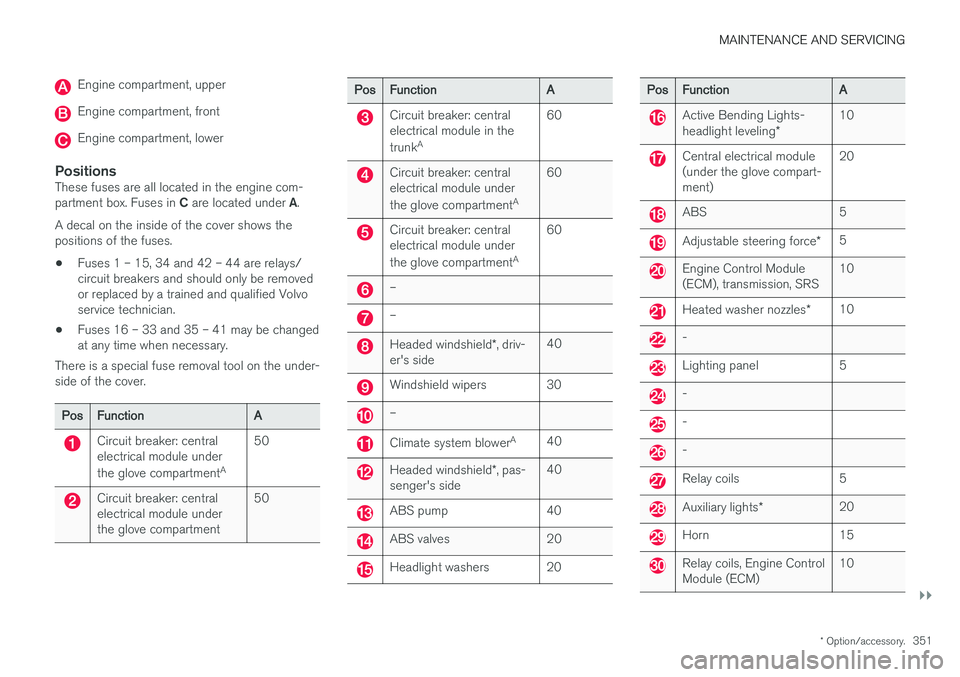
PositionsThese fuses are all located in the engine com- partment box. Fuses in C are located under A.
A decal on the inside of the cover shows the positions of the fuses. • Fuses 1 – 15, 34 and 42 – 44 are relays/ circuit breakers and should only be removedor replaced by a trained and qualified Volvoservice technician.
• Fuses 16 – 33 and 35 – 41 may be changedat any time when necessary.
There is a special fuse removal tool on the under-side of the cover.
Pos Function A
Circuit breaker: central electrical module under the glove compartmentA50
Circuit breaker: central electrical module underthe glove compartment 50
Pos
Function A
Circuit breaker: central electrical module in the trunkA 60
Circuit breaker: central electrical module under the glove compartment
A60
Circuit breaker: central electrical module under the glove compartment
A60
–
–
Headed windshield
*, driv-
er's side 40
Windshield wipers 30
–
Climate system blower
A
40
Headed windshield *, pas-
senger's side 40
ABS pump 40
ABS valves 20
Headlight washers 20
Pos
Function A
Active Bending Lights- headlight leveling*10
Central electrical module (under the glove compart-ment) 20
ABS 5
Adjustable steering force
*5
Engine Control Module (ECM), transmission, SRS 10
Heated washer nozzles
*10
-
Lighting panel 5
-
-
-
Relay coils 5
Auxiliary lights
* 20
Horn 15
Relay coils, Engine Control Module (ECM) 10
Page 354 of 396
||
MAINTENANCE AND SERVICING
352
PosFunction A
Control module - auto- matic transmission15
A/C compressor (not 4- cyl. engines)15
Relay-coils A/C, relay coils in engine compartmentcold zone for Start/Stop5
Starter motor relay
A
30
Engine control module (4- cyl. engines) Ignition coils (5 cyl. engines) 20
Engine Control Module (4- cyl. engines)
20
Engine Control Module (5-cyl. engines) 10
4-cyl. engines: mass air meter, thermostat, EVAPvalve10
5-cyl. engines: Injectionsystem, engine controlmodule 15
Pos
Function A
A/C compressor (5-cyl. engines), engine valves, oillevel sensor (5-cyl. only)10
Engine valves/oil pump/center heated oxygensensor (4-cyl. engines) 15
Front/rear heated oxygen sensors (4-cyl. engines),EVAP valve (5-cyl.engines), heated oxygensensors (5-cyl. engines)15
Oil pump/crankcase venti- lation heater/coolantpump (5-cyl. engines)
10
Ignition coils (4-cyl.engines) 15
Fuel leakage detection (5- cyl. engines), control mod-ule for radiator shutter (5-cyl. engines)5
Fuel leakage detection,A/C solenoid (4-cyl.engines) 7.5
Coolant pump (4-cyl. engines)
50
Pos
Function A
Cooling fan 60 or 80
(4-cyl. engines) 60 (5-cyl. engines)
Power steering 100
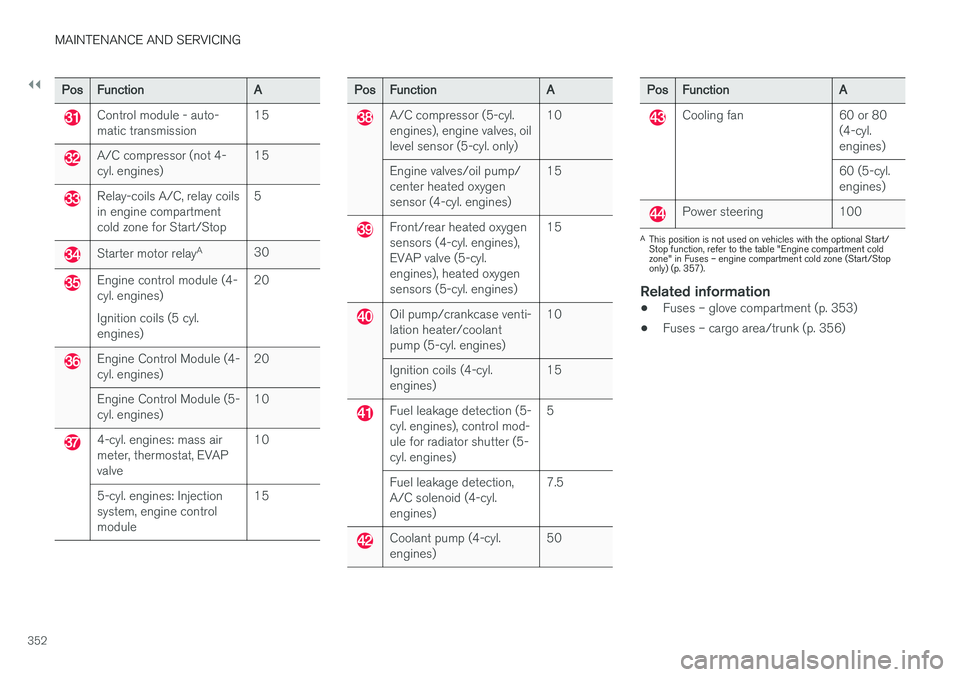
AThis position is not used on vehicles with the optional Start/ Stop function, refer to the table "Engine compartment coldzone" in Fuses – engine compartment cold zone (Start/Stoponly) (p. 357).
Related information
• Fuses – glove compartment (p. 353)
• Fuses – cargo area/trunk (p. 356)
Page 378 of 396
SPECIFICATIONS
376
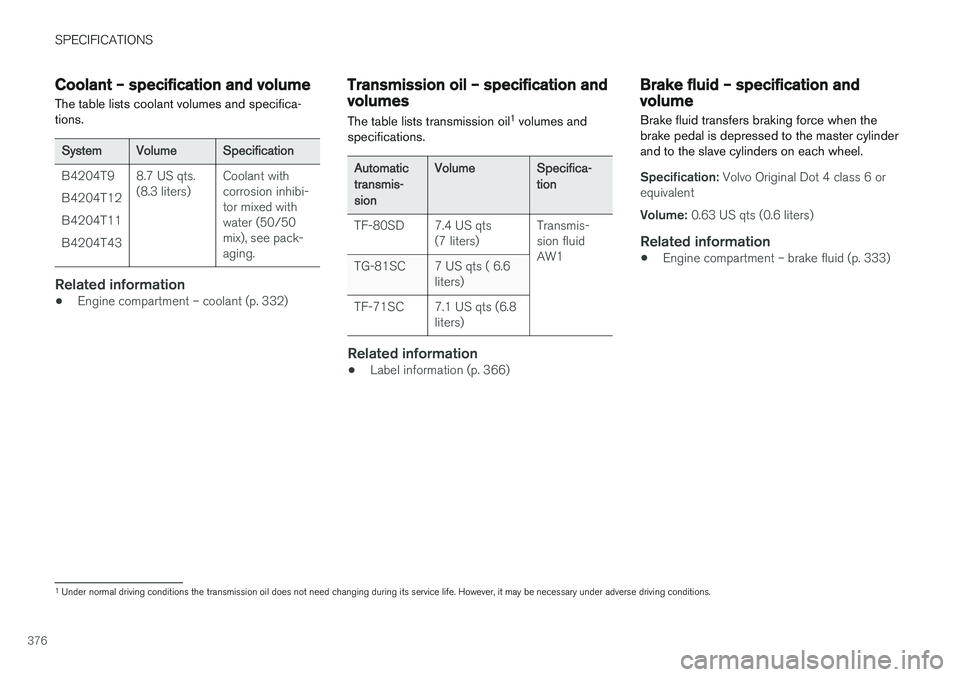
Coolant – specification and volume The table lists coolant volumes and specifica- tions.
SystemVolume Specification
B4204T9 B4204T12B4204T11B4204T43 8.7 US qts. (8.3 liters)
Coolant withcorrosion inhibi-tor mixed withwater (50/50mix), see pack-aging.
Related information
•
Engine compartment – coolant (p. 332)
Transmission oil – specification and volumes The table lists transmission oil 1
volumes and
specifications.
Automatic transmis-sion Volume
Specifica-tion
TF-80SD 7.4 US qts (7 liters) Transmis- sion fluidAW1
TG-81SC 7 US qts ( 6.6
liters)
TF-71SC 7.1 US qts (6.8 liters)
Related information
•Label information (p. 366)
Brake fluid – specification and volume
Brake fluid transfers braking force when the brake pedal is depressed to the master cylinderand to the slave cylinders on each wheel.
Specification: Volvo Original Dot 4 class 6 or
equivalent Volume: 0.63 US qts (0.6 liters)
Related information
•Engine compartment – brake fluid (p. 333)
1
Under normal driving conditions the transmission oil does not need changing during its service life. However, it may be necessary under adverse driving conditions.
Page 393 of 396
INDEX
391
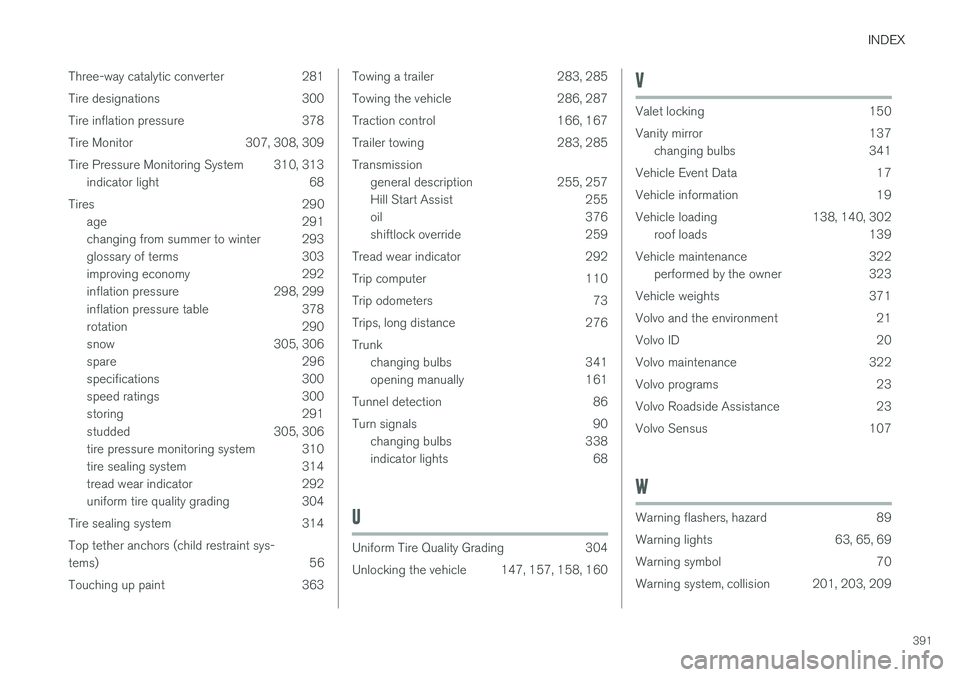
Three-way catalytic converter 281
Tire designations 300
Tire inflation pressure 378
Tire Monitor 307, 308, 309
Tire Pressure Monitoring System 310, 313
indicator light 68
Tires 290 age 291
changing from summer to winter 293
glossary of terms 303
improving economy 292
inflation pressure 298, 299
inflation pressure table 378
rotation 290
snow 305, 306
spare 296
specifications 300
speed ratings 300
storing 291
studded 305, 306
tire pressure monitoring system 310
tire sealing system 314
tread wear indicator 292
uniform tire quality grading 304
Tire sealing system 314 Top tether anchors (child restraint sys- tems) 56
Touching up paint 363
Towing a trailer 283, 285
Towing the vehicle 286, 287
Traction control 166, 167
Trailer towing 283, 285Transmission general description 255, 257
Hill Start Assist 255
oil 376
shiftlock override 259
Tread wear indicator 292
Trip computer 110
Trip odometers 73
Trips, long distance 276Trunk changing bulbs 341
opening manually 161
Tunnel detection 86
Turn signals 90 changing bulbs 338
indicator lights 68
U
Uniform Tire Quality Grading 304
Unlocking the vehicle 147, 157, 158, 160
V
Valet locking 150
Vanity mirror 137changing bulbs 341
Vehicle Event Data 17
Vehicle information 19
Vehicle loading 138, 140, 302 roof loads 139
Vehicle maintenance 322 performed by the owner 323
Vehicle weights 371
Volvo and the environment 21
Volvo ID 20
Volvo maintenance 322
Volvo programs 23
Volvo Roadside Assistance 23
Volvo Sensus 107
W
Warning flashers, hazard 89
Warning lights 63, 65, 69
Warning symbol 70
Warning system, collision 201, 203, 209