ECU VOLVO S60 2018 Owner´s Manual
[x] Cancel search | Manufacturer: VOLVO, Model Year: 2018, Model line: S60, Model: VOLVO S60 2018Pages: 396, PDF Size: 9.4 MB
Page 348 of 396
||
MAINTENANCE AND SERVICING
346
Related information
•Battery – changing (p. 347)
• Battery – maintenance (p. 346)
• Battery – symbols (p. 344)
Battery – maintenance
Proper battery maintenance can help prolong its service life.
Maintenance
• Use a screw driver to open the caps or cover and a flashlight to inspect the level.
• If necessary, add distilled water. The levelshould never be above the indicator.
• The fluid level should be checked if the bat-tery has been recharged.
• After inspection, be sure the cap over eachbattery cell or the cover is securely in place.
• Check that the battery cables are correctlyconnected and properly tightened.
• Never disconnect the battery when theengine is running, or when the key is in theignition. This could damage the vehicle'selectrical system.
• The battery should be disconnected from thevehicle when a battery charger is useddirectly on the battery.
• To help keep the battery in good condition,the vehicle should be driven for at least 15minutes a week or connected to a chargerwith an automatic charging function.
• If the battery is fully discharged a number oftimes, this may shorten its service life. Keep-ing the battery fully charged helps prolong itsservice life. •
The service life of a battery is affected byfactors such as driving conditions and cli-mate. Extreme cold may also furtherdecrease the battery
Page 351 of 396
MAINTENANCE AND SERVICING
349
Installation
1. Lower the battery into the battery box.
2. Move the battery inward and to the side untilit reaches the rear edge of the box.
3. Tighten the clamp that secures the battery.
4. Connect the ventilation hose. > Be sure that it is correctly connected tothe battery and the vent in the vehicle's body.
5. Connect the red positive cable.
6. Connect the black negative cable.
7. Press in the rear cover. (See Removal).
8. Reinstall the molding. (See Removal).
9. Reinstall the front cover and secure it with the clips. (See Removal).
Related information
• Battery – handling (p. 345)
• Battery – symbols (p. 344)
Fuses – introduction
The fuses help protect the vehicle's electrical components from overloading.
There are relay/fuseboxes located in the engine compartment, the passenger compartment andthe trunk. If an electrical component fails to function, this may be due to a blown fuse. The easiest way tosee if a fuse is blown is to remove it. To do so:
1. Pull the fuse straight out. If a fuse is difficult to remove, a special fuse removal tool is
located on the inside of the engine com- partment fusebox cover .
2. From the side, examine the curved metal wire in the fuse to see if it is intact.
If the wire is broken, insert a new fuse of thesame color and amperage (written on the fuse). If fuses burn out repeatedly, have the electrical system inspected by a trained and qualified Volvoservice technician.
WARNING
Never use metal objects or fuses with higher amperage than those stated on the followingpages. Doing so could seriously damage oroverload the vehicle's electrical system.
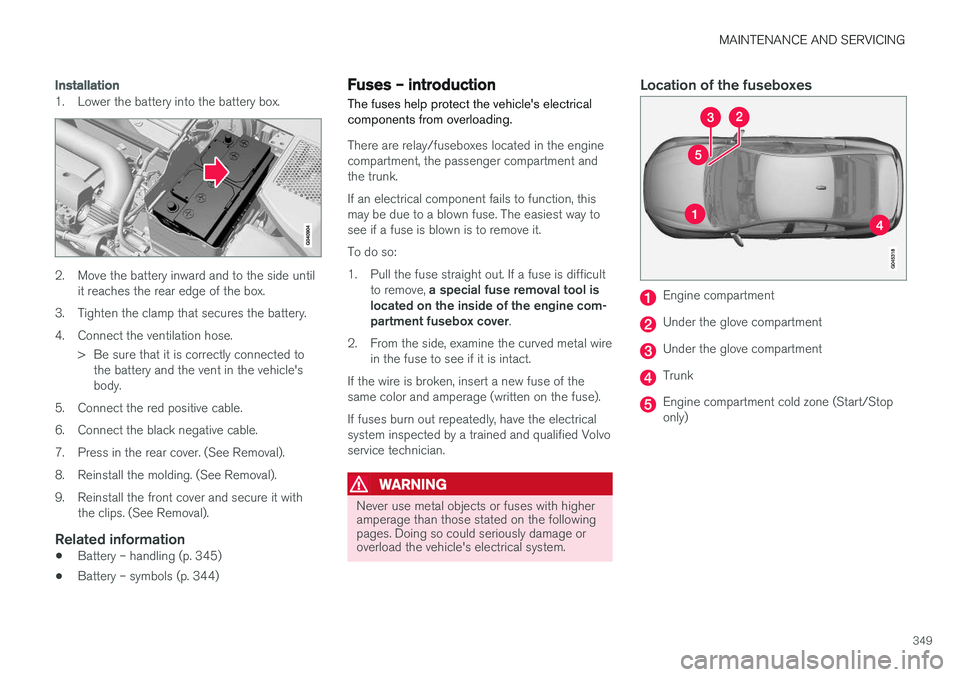
Location of the fuseboxes
Engine compartment
Under the glove compartment
Under the glove compartment
Trunk
Engine compartment cold zone (Start/Stop only)
Page 362 of 396
||
MAINTENANCE AND SERVICING
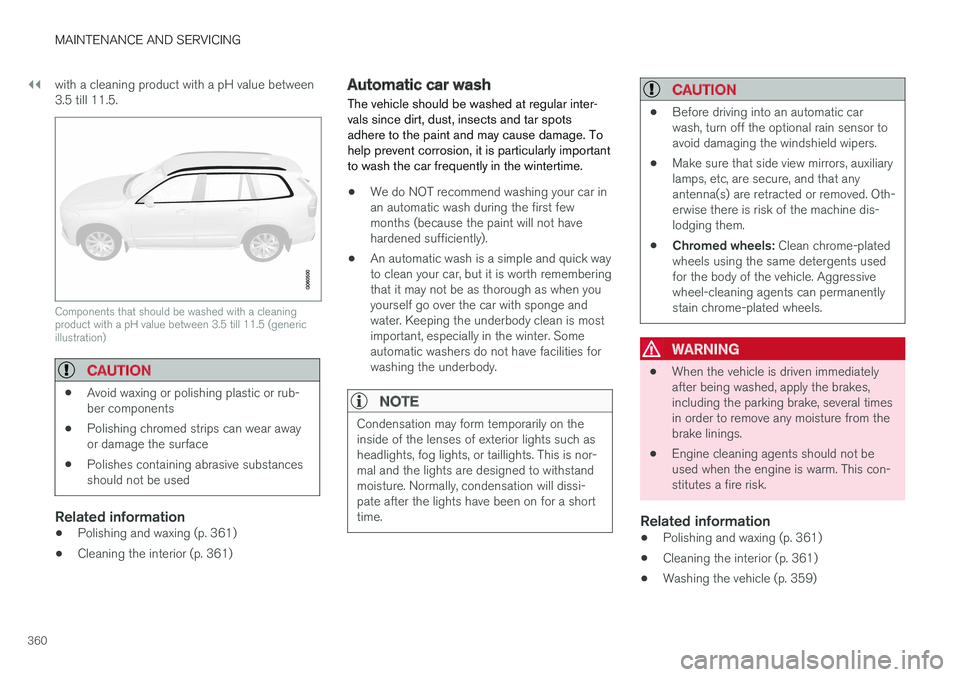
360with a cleaning product with a pH value between 3.5 till 11.5.
Components that should be washed with a cleaning product with a pH value between 3.5 till 11.5 (genericillustration)
CAUTION
•
Avoid waxing or polishing plastic or rub- ber components
• Polishing chromed strips can wear awayor damage the surface
• Polishes containing abrasive substancesshould not be used
Related information
• Polishing and waxing (p. 361)
• Cleaning the interior (p. 361)
Automatic car wash
The vehicle should be washed at regular inter- vals since dirt, dust, insects and tar spotsadhere to the paint and may cause damage. Tohelp prevent corrosion, it is particularly importantto wash the car frequently in the wintertime.
• We do NOT recommend washing your car in an automatic wash during the first fewmonths (because the paint will not havehardened sufficiently).
• An automatic wash is a simple and quick wayto clean your car, but it is worth rememberingthat it may not be as thorough as when youyourself go over the car with sponge andwater. Keeping the underbody clean is mostimportant, especially in the winter. Someautomatic washers do not have facilities forwashing the underbody.
NOTE
Condensation may form temporarily on the inside of the lenses of exterior lights such asheadlights, fog lights, or taillights. This is nor-mal and the lights are designed to withstandmoisture. Normally, condensation will dissi-pate after the lights have been on for a shorttime.
CAUTION
•
Before driving into an automatic car wash, turn off the optional rain sensor toavoid damaging the windshield wipers.
• Make sure that side view mirrors, auxiliarylamps, etc, are secure, and that anyantenna(s) are retracted or removed. Oth-erwise there is risk of the machine dis-lodging them.
• Chromed wheels:
Clean chrome-plated
wheels using the same detergents usedfor the body of the vehicle. Aggressivewheel-cleaning agents can permanentlystain chrome-plated wheels.
WARNING
• When the vehicle is driven immediately after being washed, apply the brakes,including the parking brake, several timesin order to remove any moisture from thebrake linings.
• Engine cleaning agents should not beused when the engine is warm. This con-stitutes a fire risk.
Related information
•
Polishing and waxing (p. 361)
• Cleaning the interior (p. 361)
• Washing the vehicle (p. 359)
Page 392 of 396

INDEX
390key blade 144, 145, 146, 148, 149, 150
, 151
locking the vehicle 147
replacing the battery 152
unlocking the vehicle 147
Reporting safety defects 27
Roadside Assistance 23
Road sign information (RSI) 170
Roof loads 139
S
Safety, occupant 26
Safety defects, reporting 27
Safety mode 44Seat belt reminder 30
Seat belts Automatic locking retractor/Emergency
locking retractor 47
buckling 29
maintenance 29
pretensioners 28
reminder 30
reminder warning light 69
securing child restraint systems 49, 52, 54
unbuckling 29
use during pregnancy 31
using 28
Seats, front 75, 76
Sensus 107Service connected service booking 325
Shiftlock 13 override 259
Side door mirrors 97, 98
Side impact airbags 39
Sign information (RSI) 170
Snow chains 305
Snow tires 305, 306
Spare tire 296
Spin control 166, 167SRS 31
Stability system 166, 167, 168 Corner Traction Control (CTC) 166
Engine Drag Control (EDC) 166
indicator light 68
Start/Stop (engine function) 260, 261, 262, 263, 264
Starting the engine 250 remote start 252
with keyless drive 250Starting the vehicleafter a crash (crash mode) 44, 45
Start inhibitor (immobilizer) 146 Steering wheel adjusting 82
heated 83
horn 82
keypad 82
Steering wheel paddles 82
Stone chips, touching up 363
Storage spaces 134
Studded tires 305, 306
Sunroof (moonroof) 101, 102
Sun shade 96, 97
Supplemental restraint system 31 warning light 69
Symbols, overview 379
T
Tailgate wiper/washer 95
Taillights, changing bulbs 339 Temperature sensor ambient 72
Temporary spare tire 296