ECU VOLVO S60 INSCRIPTION 2016 Owner´s Manual
[x] Cancel search | Manufacturer: VOLVO, Model Year: 2016, Model line: S60 INSCRIPTION, Model: VOLVO S60 INSCRIPTION 2016Pages: 344, PDF Size: 7.24 MB
Page 301 of 344
10 Maintenance and servicing
10
}}
299
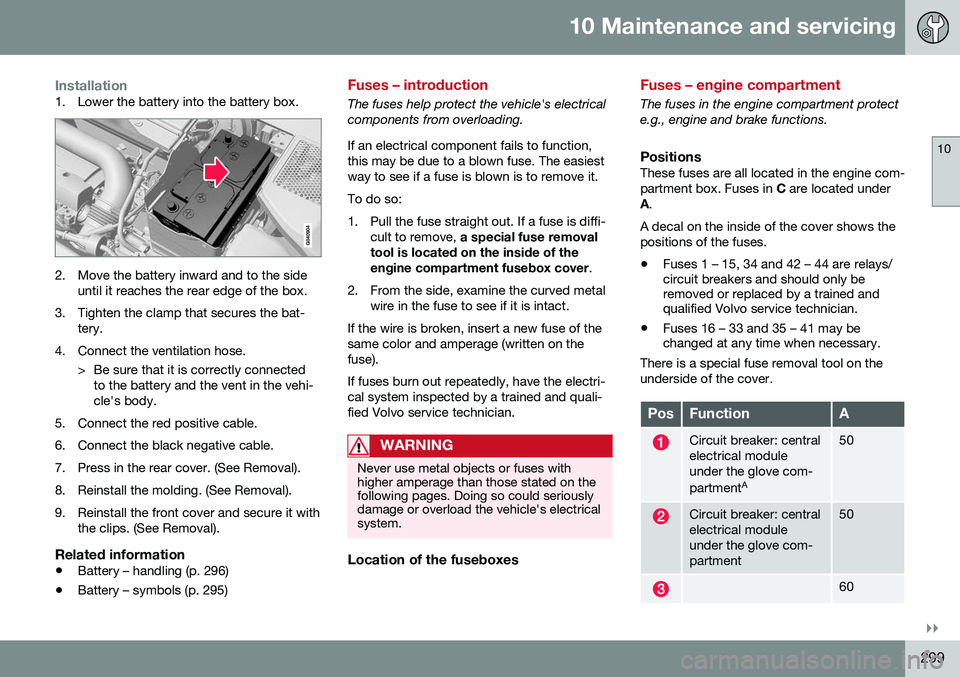
Installation1. Lower the battery into the battery box.
2. Move the battery inward and to the sideuntil it reaches the rear edge of the box.
3. Tighten the clamp that secures the bat- tery.
4. Connect the ventilation hose. > Be sure that it is correctly connectedto the battery and the vent in the vehi- cle's body.
5. Connect the red positive cable.
6. Connect the black negative cable.
7. Press in the rear cover. (See Removal).
8. Reinstall the molding. (See Removal).
9. Reinstall the front cover and secure it with the clips. (See Removal).
Related information
• Battery – handling (p. 296)
• Battery – symbols (p. 295)
Fuses – introduction
The fuses help protect the vehicle's electrical components from overloading. If an electrical component fails to function, this may be due to a blown fuse. The easiestway to see if a fuse is blown is to remove it. To do so:
1. Pull the fuse straight out. If a fuse is diffi-
cult to remove, a special fuse removal
tool is located on the inside of the engine compartment fusebox cover .
2. From the side, examine the curved metal wire in the fuse to see if it is intact.
If the wire is broken, insert a new fuse of the same color and amperage (written on thefuse). If fuses burn out repeatedly, have the electri- cal system inspected by a trained and quali-fied Volvo service technician.
WARNING
Never use metal objects or fuses with higher amperage than those stated on thefollowing pages. Doing so could seriouslydamage or overload the vehicle's electricalsystem.
Location of the fuseboxes
Fuses – engine compartment
The fuses in the engine compartment protect e.g., engine and brake functions.
PositionsThese fuses are all located in the engine com-partment box. Fuses in C are located under
A .
A decal on the inside of the cover shows thepositions of the fuses. • Fuses 1 – 15, 34 and 42 – 44 are relays/ circuit breakers and should only beremoved or replaced by a trained andqualified Volvo service technician.
• Fuses 16 – 33 and 35 – 41 may bechanged at any time when necessary.
There is a special fuse removal tool on the underside of the cover.
PosFunctionA
Circuit breaker: central electrical moduleunder the glove com- partment A50
Circuit breaker: central electrical moduleunder the glove com-partment50
60
Page 311 of 344
10 Maintenance and servicing
10
}}
309
Automatic car wash
The vehicle should be washed at regular inter- vals since dirt, dust, insects and tar spotsadhere to the paint and may cause damage.To help prevent corrosion, it is particularlyimportant to wash the car frequently in thewintertime.• We do NOT recommend washing your car in an automatic wash during the firstfew months (because the paint will nothave hardened sufficiently).
• An automatic wash is a simple and quickway to clean your car, but it is worthremembering that it may not be as thor-ough as when you yourself go over thecar with sponge and water. Keeping theunderbody clean is most important, espe-cially in the winter. Some automaticwashers do not have facilities for washingthe underbody.
NOTE
Condensation may form temporarily on the inside of the lenses of exterior lights suchas headlights, fog lights, or taillights. Thisis normal and the lights are designed towithstand moisture. Normally, condensa-tion will dissipate after the lights have beenon for a short time.
CAUTION
• Before driving into an automatic car wash, turn off the optional rain sensorto avoid damaging the windshield wip-ers.
• Make sure that side view mirrors, aux-iliary lamps, etc, are secure, and thatany antenna(s) are retracted orremoved. Otherwise there is risk of themachine dislodging them.
• Chromed wheels:
Clean chrome-
plated wheels using the same deter-gents used for the body of the vehicle.Aggressive wheel-cleaning agents canpermanently stain chrome-platedwheels.
WARNING
• When the vehicle is driven immediately after being washed, apply the brakes,including the parking brake, severaltimes in order to remove any moisturefrom the brake linings.
• Engine cleaning agents should not beused when the engine is warm. Thisconstitutes a fire risk.
Related information
•
Polishing and waxing (p. 309)
• Cleaning the interior (p. 310)
• Washing the car (p. 308)
Polishing and waxing
Normally, polishing is not required during the first year after delivery, however, waxing maybe beneficial.
• Before applying polish or wax the vehicle must be washed and dried. Tar spots canbe removed with kerosene or tar remover.Difficult spots may require a fine rubbingcompound.
• After polishing use liquid or paste wax.
• Several commercially available productscontain both polish and wax.
• Waxing alone does not substitute for pol-ishing a dull surface.
• A wide range of polymer-based waxescan be purchased today. These waxesare easy to use and produce a long-last-ing, high-gloss finish that protects thebodywork against oxidation, road dirt andfading.
• Do not polish or wax your vehicle in directsunlight (the surface of the vehicle shouldnot be warmer than 113 °F (45 °C).
Page 339 of 344
12 Index
12
337
S
Safety, occupant........................................ 26
Safety defects, reporting........................... 27
Safety mode.............................................. 43Seat beltreminder................................................ 30
Seat belts Automatic locking retractor/Emer-
gency locking retractor......................... 47
buckling................................................ 29
maintenance......................................... 29
pretensioners........................................ 28
reminder................................................ 30
reminder warning light.......................... 64
securing child restraint systems.... 49,51, 53
unbuckling............................................ 29
use during pregnancy........................... 30
using..................................................... 28
Seats, front.......................................... 70, 71
Sensus....................................................... 95Service connected service booking................ 283
Shiftlock..................................................... 14 override............................................... 220
Side door mirrors................................. 87, 88
Side impact airbags................................... 39 Sign information (RSI).............................. 145
Snow chains............................................ 264
Snow tires........................................ 264, 265
Spin control..................................... 141, 142
SRS............................................................ 31
Stability system....................... 141, 142, 143
indicator light........................................ 63
Start/Stop (engine function)..... 221, 222, 223, 224, 225
Starting the engine.................................. 211 remote start........................................ 213
with keyless drive............................... 211
Starting the vehicle after a crash (crash mode)........ 43, 44, 45
Start inhibitor (immobilizer)...................... 126 Steering wheel adjusting............................................... 75
heated................................................... 75
horn....................................................... 75
keypad.................................................. 75
Steering wheel paddles............................. 75
Stone chips, touching up......................... 312
Storage spaces........................................ 119
Studded tires................................... 264, 265
Sun shade.................................................. 86 Supplemental restraint system.................. 31
warning light......................................... 64
Symbols, overview................................... 327
T
Tailgate wiper/washer........................................ 86
Temperature sensor ambient................................................. 67
Three-way catalytic converter................. 242
Tire designations..................................... 258
Tire inflation pressure.............................. 260
Tire Monitor............................. 270, 271, 272
Tire Pressure Monitoring System.... 266, 269 indicator light........................................ 63
Tires......................................................... 249 age...................................................... 250
changing from summer to winter........ 252
glossary of terms................................ 262
improving economy............................ 251
inflation pressure........................ 255, 256
inflation pressure table....................... 260
rotation............................................... 249
Self-supporting run flat tires (SST)..... 273
snow........................................... 264, 265
specifications...................................... 257