warning VOLVO S60 TWIN ENGINE 2019 User Guide
[x] Cancel search | Manufacturer: VOLVO, Model Year: 2019, Model line: S60 TWIN ENGINE, Model: VOLVO S60 TWIN ENGINE 2019Pages: 645, PDF Size: 13.96 MB
Page 40 of 645

||
YOUR VOLVO
38
Canada
IC: 20839-ACUII06
This device complies with Industry Canadalicense-exempt RSS standards. Operation is sub-ject to the following two conditions:
(1) this device may not cause interference, and
(2) This device must accept any interferencereceived, including interference that may causeundesired operation.
Related information
Important information on accessories andextra equipment (p. 35)
Technician certification
In addition to Volvo factory training, Volvo sup-ports certification by the National Institute forAutomotive Service Excellence (A.S.E.).
Certified technicians have demonstrated a highdegree of competence in specific areas. Besidespassing exams, each technician must also haveworked in the field for two or more years before acertificate is issued. These professional techni-cians are best able to analyze vehicle problemsand perform the necessary maintenance proce-dures to keep your Volvo at peak operating con-dition.
Twin Engine vehicles
Technicians performing work on a vehicle withelectrification should also have the necessarytraining and specialized certification required forperforming repairs and/or maintenance on avehicle with electrification.
WARNING
A number of electrical components in TwinEngine vehicles use high-voltage current andcan be extremely dangerous if handled incor-rectly. These components and any orange wir-ing in the vehicle may only be handled bytrained and qualified Volvo service techni-cians.
Viewing the Vehicle IdentificationNumber (VIN)
When contacting a Volvo retailer, about e.g. yourVolvo On Call subscription, your Vehicle Identifi-
cation Number (VIN4) may be needed.
1.Tap Settings in the Top view in the centerdisplay.
2.Proceed to SystemSystem Information
Vehicle Identification Number.
> The vehicle identification number will bedisplayed.
The VIN can also be found on the first page ofthe Warranty and Service Records Informationbooklet, on your registration card, or by looking atthe dashboard through the windshield.
The VIN has a similar location on all models.
4Vehicle Identification Number
Page 41 of 645
YOUR VOLVO
}}
39
Volvo Structural Parts Statement
Volvo is one of the leading companies for carsafety.
Volvo engineers and manufactures vehiclesdesigned to help protect vehicle occupants in theevent of a collision.
Volvos are designed to absorb the impact of acollision. This energy absorption system including,but not limited to, structural components such asbumper reinforcement bars, bumper energyabsorbers, frames, rails, fender aprons, A-pillars,B-pillars and body panels must work together tomaintain cabin integrity and protect the vehicleoccupants.
The supplemental restraint system including butnot limited to air bags, side curtain air bags, anddeployment sensors work together with theabove components to provide proper timing forair bag deployment.
Due to the above, Volvo Car USA does not sup-port the use of aftermarket, alternative or any-thing other than original Volvo parts for collisionrepair.
Volvo Car USA also recommends using Volvo-approved replacement glass. The use of after-market glass, particularly a windshield, can havean adverse effect on collision avoidance andadvanced lighting systems.
In addition Volvo does not support the use or re-use of structural components from an existing
vehicle that has been previously damaged.Although these parts may appear equivalent, it isdifficult to tell if the parts have been previouslyreplaced with non-OE parts or if the part hasbeen damaged as a result of a prior collision. Thequality of these used parts may also have beenaffected due to environmental exposure.
Related information
Data recording (p. 33)
Driver distraction
A driver has a responsibility to do everythingpossible to ensure his or her own safety and thesafety of passengers in the vehicle and otherssharing the roadway. Part of this responsibility isavoiding distractions, including performing activi-ties that are not directly related to controlling thevehicle in the driving environment.
Your new Volvo is, or can be, equipped with fea-ture-rich entertainment and communication sys-tems. These include hands-free cellular tele-phones, navigation systems, and multipurposeaudio systems. You may also own other portableelectronic devices for your own convenience.When used properly and safely, they enrich thedriving experience. Improperly used, any of thesecould cause a distraction.
For all of these systems, we want to provide thefollowing warning that reflects the strong Volvoconcern for your safety. Never use these devicesor any feature of your vehicle in a way that dis-tracts you from the task of driving safely. Distrac-tion can lead to a serious accident. In addition tothis general warning, we offer the following guid-ance regarding specific new features that may befound in your vehicle:
Page 42 of 645
||
YOUR VOLVO
40
WARNING
Never use a hand-held cellular telephonewhile driving. Some jurisdictions prohibitcellular telephone use by a driver whilethe vehicle is moving.
If your vehicle is equipped with a naviga-tion system, set and make changes toyour travel itinerary only with the vehicleparked.
Never program your audio system whilethe vehicle is moving. Program radio pre-sets with the vehicle parked, and use yourprogrammed presets to make radio usequicker and simpler.
Never use portable computers or per-sonal digital assistants while the vehicleis moving.
Related information
Audio, media and Internet (p. 448)
Page 44 of 645
SAFETY
42
Safety
The vehicle is equipped with a number of safetysystems that work together to help protect thevehicle's driver and passengers in the event ofan accident.
The vehicle is equipped with a number of sensorsthat may react in the event of an accident andactivate different safety systems, such as the air-bag system and seat belt tensioners. Dependingon the specific conditions of the accident, e.g.collisions at certain angles, overturning or swerv-ing, the systems react differently to help providethe best protection.
There are also mechanical safety systems suchas the Whiplash Protection System. The vehicleis also built so that a large part of the force of acollision is distributed to the vehicle's members,pillars, floor, roof and other parts of the body.
After an accident, the vehicle's safety mode maybe activated if any important function in the vehi-cle has been damaged.
Warning symbol in the instrument panel
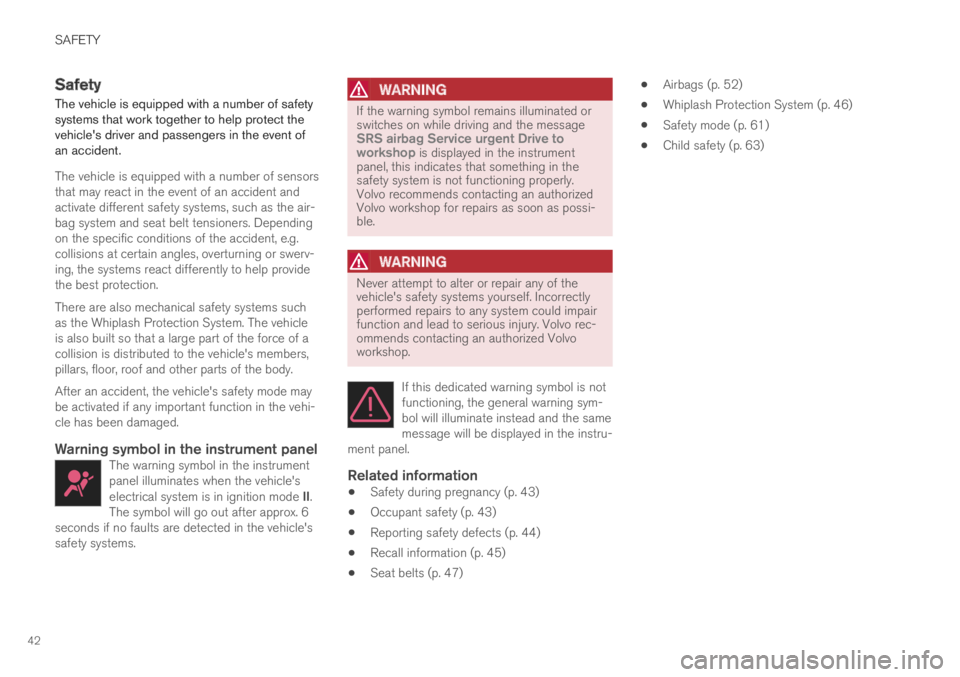
The warning symbol in the instrumentpanel illuminates when the vehicle'selectrical system is in ignition mode II.The symbol will go out after approx. 6seconds if no faults are detected in the vehicle'ssafety systems.
WARNING
If the warning symbol remains illuminated orswitches on while driving and the messageSRS airbag Service urgent Drive toworkshop is displayed in the instrumentpanel, this indicates that something in thesafety system is not functioning properly.Volvo recommends contacting an authorizedVolvo workshop for repairs as soon as possi-ble.
WARNING
Never attempt to alter or repair any of thevehicle's safety systems yourself. Incorrectlyperformed repairs to any system could impairfunction and lead to serious injury. Volvo rec-ommends contacting an authorized Volvoworkshop.
If this dedicated warning symbol is notfunctioning, the general warning sym-bol will illuminate instead and the samemessage will be displayed in the instru-ment panel.
Related information
Safety during pregnancy (p. 43)
Occupant safety (p. 43)
Reporting safety defects (p. 44)
Recall information (p. 45)
Seat belts (p. 47)
Airbags (p. 52)
Whiplash Protection System (p. 46)
Safety mode (p. 61)
Child safety (p. 63)
Page 48 of 645
||
SAFETY
46
Related information
Safety (p. 42)
Reporting safety defects (p. 44)
Occupant safety (p. 43)
Whiplash Protection System
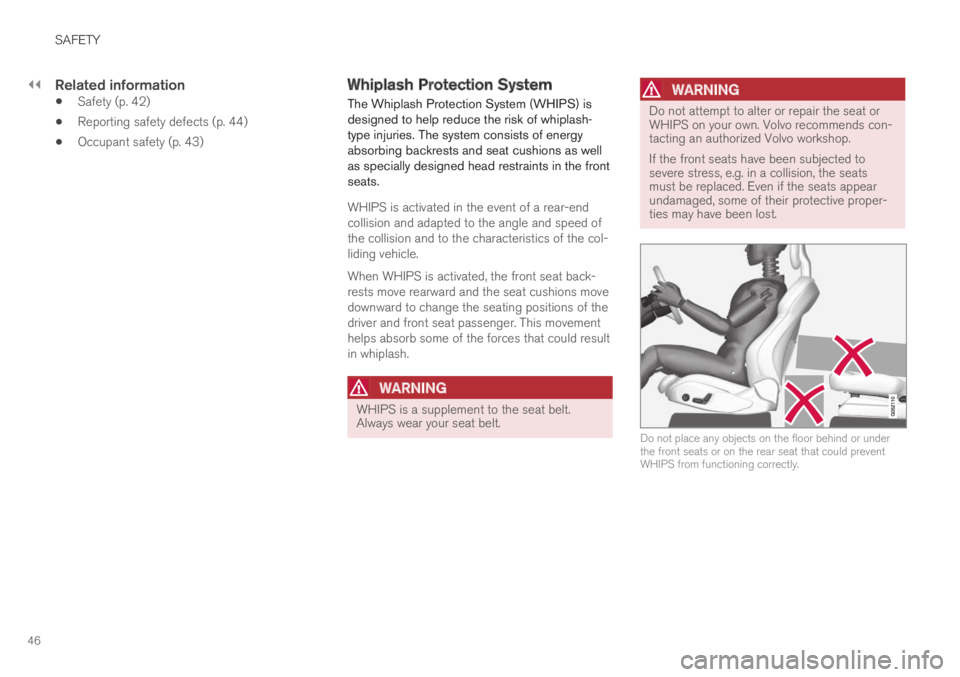
The Whiplash Protection System (WHIPS) isdesigned to help reduce the risk of whiplash-type injuries. The system consists of energyabsorbing backrests and seat cushions as wellas specially designed head restraints in the frontseats.
WHIPS is activated in the event of a rear-endcollision and adapted to the angle and speed ofthe collision and to the characteristics of the col-liding vehicle.
When WHIPS is activated, the front seat back-rests move rearward and the seat cushions movedownward to change the seating positions of thedriver and front seat passenger. This movementhelps absorb some of the forces that could resultin whiplash.
WARNING
WHIPS is a supplement to the seat belt.Always wear your seat belt.
WARNING
Do not attempt to alter or repair the seat orWHIPS on your own. Volvo recommends con-tacting an authorized Volvo workshop.
If the front seats have been subjected tosevere stress, e.g. in a collision, the seatsmust be replaced. Even if the seats appearundamaged, some of their protective proper-ties may have been lost.
Do not place any objects on the floor behind or underthe front seats or on the rear seat that could preventWHIPS from functioning correctly.
Page 49 of 645
SAFETY
}}
* Option/accessory.47
WARNING
Do not squeeze box-like cargo between therear seat cushion and the front seat backrest.
If the rear seat backrests are folded down,cargo must be secured to prevent it from slid-ing forward against the front seat backrests inthe event of a collision.
WARNING
If a rear seat backrest is folded down or if arear-facing child restraint is being used in therear seat, the seat in front must be moved for-ward so that it does not come into contactwith the backrest or child restraint.
Seating position
For WHIPS to provide optimal protection, thedriver and passenger must be seated correctlyand the system's function must not be impededin any way.
Set the front seat to the correct seating positionbefore starting to drive.
The driver and the front seat passenger shouldsit in the center of the seat with their heads asclose as possible to the head restraints.
Related information
Safety (p. 42)
Manual front seats (p. 180)
Power* front seats (p. 181)
Rear Collision Warning (p. 320)Seat belts
Seat belts should always be worn by all occu-pants in your vehicle. Children should be prop-erly restrained using an infant seat, adjustablechild seat or booster cushion as determined byage, weight and height.
Most states and provinces make it mandatory foroccupants of a vehicle to use seat belts.
Seat belt maintenance
Check periodically that the seat belts are in goodcondition. Use water and a mild detergent forcleaning. Check the seat belt mechanism's func-tion as follows: attach the seat belt and pull rap-idly on the strap.
Page 50 of 645
||
SAFETY
48
WARNING
Never repair the belt yourself. Repairsshould only be performed by a trainedand qualified Volvo service technician.
Any device used to induce slack into theshoulder belt portion of the three-pointbelt system will have a detrimental effecton the amount of protection available inthe event of a collision.
The seat back should not be tilted too farback. The shoulder belt must be taut inorder to function properly.
Do not use any type of child restraint inthe front passenger seat. We recommendthat children who have outgrown thesedevices sit in the rear seat with the seatbelt properly fastened.
Related information
Safety (p. 42)
Seat belt tensioners (p. 50)
Buckling and unbuckling seat belts (p. 48)
Door and seat belt reminders (p. 51)
Buckling and unbuckling seat belts
Make sure that all passengers have buckledtheir seat belts before starting to drive.
Buckling seat belts
1. Pull out the belt slowly and make sure it isnot twisted or damaged.
NOTE
The seat belt is equipped with a seat beltretractor that will lock up in the following sit-uations:
if the belt is pulled out too quickly.
during braking and acceleration.
if the vehicle is leaning excessively.
when driving in turns.
if the automatic locking retractor/emer-gency locking retractor (ALR/ELR) is acti-vated. Each seat belt (except for the driv-er's) is equipped with an ALR function,which is designed to keep the seat belttaut when installing a child restraint. ALRis activated when the seat belt is pulledout as far as possible. If this is done, asound from the seat belt retractor will beaudible, which is normal. The seat belt cannow only be fed into the retractor, notpulled out. This function is automaticallydisabled when the seat belt is unbuckledand fully retracted.
Page 51 of 645
SAFETY
}}
49
2.Buckle the seat belt by pushing the latchplate into the receptacle.
> A distinct "click" indicates that the belt islocked into place.
WARNING
Always insert the seat belt latch plate into thebelt buckle on the correct side. Failure to doso could cause the seat belts and belt buck-les to malfunction in a collision. There is a riskof serious injury.
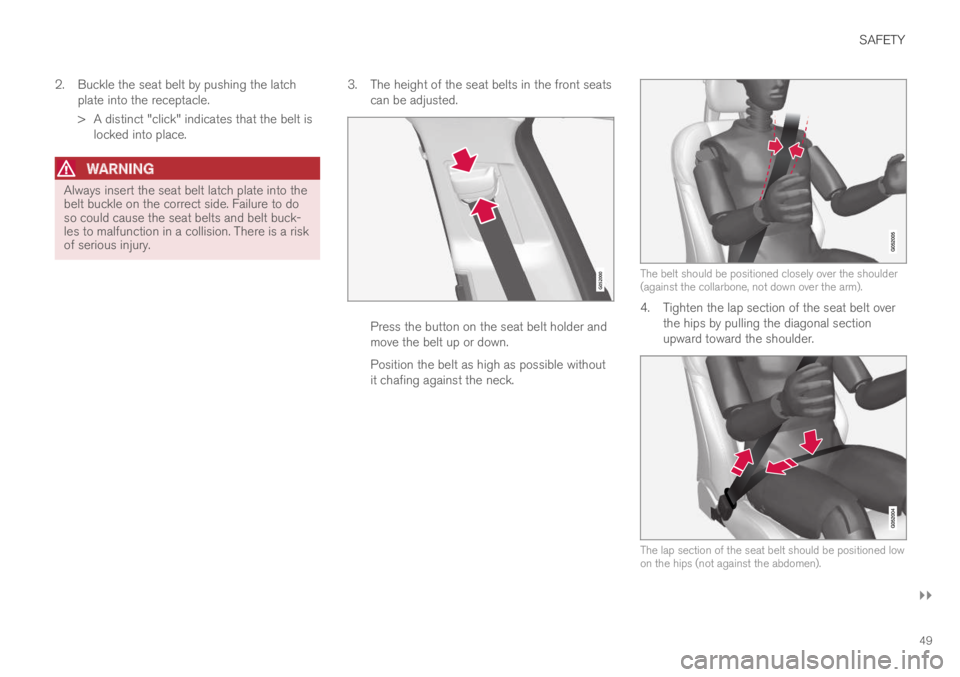
3.The height of the seat belts in the front seatscan be adjusted.
Press the button on the seat belt holder andmove the belt up or down.
Position the belt as high as possible withoutit chafing against the neck.
The belt should be positioned closely over the shoulder(against the collarbone, not down over the arm).
4. Tighten the lap section of the seat belt overthe hips by pulling the diagonal sectionupward toward the shoulder.
The lap section of the seat belt should be positioned lowon the hips (not against the abdomen).
Page 52 of 645
||
SAFETY
* Option/accessory.50
WARNING
Never use a seat belt for more than oneoccupant. Never wear the shoulder portion ofthe belt under the arm, behind the back orotherwise out of position. Such use couldcause injury in the event of an accident. Asseat belts lose much of their strength whenexposed to violent stretching, they should bereplaced after any collision, even if theyappear to be undamaged.
WARNING
Do not use clips or fasten the belts aroundhooks or other parts of the interior. This willprevent the seat belt from fitting properly.
WARNING
Never damage the seat belts and never insertany foreign objects into the belt buckle. Thismay cause the seat belts and belt buckles tomalfunction in a collision. There is a risk ofserious injury.
Unbuckling seat belts
1. Press the red button on the seat belt recep-tacle and make sure the seat belt retractsfully into the retractor slot.
2. If it does not fully retract, guide the belt man-ually into the slot and make sure it does nothang loose.
Related information
Seat belts (p. 47)
Seat belt tensioners (p. 50)
Door and seat belt reminders (p. 51)
Seat belt tensioners
The vehicle is equipped with standard and elec-tric* seat belt tensioners that can help tensionthe seat belt in a critical situation or collision.
Standard seat belt tensioners
All seat belts are equipped with a standard seatbelt tensioner.
In a collision of sufficiently violent force, the seatbelt tensioners will tension the seat belts in orderto more effectively restrain the occupants.
Electric seat belt tensioners *
The driver's and front passenger's seat belts areequipped with electric seat belt tensioners.
The seat belt tensioners interact and can be acti-vated in conjunction with the City Safety andRear Collision Warning driver support systems. Incritical situations, such as if the vehicle brakessuddenly, begins to skid or runs off the road (e.gif the vehicle rolls into a ditch, lifts off the groundor hits an obstacle in the road), or if there is a riskof collision, the seat belts can be pulled taut bythe seat belt tensioner's electric motor.
The electric seat belt tensioner helps to positionthe occupant more effectively in the seat, whichreduces the risk of the occupant striking the inte-rior of the passenger compartment and improvesthe effect of other safety systems such as theairbags.
Page 53 of 645
SAFETY
}}
* Option/accessory.51
When a critical situation has passed, the seat beltand the electric seat belt tensioner are resetautomatically. However, they can also be resetmanually.
WARNING
Never attempt to alter or repair the seat belton your own. Volvo recommends contactingan authorized Volvo workshop.
If the seat belt has been exposed to extremeforces, e.g. in conjunction with a collision, theentire seat belt must be replaced. Even if theseat belt appears undamaged, some of itsprotective properties may have been lost. Alsoreplace the seat belt if it is worn or damaged.The new seat belt must be type approved andintended for the same seating position as thereplaced seat belt.
Related information
Seat belts (p. 47)
Buckling and unbuckling seat belts (p. 48)
Resetting the electric seat belt tensioners*(p. 51)
City Safety™ (p. 305)
Rear Collision Warning (p. 320)
Resetting the electric seat belt
tensioners*
The electric seat belt tensioners are designed tobe reset automatically, but if the seat beltremains taut it can be reset manually.
1. Stop the vehicle in a safe location.
2.Unbuckle the seat belt and then rebuckle it.
> The seat belt and the electric seat belttensioner will be reset.
WARNING
Never attempt to alter or repair the seat belton your own. Volvo recommends contactingan authorized Volvo workshop.
If the seat belt has been exposed to extremeforces, e.g. in conjunction with a collision, theentire seat belt must be replaced. Even if theseat belt appears undamaged, some of itsprotective properties may have been lost. Alsoreplace the seat belt if it is worn or damaged.The new seat belt must be type approved andintended for the same seating position as thereplaced seat belt.
Related information
Seat belt tensioners (p. 50)
Seat belts (p. 47)
Door and seat belt reminders
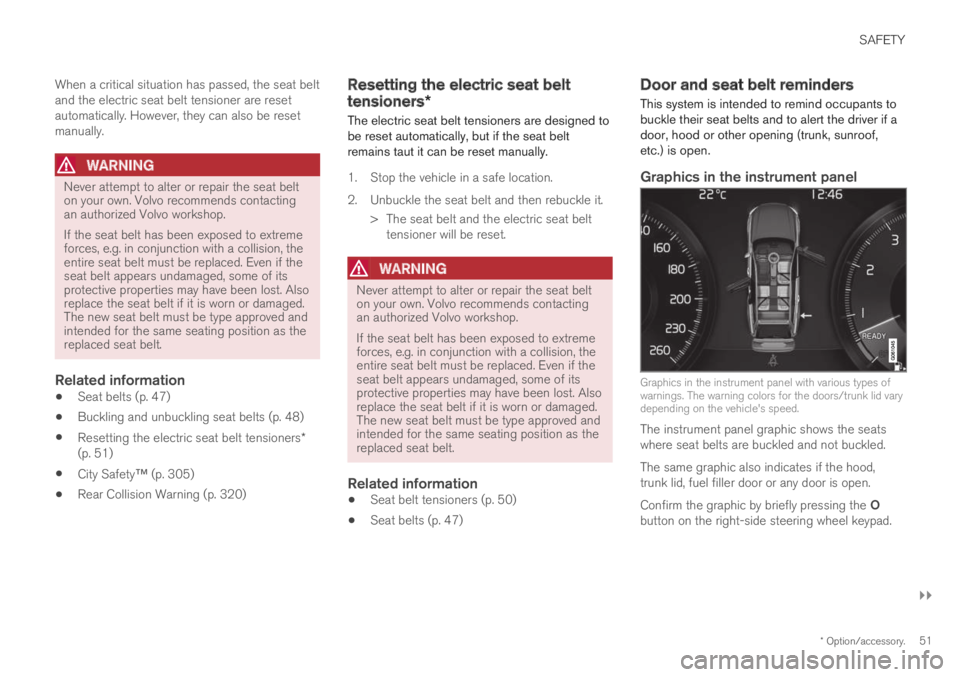
This system is intended to remind occupants tobuckle their seat belts and to alert the driver if adoor, hood or other opening (trunk, sunroof,etc.) is open.
Graphics in the instrument panel
Graphics in the instrument panel with various types ofwarnings. The warning colors for the doors/trunk lid varydepending on the vehicle's speed.
The instrument panel graphic shows the seatswhere seat belts are buckled and not buckled.
The same graphic also indicates if the hood,trunk lid, fuel filler door or any door is open.
Confirm the graphic by briefly pressing the Obutton on the right-side steering wheel keypad.