flat tire VOLVO S60 TWIN ENGINE 2019 Owner's Manual
[x] Cancel search | Manufacturer: VOLVO, Model Year: 2019, Model line: S60 TWIN ENGINE, Model: VOLVO S60 TWIN ENGINE 2019Pages: 645, PDF Size: 13.96 MB
Page 531 of 645

WHEELS AND TIRES
}}
* Option/accessory.529
1.Turn on the vehicle's hazard warning flashersif a wheel change must be performed in anarea with traffic.
2. Apply the parking brake and put the gearselector in P, or first gear if the vehicle has amanual transmission.
For vehicles with Leveling Control*: If thevehicle is equipped with pneumatic suspen-sion, this must be switched off before thevehicle is lifted with the jack*.
3.Take out the jack*, lug wrench* and tool forremoving the plastic covers, which arestowed in the foam block.
Tool for removing the plastic covers on the wheel bolts.
4. Place chocks in front of and behind thewheels that are still on the ground. For exam-ple, use heavy wooden blocks or largestones.
5.Using the lug wrench, screw the towing eyeinto place as far as possible according to theinstructions.
CAUTION
The towing eyelet must be screwed into thelug wrench* as far as possible.
6. Remove the plastic covers from the wheelbolts using the designated tool.
7.With the vehicle still on the ground, use thelug wrench/towing eye to loosen the wheelbolts ½-1 turn by pressing downward (coun-terclockwise).
8. When hoisting the vehicle, it is important thatthe jack or garage lift arms are positioned onthe designated points under the vehicle. Thetriangle markings on the plastic cover indi-cate where the jack attachment points/liftingpoints are located. There are two jack attach-ment points on each side of the vehicle.There is a groove for the jack at each attach-ment point.
9. Position the jack under the attachment pointbeing used, ensuring that the surface is firm,flat and not slippery.
Page 532 of 645
||
WHEELS AND TIRES
* Option/accessory.530
10. Crank it up until it is properly aligned and it isin contact with the vehicle's jack attachmentpoint. Make sure the top of the jack (or thegarage lift arms) is correctly positioned in theattachment point, with the bump on the topof the jack in the recess in the attachmentpoint and the base positioned vertically underthe attachment point.
11. Turn the jack so that the crank is as far aspossible from the side of the vehicle, whichwill position the jack's arms perpendicular tothe vehicle's direction of movement.
12. Raise the vehicle until the wheel to bechanged can move freely. Unscrew the wheelbolts and lift off the wheel.
Related information
Leveling control settings* (p. 420)
When changing wheels (p. 526)
Hoisting the vehicle (p. 564)
Jack* (p. 527)
Tool kit (p. 526)
Installing a wheel (p. 530)
Installing a wheel
Instructions for installing a wheel during a wheelchange.
NOTE
The jack provided with your vehicle isintended to be used only in temporary situa-tions such as changing wheels in the event ofa flat tire. Only the jack that came with yourparticular model should be used to lift thevehicle. If the vehicle needs to be lifted morefrequently or for a prolonged period, using agarage jack or hoist is recommended. Alwaysfollow this device's instructions for use.
WARNING
Apply the parking brake and put the gearselector in the Park (P) position.
Block the wheels standing on the ground,use rigid wooden blocks or large stones.
Check that the jack is not damaged, thethreads are properly lubricated and it isfree from dirt.
Be sure the jack is on a firm, level, non-slippery surface and that it is upright andnot leaning.
The jack must correctly engage in thejack attachment.
No objects should be placed between thebase of the jack and the ground, orbetween the jack and the attachment baron the vehicle.
Never let anyone remain in the vehiclewhen it is raised on a jack.
If a tire must be changed near passingtraffic, make sure all passengers move toa safe location.
Use a jack intended for the vehicle whenchanging a tire. For any other job, usestands to support the vehicle.
Never crawl under or allow any part ofyour body to be extended under a vehiclesupported by a jack.
Page 533 of 645

WHEELS AND TIRES
}}
* Option/accessory.531
1.Clean the contact surfaces between thewheel and the wheel hub.
2. Lift the wheel into place. Tighten the wheelbolts securely.
Do not grease the wheel bolt threads.
3. Lower the vehicle so that the wheel cannotrotate.
4. Tighten the wheel bolts in a crisscross pat-tern (as shown in illustration). It is importantthat the wheel bolts are securely tightened.Tighten to 140 Nm (103 ft. lbs.). Use a tor-que wrench to check torque.
5. Press the plastic covers onto the wheel bolts.
6.Check the tire inflation pressure and cali-brate the inflation pressure monitoring sys-tem*.
WARNING
The wheel bolts may need to be tightenedagain several days after a wheel change.Temperature fluctuations and vibrations cancause them to loosen slightly.
NOTE
After inflating a tire, always replace thevalve cap to help prevent valve damagecaused by gravel, dirt, etc.
Use plastic valve caps only. Metal capscould corrode and become difficult toremove.
Related information
When changing wheels (p. 526)
Hoisting the vehicle (p. 564)
Jack* (p. 527)
Tool kit (p. 526)
Removing a wheel (p. 528)
Saving a new inflation pressure in the moni-toring system* (p. 523)
Checking tire pressure (p. 519)
Spare wheel13
The spare wheel is a Temporary Spare and canbe used to temporarily replace a punctured tireon one of the vehicle's regular wheels.
The spare tire is only intended for temporary use.Replace it with a normal wheel as soon as possi-ble.
The driving characteristics of the vehicle changeand ground clearance reduces when the sparewheel is used. Do not wash the vehicle in anautomatic car wash while using the TemporarySpare.
The recommended tire pressure must be main-tained regardless of at which position the tempo-rary spare wheel is used on the vehicle.
If the spare wheel is damaged, a new one can bepurchased from a Volvo retailer.
WARNING
Current legislation prohibits the use of the"Temporary Spare" tire other than as a tem-porary replacement for a punctured tire. Itmust be replaced as soon as possible by astandard tire. Road holding and handling maybe affected with the "Temporary Spare" inuse. Do not drive faster than 80 km/h(50 mph).
Page 534 of 645
||
WHEELS AND TIRES
532
WARNING
The vehicle must never be driven withmore than one "Temporary Spare" tiremounted.
Driving with a spare wheel may alter thedriving characteristics of the vehicle.Replace the spare wheel with a normalwheel as soon as possible.
The spare wheel is smaller than the nor-mal wheel, which affects the vehicle'sground clearance. Watch for high curbsand do not wash the vehicle in an auto-matic car wash when a spare wheel ismounted.
Follow the manufacturer's recommendedtire inflation pressure for the spare wheel.
On all-wheel drive vehicles, the drive onthe rear axle can be disconnected.
If the spare wheel is mounted on thefront axle, snow chains must not be used.
The spare wheel must not be repaired.
CAUTION
The vehicle must not be driven with wheels ofdifferent dimensions or with a spare tire otherthan the one that came with the vehicle. Theuse of different size wheels can seriouslydamage your vehicle's transmission.
Related information
When changing wheels (p. 526)
Recommended tire pressure (p. 521)
Handling spare tires
Follow these instructions regarding handling thespare wheel.
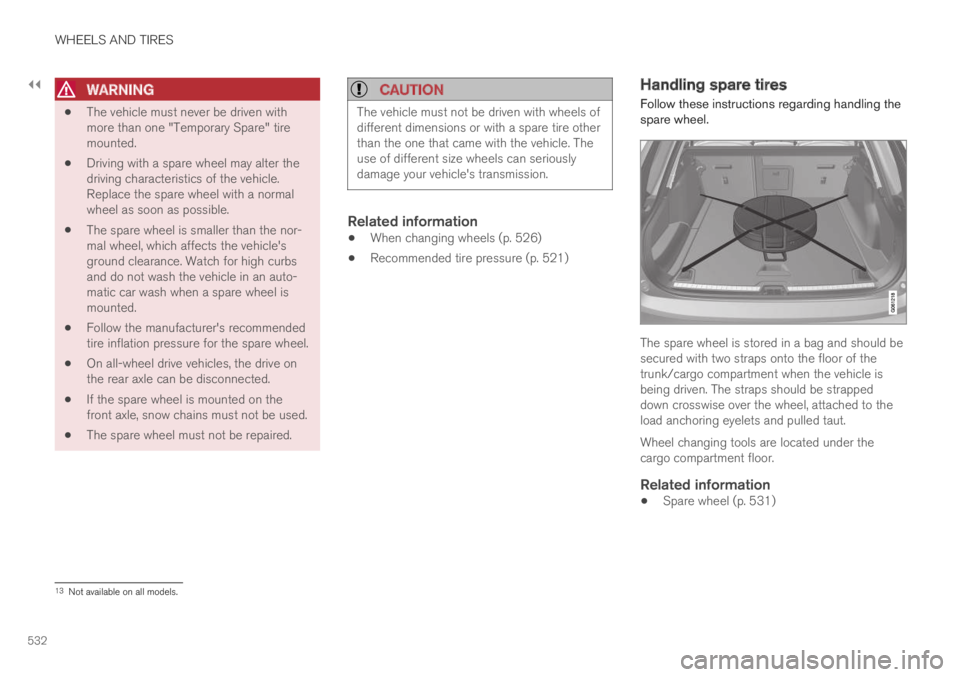
The spare wheel is stored in a bag and should besecured with two straps onto the floor of thetrunk/cargo compartment when the vehicle isbeing driven. The straps should be strappeddown crosswise over the wheel, attached to theload anchoring eyelets and pulled taut.
Wheel changing tools are located under thecargo compartment floor.
Related information
Spare wheel (p. 531)
13Not available on all models.
Page 537 of 645
WHEELS AND TIRES
}}
535
NOTE
The sealing compound effectively seals tireswith punctures in the tread but may not beable to fully seal tires with punctures in thesidewall. Do not use the tire sealing systemon tires with large tears, cracks or similardamage.
NOTE
The compressor is intended for temporary tiresealing and is approved by Volvo.
Location
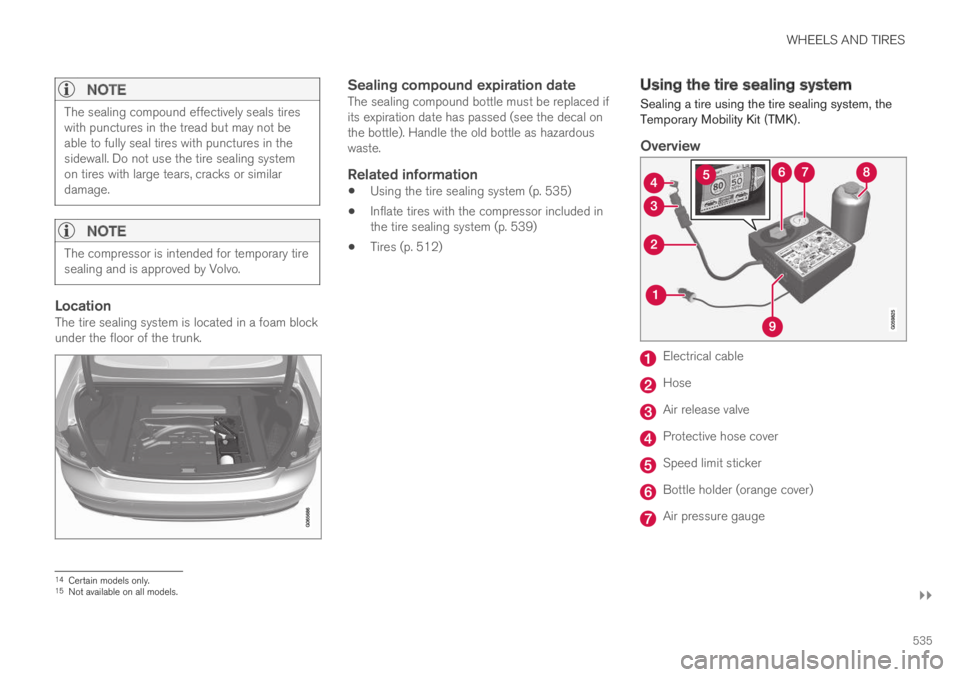
The tire sealing system is located in a foam blockunder the floor of the trunk.
Sealing compound expiration date
The sealing compound bottle must be replaced ifits expiration date has passed (see the decal onthe bottle). Handle the old bottle as hazardouswaste.
Related information
Using the tire sealing system (p. 535)
Inflate tires with the compressor included inthe tire sealing system (p. 539)
Tires (p. 512)
Using the tire sealing system
Sealing a tire using the tire sealing system, theTemporary Mobility Kit (TMK).
Overview
Electrical cable
Hose
Air release valve
Protective hose cover
Speed limit sticker
Bottle holder (orange cover)
Air pressure gauge
14Certain models only.15Not available on all models.
Page 539 of 645
WHEELS AND TIRES
}}
537
3.Make sure the switch is in the 0 (Off) posi-tion and take out the electric cable and thehose.
4.Unscrew the orange cover on the compres-sor and unscrew the cap on the sealing com-pound bottle.
5. Screw the bottle onto the bottle holder as faras possible.
The bottle and the bottle holder are equip-ped with catches to help prevent the sealingcompound from leaking. Once the bottle isscrewed into place into the bottle holder, itcannot be unscrewed. The bottle can only be
removed by a workshop16.
WARNING
Do not unscrew the bottle. It is equipped witha catch to prevent leakage.
6.Unscrew the tire's valve cap and screw thehose's valve connector as far as possibleonto the valve.
Be sure the air release valve on the com-pressor's hose is completely closed.
7. Connect the electrical cable to the nearest12 V outlet and start the vehicle.
NOTE
Make sure that none of the vehicle's other12 V sockets are used while the compressoris running.
WARNING
Never leave children unattended in the vehiclewhile the engine is running.
WARNING
Inhaling exhaust fumes could lead to seriousinjury. Never leave the engine running in anenclosed space or a space without sufficientventilation.
8.Start the compressor by moving the switch tothe I (On) position.
WARNING
Never stand next to a tire being inflated withthe compressor. If cracks, bulges, etc. form onthe tire, switch off the compressor immedi-ately. The vehicle should not be driven. Callroadside assistance to have the vehicle towedto a workshop for inspection/replacement ofthe tire. Volvo recommends an authorizedworkshop.
NOTE
When the compressor first starts, air pressuremay temporarily increase up to 6 bar (88 psi)but should decrease again after approxi-mately 30 seconds.
9. Inflate the tire for 7 minutes.
CAUTION
To help avoid overheating, the compressorshould never be used for more than10 minutes at a time.
16An authorized Volvo workshop is recommended.
Page 540 of 645
||
WHEELS AND TIRES
538
10. Switch off the compressor and check theinflation pressure using the air pressuregauge. The inflation pressure should bebetween 1.8 bar (22 psi) and 3.5 bar(51 psi). If the inflation pressure is too high,use the air release valve to release air.
WARNING
If pressure falls below 1.8 bar (22 psi), thehole in the tire may be too large. The vehicleshould not be driven. Call roadside assistanceto have the vehicle towed to a workshop forinspection/replacement of the tire. Volvo rec-ommends an authorized workshop.
11.Switch off the compressor and remove theelectrical cable.
12. Unscrew the hose from the tire's valve andscrew the valve cap back on.
NOTE
After inflating a tire, always replace thevalve cap to help prevent valve damagecaused by gravel, dirt, etc.
Use plastic valve caps only. Metal capscould corrode and become difficult toremove.
13. Put the protective hose cover onto the hoseto help prevent leakage of any residual seal-ing compound. Return the equipment to thecargo compartment.
14.Immediately drive the vehicle at least 3 km(2 miles) at a maximum speed of 80 km/h(50 mph) to allow the sealing compound toseal the tire, and then recheck the inflationpressure.
WARNING
During the tire's first revolution, some sealingcompound may spray out of the puncturehole. Before driving away, make sure that noone is near the vehicle who could be sprayedwith sealing compound. Make sure no one iswithin 2 meters(7 feet) of the vehicle.
15.Rechecking the inflation pressure
Connect the hose to the tire's valve andscrew the hose connector onto the valve asfar as possible. The compressor must beswitched off.
16.Check the inflation pressure on the air pres-sure gauge.
If the pressure is under 1.3 bar (19 psi),the tire is not sufficiently sealed. The vehi-cle should not be driven. Call roadsideassistance to have the vehicle towed.
If the inflation pressure is higher than1.3 bar (19 psi), the tire must be inflatedto the inflation pressure specified on thetire pressure decal on the driver's sidedoor pillar (1 bar = 100 kPa = 14.5 psi). Ifthe inflation pressure is too high, use theair release valve to release air.
WARNING
Check inflation pressure regularly.
Volvo recommends driving to the nearest author-ized Volvo workshop to have the tire replaced/repaired. Inform the workshop that the tire con-tains sealing compound.
The sealing compound bottle and the hose mustbe replaced after use. Volvo recommends con-tacting an authorized Volvo workshop for replace-ment.
Page 541 of 645
WHEELS AND TIRES
}}
539
WARNING
After using the tire sealing system, the vehicleshould not be driven farther than approxi-mately 200 km (120 miles).
NOTE
The compressor is an electric device. Followlocal regulations for disposal.
Related information
Recommended tire pressure (p. 521)
Tire sealing system (p. 534)
Inflate tires with the compressor included inthe tire sealing system (p. 539)
Inflate tires with the compressorincluded in the tire sealing system
The vehicle's original tires can be inflated usingthe compressor in the tire sealing system.
1. The compressor must be switched off. Makesure that the switch is in the 0 (Off) positionand take out the electrical cable and thehose.
2.Unscrew the tire's valve cap and screw thehose's valve connector as far as possibleonto the valve.
Be sure the air release valve on the com-pressor's hose is completely closed.
3. Connect the electrical cable to the nearest12 V outlet and start the vehicle.
WARNING
Inhaling exhaust fumes could lead to seriousinjury. Never leave the engine running in anenclosed space or a space without sufficientventilation.
WARNING
Never leave children unattended in the vehiclewhile the engine is running.
4.Start the compressor by moving the switch tothe I (On) position.
CAUTION
Risk of overheating. The compressor shouldnot be running for longer than 10 minutes ata time.
5. Inflate the tire to the pressure specified onthe tire pressure decal on the driver's sidedoor pillar. If the inflation pressure is toohigh, use the air release valve to release air.
6.Switch off the compressor. Remove the hoseand the electrical cable.
7. Screw the valve cap back onto the tire.
NOTE
After inflating a tire, always replace thevalve cap to help prevent valve damagecaused by gravel, dirt, etc.
Use plastic valve caps only. Metal capscould corrode and become difficult toremove.
NOTE
The compressor is an electric device. Followlocal regulations for disposal.
Page 553 of 645

LOADING, STORAGE AND PASSENGER COMPARTMENT
}}
* Option/accessory.551
Cargo compartment
Loads can be secured in the trunk to keep themin place while driving.
The folding* rear seat backrests can helpincrease the cargo capacity of the trunk. Loadanchoring eyelets and grocery bag holders areprovided to help secure objects in place.
If the vehicle is equipped with a temporary sparetire, this is secured to the cargo compartmentfloor under the cover. The towing eyelet and tiresealing system are located under the cargo com-partment floor.
Related information
Loading recommendations (p. 551)
Grocery bag holders (p. 553)
Load anchoring eyelets (p. 553)
Loading recommendations
There are a number of things that are importantto consider when carrying loads in or on thevehicle.
Load-carrying capacity is determined by the vehi-cle's curb weight. The total weight of all passen-gers and any installed accessories reduces thevehicle's load-carrying capacity by the corres-ponding amount.
WARNING
The vehicle's driving characteristics changedepending on the weight and position of theload.
Loading the cargo compartment/trunk
Keep the following in mind when loading:
Position objects so they are pressing againstthe rear seat backrests.
Heavy objects should be positioned as lowas possible. Avoid placing heavy objects onfolded-down seat backrests.
Cover sharp corners with a soft cloth or simi-lar to help prevent damage to the upholstery.
Use the load anchoring eyelets and tension-ing straps or similar to secure all objects.
WARNING
In a head-on collision at a speed of 50 km/h(30 mph), an unsecured object weighing20 kg (44 pounds) can reach a projectileweight equivalent to 1000 kg (2200 pounds).
WARNING
If objects are loaded higher than the upperedge of the side windows, leave a 10 cm(4 in.) space between the objects and thewindow. Objects placed closer to this couldimpede the function of the inflatable curtainconcealed inside the headlining.
WARNING
Always secure the load. Otherwise, it may shiftduring heavy braking and injure people in thevehicle.
Cover sharp edges and sharp corners withsomething soft.
Turn off the engine and apply the parkingbrake when loading/unloading long objects.Otherwise, it is possible for the load to reachthe gear lever or gear selector and move it toa drive position – which could cause the vehi-cle to begin rolling.
Page 563 of 645

MAINTENANCE AND SERVICE
}}
* Option/accessory.561
Messages - status messages
Status – checking engine oil level and
AdBlue level4
TPMS - tire inflation pressure check
Appointments - appointment information
and vehicle information3.
Related information
Handling messages saved from the instru-ment panel (p. 105)
Checking and filling engine oil (p. 570)
Tire pressure monitoring system* (p. 521)
Scheduling service and repairs (p. 561)
Sending vehicle information to the workshop(p. 562)
Navigating in the center display's views(p. 113)
Scheduling service and repairs5
This service offers a convenient way to scheduleservice and workshop appoints directly from thevehicle.
When it is time for service, and in certain cases ifthe vehicle requires repairs, a message will bedisplayed in the instrument panel and at the topof the center display. The time for service isdetermined by how much time has elapsed, thenumber of hours the engine has run, or the dis-tance driven since the last service.
To use the service
Create a Volvo ID and register it to the vehi-cle.
To select a Volvo retailer you would like tocontact, go to www.volvocars.com and log in.
To send and receive appointment informa-tion, the vehicle must be connected to the
Internet6.
Book service
Book a service request when desired or when amessage is displayed indicating that service orrepairs are needed.
1.Open the Car Status app from App view inthe center display.
2.Tap Appointments.
3.Tap Request appointment.
4.Check that your Volvo ID is correct.
5.Make sure your preferred Workshop is cor-rect.
6.In the Tap to write information to theworkshop field, you can provide details onwhat you would like performed during thevisit or other important information to yourworkshop.
4AdBlue Diesel models only.3Certain markets only.5Certain markets only.6There may be a charge for transmitting data over the Internet, depending on your service plan.