engine compartment overview VOLVO S60 TWIN ENGINE 2019 Owners Manual
[x] Cancel search | Manufacturer: VOLVO, Model Year: 2019, Model line: S60 TWIN ENGINE, Model: VOLVO S60 TWIN ENGINE 2019Pages: 645, PDF Size: 13.96 MB
Page 14 of 645
12
Tire sealing system534
Using the tire sealing system535
Inflate tires with the compressorincluded in the tire sealing system539
Determining the vehicle's permittedweight540
LOADING, STORAGE AND
PASSENGER COMPARTMENT
Passenger compartment interior544
Tunnel console545
Electrical outlets546
Using the electrical outlets548
Using the glove compartment549
Sun visors550
Cargo compartment551
Loading recommendations551
Roof loads and load carriers552
Grocery bag holders553
Load anchoring eyelets553
Rear seat ski hatch*554
MAINTENANCE AND SERVICE
Volvo's service program556
Data transfer between vehicle andworkshop over Wi-Fi558
Download Center559
Handling system updates via Down-load Center559
Vehicle status560
Scheduling service and repairs561
Sending vehicle information to theworkshop562
Hoisting the vehicle564
Climate control system service566
Replacing a windshield with head-updisplay*566
Opening and closing the hood566
Engine compartment overview568
Engine oil569
Checking and filling engine oil570
Refilling coolant571
Replacing bulbs572
Start battery574
Hybrid battery578
Battery symbols579
Battery recycling579
Fuses and fuseboxes580
Replacing fuses580
Page 560 of 645
||
MAINTENANCE AND SERVICE
558
Monthly:
Check cold tire pressure in all tires. Inspectthe tires for wear.
Check that engine coolant and other fluidlevels are between the indicated "min" and"max" markings.
Clean interior glass surfaces with a glasscleaner and soft paper towels.
Wipe driver information displays with a softcloth.
Visually inspect battery terminals for corro-sion. Corrosion may indicate a loose terminalconnector, or a battery near the end of itsuseful service life. Consult your Volvo retailerfor additional information.
As needed:
Wash the vehicle, including the undercarriage, toreduce wear that can be caused by a buildup ofdirt, and corrosion that can be caused by salt res-idues.
Clean leaves and twigs from air intake vents atthe base of the windshield, and from other placeswhere they may collect.
NOTE
Complete service information for qualifiedtechnicians is available online for purchase orsubscription at www.volvotechinfo.com.
Related information
Vehicle status (p. 560)
Scheduling service and repairs (p. 561)
Connecting equipment to the vehicle's datalink connector (p. 37)
Technician certification (p. 38)
Climate control system service (p. 566)
Maintenance of the brake system (p. 399)
Engine compartment overview (p. 568)
Data transfer between vehicle andworkshop over Wi-Fi
Volvo workshops have a designated Wi-Fi net-work for secure data transfer between your vehi-cle and the workshop. Your visit to the workshopwill be easier and more effective when diagnos-tics information and software can be transferredover the workshop's network.
At the workshop, your service technician can con-nect your vehicle to the workshop's Wi-Fi net-work to perform troubleshooting and downloadsoftware. For this type of communication, thevehicle only connects to a workshop's network. Itis not possible to connect the vehicle to anotherWi-Fi network (e.g. your home network) in thesame way as to a workshop's network.
Connecting with remote key
Connection is usually managed by the servicetechnician, who will use the remote key buttons. Itis therefore important to bring a key with buttonswith you when you visit the workshop. Pressingthe lock button on the remote key three times willconnect the vehicle to the workshop's Wi-Fi net-work.
When the car is connected to a Wi-Fi network,
the symbol appears in the center display.
Page 569 of 645
MAINTENANCE AND SERVICE
567
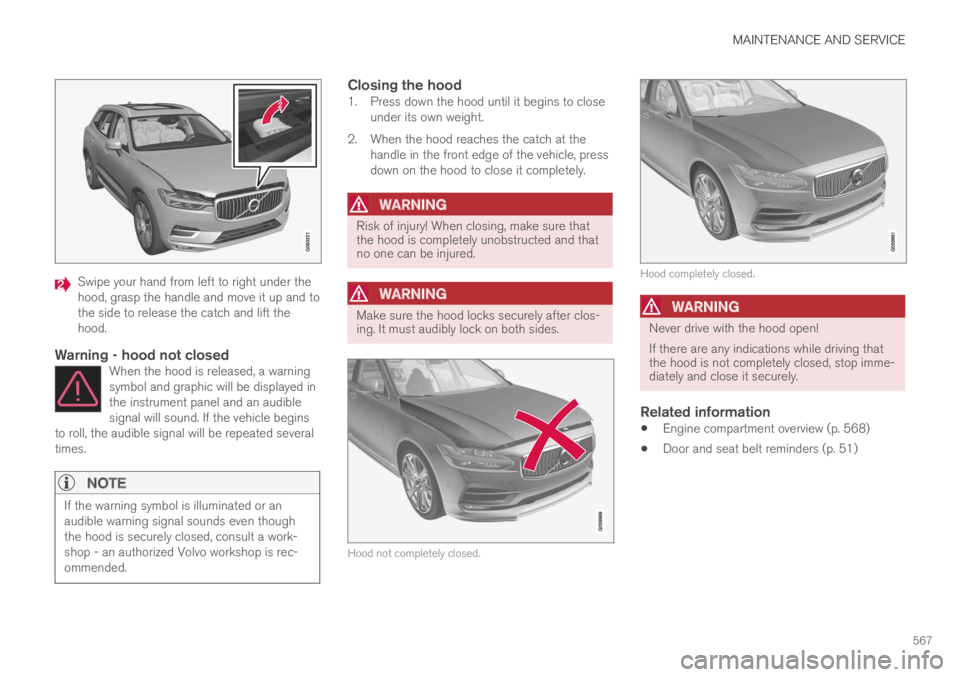
Swipe your hand from left to right under thehood, grasp the handle and move it up and tothe side to release the catch and lift thehood.
Warning - hood not closed
When the hood is released, a warningsymbol and graphic will be displayed inthe instrument panel and an audiblesignal will sound. If the vehicle beginsto roll, the audible signal will be repeated severaltimes.
NOTE
If the warning symbol is illuminated or anaudible warning signal sounds even thoughthe hood is securely closed, consult a work-shop - an authorized Volvo workshop is rec-ommended.
Closing the hood
1. Press down the hood until it begins to closeunder its own weight.
2. When the hood reaches the catch at thehandle in the front edge of the vehicle, pressdown on the hood to close it completely.
WARNING
Risk of injury! When closing, make sure thatthe hood is completely unobstructed and thatno one can be injured.
WARNING
Make sure the hood locks securely after clos-ing. It must audibly lock on both sides.
Hood not completely closed.
Hood completely closed.
WARNING
Never drive with the hood open!
If there are any indications while driving thatthe hood is not completely closed, stop imme-diately and close it securely.
Related information
Engine compartment overview (p. 568)
Door and seat belt reminders (p. 51)
Page 570 of 645
MAINTENANCE AND SERVICE
568
Engine compartment overview
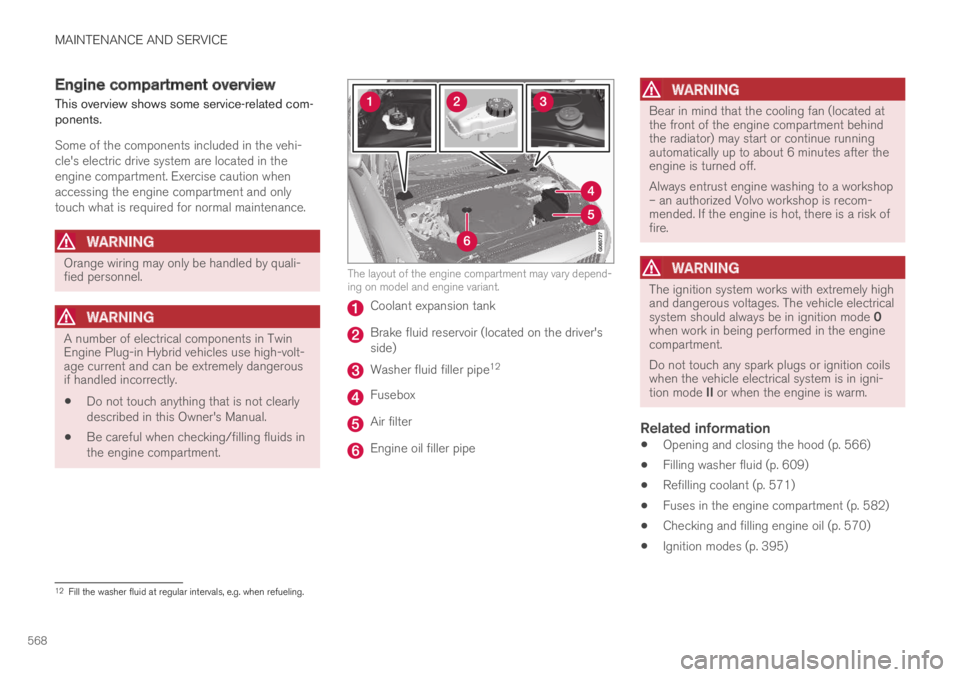
This overview shows some service-related com-ponents.
Some of the components included in the vehi-cle's electric drive system are located in theengine compartment. Exercise caution whenaccessing the engine compartment and onlytouch what is required for normal maintenance.
WARNING
Orange wiring may only be handled by quali-fied personnel.
WARNING
A number of electrical components in TwinEngine Plug-in Hybrid vehicles use high-volt-age current and can be extremely dangerousif handled incorrectly.
Do not touch anything that is not clearlydescribed in this Owner's Manual.
Be careful when checking/filling fluids inthe engine compartment.
The layout of the engine compartment may vary depend-ing on model and engine variant.
Coolant expansion tank
Brake fluid reservoir (located on the driver'sside)
Washer fluid filler pipe12
Fusebox
Air filter
Engine oil filler pipe
WARNING
Bear in mind that the cooling fan (located atthe front of the engine compartment behindthe radiator) may start or continue runningautomatically up to about 6 minutes after theengine is turned off.
Always entrust engine washing to a workshop– an authorized Volvo workshop is recom-mended. If the engine is hot, there is a risk offire.
WARNING
The ignition system works with extremely highand dangerous voltages. The vehicle electricalsystem should always be in ignition mode 0when work in being performed in the enginecompartment.
Do not touch any spark plugs or ignition coilswhen the vehicle electrical system is in igni-tion mode II or when the engine is warm.
Related information
Opening and closing the hood (p. 566)
Filling washer fluid (p. 609)
Refilling coolant (p. 571)
Fuses in the engine compartment (p. 582)
Checking and filling engine oil (p. 570)
Ignition modes (p. 395)
12Fill the washer fluid at regular intervals, e.g. when refueling.
Page 574 of 645
||
MAINTENANCE AND SERVICE
572
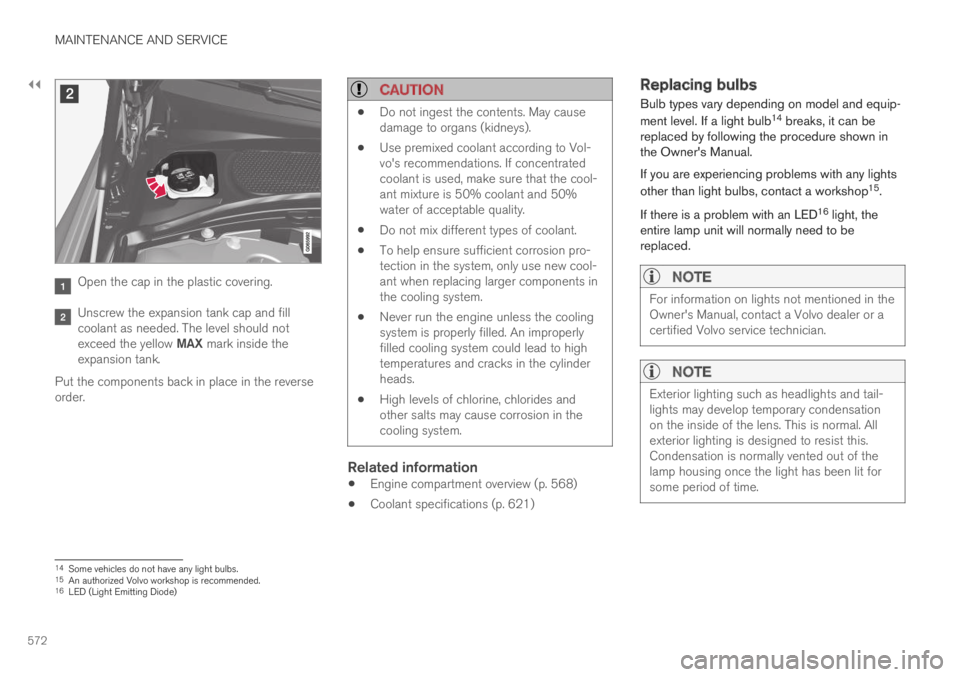
Open the cap in the plastic covering.
Unscrew the expansion tank cap and fillcoolant as needed. The level should notexceed the yellow MAX mark inside theexpansion tank.
Put the components back in place in the reverseorder.
CAUTION
Do not ingest the contents. May causedamage to organs (kidneys).
Use premixed coolant according to Vol-vo's recommendations. If concentratedcoolant is used, make sure that the cool-ant mixture is 50% coolant and 50%water of acceptable quality.
Do not mix different types of coolant.
To help ensure sufficient corrosion pro-tection in the system, only use new cool-ant when replacing larger components inthe cooling system.
Never run the engine unless the coolingsystem is properly filled. An improperlyfilled cooling system could lead to hightemperatures and cracks in the cylinderheads.
High levels of chlorine, chlorides andother salts may cause corrosion in thecooling system.
Related information
Engine compartment overview (p. 568)
Coolant specifications (p. 621)
Replacing bulbs
Bulb types vary depending on model and equip-
ment level. If a light bulb14 breaks, it can bereplaced by following the procedure shown inthe Owner's Manual.
If you are experiencing problems with any lights
other than light bulbs, contact a workshop15.
If there is a problem with an LED16 light, theentire lamp unit will normally need to bereplaced.
NOTE
For information on lights not mentioned in theOwner's Manual, contact a Volvo dealer or acertified Volvo service technician.
NOTE
Exterior lighting such as headlights and tail-lights may develop temporary condensationon the inside of the lens. This is normal. Allexterior lighting is designed to resist this.Condensation is normally vented out of thelamp housing once the light has been lit forsome period of time.
14Some vehicles do not have any light bulbs.15An authorized Volvo workshop is recommended.16LED (Light Emitting Diode)
Page 623 of 645

SPECIFICATIONS
621
Coolant specifications
Recommended grade: Volvo-approved pre-mixed coolant. If concentrated coolant is used,mix with 50% water of acceptable quality (i.e.not salt water, etc.). Consult a Volvo retailer ifyou have any questions.
To avoid deterioration of the cooling system,engine trouble, etc., only approved Volvo coolantshould be used.
WARNING
Coolant is hazardous if ingested and couldcause damage to organs (kidneys). The prod-uct contains ethylene glycol, inhibitor, emetic,water, etc.
Related information
Refilling coolant (p. 571)
Transmission fluid specifications
Under normal driving conditions, the transmis-sion fluid will not need to be changed during thetransmission's service life. However, it may needto be changed if the vehicle is driven frequentlyin adverse driving conditions.
Automatic transmission
Prescribed transmission fluid:AW1
Related information
Type designations (p. 612)
Brake fluid specifications
The medium in the hydraulic brake system iscalled brake fluid and is used to transfer brakingforce from e.g. pressure on the brake pedal via amaster brake cylinder to one or more slave cylin-ders, which in turn act on a mechanical brake.
Recommended grade: Volvo Original or similarfluid that meets a combination of Dot 4, 5.1 andISO 4925 class 6.
NOTE
Changing or filling brake fluid should beentrusted to an authorized Volvo workshop.
Related information
Engine compartment overview (p. 568)
Page 631 of 645

INDEX
629
Drive systems 410
Driving
cooling system 431
with a trailer 434
Driving economy 420
Driving through standing water 425
driving with a trailer
towball load 618
towing capacity 618
E
Economical driving420
Electrical outlet546
use548
Electrical system 574
Electric drive motor
specifications 619
electric motor 410
Range 421
Electric parking brake 400
Electronic immobilizer 243
emergency brake lights 159
Emission inspection readiness 556
Energy distribution
using map data 417
Engine
automatic start and stop of combustion
engine411
overheating431
start392
turn off394
Engine braking 397, 406
Engine compartment
coolant 571
engine oil 569
overview 568
Engine drag control 261
Engine oil 569
filling 570
filter 569
grade and volume 620
Engine shutdown 394
Engine specifications 619
Engine temperature
high 431
Environment 27
Ethanol content
max. 10% by volume 428
Exterior dimensions 615
Extra heater (Auxiliary heater) 224
F
Federal Clean Air Act556
Ferry transport418
Flooded road425
Fluids, volumes609, 622
Fluids and oils621, 622
Fog lights
front157
rear158
Four-C418
Front seat
blower214
climate207
heating208, 209
temperature215
ventilation209
Front seat manual180
Front seats, power181
adjusting passenger seat from driver's
seat188
adjusting seat181
Lumbar support187
massage184, 185
multifunction control 184, 185, 186, 187
Side bolsters186
store position182, 183
FSC, environmental labeling23