page 74 VOLVO S70 1999 User Guide
[x] Cancel search | Manufacturer: VOLVO, Model Year: 1999, Model line: S70, Model: VOLVO S70 1999Pages: 61, PDF Size: 0.88 MB
Page 17 of 61
Chapter 4 - Starting and driving
pg. 65 Starting and driving
Starting and driving
This section on starting and driving contains items such as starting the engine, operating the gear selector, towing,
trailers, etc. Page No.
Subject
pg. 66Break-in period
pg. 66-67
Fuel requirements, Refueling
pg. 68
Driving economy
pg. 69
Starting the engine
pg. 70
Manual transmission
pg. 70-73
Automatic transmission, All Wheel Drive (AWD)
pg. 74-75
Points to remember
pg. 76
Emergency towing
pg. 77
Vehicle towing information
pg. 78
Jump starting
pg. 79
Three-way catalytic converter
pg. 80
Brake system, ABS
pg. 81
TRACS/STC
pg. 82
Winter driving
pg. 83
Long distance trips
pg. 84
Trailer towing
pg. 66 Break-in period, Fuel requirements
A new car should be broken-in
Refrain from utilizing your car's full driving potential during the first 1,200 miles (2,000 km) including the "kick -
down" function (automatic transmission).
NOTE - ENGINE OIL:
Although some oil consumption occurs during normal engine operation, more oil is consumed when the engine is new
as the internal parts generate higher friction while wearing-in to each other. From the time the engine is new until the
first service is performed, the oil consumption could be higher than normal. For this reason, it is especially important
to check the oil every time you refuel your car during this period. See page 124
.
In general, the rate of oil consumption depends on such factors as: engine temperature, length of trip, driving
conditions, oil viscosity and quality, engine speed and acceleration/deceleration.
Checking your engine oil level each time the car is refueled is one of the most important items you can perform to
ProCarManuals.com
Page 19 of 61
Octane Rating
Volvo engines are designed for optimum performance on unleaded premium gasoline with an octane rating. AKI of 91,
or above. AKI (ANTI KNOCK INDEX) is an average of the Research Octane Number, RON, and the Motor Octane
Number, MON, (RON + MON/ 2).
The minimum octane requirement is AKI 87 (RON 91).
Gasoline containing alcohol and ethers
"Oxygenated fuels"
Some fuel suppliers sell gasoline containing "oxygenates" which are usually alcohols or ethers. In some areas, state or
local laws require that the service pump be marked indicating use of alcohol or ethers. However, there are areas in
which the pumps are unmarked. If you are not sure whether there is alcohol or ethers in the gasoline you buy, check
with the service station operator.
To meet seasonal air quality restrictions, some states require the use of "oxygenated" fuel in certain areas.
Volvo allows the use of the following "oxygenated fuels; however, the octane ratings listed on this page must still be
met.
Alcohol — Ethanol
Fuels containing up to 10% ethanol by volume may be used.
Ethanol may also be referred to as Ethyl alcohol, or "Gasohol".
Ethers — MTBE
Fuels containing up to 15% MTBE may be used.
Refueling
The fuel tank is designed to hold approximately:
18.4 US gal. (68 liters) - Front Wheel Drive
17.4 US gal. (66 liters) - All Wheel Drive
with sufficient volume left over to accommodate possible expansion of the fuel in hot weather. Be aware that the
"usable" tank will be somewhat less than the specified maximum. When the fuel level is low, such factors as ambient
temperature, the fuel's "Reid vapor pressure" characteristics, and terrain can affect the fuel pumps' ability to supply the
engine with an adequate supply of fuel. Therefore, it is advisable to refuel as soon as possible when the needle nears
the red zone, or when the fuel warning light comes on.
Fuel tank cover
The fuel tank cover (on the fight rear fender) is locked and must be popped open using the control on the driver's door.
ProCarManuals.com
Page 21 of 61
Incorrect spark plug gap
Dirty air cleaner
Dirty engine oil and clogged oil filter
Dragging brakes
Incorrect front end alignment
Some of the above mentioned items and others are checked at the standard Maintenance Service intervals.
NOTE: ( D )rive or 5th gear (manual transmissions) should be used as often as possible to help improve fuel economy.
Contents | Top of Page
ProCarManuals.com
Page 22 of 61
Chapter 5 - Wheels and tires
pg. 85 Wheels and tires
Wheels and tires
The handling and riding comfort of the vehicle is dependent on the inflation pressure and the type of tires fitted. Read
the following pages carefully. Page No.
Subject
pg. 86General information, Wear indicator, Tire economy, Flat spots
pg. 87
Snow chains, Winter tires
pg. 88
Inflation pressure
pg. 89
Uniform tire quality grading
pg. 86 Wheels and tires
General information
Your vehicle is equipped with tires according to the tire information label located on the rear facing side of the right
front door.
The following is an example of a tire designation code 195/60R15:
195 = tire width in mm.
60 = tire profile. This is the relationship (in percent) between the section height and the width of the tire.
R = radial tires.
15 = diameter in inches.
The tires have good road holding characteristics and offer good handling on dry and wet surfaces. It should be noted
however that the tires have been developed to give these features on snow/ice-free surfaces. Certain models are
equipped with "all-season" tires, which provide a somewhat higher degree of winter roadholding on slippery surfaces
than tires without the "all-season" rating. However, for optimum road holding on icy or snow covered roads - we
recommend suitable winter tires on all four wheels. When replacing tires, be sure that the new tires are the same size
designation, type (radial) and preferably from the same manufacturer, on all four wheels. Otherwise there is a risk of
altering the car's road-holding and handling characteristics .
NOTE: When storing wheel/tire assemblies (e.g. winter tires and wheels), either stand the assemblies upright or
suspend them off the ground. Laying wheel/tire assemblies on their sides for prolonged periods can cause wheel and/or
tire damage.
ProCarManuals.com
Page 26 of 61
Uniform tire quality grading
ALL PASSENGER CAR TIRES MUST CONFORM TO FEDERAL SAFETY REQUIREMENTS IN ADDITION TO
THESE GRADES
TREADWEAR
The treadwear grade is a comparative rating based on the wear rate of the tire when tested under controlled conditions
on a specified government test course. For example, a tire graded at 150 would wear one and one half (1 1/2) times as
well on the government course as a tire graded 100. The relative performance of tires depends upon the actual
conditions of their use, however, and many depart significantly from the norm due to variation in driving habits,
service practices and differences in road characteristics and climate.
TRACTION
The traction grades, from highest to lowest, are AA, A, B, and C, as measured under controlled conditions on specified
government test surfaces of asphalt and concrete. A tire marked C may have poor traction performance.WARNING! The traction grade assigned to this tire is based on braking (straight-ahead) traction tests and does not
include cornering (turning) traction.
TEMPERATURE
The temperature grades are AA (the highest), A, B, and C, representing the tire's resistance to the generation of heat
and its ability to dissipate heat when tested under controlled conditions on a specified indoor laboratory test wheel.
Sustained high temperature can cause the material of the tire to degenerate and reduce tire life, and excessive
temperature can lead to sudden tire failure. The grade C corresponds to a level of performance which all passenger car
tires must meet under the Federal Motor Safety Standard No. 109. Grades B and A represent higher levels of
performance on the laboratory test wheel than the minimum required by law. WARNING! The temperature grade for this tire is established for a tire that is properly inflated and not overloaded.
Excessive speed, underinflation, or excessive loading, either separately or in combination, can cause heat buildup and
possible tire failure.
Contents | Top of Page
ProCarManuals.com
Page 28 of 61
With the car still on the ground, use the lug wrench to loosen the wheel bolts 1/2 - 1 turn. Turn the bolts
counterclockwise to loosen.
Fold out the crank handle on the jack by pressing the nob on the handle downward. To attach the jack, refer to the
illustration on the following page.
NOTE: To avoid excessive wear and the necessity of rebalancing, mark and reinstall wheels in same location and
position as before removal. To lessen the chance of imbalance, each wheel hub is equipped with a guide stud to ensure
that a removed wheel can be reinstalled in its original position (as when changing over to winter tires/wheels).
CAUTION:
The car must not be driven with wheels of different dimensions or with a spare tire other than the one that came
with the car. The use of different size wheels can seriously damage your car's transmission.
Correct tightening torque on wheel bolts must be observed. The wheel bolts must be observed. The wheel bolts
should never be greased or lubricated. The extended, chromed wheel bolts must not be used with steel rims, as they
make it impossible to fit the hub caps.
WARNING!
The jack (see the following page) must engage the bar in the jack attachment (A). The car's weight must not rest on
the jack's attachment (B).
Be sure the jack is on a firm, level, non-slippery surface.
Never allow any part of your body to be extended under a car supported by a jack.
Use the jack intended for the car when replacing a wheel. For any other job, use stands to support the end of the
car being worked on.
Apply the parking brake, select position P (automatic transmission) or Reverse gear (manual transmission).
Block the wheels standing on the ground, use rigid wooden blocks or large stones.
The jack should be kept well-greased.
pg. 93 Wheel changing (cont.)
ProCarManuals.com
Page 31 of 61
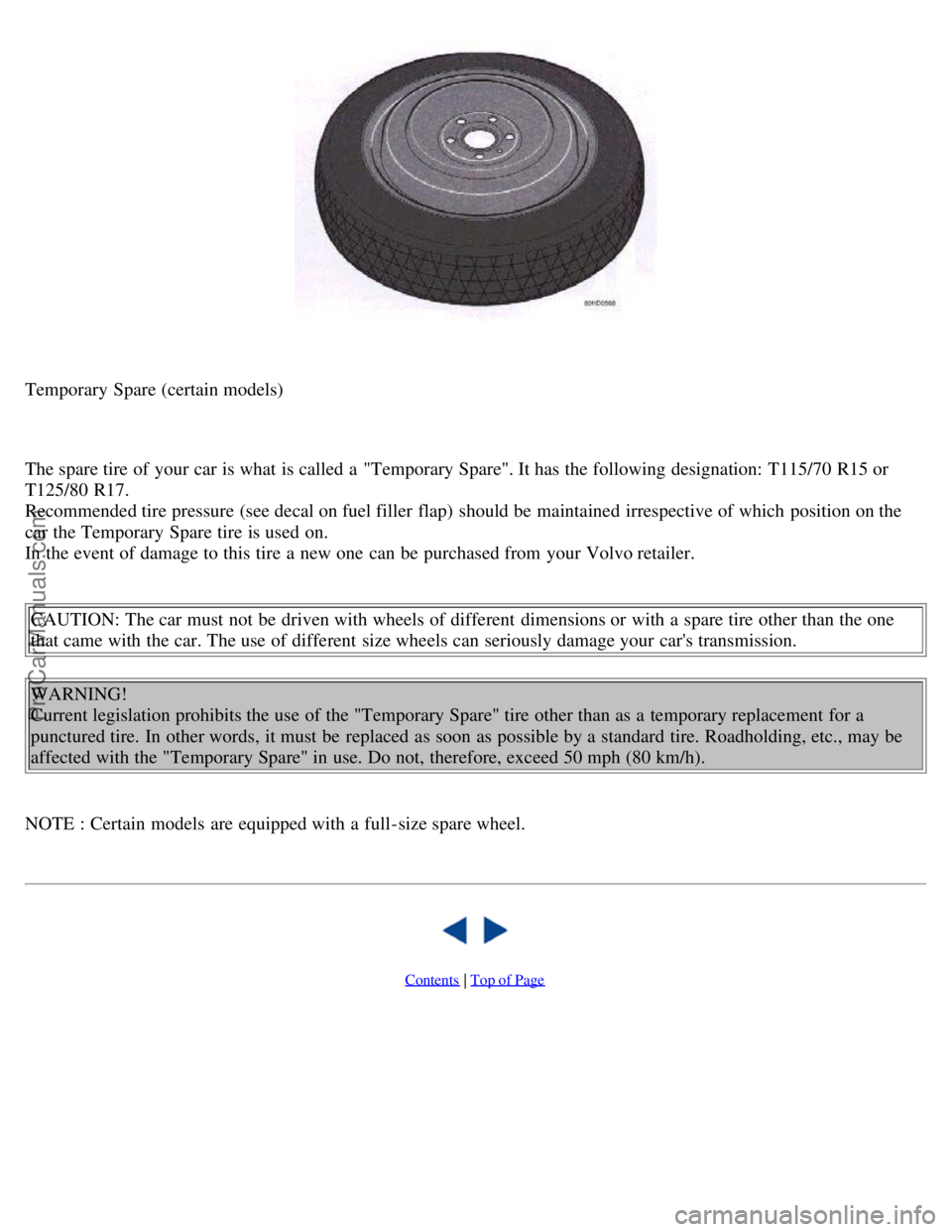
Temporary Spare (certain models)
The spare tire of your car is what is called a "Temporary Spare". It has the following designation: T115/70 R15 or
T125/80 R17.
Recommended tire pressure (see decal on fuel filler flap) should be maintained irrespective of which position on the
car the Temporary Spare tire is used on.
In the event of damage to this tire a new one can be purchased from your Volvo retailer.CAUTION: The car must not be driven with wheels of different dimensions or with a spare tire other than the one
that came with the car. The use of different size wheels can seriously damage your car's transmission.
WARNING!
Current legislation prohibits the use of the "Temporary Spare" tire other than as a temporary replacement for a
punctured tire. In other words, it must be replaced as soon as possible by a standard tire. Roadholding, etc., may be
affected with the "Temporary Spare" in use. Do not, therefore, exceed 50 mph (80 km/h).
NOTE : Certain models are equipped with a full-size spare wheel.
Contents | Top of Page
ProCarManuals.com
Page 32 of 61

Chapter 7 - Car care
pg. 109 Car care
Car care
Car care includes not only maintaining the appearance of the car, but also protecting the car exterior from the effects of
air pollution, rain, mud or road salt. The paintwork should also be touched up immediately, if damaged, to preventrust
formation. Page No. Subject
pg. 110-111
Paint touch-up
pg. 112
Washing
pg. 113
Automatic car washing, Polishing and waxing
pg. 114
Cleaning the upholstery
pg. 110 Paint touch-up
Paint touch-up
Paint damage requires immediate attention to avoid rusting. Make it a habit to check the finish regularly - when
washing the car for instance. Touch up if necessary.
Paint repairs require special equipment and skill. Contact your Volvo retailer for any extensive damage.
Minor scratches can be repaired by using Volvo touch-up paint.
NOTE: When ordering touch-up paint from your Volvo retailer, use the paint code indicated on the model plate. The
plate is located in the engine compartment, on the inside of the left front fender.
Minor stone chips and scratches
ProCarManuals.com
Page 37 of 61

Take extra care when removing stains such as ink or lipstick since the coloring can spread.
Use solvents sparingly. Too much solvent can damage the seat padding.
Start from the outside of the stain and work toward the center.
Contents | Top of Page
ProCarManuals.com
Page 38 of 61
Chapter 8 - Service and routine maintenance
pg. 115 Volvo Service
Service - an investment
An investment which will pay dividends in the form of improved reliability, durability, and resale value. Page No. Subject
pg. 116
Label information
pg. 117
Maintenance service, Warranty
pg. 118-119
Maintenance schedule
pg. 120-121
Servicing
pg. 122
Fuel/emissions systems
pg. 123
Lubrication
pg. 124-125
Engine oil
pg. 126
Power steering fluid, Brake/clutch system fluid reservoir
pg. 127
Automatic transmission fluid
pg. 128
Drive belt, Air pump system
pg. 129
Windshield washer nozzle, Washer fluid reservoir
pg. 130
Coolant
pg. 131
Engine compartment
pg. 132
Battery maintenance
pg. 116 Label information
1 Vehicle Emission Control Information
Your Volvo is designed to meet all applicable emission standards, as evidenced by the certification label on the
underside of the hood. For further information regarding these regulations, please consult your Volvo retailer.
2 Vacuum hose routing
(underside of hood)
3 Loads and Tire Pressures
(on inside of fuel tank cover)
4 Model plate
Vehicle Identification Number (VIN). Codes for color and upholstery etc. The plate is located in the engine
compartment, on the inside of left front fender. headlight.
5 Vehicle Identification Number (VIN) *
The VIN plate is located on the top left surface of the dashboard. The VIN is also stamped on the right hand door
pillar.
6 Federal Motor Vehicle Safety Standards (FMVSS) specifications (USA) and Ministry of Transport (CMVSS)
Standards (Canada)
Your Volvo is designed to meet all applicable safety standards, as evidenced by the certification label on the facing
side of the driver's door. For further information regarding these regulations, please consult your Volvo retailer.
7 Child safety latch label
ProCarManuals.com