wheel VOLVO S70 1999 User Guide
[x] Cancel search | Manufacturer: VOLVO, Model Year: 1999, Model line: S70, Model: VOLVO S70 1999Pages: 61, PDF Size: 0.88 MB
Page 25 of 61
direction throughout theirentire lifetime. In other words, if you wish to rotate the wheels, make sure that the same
wheels are always on the same side of the car.
NOTE: Please consult state or provincial regulations restricting the use of studded winter tires before installing such
tires.
* Where permitted
** All Wheel Drive models, including the AWD XC should be equipped with 195/65 R15 winter tirespg. 88 Wheels and tires (cont.)
Checking and correcting tire pressure
Check the tire pressure when refueling.
The tire pressure should be corrected only when the tires are cold.
With warm tires, correct only when the pressure is too low. The tire temperature rises after driving just a few miles.
Vehicle Loading
The tires on your Volvo will perform to specifications at all normal loads when inflated as recommended on the tire
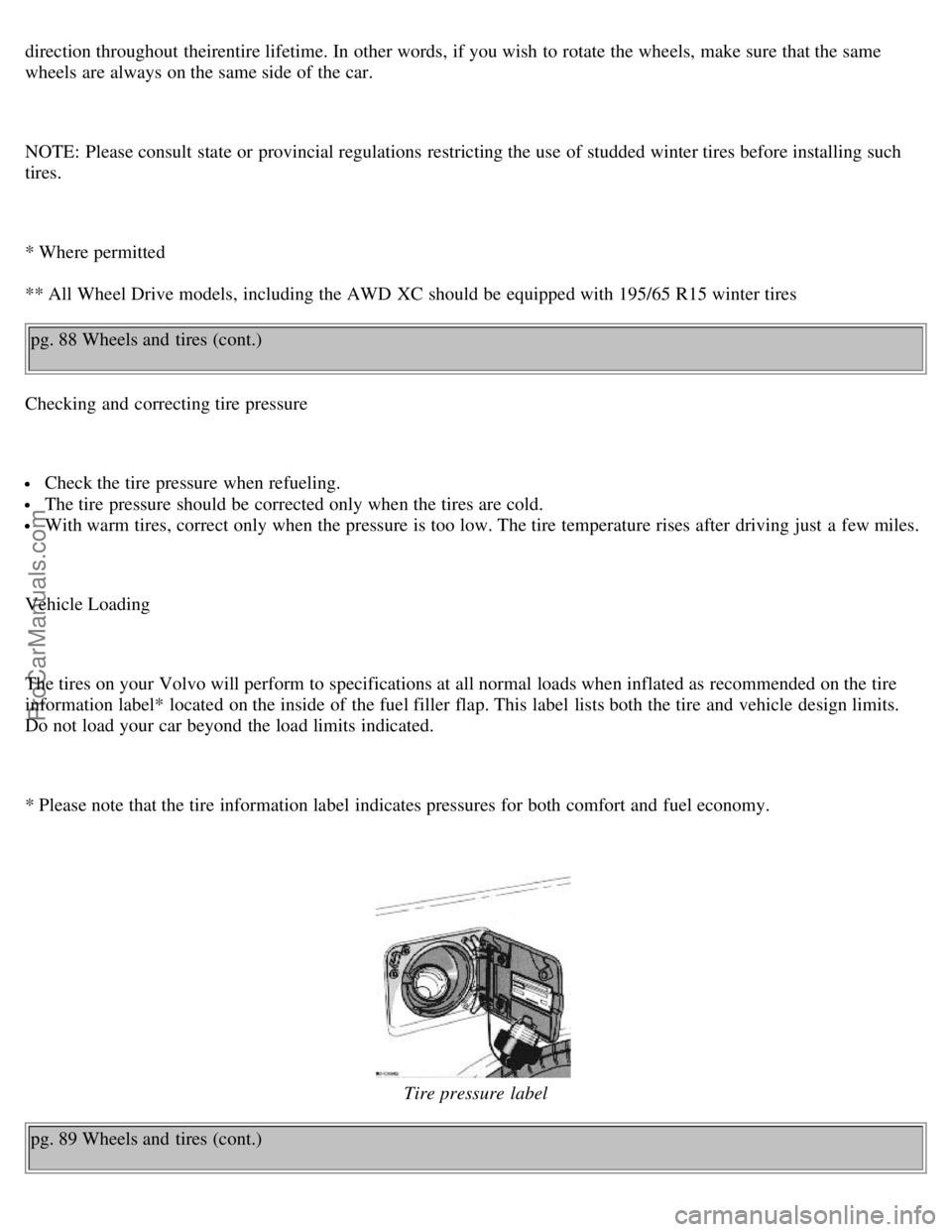
information label* located on the inside of the fuel filler flap. This label lists both the tire and vehicle design limits.
Do not load your car beyond the load limits indicated.
* Please note that the tire information label indicates pressures for both comfort and fuel economy.
Tire pressure label
pg. 89 Wheels and tires (cont.)
ProCarManuals.com
Page 26 of 61
Uniform tire quality grading
ALL PASSENGER CAR TIRES MUST CONFORM TO FEDERAL SAFETY REQUIREMENTS IN ADDITION TO
THESE GRADES
TREADWEAR
The treadwear grade is a comparative rating based on the wear rate of the tire when tested under controlled conditions
on a specified government test course. For example, a tire graded at 150 would wear one and one half (1 1/2) times as
well on the government course as a tire graded 100. The relative performance of tires depends upon the actual
conditions of their use, however, and many depart significantly from the norm due to variation in driving habits,
service practices and differences in road characteristics and climate.
TRACTION
The traction grades, from highest to lowest, are AA, A, B, and C, as measured under controlled conditions on specified
government test surfaces of asphalt and concrete. A tire marked C may have poor traction performance.WARNING! The traction grade assigned to this tire is based on braking (straight-ahead) traction tests and does not
include cornering (turning) traction.
TEMPERATURE
The temperature grades are AA (the highest), A, B, and C, representing the tire's resistance to the generation of heat
and its ability to dissipate heat when tested under controlled conditions on a specified indoor laboratory test wheel.
Sustained high temperature can cause the material of the tire to degenerate and reduce tire life, and excessive
temperature can lead to sudden tire failure. The grade C corresponds to a level of performance which all passenger car
tires must meet under the Federal Motor Safety Standard No. 109. Grades B and A represent higher levels of
performance on the laboratory test wheel than the minimum required by law. WARNING! The temperature grade for this tire is established for a tire that is properly inflated and not overloaded.
Excessive speed, underinflation, or excessive loading, either separately or in combination, can cause heat buildup and
possible tire failure.
Contents | Top of Page
ProCarManuals.com
Page 27 of 61
Chapter 6 - In case of emergency
pg. 91 In case of an emergency
In case of an emergency
Even if you maintain your car in good running condition, there is always the possibility that something might go wrong
and prevent you from driving, such as a punctured tire, blown fuse or bulb, etc. For additional information, see section
"ON CALL Road Assistance". pg. 92-93
Wheel changing
pg. 94
Spare tire
pg. 95-101
Replacing bulbs
pg. 102-104
Replacing fuses
pg. 105
Installation of accessories
pg. 106-107
Replacing wiper blades
pg. 108
In case of emergency
pg. 92 Wheel changing
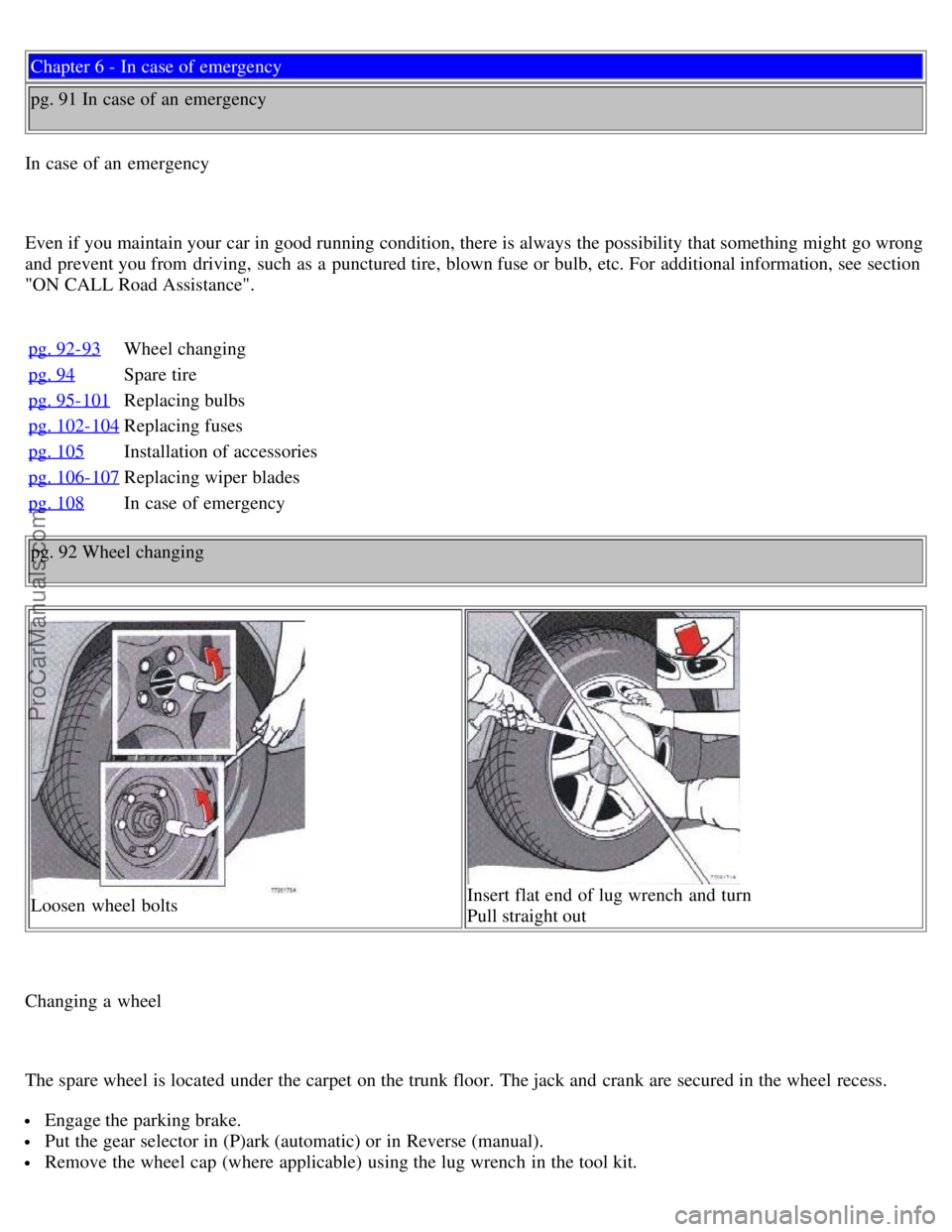
Loosen wheel boltsInsert flat end of lug wrench and turn
Pull straight out
Changing a wheel
The spare wheel is located under the carpet on the trunk floor. The jack and crank are secured in the wheel recess.
Engage the parking brake.
Put the gear selector in (P)ark (automatic) or in Reverse (manual).
Remove the wheel cap (where applicable) using the lug wrench in the tool kit.
ProCarManuals.com
Page 28 of 61
With the car still on the ground, use the lug wrench to loosen the wheel bolts 1/2 - 1 turn. Turn the bolts
counterclockwise to loosen.
Fold out the crank handle on the jack by pressing the nob on the handle downward. To attach the jack, refer to the
illustration on the following page.
NOTE: To avoid excessive wear and the necessity of rebalancing, mark and reinstall wheels in same location and
position as before removal. To lessen the chance of imbalance, each wheel hub is equipped with a guide stud to ensure
that a removed wheel can be reinstalled in its original position (as when changing over to winter tires/wheels).
CAUTION:
The car must not be driven with wheels of different dimensions or with a spare tire other than the one that came
with the car. The use of different size wheels can seriously damage your car's transmission.
Correct tightening torque on wheel bolts must be observed. The wheel bolts must be observed. The wheel bolts
should never be greased or lubricated. The extended, chromed wheel bolts must not be used with steel rims, as they
make it impossible to fit the hub caps.
WARNING!
The jack (see the following page) must engage the bar in the jack attachment (A). The car's weight must not rest on
the jack's attachment (B).
Be sure the jack is on a firm, level, non-slippery surface.
Never allow any part of your body to be extended under a car supported by a jack.
Use the jack intended for the car when replacing a wheel. For any other job, use stands to support the end of the
car being worked on.
Apply the parking brake, select position P (automatic transmission) or Reverse gear (manual transmission).
Block the wheels standing on the ground, use rigid wooden blocks or large stones.
The jack should be kept well-greased.
pg. 93 Wheel changing (cont.)
ProCarManuals.com
Page 29 of 61
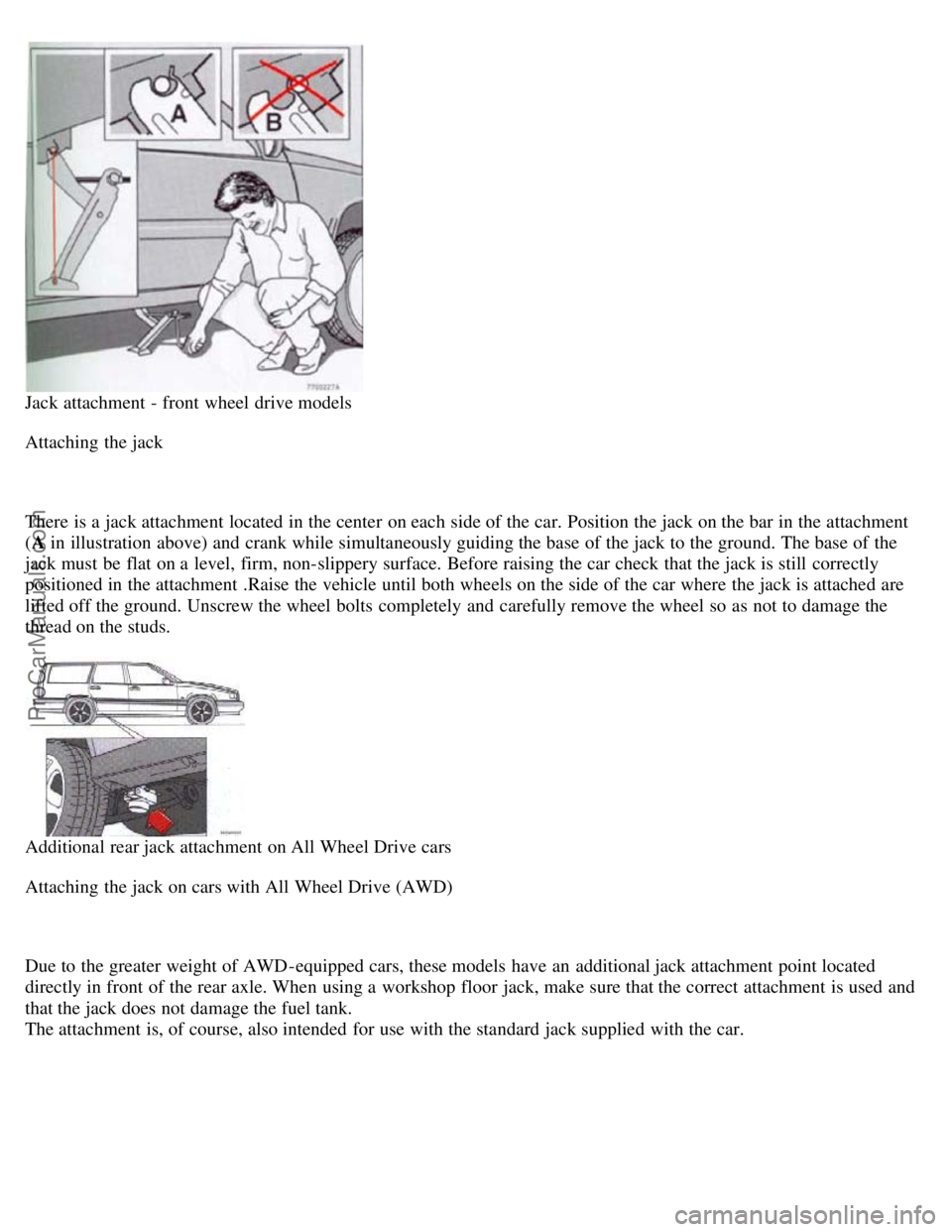
Jack attachment - front wheel drive models
Attaching the jack
There is a jack attachment located in the center on each side of the car. Position the jack on the bar in the attachment
(A in illustration above) and crank while simultaneously guiding the base of the jack to the ground. The base of the
jack must be flat on a level, firm, non-slippery surface. Before raising the car check that the jack is still correctly
positioned in the attachment .Raise the vehicle until both wheels on the side of the car where the jack is attached are
lifted off the ground. Unscrew the wheel bolts completely and carefully remove the wheel so as not to damage the
thread on the studs.
Additional rear jack attachment on All Wheel Drive cars
Attaching the jack on cars with All Wheel Drive (AWD)
Due to the greater weight of AWD-equipped cars, these models have an additional jack attachment point located
directly in front of the rear axle. When using a workshop floor jack, make sure that the correct attachment is used and
that the jack does not damage the fuel tank.
The attachment is, of course, also intended for use with the standard jack supplied with the car.
ProCarManuals.com
Page 30 of 61
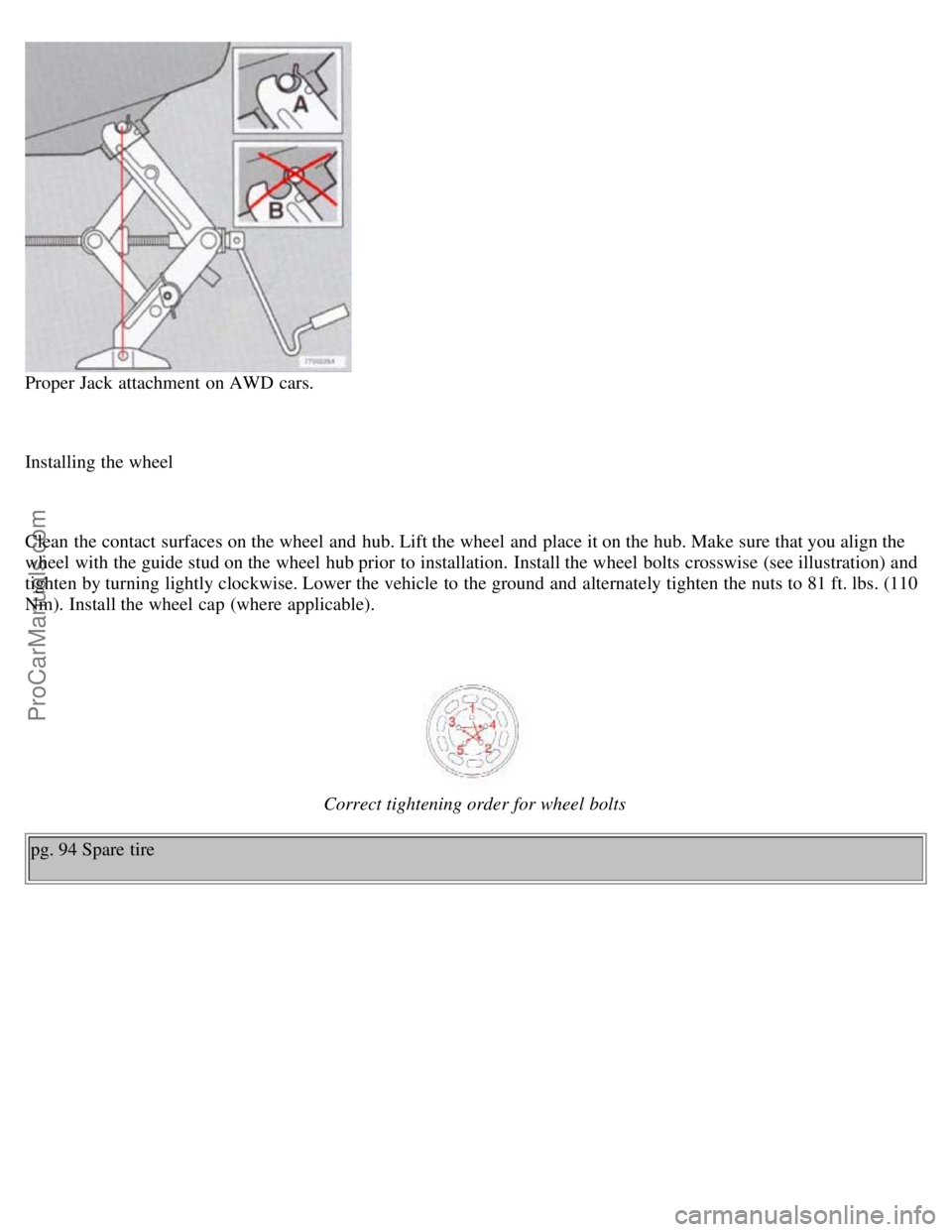
Proper Jack attachment on AWD cars.
Installing the wheel
Clean the contact surfaces on the wheel and hub. Lift the wheel and place it on the hub. Make sure that you align the
wheel with the guide stud on the wheel hub prior to installation. Install the wheel bolts crosswise (see illustration) and
tighten by turning lightly clockwise. Lower the vehicle to the ground and alternately tighten the nuts to 81 ft. lbs. (110
Nm). Install the wheel cap (where applicable).
Correct tightening order for wheel bolts
pg. 94 Spare tire
ProCarManuals.com
Page 31 of 61
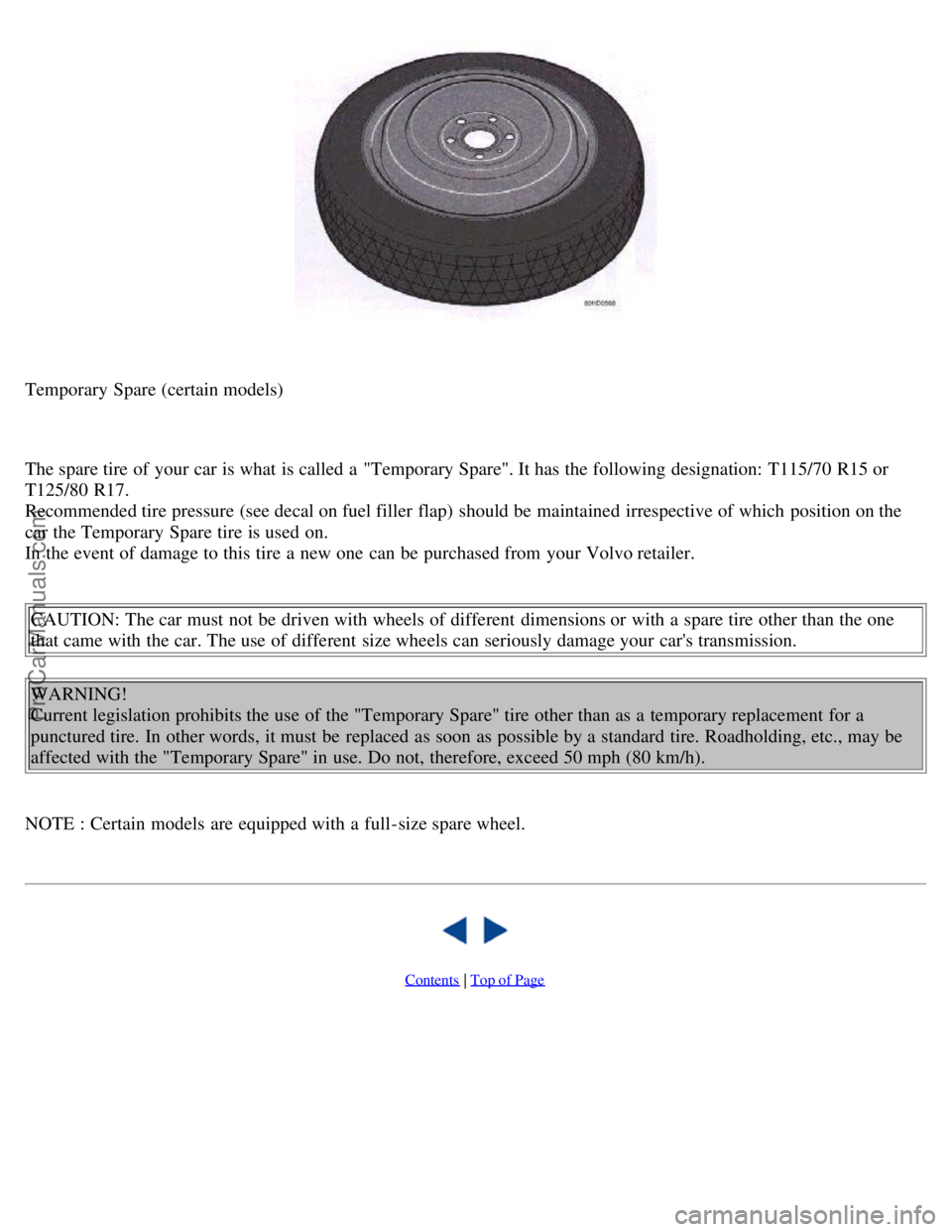
Temporary Spare (certain models)
The spare tire of your car is what is called a "Temporary Spare". It has the following designation: T115/70 R15 or
T125/80 R17.
Recommended tire pressure (see decal on fuel filler flap) should be maintained irrespective of which position on the
car the Temporary Spare tire is used on.
In the event of damage to this tire a new one can be purchased from your Volvo retailer.CAUTION: The car must not be driven with wheels of different dimensions or with a spare tire other than the one
that came with the car. The use of different size wheels can seriously damage your car's transmission.
WARNING!
Current legislation prohibits the use of the "Temporary Spare" tire other than as a temporary replacement for a
punctured tire. In other words, it must be replaced as soon as possible by a standard tire. Roadholding, etc., may be
affected with the "Temporary Spare" in use. Do not, therefore, exceed 50 mph (80 km/h).
NOTE : Certain models are equipped with a full-size spare wheel.
Contents | Top of Page
ProCarManuals.com
Page 34 of 61

Washing the car
The car should be washed at regular intervals since dirt, dust, insects and tar spots adhere to the paint and may cause
damage.
NOTE: It is particularly important to wash the car frequently in the wintertime to prevent corrosion, when salt has
been used on the roads.
When washing the car, do not expose it to direct sunlight. Use lukewarm water to soften the dirt before you wash
with a sponge, and plenty of water, to avoid scratching.
Bird droppings: Remove from paintwork as soon as possible. Otherwise the finish may be permanently damaged.
A detergent can be used to facilitate the softening of dirt and oil.
A water-soluble grease solvent may be used in cases of sticky dirt. However, use a washplace equipped with a
drainage separator.
Dry the car with a clean chamois and remember to clean the drain holes in the doors and rocker panels.
The power radio antenna (sedans) must be dried after washing.
Tar spots can be removed with kerosene or tar remover after the car has been washed.
A stiff-bristle brush and lukewarm soapy water can be used to clean the wiper blades. Frequent cleaning improves
visibility considerably.
Wash off the dirt from the underside (wheel housings fenders, etc.).
In areas of high industrial fallout, more frequent washing is recommended.
CAUTION: During high pressure washing the spray mouthpiece must never be closer to the vehicle than 13" (30
cm). Do not spray into the locks.
When washing or steam cleaning the engine, avoid spraying water or steam directly on the electrical components or
toward the rear side of the engine.
After cleaning the engine, the spark plug wells should be inspected for water and blown dry if necessary.
Suitable detergents
Special car washing detergents should be used. A suitable mixture is about 2.5 fl. oz. (8.5 cl) of detergent to 2.6 US
gal. (10 liters) of warm water. After washing with a detergent the car should be well rinsed with clean water. WARNING!
When the car is driven immediately after being washed, apply the brake several times in order to remove any
moisture from the brake linings.
Engine cleaning agents should not be used when the engine is warm. This constitutes a fire risk.
ProCarManuals.com
Page 47 of 61
Spring strut suspension with integrated shock absorbers and control arm linked to the support frame. Power-assisted
rack and pinion steering. Safety type steering column.
The alignment specifications apply to an unladen car but include fuel, coolant, and spare wheel.
Toe-in measured on the wheel rims: 2.4 mm +/- 0.7 mm
Toe-in measured on tire sides: 2.9 +/- 0.9 mm
Rear Suspension
Delta-link individual rear-wheel suspension with longitudinal support arms, double link arms and track rods.
Toe-in measured on the tire sides: 4° +/- 10°
All specifications are subject to change without notice.
Contents | Top of Page
ProCarManuals.com
Page 55 of 61
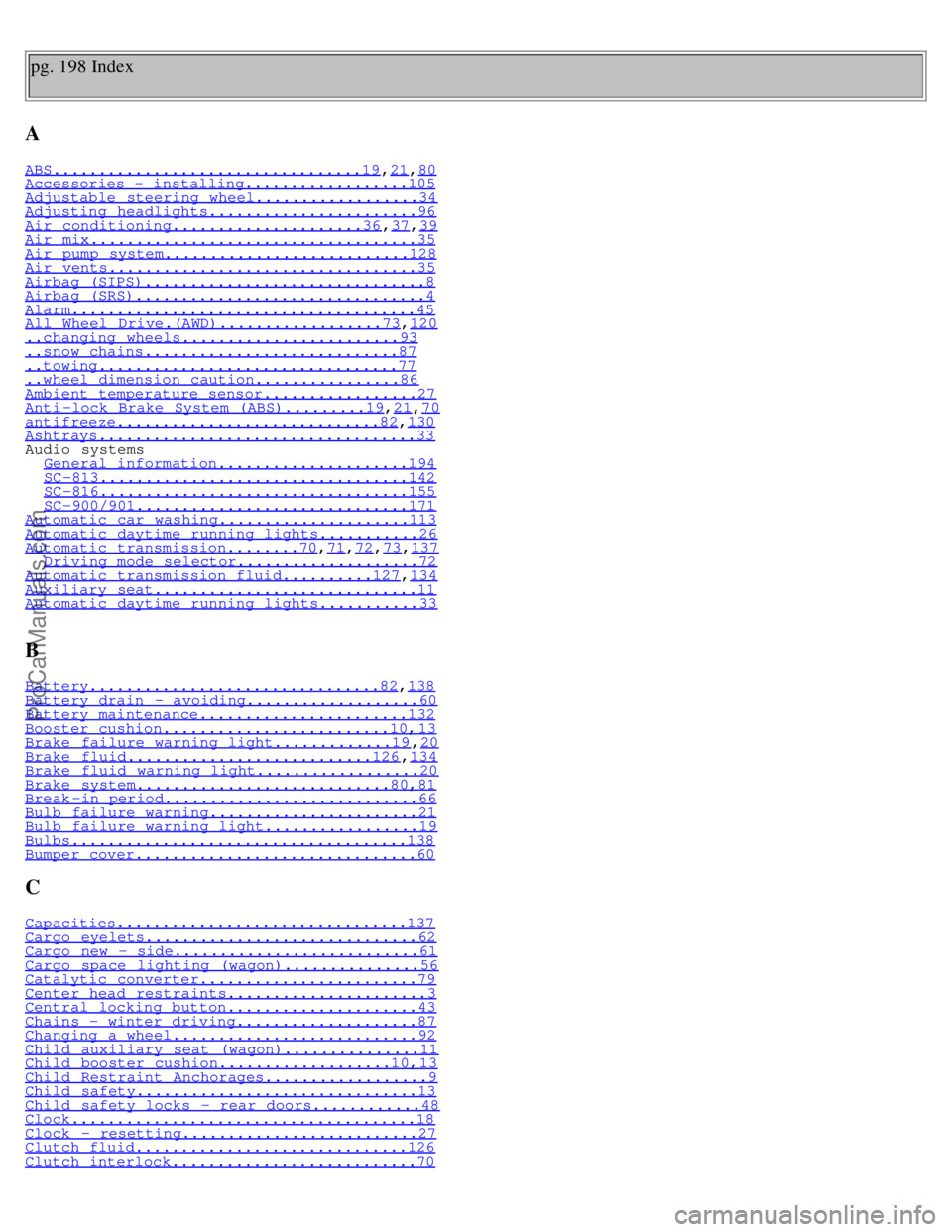
pg. 198 Index
A
ABS..................................19,21,80Accessories - installing..................105Adjustable steering wheel..................34Adjusting headlights.......................96Air conditioning.....................36,37,39Air mix....................................35Air pump system...........................128Air vents..................................35Airbag (SIPS)...............................8Airbag (SRS)................................4Alarm......................................45All Wheel Drive.(AWD)..................73,120..changing wheels........................93..snow chains............................87..towing.................................77..wheel dimension caution................86Ambient temperature sensor.................27Anti -lock Brake System (ABS).........19,21,70antifreeze.............................82,130Ashtrays...................................33Audio systems
General information.....................194
SC-813..................................142 SC-816..................................155 SC-900/901..............................171Automatic car washing.....................113Automatic daytime running lights...........26Automatic transmission........70,71,72,73,137 Driving mode selector....................72Automatic transmission fluid..........127,134Auxiliary seat.............................11Automatic daytime running lights...........33
B
Battery................................82,138Battery drain - avoiding...................60Battery maintenance.......................132Booster cushion.........................10,13Brake failure warning light.............19,20Brake fluid...........................126,134Brake fluid warning light..................20Brake system............................80,81Break -in period............................66Bulb failure warning.......................21Bulb failure warning light.................19Bulbs.....................................138Bumper cover...............................60
C
Capacities................................137Cargo eyelets..............................62Cargo new - side...........................61Cargo space lighting (wagon)...............56Catalytic converter........................79Center head restraints......................3Central locking button.....................43Chains - winter driving....................87Changing a wheel...........................92Child auxiliary seat (wagon)...............11Child booster cushion...................10,13Child Restraint Anchorages..................9Child safety...............................13Child safety locks - rear doors............48Clock......................................18Clock - resetting..........................27Clutch fluid..............................126Clutch interlock...........................70
ProCarManuals.com