window VOLVO S80 1999 User Guide
[x] Cancel search | Manufacturer: VOLVO, Model Year: 1999, Model line: S80, Model: VOLVO S80 1999Pages: 96, PDF Size: 2.27 MB
Page 26 of 96
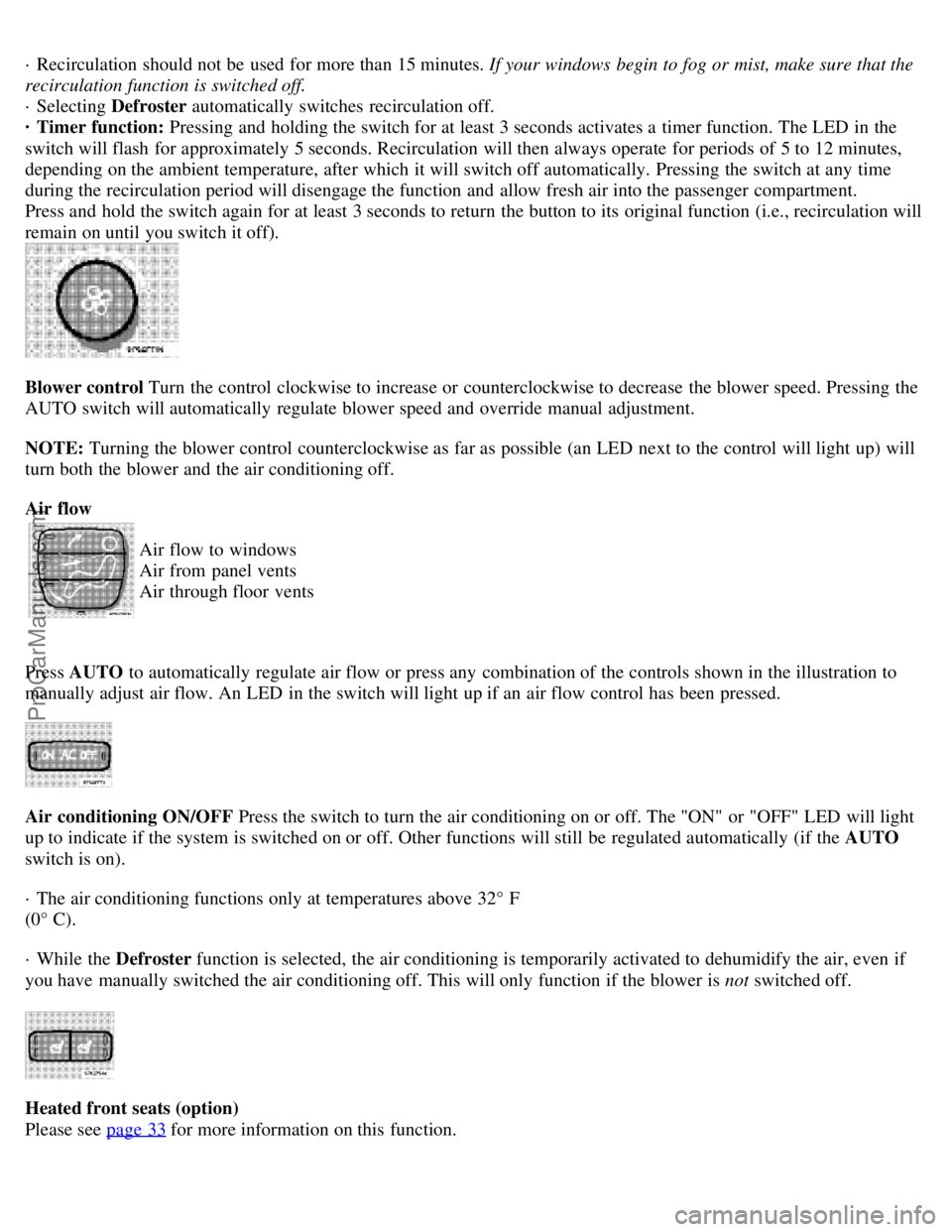
· Recirculation should not be used for more than 15 minutes. If your windows begin to fog or mist, make sure that the
recirculation function is switched off.
· Selecting Defroster automatically switches recirculation off.
· Timer function: Pressing and holding the switch for at least 3 seconds activates a timer function. The LED in the
switch will flash for approximately 5 seconds. Recirculation will then always operate for periods of 5 to 12 minutes,
depending on the ambient temperature, after which it will switch off automatically. Pressing the switch at any time
during the recirculation period will disengage the function and allow fresh air into the passenger compartment.
Press and hold the switch again for at least 3 seconds to return the button to its original function (i.e., recirculation will
remain on until you switch it off).
Blower control Turn the control clockwise to increase or counterclockwise to decrease the blower speed. Pressing the
AUTO switch will automatically regulate blower speed and override manual adjustment.
NOTE: Turning the blower control counterclockwise as far as possible (an LED next to the control will light up) will
turn both the blower and the air conditioning off.
Air flow
Air flow to windows
Air from panel vents
Air through floor vents
Press AUTO to automatically regulate air flow or press any combination of the controls shown in the illustration to
manually adjust air flow. An LED in the switch will light up if an air flow control has been pressed.
Air conditioning ON/OFF Press the switch to turn the air conditioning on or off. The "ON" or "OFF" LED will light
up to indicate if the system is switched on or off. Other functions will still be regulated automatically (if the AUTO
switch is on).
· The air conditioning functions only at temperatures above 32° F
(0° C).
· While the Defroster function is selected, the air conditioning is temporarily activated to dehumidify the air, even if
you have manually switched the air conditioning off. This will only function if the blower is not switched off.
Heated front seats (option)
Please see page 33
for more information on this function.
ProCarManuals.com
Page 27 of 96
pg. 44 Climate control system - general information
Condensation on the inside of the windows
Keeping the insides of the windows clean will help reduce the amount of condensation that forms on the windows. Use
a commercial window cleaning agent to clean the windows.
Ice and snow
Always keep the air intake grille at the base of the windshield free of snow.
Air cabin filter
Replace the air cabin filter with a new one at the recommended intervals. The filter should be replaced more often
when driving under dirty and dusty conditions. The filter cannot be cleaned and therefore should always be replaced
with a new one.
Sensors
The sunlight sensor on the dashboard and passenger compartment temperature sensor in the ECC control panel should
not be covered in any way as this could cause incorrect information to be sent to the ECC system.
Parking the car in warm weather
If your car has been parked in the sun in warm weather, opening the windows and sun roof (option) for several
minutes before driving will help release the warm air from the passenger compartment. When the engine is running,
close the windows and sun roof and use the recirculation function for several minutes to enable the air conditioning to
cool the compartment as quickly as possible.
Windows and optional sun roof
The ECC system will function best if the windows and optional sun roof are closed. If you drive with the sun roof
open, we recommend that you manually adjust the temperature and blower control (the LED in the AUTO switch
should be off).
Acceleration
The air conditioning is momentarily disengaged during full-throttle acceleration.
ECC maintenance
All maintenance on the climate control systems should be carried out by an authorized Volvo service technician only.
Refrigerant
Volvo cares about the environment. The air conditioning system in your car contains a CFC-free refrigerant - R134a.
This substance will not deplete the ozone layer. The system contains 2.2 lbs (1000 g) R134a and uses PAG oil.
Passenger compartment blower
The blower may come on automatically (certain models) after approximately 50 minutes, and stay on for 5 minutes, to
remove excess condensation in the A/C evaporator.
Contents | Top of Page
ProCarManuals.com
Page 32 of 96
WARNING!
Packages on the rear window shelf can obscure vision and may become dangerous projectiles in the event of a
sudden stop or an accident.
Anchor any heavy objects to help prevent them from moving during sudden stops.
pg. 50 Storage compartment in center console
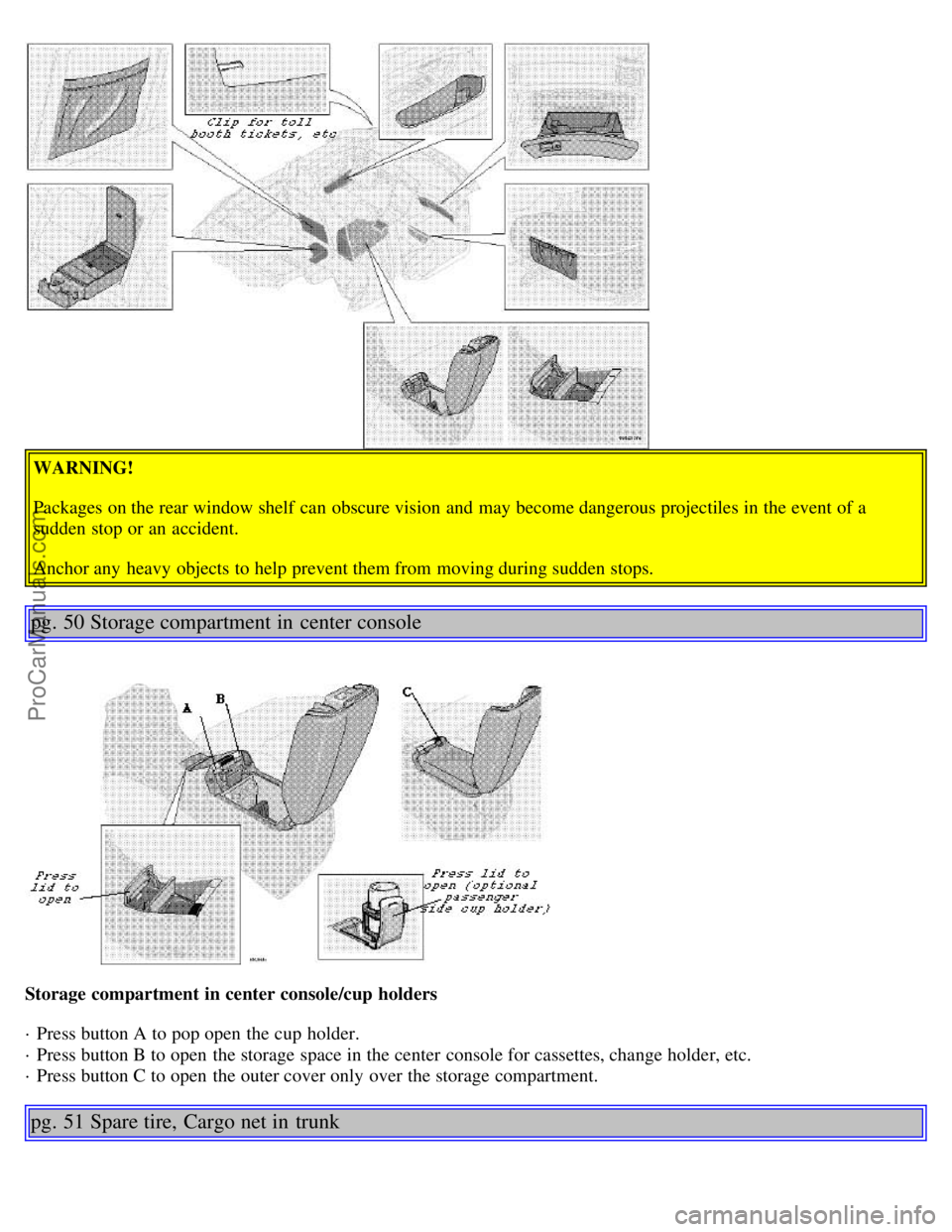
Storage compartment in center console/cup holders
· Press button A to pop open the cup holder.
· Press button B to open the storage space in the center console for cassettes, change holder, etc.
· Press button C to open the outer cover only over the storage compartment.
pg. 51 Spare tire, Cargo net in trunk
ProCarManuals.com
Page 39 of 96
"Trunk lock" function
Pressing this switch locks the trunk, even if the
doors are unlocked. The trunk will remain locked even if the doors are locked/unlocked using the master key or the
remote control.
To use this function:
· Turn the master key to position II.
· Press the "trunk lock" button. An LED in the button will light up and a message will be displayed in the text window
to indicate that this function is activated.
· The function can be turned off (deactivated) by turning the ignition key to position II and pressing the "trunk lock"
button again (the LED in the button will go out).
* The position of this button may vary, depending on the specifications of your car.
pg. 56 Remote keyless entry system
Remote keyless entry system
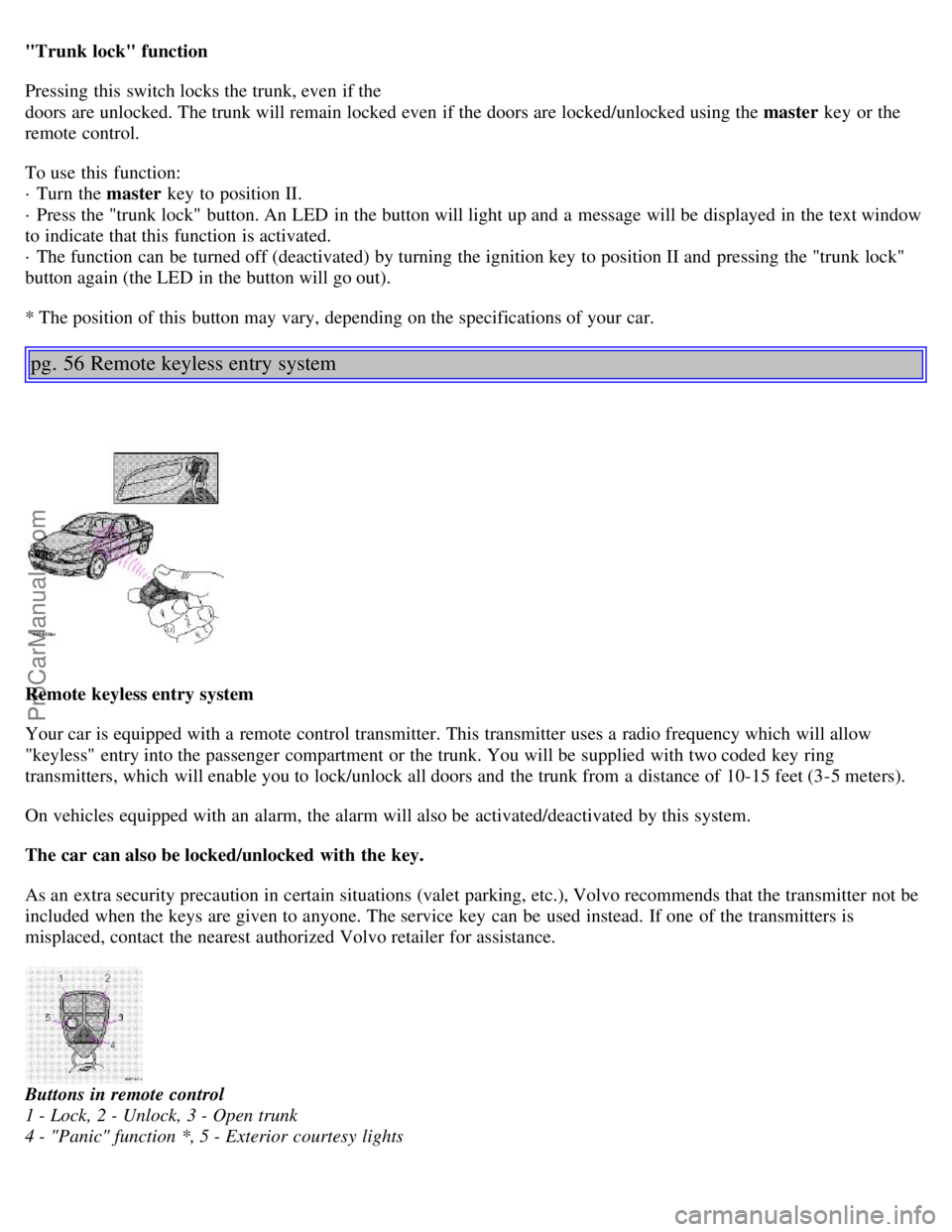
Your car is equipped with a remote control transmitter. This transmitter uses a radio frequency which will allow
"keyless" entry into the passenger compartment or the trunk. You will be supplied with two coded key ring
transmitters, which will enable you to lock/unlock all doors and the trunk from a distance of 10-15 feet (3-5 meters).
On vehicles equipped with an alarm, the alarm will also be activated/deactivated by this system.
The car can also be locked/unlocked with the key.
As an extra security precaution in certain situations (valet parking, etc.), Volvo recommends that the transmitter not be
included when the keys are given to anyone. The service key can be used instead. If one of the transmitters is
misplaced, contact the nearest authorized Volvo retailer for assistance.
Buttons in remote control
1 - Lock, 2 - Unlock, 3 - Open trunk
4 - "Panic" function *, 5 - Exterior courtesy lights
ProCarManuals.com
Page 42 of 96
Visual alarm signal
The visual alarm signal is given by flashing all turn signals and turning on the interior lighting for approximately 5
minutes.
Audible alarm signal
An audible alarm signal is given by a battery powered siren. One alarm cycle lasts for 25 seconds.
"Panic" function
In an emergency situation, this feature can be used to attract attention.
Activate the "panic" function by pressing the red button on the remote control (see illustration on page 56
) for at least
3 seconds or by pressing this button twice within 3 seconds. The turn signals will flash, the interior lights will go on
and the car's horn will sound.
The function can be turned off by pressing any of the buttons on the remote control or will stop automatically
after 25 seconds.
NOTE: This button will NOT unlock the car.
pg. 59 Alarm
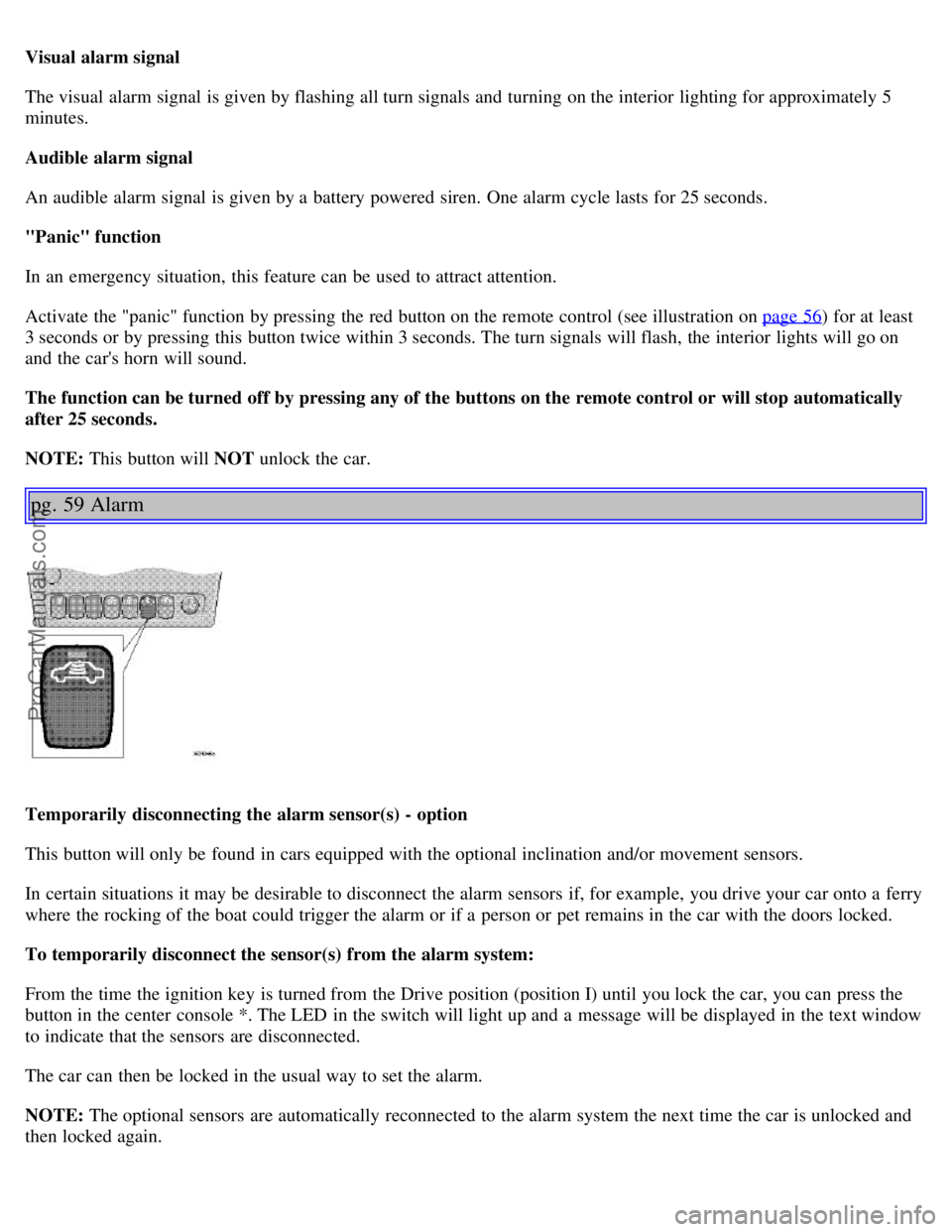
Temporarily disconnecting the alarm sensor(s) - option
This button will only be found in cars equipped with the optional inclination and/or movement sensors.
In certain situations it may be desirable to disconnect the alarm sensors if, for example, you drive your car onto a ferry
where the rocking of the boat could trigger the alarm or if a person or pet remains in the car with the doors locked.
To temporarily disconnect the sensor(s) from the alarm system:
From the time the ignition key is turned from the Drive position (position I) until you lock the car, you can press the
button in the center console *. The LED in the switch will light up and a message will be displayed in the text window
to indicate that the sensors are disconnected.
The car can then be locked in the usual way to set the alarm.
NOTE: The optional sensors are automatically reconnected to the alarm system the next time the car is unlocked and
then locked again.
ProCarManuals.com
Page 43 of 96
LED alarm status signals
The status of the alarm system is indicated by the red LED at the top of the dash:
· LED off - the alarm is not armed (set)
· LED flashes once per second - the alarm is armed (set)
· LED flashes rapidly before the ignition is switched on - the alarm has been triggered
· Fault in the alarm system: If a fault has been detected in the alarm system, a message will be displayed in the text
window. Contact a Volvo retailer.
Automatic reset function
If the car has been unlocked with the remote control, the locks will automatically reengage (re-lock) and the alarm will
reset after 2 minutes unless a door or the trunk has been opened.
* The position of this button may vary, depending on the specifications of your car.
pg. 60 Child safety locks - rear doors
Child safety lock control in left rear doorChild safety lock control in right rear door
Child safety locks - rear doors
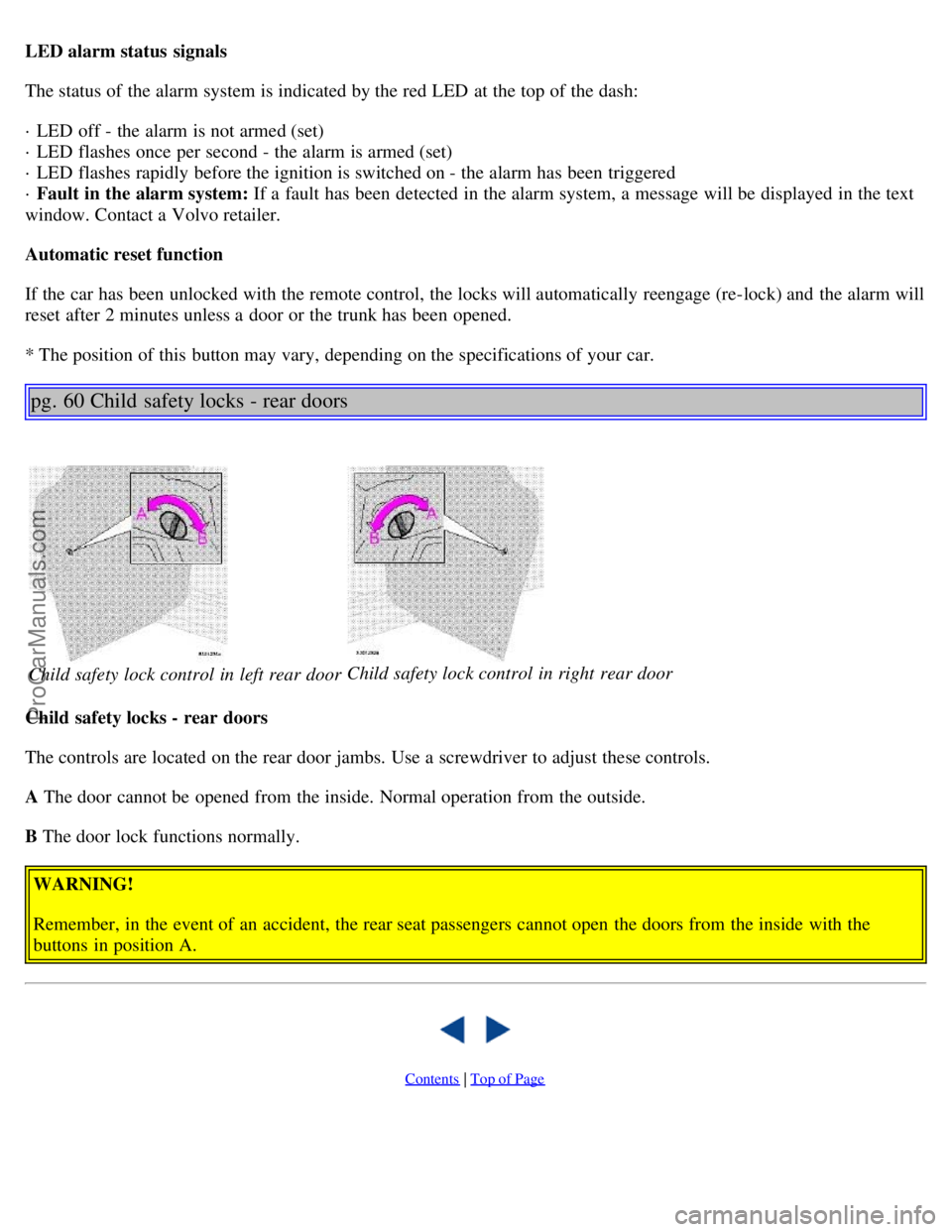
The controls are located on the rear door jambs. Use a screwdriver to adjust these controls.
A The door cannot be opened from the inside. Normal operation from the outside.
B The door lock functions normally.
WARNING!
Remember, in the event of an accident, the rear seat passengers cannot open the doors from the inside with the
buttons in position A.
Contents | Top of Page
ProCarManuals.com
Page 52 of 96
gear).
· When starting in the (M)anual position, 3rd gear is the highest gear that may be selected.
NOTE: Kickdown (see previous page) does not function when the transmission is in the manual shift (geartronic)
mode.
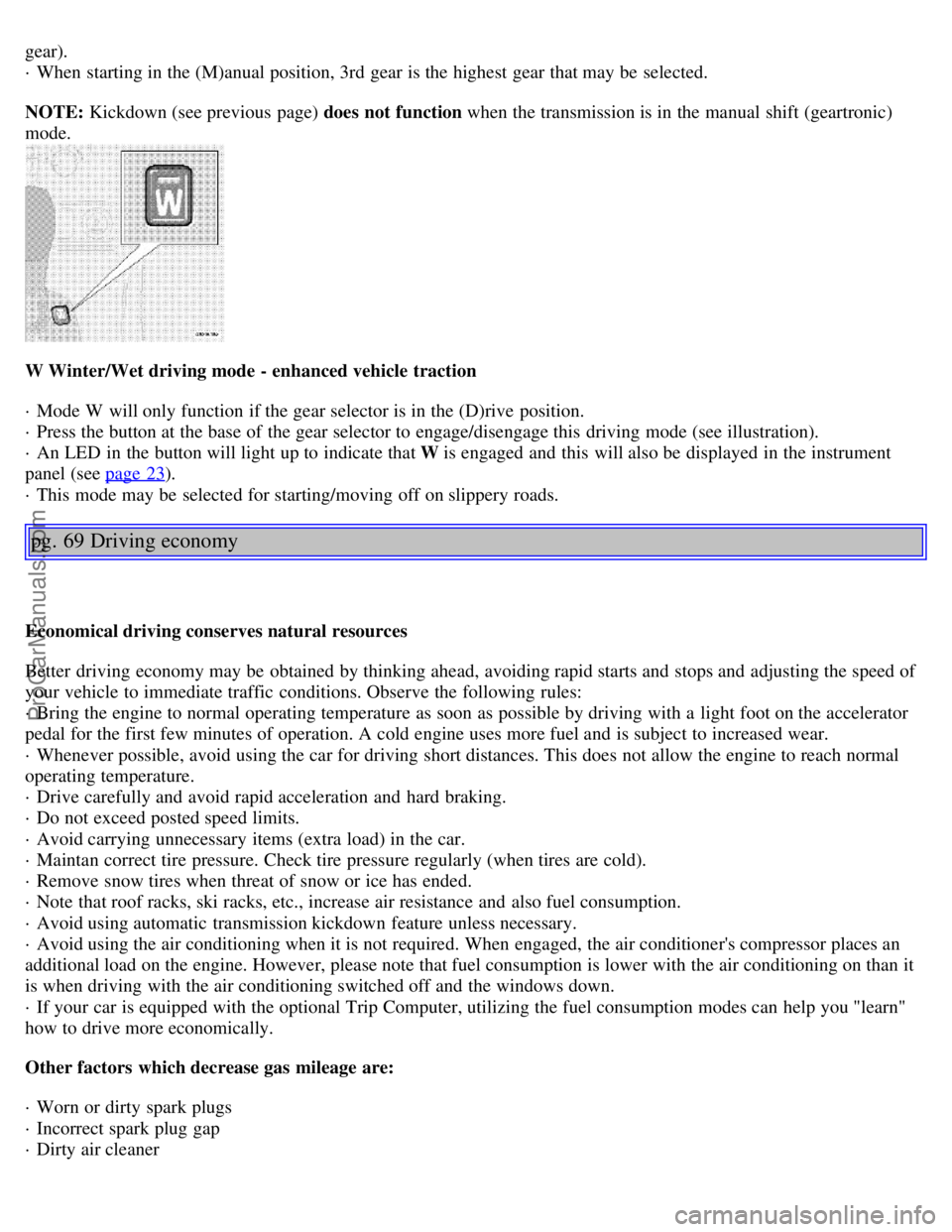
W Winter/Wet driving mode - enhanced vehicle traction
· Mode W will only function if the gear selector is in the (D)rive position.
· Press the button at the base of the gear selector to engage/disengage this driving mode (see illustration).
· An LED in the button will light up to indicate that W is engaged and this will also be displayed in the instrument
panel (see page 23
).
· This mode may be selected for starting/moving off on slippery roads.
pg. 69 Driving economy
Economical driving conserves natural resources
Better driving economy may be obtained by thinking ahead, avoiding rapid starts and stops and adjusting the speed of
your vehicle to immediate traffic conditions. Observe the following rules:
· Bring the engine to normal operating temperature as soon as possible by driving with a light foot on the accelerator
pedal for the first few minutes of operation. A cold engine uses more fuel and is subject to increased wear.
· Whenever possible, avoid using the car for driving short distances. This does not allow the engine to reach normal
operating temperature.
· Drive carefully and avoid rapid acceleration and hard braking.
· Do not exceed posted speed limits.
· Avoid carrying unnecessary items (extra load) in the car.
· Maintan correct tire pressure. Check tire pressure regularly (when tires are cold).
· Remove snow tires when threat of snow or ice has ended.
· Note that roof racks, ski racks, etc., increase air resistance and also fuel consumption.
· Avoid using automatic transmission kickdown feature unless necessary.
· Avoid using the air conditioning when it is not required. When engaged, the air conditioner's compressor places an
additional load on the engine. However, please note that fuel consumption is lower with the air conditioning on than it
is when driving with the air conditioning switched off and the windows down.
· If your car is equipped with the optional Trip Computer, utilizing the fuel consumption modes can help you "learn"
how to drive more economically.
Other factors which decrease gas mileage are:
· Worn or dirty spark plugs
· Incorrect spark plug gap
· Dirty air cleaner
ProCarManuals.com
Page 65 of 96
power driver's seat, text window, shiftlock geartronic
25Ignition switch 10A
26 Control module - climate control blower 30A
27 Central locking system, power windows, sideview mirrors,
warning lights 15A
28 Power sun roof, courtesy lights, vanity mirror lights 10A
29 -
30 Left front/rear parking lights 10A
31 Right front/rear parking lights, license plate lights 10A
32 Central electrical module, interior courtesy lights,
progressive power steering 10A
33 Fuel pump 15A
34 Power sun roof 15A
35 Central locking system, power windows 25A
36 Central locking system, power windows 25A
37 Power windows - rear doors, child safety locks 30A
38 -
pg.91 Fuses in the trunk
Fuses in the trunk
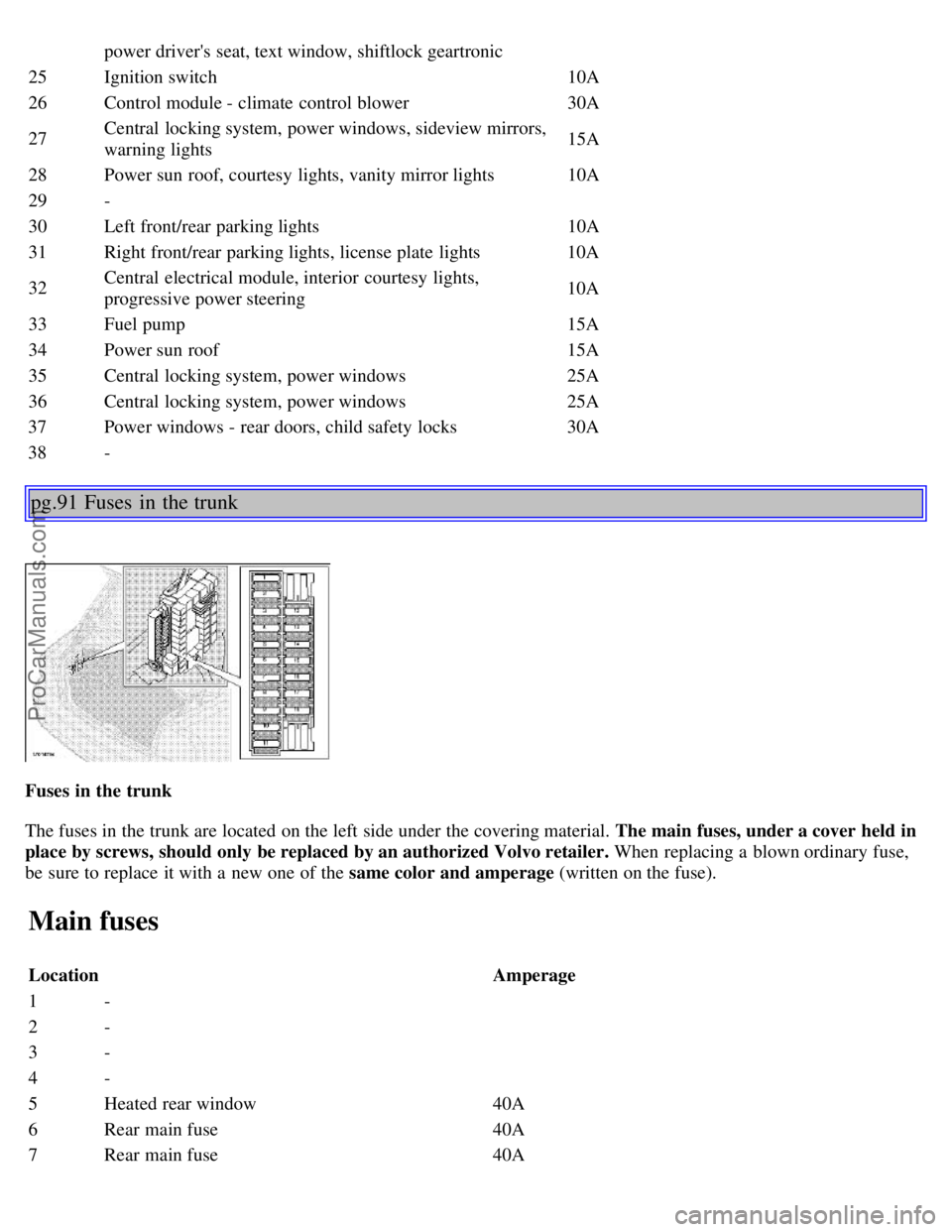
The fuses in the trunk are located on the left side under the covering material. The main fuses, under a cover held in
place by screws, should only be replaced by an authorized Volvo retailer. When replacing a blown ordinary fuse,
be sure to replace it with a new one of the same color and amperage (written on the fuse).
Main fuses
LocationAmperage
1 -
2 -
3 -
4 -
5 Heated rear window 40A
6 Rear main fuse 40A
7 Rear main fuse 40A
ProCarManuals.com
Page 91 of 96
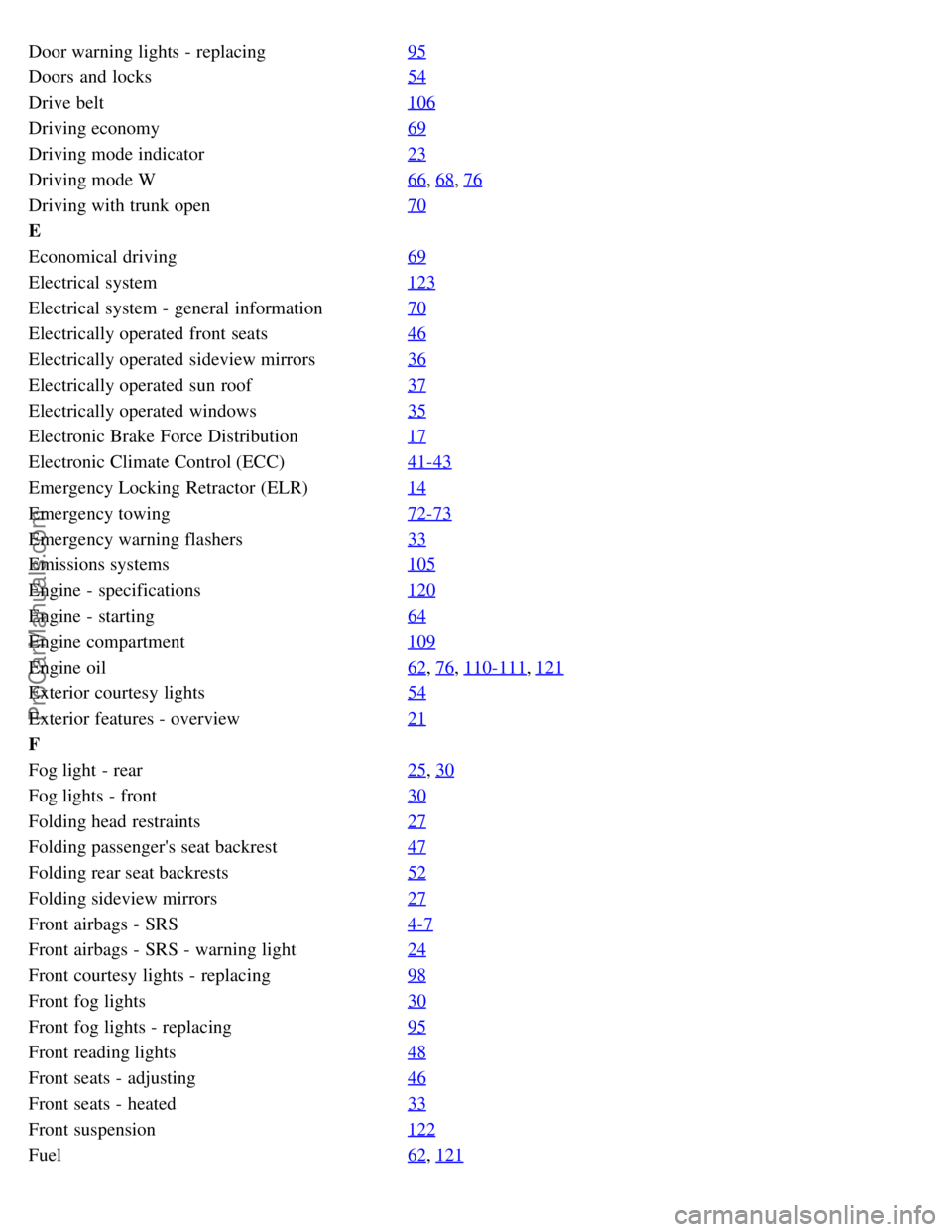
Door warning lights - replacing95
Doors and locks54
Drive belt106
Driving economy69
Driving mode indicator23
Driving mode W66, 68, 76
Driving with trunk open70
E
Economical driving69
Electrical system123
Electrical system - general information70
Electrically operated front seats46
Electrically operated sideview mirrors36
Electrically operated sun roof37
Electrically operated windows35
Electronic Brake Force Distribution17
Electronic Climate Control (ECC)41-43
Emergency Locking Retractor (ELR)14
Emergency towing72-73
Emergency warning flashers33
Emissions systems105
Engine - specifications120
Engine - starting64
Engine compartment109
Engine oil62, 76, 110-111, 121
Exterior courtesy lights54
Exterior features - overview21
F
Fog light - rear25
, 30
Fog lights - front30
Folding head restraints27
Folding passenger's seat backrest47
Folding rear seat backrests52
Folding sideview mirrors27
Front airbags - SRS4-7
Front airbags - SRS - warning light24
Front courtesy lights - replacing98
Front fog lights30
Front fog lights - replacing95
Front reading lights48
Front seats - adjusting46
Front seats - heated33
Front suspension122
Fuel62, 121
ProCarManuals.com
Page 92 of 96
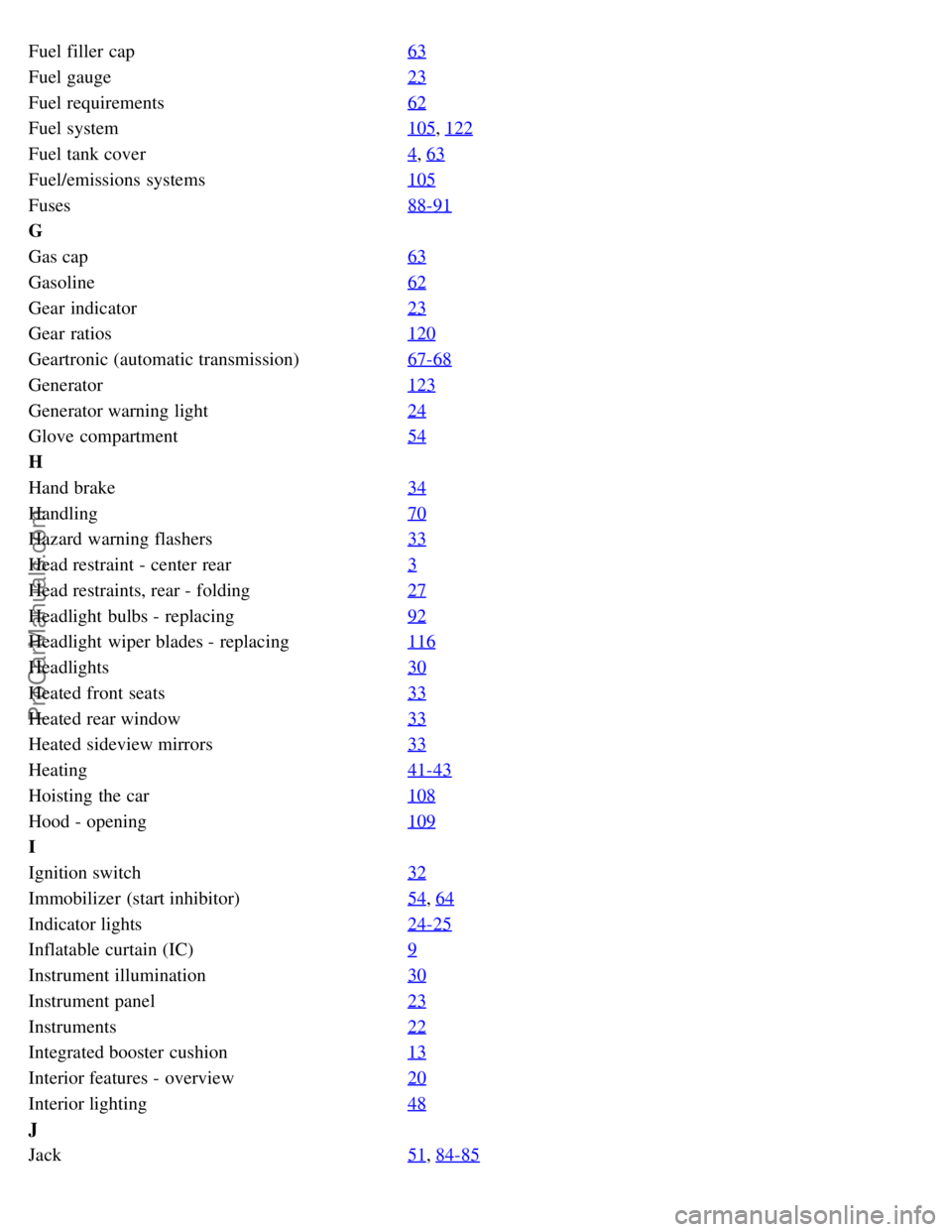
Fuel filler cap63
Fuel gauge23
Fuel requirements62
Fuel system105, 122
Fuel tank cover4, 63
Fuel/emissions systems105
Fuses88-91
G
Gas cap63
Gasoline62
Gear indicator23
Gear ratios120
Geartronic (automatic transmission)67-68
Generator123
Generator warning light24
Glove compartment54
H
Hand brake34
Handling70
Hazard warning flashers33
Head restraint - center rear3
Head restraints, rear - folding27
Headlight bulbs - replacing92
Headlight wiper blades - replacing116
Headlights30
Heated front seats33
Heated rear window33
Heated sideview mirrors33
Heating41-43
Hoisting the car108
Hood - opening109
I
Ignition switch32
Immobilizer (start inhibitor)54, 64
Indicator lights24-25
Inflatable curtain (IC)9
Instrument illumination30
Instrument panel23
Instruments22
Integrated booster cushion13
Interior features - overview20
Interior lighting48
J
Jack51
, 84-85
ProCarManuals.com