trunk VOLVO S80 2002 User Guide
[x] Cancel search | Manufacturer: VOLVO, Model Year: 2002, Model line: S80, Model: VOLVO S80 2002Pages: 111, PDF Size: 2.74 MB
Page 45 of 111
The alarm is automatically set (armed) whenever you lock your car.
When armed (set), the alarm continuously monitors a number of points on the car. The following conditions will set off
the alarm:
· The hood is forced opened.
· The trunk is forced opened.
· A door is forced opened.
· The ignition switch is tampered with.
· If there is movement in the passenger compartment (if the car is equipped with the optional movement sensor).
· The car is lifted or towed (if the car is equipped with the optional inclination sensor).
· The battery is disconnected (while the alarm is set).
Arming the alarm
Press the LOCK button on the remote control, lock the car using the key in the driver's door or press the central lock
button on one of the front doors with the door open. One long flash of the turn signals will confirm that the alarm is
set.
Disarming the alarm
Press the UNLOCK button on the remote control or unlock the doors with the key.
Turning off (stopping) the alarm
If the alarm is sounding, it can be stopped by pressing the UNLOCK button on the remote control or by unlocking the
driver's door with the key.
Visual alarm signal
The visual alarm signal is given by flashing all turn signals and turning on the interior lighting for approximately 5
minutes.
Audible alarm signal
An audible alarm signal is given by a battery powered siren. One alarm cycle lasts for 25 seconds.
"Panic" function
In an emergency situation, this feature can be used to attract attention.
Activate the "panic" function by pressing the red button on the remote control (see illustration on page 57
) for at least
3 seconds or by pressing this button twice within 3 seconds. The turn signals will flash, the interior lights will go on
and the car's horn will sound.
The function can be turned off by pressing any of the buttons on the remote control or will stop automatically
after 25 seconds. When a button is pressed, there is a 5 second delay before the panic alarm is deactivated.
NOTE: This button will NOT unlock the car.
pg. 62 Alarm
ProCarManuals.com
Page 46 of 111
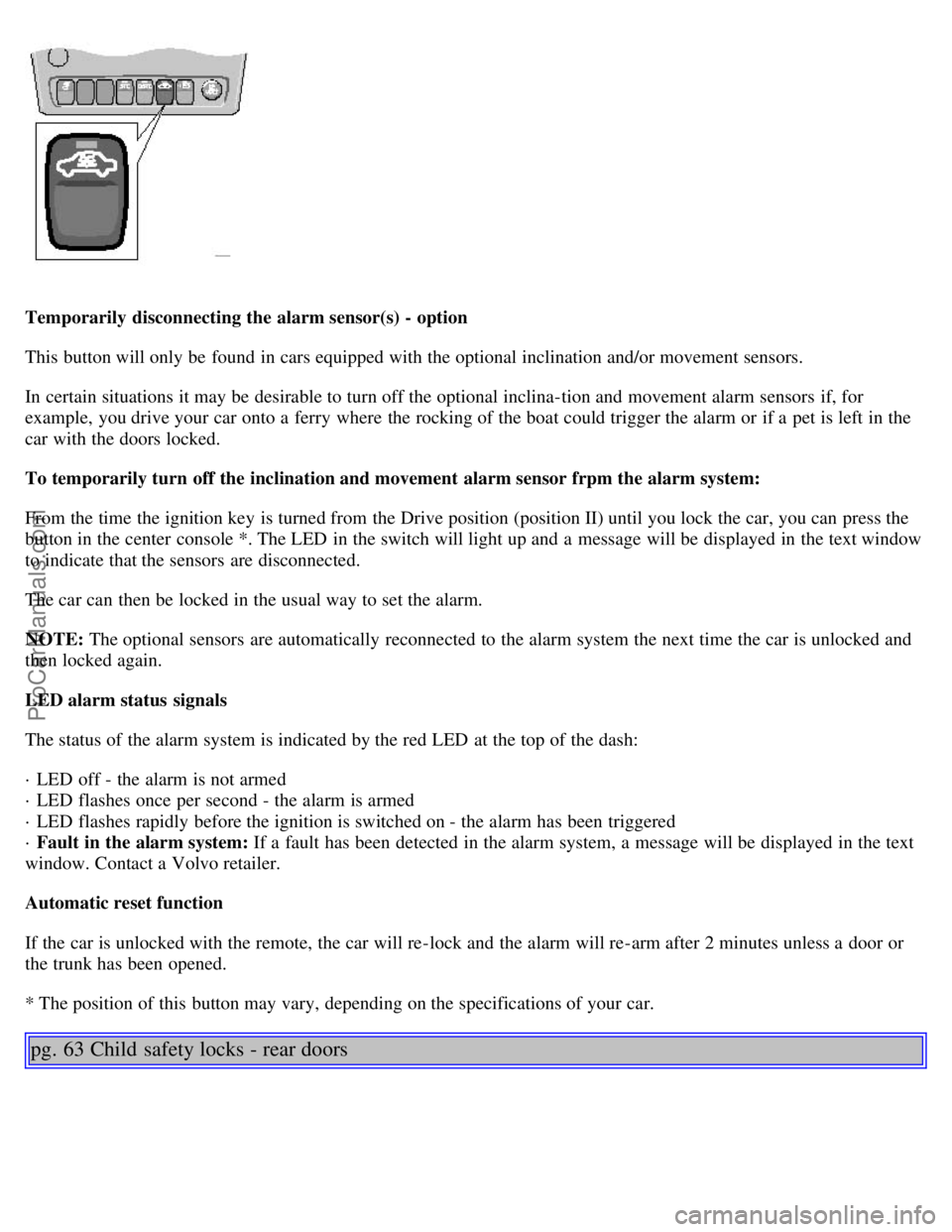
Temporarily disconnecting the alarm sensor(s) - option
This button will only be found in cars equipped with the optional inclination and/or movement sensors.
In certain situations it may be desirable to turn off the optional inclina-tion and movement alarm sensors if, for
example, you drive your car onto a ferry where the rocking of the boat could trigger the alarm or if a pet is left in the
car with the doors locked.
To temporarily turn off the inclination and movement alarm sensor frpm the alarm system:
From the time the ignition key is turned from the Drive position (position II) until you lock the car, you can press the
button in the center console *. The LED in the switch will light up and a message will be displayed in the text window
to indicate that the sensors are disconnected.
The car can then be locked in the usual way to set the alarm.
NOTE: The optional sensors are automatically reconnected to the alarm system the next time the car is unlocked and
then locked again.
LED alarm status signals
The status of the alarm system is indicated by the red LED at the top of the dash:
· LED off - the alarm is not armed
· LED flashes once per second - the alarm is armed
· LED flashes rapidly before the ignition is switched on - the alarm has been triggered
· Fault in the alarm system: If a fault has been detected in the alarm system, a message will be displayed in the text
window. Contact a Volvo retailer.
Automatic reset function
If the car is unlocked with the remote, the car will re-lock and the alarm will re-arm after 2 minutes unless a door or
the trunk has been opened.
* The position of this button may vary, depending on the specifications of your car.
pg. 63 Child safety locks - rear doors
ProCarManuals.com
Page 50 of 111
exhaust emission control systems on your car, lead has been strongly linked to certain forms of cancer.
Many fuels contain benzene as a solvent. Unburned benzene has been strongly linked to certain forms of cancer. If you
live in an area where you must fill your own gas tank, take precautions. These may include:
standing upwind away from the filler nozzle while refueling
refueling only at gas stations with vapor recovery systems that fully seal the mouth of the filler neck during refueling
wear neoprene gloves while handling a fuel filler nozzle.
Use of Additives
With the exception of gas line antifreeze during winter months, do not add solvents, thickeners, or other store -bought
additives to your car's fuel, cooling, or lubricating systems. Overuse may damage your engine, and some of these
additives contain organically volatile chemicals. Do not needlessly expose yourself to these chemicals.
pg. 68 Refueling
Refueling
The fuel tank is designed to hold approximately 21.1 US gal. (80 liters) with sufficient volume left over to
accommodate possible expansion of the fuel in hot weather. Be aware that the "usable" tank capacity will be somewhat
less than the specified maximum. When the fuel level is low, such factors as ambient temperature, the fuel's "Reid
vapor pressure" characteristics, and terrain can affect the fuel pumps' ability to supply the engine with an adequate
supply of fuel. Therefore, it is advisable to refuel as soon as possible when the needle nears the red zone, or when the
fuel warning light comes on.
Fuel filler door
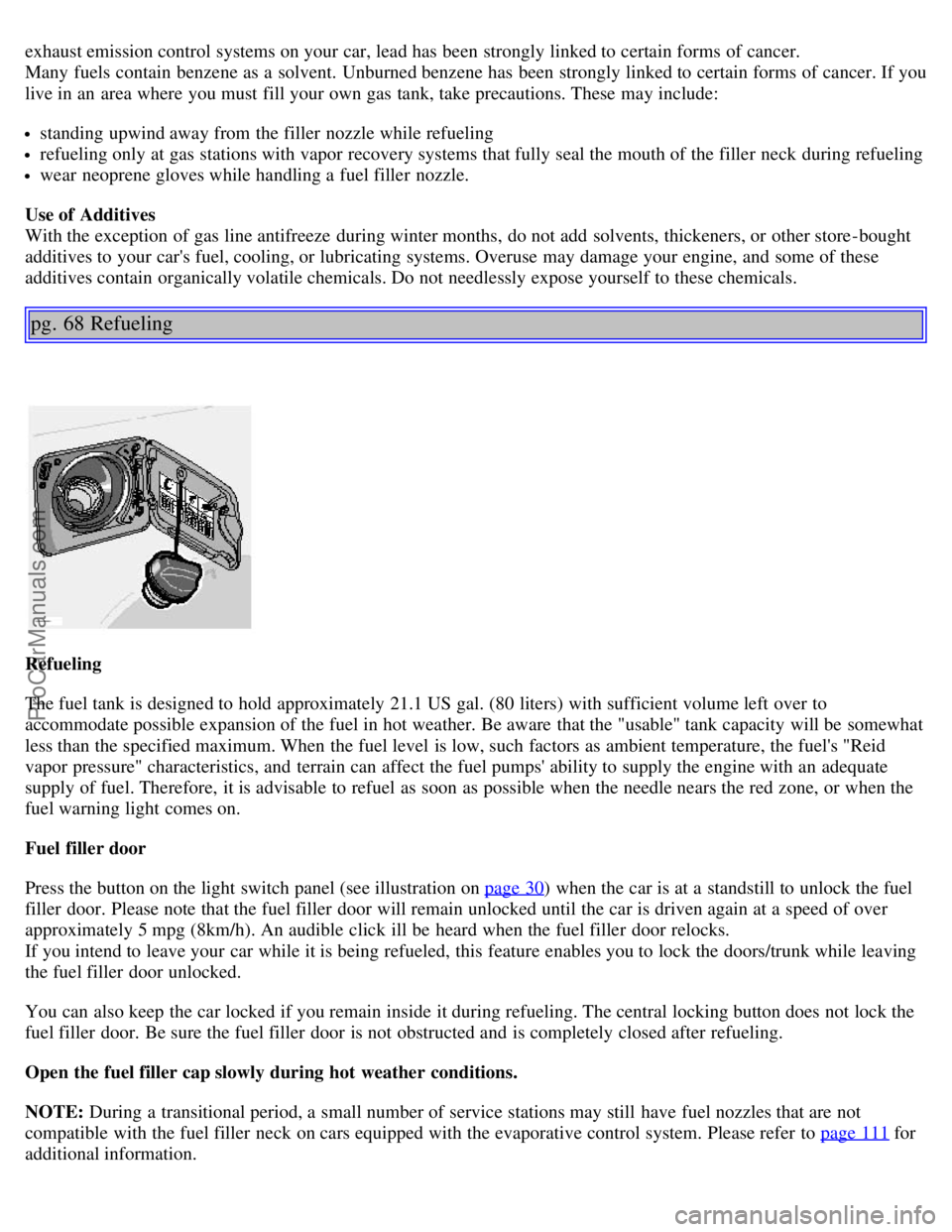
Press the button on the light switch panel (see illustration on page 30
) when the car is at a standstill to unlock the fuel
filler door. Please note that the fuel filler door will remain unlocked until the car is driven again at a speed of over
approximately 5 mpg (8km/h). An audible click ill be heard when the fuel filler door relocks.
If you intend to leave your car while it is being refueled, this feature enables you to lock the doors/trunk while leaving
the fuel filler door unlocked.
You can also keep the car locked if you remain inside it during refueling. The central locking button does not lock the
fuel filler door. Be sure the fuel filler door is not obstructed and is completely closed after refueling.
Open the fuel filler cap slowly during hot weather conditions.
NOTE: During a transitional period, a small number of service stations may still have fuel nozzles that are not
compatible with the fuel filler neck on cars equipped with the evaporative control system. Please refer to page 111
for
additional information.
ProCarManuals.com
Page 64 of 111
Changing wheels
The spare wheel is located under the carpet on the trunk floor. The jack and crank are secured in the wheel recess.
There are two jack attachment points on each side of the car.
To change a wheel:
· Engage the parking brake.
· Put the gear selector in (P)ark.
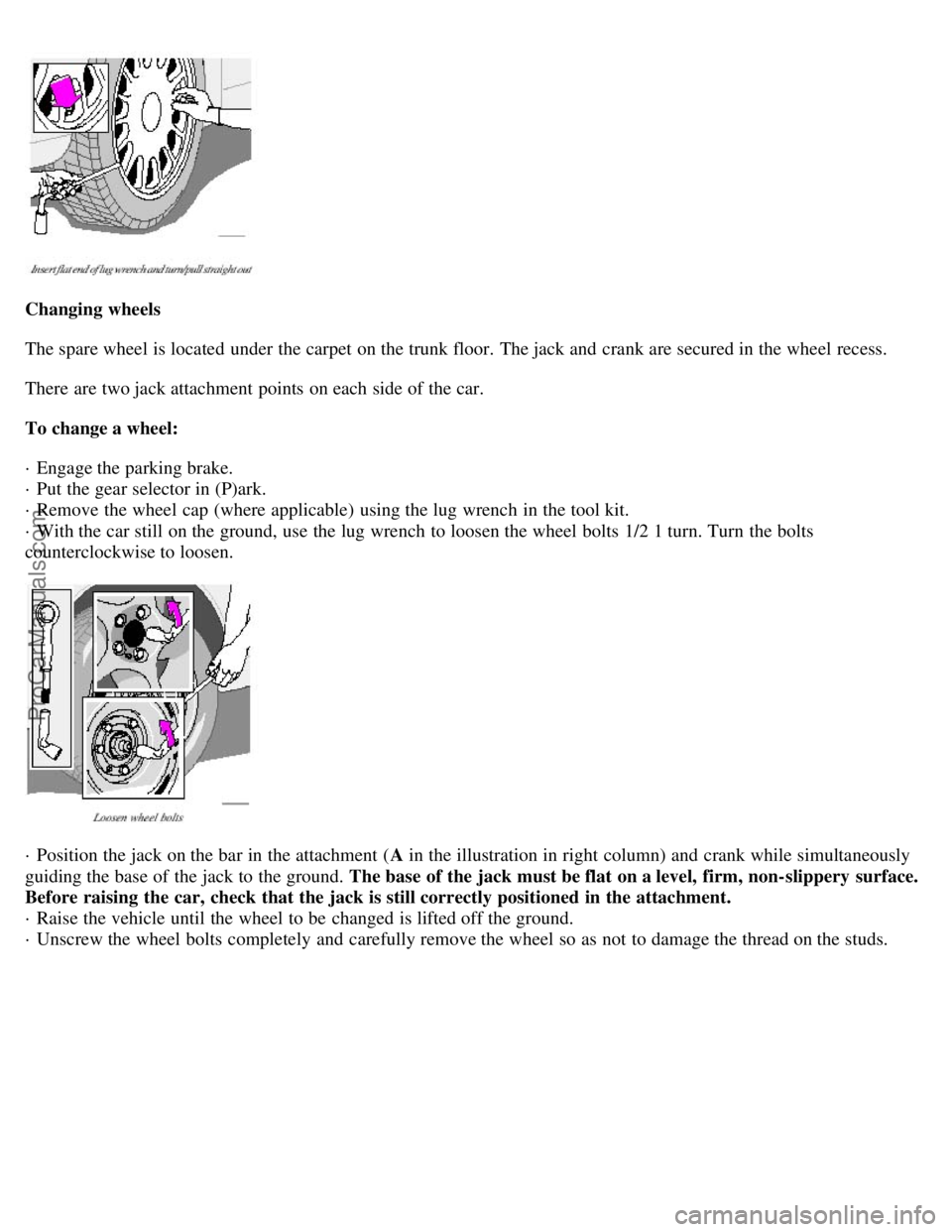
· Remove the wheel cap (where applicable) using the lug wrench in the tool kit.
· With the car still on the ground, use the lug wrench to loosen the wheel bolts 1/2 1 turn. Turn the bolts
counterclockwise to loosen.
· Position the jack on the bar in the attachment (A in the illustration in right column) and crank while simultaneously
guiding the base of the jack to the ground. The base of the jack must be flat on a level, firm, non-slippery surface.
Before raising the car, check that the jack is still correctly positioned in the attachment.
· Raise the vehicle until the wheel to be changed is lifted off the ground.
· Unscrew the wheel bolts completely and carefully remove the wheel so as not to damage the thread on the studs.
ProCarManuals.com
Page 68 of 111
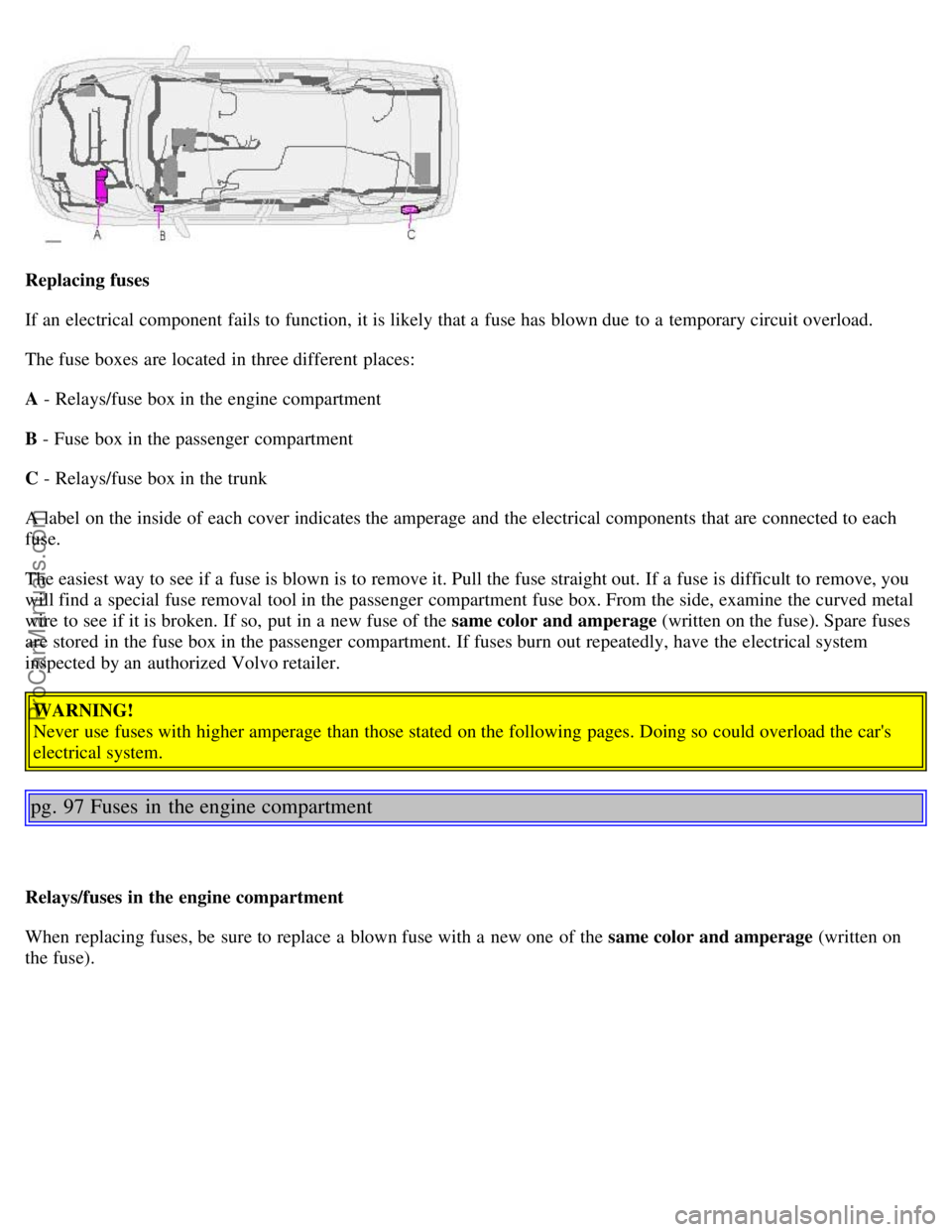
Replacing fuses
If an electrical component fails to function, it is likely that a fuse has blown due to a temporary circuit overload.
The fuse boxes are located in three different places:
A - Relays/fuse box in the engine compartment
B - Fuse box in the passenger compartment
C - Relays/fuse box in the trunk
A label on the inside of each cover indicates the amperage and the electrical components that are connected to each
fuse.
The easiest way to see if a fuse is blown is to remove it. Pull the fuse straight out. If a fuse is difficult to remove, you
will find a special fuse removal tool in the passenger compartment fuse box. From the side, examine the curved metal
wire to see if it is broken. If so, put in a new fuse of the same color and amperage (written on the fuse). Spare fuses
are stored in the fuse box in the passenger compartment. If fuses burn out repeatedly, have the electrical system
inspected by an authorized Volvo retailer.
WARNING!
Never use fuses with higher amperage than those stated on the following pages. Doing so could overload the car's
electrical system.
pg. 97 Fuses in the engine compartment
Relays/fuses in the engine compartment
When replacing fuses, be sure to replace a blown fuse with a new one of the same color and amperage (written on
the fuse).
ProCarManuals.com
Page 71 of 111
25Ignition switch, Relay starter motor 10A
26Control module - climate control blower 30A
27 Central locking system, power windows, defroster, lighting, sideview mirrors,
door warning lights, power sideview mirrors 15A
28 Power sun roof, courtesy lights, vanity mirror lights 10A
29 Telephone (option) 10A
30 Left front/rear parking lights 10A
31 Right front/rear parking lights, license plate lights 10A
32 Central electrical module, vanity mirror lighting, interior courtesy lights,
power steering 10A
33 Fuel pump 15A
34 Power sun roof 15A
35 Central locking system, power windows - left front 25A
36 Defroster, Lighting, Sideview mirrors, central locking system, power windows - right front 25A
37 Power windows - rear doors, child safety locks 30A
38 Siren alarm 5A
pg. 99 Fuses in the trunk
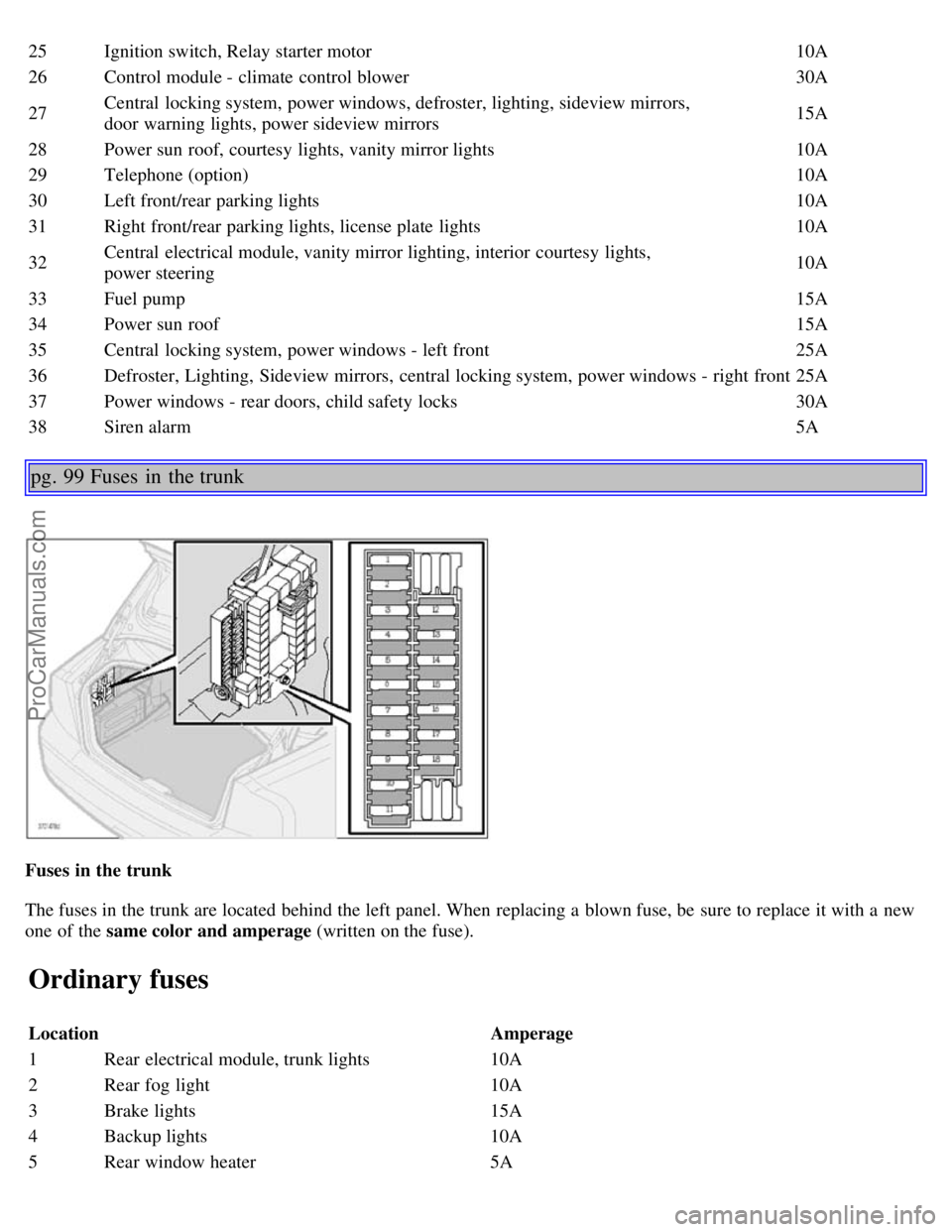
Fuses in the trunk
The fuses in the trunk are located behind the left panel. When replacing a blown fuse, be sure to replace it with a new
one of the same color and amperage (written on the fuse).
Ordinary fuses
Location Amperage
1 Rear electrical module, trunk lights 10A
2 Rear fog light 10A
3 Brake lights 15A
4 Backup lights 10A
5 Rear window heater 5A
ProCarManuals.com
Page 72 of 111
6Trunk release 10A
7Folding rear outboard head restraints 10A
8 Central locking system - rear doors/fuel filler door 15A
9 Trailer (30 supply) 15A
10 CD changer, CD ROM, VNS, antenna 10A
11 Electrical module - accesories 15A
12 -
13 -
14 -
15 Trailer (15 supply) 15A
16 -
17 -
18 -
pg. 100 Replacing bulbs
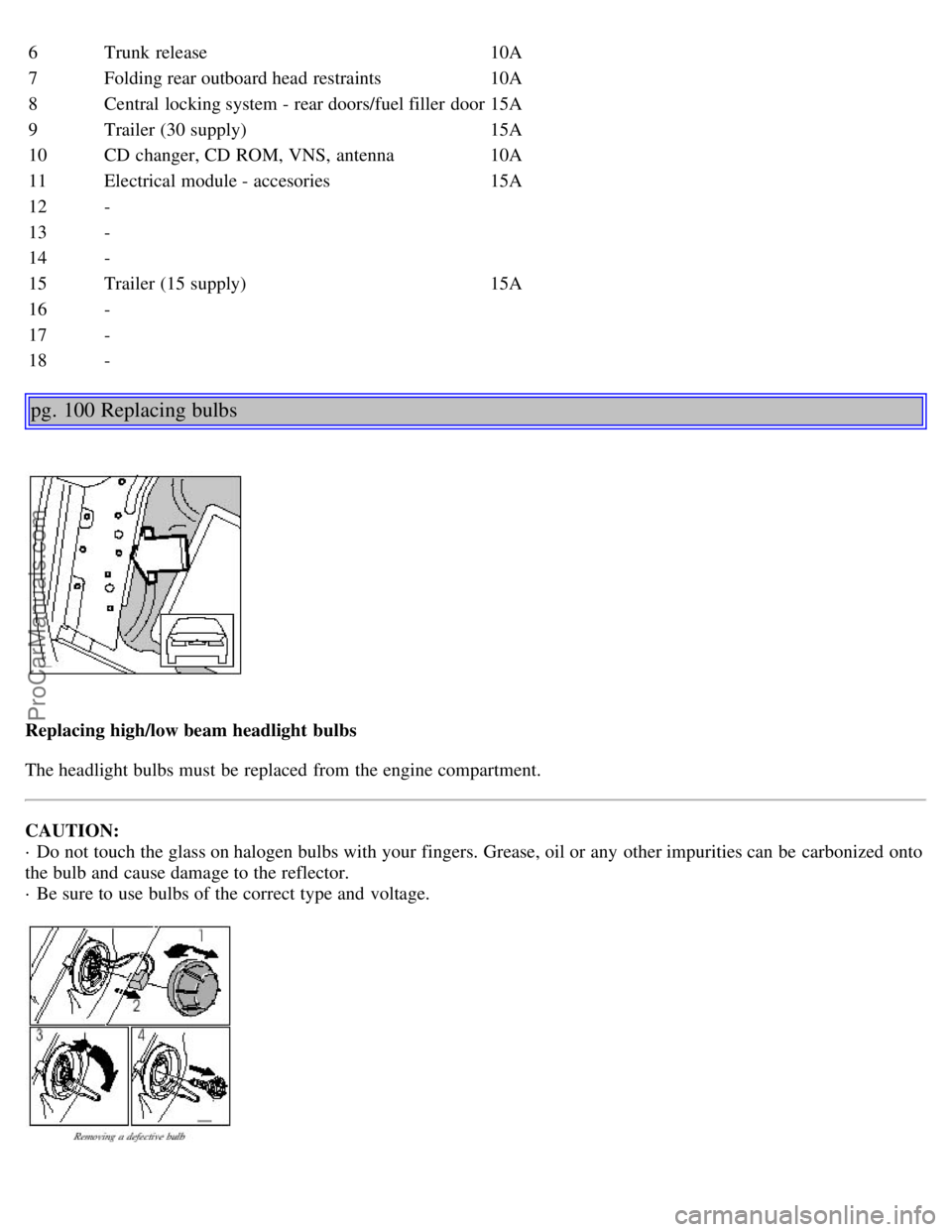
Replacing high/low beam headlight bulbs
The headlight bulbs must be replaced from the engine compartment.
CAUTION:
· Do not touch the glass on halogen bulbs with your fingers. Grease, oil or any other impurities can be carbonized onto
the bulb and cause damage to the reflector.
· Be sure to use bulbs of the correct type and voltage.
ProCarManuals.com
Page 75 of 111
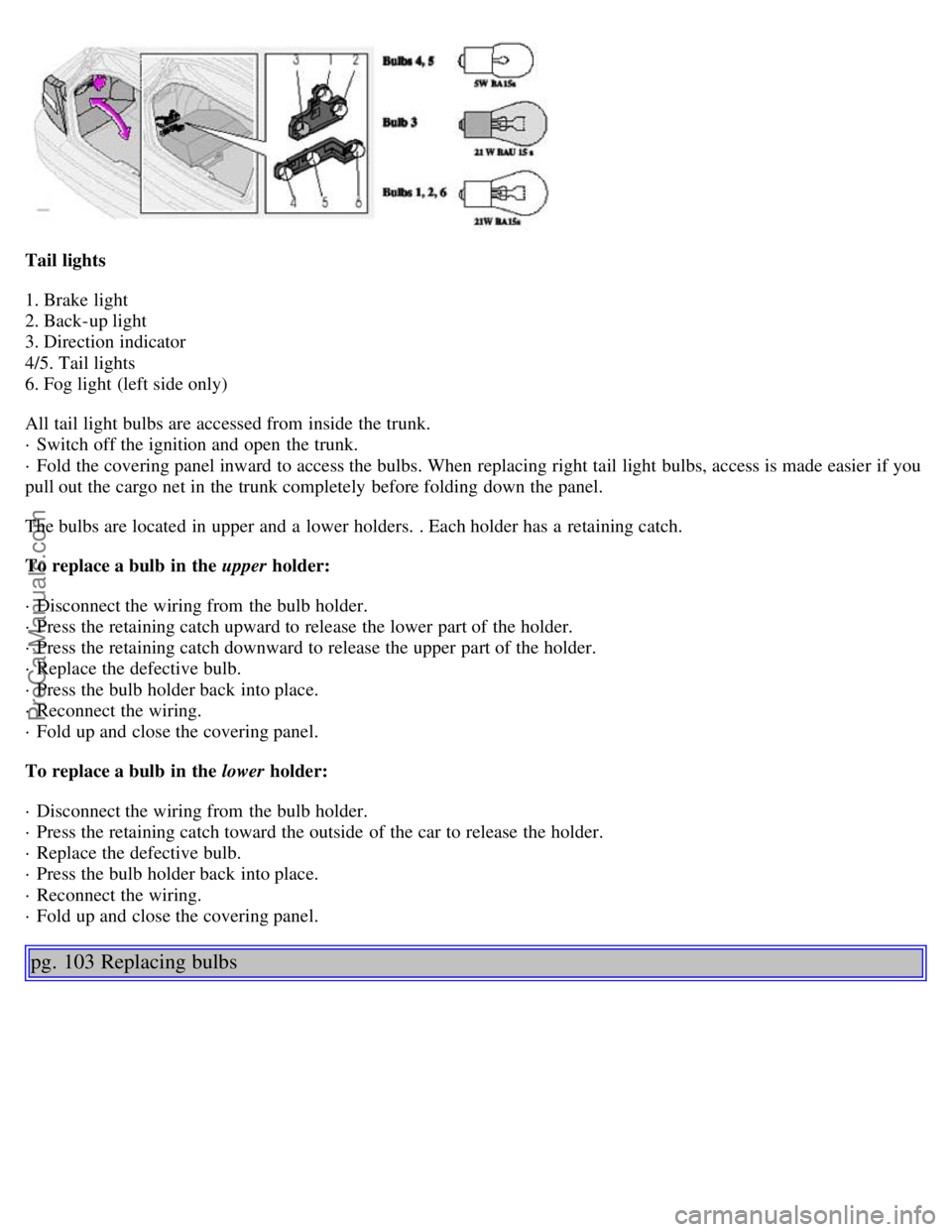
Tail lights
1. Brake light
2. Back-up light
3. Direction indicator
4/5. Tail lights
6. Fog light (left side only)
All tail light bulbs are accessed from inside the trunk.
· Switch off the ignition and open the trunk.
· Fold the covering panel inward to access the bulbs. When replacing right tail light bulbs, access is made easier if you
pull out the cargo net in the trunk completely before folding down the panel.
The bulbs are located in upper and a lower holders. . Each holder has a retaining catch.
To replace a bulb in the upper holder:
· Disconnect the wiring from the bulb holder.
· Press the retaining catch upward to release the lower part of the holder.
· Press the retaining catch downward to release the upper part of the holder.
· Replace the defective bulb.
· Press the bulb holder back into place.
· Reconnect the wiring.
· Fold up and close the covering panel.
To replace a bulb in the lower holder:
· Disconnect the wiring from the bulb holder.
· Press the retaining catch toward the outside of the car to release the holder.
· Replace the defective bulb.
· Press the bulb holder back into place.
· Reconnect the wiring.
· Fold up and close the covering panel.
pg. 103 Replacing bulbs
ProCarManuals.com
Page 80 of 111
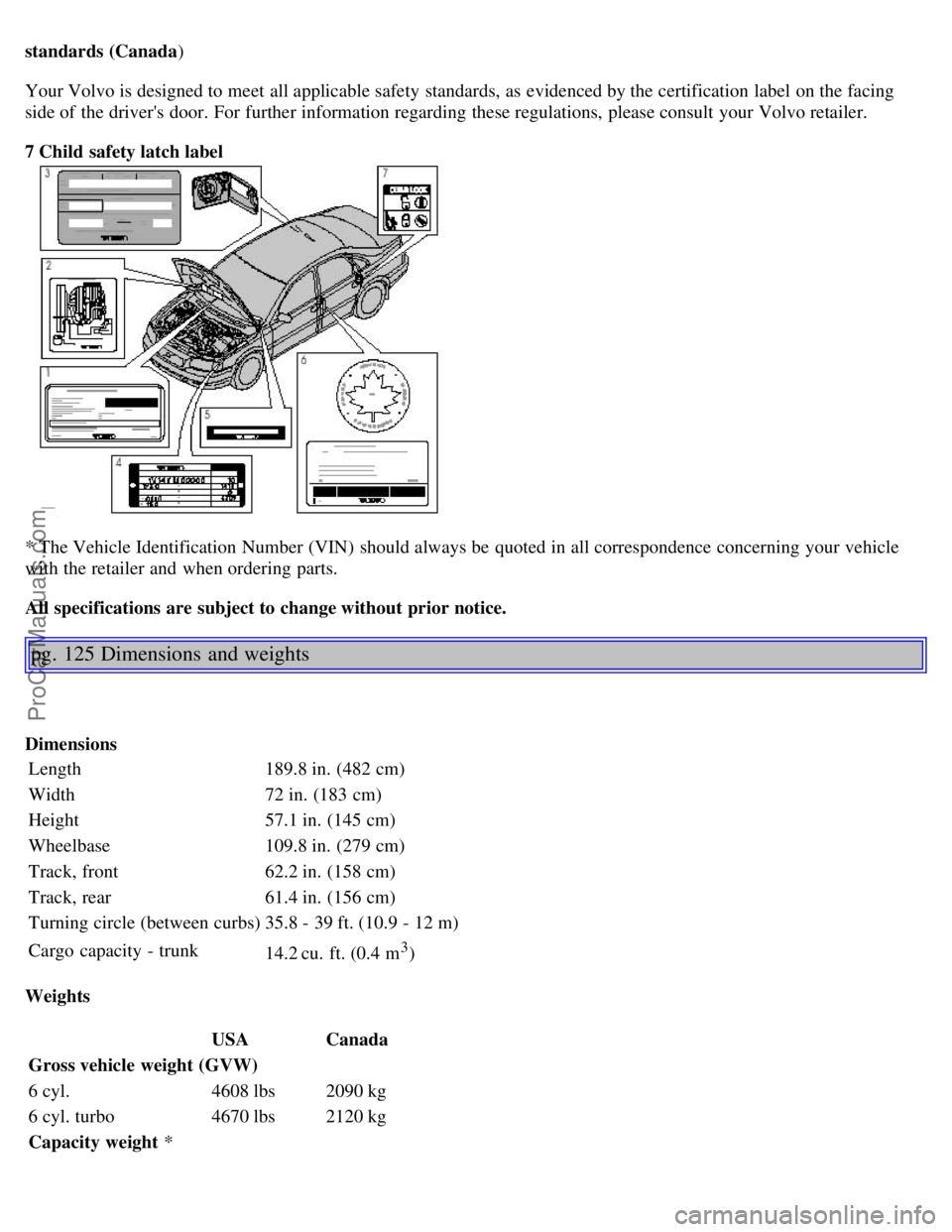
standards (Canada)
Your Volvo is designed to meet all applicable safety standards, as evidenced by the certification label on the facing
side of the driver's door. For further information regarding these regulations, please consult your Volvo retailer.
7 Child safety latch label
* The Vehicle Identification Number (VIN) should always be quoted in all correspondence concerning your vehicle
with the retailer and when ordering parts.
All specifications are subject to change without prior notice.
pg. 125 Dimensions and weights
Dimensions
Length 189.8 in. (482 cm)
Width 72 in. (183 cm)
Height 57.1 in. (145 cm)
Wheelbase 109.8 in. (279 cm)
Track, front 62.2 in. (158 cm)
Track, rear 61.4 in. (156 cm)
Turning circle (between curbs) 35.8 - 39 ft. (10.9 - 12 m)
Cargo capacity - trunk 14.2
cu. ft. (0.4 m3)
Weights USACanada
Gross vehicle weight (GVW)
6 cyl. 4608 lbs2090 kg
6 cyl. turbo 4670 lbs2120 kg
Capacity weight *
ProCarManuals.com
Page 85 of 111
Generator
Rated output: max. current: 140 A
Starter motor:
Output: 1.7 kW
BulbsBulb US no.Power Socket
Headlights
High beam H755W -
Low beam H755W -
Front parking lights/ 5WW 2.1x9.5d
Front direction indicators -21 W BAU 15d
Front fog lights H155 W -
Side marker lights -3 W W2.1x9.5d
Rear direction indicators -21W BAU 15 s
Tail lights 675W/4cp BA 15 s
Brake lights 115621W/32cp BA 15 s
Backup lights 115621W/32cp BA 15 s
Rear fog light 115621W/32cp BA 15 s
License plate light -5 W W 2.1x9.5d
Door step courtesy lights
Front -5W SV 8.5
Rear -5W W 2.1x9.5d
Trunk lights -10 W SV 8.5
Glove compartment light -2 W BA 9s
Vanity mirror lights -1.2 W SV 5.5
Instrument lighting -3 W W 2.1x9.5d
Rear ashtray -1.2 W W 2x4.6d
Front courtesy lights -10 W SV 8.5
Rear reading lights -5 W W2.1x9.5d
Sideview mirror -5W W2.1x9.5d
All specifications are subject to change without prior notice.
pg. 130 Volvo On Call
Your new Volvo comes with a four year ON CALL road assistance. Additional information, features, and benefits are
ProCarManuals.com