warning light VOLVO S80 2002 User Guide
[x] Cancel search | Manufacturer: VOLVO, Model Year: 2002, Model line: S80, Model: VOLVO S80 2002Pages: 111, PDF Size: 2.74 MB
Page 42 of 111
pg. 58 Remote keyless entry system
FCC ID:LQNP2T-APU
This device complies with part 15 of the FCC rules. Operation is subject to the following conditions: (1) This device
may not cause harmful interference, and (2) this device must accept any interference received, including interference
that may cause undesired operation.
Canadian 2306104388
Model 504 2927 by Donnelly Operation is subject to the following conditions: (1) this device may not cause
interference, and (2) this device must accept any interference, including interference that may cause undesired
operation of the device
Canadian 2306104388A
Model 509 977 by Connaught Electronics Operation is subject to the following conditions: (1) this device may not
cause interference, and (2) this device must accept any interference, including interference that may cause undesired
operation of the deviceWARNING!
Never use the transmitter to lock the doors from inside the car.
Doing so would ACTIVATE:
· the break-in alarm, which would sound if one of the doors were opened.
· the interior motion and inclination alarm sensors, if equipped. Doing so would DEACTIVATE:
· the sunroof and interior courtesy light controls.
· the central locking buttons on the front door armrests, although the interior door handles would still function to
allow occupants to leave the car.
Disabled features would remain disabled until the remote were used again to unlock the car.
In addition, locking an occupied vehicle would hinder rapid access to the occupants in an accident or emergency.
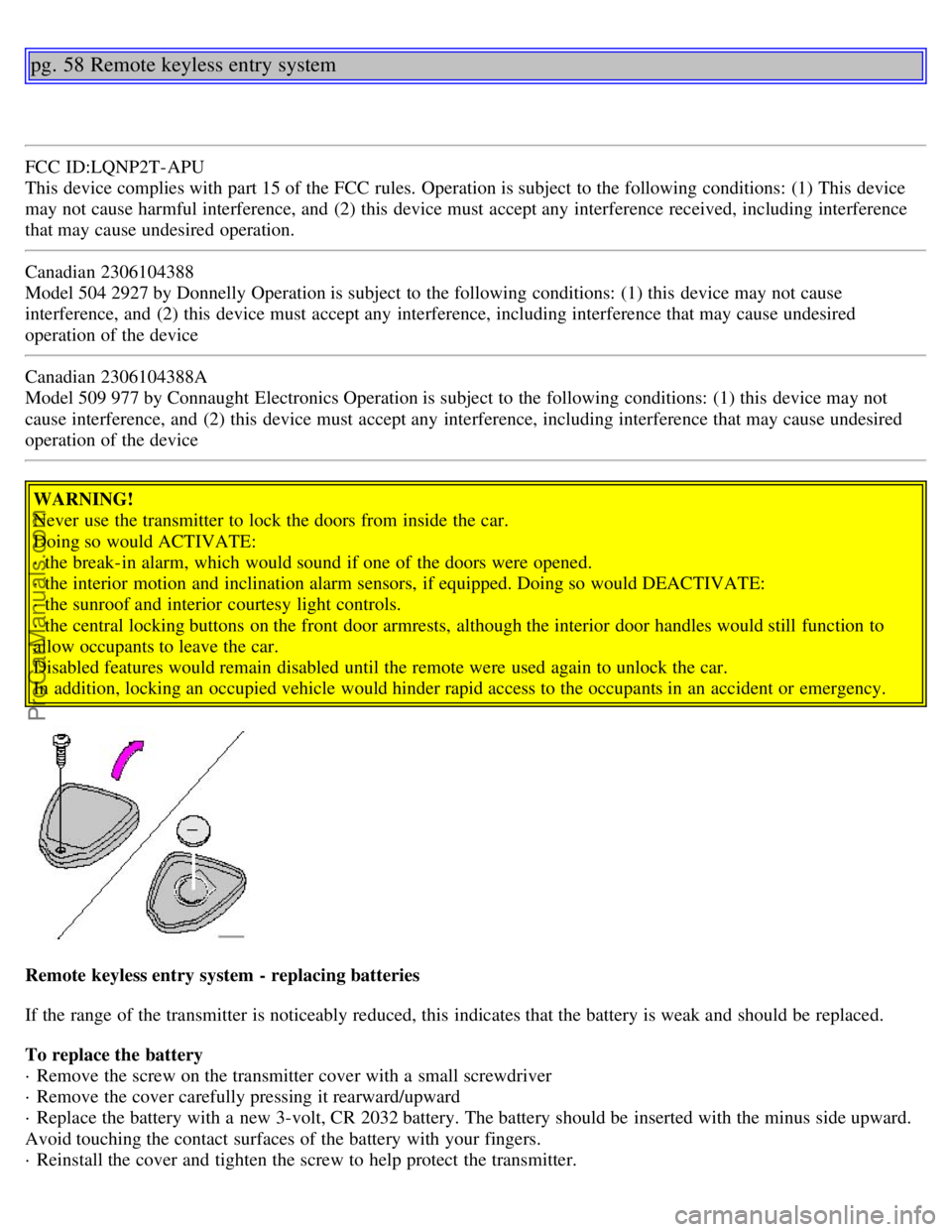
Remote keyless entry system - replacing batteries
If the range of the transmitter is noticeably reduced, this indicates that the battery is weak and should be replaced.
To replace the battery
· Remove the screw on the transmitter cover with a small screwdriver
· Remove the cover carefully pressing it rearward/upward
· Replace the battery with a new 3-volt, CR 2032 battery. The battery should be inserted with the minus side upward.
Avoid touching the contact surfaces of the battery with your fingers.
· Reinstall the cover and tighten the screw to help protect the transmitter.
ProCarManuals.com
Page 49 of 111

Deposit control gasoline (detergent additives)
Volvo recommends the use of gasoline containing deposit control additives. These additives have shown to be
effective in keeping injectors and intake valves clean. Consistent use of deposit control gasolines will help ensure good
driveability and fuel economy. If you are not sure whether the gasoline contains deposit control additives, check with
the service station operator.
Unleaded fuel
Each Volvo has a three-way catalytic converter and must use only unleaded gasoline. U.S. and Canadian regulations
require that pumps delivering unleaded gasoline be labelled "UNLEADED". Only these pumps have nozzles which fit
your car's filler inlet. It is unlawful to dispense leaded fuel into a vehicle labelled "unleaded gasoline only". Leaded
gasoline damages the three-way catalytic converter and the heated oxygen sensor system. Repeated use of leaded
gasoline will lessen the effectiveness of the emission control system and could result in loss of emission warranty
coverage. State and local vehicle inspection programs will make detection of misfueling easier, possibly resulting in
emission test failure for misfueled vehicles.
NOTE: Some U.S. and Canadian gasolines contain an octane enhancing additive called methyl-cyclopentadienyl
manganese tricarbonyl (MMT). If such fuels are used, your Emission Control System performance may be affected,
and the Check Engine light (malfunction indicator lamp) located on your instrument panel may light. If this occurs,
please return your vehicle to an authorized Volvo retailer for service.
Gasoline containing alcohol and ethers
"Oxygenated fuels"
Some fuel suppliers sell gasoline containing "oxygenates" which are usually alcohols or ethers. In some areas, state or
local laws require that the service pump be marked indicating use of alcohols or ethers. However, there are areas in
which the pumps are unmarked. If you are not sure whether there is alcohol or ethers in the gasoline you buy, check
with the service station operator. To meet seasonal air quality standards, some areas require the use of "oxygenated"
fuel. Volvo allows the use of the following "oxygenated fuels; however, the octane ratings listed on this page must still
be met.
Alcohol - Ethanol: Fuels containing up to 10% ethanol by volume may be used. Ethanol may also be referred to as
Ethyl alcohol, or "Gasohol".
Ethers - MTBE: Fuels containing up to 15% MTBE may be used.
CAUTION!
Do not use gasolines containing methanol (methyl alcohol, wood alcohol). This practice can result in vehicle
performance deterioration and can damage critical parts in the fuel system. Such damage may not be covered under the
New Vehicle Limited Warranty.
pg. 67 Fuel requirements
Carbon Monoxide - Important Warning
Carbon monoxide is a poisonous, colorless, and odorless gas. It is present in all exhaust gases. If you ever smell
exhaust fumes inside the vehicle, make sure the passenger compartment is ventilated, and immediately return the
vehicle to your retailer for correction.
Fuel Formulations
Do not use gasoline that contains lead as a knock inhibitor, and do not use lead additives. Besides damaging the
ProCarManuals.com
Page 50 of 111
exhaust emission control systems on your car, lead has been strongly linked to certain forms of cancer.
Many fuels contain benzene as a solvent. Unburned benzene has been strongly linked to certain forms of cancer. If you
live in an area where you must fill your own gas tank, take precautions. These may include:
standing upwind away from the filler nozzle while refueling
refueling only at gas stations with vapor recovery systems that fully seal the mouth of the filler neck during refueling
wear neoprene gloves while handling a fuel filler nozzle.
Use of Additives
With the exception of gas line antifreeze during winter months, do not add solvents, thickeners, or other store -bought
additives to your car's fuel, cooling, or lubricating systems. Overuse may damage your engine, and some of these
additives contain organically volatile chemicals. Do not needlessly expose yourself to these chemicals.
pg. 68 Refueling
Refueling
The fuel tank is designed to hold approximately 21.1 US gal. (80 liters) with sufficient volume left over to
accommodate possible expansion of the fuel in hot weather. Be aware that the "usable" tank capacity will be somewhat
less than the specified maximum. When the fuel level is low, such factors as ambient temperature, the fuel's "Reid
vapor pressure" characteristics, and terrain can affect the fuel pumps' ability to supply the engine with an adequate
supply of fuel. Therefore, it is advisable to refuel as soon as possible when the needle nears the red zone, or when the
fuel warning light comes on.
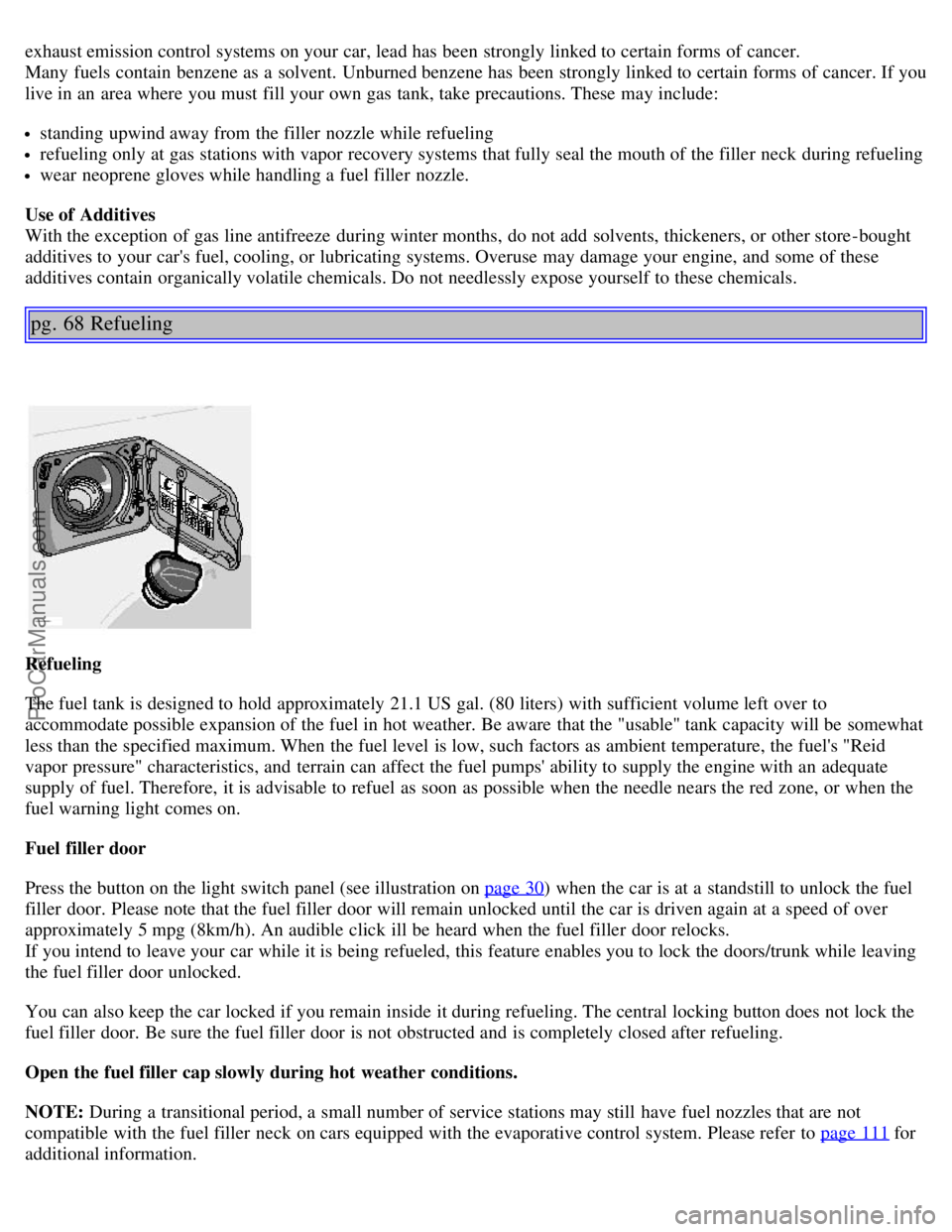
Fuel filler door
Press the button on the light switch panel (see illustration on page 30
) when the car is at a standstill to unlock the fuel
filler door. Please note that the fuel filler door will remain unlocked until the car is driven again at a speed of over
approximately 5 mpg (8km/h). An audible click ill be heard when the fuel filler door relocks.
If you intend to leave your car while it is being refueled, this feature enables you to lock the doors/trunk while leaving
the fuel filler door unlocked.
You can also keep the car locked if you remain inside it during refueling. The central locking button does not lock the
fuel filler door. Be sure the fuel filler door is not obstructed and is completely closed after refueling.
Open the fuel filler cap slowly during hot weather conditions.
NOTE: During a transitional period, a small number of service stations may still have fuel nozzles that are not
compatible with the fuel filler neck on cars equipped with the evaporative control system. Please refer to page 111
for
additional information.
ProCarManuals.com
Page 51 of 111

CAUTION:
· Do not refuel with the engine running *. Turn the ignition off or to position I. If the ignition is on, an incorrect
reading could occur in the fuel gauge.
· After refueling, close the fuel filler cap by turning it clockwise until it clicks into place *.
· Allow for fuel expansion by not overfilling the tank. Overfilling could also cause damage to the emission control
systems.
· Avoid spilling gasoline during refueling. In addition to causing damage to the environment, gasolines containing
alcohol can cause damage to painted surfaces, which may not be covered under the New Vehicle Limited Warranty.
· Do not use gasolines containing methanol (methyl alcohol, wood alcohol). This practice can result in vehicle
performance deterioration and can damage critical parts in the fuel system. Such damage may not be covered under the
New Vehicle Limited Warranty.
* If the fuel filler cap is not closed tightly or if the engine is running when the car is refueled, the Check Engine
Light (Malfunction Indicator Lamp) may indicate a fault. However, your vehicle's performance will not be affected.
Use only Volvo original or approved fuel filler caps.
pg. 69 Starting the engine
Starting the engine
1. Fasten the seat belt.
WARNING!
Before starting, check that the seat, steering wheel and mirrors are adjusted properly. Make sure the brake pedal can
be depressed completely. Adjust the seat if necessary. See page 48
.
2. Apply the parking brake, if not already set. The gear selector is locked in the (P)ark position (SHIFTLOCK).
3. Without touching the accelerator pedal, turn the ignition key* to the starting position. Allow the starter to operate
for up to 5 seconds (turbo: 10 seconds). Release the key as soon as the engine starts. If the engine fails to start, repeat
this step.
For cold starts at altitudes above 6000 ft (1800 meters), depress the accelerator pedal halfway and turn the key to the
starting position. Release the pedal slowly when the engine starts.
4. To release the gear selector from the (P)ark position, the engine must be running (or the ignition key must be in
position II) and the brake pedal must be depressed.
5. Select the desired gear. The gear engages after a very slight delay which is especially noticeable when selecting R.
NOTE:
· Your car is equipped with a KEYLOCK system. When the engine is switched off, the gear selector must be in the
( P )ark position before the key can be removed from the ignition switch.
· When starting in cold weather, the transmission may shift up at slightly higher engine speeds than normal until the
automatic transmission fluid reaches normal operating temperature.
CAUTION :
· The engine should be idling when you move the gear selector. Never accelerate until after you feel the transmission
engage! Accelerating immediately after selecting a gear will cause harsh gear engagement and premature transmission
ProCarManuals.com
Page 55 of 111
The parking brake should also be used when parking on grades.
The gear selector is mechanically locked in the P position (SHIFTLOCK). To release the gear selector from this
position, the engine must be running (or the ignition key must be in position II) and the brake pedal must be
depressed.WARNING!
Never leave the car unattended when the engine is running. If, by mistake, the gear selector is moved from P, the car
may start moving.
R (Reverse)
Never engage R while the car is moving forward.
N (Neutral)
Neutral - no gear engaged. Use the parking brake.
D (Drive)
D is the normal driving position and should be used as often as possible to help improve fuel economy. The car should
not be moving when shifting from R to the D position.
Kickdown
Automatic shift to a lower gear (kickdown) is achieved by depressing the accelerator pedal fully and briskly. An
upshift will occur when approaching the top speed for a particular gear or by releasing the accelerator pedal slightly.
Kickdown can be used for maximum acceleration or when passing at highway speeds. Kickdown does not function
when the transmission is in the manual shift (geartronic) mode (see next page).
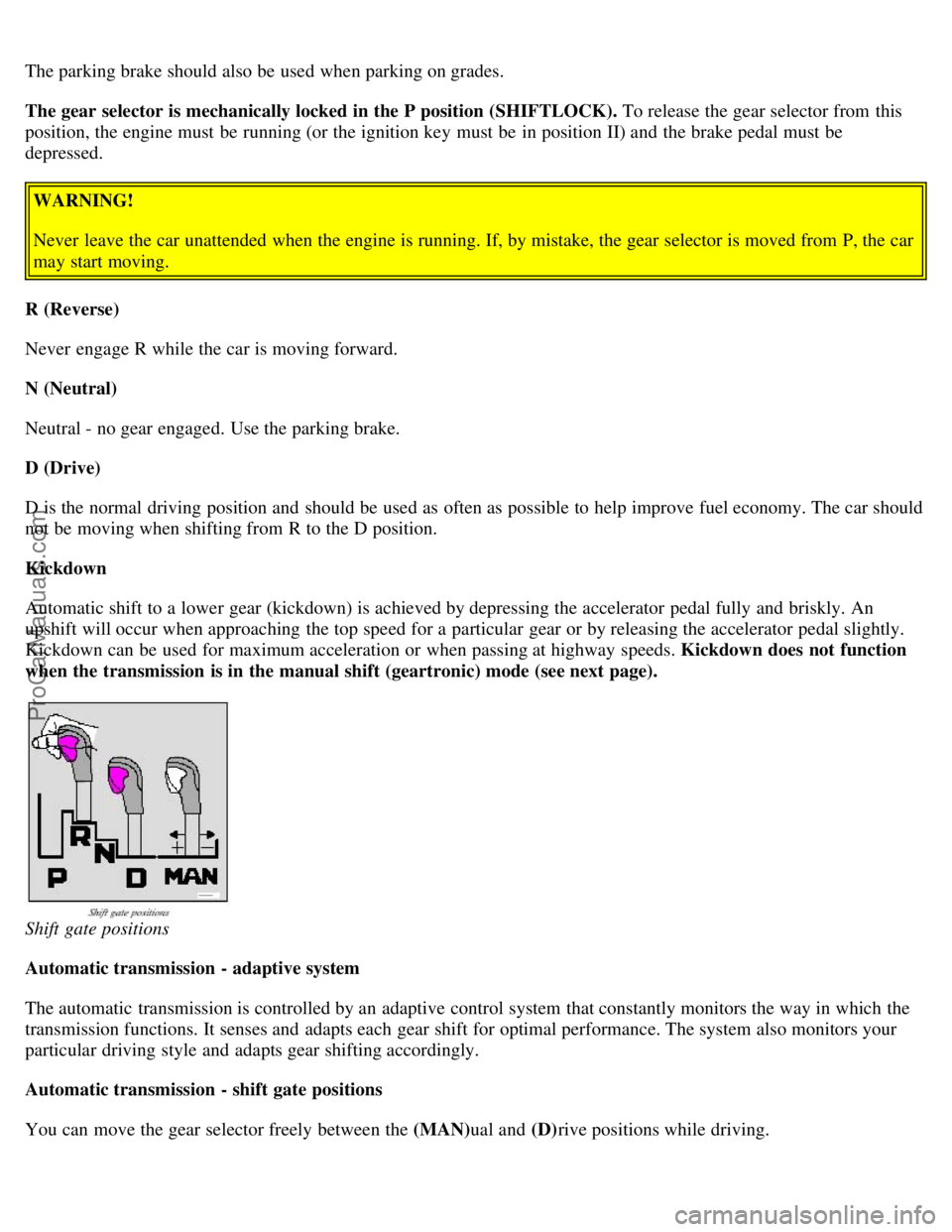
Shift gate positions
Automatic transmission - adaptive system
The automatic transmission is controlled by an adaptive control system that constantly monitors the way in which the
transmission functions. It senses and adapts each gear shift for optimal performance. The system also monitors your
particular driving style and adapts gear shifting accordingly.
Automatic transmission - shift gate positions
You can move the gear selector freely between the (MAN) ual and (D)rive positions while driving.
ProCarManuals.com
Page 57 of 111

Economical driving conserves natural resources
Better driving economy may be obtained by thinking ahead, avoiding rapid starts and stops and adjusting the speed of
your vehicle to immediate traffic conditions. Observe the following rules:
· Bring the engine to normal operating temperature as soon as possible by driving with a light foot on the accelerator
pedal for the first few minutes of operation. A cold engine uses more fuel and is subject to increased wear.
· Whenever possible, avoid using the car for driving short distances. This does not allow the engine to reach normal
operating temperature.
· Drive carefully and avoid rapid acceleration and hard braking.
· Do not exceed posted speed limits.
· Avoid carrying unnecessary items (extra load) in the car.
· Maintan correct tire pressure. Check tire pressure regularly (when tires are cold).
· Remove snow tires when threat of snow or ice has ended.
· Note that roof racks, ski racks, etc., increase air resistance and also fuel consumption.
· Avoid using automatic transmission kickdown feature unless necessary.
· However, at higher driving speeds, fuel consumption will be lower with the air conditioning on and the windows
closed than with the air conditioning off and the windows open.
· Using the onboard trip computer's fuel consumption modes can help you learn how to drive more economically.
Other factors which decrease gas mileage are:
· Worn or dirty spark plugs
· Incorrect spark plug gap
· Dirty air cleaner
· Dirty engine oil and clogged oil filter
· Dragging brakes
· Incorrect front end alignment
Some of the above mentioned items and others are checked at the standard Maintenance Service intervals.
NOTE: Vehicles equipped with automatic transmissions should use (D)rive as often as possible and avoid using
"kickdown" to help improve fuel economy.
Cooling system
The risk for engine overheating is greatest, especially in hot weather, when:
· Towing a trailer up steep inclines for prolonged periods at wide open throttle and low engine rpm.
· Stopping the engine suddenly after high speed driving (so-called "after-boiling" can occur).
· To avoid overheating, the following rules should be followed: Do not drive for prolonged periods at engine speeds
above 4500 rpm if you are towing a trailer in hilly terrain.
· Reduce speed when towing a trailer up long, steep inclines. The risk of overheat -ing can be reduced by switching off
the air conditioning system for a short time.
· Do not let the engine idle unnecessarily for prolonged periods.
· Do not mount auxiliary lamps in front of the grill. When the risk of overheating is imminent, or in the event of
overheating (the temperature gauge goes repeatedly into, or stays continual-ly in, the red section), the following
precau-tions should be taken:
· Switch off the air conditioning system.
· Pull off the road, away from traffic, stop the car and put the gear selector into Park. Do not stop the engine!
· Switch the heater to full (maximum) position. Increase the engine speed to approx. 2000 rpm (twice idling speed)
until the temperature begins to drop.
· If the warning light in the center of the instrument panel is red, and the message "Coolant level lo stop engine" is
displayed, switch off the engine as soon as possible.
ProCarManuals.com
Page 71 of 111
25Ignition switch, Relay starter motor 10A
26Control module - climate control blower 30A
27 Central locking system, power windows, defroster, lighting, sideview mirrors,
door warning lights, power sideview mirrors 15A
28 Power sun roof, courtesy lights, vanity mirror lights 10A
29 Telephone (option) 10A
30 Left front/rear parking lights 10A
31 Right front/rear parking lights, license plate lights 10A
32 Central electrical module, vanity mirror lighting, interior courtesy lights,
power steering 10A
33 Fuel pump 15A
34 Power sun roof 15A
35 Central locking system, power windows - left front 25A
36 Defroster, Lighting, Sideview mirrors, central locking system, power windows - right front 25A
37 Power windows - rear doors, child safety locks 30A
38 Siren alarm 5A
pg. 99 Fuses in the trunk
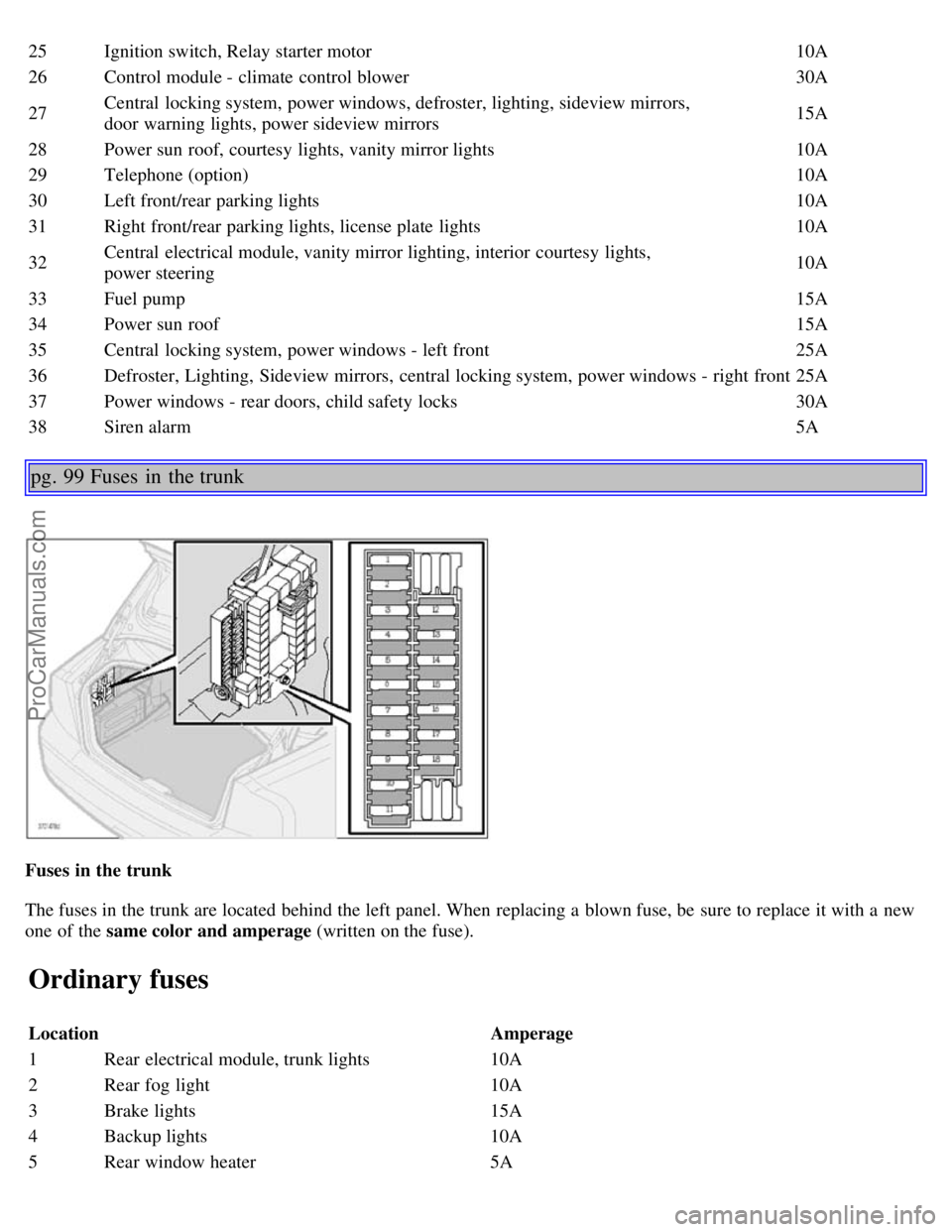
Fuses in the trunk
The fuses in the trunk are located behind the left panel. When replacing a blown fuse, be sure to replace it with a new
one of the same color and amperage (written on the fuse).
Ordinary fuses
Location Amperage
1 Rear electrical module, trunk lights 10A
2 Rear fog light 10A
3 Brake lights 15A
4 Backup lights 10A
5 Rear window heater 5A
ProCarManuals.com
Page 97 of 111
been successfully programmed. Release both buttons.
5. If you are programming a rolling code-equipped device (e.g., garage door opener or entry door lock), refer to
"Programming rolling codes" on the next page to complete the programming process. Repeat steps 3 and 4 to program
the other two transceiver buttons. If, after several attempts, you are unable to successfully train the HomeLink®
Universal Transceiver to learn your hand -held transmitter's signal, contact HomeLink® toll-free 1-800-355-3515
(Internet: www.HomeLink.com
).
pg. 148 HomeLink® Universal Transceiver (option)
WARNING!
· If you use HomeLink® to open a garage door or gate, be sure no one is near the gate or door while it is in motion.
· Do not use the HomeLink® Universal Transceiver with any garage door opener that lacks safety "stop" and
"reverse" features as required by federal safety standards. (This includes any garage door opener model
manufactured before April 1, 1982) A garage door opener that cannot "detect" an object, signalling the door to
"stop" and "reverse" does not meet current federal safety standards. Using a garage door opener without these
features increases the risk of serious injury or death. For more information on this matter, call toll-free 1-800-355-
3515 (Internet: www.HomeLink.com
).
NOTE - Canadian residents:
During programming, your hand -held transmitter may automatically stop transmitting. To successfully train
HomeLink®, continue to hold the HomeLink® button. At the same time, repeatedly press and hold your hand -held
transmitter's button at two-second intervals until HomeLink® has learned your transmitter's code. The HomeLink®
indicator light will flash first slowly, and then rapidly to indicate that the button has been successfully programmed..
Programming rolling codes
Determine, in one of the following ways, if your garage door uses a rolling code system and is manufactured after
1996:
· Refer to the garage door opener owner's manual for verification.
· If your hand -held transmitter appears to program the HomeLink® Universal Transceiver but the programmed button
does not activate the garage door, your garage door opener may have a rolling code.
· Press the programmed HomeLink® button. If the garage door opener has the rolling code feature, the HomeLink®
indicator light flashes rapidly and then glows steadily after approximately 2 seconds.
To train a garage door opener with the rolling code feature , follow these instructions after the transceiver has been
programmed (the aid of a second person may make the training quicker and easier):
1. Locate the training button on the garage door opener motor head unit . The exact location and color of the button
may vary. If you encounter difficulty, refer to the garage door opener owner's manual or call: 1-800-355-3515
(Internet: www.HomeLink.com
).
2. Press the "training" button on the garage door opener motor head unit until the "training" light comes on.
3. Firmly press and release the programmed HomeLink® button. Press and release the HomeLink® button a second
time to complete the training process.
ProCarManuals.com
Page 100 of 111
2 0 0 2
VOLVO S80
Index
pg.162 Index
A
ABS..........17
ABS - warning light..........25
Accessory lights..........27
Adjusting the steering wheel..........32
Advanced User Mode (AUM) - radio..........139
Air conditioning..........41- 45
Air pump system..........112
Air vents..........40
Airbag (SIPS)..........8
Airbag (SRS)..........4
Alarm..........61, 62
Alarm - "panic" function..........61
ALR/ELR..........14
Anti-lock Brake System (ABS)..........17
Anti-lock Brake System - warning light..........25
Antifreeze..........83, 112
Approach lighting..........56
Ashtrays..........34
Audio systems..........131
..cassette deck..........142
..CD player..........140
..HU -611 - overview..........132
..HU -801 - overview..........133
..radio..........136
..specifications..........145
AUM (Advanced User Mode) - radio..........139
Automatic car washing..........109
Automatic Locking Retractor (ALR)..........14
Automatic transmission
..Geartronic..........72, 73
ProCarManuals.com
Page 101 of 111
..Kickdown..........72
..Specifications..........126
Automatic transmission - cold starts..........71
Auxiliary socket..........27, 34
B
Backrests, rear seat - folding..........54
Battery..........83, 129
Battery maintenance..........119 -120
Replacing the battery..........120
Ventilation hose..........120
Blinds - rear/side rear windows..........38
Booster cushion..........13, 15
Booster cushion - integrated..........13
Brake failure warning light ..........24
Brake fluid..........118, 127
Brake system..........16
Bulbs (list)..........129
Bulbs - replacing..........100-106
C
Capacities (oils and fluids)..........123
, 127
Cargo net in trunk..........53
Catalytic converters - three-way..........85
Center console - switches..........27
Center head restraint - rear seat..........3
Central locking buttons..........59
Chains - winter driving..........89
Changing wheels..........92, 93
Child booster cushion ......... 13, 15
Child restraint anchorages ........ 12
Child safety..........12 -15
Child safety locks - rear doors..........63
Climate controls..........41 - 45
Climate system - general information..........44
Clock..........23
Coat hanger..........49
Cold weather driving..........83
Combination filter..........41, 45
Coolant..........112, 127
Cooling system..........74, 127
Courtesy light..........50
Courtesy lights (front) - replacing..........106
Courtesy lights - exterior..........56
Cruise control..........29
Cup holder - opening..........52
ProCarManuals.com