engine VOLVO S80 2002 Owner's Guide
[x] Cancel search | Manufacturer: VOLVO, Model Year: 2002, Model line: S80, Model: VOLVO S80 2002Pages: 111, PDF Size: 2.74 MB
Page 82 of 111
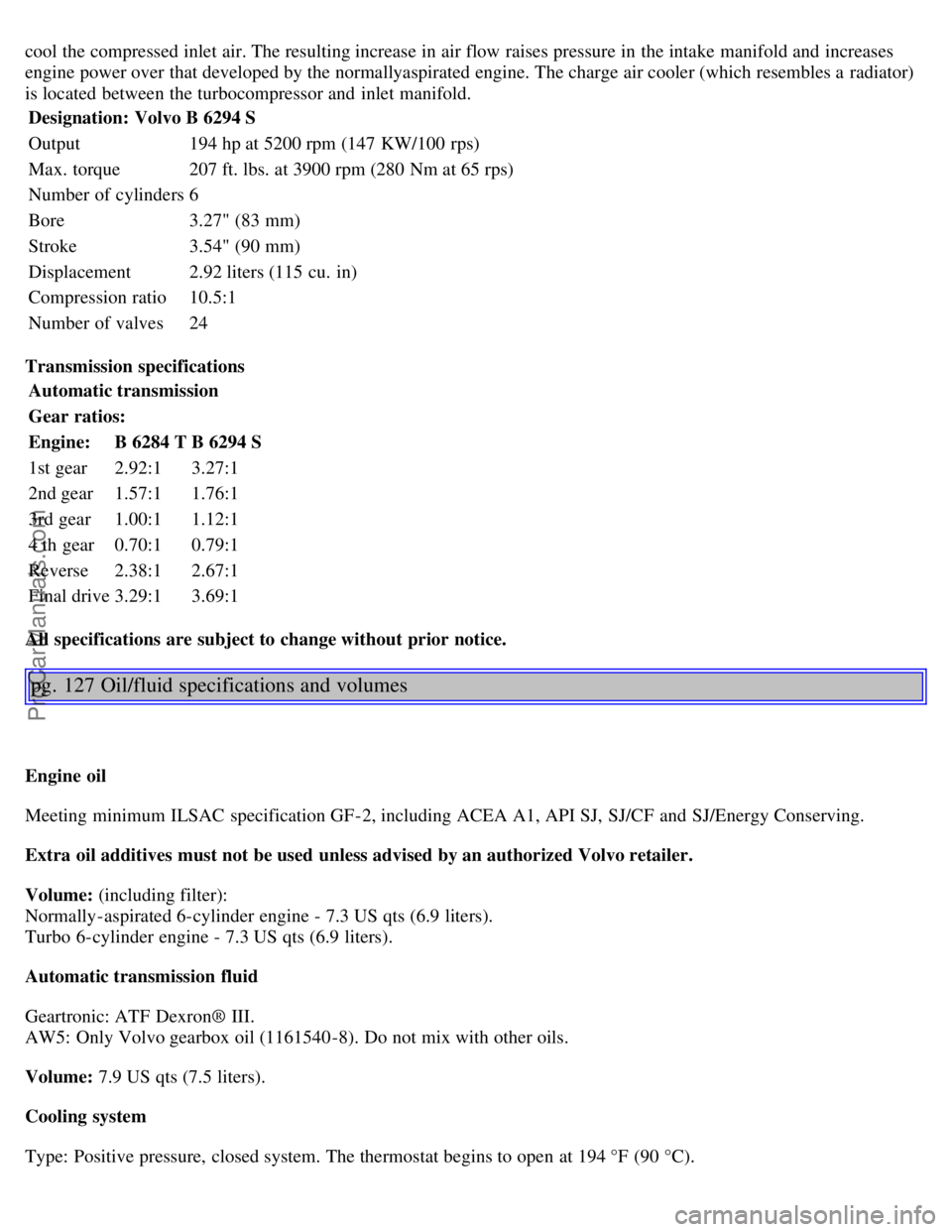
cool the compressed inlet air. The resulting increase in air flow raises pressure in the intake manifold and increases
engine power over that developed by the normallyaspirated engine. The charge air cooler (which resembles a radiator)
is located between the turbocompressor and inlet manifold.Designation: Volvo B 6294 S
Output 194 hp at 5200 rpm (147 KW/100 rps)
Max. torque 207 ft. lbs. at 3900 rpm (280 Nm at 65 rps)
Number of cylinders 6
Bore 3.27" (83 mm)
Stroke 3.54" (90 mm)
Displacement 2.92 liters (115 cu. in)
Compression ratio 10.5:1
Number of valves 24
Transmission specifications Automatic transmission
Gear ratios:
Engine: B 6284 TB 6294 S
1st gear 2.92:13.27:1
2nd gear 1.57:11.76:1
3rd gear 1.00:11.12:1
4 th gear 0.70:10.79:1
Reverse 2.38:12.67:1
Final drive 3.29:13.69:1
All specifications are subject to change without prior notice.
pg. 127 Oil/fluid specifications and volumes
Engine oil
Meeting minimum ILSAC specification GF-2, including ACEA A1, API SJ, SJ/CF and SJ/Energy Conserving.
Extra oil additives must not be used unless advised by an authorized Volvo retailer.
Volume: (including filter):
Normally-aspirated 6-cylinder engine - 7.3 US qts (6.9 liters).
Turbo 6-cylinder engine - 7.3 US qts (6.9 liters).
Automatic transmission fluid
Geartronic: ATF Dexron® III.
AW5: Only Volvo gearbox oil (1161540-8). Do not mix with other oils.
Volume: 7.9 US qts (7.5 liters).
Cooling system
Type: Positive pressure, closed system. The thermostat begins to open at 194 °F (90 °C).
ProCarManuals.com
Page 83 of 111
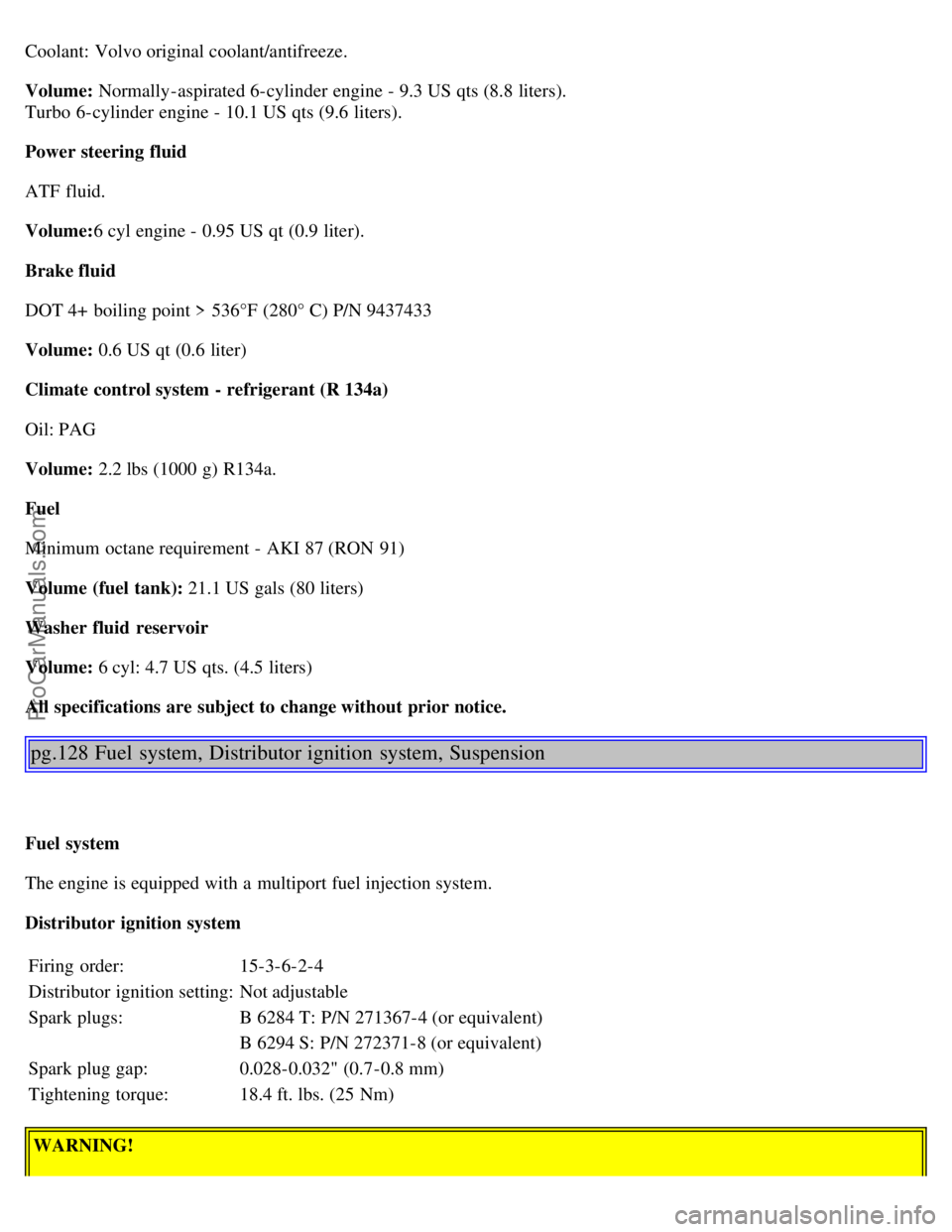
Coolant: Volvo original coolant/antifreeze.
Volume: Normally-aspirated 6-cylinder engine - 9.3 US qts (8.8 liters).
Turbo 6-cylinder engine - 10.1 US qts (9.6 liters).
Power steering fluid
ATF fluid.
Volume: 6 cyl engine - 0.95 US qt (0.9 liter).
Brake fluid
DOT 4+ boiling point > 536°F (280° C) P/N 9437433
Volume: 0.6 US qt (0.6 liter)
Climate control system - refrigerant (R 134a)
Oil: PAG
Volume: 2.2 lbs (1000 g) R134a.
Fuel
Minimum octane requirement - AKI 87 (RON 91)
Volume (fuel tank): 21.1 US gals (80 liters)
Washer fluid reservoir
Volume: 6 cyl: 4.7 US qts. (4.5 liters)
All specifications are subject to change without prior notice.
pg.128 Fuel system, Distributor ignition system, Suspension
Fuel system
The engine is equipped with a multiport fuel injection system.
Distributor ignition system
Firing order: 15-3-6-2-4
Distributor ignition setting: Not adjustable
Spark plugs: B 6284 T: P/N 271367-4 (or equivalent)
B 6294 S: P/N 272371-8 (or equivalent)
Spark plug gap: 0.028-0.032" (0.7-0.8 mm)
Tightening torque: 18.4 ft. lbs. (25 Nm)
WARNING!
ProCarManuals.com
Page 84 of 111
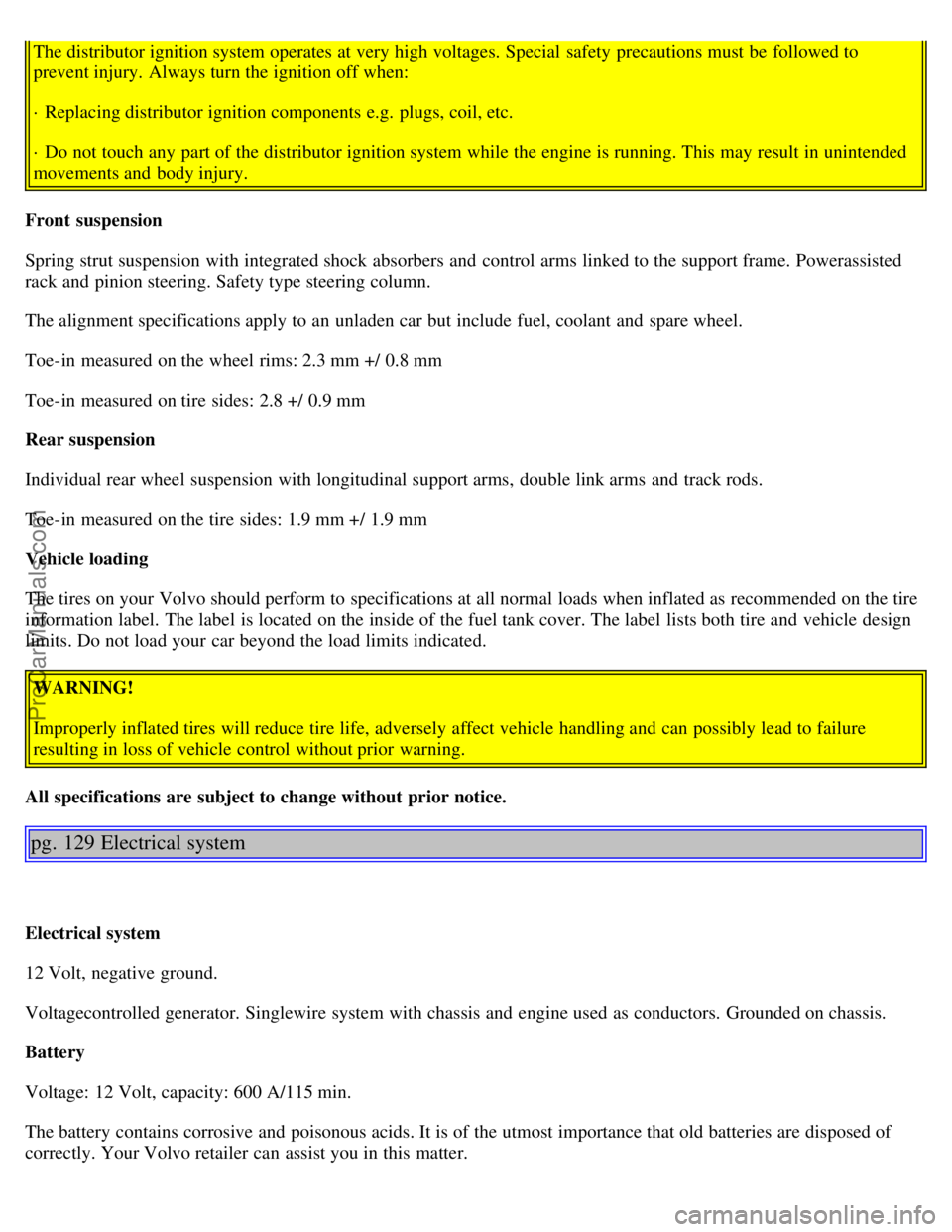
The distributor ignition system operates at very high voltages. Special safety precautions must be followed to
prevent injury. Always turn the ignition off when:
· Replacing distributor ignition components e.g. plugs, coil, etc.
· Do not touch any part of the distributor ignition system while the engine is running. This may result in unintended
movements and body injury.
Front suspension
Spring strut suspension with integrated shock absorbers and control arms linked to the support frame. Powerassisted
rack and pinion steering. Safety type steering column.
The alignment specifications apply to an unladen car but include fuel, coolant and spare wheel.
Toe-in measured on the wheel rims: 2.3 mm +/ 0.8 mm
Toe-in measured on tire sides: 2.8 +/ 0.9 mm
Rear suspension
Individual rear wheel suspension with longitudinal support arms, double link arms and track rods.
Toe-in measured on the tire sides: 1.9 mm +/ 1.9 mm
Vehicle loading
The tires on your Volvo should perform to specifications at all normal loads when inflated as recommended on the tire
information label. The label is located on the inside of the fuel tank cover. The label lists both tire and vehicle design
limits. Do not load your car beyond the load limits indicated. WARNING!
Improperly inflated tires will reduce tire life, adversely affect vehicle handling and can possibly lead to failure
resulting in loss of vehicle control without prior warning.
All specifications are subject to change without prior notice.
pg. 129 Electrical system
Electrical system
12 Volt, negative ground.
Voltagecontrolled generator. Singlewire system with chassis and engine used as conductors. Grounded on chassis.
Battery
Voltage: 12 Volt, capacity: 600 A/115 min.
The battery contains corrosive and poisonous acids. It is of the utmost importance that old batteries are disposed of
correctly. Your Volvo retailer can assist you in this matter.
ProCarManuals.com
Page 98 of 111
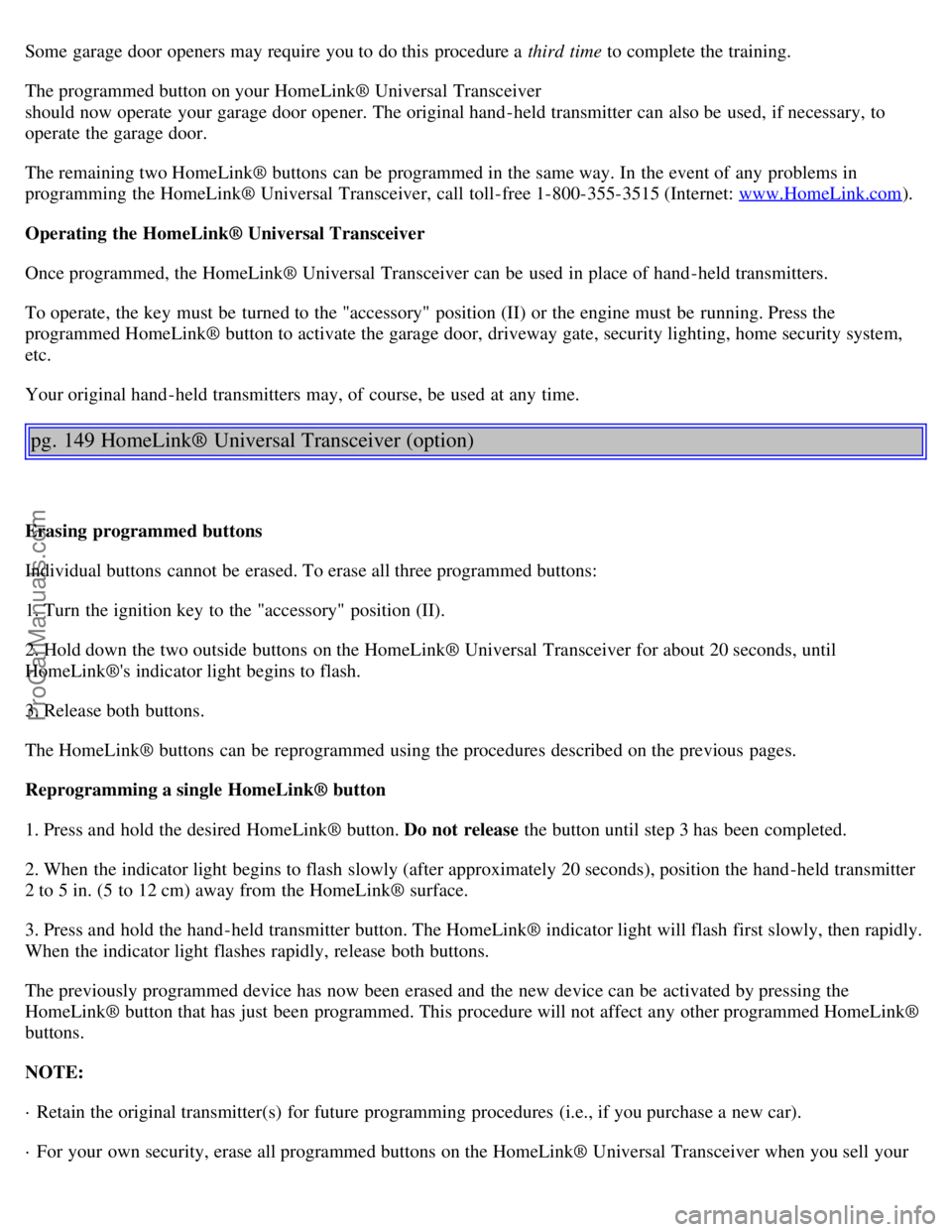
Some garage door openers may require you to do this procedure a third time to complete the training.
The programmed button on your HomeLink® Universal Transceiver
should now operate your garage door opener. The original hand -held transmitter can also be used, if necessary, to
operate the garage door.
The remaining two HomeLink® buttons can be programmed in the same way. In the event of any problems in
programming the HomeLink® Universal Transceiver, call toll-free 1-800-355-3515 (Internet: www.HomeLink.com
).
Operating the HomeLink® Universal Transceiver
Once programmed, the HomeLink® Universal Transceiver can be used in place of hand -held transmitters.
To operate, the key must be turned to the "accessory" position (II) or the engine must be running. Press the
programmed HomeLink® button to activate the garage door, driveway gate, security lighting, home security system,
etc.
Your original hand -held transmitters may, of course, be used at any time.
pg. 149 HomeLink® Universal Transceiver (option)
Erasing programmed buttons
Individual buttons cannot be erased. To erase all three programmed buttons:
1. Turn the ignition key to the "accessory" position (II).
2. Hold down the two outside buttons on the HomeLink® Universal Transceiver for about 20 seconds, until
HomeLink®'s indicator light begins to flash.
3. Release both buttons.
The HomeLink® buttons can be reprogrammed using the procedures described on the previous pages.
Reprogramming a single HomeLink® button
1. Press and hold the desired HomeLink® button. Do not release the button until step 3 has been completed.
2. When the indicator light begins to flash slowly (after approximately 20 seconds), position the hand -held transmitter
2 to 5 in. (5 to 12 cm) away from the HomeLink® surface.
3. Press and hold the hand -held transmitter button. The HomeLink® indicator light will flash first slowly, then rapidly.
When the indicator light flashes rapidly, release both buttons.
The previously programmed device has now been erased and the new device can be activated by pressing the
HomeLink® button that has just been programmed. This procedure will not affect any other programmed HomeLink®
buttons.
NOTE:
· Retain the original transmitter(s) for future programming procedures (i.e., if you purchase a new car).
· For your own security, erase all programmed buttons on the HomeLink® Universal Transceiver when you sell your
ProCarManuals.com
Page 102 of 111
D
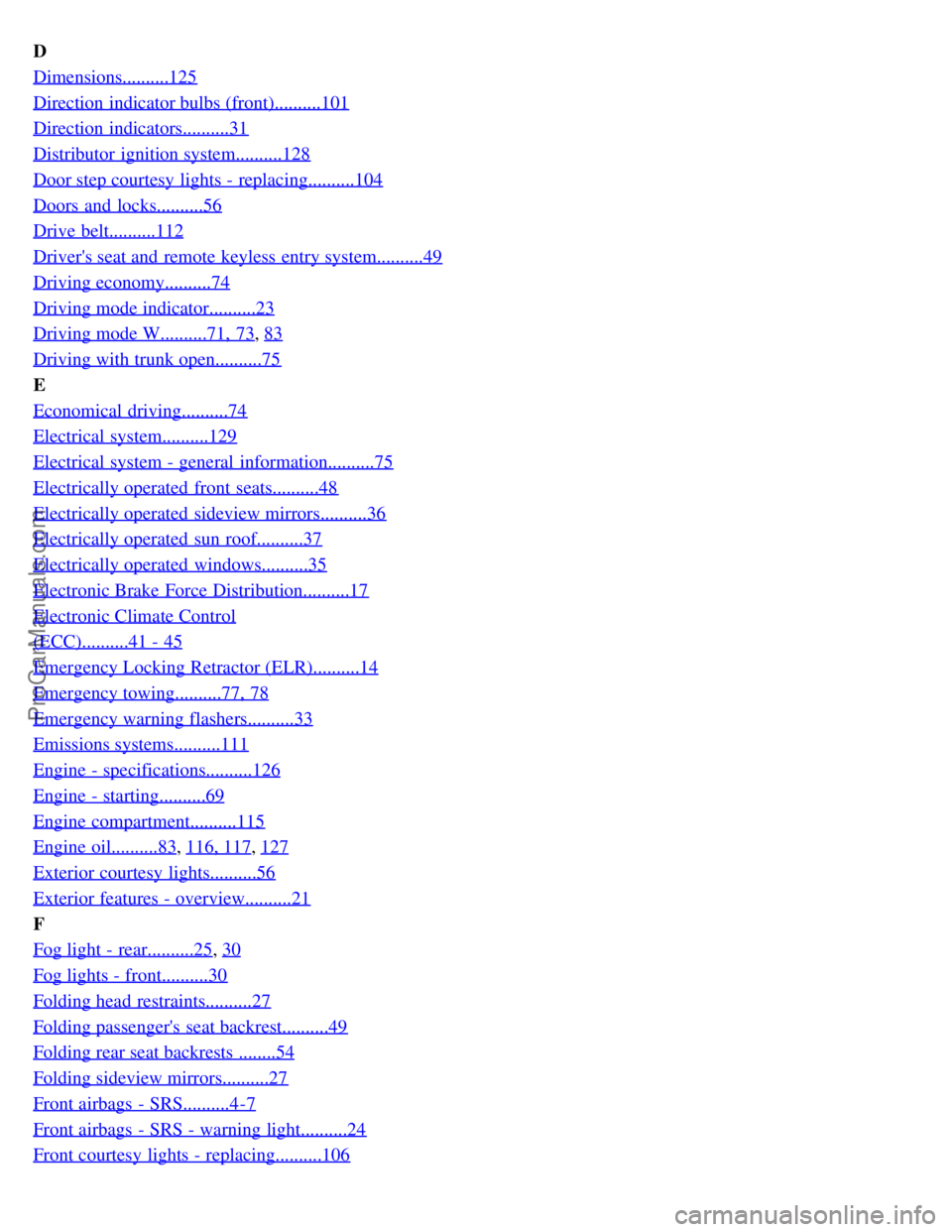
Dimensions..........125
Direction indicator bulbs (front)..........101
Direction indicators..........31
Distributor ignition system..........128
Door step courtesy lights - replacing..........104
Doors and locks..........56
Drive belt..........112
Driver's seat and remote keyless entry system..........49
Driving economy..........74
Driving mode indicator..........23
Driving mode W..........71, 73, 83
Driving with trunk open..........75
E
Economical driving..........74
Electrical system..........129
Electrical system - general information..........75
Electrically operated front seats..........48
Electrically operated sideview mirrors..........36
Electrically operated sun roof..........37
Electrically operated windows..........35
Electronic Brake Force Distribution..........17
Electronic Climate Control
(ECC)..........41 - 45
Emergency Locking Retractor (ELR)..........14
Emergency towing..........77, 78
Emergency warning flashers..........33
Emissions systems..........111
Engine - specifications..........126
Engine - starting..........69
Engine compartment..........115
Engine oil..........83, 116, 117, 127
Exterior courtesy lights..........56
Exterior features - overview..........21
F
Fog light - rear..........25
, 30
Fog lights - front..........30
Folding head restraints..........27
Folding passenger's seat backrest..........49
Folding rear seat backrests ........54
Folding sideview mirrors..........27
Front airbags - SRS..........4-7
Front airbags - SRS - warning light..........24
Front courtesy lights - replacing..........106
ProCarManuals.com
Page 104 of 111
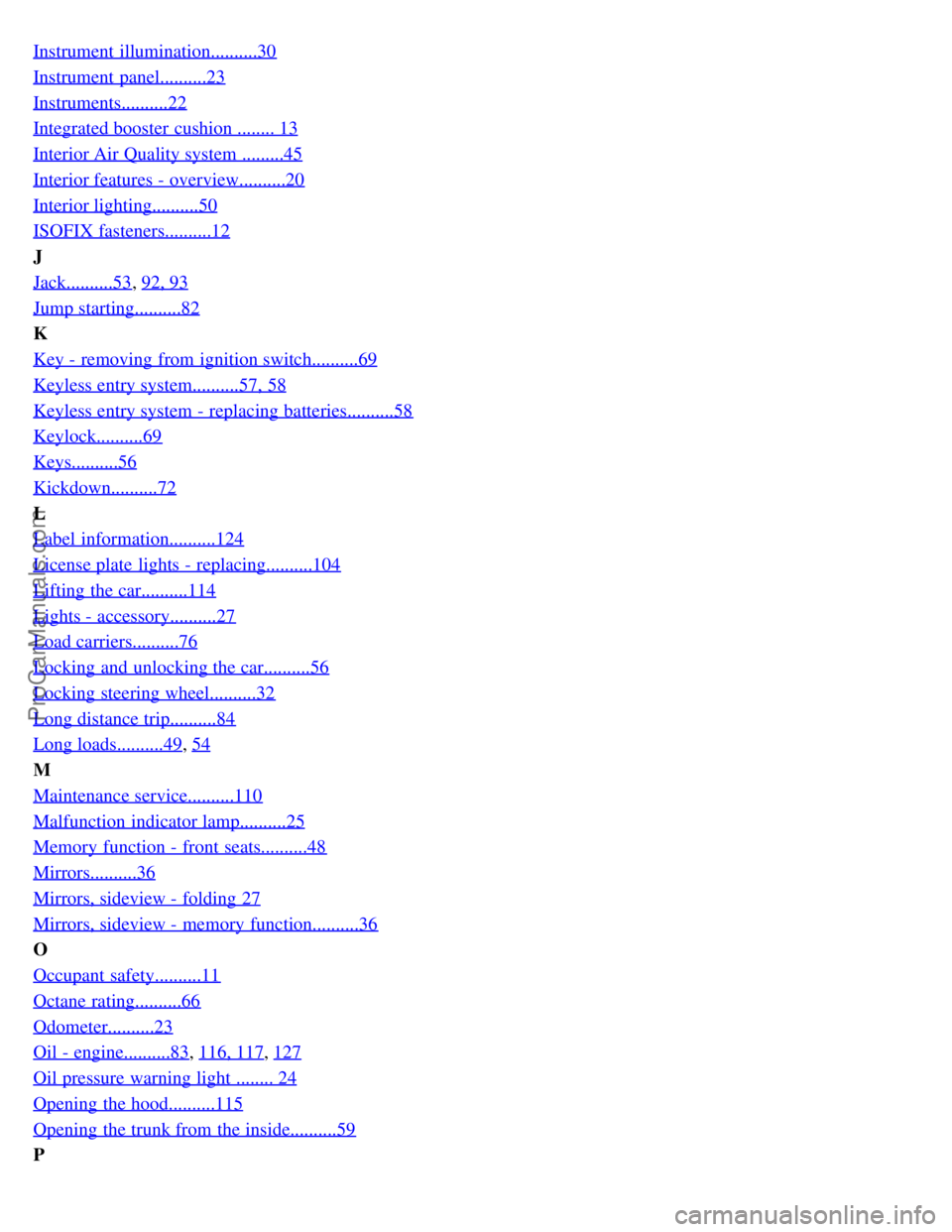
Instrument illumination..........30
Instrument panel..........23
Instruments..........22
Integrated booster cushion ........ 13
Interior Air Quality system .........45
Interior features - overview..........20
Interior lighting..........50
ISOFIX fasteners..........12
J
Jack..........53
, 92, 93
Jump starting..........82
K
Key - removing from ignition switch..........69
Keyless entry system..........57, 58
Keyless entry system - replacing batteries..........58
Keylock..........69
Keys..........56
Kickdown..........72
L
Label information..........124
License plate lights - replacing..........104
Lifting the car..........114
Lights - accessory..........27
Load carriers..........76
Locking and unlocking the car..........56
Locking steering wheel..........32
Long distance trip..........84
Long loads..........49, 54
M
Maintenance service..........110
Malfunction indicator lamp..........25
Memory function - front seats..........48
Mirrors..........36
Mirrors, sideview - folding 27
Mirrors, sideview - memory function..........36
O
Occupant safety..........11
Octane rating..........66
Odometer..........23
Oil - engine..........83, 116, 117, 127
Oil pressure warning light ........ 24
Opening the hood..........115
Opening the trunk from the inside..........59
P
ProCarManuals.com
Page 106 of 111

Shiftlock..........69, 70, 72
Side direction indicator - replacing..........103
Side impact airbag system (SIPS)..........8
Side marker lights - replacing..........105
Sideview mirrors..........36
Sideview mirrors - folding ........27
Sideview mirrors - heated..........33
Sideview mirrors - memory function..........36
Snow chains..........89
Snow tires..........89
Spare tire.......... 53, 90
Spark plugs..........128
Specifications..........126
Speed -sensitive power steering..........75
SRS..........6
SRS diagnostic system..........24
Stability Traction Control (STC)..........17, 27
Start inhibitor (immobilizer)..........56, 69
Starting the engine..........69
Steering wheel adjustment ........ 32
Steering wheel lock..........32
Storage compartment in center console..........52
Storage compartments..........51
Studded tires..........89
Sun blinds..........38
Sun roof..........37
Supplemental Restraint System..........4, 24
Suspension..........128
Switches in center console ........ 27
T
Tachometer..........23
Tail light bulbs - replacing ........ 102
Temperature gauge..........23
Temporary spare tire..........90
Text window..........26
Three-way catalytic converters..........85
Tire pressure..........90
Tires..........75, 88 - 91
Tires - changing..........92, 93
Tool bag..........53
Towing a trailer..........79
Towing eyelet..........77
Towing the car..........77, 78
Trailer towing..........79
ProCarManuals.com
Page 110 of 111

the vehicle and others sharing the roadway. Avoiding distractions is part of that responsibility.
The following should be checked regularly: *
1 Washer fluid reservoir should be filled with water and solvent (wintertime: windshield washer anti-freeze). See
page 114.
2 Power steering - When cold, the level must not be above the COLD mark and when hot it must not be above the
HOT mark. Top up if the level drops to the ADD mark with ATF fluid. See page 118.
3 Coolant level should be between the expansion tank marks. Mixture: 50% anti-freeze and 50% water. See page 112.
4 Engine oil level should be between the dipstick marks. The distance between the marks represents approx.
1.6 US qts (1.5 liters). See page 117.
5 Brake fluid - check, without removing the cap, that the level is above the MIN mark. Use brake fluid DOT 4+. See
page 118.
* Engine oil should be checked each time the car is refuelled.
Octane rating, see page 66.
Tire pressure, see label located on the rear edge of the right front door.
ProCarManuals.com