brake VOLVO S80 2002 Owners Manual
[x] Cancel search | Manufacturer: VOLVO, Model Year: 2002, Model line: S80, Model: VOLVO S80 2002Pages: 111, PDF Size: 2.74 MB
Page 2 of 111

Chapter 2 - Instruments, switches and controls
Chapter 3 - Climate control system
Chapter 4 - Interior
Chapter 5 - Keys, Locks, Alarm
Chapter 6 - Starting and driving
Chapter 7 - Wheels and tires
Chapter 8 - Maintenance/Servicing
Chapter 9 - Specifications
Chapter 10 - Audio systems
HomeLink® Universal Transceiver (option)
Index
Back Cover
© 2001 Volvo Cars of North America Inc.
General information
Shiftlock
When your car is parked, the gear selector is locked in the (P)ark position. To release the selector from this position,
turn the ignition key to position II (or start the engine), depress the brake pedal, press the button on the front side of the
gear selector and move the selector from (P)ark.
Keylock
This means that when you switch off the ignition, the gear selector must be in the (P)ark position before the key can be
removed from the ignition switch.
Anti-lock Brake System (ABS)
The ABS system in your car performs a self -diagnostic test when the vehicle first reaches the speed of approximately
12 mph (20 km/h). The brake pedal will pulsate several times and a sound may be audible from the ABS control
module. This is normal.
Fuel tank cover The fuel tank cover, located on the right rear fender, is connected to your car's central locking system.
The driver's door must be unlocked before the fuel tank cover can be opened.
Fuel filler cap
After refueling, close the fuel filler cap by turning it clockwise until it clicks into place If this cap is not closed tightly
or if the engine is running when the car is refueled, the Malfunction Indicator Lamp ("Check Engine" light) may
indicate a fault.
ProCarManuals.com
Page 4 of 111

When you drive a Volvo, you become our partner in the work to lessen the car's impact on the environment.
To reduce your vehicle's environmental impact, you can:
· Maintain proper air pressure in your tires. Tests have shown decreased fuel economy with improperly inflated tires
· Follow the recommended maintenance schedule
· Drive at a constant speed
· See an authorized Volvo retailer as soon as possible for inspection if the check engine (malfunction indicator) lamp
illuminates, or stays on after the vehicle has started
· Properly dispose of any vehicle related waste such as used motor oil, used batteries, brake pads, etc.
· When cleaning your car, use Volvo's own car care products, all of which have systematically been adapted to the
environment.
Prem-Air®
On the surface of the radiator in the engine compartment, there is a special coating called Prem-Air®. Prem-Air®
works as a catalytic converter, converting most of the ozone passing through the radiator into oxygen, thereby reducing
harmful ground-level ozone.
For additional information regarding the environmental activities inwhich Volvo Cars of North America, Inc. and
Volvo Car Corporation are involved, visit our Internet Home Page at:
http://www.volvocars.com
Top of Page
ProCarManuals.com
Page 5 of 111
2 0 0 2
VOLVO S80
Chapter 1 - Safety
pg. 1 Safety
Not wearing a seat belt is like believing "It'll never happen to me!" Volvo, the inventor of the three-point seat belt,
urges you and all adult occupants of your car to wear seat belts and ensure that children are properly restrained, using
an infant, car or booster seat determined by age, weight and height. Volvo also believes no child should sit in the front
seat of a car.
Fact: In every state and province, some type of child-restraint legislation has been passed. Additionally, most states
and provinces have already made it mandatory for occupants of a car to use seat belts.
So, urging you to "buckle up" is not just our recommendation - legislation in your state or province may mandate seat
belt usage. The few seconds it takes to buckle up may one day allow you to say, "It's a good thing I was wearing my
seat belt."
Seat belts
2
Center head restraint3
Front airbags (SRS)4
Side impact airbags (SIPS)8
Volvo Inflatable Curtain (VIC)9
Whiplash Protection System (WHIPS)10
Occupant safety11
Child safety12
Brake system16
Anti-lock Brake System (ABS)17
Stability Traction Control (STC)18
Dynamic Stability and Traction Control (DSTC)18
pg. 2 Seat belts
ProCarManuals.com
Page 12 of 111
by everyone in the car. The SRS system is a supplement to the seat belts.
WARNING!
If your car has been subjected to flood conditions (e.g. soaked carpeting/standing water on the floor of the vehicle)
or if your car has become flooddamaged in any way, do not attempt to start the vehicle or put the key in the ignition
before disconnecting the battery (see below). This may cause airbag deployment which could result in personal
injury. Have the car towed to an authorized Volvo retailer for repairs.
Automatic transmission:
Before attempting to tow the car, use the following procedure to override the shiftlock system to move the gear
selector to the neutral position.
· Switch off the ignition for at least 10 minutes and disconnect the battery
· Wait at least one minute
· Insert the key in the ignition and turn it to position II
· Press firmly on the brake pedal.
· Move the gear selector from (P)ark to the (N)eutral position.
WARNING!
Never drive with the airbags deployed. The fact that they hang out can impair the steering of your car. Other safety
systems can also be damaged. The smoke and dust formed when the airbags are deployed can cause skin and eye
irritation in the event of prolonged exposure.
pg. 8 Side impact airbags (SIPS)
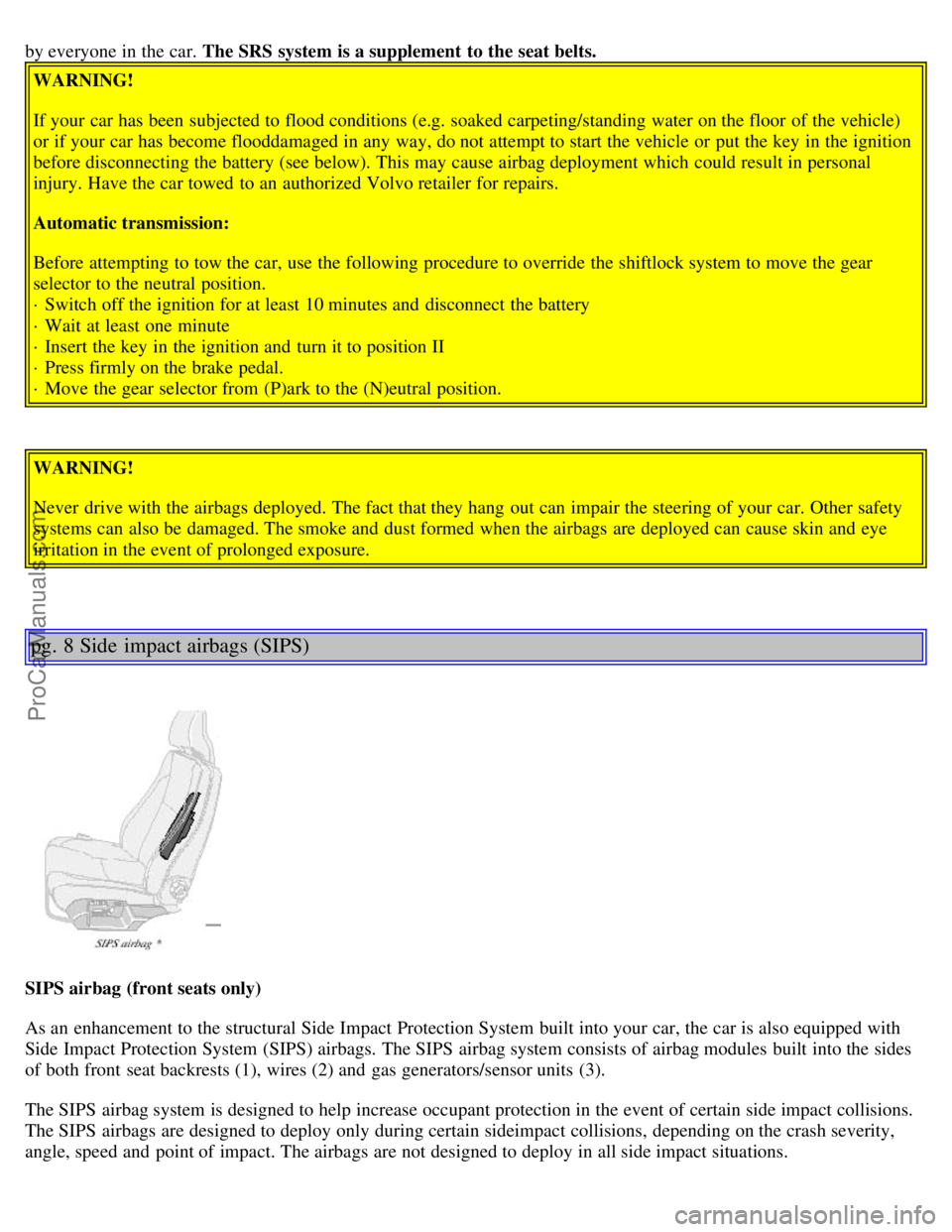
SIPS airbag (front seats only)
As an enhancement to the structural Side Impact Protection System built into your car, the car is also equipped with
Side Impact Protection System (SIPS) airbags. The SIPS airbag system consists of airbag modules built into the sides
of both front seat backrests (1), wires (2) and gas generators/sensor units (3).
The SIPS airbag system is designed to help increase occupant protection in the event of certain side impact collisions.
The SIPS airbags are designed to deploy only during certain sideimpact collisions, depending on the crash severity,
angle, speed and point of impact. The airbags are not designed to deploy in all side impact situations.
ProCarManuals.com
Page 15 of 111
2 0 0 2
VOLVO S80
Chapter 2 - Instruments, switches and controls
pg. 19 Instruments, switches and controls
Interior20
Exterior21
Instruments22
Instrument panel23
Indicator and warning lights24
Indicator and warning lights24
Text information window26
Switches in center console27
Trip computer28
Cruise control29
Light switch panel30
Turn signals, windshield wipers/washers31
Steering wheel adjustment/lock, ignition switch32
Warning flashers, heated mirrors/rear window/front seats33
Parking brake, auxiliary socket34
Electrically operated windows35
Rearview/sideview/vanity mirrors36
Sun roof37
Sun blinds38
pg. 20 Interior
ProCarManuals.com
Page 16 of 111
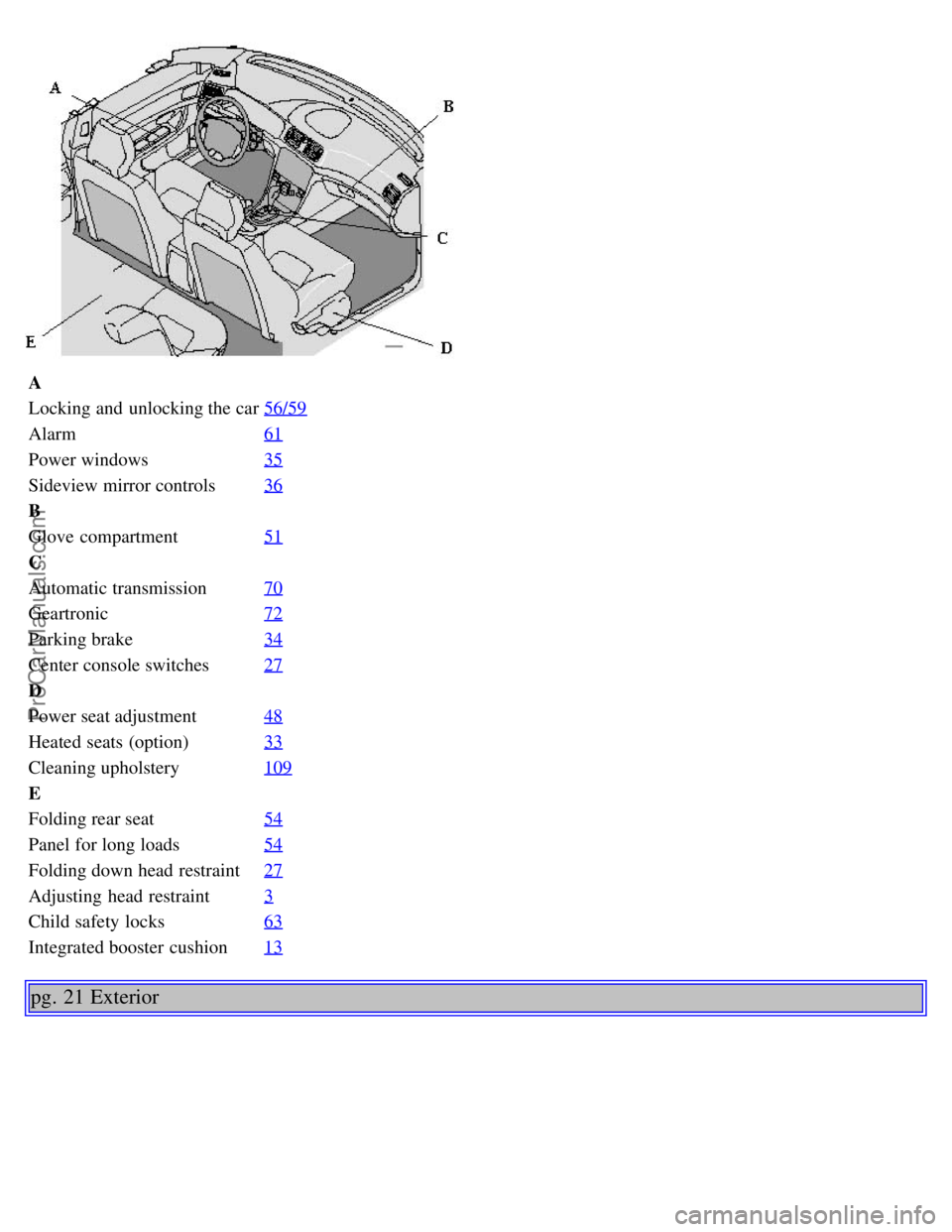
A
Locking and unlocking the car56/59
Alarm61
Power windows35
Sideview mirror controls36
B
Glove compartment51
C
Automatic transmission70
Geartronic72
Parking brake34
Center console switches27
D
Power seat adjustment48
Heated seats (option)33
Cleaning upholstery109
E
Folding rear seat54
Panel for long loads54
Folding down head restraint27
Adjusting head restraint3
Child safety locks63
Integrated booster cushion13
pg. 21 Exterior
ProCarManuals.com
Page 17 of 111
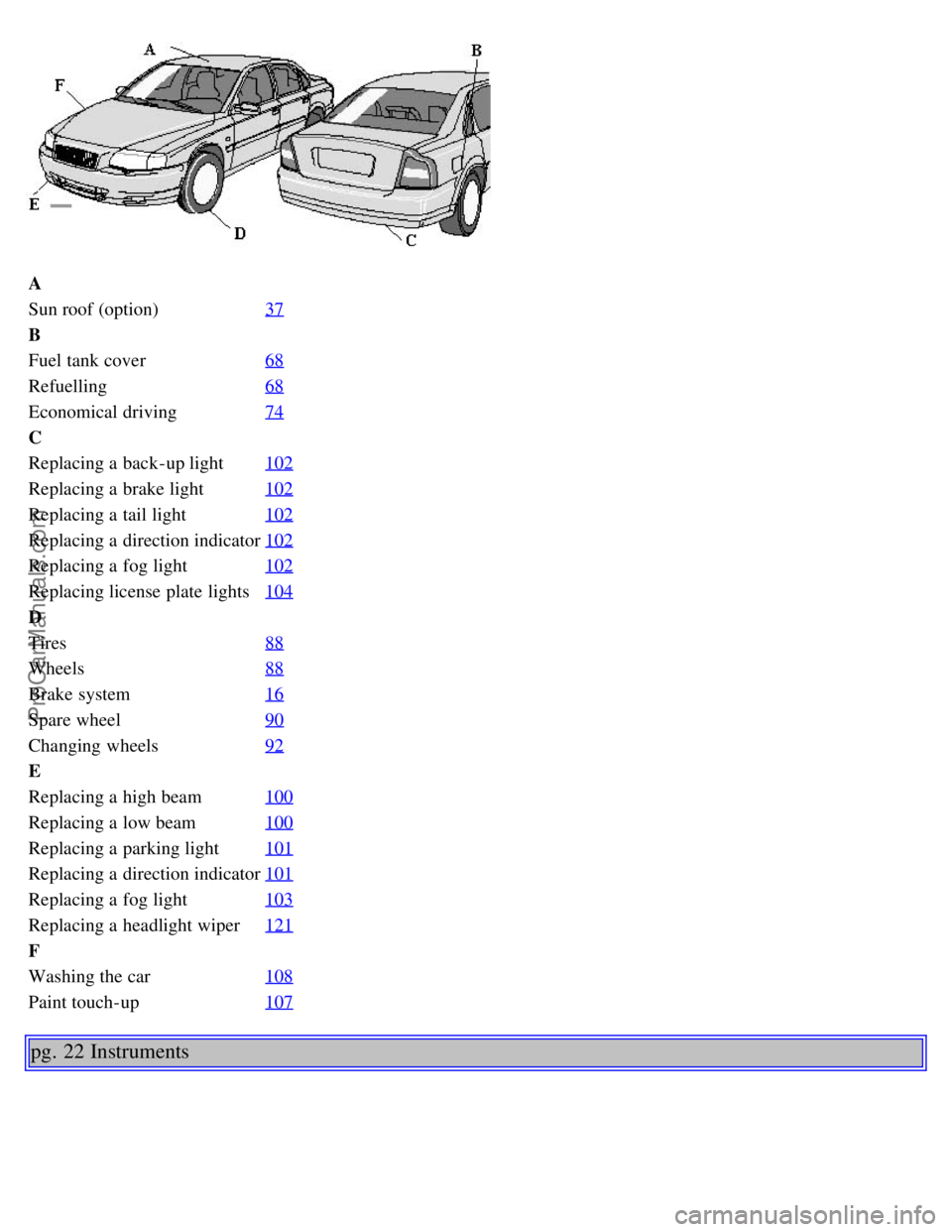
A
Sun roof (option)37
B
Fuel tank cover68
Refuelling68
Economical driving74
C
Replacing a back-up light102
Replacing a brake light102
Replacing a tail light102
Replacing a direction indicator102
Replacing a fog light102
Replacing license plate lights104
D
Tires88
Wheels88
Brake system16
Spare wheel90
Changing wheels92
E
Replacing a high beam100
Replacing a low beam100
Replacing a parking light101
Replacing a direction indicator101
Replacing a fog light103
Replacing a headlight wiper121
F
Washing the car108
Paint touch-up107
pg. 22 Instruments
ProCarManuals.com
Page 20 of 111
Please note that this symbol does not indicate a fault with your car.
At low speeds or when the car is not moving, the temperature readings may be slightly higher than the actual ambient
temperature.
12 Clock/reset button
Turn the button to adjust the clock.
13 Fuel gauge
The fuel tank holds approximately 21.1 US gal. (80 liters).
When the warning light comes on there is approximately 1.8 US gal. (8 liters) of fuel remaining.
14 Indicator and warning lights
pg. 24 Indicator and warning lights
The indicator and warning lights described on pages 24 and 25 should never stay on when driving
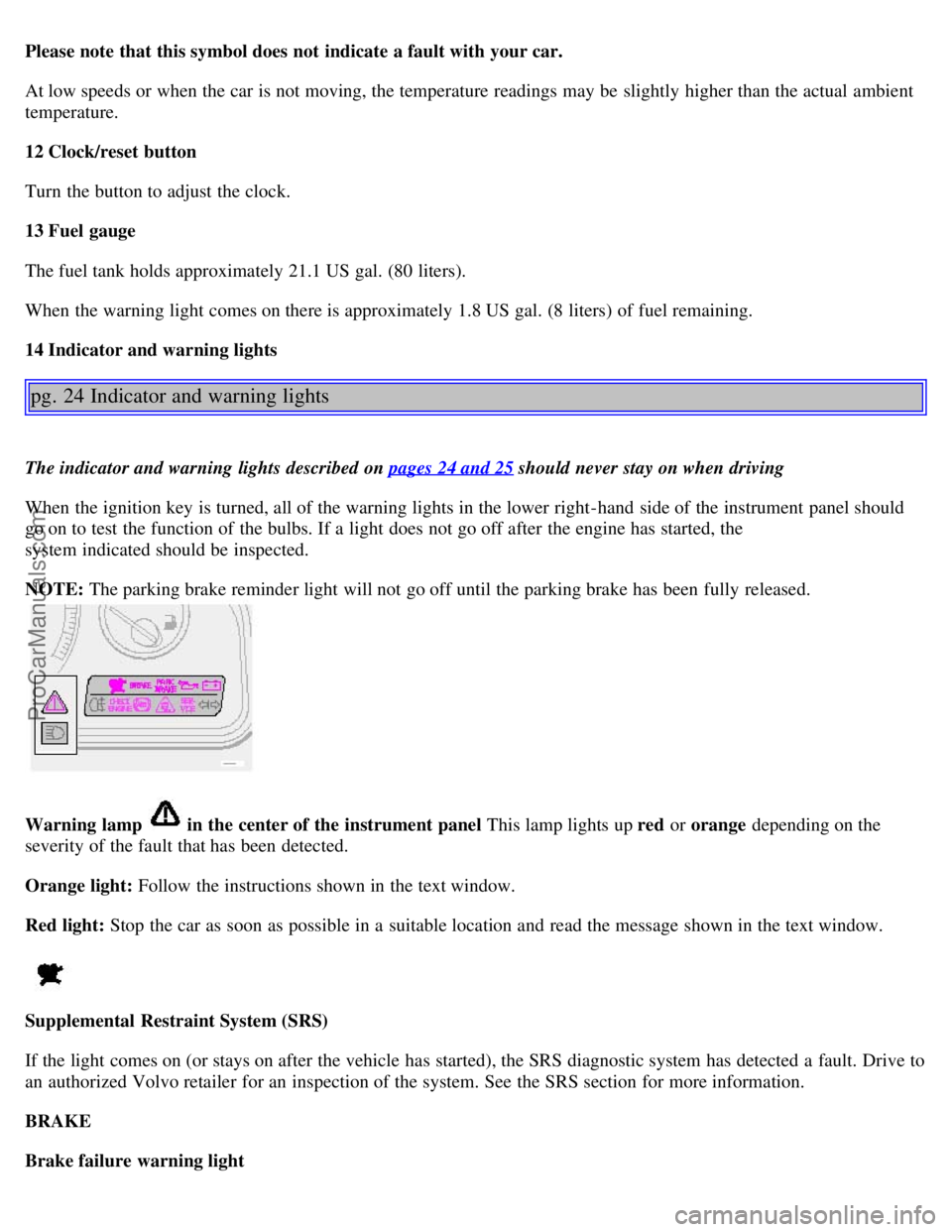
When the ignition key is turned, all of the warning lights in the lower right-hand side of the instrument panel should
go on to test the function of the bulbs. If a light does not go off after the engine has started, the
system indicated should be inspected.
NOTE: The parking brake reminder light will not go off until the parking brake has been fully released.
Warning lamp in the center of the instrument panel This lamp lights up red or orange depending on the
severity of the fault that has been detected.
Orange light: Follow the instructions shown in the text window.
Red light: Stop the car as soon as possible in a suitable location and read the message shown in the text window.
Supplemental Restraint System (SRS)
If the light comes on (or stays on after the vehicle has started), the SRS diagnostic system has detected a fault. Drive to
an authorized Volvo retailer for an inspection of the system. See the SRS section for more information.
BRAKE
Brake failure warning light
ProCarManuals.com
Page 21 of 111

If the light comes on while driving or braking, stop immediately, open the hood and check the brake fluid level
in the reservoir. See page 118
for reservoir position and instructions.
Canadian models are equipped with this warning light:
Park
Brake
Parking brake reminder light
This light will be on when the parking brake (hand brake) is applied. The parking brake lever is situated between the
front seats.
Canadian models are equipped with this warning light:
Oil pressure warning light
If the light comes on while driving, stop the car and then stop the engine immediately and check the engine oil
level . See page 117
. If the light stays on after restart, have the car towed to the nearest authorized Volvo retailer. After
hard driving, the light may come on occasionally when the engine is idling. This is normal, provided it goes off when
the engine speed is increased.
Generator warning light
If the light comes on while the engine is running, have the charging system checked.
pg. 25 Indicator and warning lights
Rear fog light
This light indicates that the rear fog light is on.
CHECK
ENGINE
Malfunction indicator lamp
On-Board Diagnostic II (OBDII): As you drive, a computer called "OBDII" monitors your car's engine, transmission,
electrical and emission systems. The CHECK ENGINE light will light up if the computer senses a condition that
potentially may need correcting. When this happens, please have your car checked by a Volvo retailer as soon as
possible.
A CHECK ENGINE light may have many causes. Sometimes, you may not notice a change in your car's behavior.
Even so, an uncorrected condition could hurt fuel economy, emission cleanliness, and driveability. Extended driving
without correcting the cause could even damage other components in your car.
Canadian models are equipped with this warning light:
ProCarManuals.com
Page 22 of 111
NOTE: If the fuel filler cap is not closed tightly or if the engine is running when the car is refueled, the Malfunction
Indicator Lamp may indicate a fault. However, your vehicle's performance will not be affected. Use only Volvo
original or approved fuel filler caps.
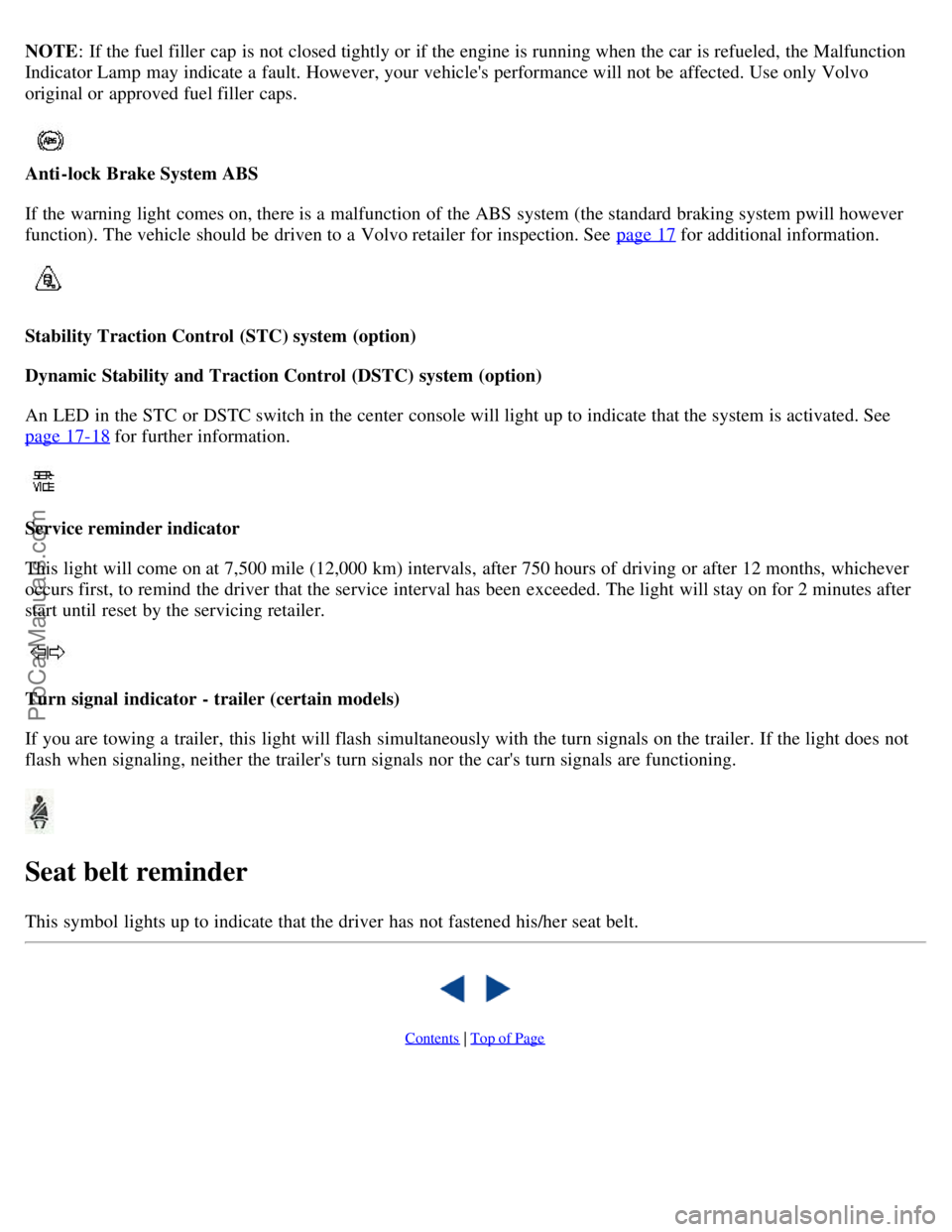
Anti-lock Brake System ABS
If the warning light comes on, there is a malfunction of the ABS system (the standard braking system pwill however
function). The vehicle should be driven to a Volvo retailer for inspection. See page 17
for additional information.
Stability Traction Control (STC) system (option)
Dynamic Stability and Traction Control (DSTC) system (option)
An LED in the STC or DSTC switch in the center console will light up to indicate that the system is activated. See
page 17-18
for further information.
Service reminder indicator
This light will come on at 7,500 mile (12,000 km) intervals, after 750 hours of driving or after 12 months, whichever
occurs first, to remind the driver that the service interval has been exceeded. The light will stay on for 2 minutes after
start until reset by the servicing retailer.
Turn signal indicator - trailer (certain models)
If you are towing a trailer, this light will flash simultaneously with the turn signals on the trailer. If the light does not
flash when signaling, neither the trailer's turn signals nor the car's turn signals are functioning.
Seat belt reminder
This symbol lights up to indicate that the driver has not fastened his/her seat belt.
Contents | Top of Page
ProCarManuals.com