child seat VOLVO S80 2002 Owners Manual
[x] Cancel search | Manufacturer: VOLVO, Model Year: 2002, Model line: S80, Model: VOLVO S80 2002Pages: 111, PDF Size: 2.74 MB
Page 5 of 111
2 0 0 2
VOLVO S80
Chapter 1 - Safety
pg. 1 Safety
Not wearing a seat belt is like believing "It'll never happen to me!" Volvo, the inventor of the three-point seat belt,
urges you and all adult occupants of your car to wear seat belts and ensure that children are properly restrained, using
an infant, car or booster seat determined by age, weight and height. Volvo also believes no child should sit in the front
seat of a car.
Fact: In every state and province, some type of child-restraint legislation has been passed. Additionally, most states
and provinces have already made it mandatory for occupants of a car to use seat belts.
So, urging you to "buckle up" is not just our recommendation - legislation in your state or province may mandate seat
belt usage. The few seconds it takes to buckle up may one day allow you to say, "It's a good thing I was wearing my
seat belt."
Seat belts
2
Center head restraint3
Front airbags (SRS)4
Side impact airbags (SIPS)8
Volvo Inflatable Curtain (VIC)9
Whiplash Protection System (WHIPS)10
Occupant safety11
Child safety12
Brake system16
Anti-lock Brake System (ABS)17
Stability Traction Control (STC)18
Dynamic Stability and Traction Control (DSTC)18
pg. 2 Seat belts
ProCarManuals.com
Page 6 of 111
Seat belts
Always fasten the seat belts before you drive or ride. A chime will sound several times if the driver has not
fastened his seat belt.
To buckle:
Pull the belt out far enough to insert the latch plate into the receptacle until a distinct click is heard. The seat belt
retractor is normally "unlocked" and you can move freely, provided that the shoulder belt is not pulled out too far. The
retractor will lock up as follows:
· if the belt is pulled out rapidly
· during braking and acceleration
· if the vehicle is leaning excessively
· when driving in turns
For the seat belt to provide maximum protection in the event of an accident, it must be worn correctly. When wearing
the seat belt remember:
· The belt should not be twisted or turned.
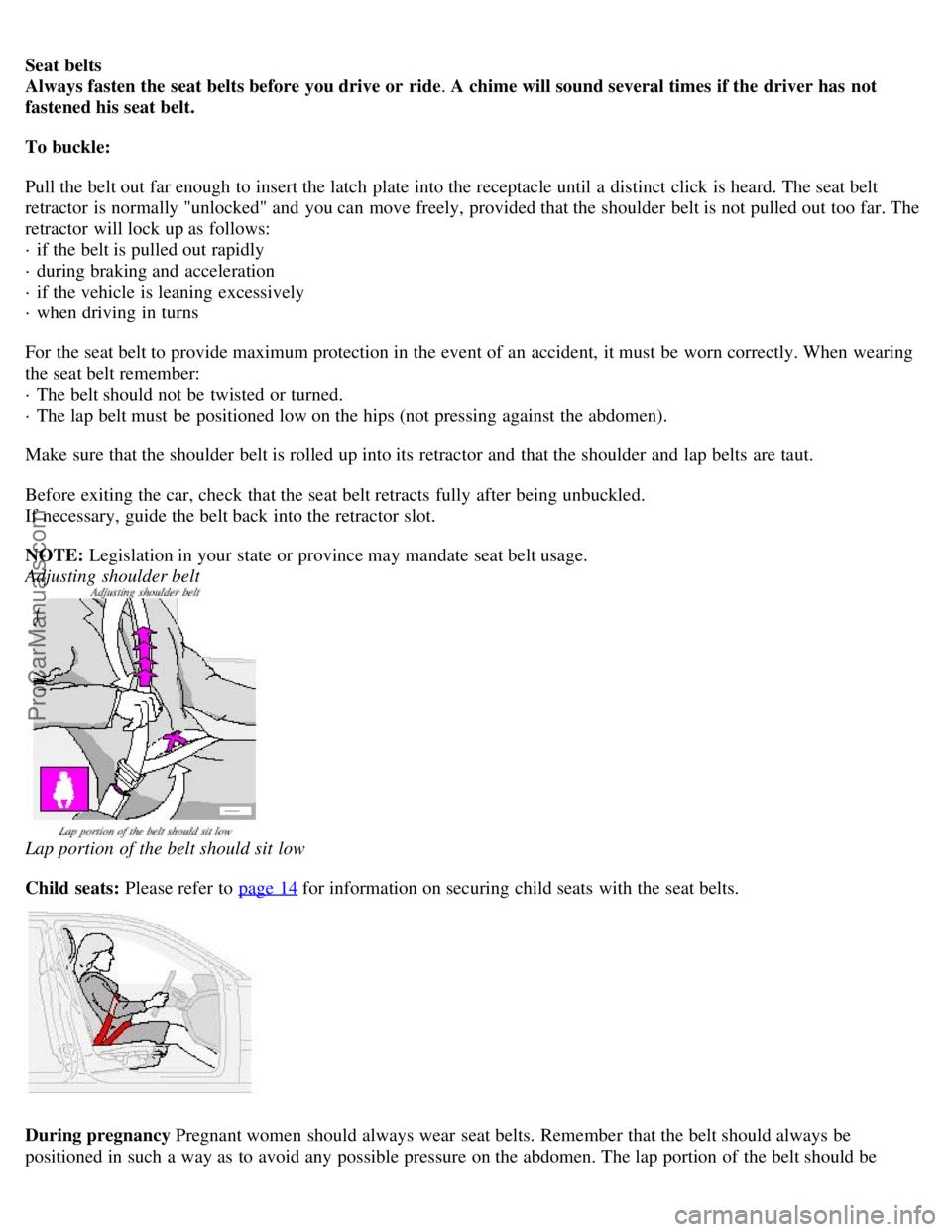
· The lap belt must be positioned low on the hips (not pressing against the abdomen).
Make sure that the shoulder belt is rolled up into its retractor and that the shoulder and lap belts are taut.
Before exiting the car, check that the seat belt retracts fully after being unbuckled.
If necessary, guide the belt back into the retractor slot.
NOTE: Legislation in your state or province may mandate seat belt usage.
Adjusting shoulder belt
Lap portion of the belt should sit low
Child seats: Please refer to page 14
for information on securing child seats with the seat belts.
During pregnancy Pregnant women should always wear seat belts. Remember that the belt should always be
positioned in such a way as to avoid any possible pressure on the abdomen. The lap portion of the belt should be
ProCarManuals.com
Page 7 of 111
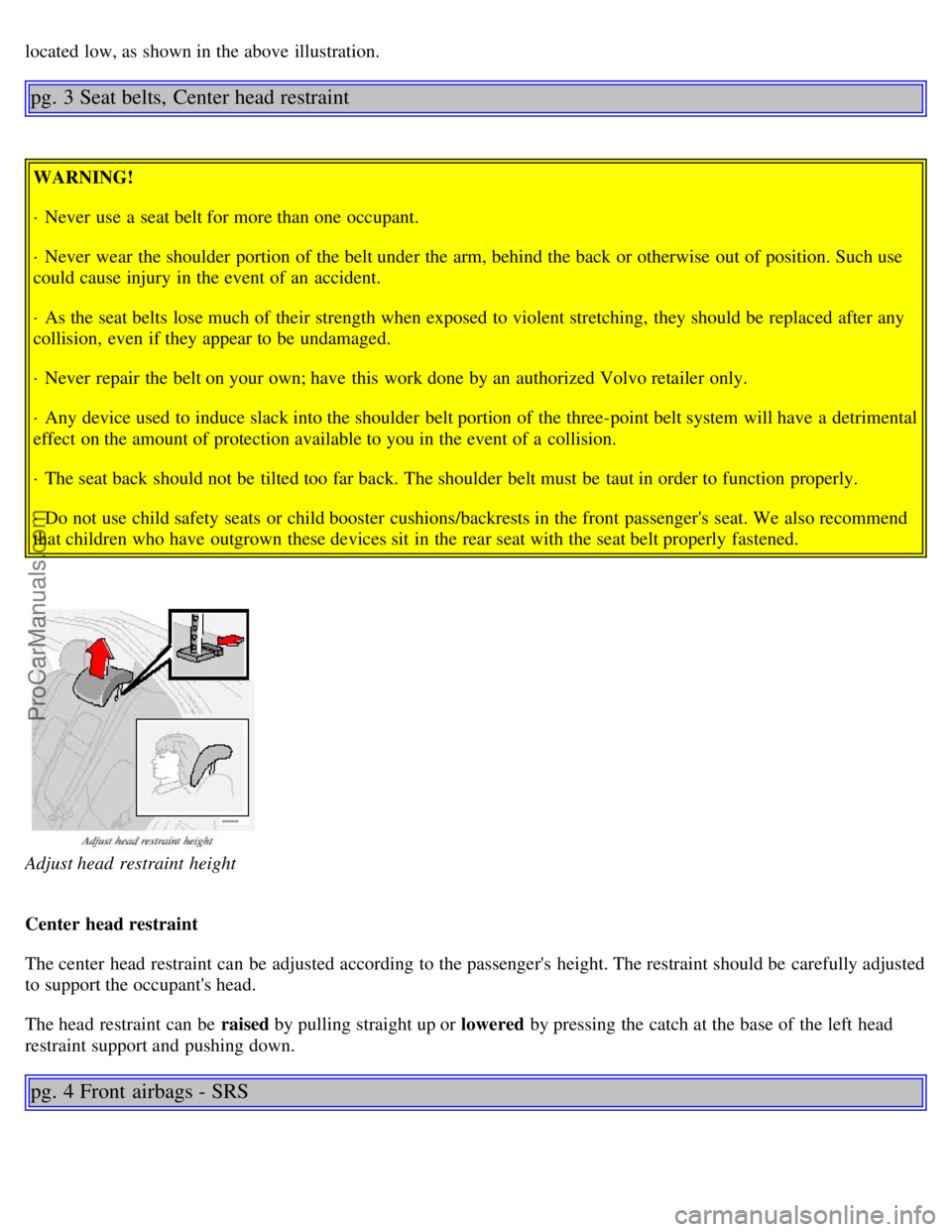
located low, as shown in the above illustration.
pg. 3 Seat belts, Center head restraint
WARNING!
· Never use a seat belt for more than one occupant.
· Never wear the shoulder portion of the belt under the arm, behind the back or otherwise out of position. Such use
could cause injury in the event of an accident.
· As the seat belts lose much of their strength when exposed to violent stretching, they should be replaced after any
collision, even if they appear to be undamaged.
· Never repair the belt on your own; have this work done by an authorized Volvo retailer only.
· Any device used to induce slack into the shoulder belt portion of the three-point belt system will have a detrimental
effect on the amount of protection available to you in the event of a collision.
· The seat back should not be tilted too far back. The shoulder belt must be taut in order to function properly.
· Do not use child safety seats or child booster cushions/backrests in the front passenger's seat. We also recommend
that children who have outgrown these devices sit in the rear seat with the seat belt properly fastened.
Adjust head restraint height
Center head restraint
The center head restraint can be adjusted according to the passenger's height. The restraint should be carefully adjusted
to support the occupant's head.
The head restraint can be raised by pulling straight up or lowered by pressing the catch at the base of the left head
restraint support and pushing down.
pg. 4 Front airbags - SRS
ProCarManuals.com
Page 10 of 111
P.O. Box 914Willowdale, Ontario M2H 2N7
Rockleigh, New Jersey 07647-09141-800-663-8255
800-458-1552
pg. 6 Front airbags - SRS
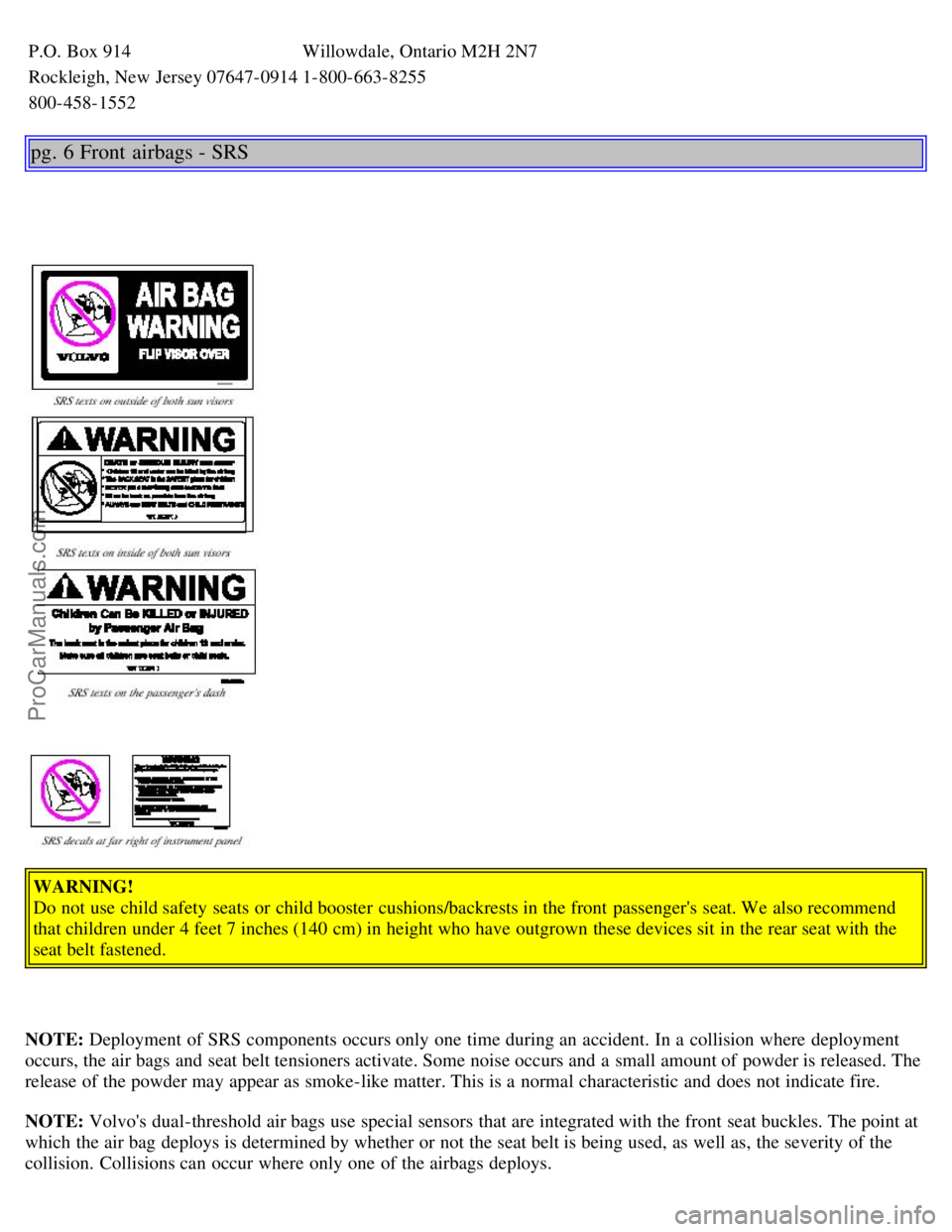
WARNING!
Do not use child safety seats or child booster cushions/backrests in the front passenger's seat. We also recommend
that children under 4 feet 7 inches (140 cm) in height who have outgrown these devices sit in the rear seat with the
seat belt fastened.
NOTE: Deployment of SRS components occurs only one time during an accident. In a collision where deployment
occurs, the air bags and seat belt tensioners activate. Some noise occurs and a small amount of powder is released. The
release of the powder may appear as smoke-like matter. This is a normal characteristic and does not indicate fire.
NOTE: Volvo's dual-threshold air bags use special sensors that are integrated with the front seat buckles. The point at
which the air bag deploys is determined by whether or not the seat belt is being used, as well as, the severity of the
collision. Collisions can occur where only one of the airbags deploys.
ProCarManuals.com
Page 11 of 111
NOTE: Volvo's dual-stage airbags: If the impact is less severe, but severe enough to present a clear injury risk, the
dual-stage airbags are triggered at just 70% of its total capacity. If the impact is more severe, the dual-stage airbags are
triggered with full capacity.
WARNING!
· Children must never be allowed in the front passenger seat. Volvo recommends that ALL occupants (adults and
children) shorter than 4 feet 7 inches (140 cm) be seated in the back seat of any vehicle with a front passenger side
airbag.
· Occupants in the front passenger's seat must never sit on the edge of the seat, sit leaning toward the instrument
panel or otherwise sit out of position. The occupant's back must be as upright as comfort allows and be against the
seat back with the seat belt properly fastened.
· Feet must be on the floor, e.g. not on the dash, seat or out of the window.
· No objects or accessory equipment, e.g. dash covers, may be placed on, attached to or installed near the SRS hatch
(the area above the glove compartment) or the area affected by airbag deployment (see illustration on page 4
).
· There should be no loose articles, e.g. coffee cups, on the floor, seat or dash area.
· Never try to open the SRS cover on the steering wheel or the passenger side SRS seam. This should only be done
by an authorized Volvo service technician.
· Failure to follow these instructions can result in injury to the vehicle occupants in an accident.
pg. 7 Front airbags - SRS
NOTE : The information on this page does not pertain to the Side Impact Protection System airbags.
When are the airbags deployed?
The SRS system is designed to deploy during certain frontal or frontangular collisions, impacts, or decelerations,
depending on the crash severity, angle, speed and object impacted. The SRS sensor is designed to react to both the
impact of the collision and the inertial forces generated by it and to determine if the intensity of the collision is
sufficient for the airbags to be deployed.
WARNING!
The SRS is designed to help prevent serious injury. Deployment occurs very quickly and with considerable force.
During normal deployment and depending on variables such as seating position, one may experience abrasions,
bruises, swellings, or other injuries as a result of airbag(s) deployment.
If the airbags have been deployed, we recommend the following:
· Have the car towed to an authorized Volvo retailer. Never drive with the airbags deployed.
· Have an authorized Volvo retailer replace the SRS system components.
· Use only new, Genuine Volvo Parts when replacing SRS components (airbags, seat belts, tensioners, etc.).
When are the airbags NOT deployed? Not all frontal collisions activate the SRS system. If the collision involves a
nonrigid object (e.g., a snow drift or bush), or a rigid, fixed object at a low speed, the SRS system will not necessarily
deploy. Front airbags do not normally deploy in a side impact collision, in a collision from the rear or in a rollover
situation. The amount of damage to the bodywork does not reliably indicate if the airbags should have deployed or not.
Seat belts the heart of the Volvo safety system The heart of the Volvo safety system is the threepoint seat belt (a
Volvo invention)! In order for the SRS system to provide the protection intended, seat belts must be worn at all times
ProCarManuals.com
Page 14 of 111
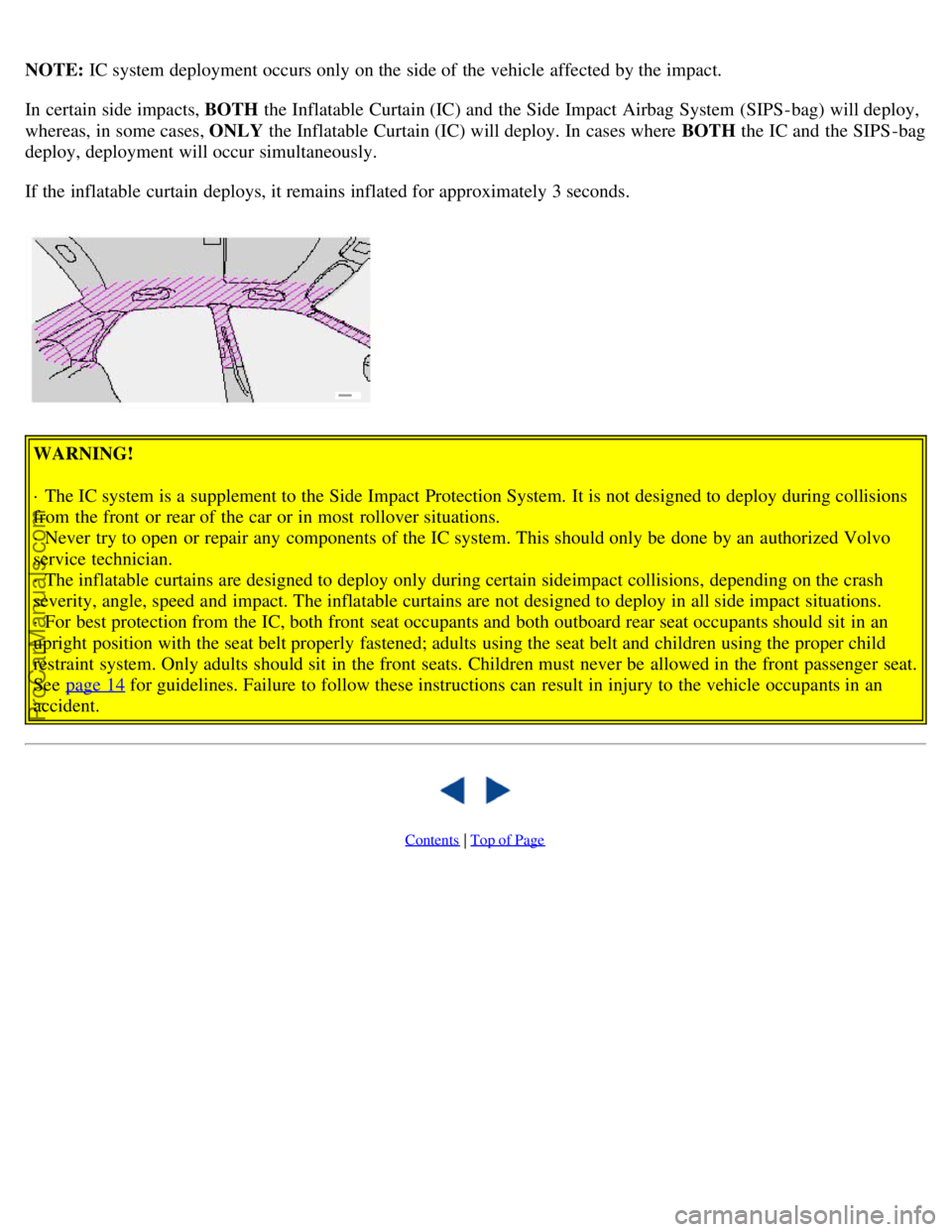
NOTE: IC system deployment occurs only on the side of the vehicle affected by the impact.
In certain side impacts, BOTH the Inflatable Curtain (IC) and the Side Impact Airbag System (SIPS-bag) will deploy,
whereas, in some cases, ONLY the Inflatable Curtain (IC) will deploy. In cases where BOTH the IC and the SIPS -bag
deploy, deployment will occur simultaneously.
If the inflatable curtain deploys, it remains inflated for approximately 3 seconds.
WARNING!
· The IC system is a supplement to the Side Impact Protection System. It is not designed to deploy during collisions
from the front or rear of the car or in most rollover situations.
· Never try to open or repair any components of the IC system. This should only be done by an authorized Volvo
service technician.
· The inflatable curtains are designed to deploy only during certain sideimpact collisions, depending on the crash
severity, angle, speed and impact. The inflatable curtains are not designed to deploy in all side impact situations.
· For best protection from the IC, both front seat occupants and both outboard rear seat occupants should sit in an
upright position with the seat belt properly fastened; adults using the seat belt and children using the proper child
restraint system. Only adults should sit in the front seats. Children must never be allowed in the front passenger seat.
See page 14
for guidelines. Failure to follow these instructions can result in injury to the vehicle occupants in an
accident.
Contents | Top of Page
ProCarManuals.com
Page 16 of 111
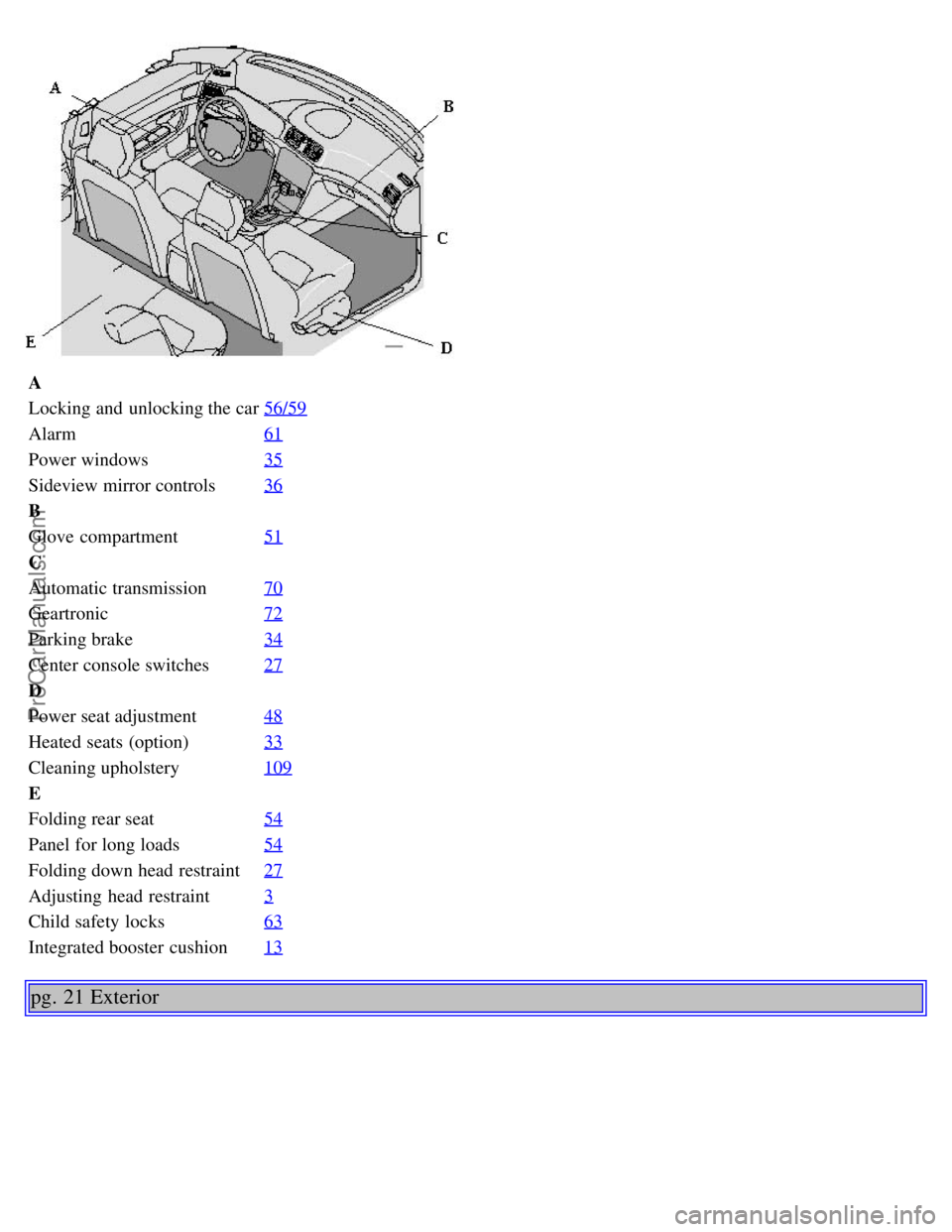
A
Locking and unlocking the car56/59
Alarm61
Power windows35
Sideview mirror controls36
B
Glove compartment51
C
Automatic transmission70
Geartronic72
Parking brake34
Center console switches27
D
Power seat adjustment48
Heated seats (option)33
Cleaning upholstery109
E
Folding rear seat54
Panel for long loads54
Folding down head restraint27
Adjusting head restraint3
Child safety locks63
Integrated booster cushion13
pg. 21 Exterior
ProCarManuals.com
Page 31 of 111
Move the seat as far rearward as possible for easiest access to the lumbar support control.
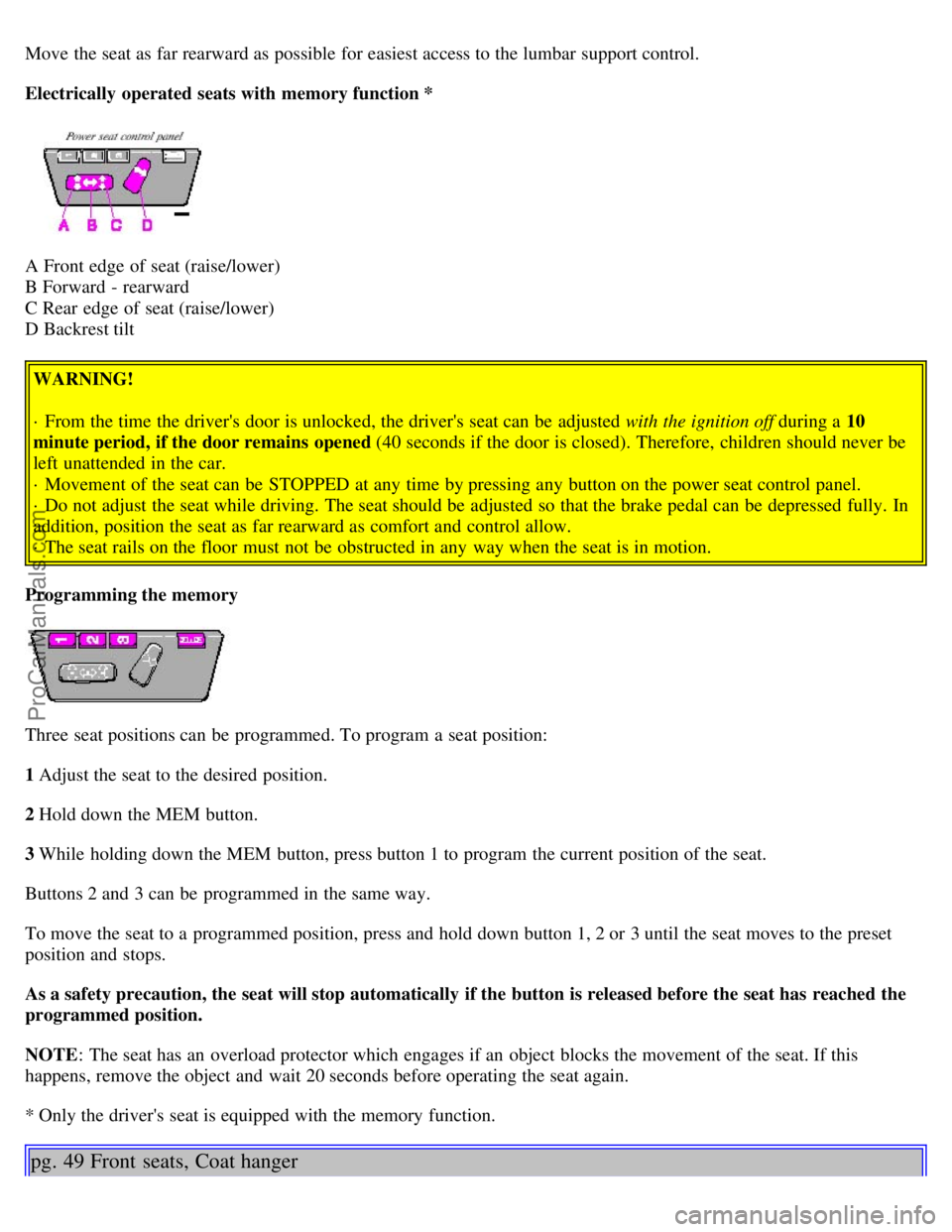
Electrically operated seats with memory function *
A Front edge of seat (raise/lower)
B Forward - rearward
C Rear edge of seat (raise/lower)
D Backrest tilt WARNING!
· From the time the driver's door is unlocked, the driver's seat can be adjusted with the ignition off during a 10
minute period, if the door remains opened (40 seconds if the door is closed). Therefore, children should never be
left unattended in the car.
· Movement of the seat can be STOPPED at any time by pressing any button on the power seat control panel.
· Do not adjust the seat while driving. The seat should be adjusted so that the brake pedal can be depressed fully. In
addition, position the seat as far rearward as comfort and control allow.
· The seat rails on the floor must not be obstructed in any way when the seat is in motion.
Programming the memory
Three seat positions can be programmed. To program a seat position:
1 Adjust the seat to the desired position.
2 Hold down the MEM button.
3 While holding down the MEM button, press button 1 to program the current position of the seat.
Buttons 2 and 3 can be programmed in the same way.
To move the seat to a programmed position, press and hold down button 1, 2 or 3 until the seat moves to the preset
position and stops.
As a safety precaution, the seat will stop automatically if the button is released before the seat has reached the
programmed position.
NOTE : The seat has an overload protector which engages if an object blocks the movement of the seat. If this
happens, remove the object and wait 20 seconds before operating the seat again.
* Only the driver's seat is equipped with the memory function.
pg. 49 Front seats, Coat hanger
ProCarManuals.com
Page 36 of 111
· Press button B to open the storage space in the center console for cassettes, change holder, etc.
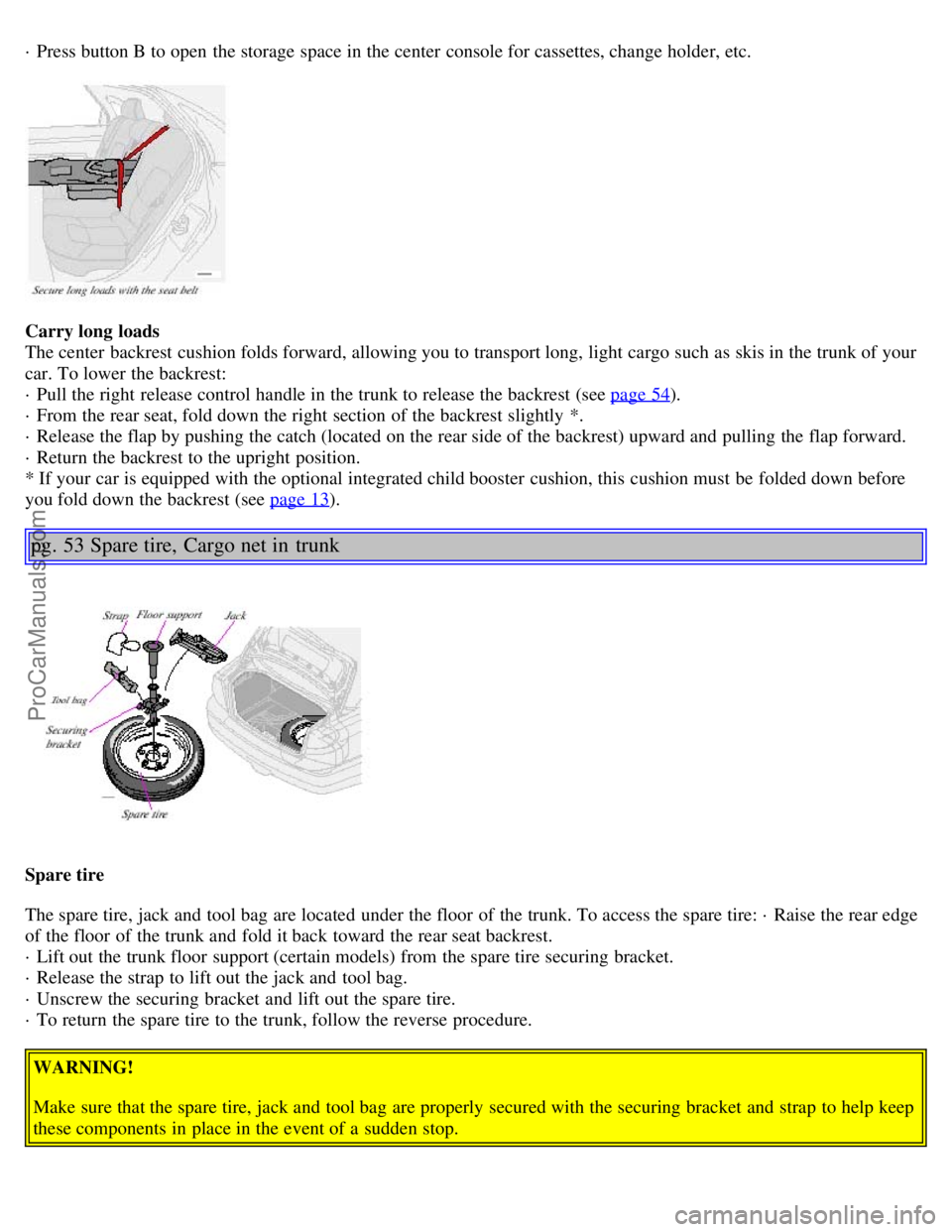
Carry long loads
The center backrest cushion folds forward, allowing you to transport long, light cargo such as skis in the trunk of your
car. To lower the backrest:
· Pull the right release control handle in the trunk to release the backrest (see page 54
).
· From the rear seat, fold down the right section of the backrest slightly *.
· Release the flap by pushing the catch (located on the rear side of the backrest) upward and pulling the flap forward.
· Return the backrest to the upright position.
* If your car is equipped with the optional integrated child booster cushion, this cushion must be folded down before
you fold down the backrest (see page 13
).
pg. 53 Spare tire, Cargo net in trunk
Spare tire
The spare tire, jack and tool bag are located under the floor of the trunk. To access the spare tire: · Raise the rear edge
of the floor of the trunk and fold it back toward the rear seat backrest.
· Lift out the trunk floor support (certain models) from the spare tire securing bracket.
· Release the strap to lift out the jack and tool bag.
· Unscrew the securing bracket and lift out the spare tire.
· To return the spare tire to the trunk, follow the reverse procedure.
WARNING!
Make sure that the spare tire, jack and tool bag are properly secured with the securing bracket and strap to help keep
these components in place in the event of a sudden stop.
ProCarManuals.com
Page 38 of 111

· Pull the release control handle(s) in the trunk to release the backrest(s) (see illustration above). If the outboard rear
head restraints are folded down, they should be returned to the upright position before folding the backrest down. It
may be necessary to manually adjust the center head restraint.
· Fold the backrest down.WARNING!
All S80 cars feature 60/40 split fold-down rear seats. This function is performed by handles inside the trunk, and
also provides a means for children and adults to enter the passenger compartment in the event they become locked
inside the trunk. Adults are advised to familiarize them-selves with the operation and location of the release handles.
To fold down the rear seats from inside the trunk, pull the release control handles located on either side of the trunk.
WARNING!
· Keep vehicle doors and the luggage compartment locked and keep keys out of a child's reach. Unsupervised
children could lock themselves in an open trunk and risk injury. Children should be taught not to play in vehicles.
· On hot days, the temperature in the trunk or vehicle interior can rise very quickly. Exposure of people to these high
temperatures for even a short period of time can cause heat-related injury or death. Small children are particularly at
risk.
WARNING!
· When the backrest is returned to the upright position, check that it is properly locked in place. Return the head
restraints to the upright position.
· Long loads should always be securely anchored to help avoid injury in the event of a sudden stop.
· Always turn the engine off and apply the parking brake when loading/unloading the vehicle.
· Place the transmission in the P (PARK) position to help prevent inadvertent movement of the gear selector.
Contents | Top of Page
ProCarManuals.com