weight VOLVO S80 2006 User Guide
[x] Cancel search | Manufacturer: VOLVO, Model Year: 2006, Model line: S80, Model: VOLVO S80 2006Pages: 122, PDF Size: 2.33 MB
Page 70 of 122
NOTE: This information may not appear on the tire because it is not required by law.
7. M+S or M/S = Mud and Snow, AT = All Terrain, AS = All Season
8. U.S. DOT Tire Identification Number (TIN): This begins with the letters "DOT" and indicates that the tire meets all
federal standards. The next two numbers or letters are the plant code where it was manufactured, the next two are the
tire size code and the last four numbers represent the week and year the tire was built. For example, the numbers 317
mean the 31st week of 1997. After 2000 the numbers go to four digits. For example, 2501 means the 25th week of
2001. The numbers in between are marketing codes used at the manufacturer's discretion. This information helps a tire
manufacturer identify a tire for safety recall purposes.
9. Tire Ply Composition and Material Used: Indicates the number of plies indicates or the number of layers of rubber-
coated fabric in the tire tread and sidewall. Tire manufacturers also must indicate the ply materials in the tire and the
sidewall, which include steel, nylon, polyester, and others.
10. Maximum Load: Indicates the maximum load in pounds and kilograms that can be carried by the tire. Refer to the
vehicle's tire information placard or the safety certification label, located on the B-Pillar or the driver's door or on the
inside of the fuel filler door on Canadian models, for the correct tire pressure for your vehicle.
11. Treadwear, Traction, and Temperature grades: See page 113
for more information.
12. Maximum permissible inflation pressure: the greatest amount of air pressure that should ever be put in the tire. This
limit is set by the tire manufacturer.
pg. 111 Wheels and tires
Glossary of tire terminology
The tire suppliers may have additional markings, notes or warnings such as standard load, radial tubeless, etc.
Glossary of tire terminology
• Tire information placard: A placard showing the OE (Original Equipment) tire sizes, recommended inflation
pressure, and the maximum weight the vehicle can carry.
• Tire Identification Number (TIN): A number on the sidewall of each tire providing information about the tire
brand and manufacturing plant, tire size and date of manufacturer.
• Inflation pressure: A measure of the amount of air in a tire.
• Standard load: A class of P-metric or Metric tires designed to carry a maximum load at 35 psi [37 psi (2.5 bar) for
Metric tires]. Increasing the inflation pressure beyond this pressure will not increase the tires load carrying capability.
• Extra load: A class of P-metric or Metric tires designed to carry a heavier maximum load at 41 psi [43 psi (2.9 bar)
for Metric tires]. Increasing the inflation pressure beyond this pressure will not increase the tires load carrying
capability.
• kPa: Kilopascal, a metric unit of air pressure.
• PSI: Pounds per square inch, a standard unit of air pressure.
• B-pillar: The structural member at the side of the vehicle behind the front door.
• Bead area of the tire: Area of the tire next to the rim.
• Sidewall of the tire: Area between the bead area and the tread.
ProCarManuals.com
Page 71 of 122
• Tread area of the tire: Area of the perimeter of the tire that contacts the road when mounted on the vehicle.
• Rim: The metal support (wheel) for a tire or a tire and tube assembly upon which the tire beads are seated.
• Maximum load rating: a figure indicating the maximum load in pounds and kilograms that can be carried by the
tire. This rating is established by the tire manufacturer.
• Maximum permissible inflation pressure: the greatest amount of air pressure that should ever be put in the tire.
This limit is set by the tire manufacturer.
• Recommended tire inflation pressure: inflation pressure, established by Volvo, which is based on the type of tires
that are mounted on a vehicle at the factory. This inflation pressure is affected by the number of occupants in the car,
the amount of cargo, and the speed at which the vehicle will be driven for a prolonged period. This information can be
found on the tire inflation placard(s) located on the driver's side B-pillar or on the inside of the fuel filler door on
Canadian models, and in the tire inflation table in this chapter.
• Cold tires: The tires are considered to be cold when they have the same temperature as the surrounding (ambient)
air. This temperature is normally reached after the car has been parked for at least 3 hours.
pg. 112 Wheels and tires
Vehicle loading
Properly loading your vehicle will provide maximum return of vehicle design performance.
Before loading your vehicle, familiarize yourself with the following terms for determining your vehicle's weight
ratings, with or without a trailer, from the vehicle's Federal/Canadian Motor Vehicle Safety Standards
(FMVSS/CMVSS) label, and the vehicle's tire information placard:
Curb weight
The weight of the vehicle including a full tank of fuel and all standard equipment. It does not include passengers,
cargo, or optional equipment.
Capacity weight
All weight added to the curb weight, including cargo and optional equipment. When towing, trailer hitch tongue load
is also part of cargo weight.
NOTE: For trailer towing information, please refer to the section "Towing a trailer" on page 89
.
Permissible axle weight
The maximum allowable weight that can be carried by a single axle (front or rear). These numbers are shown on the
Federal/Canadian Motor Vehicle Safety Standards (FMVSS/CMVSS) label. The total load on each axle must never
exceed its maximum permissible weight.
Gross vehicle weight (GVW)
The vehicle's curb weight + cargo + passengers.
NOTE:
• The location of the various labels in your vehicle can be found on page 150
.
ProCarManuals.com
Page 72 of 122
• A table listing important weight limits for your vehicle can be found on page 151.
Steps for Determining Correct Load Limit
(1) Locate the statement "the combined weight of occupants and cargo should never exceed XXX pounds" on your
vehicle's placard.
(2) Determine the combined weight of the driver and passengers that will be riding in your vehicle.
(3) Subtract the combined weight of the driver and passengers from XXX kilograms or XXX pounds.
(4) The resulting figure equals the available amount of cargo and luggage load capacity. For example, if the "XXX"
amount equals 1400 lbs. and there will be five 150 lb. passengers in your vehicle, the amount of available cargo and
luggage load capacity is 650 lbs. (1400-750 (5 x 150) = 650 lbs.)
(5) Determine the combined weight of luggage and cargo being loaded on the vehicle. That weight may not safely
exceed the available cargo and luggage load capacity calculated in Step 4.
(6) If your vehicle will be towing a trailer, load from your trailer will be transferred to your vehicle. Consult this
manual
1 to determine how this reduces the available cargo and luggage load capacity of your vehicle.
WARNING!
- Exceeding the permissible axle weight, gross vehicle weight, or any other weight rating limits can cause tire
overheating resulting in permanent deformation or catastrophic failure.
- Do not use replacement tires with lower load carrying capacities than the tires that were original equipment on the
vehicle because this will lower the vehicle's GVW rating. Replacement tires with a higher limit than the originals do
not increase the vehicle's GVW rating limitations.
1 See "Towing a trailer" on page 89.
pg. 113 Wheels and tires
Uniform tire quality grading
ALL PASSENGER VEHICLE TIRES MUST CONFORM TO FEDERAL SAFETY REQUIREMENTS IN
ADDITION TO THESE GRADES
Quality grades can be found, where applicable, on the tire sidewall between the tread should and maximum section
width. For example:
Treadwear 200 Traction AA Temperature A
TREADWEAR
The treadwear grade is a comparative rating based on the wear rate of the tire when tested under controlled conditions
on a specified government test course. For example, a tire graded 150 would wear one and one half (1 1/2) times as
well on the government course as a tire graded 100. The relative performance of tires depends upon the actual
conditions of their use, however, and many depart significantly from the norm due to variation in driving habits,
service practices and differences in road characteristics and climate.
TRACTION
The traction grades, from highest to lowest, are AA, A, B, and C, as measured under controlled conditions on specified
ProCarManuals.com
Page 76 of 122
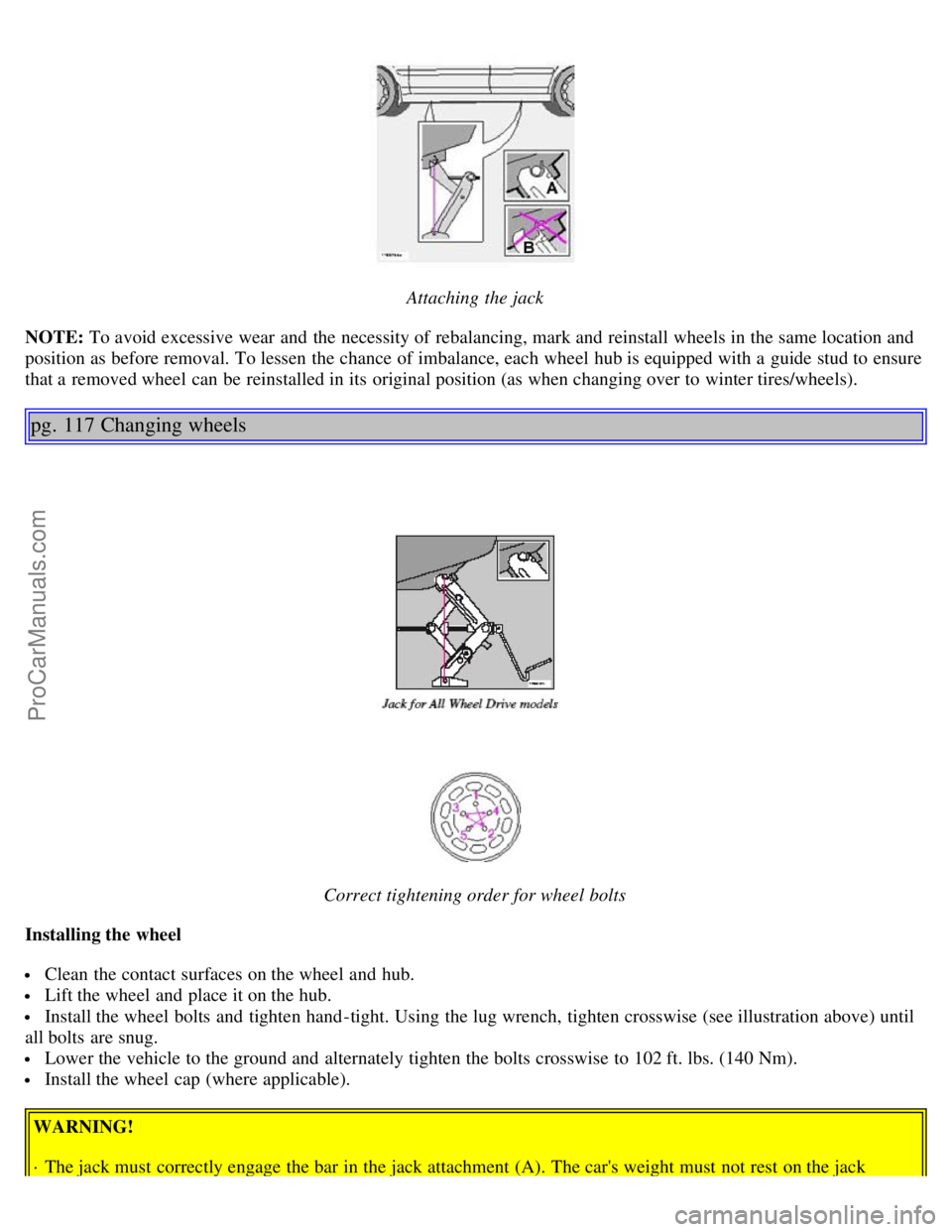
Attaching the jack
NOTE: To avoid excessive wear and the necessity of rebalancing, mark and reinstall wheels in the same location and
position as before removal. To lessen the chance of imbalance, each wheel hub is equipped with a guide stud to ensure
that a removed wheel can be reinstalled in its original position (as when changing over to winter tires/wheels).
pg. 117 Changing wheels
Correct tightening order for wheel bolts
Installing the wheel
Clean the contact surfaces on the wheel and hub.
Lift the wheel and place it on the hub.
Install the wheel bolts and tighten hand -tight. Using the lug wrench, tighten crosswise (see illustration above) until
all bolts are snug.
Lower the vehicle to the ground and alternately tighten the bolts crosswise to 102 ft. lbs. (140 Nm).
Install the wheel cap (where applicable).
WARNING!
· The jack must correctly engage the bar in the jack attachment (A). The car's weight must not rest on the jack
ProCarManuals.com
Page 91 of 122
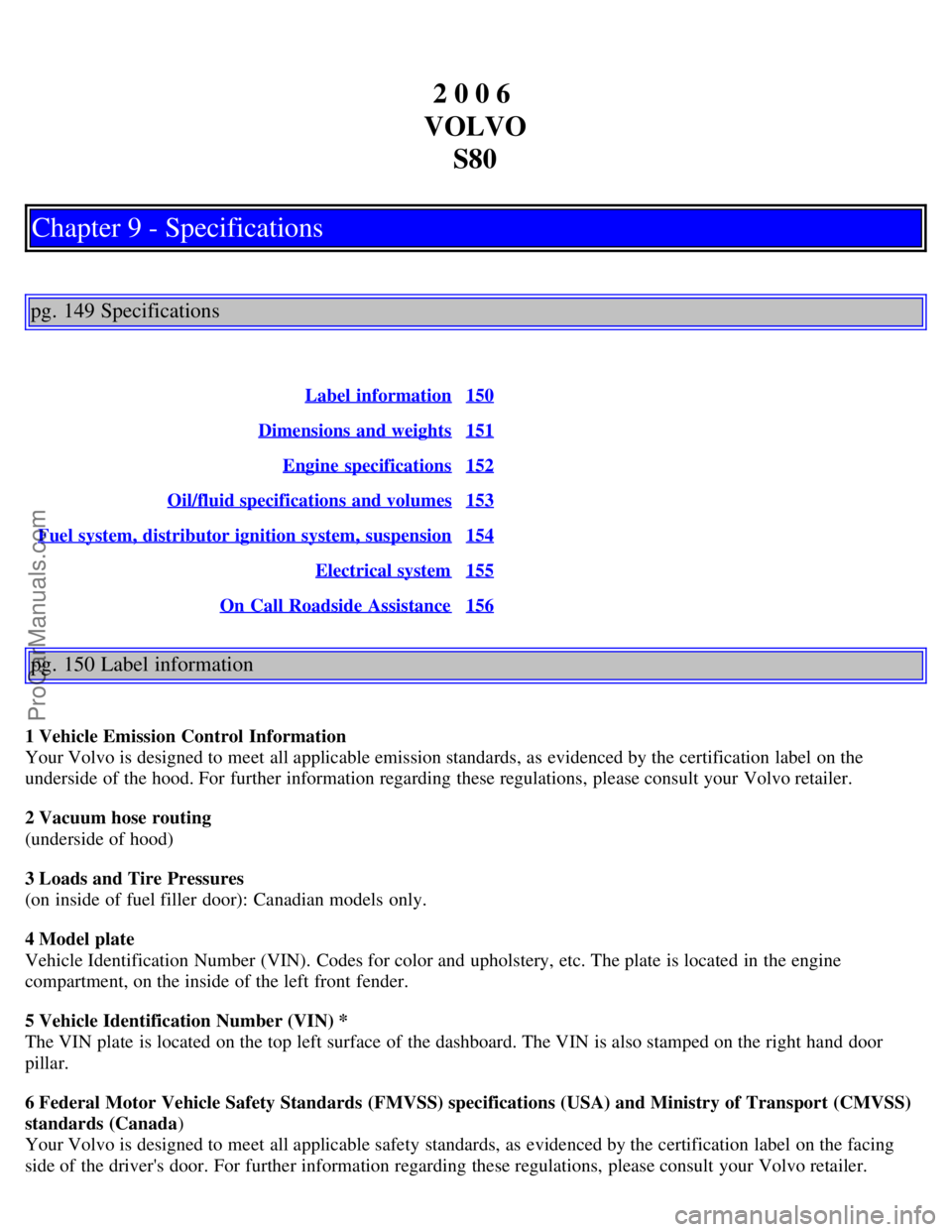
2 0 0 6
VOLVO S80
Chapter 9 - Specifications
pg. 149 Specifications
Label information150
Dimensions and weights151
Engine specifications152
Oil/fluid specifications and volumes153
Fuel system, distributor ignition system, suspension154
Electrical system155
On Call Roadside Assistance156
pg. 150 Label information
1 Vehicle Emission Control Information
Your Volvo is designed to meet all applicable emission standards, as evidenced by the certification label on the
underside of the hood. For further information regarding these regulations, please consult your Volvo retailer.
2 Vacuum hose routing
(underside of hood)
3 Loads and Tire Pressures
(on inside of fuel filler door): Canadian models only.
4 Model plate
Vehicle Identification Number (VIN). Codes for color and upholstery, etc. The plate is located in the engine
compartment, on the inside of the left front fender.
5 Vehicle Identification Number (VIN) *
The VIN plate is located on the top left surface of the dashboard. The VIN is also stamped on the right hand door
pillar.
6 Federal Motor Vehicle Safety Standards (FMVSS) specifications (USA) and Ministry of Transport (CMVSS)
standards (Canada )
Your Volvo is designed to meet all applicable safety standards, as evidenced by the certification label on the facing
side of the driver's door. For further information regarding these regulations, please consult your Volvo retailer.
ProCarManuals.com
Page 92 of 122
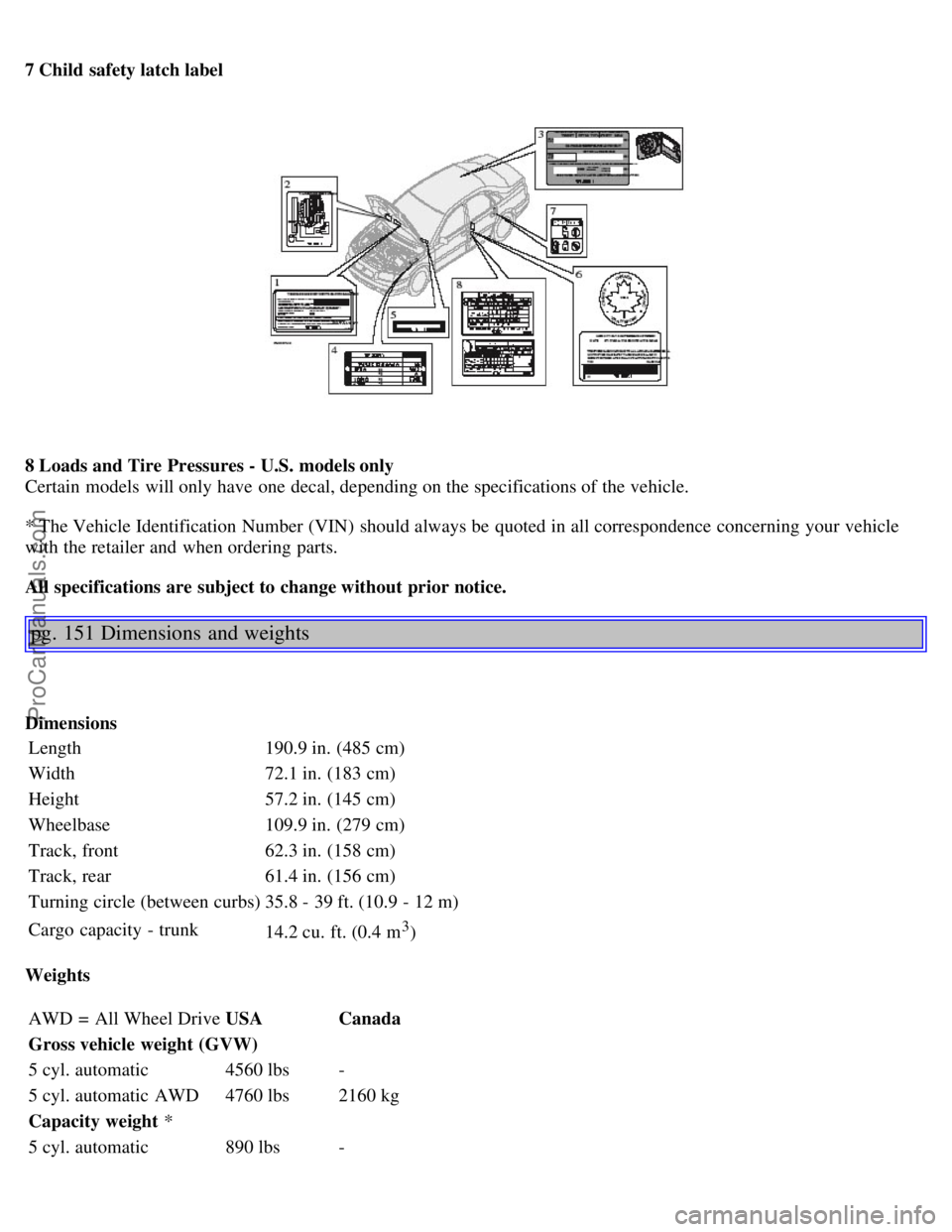
7 Child safety latch label
8 Loads and Tire Pressures - U.S. models only
Certain models will only have one decal, depending on the specifications of the vehicle.
* The Vehicle Identification Number (VIN) should always be quoted in all correspondence concerning your vehicle
with the retailer and when ordering parts.
All specifications are subject to change without prior notice.
pg. 151 Dimensions and weights
Dimensions
Length 190.9 in. (485 cm)
Width 72.1 in. (183 cm)
Height 57.2 in. (145 cm)
Wheelbase 109.9 in. (279 cm)
Track, front 62.3 in. (158 cm)
Track, rear 61.4 in. (156 cm)
Turning circle (between curbs) 35.8 - 39 ft. (10.9 - 12 m)
Cargo capacity - trunk 14.2 cu. ft. (0.4 m
3)
Weights AWD = All Wheel Drive USACanada
Gross vehicle weight (GVW)
5 cyl. automatic 4560 lbs-
5 cyl. automatic AWD 4760 lbs2160 kg
Capacity weight *
5 cyl. automatic 890 lbs-
ProCarManuals.com
Page 93 of 122
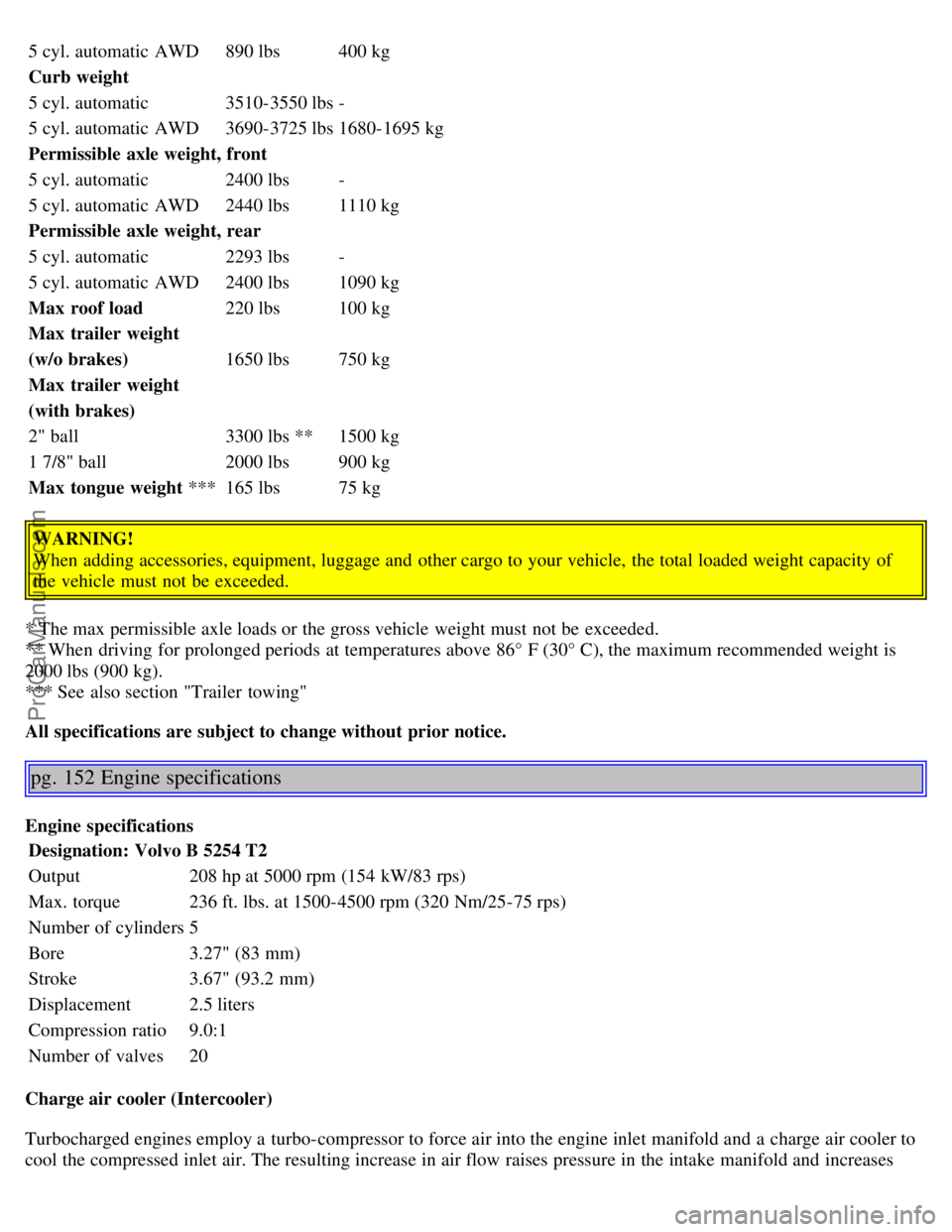
5 cyl. automatic AWD890 lbs400 kg
Curb weight
5 cyl. automatic 3510-3550 lbs-
5 cyl. automatic AWD 3690-3725 lbs1680-1695 kg
Permissible axle weight, front
5 cyl. automatic 2400 lbs-
5 cyl. automatic AWD 2440 lbs1110 kg
Permissible axle weight, rear
5 cyl. automatic 2293 lbs-
5 cyl. automatic AWD 2400 lbs1090 kg
Max roof load 220 lbs100 kg
Max trailer weight
(w/o brakes) 1650 lbs750 kg
Max trailer weight
(with brakes)
2" ball 3300 lbs **1500 kg
1 7/8" ball 2000 lbs900 kg
Max tongue weight ***165 lbs 75 kg
WARNING!
When adding accessories, equipment, luggage and other cargo to your vehicle, the total loaded weight capacity of
the vehicle must not be exceeded.
* The max permissible axle loads or the gross vehicle weight must not be exceeded.
** When driving for prolonged periods at temperatures above 86° F (30° C), the maximum recommended weight is
2000 lbs (900 kg).
*** See also section "Trailer towing"
All specifications are subject to change without prior notice.
pg. 152 Engine specifications
Engine specifications Designation: Volvo B 5254 T2
Output 208 hp at 5000 rpm (154 kW/83 rps)
Max. torque 236 ft. lbs. at 1500-4500 rpm (320 Nm/25-75 rps)
Number of cylinders 5
Bore 3.27" (83 mm)
Stroke 3.67" (93.2 mm)
Displacement 2.5 liters
Compression ratio 9.0:1
Number of valves 20
Charge air cooler (Intercooler)
Turbocharged engines employ a turbo-compressor to force air into the engine inlet manifold and a charge air cooler to
cool the compressed inlet air. The resulting increase in air flow raises pressure in the intake manifold and increases
ProCarManuals.com
Page 115 of 122
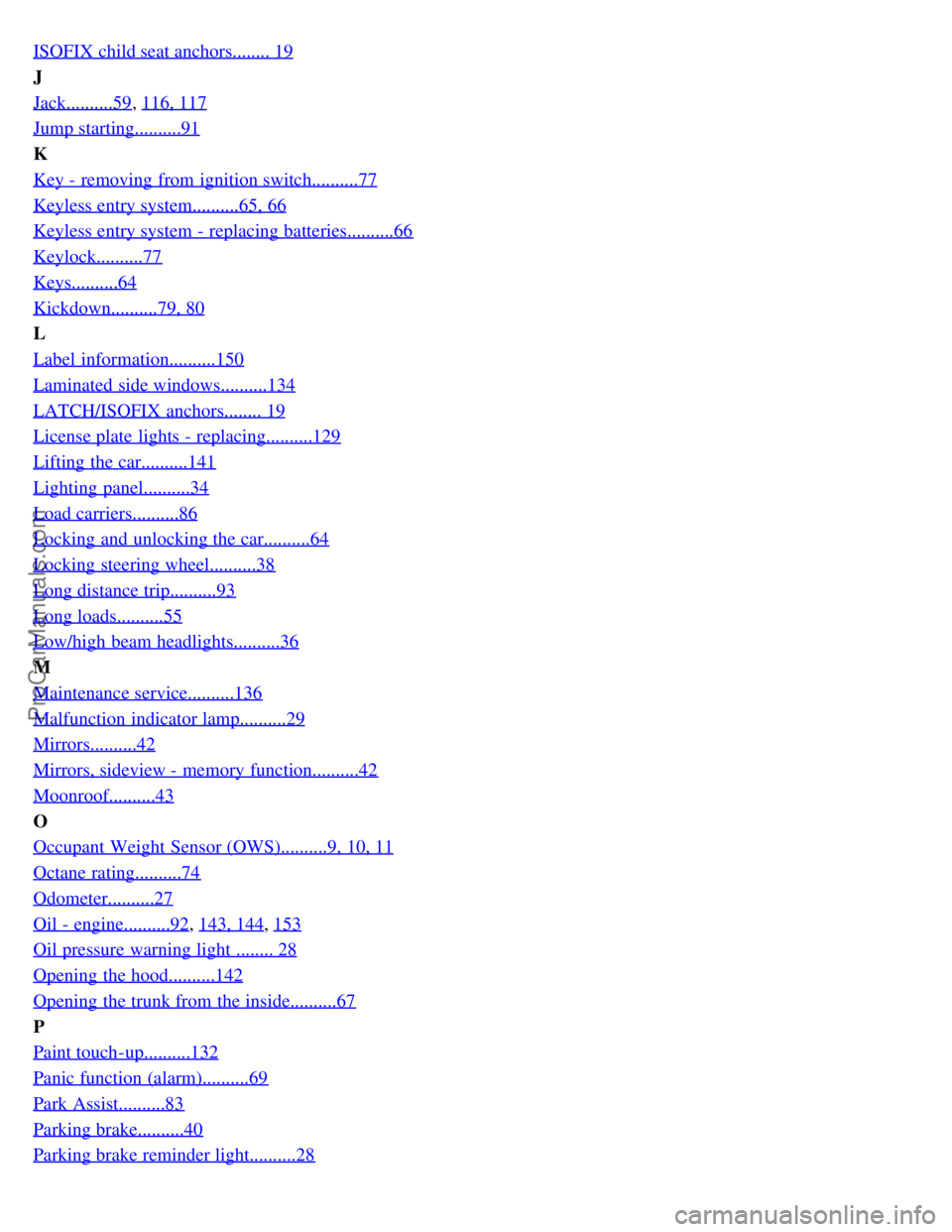
ISOFIX child seat anchors........ 19
J
Jack..........59
, 116, 117
Jump starting..........91
K
Key - removing from ignition switch..........77
Keyless entry system..........65, 66
Keyless entry system - replacing batteries..........66
Keylock..........77
Keys..........64
Kickdown..........79, 80
L
Label information..........150
Laminated side windows..........134
LATCH/ISOFIX anchors........ 19
License plate lights - replacing..........129
Lifting the car..........141
Lighting panel..........34
Load carriers..........86
Locking and unlocking the car..........64
Locking steering wheel..........38
Long distance trip..........93
Long loads..........55
Low/high beam headlights..........36
M
Maintenance service..........136
Malfunction indicator lamp..........29
Mirrors..........42
Mirrors, sideview - memory function..........42
Moonroof..........43
O
Occupant Weight Sensor (OWS)..........9, 10, 11
Octane rating..........74
Odometer..........27
Oil - engine..........92, 143, 144, 153
Oil pressure warning light ........ 28
Opening the hood..........142
Opening the trunk from the inside..........67
P
Paint touch-up..........132
Panic function (alarm)..........69
Park Assist..........83
Parking brake..........40
Parking brake reminder light..........28
ProCarManuals.com
Page 117 of 122
Shiftlock..........77, 78, 80
Side impact airbag system (SIPS)..........12
Side marker lights - replacing..........130
Side turn signals - replacing..........130
Sideview mirrors..........42
Sideview mirrors - heated..........39
Sideview mirrors - memory function..........42
Spare tire.......... 59
Spark plugs..........154
Specifications..........152
Speed -sensitive power steering..........85
SRS..........8
SRS system components, inspecting..........14
Stability Traction Control ..........98, 99
Start inhibitor (immobilizer)..........64, 77
Starting the engine..........77
Steering wheel adjustment ........ 38
Steering wheel lock..........38
Storage compartment in center console..........58
Storage compartments..........57
Sun blinds..........44
Supplemental Restraint System..........29
Supplemental Restraint System (SRS)..........5
Suspension..........154
Switches in center console ........ 31
T
Tachometer..........27
Tail light bulbs - replacing ........ 127
Temperature gauge..........27
Text window..........30
Three-way catalytic converters..........94, 95
Tire Pressure Monitoring System ..........107
102 - 117
Tires - changing..........116, 116
Tool bag..........59
Towing a trailer..........89
Towing eyelet..........87
Towing the car..........87, 88
Trailer hitch, detachable - installing/removing..........90
Trailer towing..........89
Trailer weight - maximum..........151
Transmission - automatic..........81, 82
Transmission fluid (automatic)..........153
Trip computer..........32
ProCarManuals.com
Page 118 of 122
Trip odometer..........27
Trunk - opening from the inside..........67
Trunk - unlocking with master key..........67
Trunk lights - replacing..........130
Turn signal bulbs (front)..........126
Turn signals..........36
U
Unlocking the trunk with key..........67
Upholstery - cleaning..........135
Seat belts..........3
V
Vanity mirror lights - replacing..........128
Vehicle Event Data ........136
Vehicle Identification Number (VIN)..........150
Volvo Inflatable Curtain (VIC)..........13
Warning flashers..........39
Washer fluid reservoir..........153
Vehicle loading..........154
Ventilation..........46
Ventilation hose, battery ........146
Volumes (oils and fluids) ........153
Volvo On Call..........156
W
Warning lights..........28, 29
Warranty..........136
Washer fluid reservoir..........141
Washer fluid solvent..........92
Washing the car..........133, 134, 135
Water repellent glass..........134
Waxing..........134
Weight distribution..........85
Weights..........151
Wheels - changing..........116, 117
Wheels and tires..........102 - 117
Whiplash Protection System (WHIPS)..........15
Windows - electrically operated..........41
Windshield washer solvent ........ 92
Windshield wiper blades - replacing..........148
Windshield wipers/washers..........37
Winter driving..........92
Winter/Wet driving mode..........79, 81
Wiper blades - replacing..........148
ProCarManuals.com