warning light VOLVO S80 2006 Owner's Manual
[x] Cancel search | Manufacturer: VOLVO, Model Year: 2006, Model line: S80, Model: VOLVO S80 2006Pages: 122, PDF Size: 2.33 MB
Page 67 of 122
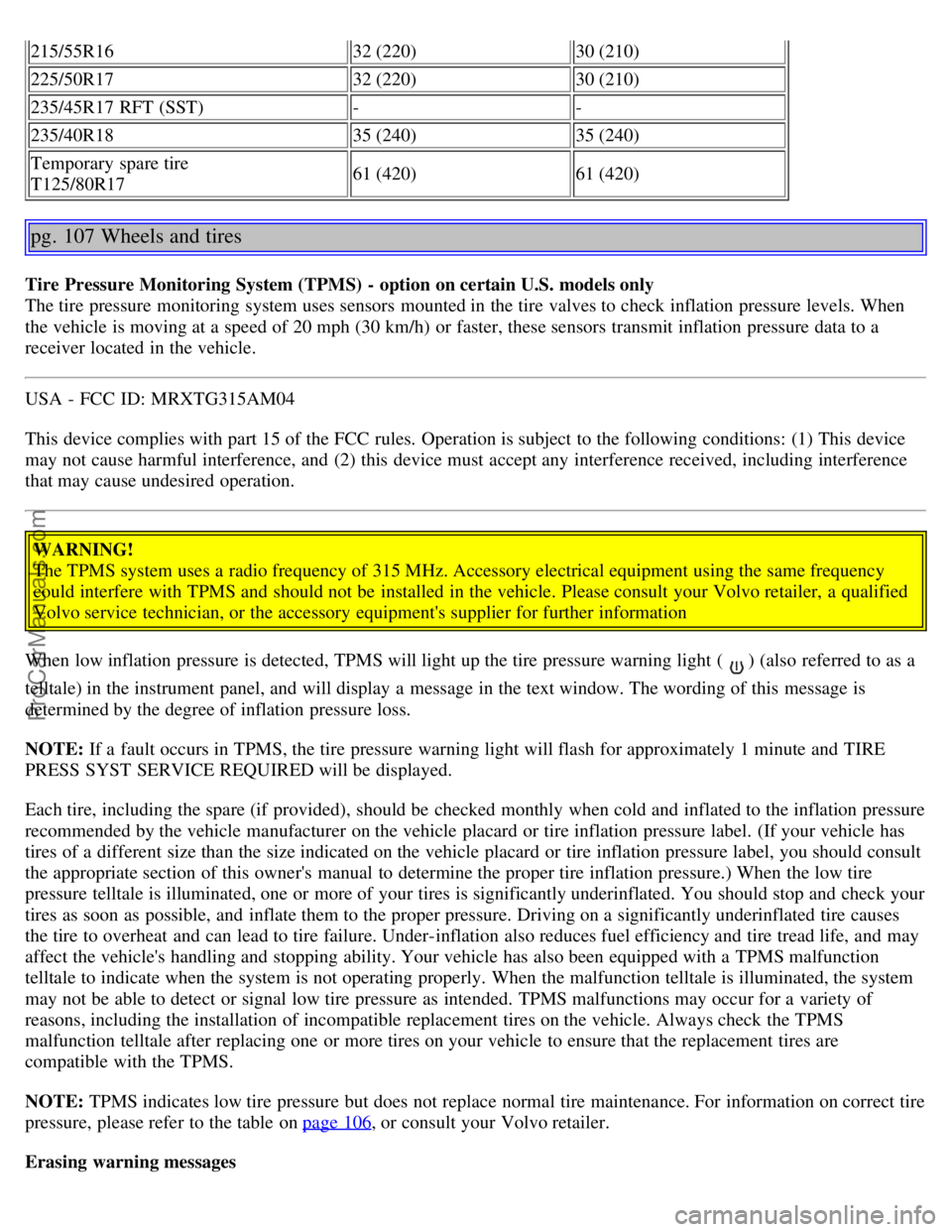
215/55R1632 (220)30 (210)
225/50R17 32 (220)30 (210)
235/45R17 RFT (SST) --
235/40R18 35 (240)35 (240)
Temporary spare tire
T125/80R17 61 (420)
61 (420)
pg. 107 Wheels and tires
Tire Pressure Monitoring System (TPMS) - option on certain U.S. models only
The tire pressure monitoring system uses sensors mounted in the tire valves to check inflation pressure levels. When
the vehicle is moving at a speed of 20 mph (30 km/h) or faster, these sensors transmit inflation pressure data to a
receiver located in the vehicle.
USA - FCC ID: MRXTG315AM04
This device complies with part 15 of the FCC rules. Operation is subject to the following conditions: (1) This device
may not cause harmful interference, and (2) this device must accept any interference received, including interference
that may cause undesired operation.
WARNING!
The TPMS system uses a radio frequency of 315 MHz. Accessory electrical equipment using the same frequency
could interfere with TPMS and should not be installed in the vehicle. Please consult your Volvo retailer, a qualified
Volvo service technician, or the accessory equipment's supplier for further information
When low inflation pressure is detected, TPMS will light up the tire pressure warning light (
) (also referred to as a
telltale) in the instrument panel, and will display a message in the text window. The wording of this message is
determined by the degree of inflation pressure loss.
NOTE: If a fault occurs in TPMS, the tire pressure warning light will flash for approximately 1 minute and TIRE
PRESS SYST SERVICE REQUIRED will be displayed.
Each tire, including the spare (if provided), should be checked monthly when cold and inflated to the inflation pressure
recommended by the vehicle manufacturer on the vehicle placard or tire inflation pressure label. (If your vehicle has
tires of a different size than the size indicated on the vehicle placard or tire inflation pressure label, you should consult
the appropriate section of this owner's manual to determine the proper tire inflation pressure.) When the low tire
pressure telltale is illuminated, one or more of your tires is significantly underinflated. You should stop and check your
tires as soon as possible, and inflate them to the proper pressure. Driving on a significantly underinflated tire causes
the tire to overheat and can lead to tire failure. Under-inflation also reduces fuel efficiency and tire tread life, and may
affect the vehicle's handling and stopping ability. Your vehicle has also been equipped with a TPMS malfunction
telltale to indicate when the system is not operating properly. When the malfunction telltale is illuminated, the system
may not be able to detect or signal low tire pressure as intended. TPMS malfunctions may occur for a variety of
reasons, including the installation of incompatible replacement tires on the vehicle. Always check the TPMS
malfunction telltale after replacing one or more tires on your vehicle to ensure that the replacement tires are
compatible with the TPMS.
NOTE: TPMS indicates low tire pressure but does not replace normal tire maintenance. For information on correct tire
pressure, please refer to the table on page 106
, or consult your Volvo retailer.
Erasing warning messages
ProCarManuals.com
Page 68 of 122
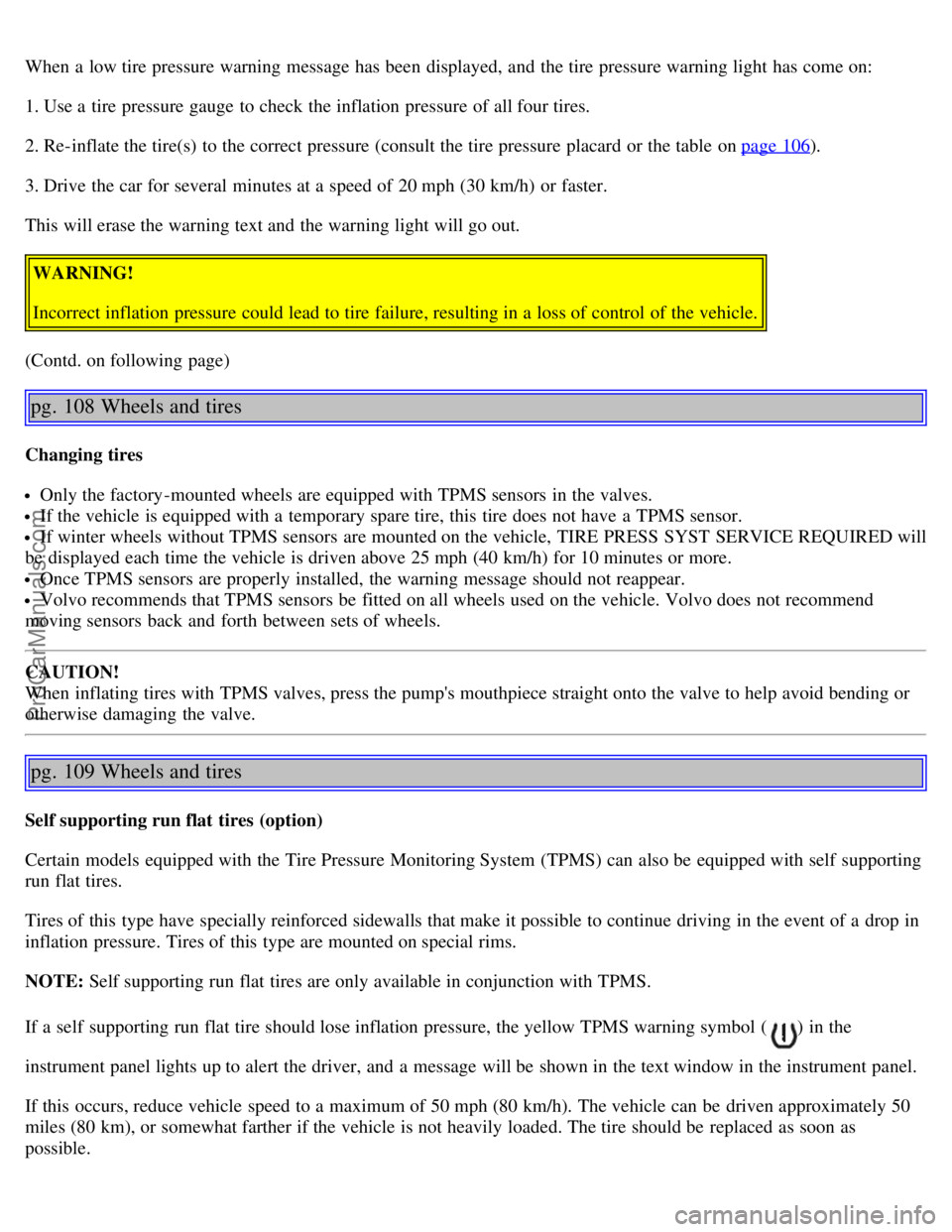
When a low tire pressure warning message has been displayed, and the tire pressure warning light has come on:
1. Use a tire pressure gauge to check the inflation pressure of all four tires.
2. Re-inflate the tire(s) to the correct pressure (consult the tire pressure placard or the table on page 106
).
3. Drive the car for several minutes at a speed of 20 mph (30 km/h) or faster.
This will erase the warning text and the warning light will go out.
WARNING!
Incorrect inflation pressure could lead to tire failure, resulting in a loss of control of the vehicle.
(Contd. on following page)
pg. 108 Wheels and tires
Changing tires
Only the factory-mounted wheels are equipped with TPMS sensors in the valves.
If the vehicle is equipped with a temporary spare tire, this tire does not have a TPMS sensor.
If winter wheels without TPMS sensors are mounted on the vehicle, TIRE PRESS SYST SERVICE REQUIRED will
be displayed each time the vehicle is driven above 25 mph (40 km/h) for 10 minutes or more.
Once TPMS sensors are properly installed, the warning message should not reappear.
Volvo recommends that TPMS sensors be fitted on all wheels used on the vehicle. Volvo does not recommend
moving sensors back and forth between sets of wheels.
CAUTION!
When inflating tires with TPMS valves, press the pump's mouthpiece straight onto the valve to help avoid bending or
otherwise damaging the valve.
pg. 109 Wheels and tires
Self supporting run flat tires (option)
Certain models equipped with the Tire Pressure Monitoring System (TPMS) can also be equipped with self supporting
run flat tires.
Tires of this type have specially reinforced sidewalls that make it possible to continue driving in the event of a drop in
inflation pressure. Tires of this type are mounted on special rims.
NOTE: Self supporting run flat tires are only available in conjunction with TPMS.
If a self supporting run flat tire should lose inflation pressure, the yellow TPMS warning symbol (
) in the
instrument panel lights up to alert the driver, and a message will be shown in the text window in the instrument panel.
If this occurs, reduce vehicle speed to a maximum of 50 mph (80 km/h). The vehicle can be driven approximately 50
miles (80 km), or somewhat farther if the vehicle is not heavily loaded. The tire should be replaced as soon as
possible.
ProCarManuals.com
Page 95 of 122
WARNING!
The distributor ignition system operates at very high voltages. Special safety precautions must be followed to
prevent injury. Always turn the ignition off when:
Replacing distributor ignition components e.g. plugs, coil, etc.
Do not touch any part of the distributor ignition system while the engine is running. This may result in unintended
movements and body injury.
Front suspension
Spring strut suspension with integrated shock absorbers and control arms linked to the support frame. Power-assisted
rack and pinion steering. Safety type steering column.
The alignment specifications apply to an unladen car but include fuel, coolant and spare wheel.
Rear suspension
Individual rear wheel suspension with longitudinal support arms, double link arms and track rods.
Vehicle loading
The tires on your Volvo should perform to specifications at all normal loads when inflated as recommended on the tire
information label. The label is located on the inside of the fuel filler door and lists vehicle design limits. Do not load
your car beyond the load limits indicated.
WARNING!
Improperly inflated tires will reduce tire life, adversely affect vehicle handling and can possibly lead to failure
resulting in loss of vehicle control without prior warning.
All specifications are subject to change without prior notice.
pg. 155 Electrical system
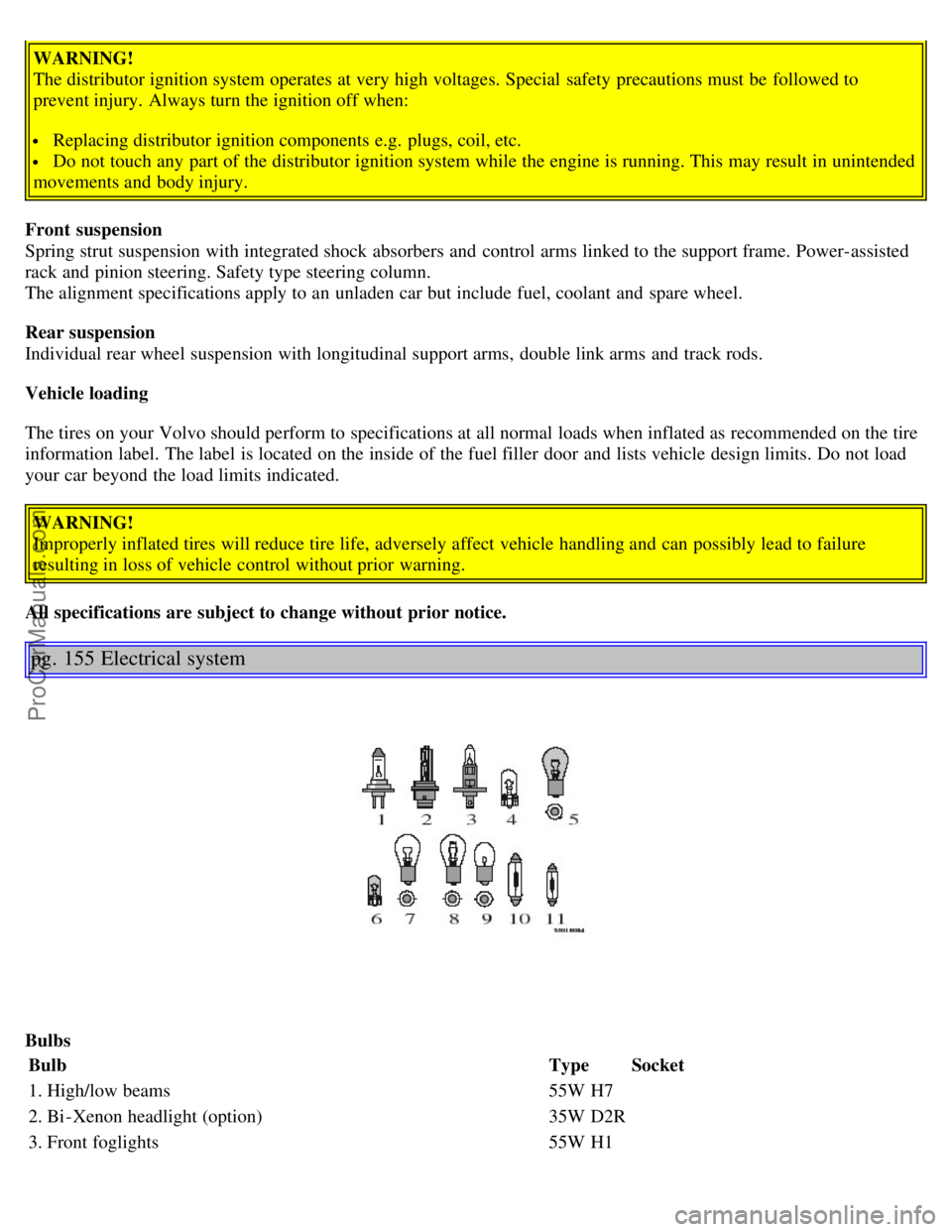
Bulbs Bulb TypeSocket
1. High/low beams 55W H7
2. Bi -Xenon headlight (option) 35W D2R
3. Front foglights 55W H1
ProCarManuals.com
Page 96 of 122
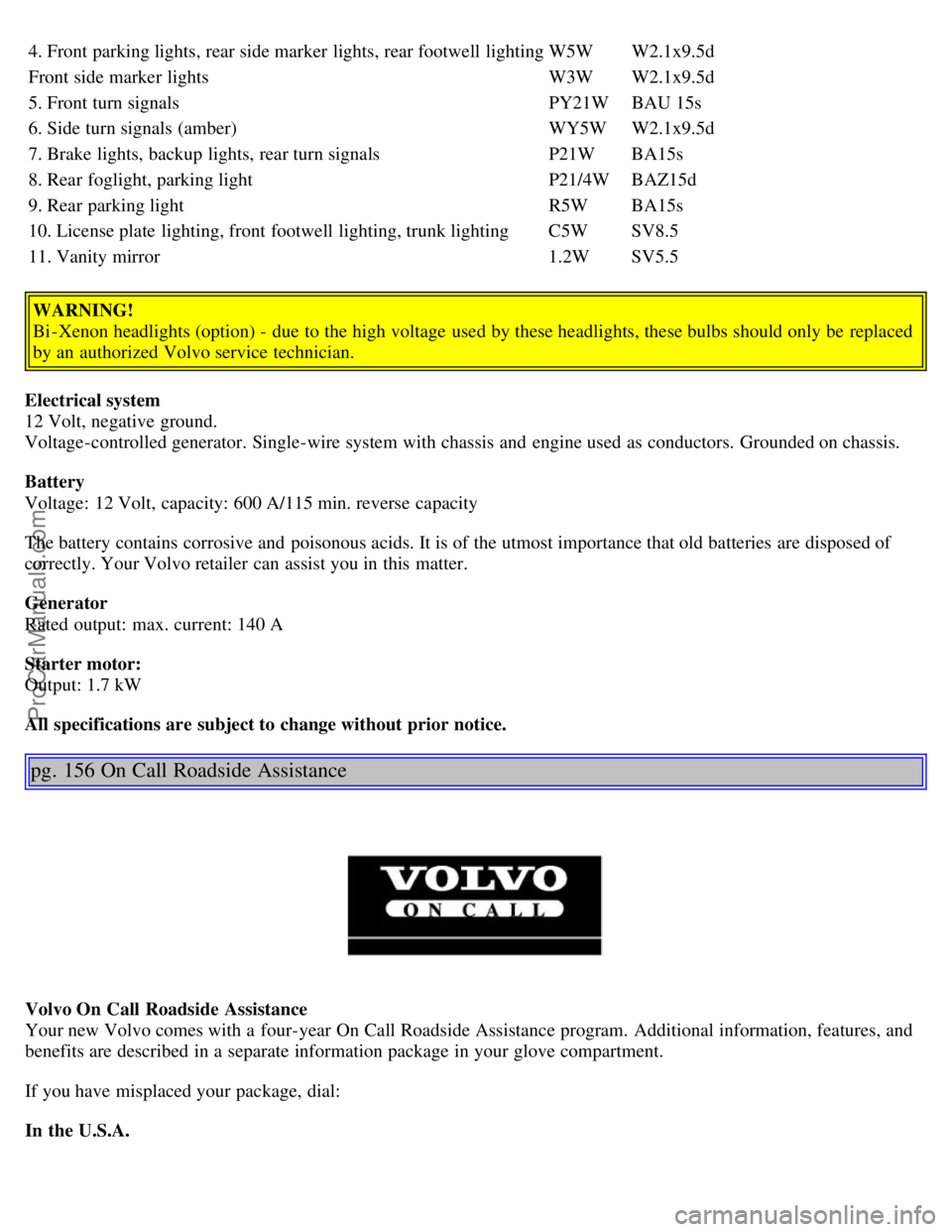
4. Front parking lights, rear side marker lights, rear footwell lightingW5WW2.1x9.5d
Front side marker lights W3WW2.1x9.5d
5. Front turn signals PY21WBAU 15s
6. Side turn signals (amber) WY5WW2.1x9.5d
7. Brake lights, backup lights, rear turn signals P21WBA15s
8. Rear foglight, parking light P21/4WBAZ15d
9. Rear parking light R5WBA15s
10. License plate lighting, front footwell lighting, trunk lighting C5WSV8.5
11. Vanity mirror 1.2WSV5.5
WARNING!
Bi -Xenon headlights (option) - due to the high voltage used by these headlights, these bulbs should only be replaced
by an authorized Volvo service technician.
Electrical system
12 Volt, negative ground.
Voltage-controlled generator. Single-wire system with chassis and engine used as conductors. Grounded on chassis.
Battery
Voltage: 12 Volt, capacity: 600 A/115 min. reverse capacity
The battery contains corrosive and poisonous acids. It is of the utmost importance that old batteries are disposed of
correctly. Your Volvo retailer can assist you in this matter.
Generator
Rated output: max. current: 140 A
Starter motor:
Output: 1.7 kW
All specifications are subject to change without prior notice.
pg. 156 On Call Roadside Assistance
Volvo On Call Roadside Assistance
Your new Volvo comes with a four-year On Call Roadside Assistance program. Additional information, features, and
benefits are described in a separate information package in your glove compartment.
If you have misplaced your package, dial:
In the U.S.A.
ProCarManuals.com
Page 109 of 122
Repeat steps 3 and 4 to program the other two transceiver buttons.
If, after several attempts, you are unable to successfully train the HomeLink® Universal Transceiver to learn your
hand -held transmitter's signal, contact HomeLink® toll-free 1-800-355-3515 (Internet: www.HomeLink.com
).
pg. 176 HomeLink® Universal Transceiver (option)
WARNING!
If you use HomeLink® to open a garage door or gate, be sure no one is near the gate or door while it is in motion.
Do not use the HomeLink® Universal Transceiver with any garage door opener that lacks safety "stop" and
"reverse" features as required by federal safety standards. (This includes any garage door opener model
manufactured before April 1, 1982) A garage door opener that cannot "detect" an object, signalling the door to
"stop" and "reverse" does not meet current federal safety standards. Using a garage door opener without these
features increases the risk of serious injury or death. For more information on this matter, call toll-free 1-800-355-
3515 (Internet: www.HomeLink.com
).
NOTE - Canadian residents:
During programming, your hand -held transmitter may automatically stop transmitting. To successfully train
HomeLink®, continue to hold the HomeLink® button. At the same time, repeatedly press and hold your hand -held
transmitter's button at two -second intervals until HomeLink® has learned your transmitter's code. The HomeLink®
indicator light will flash first slowly, and then rapidly to indicate that the button has been successfully programmed.
Determining if your garage door uses a rolling code
Determine, in one of the following ways, if your garage door uses a rolling code system and is manufactured after
1996:
Refer to the garage door opener owner's manual for verification.
If your hand -held transmitter appears to program the HomeLink® Universal Transceiver but the programmed button
does not activate the garage door, your garage door opener may have a rolling code.
Press the programmed HomeLink® button. If the garage door opener has the rolling code feature, the HomeLink®
indicator light flashes rapidly and then glows steadily after approximately 2 seconds.
To train a rolling code garage door opener , follow these instructions after programming the desired transceiver
button according to "Programming the transceiver." The help of a second person may make training easier.
1. Locate the training button on the garage door opener motor head unit . The location and color of the training button
may vary. If you encounter difficulty, refer to the garage door opener owner's manual or call toll-free 1-800-355-3515
(Internet: www.HomeLink.com
).
2. Press the "training" button on the garage door opener motor head unit until the "training" light comes on.
3. Press and release the programmed HomeLink® button. Press and release the programmed HomeLink® button a
second time to complete the training process.
Some garage door openers may require you to do this procedure a third time to complete the training.
The programmed button on your HomeLink® Universal Transceiver should now operate your garage door opener. The
original hand -held transmitter can also be used, as desired, to operate the garage door.
The remaining two HomeLink® buttons can be programmed in the same way. In the event of any problems in
ProCarManuals.com
Page 111 of 122
2 0 0 6
VOLVO S80
Index
pg. 179 Index
A
ABS..........97
ABS - warning light..........29
Active chassis system (Four-C)..........82
Adjusting the steering wheel..........38
Air conditioning..........47, 48, 49, 51
Air vents..........46
Airbag, front..........6
Alarm..........67, 68
Alarm - "panic" function..........67
All Wheel Drive (AWD) general information..........95
Anti-lock Brake System (ABS)..........97
Anti-lock Brake System - warning light..........29
Antifreeze..........92, 138
Ashtrays..........40
Audio systems..........157
CD player..........169
HU -650 - overview..........159
HU -850 - overview..........160
Specifications..........174
Automatic car washing..........134
Automatic transmission
five speed..........78
Geartronic..........80
Auxiliary socket..........40
B
Backrests, rear seat - folding..........60
Battery..........92, 155
maintenance..........147
replacing..........146
ventilation hose..........146
ProCarManuals.com
Page 112 of 122
"Black box" (Vehicle Event Data)..........136
Blinds - rear/side rear windows..........44
Booster cushion - integrated..........20
Brake failure warning light ..........28
Brake fluid..........145, 153
Brake system..........96
Bulbs (list)..........155
Bulbs - replacing..........125-131
C
Capacities (oils and fluids)..........149
, 153
Cargo net in trunk..........59
Cassette deck (HU-650)..........171
Catalytic converters - three-way..........94, 95
Center console - switches..........31
Center head restraint ..........61
Central locking buttons..........67
Changing wheels..........116, 117
Chassis setting ..........82
Child booster cushion ......... 20
Child restraint anchorages ........ 19
Child safety..........17 -21
Child safety locks - rear doors..........71
Child seat anchors ISOFIX ........ 19
Climate controls..........47, 48, 49, 51
Climate system - general information..........50
Clock..........27
Coat hanger..........55
Cold weather driving..........92
Combination filter..........47, 51
Coolant..........138, 153
Cooling system..........84, 153
Courtesy light..........56
Courtesy lights (front) - replacing..........131
Courtesy lights - exterior..........64
Cruise control..........33
Cup holder - opening..........58
D
Detachable trailer hitch - installing/removing..........90
Dimensions..........151
Direction indicators..........36
Distributor ignition system..........154
Door step courtesy lights - replacing..........129
Doors and locks..........64
Drive belt..........138
ProCarManuals.com
Page 113 of 122
Driving economy..........84
Driving mode indicator..........27
Driving mode W..........79, 81
Driving with trunk open..........85
Dynamic Stability Traction Control..........98, 99
E
Economical driving..........84
Electrical system..........155
Electrical system - general information..........85
Electrically operated front seats..........54
Electrically operated moonroof..........43
Electrically operated sideview mirrors..........42
Electrically operated windows..........41
Electronic Brake Force Distribution..........97
Electronic Climate Control(ECC)..........47 - 51
Emergency towing..........87, 88
Emergency warning flashers..........39
Emission inspection readiness..........140
Emissions systems..........137
Engine - specifications..........152
Engine - starting..........77
Engine compartment..........142
Engine oil..........92, 143, 144, 153
Exterior courtesy lights..........64
Exterior features - overview..........25
F
Fog light - rear..........29
, 35
Folding passenger's seat backrest..........55
Folding rear seat backrests ........60
Four-C (active chassis system).........82
Front airbags ..........6, ,7, 8
Front airbags - SRS..........9, 10, 11
Front airbags - SRS - warning light..........29
Front courtesy lights - replacing..........131
Front fog lights - replacing ........128
Front reading lights..........56
Front seats - adjusting..........54
Front seats - heated..........39
Front suspension..........154
Fuel..........74, 153
Fuel filler cap..........76
Fuel filler door..........76
Fuel filler door - unlocking manually..........35
Fuel filler door - unlocking ..........34
ProCarManuals.com
Page 114 of 122
Fuel gauge..........27
Fuel requirements..........74
Fuel system..........137, 133, 154
Fuel/emissions systems..........137
Fuses..........120 - 124
G
Gas cap..........76
Gasoline..........74
Gear indicator..........27
Geartronic ..........80
Generator..........155
Generator warning light..........28
Glossary of tire terminology..........111
H
Hand brake..........40
Handling..........85
Hazard warning flashers..........39
Head restraint - center rear..........61
Headlight bulbs - replacing..........125
Headlight flash..........36
Headlight wiper blades - replacing..........148
Headlights..........36
Heated front seats..........39
Heated rear window..........39
Heated sideview mirrors..........39
Heating..........47 - 49, 51
High beam flash..........36
High/low beam headlights..........36
Hoisting the car..........141
Home safe lighting..........36
HomeLink® ........175, 176, 176
Hood - opening..........142
I
Ignition switch..........38
Immobilizer (start inhibitor)..........64, 77
Indicator lights..........28, 29
Inflatable curtain ..........13
Inspecting SRS system components..........14
Instrument panel..........27
Instruments..........26
Integrated booster cushion ........ 20
Interior Air Quality system .........51
Interior features - overview..........24
Interior lighting..........56
ProCarManuals.com
Page 115 of 122
ISOFIX child seat anchors........ 19
J
Jack..........59
, 116, 117
Jump starting..........91
K
Key - removing from ignition switch..........77
Keyless entry system..........65, 66
Keyless entry system - replacing batteries..........66
Keylock..........77
Keys..........64
Kickdown..........79, 80
L
Label information..........150
Laminated side windows..........134
LATCH/ISOFIX anchors........ 19
License plate lights - replacing..........129
Lifting the car..........141
Lighting panel..........34
Load carriers..........86
Locking and unlocking the car..........64
Locking steering wheel..........38
Long distance trip..........93
Long loads..........55
Low/high beam headlights..........36
M
Maintenance service..........136
Malfunction indicator lamp..........29
Mirrors..........42
Mirrors, sideview - memory function..........42
Moonroof..........43
O
Occupant Weight Sensor (OWS)..........9, 10, 11
Octane rating..........74
Odometer..........27
Oil - engine..........92, 143, 144, 153
Oil pressure warning light ........ 28
Opening the hood..........142
Opening the trunk from the inside..........67
P
Paint touch-up..........132
Panic function (alarm)..........69
Park Assist..........83
Parking brake..........40
Parking brake reminder light..........28
ProCarManuals.com