ECU VOLVO S80 2008 User Guide
[x] Cancel search | Manufacturer: VOLVO, Model Year: 2008, Model line: S80, Model: VOLVO S80 2008Pages: 275, PDF Size: 7.17 MB
Page 42 of 275
The rear seat's center position is not equipped with ISOFIX lower anchors. When installing a child restraint in this
position, attach the restraint's top tether strap (if it is so equipped) to the top tether anchorage point (see the
information on page 43
) and secure the restraint with the vehicle's center seat belt (see the information beginning on
page 34
).
Always follow your child seat manufacturer's installation instructions, and use both ISOFIX lower anchors and top
tethers whenever possible.
WARNING
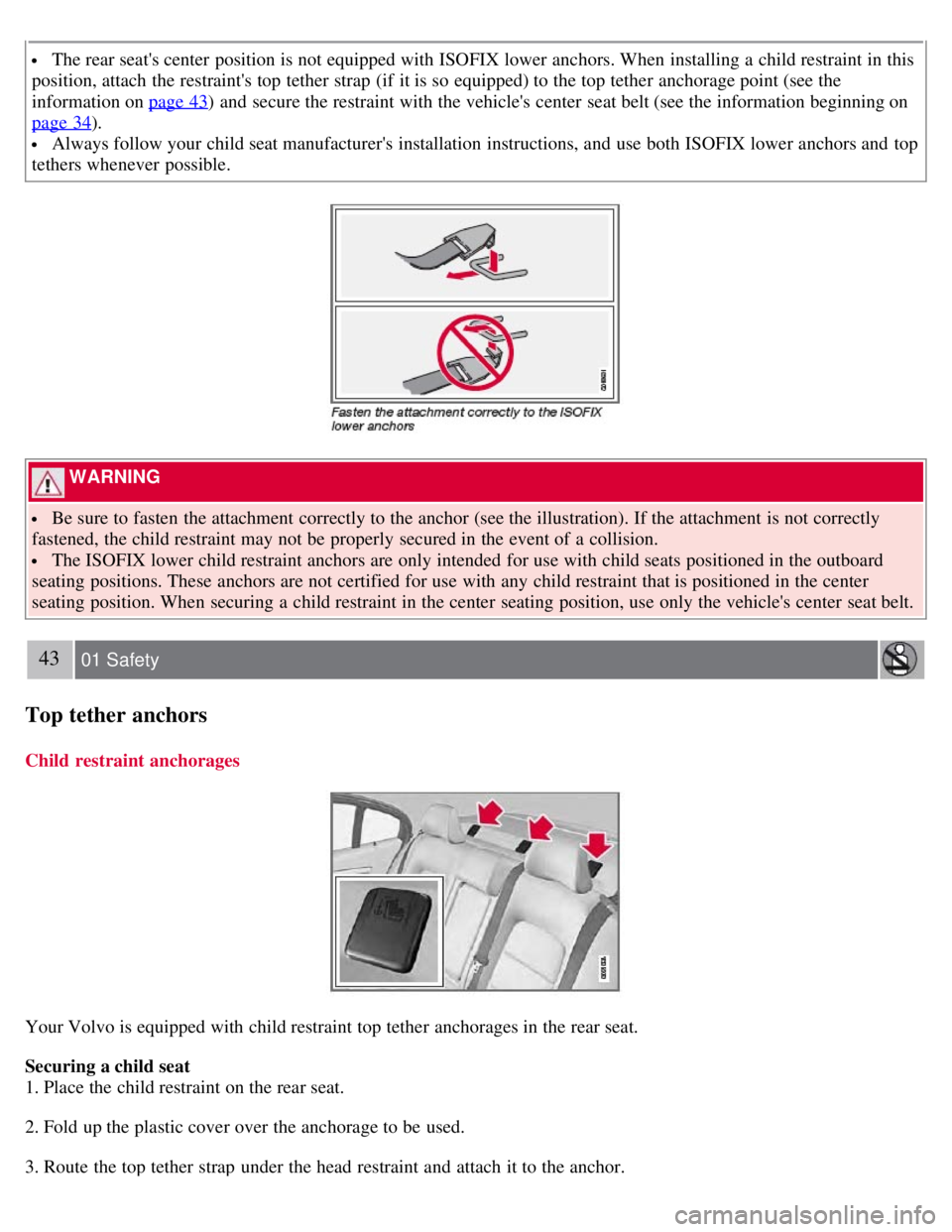
Be sure to fasten the attachment correctly to the anchor (see the illustration). If the attachment is not correctly
fastened, the child restraint may not be properly secured in the event of a collision.
The ISOFIX lower child restraint anchors are only intended for use with child seats positioned in the outboard
seating positions. These anchors are not certified for use with any child restraint that is positioned in the center
seating position. When securing a child restraint in the center seating position, use only the vehicle's center seat belt.
43 01 Safety
Top tether anchors
Child restraint anchorages
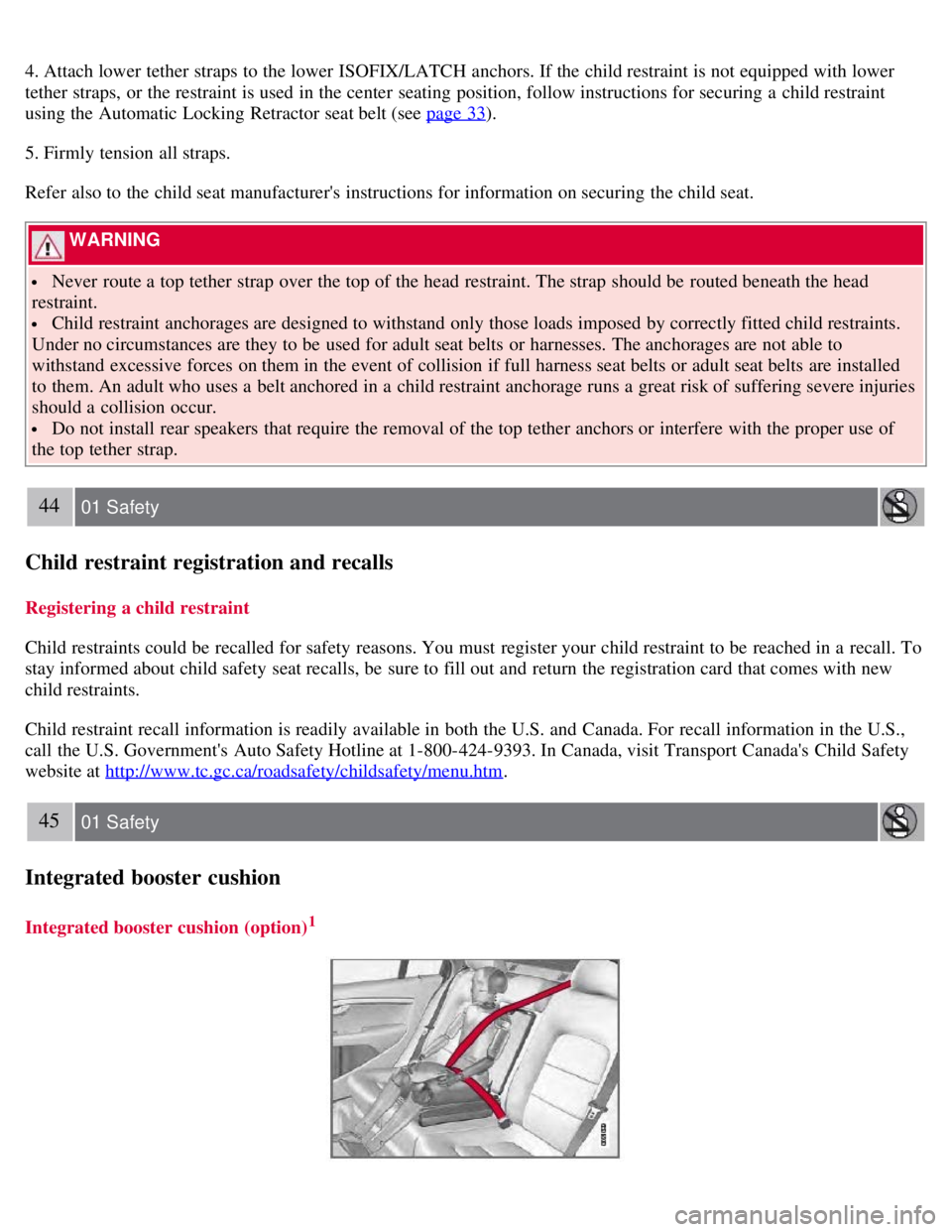
Your Volvo is equipped with child restraint top tether anchorages in the rear seat.
Securing a child seat
1. Place the child restraint on the rear seat.
2. Fold up the plastic cover over the anchorage to be used.
3. Route the top tether strap under the head restraint and attach it to the anchor.
Page 43 of 275
4. Attach lower tether straps to the lower ISOFIX/LATCH anchors. If the child restraint is not equipped with lower
tether straps, or the restraint is used in the center seating position, follow instructions for securing a child restraint
using the Automatic Locking Retractor seat belt (see page 33
).
5. Firmly tension all straps.
Refer also to the child seat manufacturer's instructions for information on securing the child seat.
WARNING
Never route a top tether strap over the top of the head restraint. The strap should be routed beneath the head
restraint.
Child restraint anchorages are designed to withstand only those loads imposed by correctly fitted child restraints.
Under no circumstances are they to be used for adult seat belts or harnesses. The anchorages are not able to
withstand excessive forces on them in the event of collision if full harness seat belts or adult seat belts are installed
to them. An adult who uses a belt anchored in a child restraint anchorage runs a great risk of suffering severe injuries
should a collision occur.
Do not install rear speakers that require the removal of the top tether anchors or interfere with the proper use of
the top tether strap.
44 01 Safety
Child restraint registration and recalls
Registering a child restraint
Child restraints could be recalled for safety reasons. You must register your child restraint to be reached in a recall. To
stay informed about child safety seat recalls, be sure to fill out and return the registration card that comes with new
child restraints.
Child restraint recall information is readily available in both the U.S. and Canada. For recall information in the U.S.,
call the U.S. Government's Auto Safety Hotline at 1-800-424-9393. In Canada, visit Transport Canada's Child Safety
website at http://www.tc.gc.ca/roadsafety/childsafety/menu.htm
.
45 01 Safety
Integrated booster cushion
Integrated booster cushion (option)1
Page 44 of 275
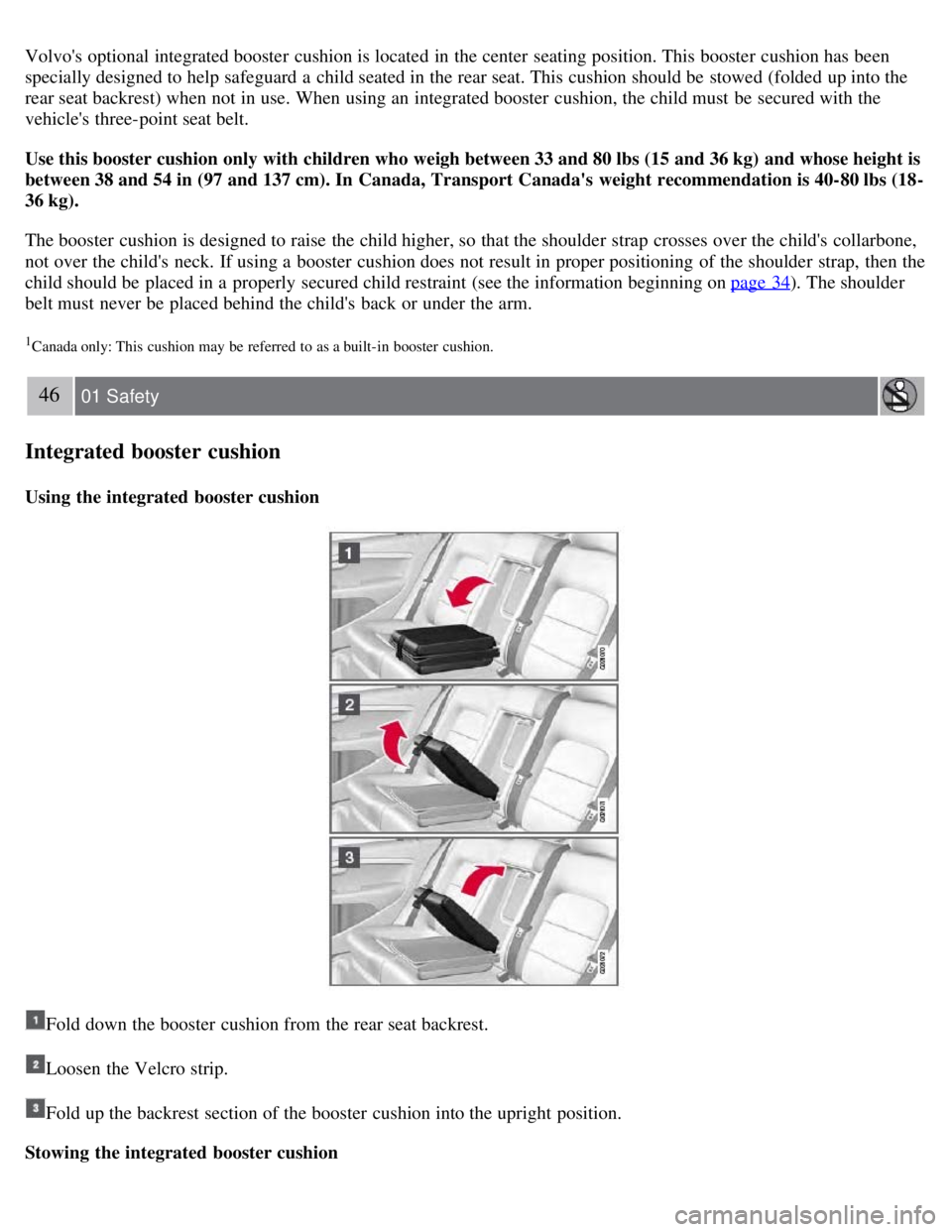
Volvo's optional integrated booster cushion is located in the center seating position. This booster cushion has been
specially designed to help safeguard a child seated in the rear seat. This cushion should be stowed (folded up into the
rear seat backrest) when not in use. When using an integrated booster cushion, the child must be secured with the
vehicle's three-point seat belt.
Use this booster cushion only with children who weigh between 33 and 80 lbs (15 and 36 kg) and whose height is
between 38 and 54 in (97 and 137 cm). In Canada, Transport Canada's weight recommendation is 40-80 lbs (18-
36 kg).
The booster cushion is designed to raise the child higher, so that the shoulder strap crosses over the child's collarbone,
not over the child's neck. If using a booster cushion does not result in proper positioning of the shoulder strap, then the
child should be placed in a properly secured child restraint (see the information beginning on page 34
). The shoulder
belt must never be placed behind the child's back or under the arm.
1Canada only: This cushion may be referred to as a built- in booster cushion.
46 01 Safety
Integrated booster cushion
Using the integrated booster cushion
Fold down the booster cushion from the rear seat backrest.
Loosen the Velcro strip.
Fold up the backrest section of the booster cushion into the upright position.
Stowing the integrated booster cushion
Page 45 of 275
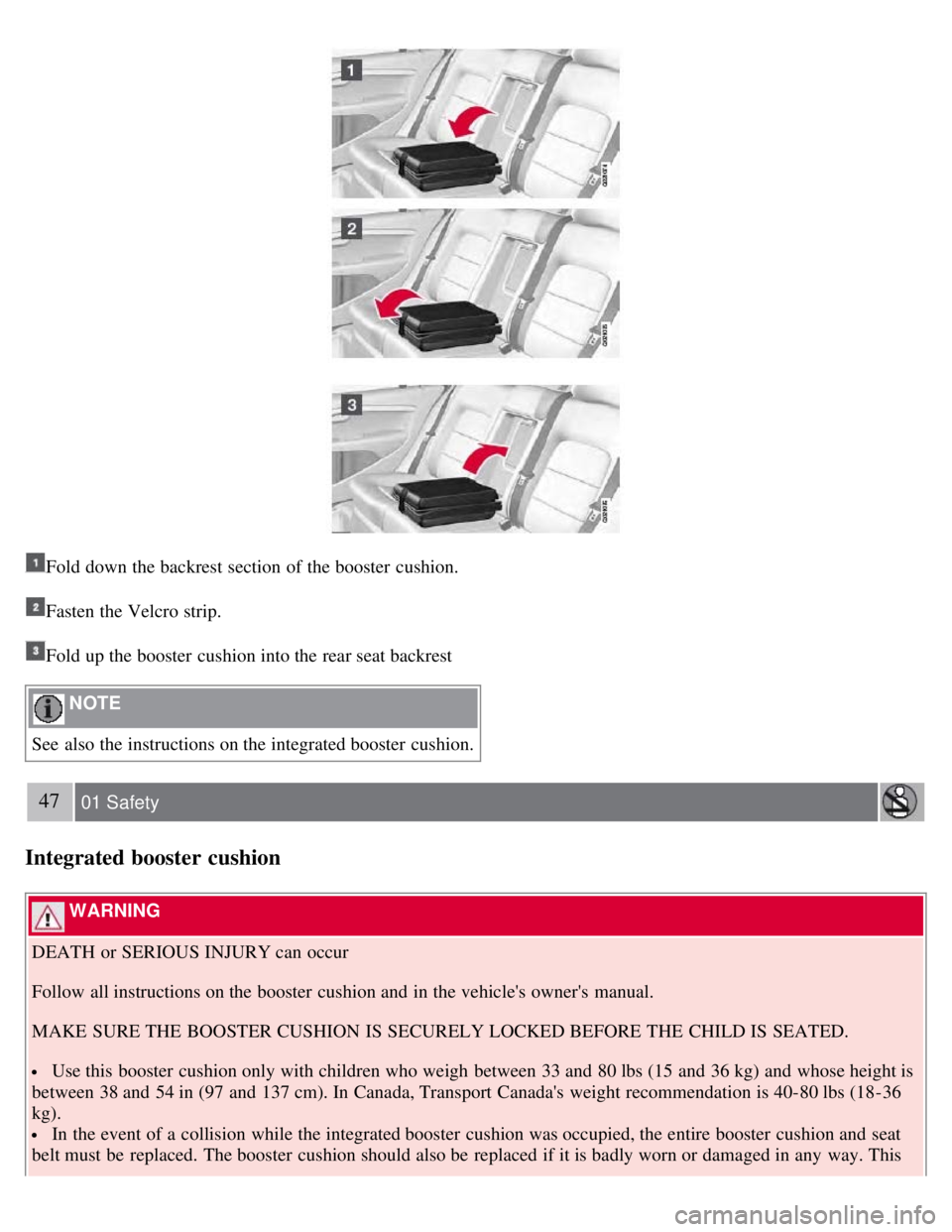
Fold down the backrest section of the booster cushion.
Fasten the Velcro strip.
Fold up the booster cushion into the rear seat backrest
NOTE
See also the instructions on the integrated booster cushion.
47 01 Safety
Integrated booster cushion
WARNING
DEATH or SERIOUS INJURY can occur
Follow all instructions on the booster cushion and in the vehicle's owner's manual.
MAKE SURE THE BOOSTER CUSHION IS SECURELY LOCKED BEFORE THE CHILD IS SEATED.
Use this booster cushion only with children who weigh between 33 and 80 lbs (15 and 36 kg) and whose height is
between 38 and 54 in (97 and 137 cm). In Canada, Transport Canada's weight recommendation is 40-80 lbs (18-36
kg).
In the event of a collision while the integrated booster cushion was occupied, the entire booster cushion and seat
belt must be replaced. The booster cushion should also be replaced if it is badly worn or damaged in any way. This
Page 79 of 275
82 03 Your driving environment
Seats
Front seats
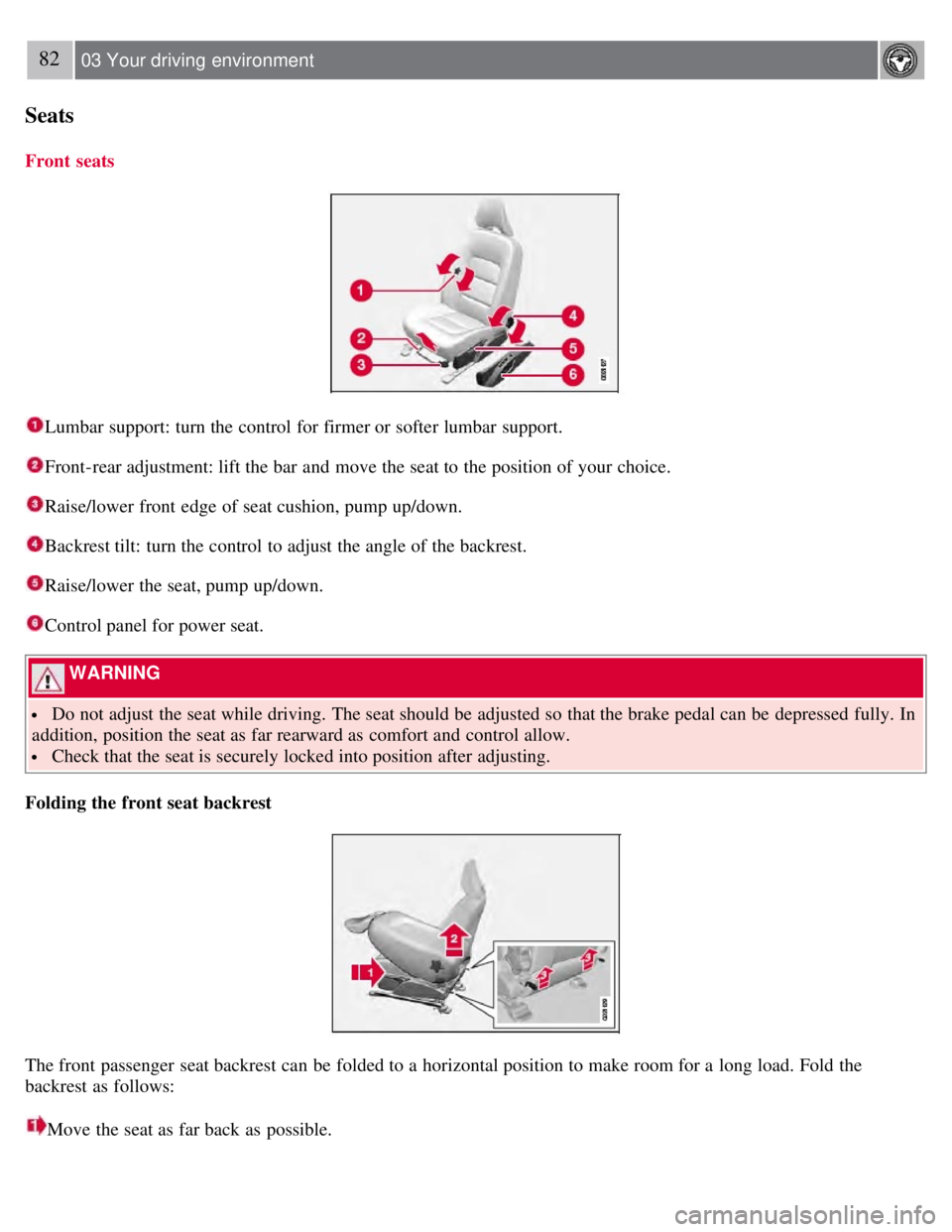
Lumbar support: turn the control for firmer or softer lumbar support.
Front-rear adjustment: lift the bar and move the seat to the position of your choice.
Raise/lower front edge of seat cushion, pump up/down.
Backrest tilt: turn the control to adjust the angle of the backrest.
Raise/lower the seat, pump up/down.
Control panel for power seat.
WARNING
Do not adjust the seat while driving. The seat should be adjusted so that the brake pedal can be depressed fully. In
addition, position the seat as far rearward as comfort and control allow.
Check that the seat is securely locked into position after adjusting.
Folding the front seat backrest
The front passenger seat backrest can be folded to a horizontal position to make room for a long load. Fold the
backrest as follows:
Move the seat as far back as possible.
Page 80 of 275
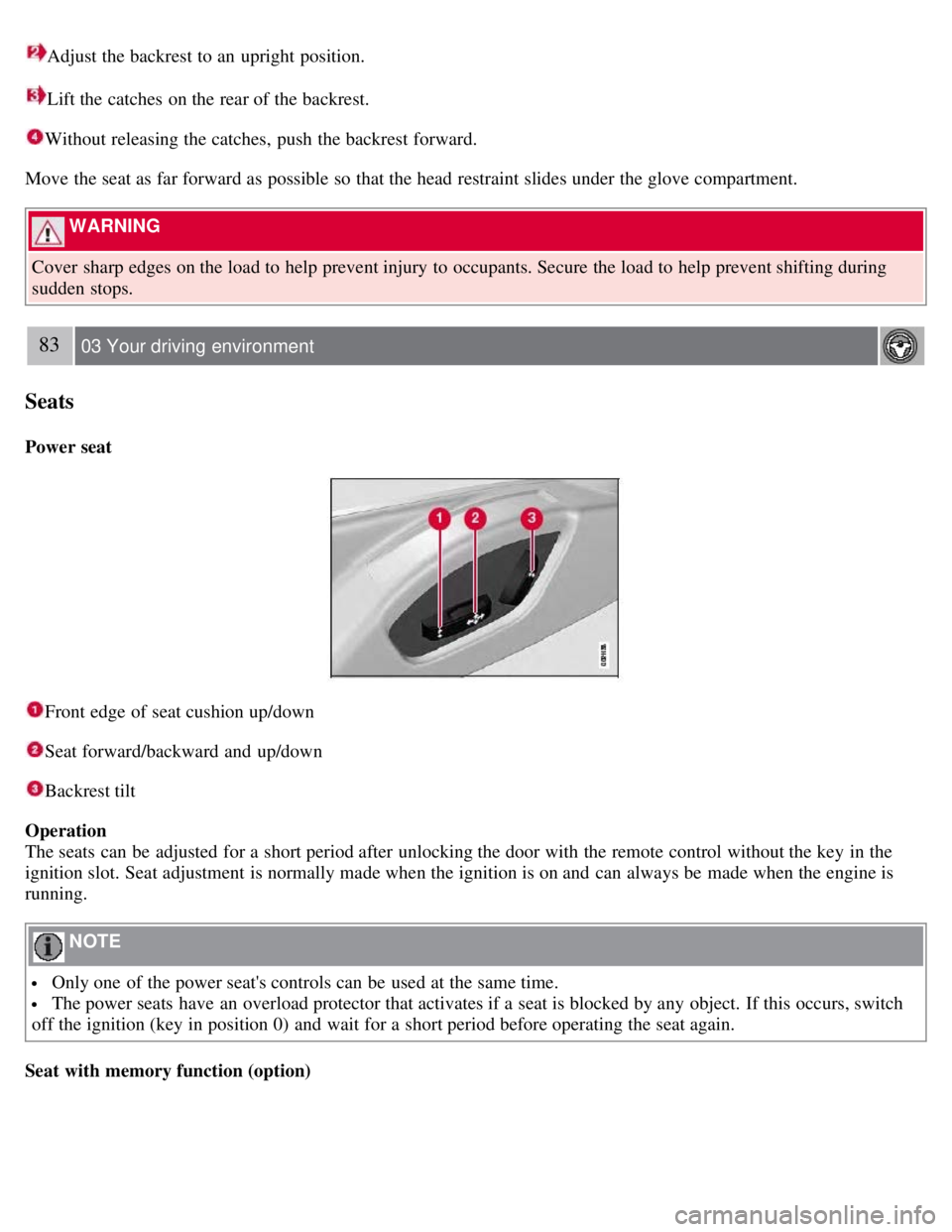
Adjust the backrest to an upright position.
Lift the catches on the rear of the backrest.
Without releasing the catches, push the backrest forward.
Move the seat as far forward as possible so that the head restraint slides under the glove compartment.
WARNING
Cover sharp edges on the load to help prevent injury to occupants. Secure the load to help prevent shifting during
sudden stops.
83 03 Your driving environment
Seats
Power seat
Front edge of seat cushion up/down
Seat forward/backward and up/down
Backrest tilt
Operation
The seats can be adjusted for a short period after unlocking the door with the remote control without the key in the
ignition slot. Seat adjustment is normally made when the ignition is on and can always be made when the engine is
running.
NOTE
Only one of the power seat's controls can be used at the same time.
The power seats have an overload protector that activates if a seat is blocked by any object. If this occurs, switch
off the ignition (key in position 0) and wait for a short period before operating the seat again.
Seat with memory function (option)
Page 83 of 275
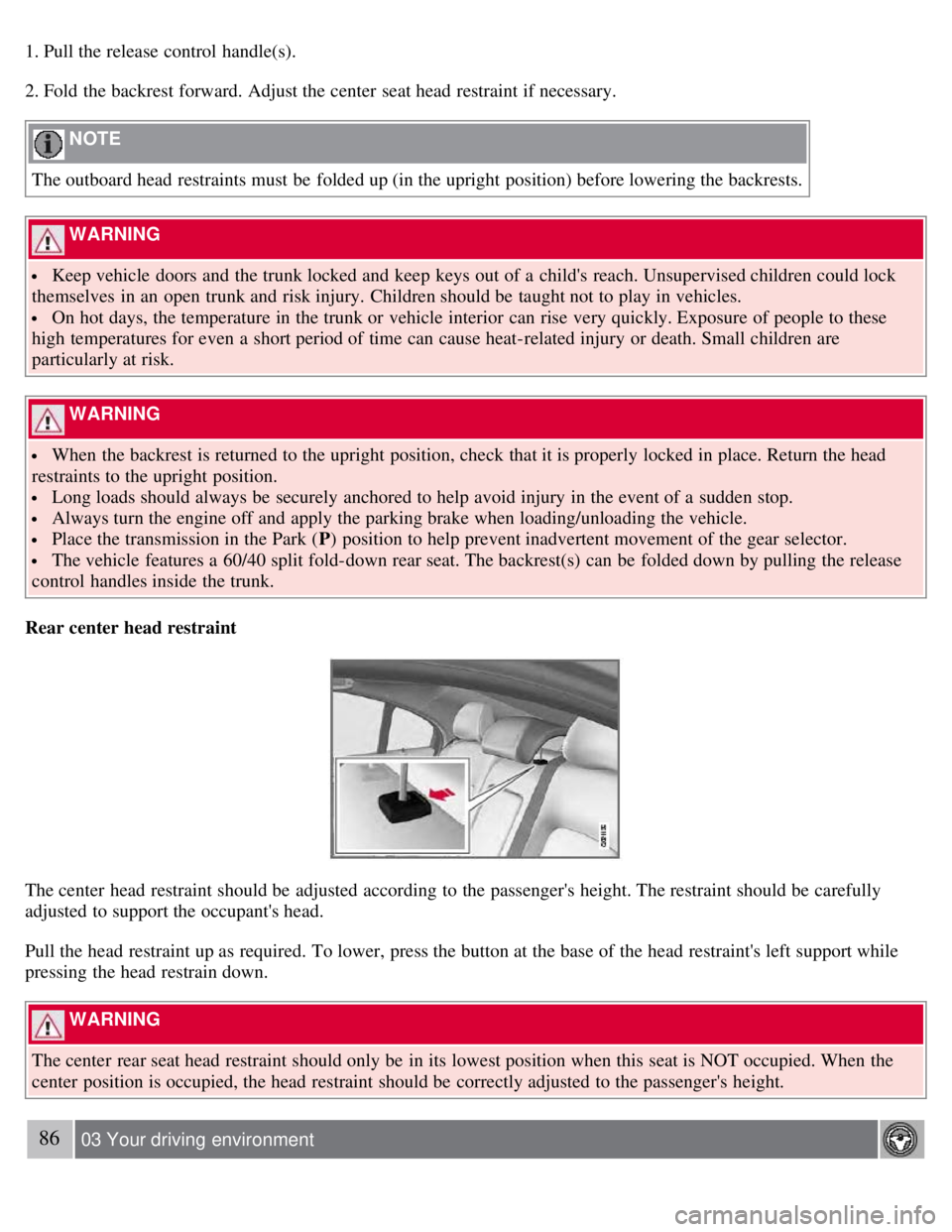
1. Pull the release control handle(s).
2. Fold the backrest forward. Adjust the center seat head restraint if necessary.
NOTE
The outboard head restraints must be folded up (in the upright position) before lowering the backrests.
WARNING
Keep vehicle doors and the trunk locked and keep keys out of a child's reach. Unsupervised children could lock
themselves in an open trunk and risk injury. Children should be taught not to play in vehicles.
On hot days, the temperature in the trunk or vehicle interior can rise very quickly. Exposure of people to these
high temperatures for even a short period of time can cause heat-related injury or death. Small children are
particularly at risk.
WARNING
When the backrest is returned to the upright position, check that it is properly locked in place. Return the head
restraints to the upright position.
Long loads should always be securely anchored to help avoid injury in the event of a sudden stop.
Always turn the engine off and apply the parking brake when loading/unloading the vehicle.
Place the transmission in the Park ( P) position to help prevent inadvertent movement of the gear selector.
The vehicle features a 60/40 split fold-down rear seat. The backrest(s) can be folded down by pulling the release
control handles inside the trunk.
Rear center head restraint
The center head restraint should be adjusted according to the passenger's height. The restraint should be carefully
adjusted to support the occupant's head.
Pull the head restraint up as required. To lower, press the button at the base of the head restraint's left support while
pressing the head restrain down.
WARNING
The center rear seat head restraint should only be in its lowest position when this seat is NOT occupied. When the
center position is occupied, the head restraint should be correctly adjusted to the passenger's height.
86 03 Your driving environment
Page 101 of 275
Introduction
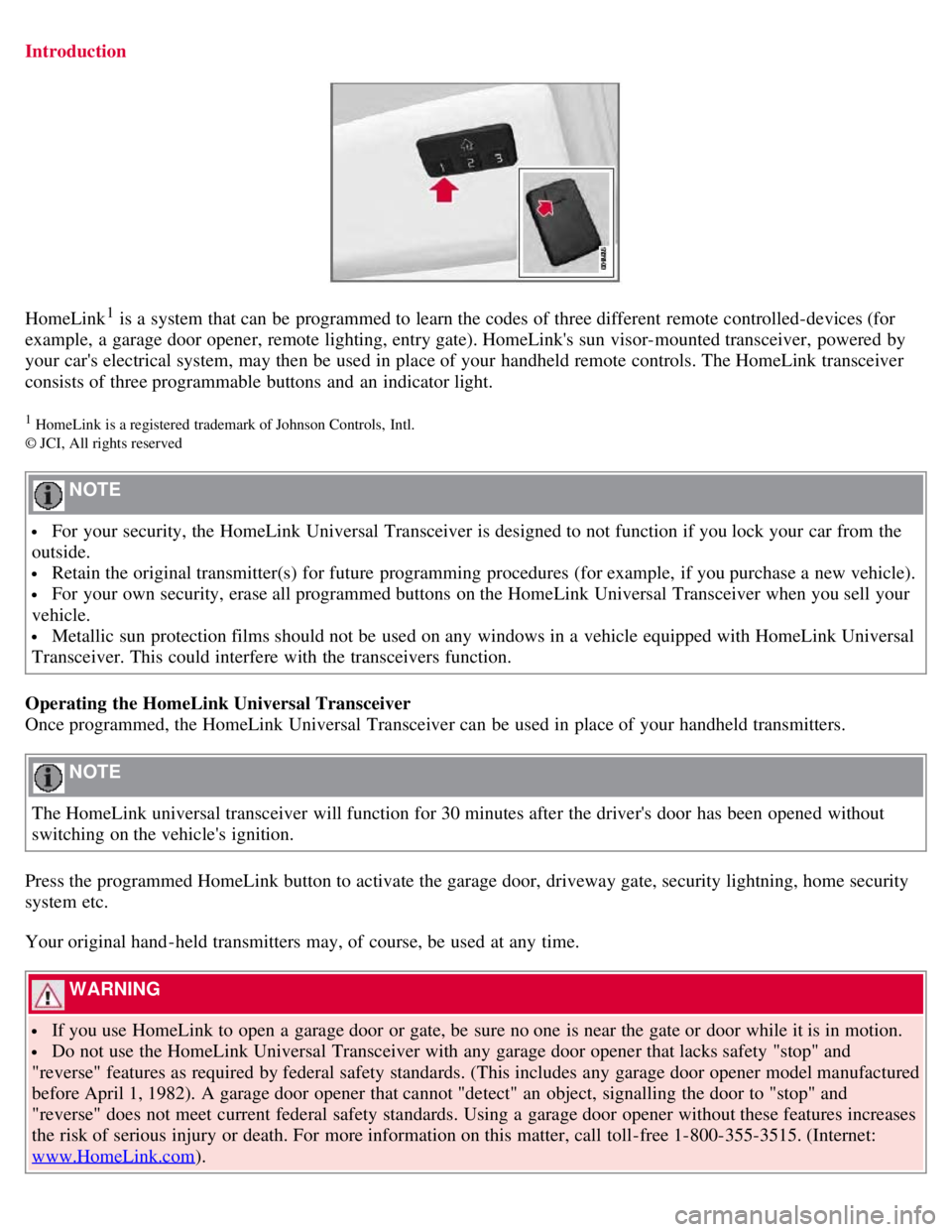
HomeLink1 is a system that can be programmed to learn the codes of three different remote controlled-devices (for
example, a garage door opener, remote lighting, entry gate). HomeLink's sun visor-mounted transceiver, powered by
your car's electrical system, may then be used in place of your handheld remote controls. The HomeLink transceiver
consists of three programmable buttons and an indicator light.
1 HomeLink is a registered trademark of Johnson Controls, Intl.
© JCI, All rights reserved
NOTE
For your security, the HomeLink Universal Transceiver is designed to not function if you lock your car from the
outside.
Retain the original transmitter(s) for future programming procedures (for example, if you purchase a new vehicle).
For your own security, erase all programmed buttons on the HomeLink Universal Transceiver when you sell your
vehicle.
Metallic sun protection films should not be used on any windows in a vehicle equipped with HomeLink Universal
Transceiver. This could interfere with the transceivers function.
Operating the HomeLink Universal Transceiver
Once programmed, the HomeLink Universal Transceiver can be used in place of your handheld transmitters.
NOTE
The HomeLink universal transceiver will function for 30 minutes after the driver's door has been opened without
switching on the vehicle's ignition.
Press the programmed HomeLink button to activate the garage door, driveway gate, security lightning, home security
system etc.
Your original hand -held transmitters may, of course, be used at any time.
WARNING
If you use HomeLink to open a garage door or gate, be sure no one is near the gate or door while it is in motion.
Do not use the HomeLink Universal Transceiver with any garage door opener that lacks safety "stop" and
"reverse" features as required by federal safety standards. (This includes any garage door opener model manufactured
before April 1, 1982). A garage door opener that cannot "detect" an object, signalling the door to "stop" and
"reverse" does not meet current federal safety standards. Using a garage door opener without these features increases
the risk of serious injury or death. For more information on this matter, call toll-free 1-800-355-3515. (Internet:
www.HomeLink.com
).
Page 191 of 275
To increase loading space, the rear seat backrests can be folded down, see page 85.
The trunk lid can be unlocked via the button located on the lighting panel, see page 64.
Load the cargo in the trunk against the backrest.
Load wide cargo in the trunk on both sides of the rear seat split.
Unstable loads can be secured to the load anchoring eyelets with straps or web lashings to help keep them from
shifting.
Folding down the rear seat backrests
See page 85
for information.
WARNING
The vehicle's driving characteristics may change depending on the weight and distribution of the load.
A 44-pound (20 kg) object produces a force of 2,200 pounds (1,000 kg) in a head-on collision at 30 mph (50
km/h).
Loading the cargo area
Stop the engine and apply the parking brake when loading or unloading long objects. The gear selector can be knocked
out of position by long loads, which could set the vehicle in motion. To increase loading space, the rear seat backrests
can be folded down, see page 85
.
WARNING
Stop the engine, put the gear selector in P , and apply the parking brake when loading or unloading long objects.
The rear seat should not be loaded to a level higher than 2 in. (5 cm) below the upper edge of the rear side
windows. Objects placed higher than this level could impede the function of the Volvo Inflatable Curtain.
Load anchoring eyelets
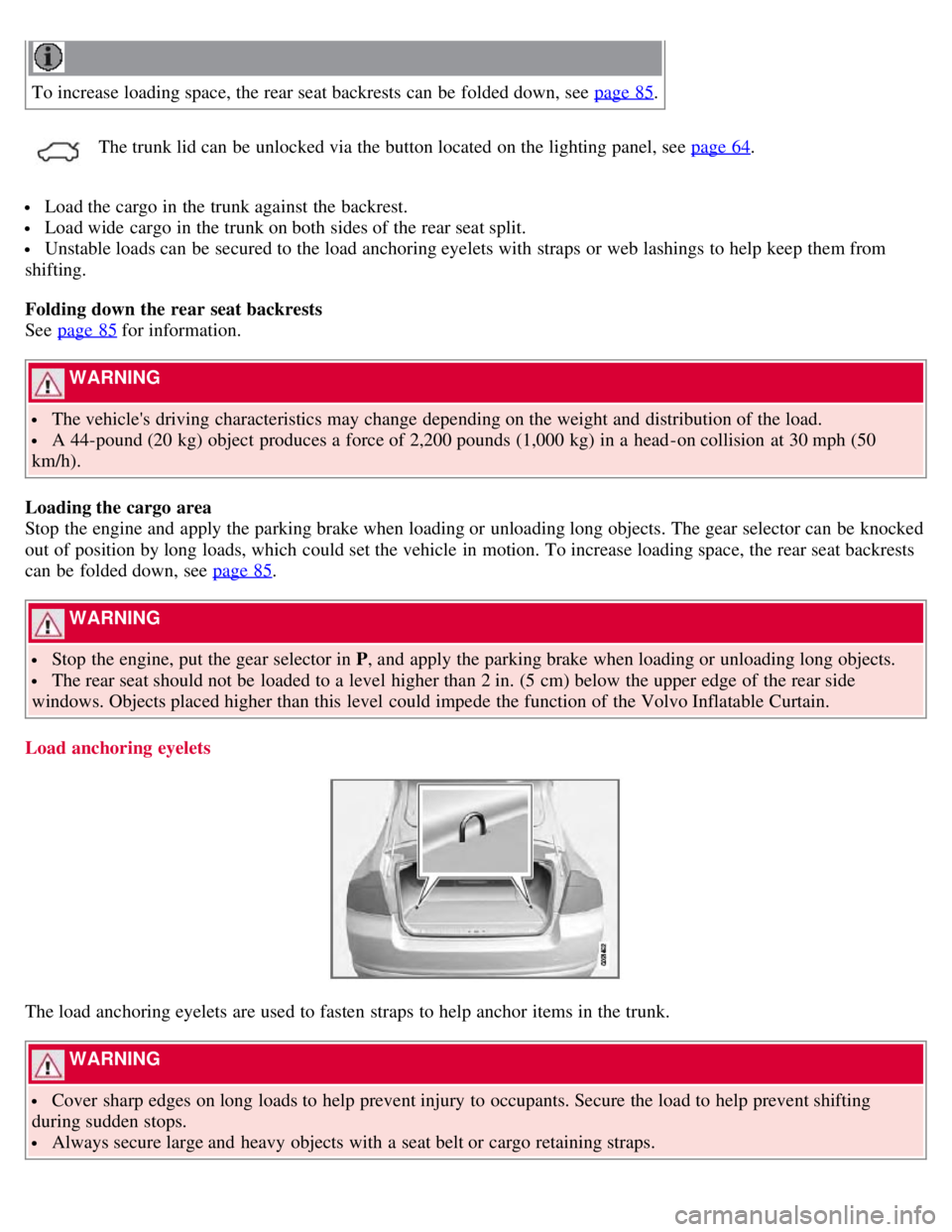
The load anchoring eyelets are used to fasten straps to help anchor items in the trunk.
WARNING
Cover sharp edges on long loads to help prevent injury to occupants. Secure the load to help prevent shifting
during sudden stops.
Always secure large and heavy objects with a seat belt or cargo retaining straps.
Page 192 of 275
199 05 During your trip
Loading
Grocery bag holder1
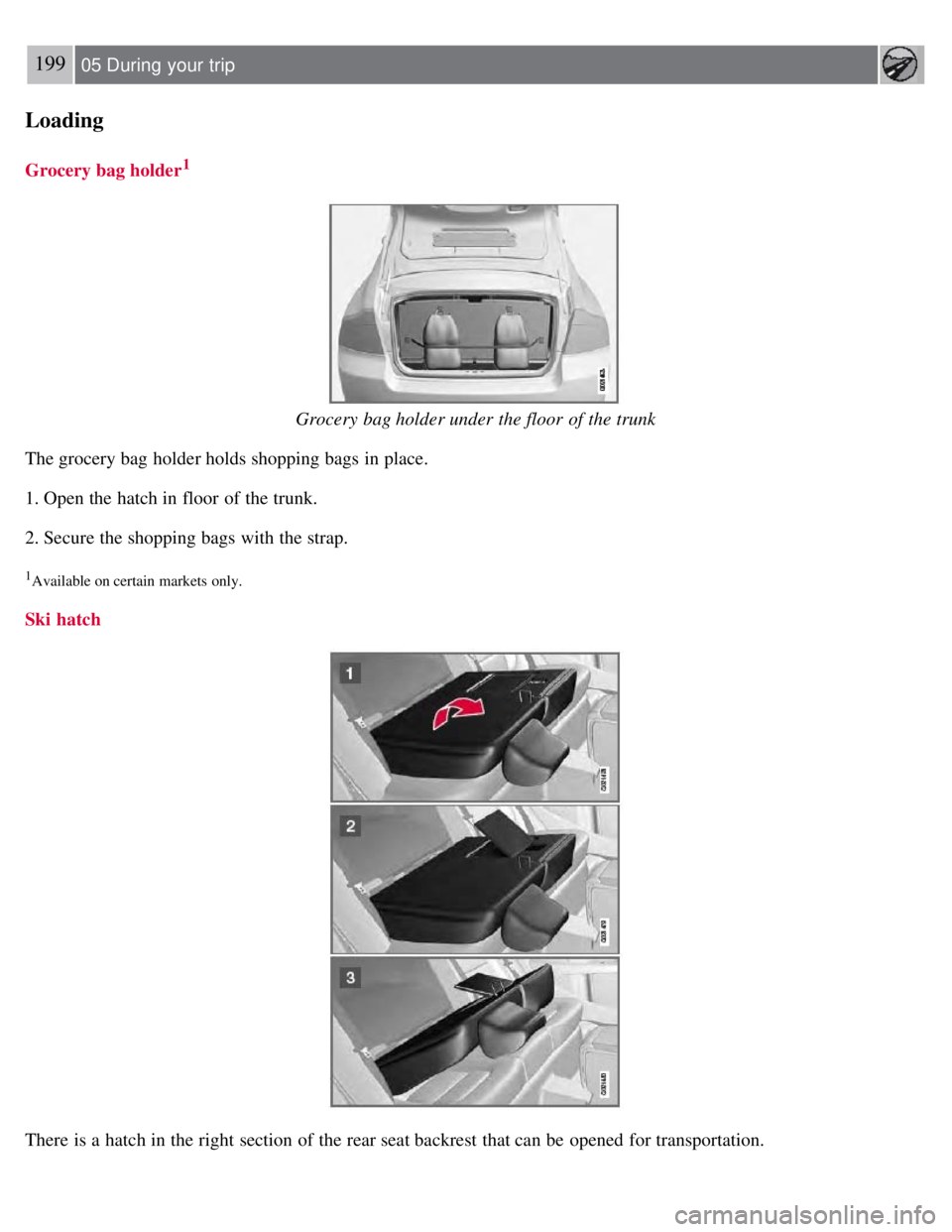
Grocery bag holder under the floor of the trunk
The grocery bag holder holds shopping bags in place.
1. Open the hatch in floor of the trunk.
2. Secure the shopping bags with the strap.
1Available on certain markets only.
Ski hatch
There is a hatch in the right section of the rear seat backrest that can be opened for transportation.