instrument panel VOLVO S80 2008 Owner's Manual
[x] Cancel search | Manufacturer: VOLVO, Model Year: 2008, Model line: S80, Model: VOLVO S80 2008Pages: 275, PDF Size: 7.17 MB
Page 234 of 275
The tire pressure monitoring system uses sensors mounted in the tire valves to check inflation pressure levels. When
the vehicle is moving at a speed of approximately 20 mph (30 km/h) or faster, these sensors transmit inflation pressure
data to a receiver located in the vehicle.
NOTE
USA - FCC ID: KR5S122780002
This device complies with part 15 of the FCC rules. Operation is subject to the following conditions: (1) This device
may not cause harmful interference, and (2) this device must accept any interference received, including interference
that may cause undesired operation.
When low inflation pressure is detected, TPMS will light up the tire pressure warning light (
) (also referred to as
a telltale) in the instrument panel, and will display a message in the text window. The wording of this message is
determined by the degree of inflation pressure loss.
NOTE
If a fault occurs in TPMS, the tire pressure warning light will flash for approximately 1 minute and TIRE PRESS
SYST SERVICE REQUIRED will be displayed.
Each tire, including the spare (if provided), should be checked monthly when cold and inflated to the inflation pressure
recommended by the vehicle manufacturer on the vehicle placard or tire inflation pressure label. (If your vehicle has
tires of a different size than the size indicated on the vehicle placard or tire inflation pressure label, you should
determine the proper tire inflation pressure for those tires.)
As an added safety feature, your vehicle has been equipped with a tire pressure monitoring system (TPMS) that
illuminates a low tire pressure telltale when one or more of your tires is significantly under-inflated. Accordingly,
when the low tire pressure telltale illuminates, you should stop and check your tires as soon as possible, and inflate
them to the proper pressure. Driving on a significantly under-inflated tire causes the tire to overheat and can lead to
tire failure. Under-inflation also reduces fuel efficiency and tire tread life, and may affect the vehicle's handling and
stopping ability.
Please note that the TPMS is not a substitute for proper tire maintenance, and it is the driver's responsibility to
maintain correct tire pressure, even if under-inflation has not reached the level to trigger illumination of the TPMS low
tire pressure telltale.
Your vehicle has also been equipped with a TPMS malfunction indicator to indicate when the system is not operating
properly. The TPMS malfunction indicator is combined with the low tire pressure telltale. When the system detects a
malfunction, the telltale will flash for approximately one minute and then remain continuously illuminated. This
sequence will continue upon subsequent vehicle start-ups as long as the malfunction exists. When the malfunction
indicator is illuminated, the system may not be able to detect or signal low tire pressure as intended. TPMS
malfunctions may occur for a variety of reasons, including the installation of replacement or alternate tires or wheels
on the vehicle that prevent the TPMS from functioning properly. Always check the TPMS malfunction telltale after
replacing one or more tires or wheels on your vehicle to ensure that the replacement or alternate tires and wheels allow
the TPMS to continue to function properly.
243 06 Maintenance and specifications
Wheels and tires
Page 236 of 275
Self supporting run flat tires
Certain models equipped with the Tire Pressure Monitoring System (TPMS) can also be equipped with self supporting
run flat tires.
Tires of this type have specially reinforced sidewalls that make it possible to continue driving in the event of a drop in
inflation pressure. Tires of this type are mounted on special rims.
NOTE
Self supporting run flat tires are only available in conjunction with TPMS.
If a self supporting run flat tire should lose inflation pressure, the yellow TPMS warning symbol (
) in the
instrument panel lights up to alert the driver, and a message will be shown in the text window in the instrument panel.
If this occurs, reduce vehicle speed to a maximum of 50 mph (80 km/h). The vehicle can be driven approximately 50
miles (80 km), or somewhat farther if the vehicle is not heavily loaded. The tire should be replaced as soon as
possible.
Hard braking and sudden steering maneuvers should be avoided.
In certain cases, it may be difficult to see which self supporting run flat tire is defective. To determine which tire is
damaged, check the inflation pressure of all four tires.
WARNING
Only specially trained persons should mount self supporting run flat tires.
If self supporting run flat tires are mounted, the vehicle must be equipped with a Tire Pressure Monitoring
System.
After a low pressure warning has been displayed, do not exceed 50 mph (80 km/h).
Avoid severe cornering and hard braking, and minimize the distance traveled before replacing the self supporting
run flat tire.
Self supporting run flat tires cannot be repaired. They must be replaced if damaged or punctured.
245 06 Maintenance and specifications
Wheels and tires
Tire designations
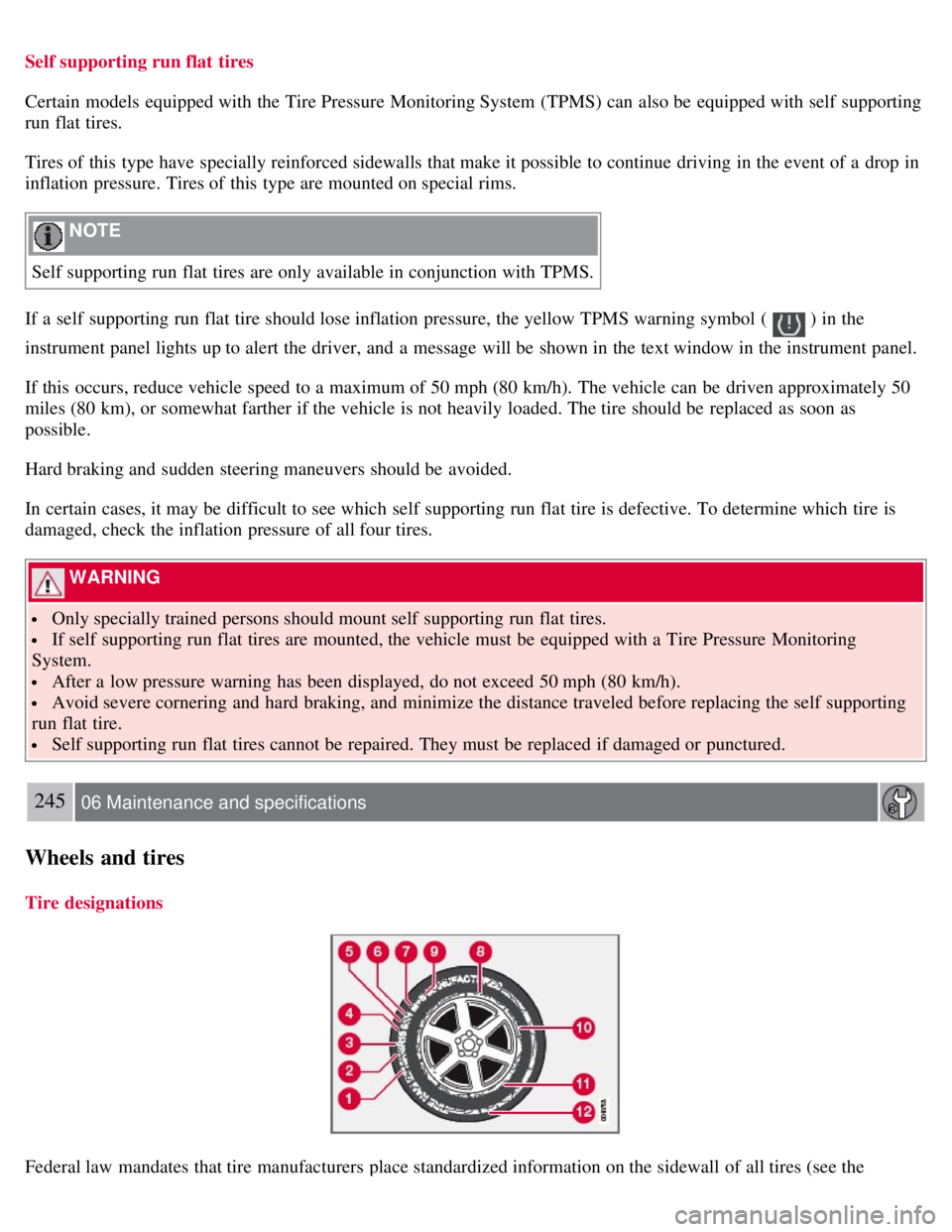
Federal law mandates that tire manufacturers place standardized information on the sidewall of all tires (see the
Page 269 of 275
Infant seats36-37
Inflatable curtain27
Inflation pressure237-238
Inflation pressure tables240-241
Information lights74-77
Information symbol76
Inspection readiness210
Instrument lighting89
Instrument overview72-74
Instrument panel124-125
Integrated booster cushion45-47
Interior Air Quality System127, 131
Interior lighting93-94
ISOFIX anchors42
J
Jack
attaching 254
location of253
Jump starting 109
K
Key blade52
, 57-58
valet locking58
Keyless drive
location of antennas (pacemaker warning) 62
locking and unlocking the vehicle60- 61
starting the engine108
L
Labels
list of 268
location of267
Lane Departure Warning 174
LATCH anchors42
Leather care264
Lighting panel89
Load anchoring eyelets198
Loading the vehicle198-199, 247
roof loads200
Locking
automatic 63
from the inside63
from the outside63
glove compartment64
trunk64
Locking the vehicle 54
Page 270 of 275
Locks, child safety48
Long loads, ski hatch199
Low beams89
Low fuel level warning light76
Low oil pressure warning light76
M
Main instrument panel124-125
Maintenance208
performed by the owner209
Malfunction indicator light 75
Manual parking brake115
Menu system122
overview123
Messages in the instrument panel 124-125
Mirrors
defroster 100
power door99
rearview, auto-dim function100
retractable99
vanity185
Moonroof 101-102
Motor oil
checking 210
specifications272
volumes274
O
Occupant safety 14
Occupant weight sensor22-24
Octane ratings193
Octane recommendations193
Odometer, trip78
Oil
checking 212
low pressure warning light76
specifications272
volumes274
On Call Roadside Assistance 277
Opening the trunk from the inside65
Overhead courtesy lighting93-94
Overheating, engine77
Oxygen sensors, heated197
P
Pacemaker (keyless drive warning)62
Paint, touching up266