oil VOLVO S80 2008 Owner's Manual
[x] Cancel search | Manufacturer: VOLVO, Model Year: 2008, Model line: S80, Model: VOLVO S80 2008Pages: 275, PDF Size: 7.17 MB
Page 228 of 275
2 0 0 8
VOLVO S80
235 06 Maintenance and specifications
Wheels and tires
Introduction
Your vehicle is equipped with tires according to the vehicle's tire information placard on the B-pillar (the structural
member at the side of the vehicle, at the rear of the driver's door opening).
The tires have good road holding characteristics and offer good handling on dry and wet surfaces. It should be noted
however that the tires have been developed to give these features on snow/ice-free surfaces.
Certain models are equipped with "all-season" tires, which provide a somewhat higher degree of road holding on
slippery surfaces than tires without the "all-season" rating. However, for optimum road holding on icy or snow-
covered roads, we recommend suitable winter tires on all four wheels.
When replacing tires, be sure that the new tires are the same size designation, type (radial) and preferably from the
same manufacturer, on all four wheels. Otherwise there is a risk of altering the car's roadholding and handling
characteristics.
Storing wheels and tires
When storing complete wheels (tires mounted on rims), they should be suspended off the floor or placed on their sides
on the floor.
Tires not mounted on rims should be stored on their sides or standing upright, but should not be suspended.
CAUTION
Tires should preferably be stored in a cool, dry, dark place, and should never be stored in close proximity to
solvents, gasoline, oils, etc.
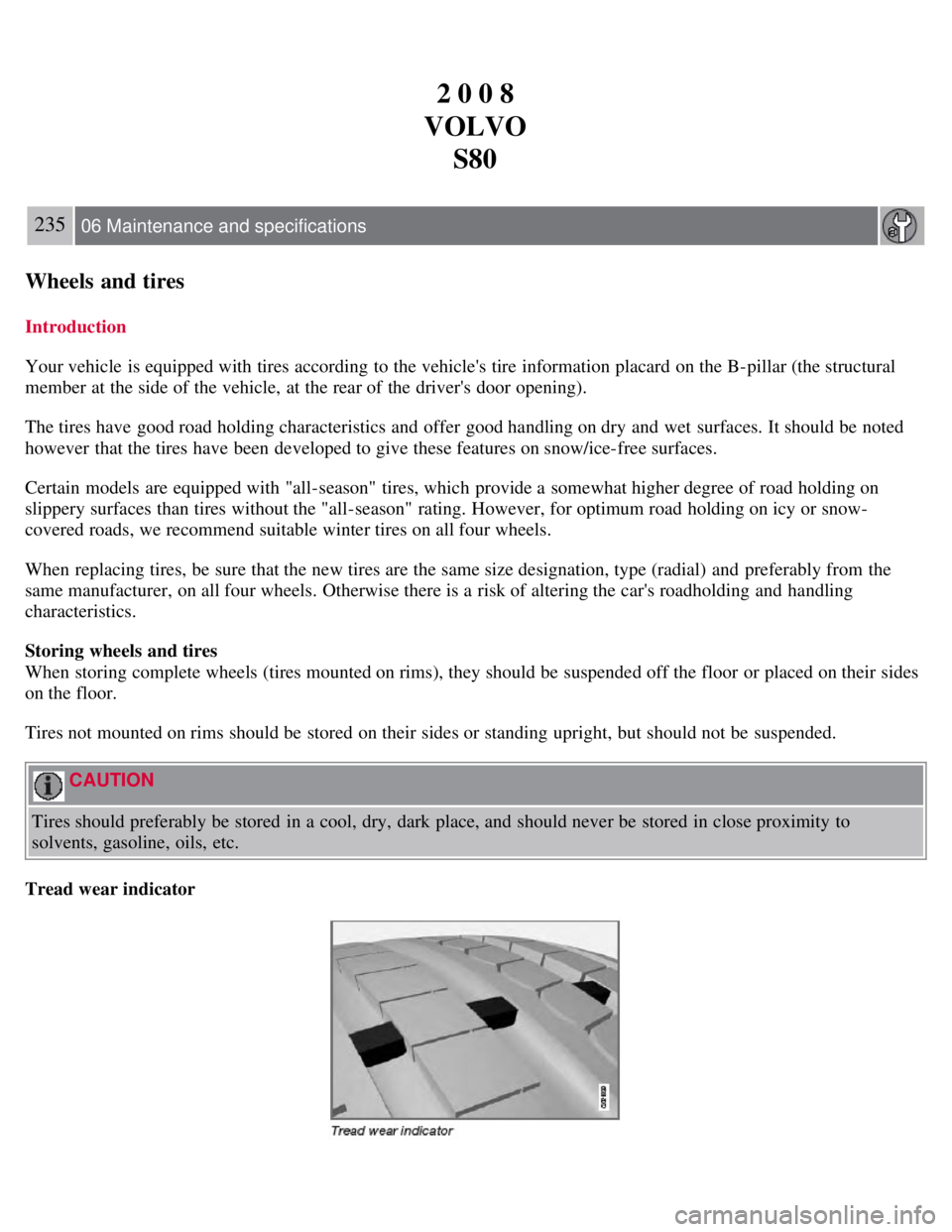
Tread wear indicator
Page 252 of 275
Replacing the sealing compound container
The sealing compound container must be replaced if:
the tire sealing system has been used to repair a tire
the container's expiration date has passed (see the date on decal).
NOTE
After use, the sealing compound bottle, the hose, and certain other system components must be replaced. Please
consult your Volvo retailer for replacement parts.
If the sealing compound bottle's expiration date has passed, please take it to a Volvo retailer or a recycling station
that can properly dispose of harmful substances.
262 06 Maintenance and specifications
Vehicle care
Washing the car
WARNING
Be sure that the compressor is not connected to a 12-volt socket while replacing the container.
The following points should be kept in mind when washing and cleaning the car:
The car should be washed at regular intervals since dirt, dust, insects and tar spots adhere to the paint and may cause
damage. To help prevent corrosion, it is particularly important to wash the car frequently in the wintertime.
Avoid washing your car in direct sunlight. Doing so may cause detergents and wax to dry out and become abrasive.
To avoid scratching, use lukewarm water to soften the dirt before you wash with a soft sponge, and plenty of sudsy
water.
Bird droppings : Remove from paintwork as soon as possible. Otherwise the finish may be permanently damaged.
A detergent can be used to facilitate the softening of dirt and oil.
A water-soluble grease solvent may be used in cases of sticky dirt. However, use a wash place equipped with a
drainage separator.
Dry the car with a clean chamois and remember to clean the drain holes in the doors and rocker panels.
Tar spots can be removed with kerosene or tar remover after the car has been washed.
A stiff-bristle brush and lukewarm soapy water can be used to clean the wiper blades. Frequent cleaning of the
windshield and wiper blades improves visibility considerably and also helps prolong the service life of the wiper
blades.
Wash off the dirt from the underside (wheel housings, fenders, etc).
In areas of high industrial fallout, more frequent washing is recommended.
After cleaning the engine, the spark plug wells should be inspected for water and blown dry if necessary.
NOTE
When washing the car, remember to remove dirt from the drain holes in the doors and sills.
CAUTION
During high pressure washing, the spray mouthpiece must never be closer to the vehicle than 13" (30 cm). Do not
spray into the locks.
Page 254 of 275
the lights have been on for a short time.
264 06 Maintenance and specifications
Vehicle care
Polishing and waxing
Normally, polishing is not required during the first year after delivery, however, waxing may be beneficial.
Before applying polish or wax the vehicle must be washed and dried. Tar spots can be removed with kerosene or tar
remover. Difficult spots may require a fine rubbing compound.
After polishing use liquid or paste wax.
Several commercially available products contain both polish and wax.
Waxing alone does not substitute for polishing a dull surface.
A wide range of polymer-based waxes can be purchased today. These waxes are easy to use and produce a long-
lasting, high-gloss finish that protects the bodywork against oxidation, road dirt and fading.
Do not polish or wax your vehicle in direct sunlight (the surface of the vehicle should not be warmer than 113° F
(45° C).
CAUTION
Volvo does not recommend the use of long-life or durable paint protection coatings, some of which may claim to
prevent pitting, fading, oxidation, etc. These coatings have not been tested by Volvo for compatibility with your
vehicle's clear coat. Some of them may cause the clear coat to soften, crack, or cloud. Damage caused by application
of paint protection coatings may not be covered under your vehicle's paint warranty.
Cleaning the interior
Only use cleaning agents and car care products recommended by Volvo. Clean regularly and follow the instructions
included with the car care product.
Upholstery care
Fabric
Clean with soapy water or a detergent. For more difficult spots caused by oil, ice cream, shoe polish, grease, etc., use a
clothing/fabric stain remover. Consult your Volvo retailer.
Alcantera™ suede-like material
Suede -like upholstery can be cleaned with a soft cloth and mild soap solution.
Leather care
Volvo's leather upholstery is manufactured with a protectant to repel soiling. Over time, sunlight, grease and dirt can
break down the protection. Staining, cracking, scuffing, and fading can result.
Volvo offers an easy-to-use, non-greasy leather care kit formulated to clean and beautify your vehicle's leather, and to
renew the protective qualities of its finish. The cleaner removes dirt and oil buildup. The light cream protectant
restores a barrier against soil and sunlight.
265 06 Maintenance and specifications
Vehicle care
Page 259 of 275
271 06 Maintenance and specifications
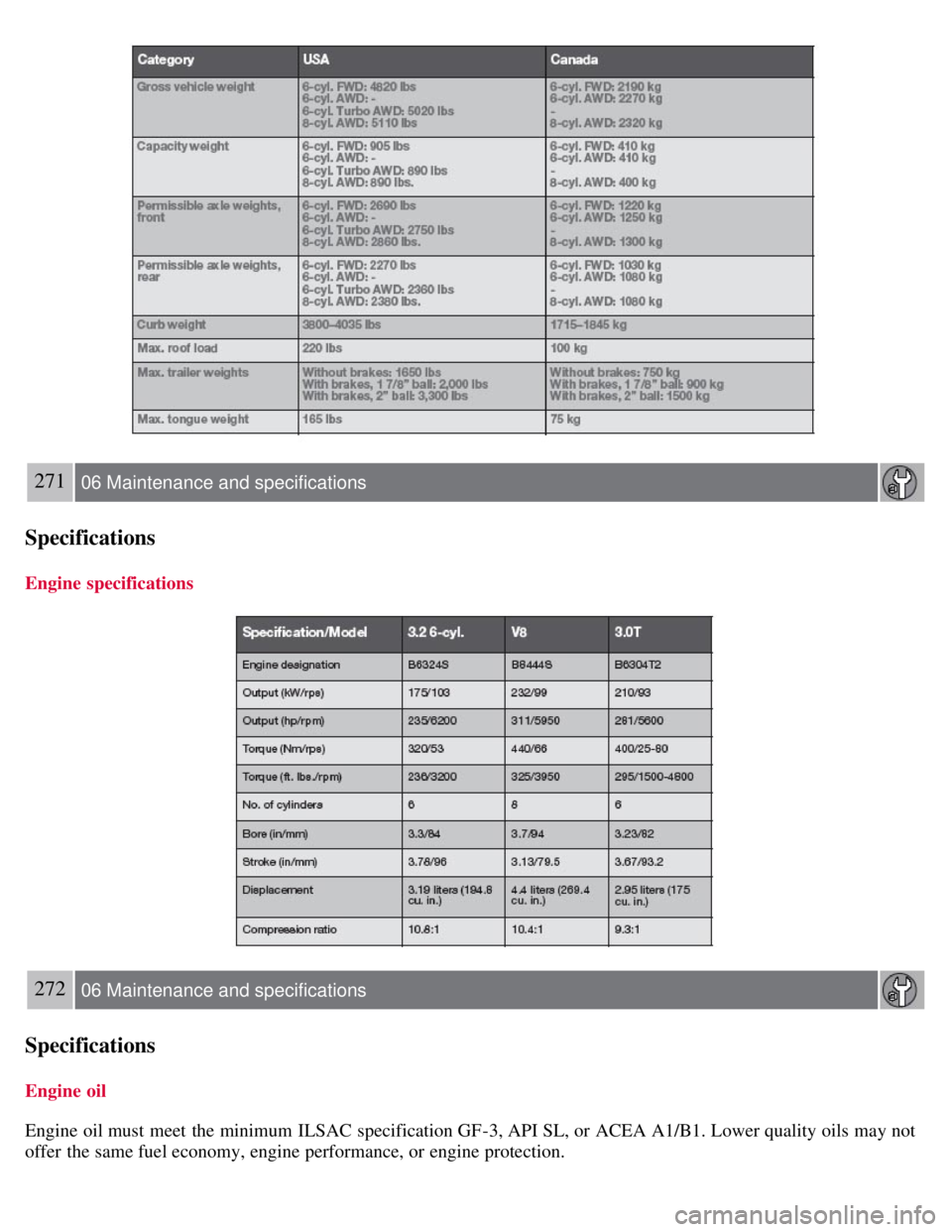
Specifications
Engine specifications
272 06 Maintenance and specifications
Specifications
Engine oil
Engine oil must meet the minimum ILSAC specification GF-3, API SL, or ACEA A1/B1. Lower quality oils may not
offer the same fuel economy, engine performance, or engine protection.
Page 260 of 275
Volvo recommends Castrol oil products.
Depending on your driving habits, premium or synthetic oils may provide superior fuel economy and engine
protection. Consult your Volvo retailer for recommendations on premium or synthetic oils.
Oil additives must not be used.
Synthetic oil is not used when the oil is changed at the normal maintenance services. This oil is only used at customer
request, at additional charge. Please consult your Volvo retailer.
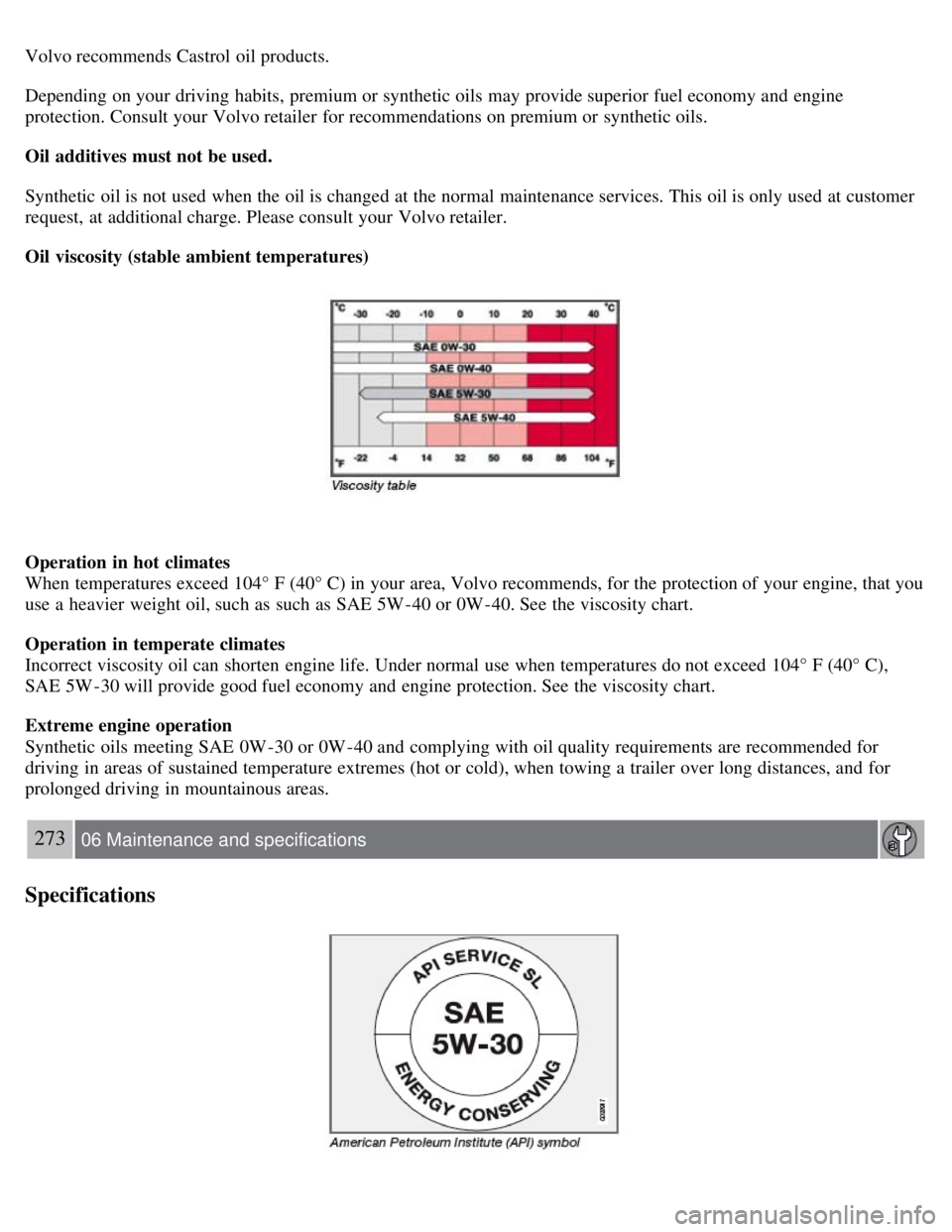
Oil viscosity (stable ambient temperatures)
Operation in hot climates
When temperatures exceed 104° F (40° C) in your area, Volvo recommends, for the protection of your engine, that you
use a heavier weight oil, such as such as SAE 5W -40 or 0W -40. See the viscosity chart.
Operation in temperate climates
Incorrect viscosity oil can shorten engine life. Under normal use when temperatures do not exceed 104° F (40° C),
SAE 5W -30 will provide good fuel economy and engine protection. See the viscosity chart.
Extreme engine operation
Synthetic oils meeting SAE 0W -30 or 0W -40 and complying with oil quality requirements are recommended for
driving in areas of sustained temperature extremes (hot or cold), when towing a trailer over long distances, and for
prolonged driving in mountainous areas.
273 06 Maintenance and specifications
Specifications
Page 261 of 275
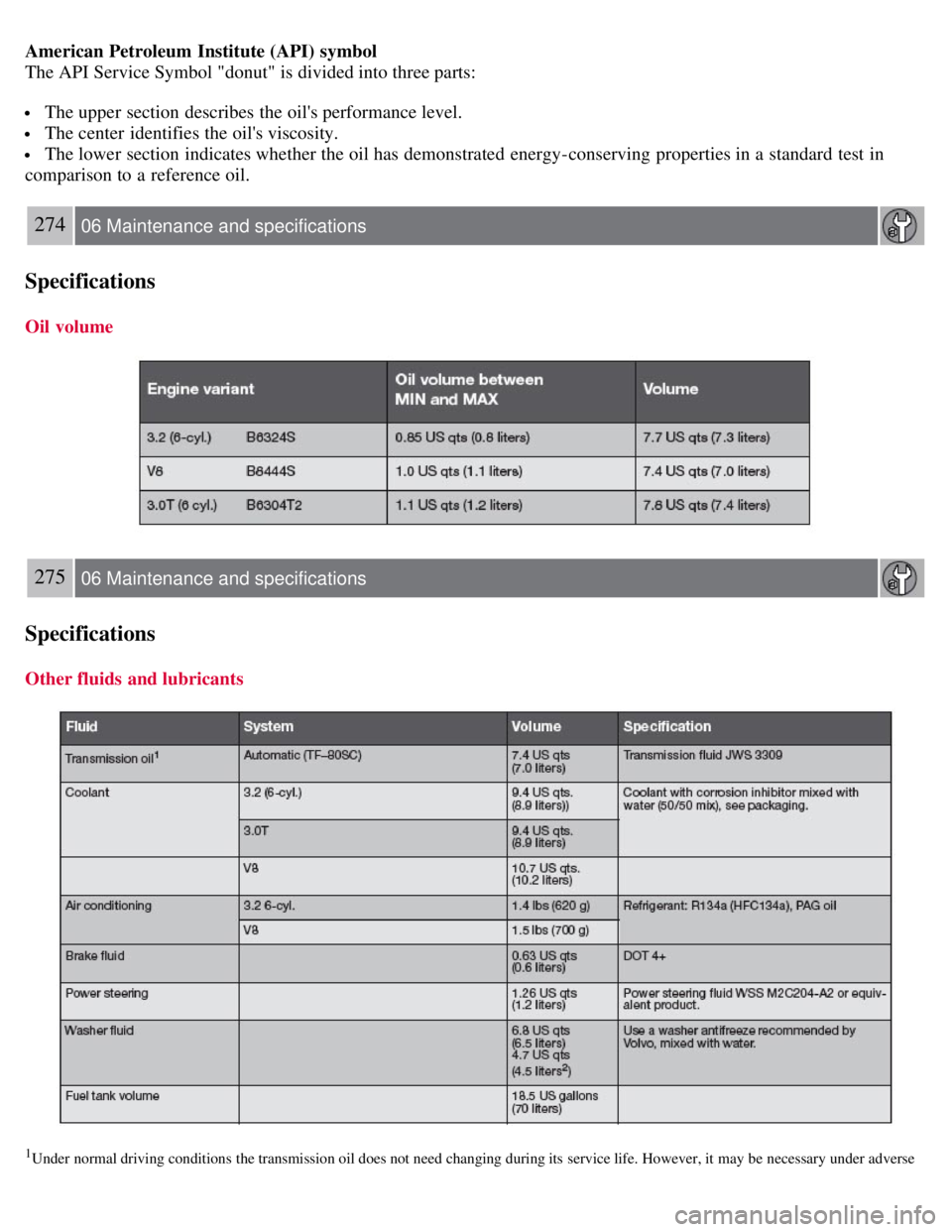
American Petroleum Institute (API) symbol
The API Service Symbol "donut" is divided into three parts:
The upper section describes the oil's performance level.
The center identifies the oil's viscosity.
The lower section indicates whether the oil has demonstrated energy-conserving properties in a standard test in
comparison to a reference oil.
274 06 Maintenance and specifications
Specifications
Oil volume
275 06 Maintenance and specifications
Specifications
Other fluids and lubricants
1Under normal driving conditions the transmission oil does not need changing during its service life. However, it may be necessary under adverse
Page 265 of 275
Geartronic110-111
general description110- 111
oil275
shiftlock override111
Axle weight 247
B
Battery
changing 227-228
maintenance227
remote control, replacing59
specifications276
warning symbols226
Black box 6, 208
Blind Spot Information System(BLIS)179-181
Booster cushion, integrated45-47
Booster cushions41
Brake lights91
emergency brake lights91
Brake support 166
Brake system
checking fluid level 215
emergency brake assistance114
fluid275
general information113
warning light77
Bulbs
footwell lighting 222
headlights216- 218
introduction216
license plate lights221
side marker lights219
specifications223
taillight219- 221
trunk lighting222
C
Capacity weight 247
Catalytic converter196
CD player/changer138-139
Central locking system, introduction52
Chains250
Check engine light75
Child restraint systems34-35
booster cushions41
convertible seats38- 40
Page 267 of 275
Driving through water189
E
ECC128-133
Economical driving188
Electric parking brake116
Electronic Climate Control128-131
air distribution table133
Interior Air Quality System131
ventilated seats129
Emergency brake lights 91
Emergency locking retractor33
Emergency starting109
Emergency towing204-205
Emission inspection readiness210
Engine
overheating 77
specifications271
starting107
starting with keyless drive108
Engine compartment overview 211
Engine oil
checking 212
low pressure warning light76
specifications272
volumes274
Environment 9
Eyelets for anchoring loads198
F
Federal Clean Air Act208
Flat tires
tire sealing system 256
Fluid specifications 275
Fog lights
front 76
front, changing bulbs219
front/rear91
Four C (active chassis system) 153
Front airbags19-21
disconnecting passenger's side airbag22- 24
Front fog lights76, 91
changing bulbs219
Front park assist 176-178
Front seats84
heated129
Page 270 of 275
Locks, child safety48
Long loads, ski hatch199
Low beams89
Low fuel level warning light76
Low oil pressure warning light76
M
Main instrument panel124-125
Maintenance208
performed by the owner209
Malfunction indicator light 75
Manual parking brake115
Menu system122
overview123
Messages in the instrument panel 124-125
Mirrors
defroster 100
power door99
rearview, auto-dim function100
retractable99
vanity185
Moonroof 101-102
Motor oil
checking 210
specifications272
volumes274
O
Occupant safety 14
Occupant weight sensor22-24
Octane ratings193
Octane recommendations193
Odometer, trip78
Oil
checking 212
low pressure warning light76
specifications272
volumes274
On Call Roadside Assistance 277
Opening the trunk from the inside65
Overhead courtesy lighting93-94
Overheating, engine77
Oxygen sensors, heated197
P
Pacemaker (keyless drive warning)62
Paint, touching up266
Page 274 of 275
uniform tire quality grading249
Top tether anchors (child restraint systems)43
Touching up paint266
Towing a trailer201-202
trailer hitch203
Towing the vehicle 204, 205
Traction control151
Trailer towing201-203
trailer hitch203
Transmission
Geartronic 110
general description110- 111
oil275
shiftlock override111
Tread wear indicator 235
Trip computer147
Trip odometers78
Trips, long distance189
Trunk
changing bulbs 222
driving with it open188
locking/unlocking64
opening from the inside65
Turn signals
changing bulbs 218
indicator lights76
using92
U
Uniform Tire Quality Grading 249
Unlocking the trunk55
Unlocking the vehicle54
Upholstery care264
V
Valet locking58
Vanity mirror185
changing bulbs222
Vehicle dimensions 269
Vehicle event data6, 208
Vehicle loading198-199, 247
roof loads200
Vehicle maintenance 208
performed by the owner209
Vehicle weights 270
Ventilated seats129