fog light VOLVO S80 2013 Owner´s Manual
[x] Cancel search | Manufacturer: VOLVO, Model Year: 2013, Model line: S80, Model: VOLVO S80 2013Pages: 372, PDF Size: 6.45 MB
Page 179 of 372
04 Driver support
Blind Spot Information System*
04
* Option/accessory, for more information, see Introduction.177 When does BLIS function
The system functions when your vehicle is
moving at speeds above 6 mph (10 km/h).
When you pass another vehicle:The system reacts when you pass another
vehicle at a speed of up to 6 mph (10 km/h)
faster than that vehicle.
When you are passed by another vehicle:The system reacts if your vehicle is passed by
another vehicle at a speed of up to 43 mph
(70 km/h) faster than your vehicle.
WARNING
•BLIS does not function in sharp curves.
•BLIS does not function when your vehi-
cle is backing up.
•If you are towing a wide trailer, this may
prevent the BLIS cameras from detect-
ing other vehicles in adjacent lanes.
How BLIS functions in daylight and
darkness
Daylight
BLIS reacts to the shape of surrounding vehi-
cles. The system is designed to help detect
motor vehicles such as cars, trucks, buses,
motorcycles, etc.
DarknessBLIS reacts to the headlights of surrounding
vehicles. In order to be detected by BLIS, a
vehicle in the blind area must have its head-
lights on. This means, for example, that the
system will not detect a trailer without head-
lights that is being towed behind a car or truck.
WARNING
•BLIS does not react to cyclists or
mopeds.
•BLIS does not react to vehicles that are
standing still.
•The BLIS cameras have the same limi-
tation as the human eye. In other words,
their "vision is impaired" by adverse
weather conditions such as heavy
snowfall, intense light directly into the
camera, dense fog, etc.
LimitationsIn certain situations, the BLIS indicator light(s)
may illuminate even when there are no other
vehicles in the area monitored by the system.
NOTE
If the BLIS indicator lights illuminate occa-
sionally even when there are no other vehi-
cles in the blind area, this does not indicate
a fault in the system.
In the event of a fault,
Blind spot syst.
Service required will be displayed.
The following are several examples of situa-
tions in which the BLIS indicator light(s) may
illuminate even when there are no other vehi-
cles in the area monitored by the system.
Light reflected from a wet road surface
Page 193 of 372
05 Comfort and driving pleasure
Climate system
05
* Option/accessory, for more information, see Introduction.191 Introduction
Air conditioningThe vehicle is equipped with Electronic Climate
Control (ECC). The climate control system
cools, heats or dehumidifies the air in the pas-
senger compartment.
NOTE
•The air conditioning can be switched
off, but to ensure the best possible cli-
mate comfort in the passenger com-
partment and to prevent the windows
from misting, it should always be on.
•In warm weather, a small amount of
water may accumulate under the car
when it has been parked. This water is
condensation from the A/C system and
is normal.
Sensor location
•The sunlight sensor is located on the top
side of the dashboard.
NOTE
The sunlight sensor monitors which side of
the car that is most exposed to sunlight.
This can mean that the temperature may
differ between the right and left-side air
vents, even if the temperatures set for both
sides of the passenger compartment are the
same.
•The temperature sensor for the passenger
compartment is located below the climate
control panel.
•The outside (ambient) temperature sensor
is located on the door mirror.
•The humidity sensor* is located in the inte-
rior rearview mirror.
NOTE
Do not cover or block the sensors with
clothing or other objects.
Side windows and moonroofTo ensure that the air conditioning works opti-
mally, the side windows, and the optional
moonroof should be closed.
Fog on the inside of the windowsThe defroster function should be used to
remove fog or mist from the inside of the win-
dows. Keeping the windows clean with a com-mercially available window washing spray will
also help prevent fogging or misting.
Vents in the parcel shelf
NOTE
The air vents at the rear of the parcel shelf
should never be obstructed.
Temporary shut-off of the air
conditioning
The air conditioning is momentarily disen-
gaged during full-throttle acceleration or when
driving uphill with a trailer. This may result in a
temporary increase in cabin temperature.
Ice and snowAlways keep the air intake grille at the base of
the windshield free of snow.
Climate system maintenanceSpecial tools and equipment are required to
maintain and carry out repairs on the climate
system. Work of this type should only be done
by a trained and qualified Volvo service tech-
nician.
RefrigerantVolvo cares about the environment. The air
conditioning system in your car contains a
CFC-free refrigerant – R134a. This substance
will not deplete the ozone layer. The air condi-
Page 197 of 372
05 Comfort and driving pleasure
Climate system
05
* Option/accessory, for more information, see Introduction.195
The ventilation can be used at the same time
as seat heating.
The ventilation system can be activated when
the engine is running. There are three comfort
levels that produce different cooling and dehu-
midifying effects:
•Level three: press the button once for
maximum output – three indicator lights
come on.
•Level two: press the button twice for a
lower output – two indicator lights come
on.
•Level one: press the button three times for
the lowest output – one indicator light
comes on.
•Press the button a fourth time to switch off
the function – the indicator light will go out.
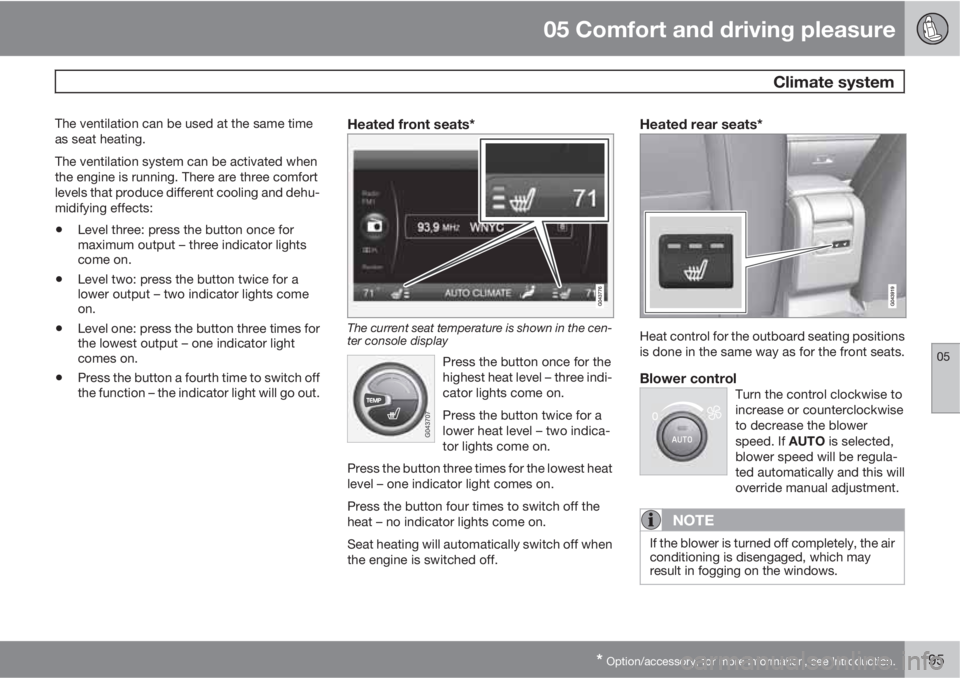
Heated front seats*
The current seat temperature is shown in the cen-
ter console display
Press the button once for the
highest heat level – three indi-
cator lights come on.
Press the button twice for a
lower heat level – two indica-
tor lights come on.
Press the button three times for the lowest heat
level – one indicator light comes on.
Press the button four times to switch off the
heat – no indicator lights come on.
Seat heating will automatically switch off when
the engine is switched off.
Heated rear seats*
Heat control for the outboard seating positions
is done in the same way as for the front seats.
Blower controlTurn the control clockwise to
increase or counterclockwise
to decrease the blower
speed. If AUTO is selected,
blower speed will be regula-
ted automatically and this will
override manual adjustment.
NOTE
If the blower is turned off completely, the air
conditioning is disengaged, which may
result in fogging on the windows.
Page 199 of 372
05 Comfort and driving pleasure
Climate system
05
* Option/accessory, for more information, see Introduction.197
A/C – ON/OFFWhen the indicator light in the
button is on, the air condition-
ing is controlled automati-
cally. This cools/heats and
dehumidifies the incoming air.
When the indicator light in the
button is off, the air condition-
ing is disengaged. Other functions are still con-
trolled automatically. When maximum
defroster is selected, the air conditioning sys-
tem is set for maximum blower speed and
dehumidification.
DefrosterThis function defrosts/de-ices
the windshield and front side
windows. The indicator light
in the defroster button lights
when the function is active.
•Blower speed increases automatically and
the air conditioning will switch on (if not
already on and if the passenger compart-
ment blower is not turned off) to dehumid-
ify the air in the passenger compartment.
Air conditioning can be switched off by
pressing the AC button.
•Recirculation will not function while defrost
is engaged.The climate system will return to its previous
settings when the defroster function is
switched off.
Recirculation/air quality system
Recirculation
This function can be used to
shut out exhaust fumes,
smoke, etc., from the passen-
ger compartment. The air in
the passenger compartment
is then recirculated, i.e., no air
from outside the car is taken
into the car when this function is activated. The
indicator light in the button will illuminate when
recirculation is selected.
If the air in the car recirculates for too long,
there is a risk of condensation forming on the
insides of the windows, especially in winter.
TimerThe timer function minimizes the risk of fog-
ging, or stale air when the recirculation function
is selected by automatically switching off the
function after a certain length of time, depend-
ing on the ambient temperature. Activate/
deactivate the function under Climate
settings
Recirculation timer. See page
185 for a description of the menu system.
NOTE
When Defroster is selected, recirculation is
always deactivated.
Interior Air Quality System–IAQS*This system consists of a multifilter and an air
quality sensor. The filter helps remove gases
and particles from the incoming air, thereby
reducing the amounts of odors and contami-
nants entering the vehicle. The air quality sen-
sor detects increased levels of contaminants in
the outside air. When the air quality sensor
detects contaminated outside air, the air intake
closes and the air inside the passenger com-
partment is recirculated, i.e., no outside air
enters the vehicle. The filter also cleans recir-
culated passenger compartment air. When the
AUTO button is depressed the air quality sen-
sor is always engaged.
Activate or deactivate this function in Climate
settings
Interior air quality system.
Page 326 of 372
09 Maintenance and specifications
Replacing bulbs 09
324
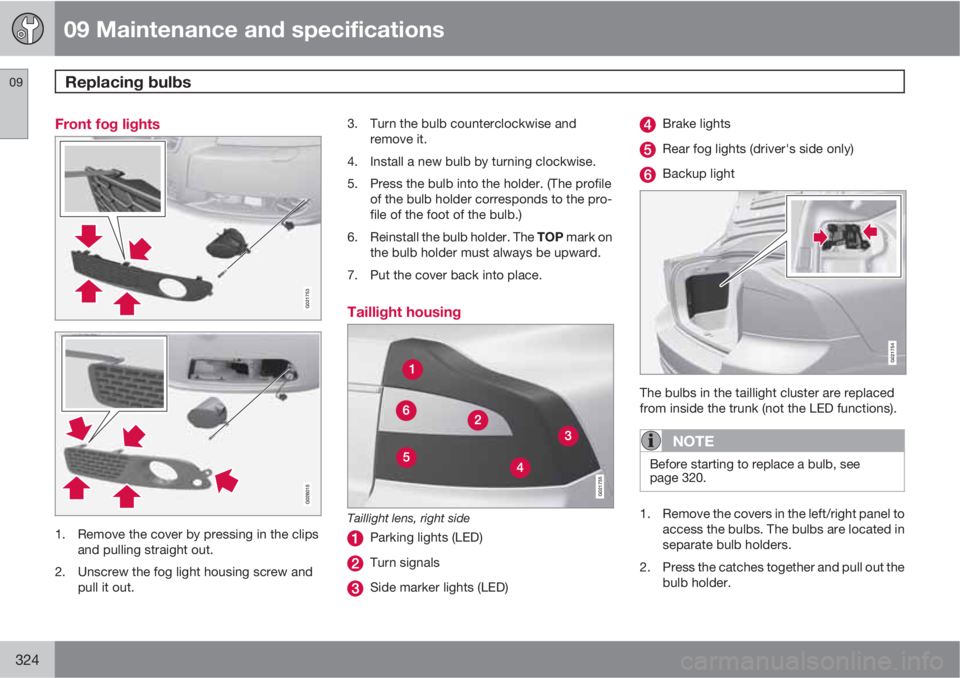
Front fog lights
G021753
1. Remove the cover by pressing in the clips
and pulling straight out.
2. Unscrew the fog light housing screw and
pull it out.3. Turn the bulb counterclockwise and
remove it.
4. Install a new bulb by turning clockwise.
5. Press the bulb into the holder. (The profile
of the bulb holder corresponds to the pro-
file of the foot of the bulb.)
6.
Reinstall the bulb holder. The TOP mark on
the bulb holder must always be upward.
7. Put the cover back into place.
Taillight housing
G021755
Taillight lens, right side
Parking lights (LED)
Turn signals
Side marker lights (LED)
Brake lights
Rear fog lights (driver's side only)
Backup light
G021754
The bulbs in the taillight cluster are replaced
from inside the trunk (not the LED functions).
NOTE
Before starting to replace a bulb, see
page 320.
1. Remove the covers in the left/right panel to
access the bulbs. The bulbs are located in
separate bulb holders.
2. Press the catches together and pull out the
bulb holder.
Page 328 of 372
09 Maintenance and specifications
Replacing bulbs 09
326* Option/accessory, for more information, see Introduction.
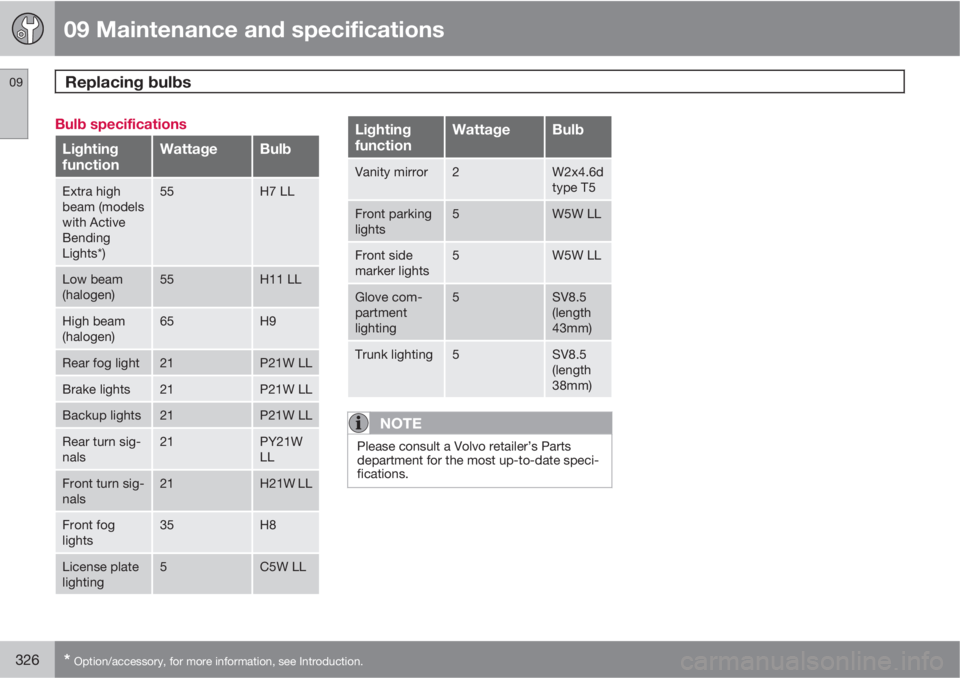
Bulb specifications
Lighting
functionWattageBulb
Extra high
beam (models
with Active
Bending
Lights*)55H7 LL
Low beam
(halogen)55H11 LL
High beam
(halogen)65H9
Rear fog light21P21W LL
Brake lights21P21W LL
Backup lights21P21W LL
Rear turn sig-
nals21PY21W
LL
Front turn sig-
nals21H21W LL
Front fog
lights35H8
License plate
lighting5C5W LL
Lighting
functionWattageBulb
Vanity mirror2W2x4.6d
type T5
Front parking
lights5W5W LL
Front side
marker lights5W5W LL
Glove com-
partment
lighting5SV8.5
(length
43mm)
Trunk lighting5SV8.5
(length
38mm)
NOTE
Please consult a Volvo retailer’s Parts
department for the most up-to-date speci-
fications.
Page 343 of 372
09 Maintenance and specifications
Vehicle care09
341
not have facilities for washing the under-
body.
CAUTION
•Before driving into an automatic car
wash, turn off the optional rain sensor to
avoid damaging the windshield wipers.
•Make sure that side view mirrors, auxil-
iary lamps, etc, are secure, and that any
antenna(s) are retracted or removed.
Otherwise there is risk of the machine
dislodging them.
•Chromed wheels: Clean chrome-
plated wheels using the same deter-
gents used for the body of the vehicle.
Aggressive wheel-cleaning agents can
permanently stain chrome-plated
wheels.
WARNING
•When the vehicle is driven immediately
after being washed, apply the brakes,
including the parking brake, several
times in order to remove any moisture
from the brake linings.
•Engine cleaning agents should not be
used when the engine is warm. This
constitutes a fire risk.
Exterior lightingCondensation may form temporarily on the
inside of the lenses of exterior lights such as
headlights, fog lights, or taillights. This is nor-
mal and the lights are designed to withstand
moisture. Normally, condensation will dissi-
pate after the lights have been on for a short
time.
Polishing and waxing
•Normally, polishing is not required during
the first year after delivery, however, wax-
ing may be beneficial.
•Before applying polish or wax the vehicle
must be washed and dried. Tar spots can
be removed with kerosene or tar remover.
Difficult spots may require a fine rubbing
compound.
•After polishing use liquid or paste wax.
•Several commercially available products
contain both polish and wax.
•Waxing alone does not substitute for pol-
ishing a dull surface.
•A wide range of polymer-based waxes can
be purchased today. These waxes are easy
to use and produce a long-lasting, high-
gloss finish that protects the bodywork
against oxidation, road dirt and fading.
•Do not polish or wax your vehicle in direct
sunlight (the surface of the vehicle should
not be warmer than 113 °F (45 °C).
CAUTION
Volvo does not recommend the use of long-
life or durable paint protection coatings,
some of which may claim to prevent pitting,
fading, oxidation, etc. These coatings have
not been tested by Volvo for compatibility
with your vehicle's clear coat. Some of them
may cause the clear coat to soften, crack,
or cloud. Damage caused by application of
paint protection coatings may not be cov-
ered under your vehicle's paint warranty.
Cleaning the interior
Only use cleaning agents and car care prod-
ucts recommended by Volvo. Clean regularly
and follow the instructions included with the
car care product.
Upholstery care
Fabric
Clean with soapy water or a detergent. For
more difficult spots caused by oil, ice cream,
shoe polish, grease, etc., use a clothing/fabric
stain remover. Consult your Volvo retailer.
AlcanteraTM suede-like materialSuede-like upholstery can be cleaned with a
soft cloth and mild soap solution.
Page 358 of 372
10 Specifications
Overview of information and warning symbols
10
356* Option/accessory, for more information, see Introduction.
Introduction
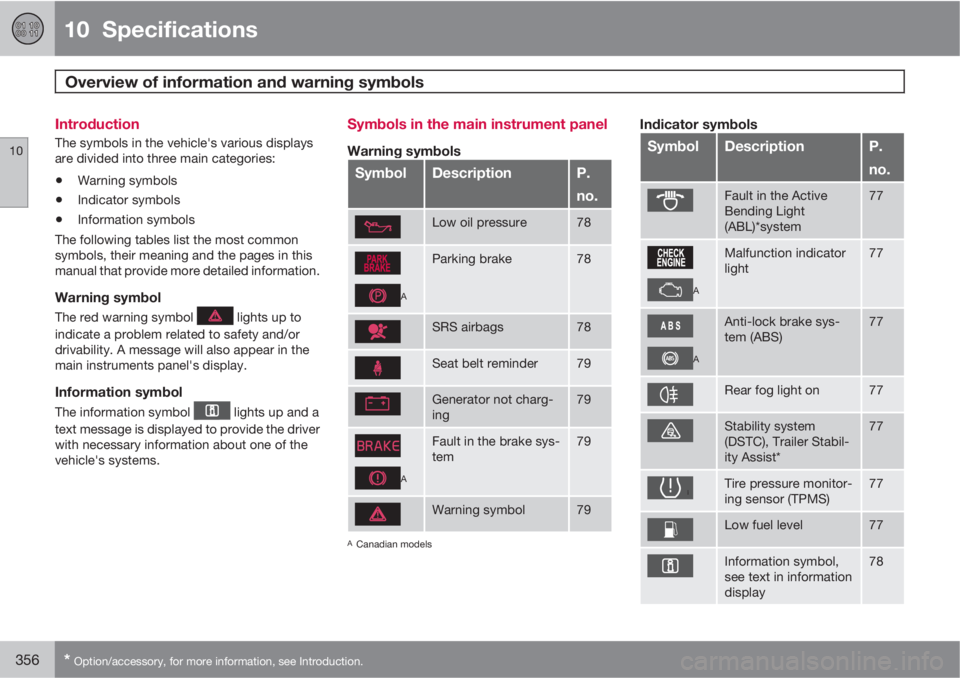
The symbols in the vehicle's various displays
are divided into three main categories:
•Warning symbols
•Indicator symbols
•Information symbols
The following tables list the most common
symbols, their meaning and the pages in this
manual that provide more detailed information.
Warning symbol
The red warning symbol lights up to
indicate a problem related to safety and/or
drivability. A message will also appear in the
main instruments panel's display.
Information symbol
The information symbol lights up and a
text message is displayed to provide the driver
with necessary information about one of the
vehicle's systems.
Symbols in the main instrument panel
Warning symbols
SymbolDescriptionP.
no.
Low oil pressure78
A
Parking brake78
SRS airbags78
Seat belt reminder79
Generator not charg-
ing79
A
Fault in the brake sys-
tem79
Warning symbol79
ACanadian models
Indicator symbols
SymbolDescriptionP.
no.
Fault in the Active
Bending Light
(ABL)*system77
A
Malfunction indicator
light77
A
Anti-lock brake sys-
tem (ABS)77
Rear fog light on77
Stability system
(DSTC), Trailer Stabil-
ity Assist*77
Tire pressure monitor-
ing sensor (TPMS)77
Low fuel level77
Information symbol,
see text in information
display78
Page 364 of 372
11 Index
11
362
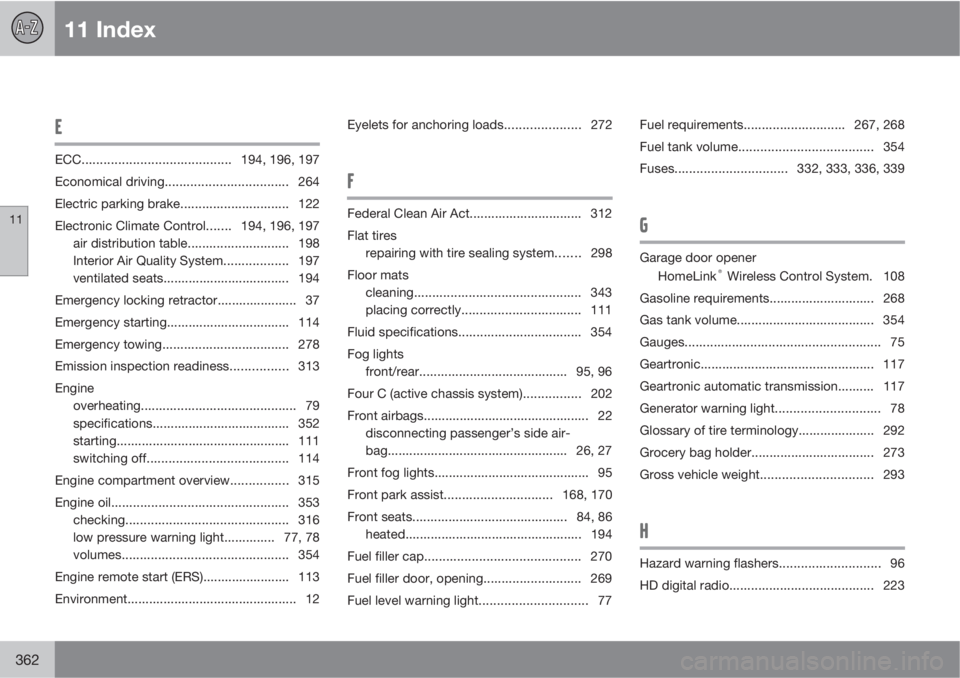
E
ECC.........................................194, 196, 197
Economical driving.................................. 264
Electric parking brake.............................. 122
Electronic Climate Control.......194, 196, 197
air distribution table............................ 198
Interior Air Quality System.................. 197
ventilated seats................................... 194
Emergency locking retractor...................... 37
Emergency starting.................................. 114
Emergency towing................................... 278
Emission inspection readiness................ 313
Engine
overheating........................................... 79
specifications...................................... 352
starting................................................ 111
switching off....................................... 114
Engine compartment overview................315
Engine oil................................................. 353
checking............................................. 316
low pressure warning light.............. 77, 78
volumes.............................................. 354
Engine remote start (ERS)........................ 113
Environment............................................... 12Eyelets for anchoring loads..................... 272
F
Federal Clean Air Act............................... 312
Flat tires
repairing with tire sealing system....... 298
Floor mats
cleaning.............................................. 343
placing correctly................................. 111
Fluid specifications.................................. 354
Fog lights
front/rear......................................... 95, 96
Four C (active chassis system)................202
Front airbags.............................................. 22
disconnecting passenger’s side air-
bag.................................................. 26, 27
Front fog lights........................................... 95
Front park assist..............................168, 170
Front seats...........................................84, 86
heated................................................. 194
Fuel filler cap........................................... 270
Fuel filler door, opening........................... 269
Fuel level warning light.............................. 77Fuel requirements............................ 267, 268
Fuel tank volume.....................................354
Fuses............................... 332, 333, 336, 339G
Garage door opener
HomeLink® Wireless Control System. 108
Gasoline requirements............................. 268
Gas tank volume...................................... 354
Gauges...................................................... 75
Geartronic................................................ 117
Geartronic automatic transmission.......... 117
Generator warning light............................. 78
Glossary of tire terminology..................... 292
Grocery bag holder.................................. 273
Gross vehicle weight...............................293
H
Hazard warning flashers............................ 96
HD digital radio........................................ 223
Page 367 of 372
11 Index
11
365
Parking lights............................................. 95
changing bulbs................................... 323
Personal Car Communicator, unique func-
tions........................................................... 56
Polishing.................................................. 341
Power front seat
memory function................................... 85
with keyless drive................................. 86
Power mirrors.......................................... 103
defroster............................................. 104
Power moonroof...................................... 106
Power steering
fluid..................................................... 319
speed-dependent............................... 202
Power steering fluid................................. 354
Power windows....................................... 101
laminated glass................................... 102
Pregnancy, using seat belts during........... 20
Private locking........................................... 60
PROPOSITION 65 WARNING. . 114, 331, 355R
Radio
SiriusXM
E satellite radio.................... 225
Radio functions........................................ 221
HD digital radio................................... 223
Rain sensor................................................ 99
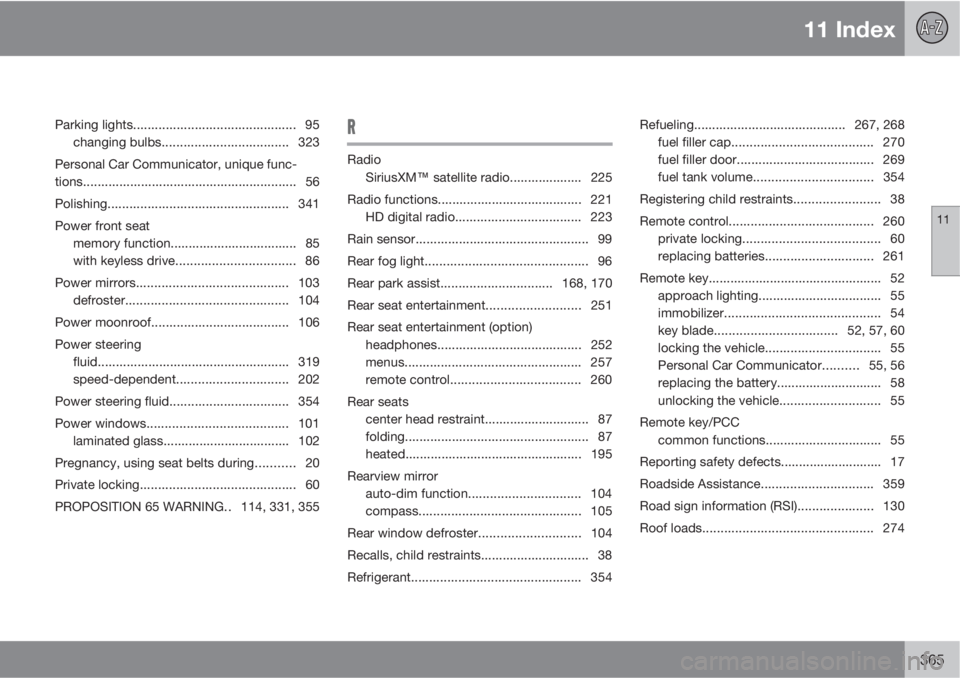
Rear fog light............................................. 96
Rear park assist............................... 168, 170
Rear seat entertainment..........................251
Rear seat entertainment (option)
headphones........................................252
menus................................................. 257
remote control.................................... 260
Rear seats
center head restraint............................. 87
folding................................................... 87
heated................................................. 195
Rearview mirror
auto-dim function............................... 104
compass............................................. 105
Rear window defroster............................104
Recalls, child restraints.............................. 38
Refrigerant............................................... 354Refueling..........................................267, 268
fuel filler cap....................................... 270
fuel filler door...................................... 269
fuel tank volume.................................354
Registering child restraints........................ 38
Remote control........................................ 260
private locking...................................... 60
replacing batteries.............................. 261
Remote key................................................ 52
approach lighting.................................. 55
immobilizer........................................... 54
key blade..................................52, 57, 60
locking the vehicle................................ 55
Personal Car Communicator..........55, 56
replacing the battery............................. 58
unlocking the vehicle............................ 55
Remote key/PCC
common functions................................ 55
Reporting safety defects............................ 17
Roadside Assistance............................... 359
Road sign information (RSI)..................... 130
Roof loads............................................... 274