ECU VOLVO S80 2013 Owner´s Manual
[x] Cancel search | Manufacturer: VOLVO, Model Year: 2013, Model line: S80, Model: VOLVO S80 2013Pages: 372, PDF Size: 6.45 MB
Page 275 of 372
07 During your trip
Loading
07
* Option/accessory, for more information, see Introduction.273
WARNING
•Cover sharp edges on long loads to help
prevent injury to occupants. Secure the
load to help prevent shifting during sud-
den stops.
•Always secure large and heavy objects
with a seat belt or cargo retaining
straps.
•Always secure the load to help prevent
it from moving in the event of sudden
stops.
•Switch off the engine, apply the parking
brake and put the gear selector in P
when loading and unloading the vehicle.
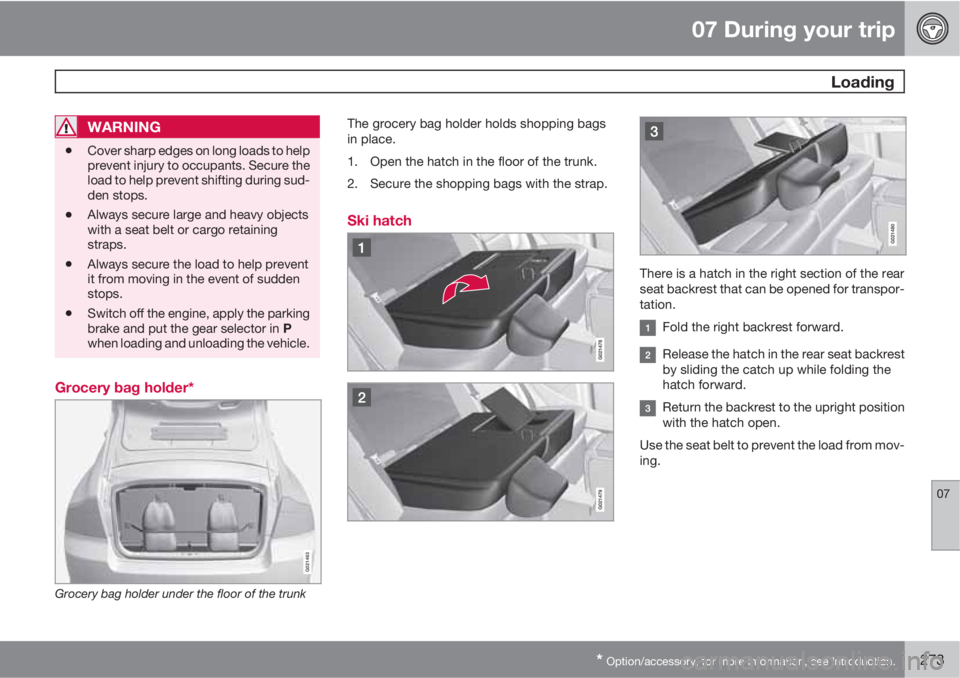
Grocery bag holder*
G021463
Grocery bag holder under the floor of the trunk
The grocery bag holder holds shopping bags
in place.
1. Open the hatch in the floor of the trunk.
2. Secure the shopping bags with the strap.
Ski hatch
There is a hatch in the right section of the rear
seat backrest that can be opened for transpor-
tation.
Fold the right backrest forward.
Release the hatch in the rear seat backrest
by sliding the catch up while folding the
hatch forward.
Return the backrest to the upright position
with the hatch open.
Use the seat belt to prevent the load from mov-
ing.
Page 276 of 372
07 During your trip
Loading
07
274
WARNING
•Always secure the load to help prevent
it from moving in the event of sudden
braking.
•Switch off the engine, apply the parking
brake and put the gear selector in P
when loading and unloading the vehicle.
The cover on the rear seat armrest/child seat
has no hinge. The cover must be removed
before the ski hatch is used.
Removal:
–Open the cover 30 degrees and lift straight
up.
Installation:
–Insert the cover in the grooves behind the
upholstery and close the cover.
Roof loads
Using load carriersLoad carriers are available as Volvo accesso-
ries. Observe the following points when in use:
•To avoid damaging your vehicle and to
achieve maximum safety when driving, we
recommend using the load carriers thatVolvo has developed especially for your
vehicle.
•Volvo-approved removable roof racks are
designed to carry the maximum allowable
roof load for this vehicle: 220 lbs (100 kg).
For non-Volvo roof racks, check the man-
ufacturer's weight limits for the rack.
•Never exceed the rack manufacturer's
weigh limits and never exceed the maxi-
mum rated roof load of 220 lbs (100 kg).
•Avoid single-point loads. Distribute loads
evenly.
•Place heavier cargo at the bottom of the
load.
•Secure the cargo correctly with appropri-
ate tie-down equipment.
•Check periodically that the load carriers
and load are properly secured.
•Remember that the vehicle's center of
gravity and handling change when you
carry a load on the roof.
•The vehicle's wind resistance and fuel con-
sumption will increase with the size of the
load.
•Drive smoothly. Avoid rapid starts, fast
cornering and hard braking.
Page 280 of 372
07 During your trip
Emergency towing
07
278
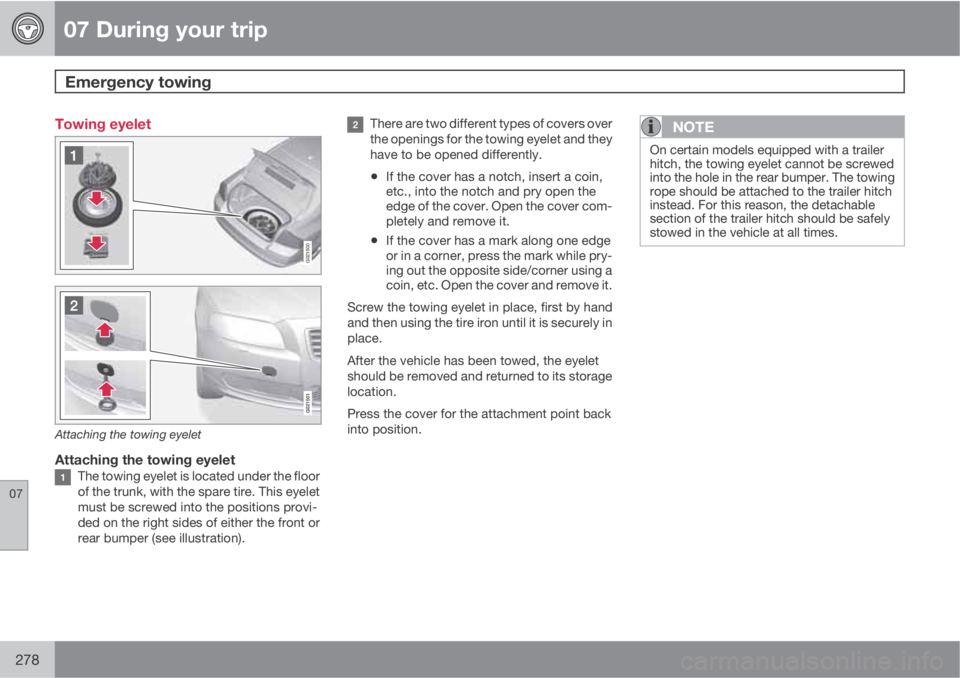
Towing eyelet
G021500
Attaching the towing eyelet
Attaching the towing eyeletThe towing eyelet is located under the floor
of the trunk, with the spare tire. This eyelet
must be screwed into the positions provi-
ded on the right sides of either the front or
rear bumper (see illustration).
There are two different types of covers over
the openings for the towing eyelet and they
have to be opened differently.
•If the cover has a notch, insert a coin,
etc., into the notch and pry open the
edge of the cover. Open the cover com-
pletely and remove it.
•If the cover has a mark along one edge
or in a corner, press the mark while pry-
ing out the opposite side/corner using a
coin, etc. Open the cover and remove it.
Screw the towing eyelet in place, first by hand
and then using the tire iron until it is securely in
place.
After the vehicle has been towed, the eyelet
should be removed and returned to its storage
location.
Press the cover for the attachment point back
into position.
NOTE
On certain models equipped with a trailer
hitch, the towing eyelet cannot be screwed
into the hole in the rear bumper. The towing
rope should be attached to the trailer hitch
instead. For this reason, the detachable
section of the trailer hitch should be safely
stowed in the vehicle at all times.
Page 282 of 372
07 During your trip
Emergency towing
07
280* Option/accessory, for more information, see Introduction.
Having the vehicle towed by a tow
truck
Call for professional help from an authorized
towing company.Volvo recommends the use of
flat bed equipment.
CAUTION
•The vehicle should always be towed in
the forward direction.
•Vehicles with All Wheel Drive (AWD)*
that are being towed with the front
wheels off the ground should not be
towed at a speed above approx. 45 mph
(70 km/h) and should not be towed far-
ther than 30 miles (50 km).
•If the vehicle is being towed on a flat bed
truck, the towing eyelet must not be
used to pull the vehicle up onto the flat
bed or to secure the vehicle on the flat
bed. Consult the tow truck operator.
Page 302 of 372
08 Wheels and tires
Tire Sealing System
08
300
Tire sealing system–temporarily
repairing a flat tire
G014338
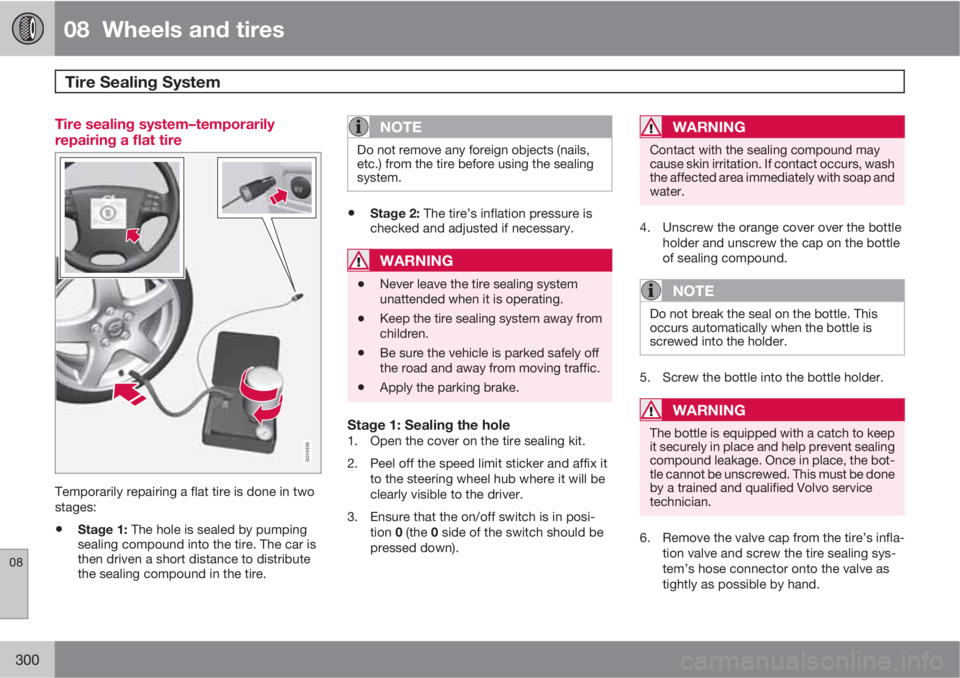
Temporarily repairing a flat tire is done in two
stages:
•Stage 1: The hole is sealed by pumping
sealing compound into the tire. The car is
then driven a short distance to distribute
the sealing compound in the tire.
NOTE
Do not remove any foreign objects (nails,
etc.) from the tire before using the sealing
system.
•Stage 2: The tire’s inflation pressure is
checked and adjusted if necessary.
WARNING
•Never leave the tire sealing system
unattended when it is operating.
•Keep the tire sealing system away from
children.
•Be sure the vehicle is parked safely off
the road and away from moving traffic.
•Apply the parking brake.
Stage 1: Sealing the hole1. Open the cover on the tire sealing kit.
2. Peel off the speed limit sticker and affix it
to the steering wheel hub where it will be
clearly visible to the driver.
3. Ensure that the on/off switch is in posi-
tion 0 (the 0 side of the switch should be
pressed down).
WARNING
Contact with the sealing compound may
cause skin irritation. If contact occurs, wash
the affected area immediately with soap and
water.
4. Unscrew the orange cover over the bottle
holder and unscrew the cap on the bottle
of sealing compound.
NOTE
Do not break the seal on the bottle. This
occurs automatically when the bottle is
screwed into the holder.
5. Screw the bottle into the bottle holder.
WARNING
The bottle is equipped with a catch to keep
it securely in place and help prevent sealing
compound leakage. Once in place, the bot-
tle cannot be unscrewed. This must be done
by a trained and qualified Volvo service
technician.
6. Remove the valve cap from the tire’s infla-
tion valve and screw the tire sealing sys-
tem’s hose connector onto the valve as
tightly as possible by hand.
Page 305 of 372
08 Wheels and tires
Tire Sealing System
08
303 Inflating tires
The tire sealing system can be used to inflate
the tires. To do so:
1. Park the car in a safe place.
2. The compressor should be switched off.
Ensure that the on/off switch is in position
0 (the 0 side of the switch should be
pressed down).
3. Take out the electrical wire and hose.
4. Remove the valve cap from the tire’s infla-
tion valve and screw the hose connector
onto the valve as tightly as possible by
hand.
5. Connect the electrical wire to the nearest
12-volt socket in the vehicle.
6. Start the vehicle’s engine.WARNING
•The vehicle’s engine should be running
when the tire sealing system is used to
avoid battery drain. Therefore, be sure
the vehicle is parked in a well ventilated
place, or outdoors, before using the sys-
tem. The parking brake should be
securely applied and the gear selector
should be in the P (park) position.
•Children should never be left unattended
in the vehicle when the engine is running.
7. Check the tire’s inflation pressure on the
gauge. Switch off the compressor briefly to
get a clear reading from the pressure
gauge.
8. Refer to the tire inflation table in this chap-
ter for the correct inflation pressure. If the
tire needs to be inflated, start the tire seal-
ing system’s compressor (press the on/off
switch to position I). If necessary, release
air from the tire by turning the air release
knob counterclockwise.
CAUTION
The compressor should not be used for
more than 10 minutes at a time to avoid
overheating.
9. Turn off the compressor (press the on/off
switch to position 0) when the correct infla-
tion pressure has been reached.
10. Unscrew the hose from the tire’s inflation
valve and reinstall the valve cap.
11. Disconnect the electrical wire from the
12-volt socket.
Page 306 of 372
08 Wheels and tires
Changing a wheel
08
304* Option/accessory, for more information, see Introduction.
Removing a wheel
G014341
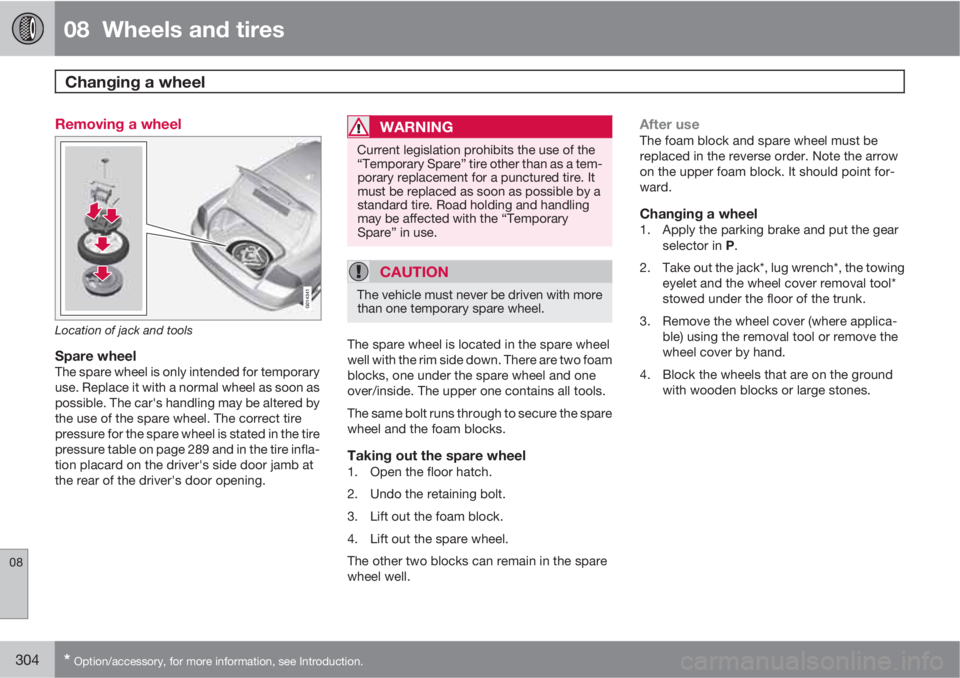
Location of jack and tools
Spare wheelThe spare wheel is only intended for temporary
use. Replace it with a normal wheel as soon as
possible. The car's handling may be altered by
the use of the spare wheel. The correct tire
pressure for the spare wheel is stated in the tire
pressure table on page 289 and in the tire infla-
tion placard on the driver's side door jamb at
the rear of the driver's door opening.
WARNING
Current legislation prohibits the use of the
“Temporary Spare” tire other than as a tem-
porary replacement for a punctured tire. It
must be replaced as soon as possible by a
standard tire. Road holding and handling
may be affected with the “Temporary
Spare” in use.
CAUTION
The vehicle must never be driven with more
than one temporary spare wheel.
The spare wheel is located in the spare wheel
well with the rim side down. There are two foam
blocks, one under the spare wheel and one
over/inside. The upper one contains all tools.
The same bolt runs through to secure the spare
wheel and the foam blocks.
Taking out the spare wheel1. Open the floor hatch.
2. Undo the retaining bolt.
3. Lift out the foam block.
4. Lift out the spare wheel.
The other two blocks can remain in the spare
wheel well.
After useThe foam block and spare wheel must be
replaced in the reverse order. Note the arrow
on the upper foam block. It should point for-
ward.
Changing a wheel1. Apply the parking brake and put the gear
selector in P.
2. Take out the jack*, lug wrench*, the towing
eyelet and the wheel cover removal tool*
stowed under the floor of the trunk.
3. Remove the wheel cover (where applica-
ble) using the removal tool or remove the
wheel cover by hand.
4. Block the wheels that are on the ground
with wooden blocks or large stones.
Page 323 of 372
09 Maintenance and specifications
Replacing bulbs09
321
NOTE
•Always switch off the ignition before
starting to replace a bulb.
•The optional Active Bending Light bulbs
contain trace amounts of mercury.
These bulbs should always be disposed
of by a trained and qualified Volvo serv-
ice technician.
Removing the headlight housing1. Switch off the ignition by briefly pressing
the START/STOP ENGINE button.
2. Remove the remote key from the ignition
slot
1.
3. (Upper illustration under "Headlight hous-
ing")
Withdraw the headlight housing's lock-
ing pins.
Pull the headlight housing straight out.
CAUTION
When disconnecting the connector, pull on
the connector itself and not on the wiring.
4. (Lower illustration under "Headlight hous-
ing")
Unplug the wiring connector by holding
down the clip with your thumb.
Pull out the connector with the other
hand.
5. Lift out the housing and place it on a soft
surface to avoid scratching the lens.
6. Replace the defective bulb(s).
Reinserting the headlight housing1. Plug in the connector until it clicks into
place.
2. Reinstall the headlight housing and locking
pins. Check that they are correctly
inserted. The headlight housing must be
properly inserted and secured in place
before the lighting is switched on or the
remote key is inserted into the ignition slot.
3. Check that the lights function properly.
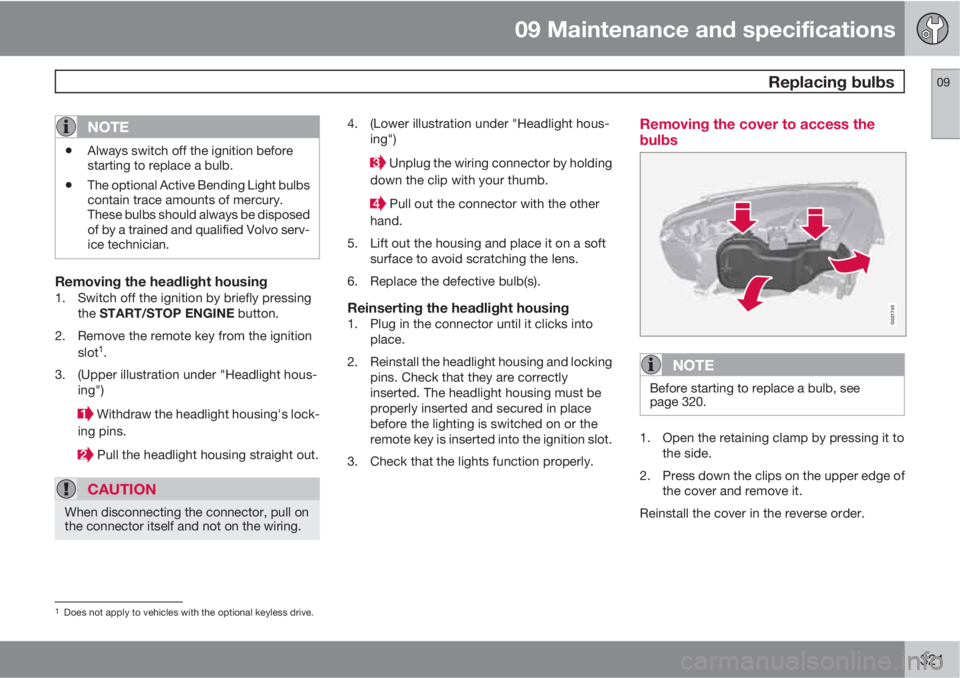
Removing the cover to access the
bulbs
G021745
NOTE
Before starting to replace a bulb, see
page 320.
1. Open the retaining clamp by pressing it to
the side.
2. Press down the clips on the upper edge of
the cover and remove it.
Reinstall the cover in the reverse order.
1Does not apply to vehicles with the optional keyless drive.
Page 324 of 372
09 Maintenance and specifications
Replacing bulbs 09
322
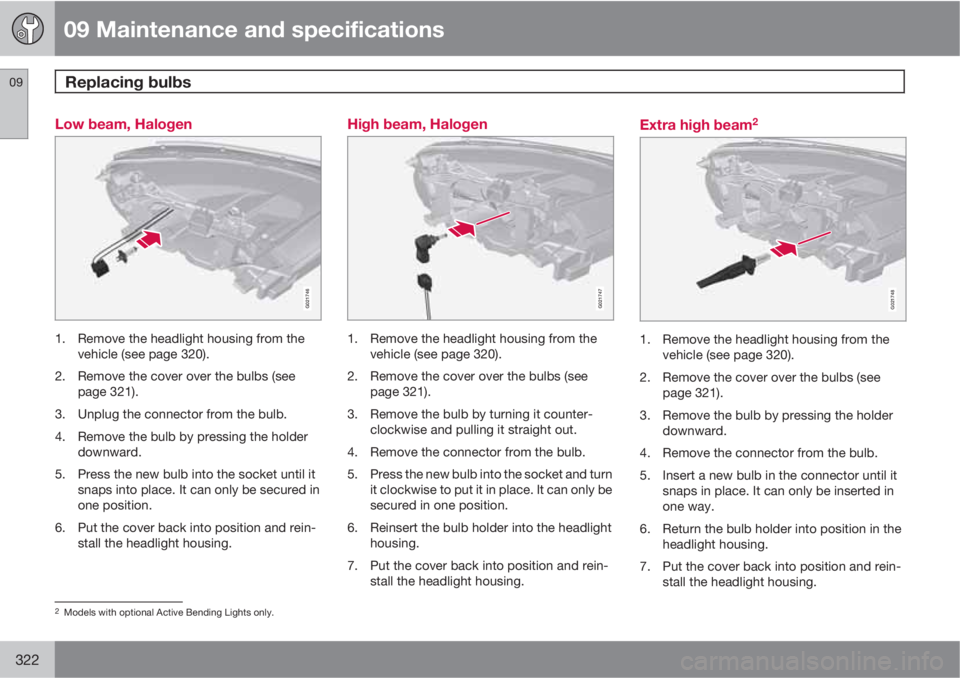
Low beam, Halogen
G021746
1. Remove the headlight housing from the
vehicle (see page 320).
2. Remove the cover over the bulbs (see
page 321).
3. Unplug the connector from the bulb.
4. Remove the bulb by pressing the holder
downward.
5. Press the new bulb into the socket until it
snaps into place. It can only be secured in
one position.
6. Put the cover back into position and rein-
stall the headlight housing.
High beam, Halogen
G021747
1. Remove the headlight housing from the
vehicle (see page 320).
2. Remove the cover over the bulbs (see
page 321).
3. Remove the bulb by turning it counter-
clockwise and pulling it straight out.
4. Remove the connector from the bulb.
5. Press the new bulb into the socket and turn
it clockwise to put it in place. It can only be
secured in one position.
6. Reinsert the bulb holder into the headlight
housing.
7. Put the cover back into position and rein-
stall the headlight housing.
Extra high beam2
G021748
1. Remove the headlight housing from the
vehicle (see page 320).
2. Remove the cover over the bulbs (see
page 321).
3. Remove the bulb by pressing the holder
downward.
4. Remove the connector from the bulb.
5. Insert a new bulb in the connector until it
snaps in place. It can only be inserted in
one way.
6. Return the bulb holder into position in the
headlight housing.
7. Put the cover back into position and rein-
stall the headlight housing.
2Models with optional Active Bending Lights only.
Page 325 of 372
09 Maintenance and specifications
Replacing bulbs09
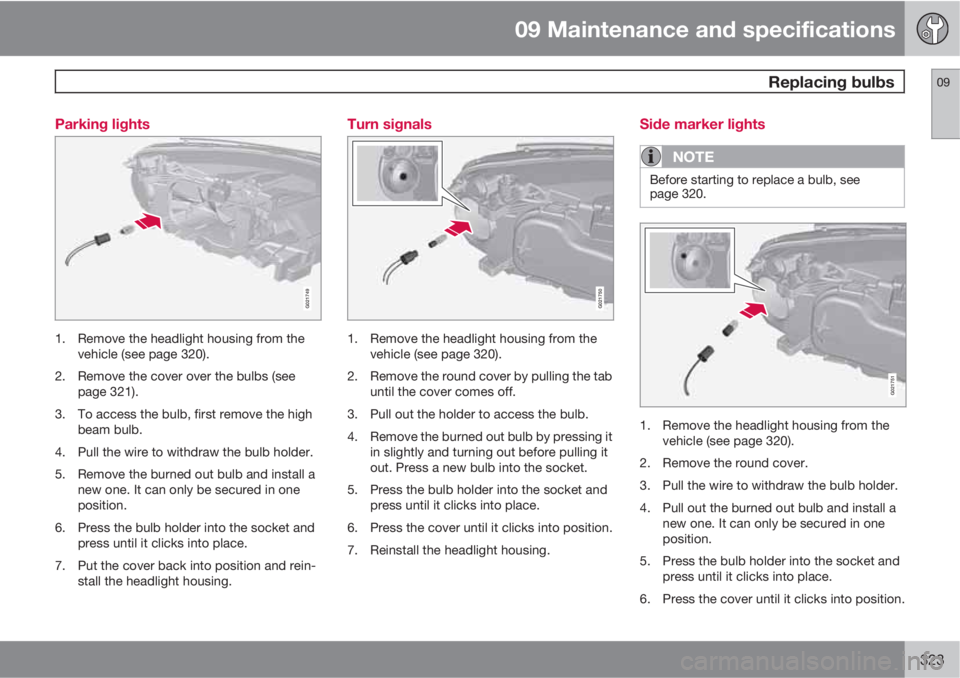
323 Parking lights
G021749
1. Remove the headlight housing from the
vehicle (see page 320).
2. Remove the cover over the bulbs (see
page 321).
3. To access the bulb, first remove the high
beam bulb.
4. Pull the wire to withdraw the bulb holder.
5. Remove the burned out bulb and install a
new one. It can only be secured in one
position.
6. Press the bulb holder into the socket and
press until it clicks into place.
7. Put the cover back into position and rein-
stall the headlight housing.
Turn signals
G021750
1. Remove the headlight housing from the
vehicle (see page 320).
2. Remove the round cover by pulling the tab
until the cover comes off.
3. Pull out the holder to access the bulb.
4. Remove the burned out bulb by pressing it
in slightly and turning out before pulling it
out. Press a new bulb into the socket.
5. Press the bulb holder into the socket and
press until it clicks into place.
6. Press the cover until it clicks into position.
7. Reinstall the headlight housing.
Side marker lights
NOTE
Before starting to replace a bulb, see
page 320.
G021751
1. Remove the headlight housing from the
vehicle (see page 320).
2. Remove the round cover.
3. Pull the wire to withdraw the bulb holder.
4. Pull out the burned out bulb and install a
new one. It can only be secured in one
position.
5. Press the bulb holder into the socket and
press until it clicks into place.
6. Press the cover until it clicks into position.