brake VOLVO S80 2013 Owner´s Manual
[x] Cancel search | Manufacturer: VOLVO, Model Year: 2013, Model line: S80, Model: VOLVO S80 2013Pages: 372, PDF Size: 6.45 MB
Page 278 of 372
07 During your trip
Towing a trailer
07
276
NOTE
•When parking the vehicle with a trailer
on a hill, apply the parking brake before
putting the gear selector in P. Always
follow the trailer manufacturer's recom-
mendations for wheel chocking.
•When starting on a hill, put the gear
selector in D before releasing the park-
ing brake. See also page 123 for more
detailed information about starting off
on a hill while towing a trailer.
•If you use the manual (Geartronic) shift
positions while towing a trailer, make
sure the gear you select does not put
too much strain on the engine (using too
high a gear).
•The drawbar assembly/trailer hitch may
be rated for trailers heavier than the
vehicle is designed to tow. Please
adhere to Volvo's recommended trailer
weights.
•Avoid driving with a trailer on inclines of
more than 15%.
Trailer cableAn adapter is required if the vehicle's trailer
hitch has a 13-pin connector and the trailer has
7 pins. Use an adapter cable approved by
Volvo. Make sure the cable does not drag on
the ground.
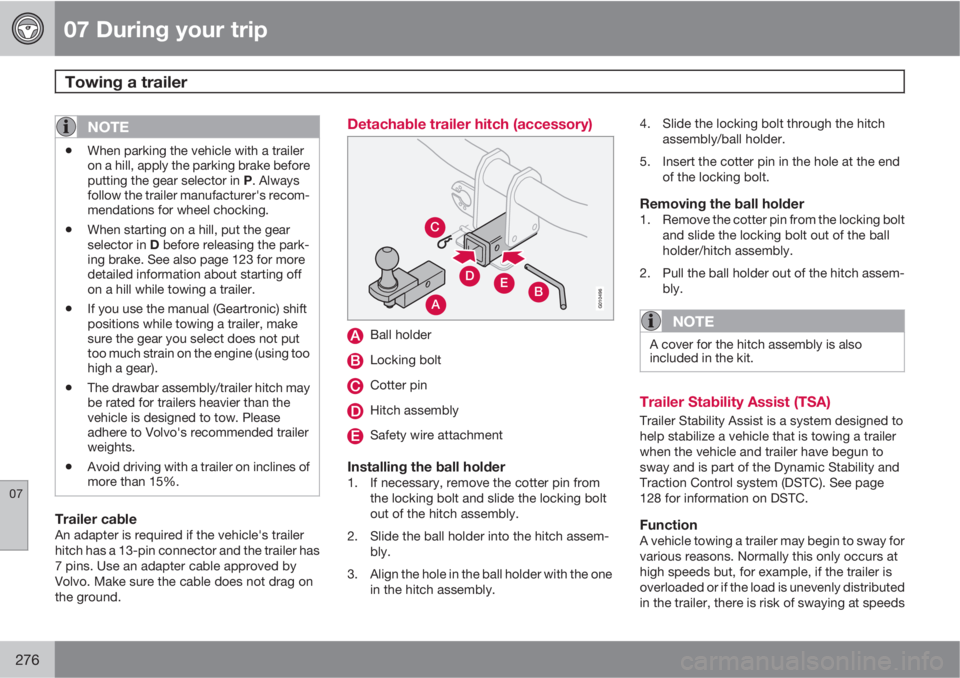
Detachable trailer hitch (accessory)
A
C
EDBG010496
Ball holder
Locking bolt
Cotter pin
Hitch assembly
Safety wire attachment
Installing the ball holder1. If necessary, remove the cotter pin from
the locking bolt and slide the locking bolt
out of the hitch assembly.
2. Slide the ball holder into the hitch assem-
bly.
3. Align the hole in the ball holder with the one
in the hitch assembly.4. Slide the locking bolt through the hitch
assembly/ball holder.
5. Insert the cotter pin in the hole at the end
of the locking bolt.
Removing the ball holder1. Remove the cotter pin from the locking bolt
and slide the locking bolt out of the ball
holder/hitch assembly.
2. Pull the ball holder out of the hitch assem-
bly.
NOTE
A cover for the hitch assembly is also
included in the kit.
Trailer Stability Assist (TSA)
Trailer Stability Assist is a system designed to
help stabilize a vehicle that is towing a trailer
when the vehicle and trailer have begun to
sway and is part of the Dynamic Stability and
Traction Control system (DSTC). See page
128 for information on DSTC.
FunctionA vehicle towing a trailer may begin to sway for
various reasons. Normally this only occurs at
high speeds but, for example, if the trailer is
overloaded or if the load is unevenly distributed
in the trailer, there is risk of swaying at speeds
Page 279 of 372
07 During your trip
Towing a trailer
07
277
between approximately 45-55 mph (70-90 km/
h).
Swaying may be caused by factors such as:
•The vehicle and trailer are hit by a sudden,
strong crosswind
•The vehicle and trailer are traveling on an
uneven road surface or drive over a bump
•Sudden movements of the steering wheel
Facts about TSA
•TSA intervenes at speeds above approxi-
mately 40 mph (60 km/h)
•The DSTC symbol () in the instru-
ment panel will flash when TSA is working
•If the driver switches off the DSTC sys-
tem's Spin Control function, TSA will also
be switched off (but will be on again the
next time the engine is started)
•TSA may not intervene when the vehicle
and trailer begin to sway if the driver tries
to compensate for the swaying motion by
moving the steering wheel rapidly
How TSA worksOnce swaying has begun, it can be very diffi-
cult to stop, which makes it difficult to control
the vehicle and trailer.
The TSA system continuously monitors the
vehicle's movements, particularly lateralmovement. If the system detects a tendency to
sway, the brakes are applied individually on the
front wheels, which has a stabilizing effect on
the vehicle and trailer. This is often enough to
enable the driver to regain control of the vehi-
cle.
If this is not adequate to stop the swaying
motion, the brakes are applied to all of the
wheels on the vehicle and on the trailer if it is
equipped with brakes, and engine power is
temporarily reduced. As the swaying motion
begins to decrease and the vehicle-trailer have
once again become stable, TSA will no stop
regulating the brakes/engine power and the
driver regains control of the vehicle.
Page 281 of 372
07 During your trip
Emergency towing
07
279
WARNING
•When the vehicle is being towed, the
ignition should be in mode II (in mode I,
all of the vehicle's airbags are deacti-
vated). See page 83 for more informa-
tion about ignition modes.
•Never remove the remote key from the
ignition slot when the vehicle is being
towed. For vehicles with keyless drive,
the remote key must remain inside the
vehicle.
•The power brakes and power steering
will not function when the engine is not
running. Approximately 5 times more
pressure will be required on the brake
pedal and the steering wheel will be
considerably harder to turn.
•The towing eyelets must not be used for
pulling the vehicle out of a ditch or for
any similar purpose involving severe
strain. Do not use the towing eyelets to
pull the vehicle up onto a flat bed tow
truck.
Towing the vehicle
1. With the remote key fully pressed into the
ignition slot1, press START/STOP
ENGINE for approximately 2 seconds to
activate ignition mode II.
2. The remote key must remain in the ignition
slot
2 for the entire time that the vehicle is
being towed.
3. Keep the tow rope taut when the towing
vehicle slows down by applying light pres-
sure on the brake pedal. This will help pre-
vent jarring movements of the vehicle
being towed.
4. Be prepared to apply the brakes to stop the
vehicle being towed.
CAUTION
General towing precautions:
•Please check with state and local
authorities before attempting this type
of towing, as vehicles being towed are
subject to regulations regarding maxi-
mum towing speed, length and type of
towing device, lighting, etc.
•If the vehicle's battery is dead, attach
jumper cables (see page 114) to provide
current for releasing the electric parking
brake and to move the gear selector
from the P position to N. If this is not
possible, see page 118 for information
about manually overriding the shiftlock
system to move the gear selector from
P to N.
•Maximum speed: 50 mph (80 km/h). Do
not exceed the maximum allowable
towing speed.
•Maximum distance with front wheels on
ground: 50 miles (80 km).
•The vehicle should only be towed in the
forward direction.
1Not necessary in vehicles with the optional keyless drive.2For vehicles with the the optional keyless dirive, the remote key must be in the vehicle.
Page 298 of 372
08 Wheels and tires
Snow chains, snow tires, studded tires
08
296
Winter driving conditions
Snow chainsSnow chains can be used on your Volvo with
the following restrictions:
•Snow chains should be installed on front
wheels only. Use only Volvo approved
snow chains.
•If accessory, aftermarket or "custom" tires
and wheels are installed and are of a size
different than the original tires and wheels,
chains in some cases CANNOT be used.
Sufficient clearances between chains and
brakes, suspension and body components
must be maintained.
•Some strap-on type chains will interfere
with brake components and therefore
CANNOT be used.
•All Wheel Drive models: Snow chains
should only be installed on the front
wheels.
•Certain size tires may not allow the assem-
bly of snow chains/traction devices.
Consult your Volvo retailer for additional snow
chain information.
CAUTION
•Check local regulations regarding the
use of snow chains before installing.
•Use single-sided snow chains only.
•Always follow the chain manufacturer's
installation instructions carefully. Install
chains as tightly as possible and
retighten periodically.
•Never exceed the chain manufacturer's
specified maximum speed limit. (Under
no circumstances should you exceed
31 mph (50 km/h).
•Avoid bumps, holes or sharp turns
when driving with snow chains.
•The handling of the vehicle can be
adversely affected when driving with
chains. Avoid fast or sharp turns as well
as locked wheel braking.
Snow tires, studded tires1
Tires for winter use:
•Owners who live in or regularly commute
through areas with sustained periods of
snow or icy driving conditions are strongly
advised to fit suitable winter tires to help
retain the highest degree of traction.
•It is important to install winter tires on all
four wheels to help retain traction duringcornering, braking, and accelerating. Fail-
ure to do so could reduce traction to an
unsafe level or adversely affect handling.
•Do not mix tires of different design as this
could also negatively affect overall tire road
grip.
•Winter tires wear more quickly on dry roads
in warm weather. They should be removed
when the winter driving season has ended.
•Studded tires should be run-in
300 – 600 miles (500 – 1000 km) during
which the vehicle should be driven as
smoothly as possible to give the studs the
opportunity to seat properly in the tires.
The tires should have the same rotational
direction throughout their entire lifetime.
NOTE
Please consult state or provincial regula-
tions restricting the use of studded winter
tires before installing such tires.
1Where permitted
Page 302 of 372
08 Wheels and tires
Tire Sealing System
08
300
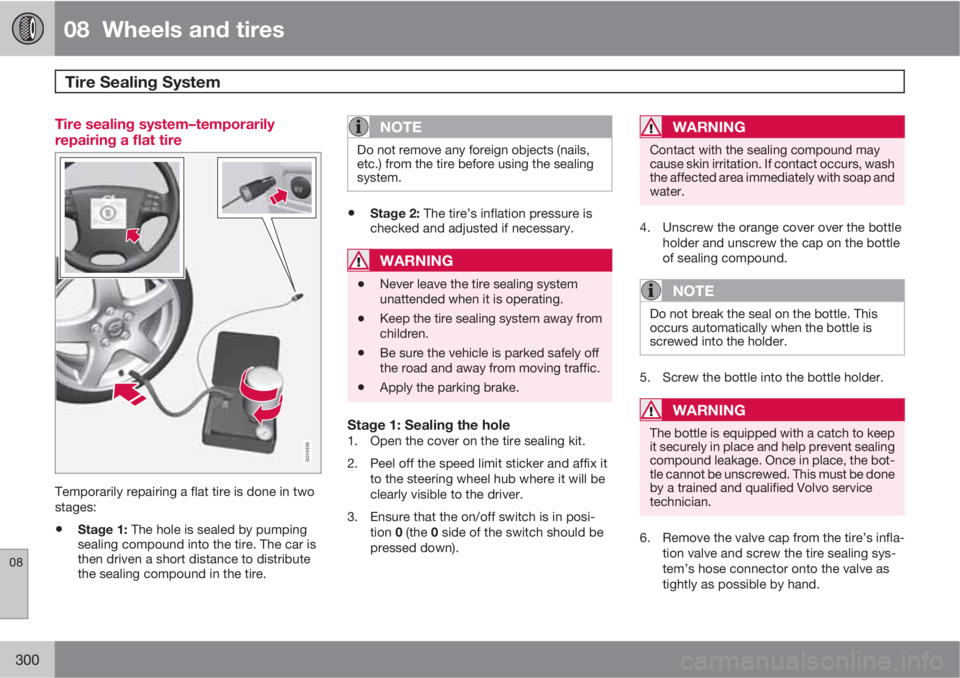
Tire sealing system–temporarily
repairing a flat tire
G014338
Temporarily repairing a flat tire is done in two
stages:
•Stage 1: The hole is sealed by pumping
sealing compound into the tire. The car is
then driven a short distance to distribute
the sealing compound in the tire.
NOTE
Do not remove any foreign objects (nails,
etc.) from the tire before using the sealing
system.
•Stage 2: The tire’s inflation pressure is
checked and adjusted if necessary.
WARNING
•Never leave the tire sealing system
unattended when it is operating.
•Keep the tire sealing system away from
children.
•Be sure the vehicle is parked safely off
the road and away from moving traffic.
•Apply the parking brake.
Stage 1: Sealing the hole1. Open the cover on the tire sealing kit.
2. Peel off the speed limit sticker and affix it
to the steering wheel hub where it will be
clearly visible to the driver.
3. Ensure that the on/off switch is in posi-
tion 0 (the 0 side of the switch should be
pressed down).
WARNING
Contact with the sealing compound may
cause skin irritation. If contact occurs, wash
the affected area immediately with soap and
water.
4. Unscrew the orange cover over the bottle
holder and unscrew the cap on the bottle
of sealing compound.
NOTE
Do not break the seal on the bottle. This
occurs automatically when the bottle is
screwed into the holder.
5. Screw the bottle into the bottle holder.
WARNING
The bottle is equipped with a catch to keep
it securely in place and help prevent sealing
compound leakage. Once in place, the bot-
tle cannot be unscrewed. This must be done
by a trained and qualified Volvo service
technician.
6. Remove the valve cap from the tire’s infla-
tion valve and screw the tire sealing sys-
tem’s hose connector onto the valve as
tightly as possible by hand.
Page 305 of 372
08 Wheels and tires
Tire Sealing System
08
303 Inflating tires
The tire sealing system can be used to inflate
the tires. To do so:
1. Park the car in a safe place.
2. The compressor should be switched off.
Ensure that the on/off switch is in position
0 (the 0 side of the switch should be
pressed down).
3. Take out the electrical wire and hose.
4. Remove the valve cap from the tire’s infla-
tion valve and screw the hose connector
onto the valve as tightly as possible by
hand.
5. Connect the electrical wire to the nearest
12-volt socket in the vehicle.
6. Start the vehicle’s engine.WARNING
•The vehicle’s engine should be running
when the tire sealing system is used to
avoid battery drain. Therefore, be sure
the vehicle is parked in a well ventilated
place, or outdoors, before using the sys-
tem. The parking brake should be
securely applied and the gear selector
should be in the P (park) position.
•Children should never be left unattended
in the vehicle when the engine is running.
7. Check the tire’s inflation pressure on the
gauge. Switch off the compressor briefly to
get a clear reading from the pressure
gauge.
8. Refer to the tire inflation table in this chap-
ter for the correct inflation pressure. If the
tire needs to be inflated, start the tire seal-
ing system’s compressor (press the on/off
switch to position I). If necessary, release
air from the tire by turning the air release
knob counterclockwise.
CAUTION
The compressor should not be used for
more than 10 minutes at a time to avoid
overheating.
9. Turn off the compressor (press the on/off
switch to position 0) when the correct infla-
tion pressure has been reached.
10. Unscrew the hose from the tire’s inflation
valve and reinstall the valve cap.
11. Disconnect the electrical wire from the
12-volt socket.
Page 306 of 372
08 Wheels and tires
Changing a wheel
08
304* Option/accessory, for more information, see Introduction.
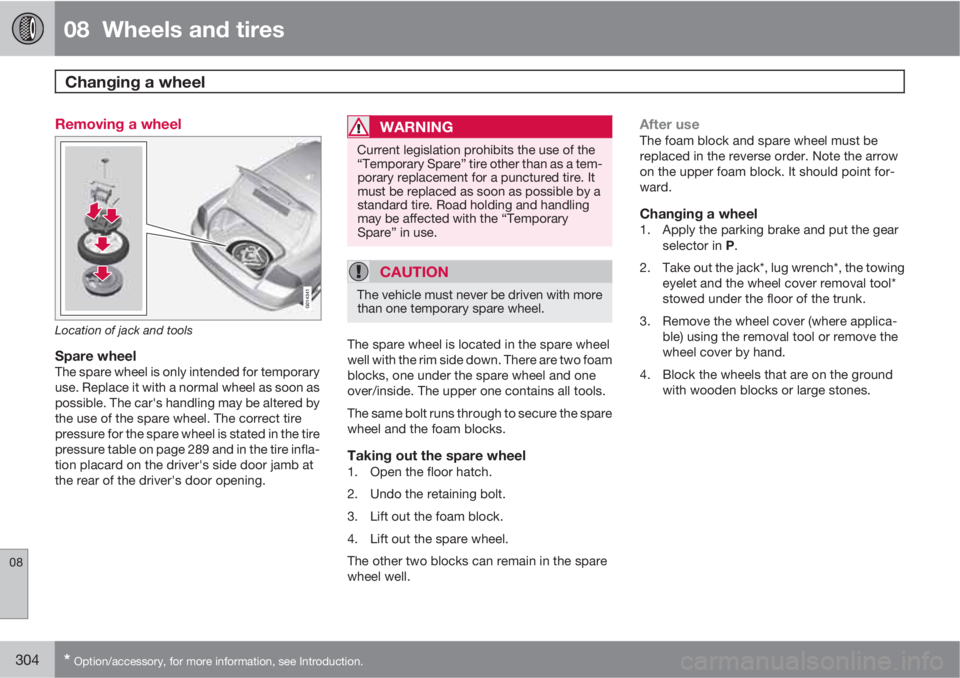
Removing a wheel
G014341
Location of jack and tools
Spare wheelThe spare wheel is only intended for temporary
use. Replace it with a normal wheel as soon as
possible. The car's handling may be altered by
the use of the spare wheel. The correct tire
pressure for the spare wheel is stated in the tire
pressure table on page 289 and in the tire infla-
tion placard on the driver's side door jamb at
the rear of the driver's door opening.
WARNING
Current legislation prohibits the use of the
“Temporary Spare” tire other than as a tem-
porary replacement for a punctured tire. It
must be replaced as soon as possible by a
standard tire. Road holding and handling
may be affected with the “Temporary
Spare” in use.
CAUTION
The vehicle must never be driven with more
than one temporary spare wheel.
The spare wheel is located in the spare wheel
well with the rim side down. There are two foam
blocks, one under the spare wheel and one
over/inside. The upper one contains all tools.
The same bolt runs through to secure the spare
wheel and the foam blocks.
Taking out the spare wheel1. Open the floor hatch.
2. Undo the retaining bolt.
3. Lift out the foam block.
4. Lift out the spare wheel.
The other two blocks can remain in the spare
wheel well.
After useThe foam block and spare wheel must be
replaced in the reverse order. Note the arrow
on the upper foam block. It should point for-
ward.
Changing a wheel1. Apply the parking brake and put the gear
selector in P.
2. Take out the jack*, lug wrench*, the towing
eyelet and the wheel cover removal tool*
stowed under the floor of the trunk.
3. Remove the wheel cover (where applica-
ble) using the removal tool or remove the
wheel cover by hand.
4. Block the wheels that are on the ground
with wooden blocks or large stones.
Page 308 of 372
08 Wheels and tires
Changing a wheel
08
306
WARNING
•The jack must correctly engage the jack
attachment.
•Be sure the jack is on a firm, level, non-
slippery surface.
•Never allow any part of your body to be
extended under a vehicle supported by
a jack.
•Use the jack intended for the vehicle
when changing a tire. For any other job,
use stands to support the vehicle.
•Apply the parking brake and put the
gear selector in the Park (P) position.
•Block the wheels standing on the
ground, use rigid wooden blocks or
large stones.
•The jack should be kept well-greased
and clean, and should not be damaged.
•No objects should be placed between
the base of jack and the ground, or
between the jack and the attachment
bar on the vehicle.
NOTE
The jack provided with your vehicle is
intended to be used only in temporary sit-
uations such as changing wheels in the
event of a flat tire. Only the jack that came
with your particular model should be used
to lift the vehicle. If the vehicle needs to be
lifted more frequently or for a prolonged
period, using a garage jack or hoist is rec-
ommended. Always follow this device’s
instructions for use.
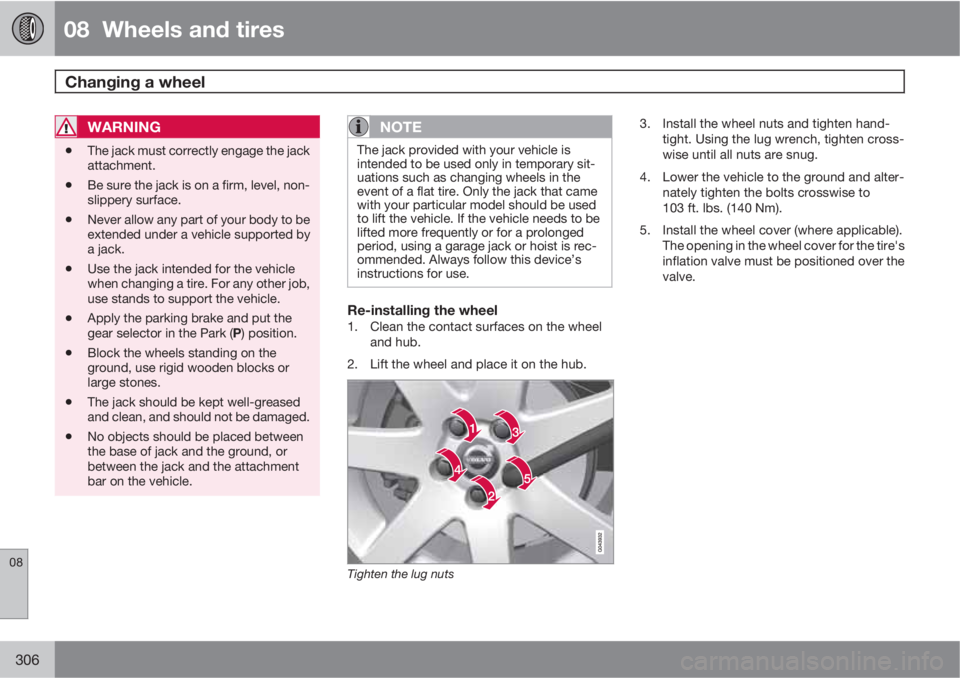
Re-installing the wheel1. Clean the contact surfaces on the wheel
and hub.
2. Lift the wheel and place it on the hub.
Tighten the lug nuts
3. Install the wheel nuts and tighten hand-
tight. Using the lug wrench, tighten cross-
wise until all nuts are snug.
4. Lower the vehicle to the ground and alter-
nately tighten the bolts crosswise to
103 ft. lbs. (140 Nm).
5. Install the wheel cover (where applicable).
The opening in the wheel cover for the tire's
inflation valve must be positioned over the
valve.
Page 317 of 372

09 Maintenance and specifications
Hood and engine compartment09
315 Opening and closing the hood
G010951
Pull the lever located under the left side of
the dash to release the hood lock.
Lift the hood slightly. Press the release
control (located under the right front edge
of the hood) to the left, and lift the hood.
WARNING
Check that the hood locks properly when
closed.
Engine compartment, overview
Coolant expansion tank
Power steering fluid reservoir
Dipstick-engine oil
Filler cap-engine oil
Cover over brake fluid reservoir
Battery
Relay/fuse box
Washer fluid reservoir
The appearance of the engine compartment
may vary depending on engine model.
WARNING
The cooling fan (located at the front of the
engine compartment, behind the radiator)
may start or continue to operate (for up to
6 minutes) after the engine has been
switched off.
WARNING
Before performing any operations in the
engine compartment, the ignition should
always be completely switched off (in mode
0, see page 83) and there should be no
remote keys in the passenger compartment.
The gear selector should be in the P (park)
position. If the engine has been running,
wait until it has cooled before touching any
components in the engine compartment.
The distributor ignition system operates at
very high voltages. Special safety precau-
tions must be followed to prevent injury.
Always turn the ignition off when:
•Replacing distributor ignition compo-
nents e.g. plugs, coil, etc.
•Do not touch any part of the distributor
ignition system while the engine is run-
ning. This may result in unintended
movements and body injury.
Page 320 of 372
09 Maintenance and specifications
Fluids 09
318
Coolant
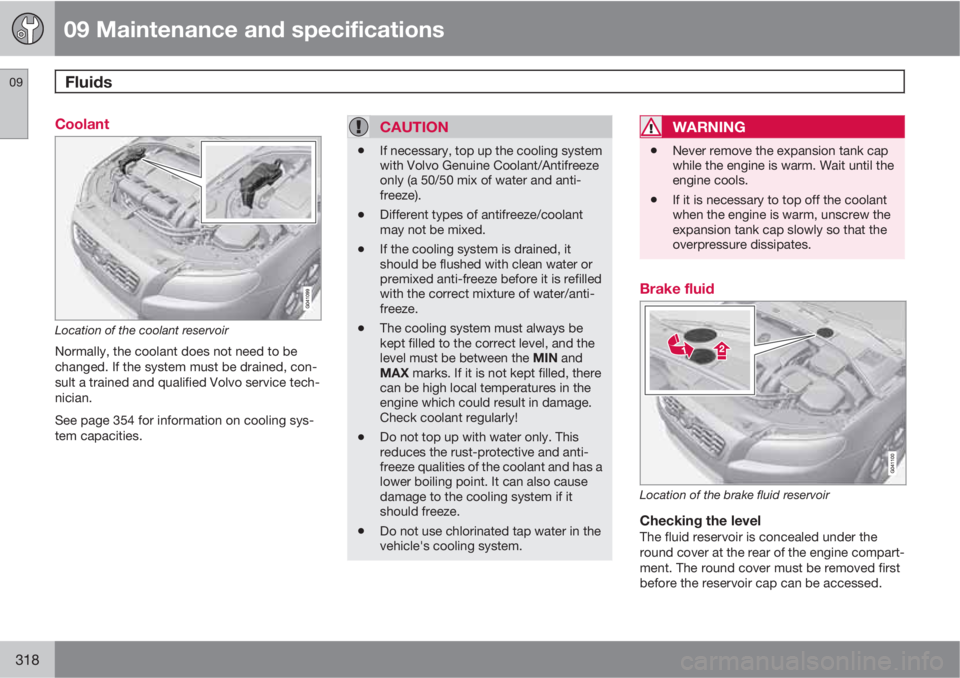
Location of the coolant reservoir
Normally, the coolant does not need to be
changed. If the system must be drained, con-
sult a trained and qualified Volvo service tech-
nician.
See page 354 for information on cooling sys-
tem capacities.
CAUTION
•If necessary, top up the cooling system
with Volvo Genuine Coolant/Antifreeze
only (a 50/50 mix of water and anti-
freeze).
•Different types of antifreeze/coolant
may not be mixed.
•If the cooling system is drained, it
should be flushed with clean water or
premixed anti-freeze before it is refilled
with the correct mixture of water/anti-
freeze.
•The cooling system must always be
kept filled to the correct level, and the
level must be between the MIN and
MAX marks. If it is not kept filled, there
can be high local temperatures in the
engine which could result in damage.
Check coolant regularly!
•Do not top up with water only. This
reduces the rust-protective and anti-
freeze qualities of the coolant and has a
lower boiling point. It can also cause
damage to the cooling system if it
should freeze.
•Do not use chlorinated tap water in the
vehicle's cooling system.
WARNING
•Never remove the expansion tank cap
while the engine is warm. Wait until the
engine cools.
•If it is necessary to top off the coolant
when the engine is warm, unscrew the
expansion tank cap slowly so that the
overpressure dissipates.
Brake fluid
Location of the brake fluid reservoir
Checking the levelThe fluid reservoir is concealed under the
round cover at the rear of the engine compart-
ment. The round cover must be removed first
before the reservoir cap can be accessed.