transmission VOLVO S80 2015 Owner´s Manual
[x] Cancel search | Manufacturer: VOLVO, Model Year: 2015, Model line: S80, Model: VOLVO S80 2015Pages: 392, PDF Size: 10.66 MB
Page 226 of 392
05 Comfort and driving pleasure
Active chassis system–Four C*
05
224* Option/accessory, for more information, see Introduction.
Active chassis (Four C)
Active chassis, Four-C (Continuously Con- trolled Chassis Concept), regulates the cha-racteristics of the shock absorbers so that thevehicle's driving characteristics can beadjusted. There are three settings: Comfort,Sport and Advanced.
ComfortComfort mode offers a somewhat softer rideand the transmission shifts gears at lowerrpm. This mode is particularly suitable forlong-distance highway driving. The indicatorlight in the button will be on when this modeis selected.
SportIn this mode, the vehicle's body sway isreduced during cornering and steeringresponse is more immediate. The transmis-sion shifts up at higher rpm for sportier driv-ing. The indicator light in the button will be onto indicate that Sport mode has beenselected.
AdvancedIn this mode, body sway in curves is minimaland steering response is very direct. Gearshifting is done at high rpm in each gear fordynamic and active driving.
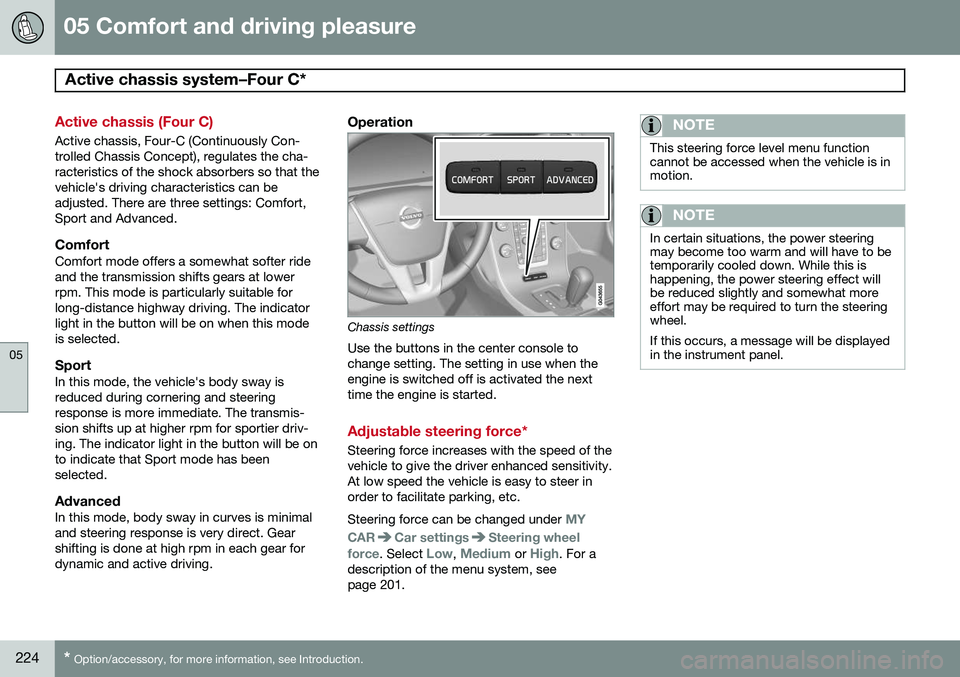
Operation
Chassis settings
Use the buttons in the center console to change setting. The setting in use when theengine is switched off is activated the nexttime the engine is started.
Adjustable steering force*
Steering force increases with the speed of the vehicle to give the driver enhanced sensitivity.At low speed the vehicle is easy to steer inorder to facilitate parking, etc. Steering force can be changed under
MY
CAR
Car settingsSteering wheel
force
. Select Low, Medium or High. For a
description of the menu system, see page 201.
NOTE
This steering force level menu function cannot be accessed when the vehicle is inmotion.
NOTE
In certain situations, the power steering may become too warm and will have to betemporarily cooled down. While this ishappening, the power steering effect willbe reduced slightly and somewhat moreeffort may be required to turn the steeringwheel. If this occurs, a message will be displayed in the instrument panel.
Page 278 of 392
07 During your trip
Driving recommendations
07
276
General information
Economical driving conserves natural
resources
Better driving economy may be obtained by thinking ahead, avoiding rapid starts andstops and adjusting the speed of your vehicleto immediate traffic conditions. Observe the following rules:
• Bring the engine to normal operating tem- perature as soon as possible by drivingwith a light foot on the accelerator pedalfor the first few minutes of operation. Acold engine uses more fuel and is subjectto increased wear.
• Whenever possible, avoid using the vehi-cle for driving short distances. This doesnot allow the engine to reach normaloperating temperature.
• Drive carefully and avoid rapid accelera-tion and hard braking.
• Use the transmission's Drive (
D) position
as often as possible and avoid using kick-down.
• Using the engine's optional Eco function 1
can help improve fuel economy. Seepage 128 for additional information.
• Do not exceed posted speed limits. •
Avoid carrying unnecessary items (extraload) in the vehicle.
• Maintain correct tire pressure. Check tirepressure regularly (when tires are cold).
• Remove snow tires when threat of snowor ice has ended.
• Note that roof racks, ski racks, etc,increase air resistance and also fuel con-sumption.
• At highway driving speeds, fuel consump-tion will be lower with the air conditioningon and the windows closed than with theair conditioning off and the windowsopen.
• Using the onboard trip computer's fuelconsumption modes can help you learnhow to drive more economically.
Other factors that decrease gas mileage are: • Dirty air cleaner
• Dirty engine oil and clogged oil filter
• Dragging brakes
• Incorrect front end alignment
Some of the above mentioned items and oth- ers are checked at the standard maintenanceintervals.
WARNING
Driving with the trunk open: Driving with
the trunk open could lead to poisonous exhaust gases entering the passengercompartment. If the trunk must be keptopen for any reason, proceed as follows:
• Close the windows
• Set the ventilation system control to air flow to floor, windshield and side win- dows and the blower control to itshighest setting.
Weight distribution affects handlingAt the specified curb weight your vehicle has a tendency to understeer, which means thatthe steering wheel has to be turned morethan might seem appropriate for the curva-ture of a bend. This ensures good stabilityand reduces the risk of rear wheel skid.Remember that these properties can alterwith the vehicle load. The heavier the load inthe trunk, the less the tendency to under-steer.
Handling, roadholdingVehicle load, tire design and inflation pres-sure all affect vehicle handling. Therefore,check that the tires are inflated to the recom-mended pressure according to the vehicle
1
Available on certain 4-cyl. engines
Page 280 of 392
07 During your trip
Driving recommendations
07
278
Before a long distance tripIt is always worthwhile to have your vehicle checked by a trained and qualified Volvoservice technician before driving long dis-tances. Your retailer will also be able to sup-ply you with bulbs, fuses, spark plugs andwiper blades for your use in the event thatproblems occur. As a minimum, the following items should be checked before any long trip:• Check that engine runs smoothly and that fuel consumption is normal.
• Check for fuel, oil, and fluid leakage
• Have the transmission oil level checked.
• Check condition of drive belts.
• Check state of the battery's charge.
• Examine tires carefully (the spare tire aswell), and replace those that are worn.Check tire pressures.
• The brakes, front wheel alignment, andsteering gear should be checked by atrained and qualified Volvo service techni-cian only.
• Check all lights, including high beams.
• Reflective warning triangles are legallyrequired in some states/provinces.
• Have a word with a trained and qualifiedVolvo service technician if you intend to drive in countries where it may be difficultto obtain the correct fuel.
• Consider your destination. If you will bedriving through an area where snow or iceare likely to occur, consider snow tires.
Cold weather precautionsIf you wish to check your vehicle before the approach of cold weather, the followingadvice is worth noting:
• Make sure that the engine coolant con- tains 50 percent antifreeze. Any othermixture will reduce freeze protection. Thisgives protection against freezing down to–31 °F (–35 °C). The use of "recycled"antifreeze is not approved by Volvo. Dif-ferent types of antifreeze must not bemixed.
• Volvo recommends using only genuineVolvo antifreeze in your vehicle's radiator.
• Try to keep the fuel tank well filled – thishelps prevent the formation of condensa-tion in the tank. In addition, in extremelycold weather conditions it is worthwhileto add fuel line de-icer before refueling.
• The viscosity of the engine oil is impor-tant. Oil with low viscosity (thinner oil)improves cold-weather starting as well asdecreasing fuel consumption while theengine is warming up. Full synthetic0W-30 oil is recommended for driving inareas with sustained low temperatures. •
The load placed on the battery is greaterduring the winter since the windshieldwipers, lighting, etc., are used moreoften. Moreover, the capacity of the bat-tery decreases as the temperature drops.In very cold weather, a poorly chargedbattery can freeze and be damaged. It istherefore advisable to check the state ofcharge more frequently and spray an anti-rust oil on the battery posts.
• Volvo recommends the use of snow tireson all four wheels for winter driving, seepage 307.
• To prevent the washer fluid reservoir fromfreezing, add washer solvents containingantifreeze. This is important since dirt isoften splashed on the windshield duringwinter driving, requiring the frequent useof the washers and wipers. Volvo WasherSolvent should be diluted as follows:Down to 14 °F (–10 °C): 1 part washersolvent and 4 parts water Down to 5 °F(–15 °C): 1 part washer solvent and3 parts water Down to 0 °F (–18 °C):1 part washer solvent and 2 parts waterDown to –18 °F (–28 °C): 1 part washersolvent and 1 part water.
• Use Volvo Teflon Lock Spray in the locks.
• Avoid using de-icing sprays as they cancause damage to the locks.
Page 289 of 392
07 During your trip
Towing a trailer
07
}}
287
Introduction
Volvo recommends the use of Volvo trailer hitches that are specially designed for thevehicle.
NOTE
See page 369 for the maximum trailer and tongue weights recommended by Volvo.
•Observe the legal requirements of the state/province in which the vehicles are
• All Volvo models are equipped withenergy-absorbing shock-mounted bump-ers. Trailer hitch installation should notinterfere with the proper operation of thisbumper system.
Trailer towing does not normally present any particular problems, but take into considera-tion: • Increase tire pressure to recommended full pressure. See the tire inflation tableon page 300.
• When your vehicle is new, avoid towingheavy trailers during the first 620 miles(1,000 km).
• Maximum speed when towing a trailer:50 mph (80 km/h).
• Engine and transmission are subject toincreased loads. Therefore, engine cool-ant temperature should be closely watched when driving in hot climates orhilly terrain. Use a lower gear and turn offthe air conditioner if the temperaturegauge needle enters the red range.
• If the automatic transmission begins tooverheat, a message will be displayed inthe text window.
• Avoid overload and other abusive opera-tion.
• Hauling a trailer affects handling, durabil-ity, and economy.
• It is necessary to balance trailer brakeswith the towing vehicle brakes to providea safe stop (check and observe state/local regulations).
• Do not connect the trailer's brake systemdirectly to the vehicle's brake system.
• More frequent vehicle maintenance isrequired.
• Remove the ball holder when the hitch isnot being used.
WARNING
• Bumper-attached trailer hitches must not be used on Volvos, nor shouldsafety chains be attached to thebumper.
• Trailer hitches attaching to the vehiclerear axle must not be used.
• Never connect a trailer's hydraulicbrake system directly to the vehiclebrake system, nor a trailer's lightingsystem directly to the vehicle lightingsystem. Consult your nearest author-ized Volvo retailer for correct installa-tion.
• When towing a trailer, the trailer'ssafety wire must be correctly fastenedto the hole or hook provided in thetrailer hitch on the vehicle. The safetywire should never be fastened to orwound around the drawbar ball.
Page 310 of 392
08 Wheels and tires
Temporary Spare
08
308
Spare tire
The spare tire in your vehicle1
is called a
"Temporary Spare". Recommended tire pressure (see the placard on the B-pillar or on the fuel filler door) shouldbe maintained irrespective of which positionon the vehicle the temporary spare tire isused on. In the event of damage to this tire, a new one can be purchased from your Volvo retailer.
WARNING
Current legislation prohibits the use of the "Temporary Spare" tire other than as atemporary replacement for a puncturedtire. It must be replaced as soon as possi-ble by a standard tire. Road holding andhandling may be affected with the "Tem-porary Spare" in use. Do not exceed50 mph (80 km/h).
CAUTION
The vehicle must not be driven with wheels of different dimensions or with a spare tireother than the one that came with the vehi-cle. The use of different size wheels canseriously damage your car's transmission.
1 Not on models equipped with the Tire sealing system.
Page 351 of 392
09 Maintenance and specifications
Fuses09
}}
* Option/accessory, for more information, see Introduction.349
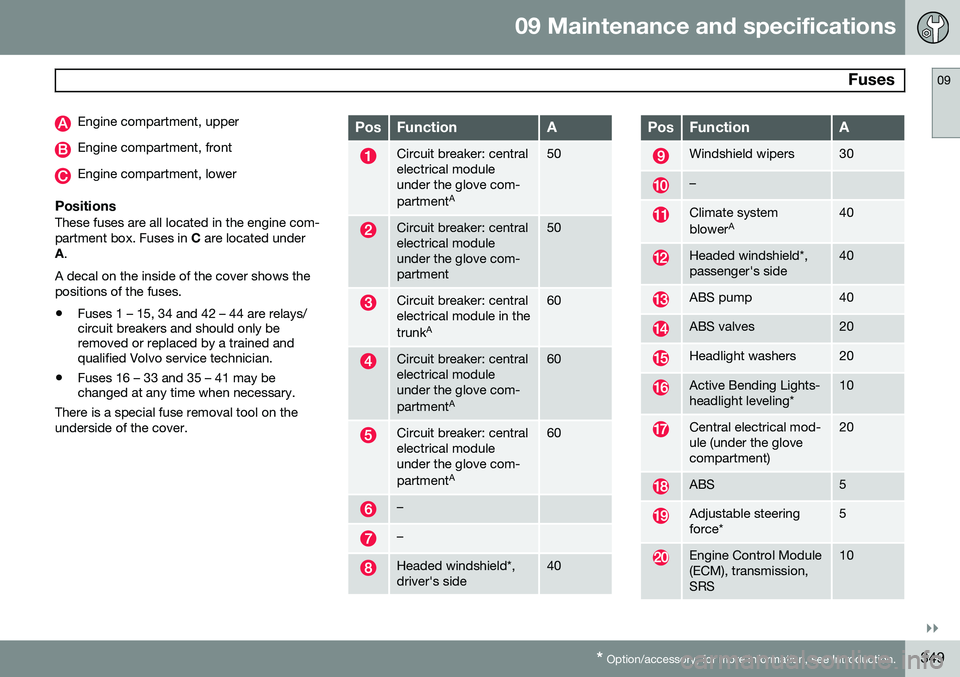
Engine compartment, upper
Engine compartment, front
Engine compartment, lower
PositionsThese fuses are all located in the engine com- partment box. Fuses in C are located under
A .
A decal on the inside of the cover shows thepositions of the fuses. • Fuses 1 – 15, 34 and 42 – 44 are relays/ circuit breakers and should only beremoved or replaced by a trained andqualified Volvo service technician.
• Fuses 16 – 33 and 35 – 41 may bechanged at any time when necessary.
There is a special fuse removal tool on the underside of the cover.
PosFunctionA
Circuit breaker: central electrical moduleunder the glove com- partment A50
Circuit breaker: central electrical moduleunder the glove com-partment50
Circuit breaker: central electrical module in the trunkA60
Circuit breaker: central electrical moduleunder the glove com- partment A60
Circuit breaker: central electrical moduleunder the glove com- partmentA60
–
–
Headed windshield*, driver's side40
PosFunctionA
Windshield wipers30
–
Climate system blower
A40
Headed windshield*, passenger's side40
ABS pump40
ABS valves20
Headlight washers20
Active Bending Lights- headlight leveling*10
Central electrical mod- ule (under the glovecompartment)20
ABS5
Adjustable steering force*5
Engine Control Module (ECM), transmission,SRS10
Page 352 of 392
09 Maintenance and specifications
Fuses 09
350* Option/accessory, for more information, see Introduction.
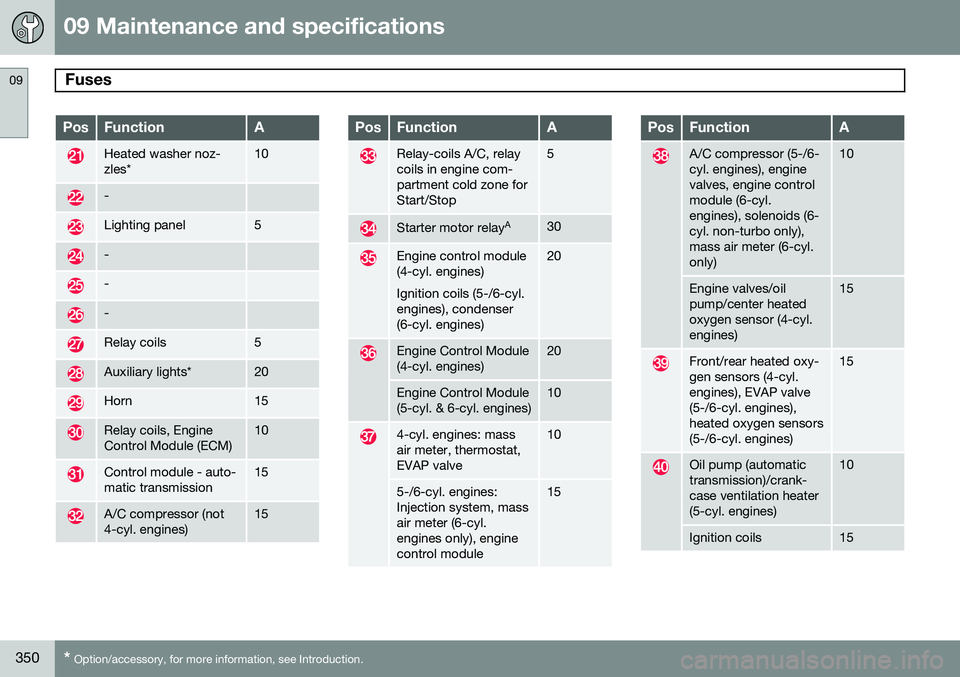
PosFunctionA
Heated washer noz- zles*10
-
Lighting panel5
-
-
-
Relay coils5
Auxiliary lights*20
Horn15
Relay coils, Engine Control Module (ECM)10
Control module - auto- matic transmission15
A/C compressor (not 4-cyl. engines)15
PosFunctionA
Relay-coils A/C, relay coils in engine com-partment cold zone forStart/Stop5
Starter motor relay A30
Engine control module (4-cyl. engines) Ignition coils (5-/6-cyl. engines), condenser(6-cyl. engines)20
Engine Control Module (4-cyl. engines)20
Engine Control Module (5-cyl. & 6-cyl. engines)10
4-cyl. engines: mass air meter, thermostat,EVAP valve10
5-/6-cyl. engines: Injection system, massair meter (6-cyl.engines only), enginecontrol module15
PosFunctionA
A/C compressor (5-/6- cyl. engines), enginevalves, engine controlmodule (6-cyl.engines), solenoids (6-cyl. non-turbo only),mass air meter (6-cyl.only)10
Engine valves/oil pump/center heatedoxygen sensor (4-cyl.engines)15
Front/rear heated oxy- gen sensors (4-cyl.engines), EVAP valve(5-/6-cyl. engines),heated oxygen sensors(5-/6-cyl. engines)15
Oil pump (automatic transmission)/crank-case ventilation heater(5-cyl. engines)10
Ignition coils15
Page 375 of 392
10 Specifications
Specifications
10
}}
373
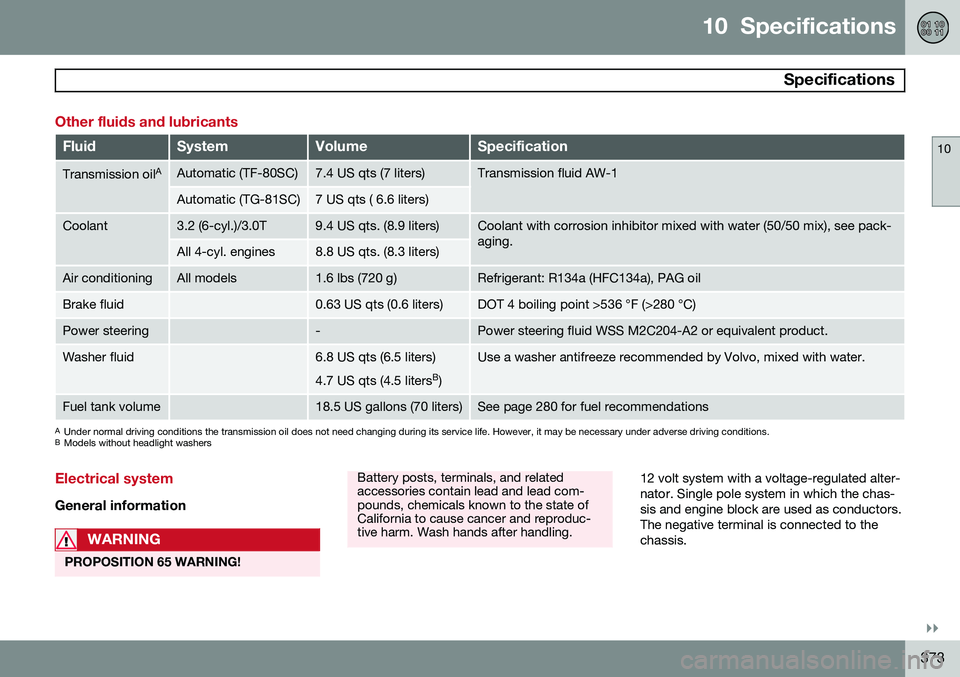
Other fluids and lubricants
FluidSystemVolumeSpecification
Transmission oilAAutomatic (TF-80SC)7.4 US qts (7 liters)Transmission fluid AW-1
Automatic (TG-81SC)7 US qts ( 6.6 liters)
Coolant3.2 (6-cyl.)/3.0T9.4 US qts. (8.9 liters)Coolant with corrosion inhibitor mixed with water (50/50 mix), see pack- aging.
All 4-cyl. engines8.8 US qts. (8.3 liters)
Air conditioningAll models1.6 lbs (720 g)Refrigerant: R134a (HFC134a), PAG oil
Brake fluid0.63 US qts (0.6 liters)DOT 4 boiling point >536 °F (>280 °C)
Power steering-Power steering fluid WSS M2C204-A2 or equivalent product.
Washer fluid6.8 US qts (6.5 liters) 4.7 US qts (4.5 liters B
)Use a washer antifreeze recommended by Volvo, mixed with water.
Fuel tank volume18.5 US gallons (70 liters)See page 280 for fuel recommendations
A Under normal driving conditions the transmission oil does not need changing during its service life. However, it may be necessary under adverse driving conditions.
B Models without headlight washers
Electrical system
General information
WARNING
PROPOSITION 65 WARNING!
Battery posts, terminals, and related accessories contain lead and lead com-pounds, chemicals known to the state ofCalifornia to cause cancer and reproduc-tive harm. Wash hands after handling.12 volt system with a voltage-regulated alter- nator. Single pole system in which the chas-sis and engine block are used as conductors.The negative terminal is connected to thechassis.
Page 382 of 392
11 Index
11
380
1, 2, 3 ...
12-volt sockets........................................ 227
A
ABS (anti-lock brake system).................. 136
Accessory installation warning.................. 13
Active chassis system............................. 224
Active high beams..................................... 95Active yaw control................................... 144
Adaptive brake lights............................... 135
Adaptive cruise control.................... 150, 152 queue assist........................................ 155
Airbags disconnecting the front passenger’s
side................................................. 26, 27
front...................................................... 22
inflatable curtain................................... 32
side impact........................................... 30
Air conditioning........................................ 212
Air distribution.......................................... 208
Air distribution table................................. 216
Air vents................................................... 209 All Wheel Drive......................................... 124
Ambient temperature sensor..................... 81
Anti-freeze....................................... 278, 332Anti-lock brake system
warning light......................................... 79
Anti-lock Brake System (ABS)................. 136
Approach lighting.............................. 57, 101Audio system AUX/USB sockets............................... 256 Bluetooth ®
devices............................. 259
Bluetooth ®
hands-free system........... 261
Bluetooth streaming audio................. 259
getting started.................................... 233
HD digital radio................................... 244
introduction......................................... 232
media player....................................... 251
overview.............................................. 232
radio functions.................................... 242SiriusXM ™ satellite radio.................... 246
sound settings.................................... 237
steering wheel keypad........................ 233
voice control....................................... 270
Auto-dim rearview mirror......................... 107
Automatic locking retractor....................... 38 Automatic transmission
Eco (driving function).......................... 128
Geartronic........................................... 122
general description..................... 121, 122
oil........................................................ 373
shiftlock override................................ 124
Axle weight.............................................. 304
B
Battery maintenance....................................... 344
remote key, replacing........................... 61
replacing..................................... 344, 345
specifications...................................... 373
warning symbols................................. 343
Blind Spot Information System (BLIS)..... 192
Bluetooth cell phone connection............. 261
Booster cushions....................................... 47
Brake lights.............................................. 135Brake system ABS..................................................... 136
Brake pad inspection.......................... 135
checking fluid level............................. 332
emergency brake assistance.............. 136
Page 384 of 392
11 Index
11
382
Driving economically................................ 276
Driving in cold weather............................ 278
Driving through water.............................. 277
E
ECC......................................... 210, 212, 214
Eco (driving function)............................... 128
Eco coast................................................. 128
Eco guide................................................. 126
Economical driving.................................. 276
Electrically heated steering wheel............. 93
Electric parking brake.............................. 138
Electronic Climate Control....... 210, 212, 214air distribution table............................ 216
Interior Air Quality System.................. 214
ventilated seats................................... 210
Emergency locking retractor...................... 38
Emergency starting.................................. 119
Emergency towing................................... 289
Emission inspection readiness................ 326Engine overheating........................................... 80
specifications...................................... 370 Start/Stop........................................... 131
starting................................................ 116
switching off....................................... 119
Engine compartment overview................ 328
Engine oil................................................. 371 checking............................................. 330
low pressure warning light.................... 79
volumes.............................................. 372
Engine remote start (ERS)........................ 118
Environment............................................... 12
Eyelets for anchoring loads..................... 284
F
Federal Clean Air Act............................... 324 Flat tires repairing with tire sealing system....... 309
Floor mats cleaning.............................................. 361
placing correctly................................. 116
Fluid specifications.................................. 373
Fog lights................................................... 79 rear........................................................ 98
Four C (active chassis system)................ 224 Front airbags.............................................. 22
disconnecting passenger’s side air-
bag.................................................. 26, 27
Front park assist.............................. 185, 187
Front seats........................................... 86, 88 heated................................................. 210
Fuel filler cap........................................... 282
Fuel filler door, opening........................... 281
Fuel level warning light.............................. 79
Fuel requirements............................ 279, 280
Fuel tank volume..................................... 373
Fuses............................... 347, 348, 352, 355G
Garage door opener HomeLink ®
Wireless Control System. 113
Gasoline requirements............................. 280
Gas tank volume...................................... 373
Gauges...................................................... 75
Geartronic................................................ 122
Geartronic automatic transmission.......... 122
Generator warning light............................. 80