headlights VOLVO S80 2016 Owner´s Manual
[x] Cancel search | Manufacturer: VOLVO, Model Year: 2016, Model line: S80, Model: VOLVO S80 2016Pages: 380, PDF Size: 9.45 MB
Page 322 of 380
||
10 Maintenance and servicing
10
320* Option/accessory, for more information, see Introduction.
CAUTION
Never touch the glass of bulbs with your fingers. Grease and oils from your fingersvaporize in the heat and will leave adeposit on the reflector, which will damageit.
WARNING
• The engine should not be running when changing bulbs.
• If the engine has been running justprior to replacing bulbs in the head-light housing, please keep in mind thatcomponents in the engine compart-ment will be hot.
WARNING
•
Active Bending Lights* – due to the high voltage used by these headlights,these bulbs should only be replacedby a trained and qualified Volvo serv-ice technician.
• Turn off the lights and remove theremote key from the ignition beforechanging any bulbs.
Related information
•
Bulbs – headlight housing (p. 320)
• Bulbs – taillight housing (p. 324)
• Bulbs – vanity mirror lighting (p. 326)
• Bulbs – license plate lighting (p. 325)
Bulbs – headlight housing
The entire headlight housing must be lifted out when replacing all front bulbs.
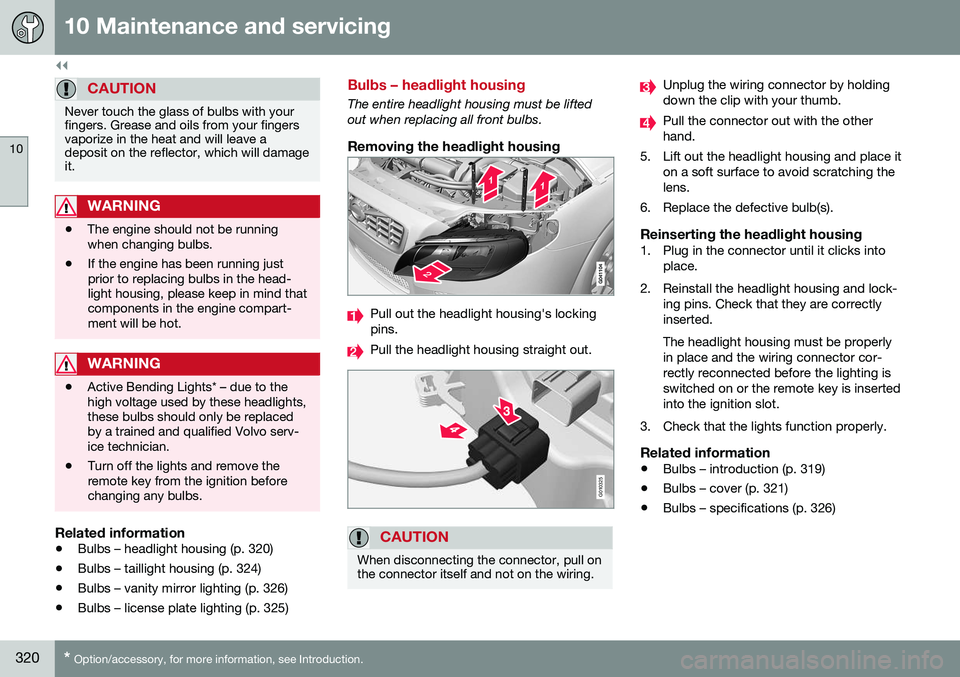
Removing the headlight housing
Pull out the headlight housing's locking pins.
Pull the headlight housing straight out.
G010325
CAUTION
When disconnecting the connector, pull on the connector itself and not on the wiring.
Unplug the wiring connector by holding down the clip with your thumb.
Pull the connector out with the other hand.
5. Lift out the headlight housing and place it on a soft surface to avoid scratching thelens.
6. Replace the defective bulb(s).
Reinserting the headlight housing1. Plug in the connector until it clicks into place.
2. Reinstall the headlight housing and lock- ing pins. Check that they are correctlyinserted. The headlight housing must be properly in place and the wiring connector cor-rectly reconnected before the lighting isswitched on or the remote key is insertedinto the ignition slot.
3. Check that the lights function properly.
Related information
• Bulbs – introduction (p. 319)
• Bulbs – cover (p. 321)
• Bulbs – specifications (p. 326)
Page 331 of 380
10 Maintenance and servicing
10
329
With the wipers in the service position, fold out the wiper arm from the wind-shield. Press the button on the wiperblade attachment and pull the wiperblade straight out, parallel with the wiperarm.
Slide in the new wiper blade until it clicks into place.
Check that the blade is securely in place.
4. Press the wipers back against the wind- shield.
To return the wipers from the service position to the normal position, fold the wipers backagainst the windshield and press the START/
STOP ENGINE button briefly to put the igni-
tion in mode I (or start the engine).
CleaningKeeping the windshield and wiper bladesclean helps improve visibility and prolongsthe service life of the wiper blades. Clean thewiper blades with a stiff-bristle brush andlukewarm soap solution or car washing deter-gent.
Related information
• Engine compartment – washer fluid (p. 329)
• Wiper blades – service position (p. 327)
Engine compartment – washer fluid
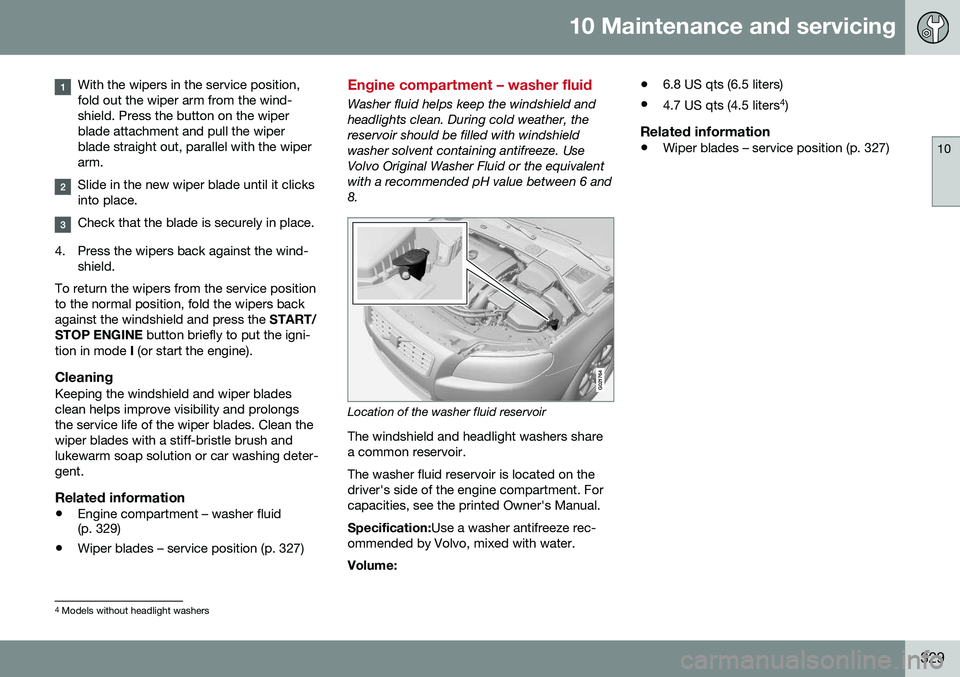
Washer fluid helps keep the windshield and headlights clean. During cold weather, thereservoir should be filled with windshieldwasher solvent containing antifreeze. UseVolvo Original Washer Fluid or the equivalentwith a recommended pH value between 6 and8.
G021764
Location of the washer fluid reservoir
The windshield and headlight washers share a common reservoir. The washer fluid reservoir is located on the driver's side of the engine compartment. Forcapacities, see the printed Owner's Manual. Specification: Use a washer antifreeze rec-
ommended by Volvo, mixed with water. Volume: •
6.8 US qts (6.5 liters)
• 4.7 US qts (4.5 liters 4
)
Related information
• Wiper blades – service position (p. 327)
4
Models without headlight washers
Page 347 of 380
10 Maintenance and servicing
10
345
Washing the car
The vehicle should be washed at regular inter- vals since dirt, dust, insects and tar spotsadhere to the paint and may cause damage.To help prevent corrosion, it is particularlyimportant to wash the car frequently in thewintertime. The following points should be kept in mind when washing and cleaning the car: •Avoid washing your car in direct sunlight. Doing so may cause detergents and waxto dry out and become abrasive. To avoidscratching, use lukewarm water to softenthe dirt before you wash with a softsponge, and plenty of sudsy water.
• Bird droppings
: Remove from paintwork
as soon as possible. Otherwise the finishmay be permanently damaged.
• A detergent can be used to facilitate thesoftening of dirt and oil.
• Dry the car with a clean chamois andremember to clean the drain holes in thedoors and rocker panels.
• Tar spots can be removed with tarremover after the car has been washed.
• A stiff-bristle brush and lukewarm soapywater can be used to clean the wiperblades. Frequent cleaning of the wind-shield and wiper blades improves visibilityconsiderably and also helps prolong theservice life of the wiper blades. •
Wash off the dirt from the underside(wheel housings, fenders, etc).
• In areas of high industrial fallout, morefrequent washing is recommended.
NOTE
When washing the car, remember to remove dirt from the drain holes in thedoors and sills.
CAUTION
• During high pressure washing, the spray mouthpiece must never becloser to the vehicle than 13" (30 cm).Do not spray into the locks.
• Dirt, snow, etc., on the headlights canreduce lighting capacity considerably.Clean the headlights regularly, forexample when refueling.
Special moonroof cautions:
• Always close the moonroof and sunshade before washing your vehicle.
• Never use abrasive cleaning agents onthe moonroof.
• Never use wax on the rubber sealsaround the moonroof.
Exterior componentsVolvo recommends the use of special clean- ing products, available at your Volvo retailer, for cleaning colored plastic, rubber, or orna-mental components such as chromed stripson the exterior of your vehicle. The instruc-tions for using these products should be fol-lowed carefully. Solvents or stain removersshould not be used.
CAUTION
•
Avoid waxing or polishing plastic or rubber components
• Polishing chromed strips can wearaway or damage the surface
• Polishes containing abrasive sub-stances should not be used
Related information
•
Polishing and waxing (p. 346)
• Cleaning the interior (p. 347)
Page 348 of 380
10 Maintenance and servicing
10
346
Automatic car wash
The vehicle should be washed at regular inter- vals since dirt, dust, insects and tar spotsadhere to the paint and may cause damage.To help prevent corrosion, it is particularlyimportant to wash the car frequently in thewintertime.• We do NOT recommend washing your car in an automatic wash during the firstfew months (because the paint will nothave hardened sufficiently).
• An automatic wash is a simple and quickway to clean your car, but it is worthremembering that it may not be as thor-ough as when you yourself go over thecar with sponge and water. Keeping theunderbody clean is most important, espe-cially in the winter. Some automaticwashers do not have facilities for washingthe underbody.
NOTE
Condensation may form temporarily on the inside of the lenses of exterior lights suchas headlights, fog lights, or taillights. Thisis normal and the lights are designed towithstand moisture. Normally, condensa-tion will dissipate after the lights have beenon for a short time.
CAUTION
• Before driving into an automatic car wash, turn off the optional rain sensorto avoid damaging the windshield wip-ers.
• Make sure that side view mirrors, aux-iliary lamps, etc, are secure, and thatany antenna(s) are retracted orremoved. Otherwise there is risk of themachine dislodging them.
• Chromed wheels:
Clean chrome-
plated wheels using the same deter-gents used for the body of the vehicle.Aggressive wheel-cleaning agents canpermanently stain chrome-platedwheels.
WARNING
• When the vehicle is driven immediately after being washed, apply the brakes,including the parking brake, severaltimes in order to remove any moisturefrom the brake linings.
• Engine cleaning agents should not beused when the engine is warm. Thisconstitutes a fire risk.
Related information
•
Polishing and waxing (p. 346)
• Cleaning the interior (p. 347)
• Washing the car (p. 345)
Polishing and waxing
Normally, polishing is not required during the first year after delivery, however, waxing maybe beneficial.
• Before applying polish or wax the vehicle must be washed and dried. Tar spots canbe removed with kerosene or tar remover.Difficult spots may require a fine rubbingcompound.
• After polishing use liquid or paste wax.
• Several commercially available productscontain both polish and wax.
• Waxing alone does not substitute for pol-ishing a dull surface.
• A wide range of polymer-based waxescan be purchased today. These waxesare easy to use and produce a long-last-ing, high-gloss finish that protects thebodywork against oxidation, road dirt andfading.
• Do not polish or wax your vehicle in directsunlight (the surface of the vehicle shouldnot be warmer than 113 °F (45 °C).
Page 370 of 380
12 Index
12
368
A
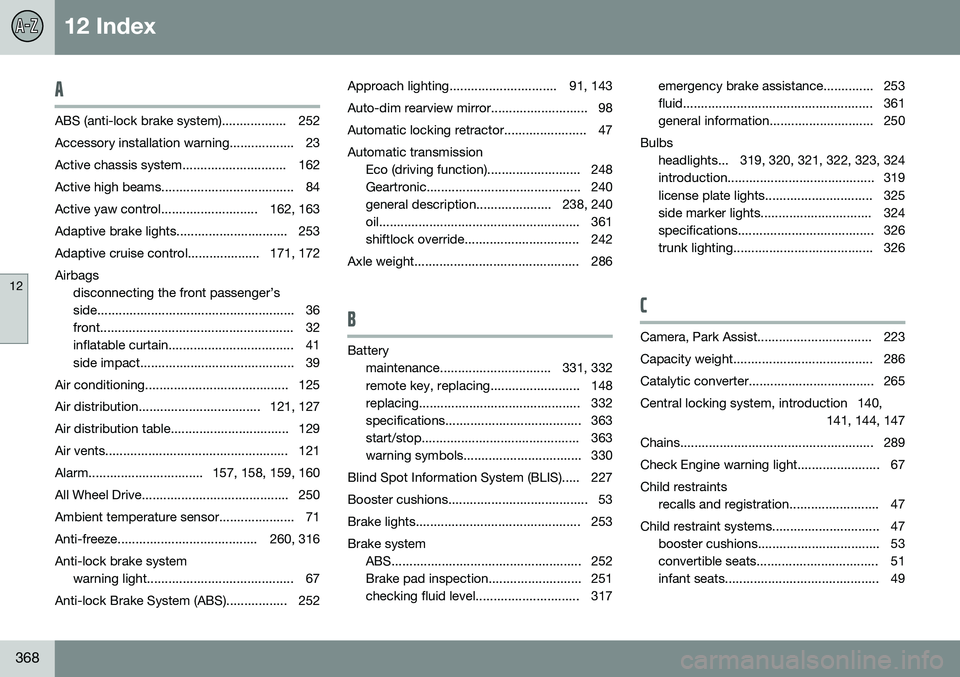
ABS (anti-lock brake system).................. 252
Accessory installation warning.................. 23
Active chassis system............................. 162
Active high beams..................................... 84Active yaw control........................... 162, 163
Adaptive brake lights............................... 253
Adaptive cruise control.................... 171, 172Airbags disconnecting the front passenger’s
side....................................................... 36
front...................................................... 32
inflatable curtain................................... 41
side impact........................................... 39
Air conditioning........................................ 125
Air distribution.................................. 121, 127
Air distribution table................................. 129
Air vents................................................... 121
Alarm................................ 157, 158, 159, 160
All Wheel Drive......................................... 250
Ambient temperature sensor..................... 71
Anti-freeze....................................... 260, 316Anti-lock brake system warning light......................................... 67
Anti-lock Brake System (ABS)................. 252 Approach lighting.............................. 91, 143
Auto-dim rearview mirror........................... 98
Automatic locking retractor....................... 47Automatic transmission
Eco (driving function).......................... 248
Geartronic........................................... 240
general description..................... 238, 240
oil........................................................ 361
shiftlock override................................ 242
Axle weight.............................................. 286
B
Battery maintenance............................... 331, 332
remote key, replacing......................... 148
replacing............................................. 332
specifications...................................... 363
start/stop............................................ 363
warning symbols................................. 330
Blind Spot Information System (BLIS)..... 227
Booster cushions....................................... 53
Brake lights.............................................. 253Brake system ABS..................................................... 252
Brake pad inspection.......................... 251
checking fluid level............................. 317 emergency brake assistance.............. 253
fluid..................................................... 361
general information............................. 250
Bulbs headlights... 319, 320, 321, 322, 323, 324
introduction......................................... 319
license plate lights.............................. 325
side marker lights............................... 324
specifications...................................... 326
trunk lighting....................................... 326
C
Camera, Park Assist................................ 223
Capacity weight....................................... 286
Catalytic converter................................... 265
Central locking system, introduction 140, 141, 144, 147
Chains...................................................... 289
Check Engine warning light....................... 67Child restraints recalls and registration......................... 47
Child restraint systems.............................. 47 booster cushions.................................. 53
convertible seats.................................. 51
infant seats........................................... 49
Page 372 of 380
12 Index
12
370
Engine compartment overview................ 313
Engine oil................................................. 359checking............................................. 314
low pressure warning light.................... 68
volumes.............................................. 360
Engine remote start (ERS)........................ 235
Environment............................................... 22
F
Federal Clean Air Act............................... 307 Flat tires repairing with tire sealing system....... 298
Floor mats cleaning.............................................. 348
placing correctly................................. 233
Fluid specifications.......................... 361, 362
Fog lights................................................... 67 rear........................................................ 87
Four C (active chassis system)................ 162
Front airbags.............................................. 32 disconnecting passenger’s side airbag 36
Front park assist.............................. 219, 223
Front seats................................................. 74 heated................................................. 123
Fuel filler cap........................................... 264 Fuel filler door, opening................... 263, 264
Fuel level warning light.............................. 67
Fuel requirements............................ 261, 262
Fuel tank volume..................................... 362
Fuses....................................... 333, 335, 342
G
Garage door opener
HomeLink ®
Wireless Control
System........................................ 102, 103
Gasoline requirements............................. 262
Gas tank volume...................................... 362
Gauges...................................................... 62
Geartronic................................................ 240
Geartronic automatic transmission.......... 240
Generator warning light............................. 69
Glossary of tire terminology..................... 287
Grocery bag holder.................................. 138
Gross vehicle weight............................... 286
H
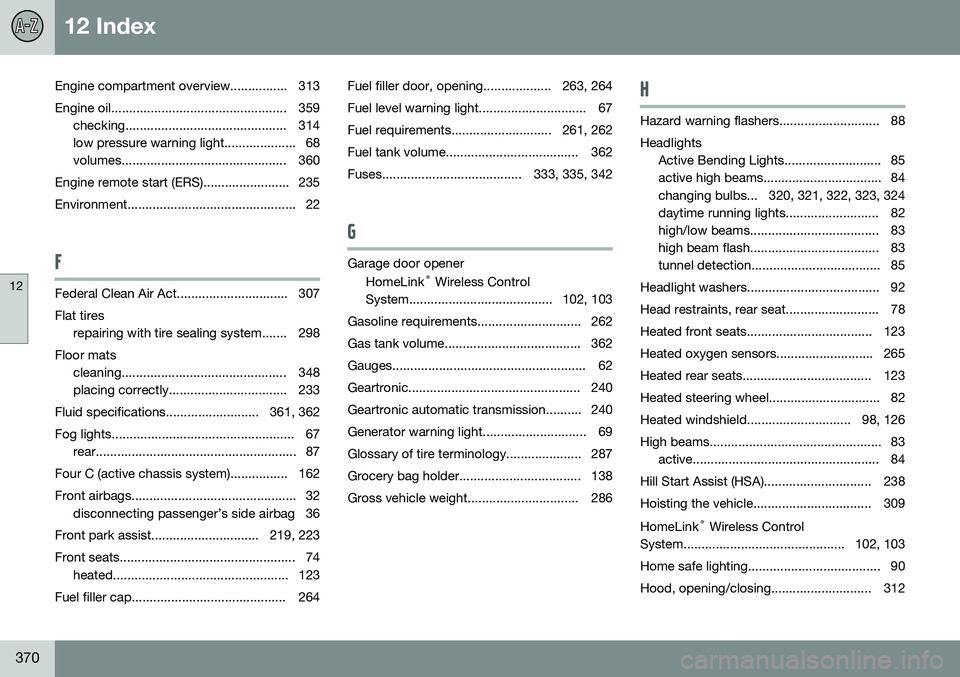
Hazard warning flashers............................ 88 Headlights Active Bending Lights........................... 85
active high beams................................. 84
changing bulbs... 320, 321, 322, 323, 324
daytime running lights.......................... 82
high/low beams.................................... 83
high beam flash.................................... 83
tunnel detection.................................... 85
Headlight washers..................................... 92
Head restraints, rear seat.......................... 78
Heated front seats................................... 123
Heated oxygen sensors........................... 265
Heated rear seats.................................... 123
Heated steering wheel............................... 82
Heated windshield............................. 98, 126
High beams................................................ 83 active.................................................... 84
Hill Start Assist (HSA).............................. 238
Hoisting the vehicle................................. 309 HomeLink ®
Wireless Control
System............................................. 102, 103
Home safe lighting..................................... 90
Hood, opening/closing............................ 312