ignition VOLVO S80 2016 Owner´s Manual
[x] Cancel search | Manufacturer: VOLVO, Model Year: 2016, Model line: S80, Model: VOLVO S80 2016Pages: 380, PDF Size: 9.45 MB
Page 333 of 380
10 Maintenance and servicing
10
}}
331
CAUTION
The infotainment system's energy-saving feature may not function correctly or at all,and/or a message may be displayed if abattery charger or jumper cables are notconnected properly.
• The negative terminal on the battery must
never be used to connect a
jumper cable or a battery charger.Only the ground point on the chassismay be used.
See Jump starting (p. 237) for an illustra- tion and additional information.
WARNING
• Never expose the battery to open flame or electric spark.
• Do not smoke near the battery.
• Battery fluid contains sulfuric acid. Donot allow battery fluid to contact eyes,skin, fabrics or painted surfaces. Ifcontact occurs, flush the affected areaimmediately with water. Obtain medi-cal help immediately if eyes are affec-ted.
NOTE
The life of the battery is shortened if it becomes discharged repeatedly.
Related information
•
Battery – changing (p. 332)
• Battery – maintenance (p. 331)
• Battery – symbols (p. 330)
Battery – maintenance
Proper battery maintenance can help prolong its service life.
Maintenance
• Use a screw driver to open the caps or cover and a flashlight to inspect the level.
• If necessary, add distilled water. The levelshould never be above the indicator.
• The fluid level should be checked if thebattery has been recharged.
• After inspection, be sure the cap overeach battery cell or the cover is securelyin place.
• Check that the battery cables are cor-rectly connected and properly tightened.
• Never disconnect the battery when theengine is running, or when the key is inthe ignition. This could damage the vehi-cle's electrical system.
• The battery should be disconnected fromthe vehicle when a battery charger isused directly on the battery.
• To help keep the battery in good condi-tion, the vehicle should be driven for atleast 15 minutes a week or connected toa charger with an automatic chargingfunction.
• If the battery is fully discharged a numberof times, this may shorten its service life.Keeping the battery fully charged helpsprolong its service life.
Page 335 of 380
10 Maintenance and servicing
10
}}
333
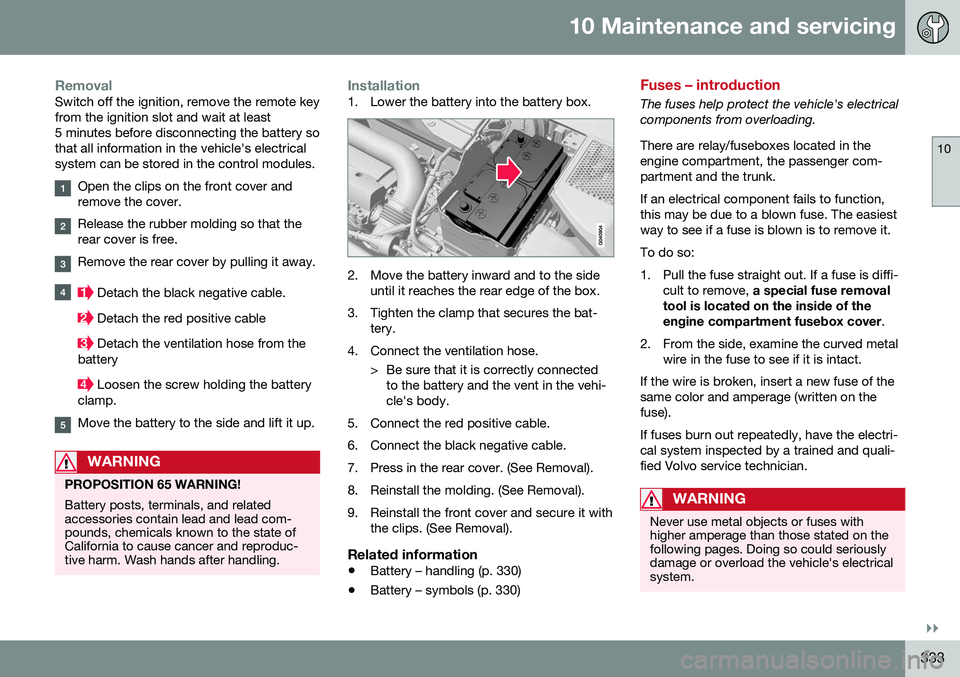
RemovalSwitch off the ignition, remove the remote key from the ignition slot and wait at least5 minutes before disconnecting the battery sothat all information in the vehicle's electricalsystem can be stored in the control modules.
Open the clips on the front cover and remove the cover.
Release the rubber molding so that the rear cover is free.
Remove the rear cover by pulling it away.
Detach the black negative cable.
Detach the red positive cable
Detach the ventilation hose from the
battery
Loosen the screw holding the battery
clamp.
Move the battery to the side and lift it up.
WARNING
PROPOSITION 65 WARNING! Battery posts, terminals, and related accessories contain lead and lead com-pounds, chemicals known to the state ofCalifornia to cause cancer and reproduc-tive harm. Wash hands after handling.
Installation1. Lower the battery into the battery box.
2. Move the battery inward and to the side until it reaches the rear edge of the box.
3. Tighten the clamp that secures the bat- tery.
4. Connect the ventilation hose. > Be sure that it is correctly connectedto the battery and the vent in the vehi- cle's body.
5. Connect the red positive cable.
6. Connect the black negative cable.
7. Press in the rear cover. (See Removal).
8. Reinstall the molding. (See Removal).
9. Reinstall the front cover and secure it with the clips. (See Removal).
Related information
• Battery – handling (p. 330)
• Battery – symbols (p. 330)
Fuses – introduction
The fuses help protect the vehicle's electrical components from overloading. There are relay/fuseboxes located in the engine compartment, the passenger com-partment and the trunk. If an electrical component fails to function, this may be due to a blown fuse. The easiestway to see if a fuse is blown is to remove it. To do so:
1. Pull the fuse straight out. If a fuse is diffi-
cult to remove, a special fuse removal
tool is located on the inside of the engine compartment fusebox cover .
2. From the side, examine the curved metal wire in the fuse to see if it is intact.
If the wire is broken, insert a new fuse of the same color and amperage (written on thefuse). If fuses burn out repeatedly, have the electri- cal system inspected by a trained and quali-fied Volvo service technician.
WARNING
Never use metal objects or fuses with higher amperage than those stated on thefollowing pages. Doing so could seriouslydamage or overload the vehicle's electricalsystem.
Page 339 of 380
10 Maintenance and servicing
10
}}
* Option/accessory, for more information, see Introduction.337
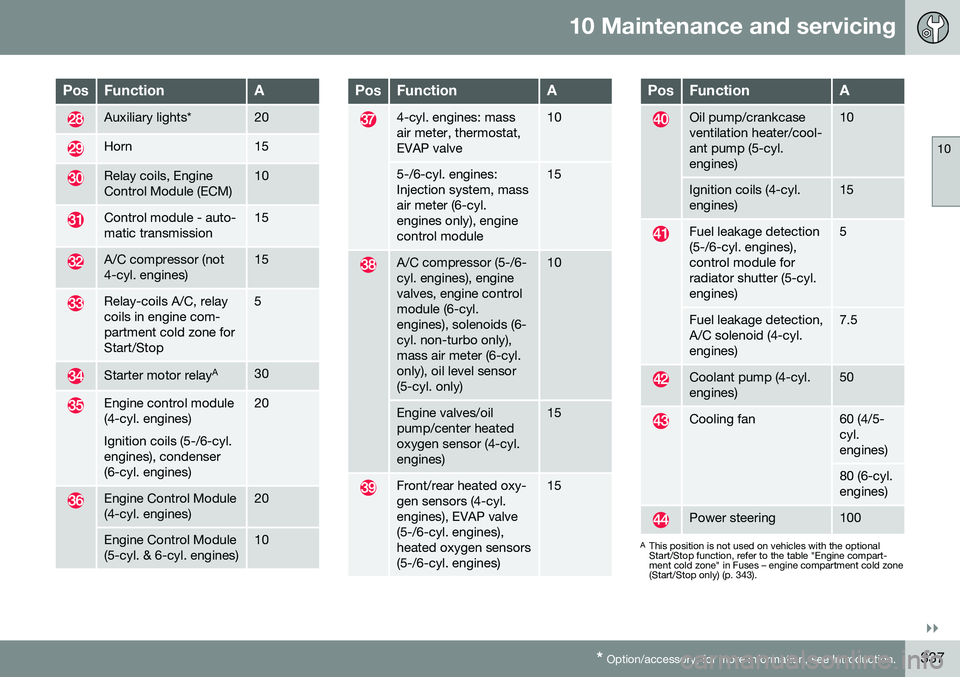
PosFunctionA
Auxiliary lights*20
Horn15
Relay coils, Engine Control Module (ECM)10
Control module - auto- matic transmission15
A/C compressor (not 4-cyl. engines)15
Relay-coils A/C, relay coils in engine com-partment cold zone forStart/Stop5
Starter motor relay A30
Engine control module (4-cyl. engines) Ignition coils (5-/6-cyl. engines), condenser(6-cyl. engines)20
Engine Control Module (4-cyl. engines)20
Engine Control Module (5-cyl. & 6-cyl. engines)10
PosFunctionA
4-cyl. engines: mass air meter, thermostat,EVAP valve10
5-/6-cyl. engines: Injection system, massair meter (6-cyl.engines only), enginecontrol module15
A/C compressor (5-/6- cyl. engines), enginevalves, engine controlmodule (6-cyl.engines), solenoids (6-cyl. non-turbo only),mass air meter (6-cyl.only), oil level sensor(5-cyl. only)10
Engine valves/oil pump/center heatedoxygen sensor (4-cyl.engines)15
Front/rear heated oxy- gen sensors (4-cyl.engines), EVAP valve(5-/6-cyl. engines),heated oxygen sensors(5-/6-cyl. engines)15
PosFunctionA
Oil pump/crankcase ventilation heater/cool-ant pump (5-cyl.engines)10
Ignition coils (4-cyl. engines)15
Fuel leakage detection (5-/6-cyl. engines),control module forradiator shutter (5-cyl.engines)5
Fuel leakage detection, A/C solenoid (4-cyl.engines)7.5
Coolant pump (4-cyl. engines)50
Cooling fan60 (4/5- cyl.engines)
80 (6-cyl. engines)
Power steering100
A
This position is not used on vehicles with the optional Start/Stop function, refer to the table "Engine compart-ment cold zone" in Fuses – engine compartment cold zone(Start/Stop only) (p. 343).
Page 373 of 380
12 Index
12
371
Horn........................................................... 81
I
ID, Volvo.................................................... 21
Ignition modes..................................... 72, 73
Immobilizer.............................................. 142
Important information.......................... 13, 14
Indicator lights............................... 62, 64, 68
Infant seats................................................ 49
Inflatable Curtain........................................ 41
Inflation pressure............................. 281, 282
Inflation pressure table............................ 285Information and warning symbols, table
of.............................................................. 364
Information lights........................... 62, 64, 68
Inspection readiness................................ 310
Instrument lighting..................................... 86
"theater" lighting................................... 86
Instrument overview............................ 59, 62
Instrument panel........................ 62, 106, 107
Interior Air Quality System....................... 119
Interior lighting........................................... 89Internet connection booking service.................................. 310 ISOFIX/LATCH anchors............................. 54
J
Jack
attaching............................................. 276
location of........................................... 276
Jump starting........................................... 237
K
Key blade. 140, 141, 144, 145, 146, 147, 150 private locking.................................... 146
valet locking........................................ 146
Keyless drive............................................ 149 general description............. 150, 151, 152
starting the vehicle............................. 233
Keyless locking/unlocking....................... 149
L
Labels list of................................................... 354
location of........................................... 353
Lane Departure Warning (LDW) 214, 216, 217LATCH anchors......................................... 54
Leather care............................................. 347
Lighting panel............................................ 82
Loading the vehicle.................. 136, 138, 286
roof loads............................................ 137
Locking............................ 153, 154, 155, 156
Locking the vehicle.................................. 143
Locks, child safety..................................... 57
Low beams................................................ 83
Low oil pressure warning light................... 68
M
Main instrument panel..................... 106, 107
Maintenance............................................ 307 hoisting the vehicle............................. 309
performed by the owner..................... 308
Malfunction indicator light......................... 67
Messages in the instrument panel... 106, 107Mirrors defroster............................................... 98
power door..................................... 96, 97
rearview, auto-dim function.................. 98
retractable....................................... 96, 97
vanity.................................................. 135
Moonroof......................................... 100, 101