air condition VOLVO S90 1998 User Guide
[x] Cancel search | Manufacturer: VOLVO, Model Year: 1998, Model line: S90, Model: VOLVO S90 1998Pages: 175, PDF Size: 4.45 MB
Page 74 of 175
1998 Volvo S90
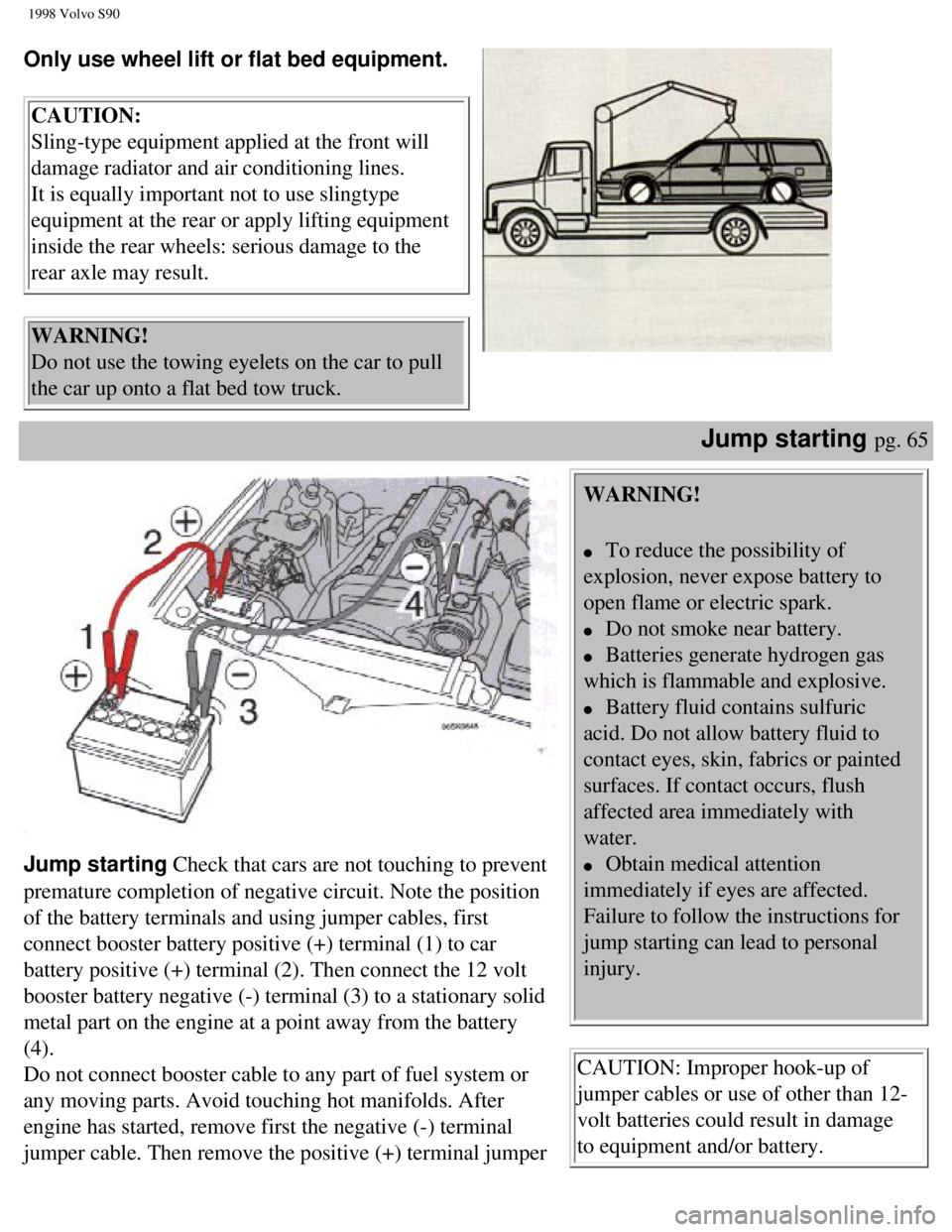
Only use wheel lift or flat bed equipment.
CAUTION:
Sling-type equipment applied at the front will
damage radiator and air conditioning lines.
It is equally important not to use slingtype
equipment at the rear or apply lifting equipment
inside the rear wheels: serious damage to the
rear axle may result.
WARNING!
Do not use the towing eyelets on the car to pull
the car up onto a flat bed tow truck.
Jump starting pg. 65
Jump starting Check that cars are not touching to prevent
premature completion of negative circuit. Note the position
of the battery terminals and using jumper cables, first
connect booster battery positive (+) terminal (1) to car
battery positive (+) terminal (2). Then connect the 12 volt
booster battery negative (-) terminal (3) to a stationary solid
metal part on the engine at a point away from the battery
(4).
Do not connect booster cable to any part of fuel system or
any moving parts. Avoid touching hot manifolds. After
engine has started, remove first the negative (-) terminal
jumper cable. Then remove the positive (+) terminal jumper
WARNING!
l To reduce the possibility of
explosion, never expose battery to
open flame or electric spark.
l Do not smoke near battery.
l Batteries generate hydrogen gas
which is flammable and explosive.
l Battery fluid contains sulfuric
acid. Do not allow battery fluid to
contact eyes, skin, fabrics or painted
surfaces. If contact occurs, flush
affected area immediately with
water.
l Obtain medical attention
immediately if eyes are affected.
Failure to follow the instructions for
jump starting can lead to personal
injury.
CAUTION: Improper hook-up of
jumper cables or use of other than 12-
volt batteries could result in damage
to equipment and/or battery.
file:///K|/ownersdocs/1998/1998_SV90/98S90_063.htm (2 of 4)12/30/2006 \
1:52:43 PM
Page 79 of 175
1998 Volvo S90
Observe legal requirements of
the state in which the vehicles
are registered.
WARNING! Bumper-
attached trailer hitches must
not be used on Volvos, nor
should safety chains be
attached to the bumper.
Trailer hitches attaching to
the vehicle rear axle must
not be used. kgs) a top speed of 50 mph (80
km/h) should never be
exceeded.
l Increase tire pressure to
recommended full-load
pressure. See section "Wheels
and tires".
l Engine and transmission are
subject to increased loads.
Therefore, engine coolant
temperature should be closely
watched when driving in hot
climates or hilly terrain. Use
lower gear and turn off air
conditioner if temperature gauge
pointer enters the red range.
towing a trailer to ensure that the
max. permissible axle load or
gross vehicle weight are not
exceeded.
NOTE: Refer to section
"Automatic transmission" for
additional trailer hauling tips.
Winter driving pg. 69
Cold weather precautions
l If you wish to check your car before the
approach of cold weather, the following advice is
worth noting:
Make sure that the engine coolant contains at least
50 percent antifreeze: that is, 5.3 qts. (5 liters)
Volvo Genuine Coolant/Antifreeze. This gives
protection against freezing down to -31°F (-35°
C). See section "Coolant".
The use of "recycled" antifreeze is not approved
by Volvo. Different types of antifreeze may not be
mixed.
l Try to keep the fuel tank well filled - this
prevents the formation of condensation in the
tank.
In addition in extremely cold weather conditions it
is worthwhile to add fuel line de-icer before
refueling.
l The viscosity of the engine oil is important. Oil
with low viscosity (thinner oil) improves cold-
weather starting as well as decreasing fuel
consumption while the engine is warming up. For
winter use, 5W-30 oil, particularly the synthetic
type, is recommended.
Be sure to use good quality oil but do not use this
l The Volvo Washer Solvent should be diluted as
follows:
Down to 14°F (-10°C): 1 part anti-freeze and 4
parts water
Down to 5°F (-15°C): 1 part anti-freeze and 3
parts water
Down to 0°F (-18°C): 1 part anti-freeze and 2
parts water
Down to -18°F (-28°): 1 part anti-freeze and 1
part water
l Use lock spray or grease in the locks.
NOTE: Avoid the use of de-icing spray as they
can cause damage to the locks.
Automatic differential lock (certain
models)
The differential automatically locks at speed
between 3 - 25 mph (5 - 40 km/h) if either of the
drive wheels begins to lose traction. The
differential lock improves power distribution to
the drive wheels in slippery conditions, shifting
power to the wheel with best traction. It also
file:///K|/ownersdocs/1998/1998_SV90/98S90_067.htm (3 of 5)12/30/2006 \
1:52:43 PM
Page 115 of 175

1998 Volvo S90
Maintenance service
Volvo advises you to follow the
service program which is
outlined in the "Maintenance
Records Manual". This
maintenance program contains
inspections and services
necessary for the proper
function of your car.
The maintenance services
contain several checks which
require special instruments and
tools and therefore must be
performed by a qualified
technician.
To keep your Volvo in top
condition, specify time tested
and proven Genuine Volvo Parts
and Accessories.
The Federal Clean Air
Act - U.S.
The Clean Air Act requires
vehicle manufacturers to furnish
written instructions to the
ultimate purchaser to assure the
proper functioning of those
components that control
emissions.
The maintenance instructions
listed in the "Servicing" section
of this Manual represent the
minimum maintenance required.
These services are not covered
by the warranty. You will be
required to pay for labor and
material used. Refer to your
Warranty booklet for further
details.
Maintenance services
Your Volvo has passed several
major inspections before being
delivered to you, according to
Volvo specifications. The
maintenance services outlined in
this book should be performed
as indicated. The extended
maintenance service intervals
make it even more advisable to
follow this program. Inspection
and service should also be
performed any time a
malfunction is observed or
suspected.
It is recommended that receipts
for vehicle emission services be
retained in the event that
questions arise concerning
maintenance. See your
"Maintenance Records Manual".Applicable warranties -
U.S.
In accordance with U.S. Federal
Regulations, the following list of
applicable U.S. warranties is
provided. For Canadian
specification vehicles, see your
separate warranty booklet.
l New Car Limited Warranty
l Parts and Accessories Limited
Warranty
l Corrosion Protection Limited
Warranty
l Seatbelt and Supplemental
Restraint Systems Limited
Warranty
l Emission Design and Defect
Warranty
l Emission Performance
Warranty
These are the Federal warranties;
other warranties are provided as
required by state law.
Refer to your separate Warranty
booklet for detailed information
concerning each of the warranties.
Maintenance Schedule pg. 106
file:///K|/ownersdocs/1998/1998_SV90/98S90_103.htm (4 of 7)12/30/2006 \
1:52:48 PM
Page 116 of 175
 I= Inspect (Correct or Replace if ne\
cessary)
R= Replace L= Lubricate
Maintenance Operation thousand
miles
(thousand km")
1998 Volvo S90
Maintenance schedule
A= Adjust (Correct if necessary) I= Inspect (Correct or Replace if ne\
cessary)
R= Replace L= Lubricate
Maintenance Operation thousand
miles
(thousand km) 5
(8)
10
(16) 15
(25) 20
(32) 25
(40) 30
(48) 35
(56) 40
(64) 45
(72) 50
(80) 55
(88) 60
(96)
EMISSION SYSTEM
MAINTENANCE
Engine oil and filter R R R R R R R R R R R R
Engine drive belt (accessory belt) I R
Air cleaner filter R R
Spark plugs R R
Automatic transmission fluid I I I I I I
Timing belt - B 6304 S
4
1) See section "Engine oil" for detailed information.
NOTE: The oil should be changed at these intervals or after 750 hours of\
driving or after 12 months
which ever occurs first. See "Service Reminder indicator", page 19.
2) For services beyond 60,000 miles (96,000 km), consult your "Mainte\
nance Records booklet".
3) These intervals may apply, depending on actual driving conditions (\
see page 109 for details)
4) For proper functioning of the vehicle and its emission control syste\
m, Volvo recommends that the
file:///K|/ownersdocs/1998/1998_SV90/98S90_103.htm (5 of 7)12/30/2006 \
1:52:48 PM
Page 121 of 175
1998 Volvo S90
extreme operating conditions such as trailer
towing in sustained ambient temperatures over
104° F (40° C). However, SAE 10W-30 synthetic
oil would be a better alternative in such
conditions.
SAE 15W-40 should not be used under normal
operating conditions.
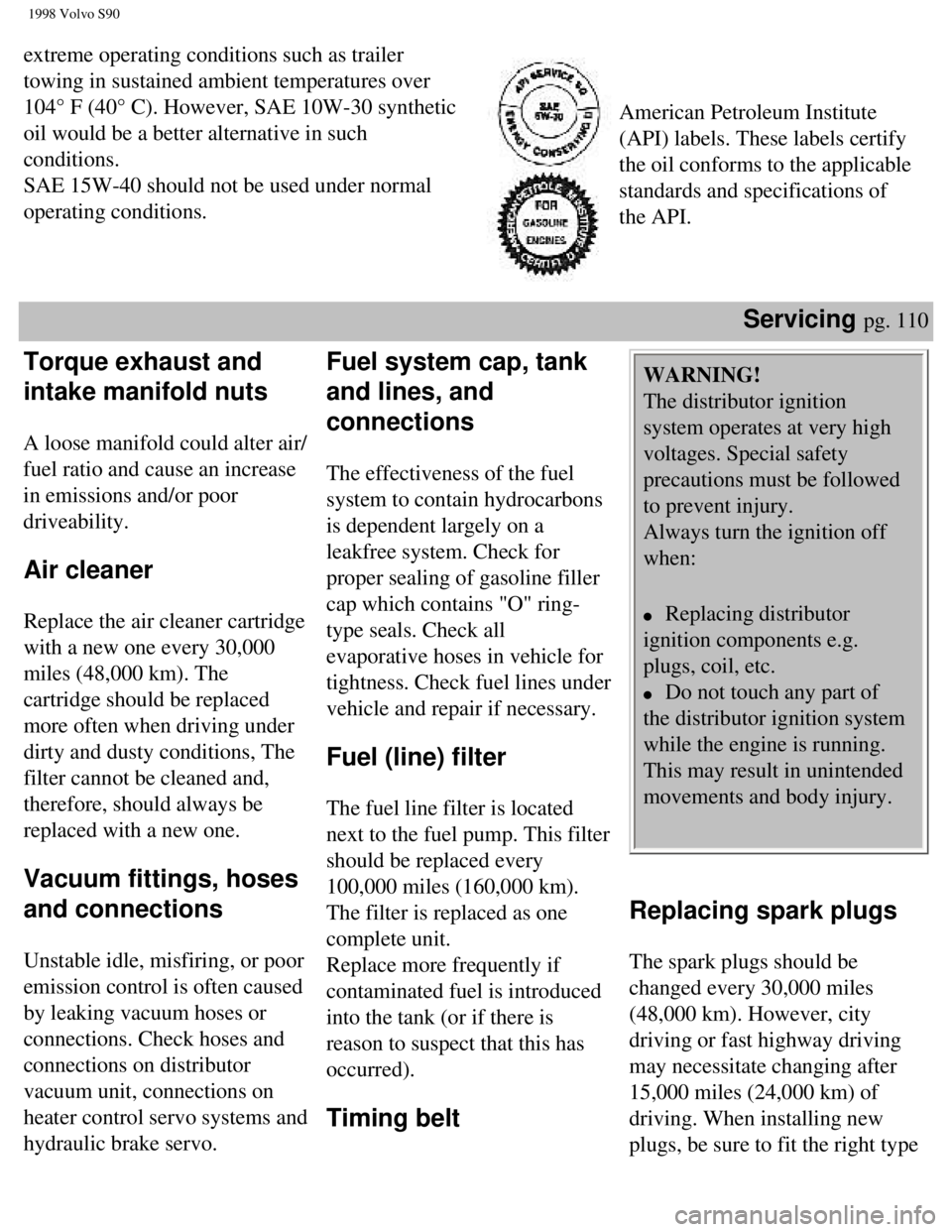
American Petroleum Institute
(API) labels. These labels certify
the oil conforms to the applicable
standards and specifications of
the API.
Servicing pg. 110
Torque exhaust and
intake manifold nuts
A loose manifold could alter air/
fuel ratio and cause an increase
in emissions and/or poor
driveability.
Air cleaner
Replace the air cleaner cartridge
with a new one every 30,000
miles (48,000 km). The
cartridge should be replaced
more often when driving under
dirty and dusty conditions, The
filter cannot be cleaned and,
therefore, should always be
replaced with a new one.
Vacuum fittings, hoses
and connections
Unstable idle, misfiring, or poor
emission control is often caused
by leaking vacuum hoses or
connections. Check hoses and
connections on distributor
vacuum unit, connections on
heater control servo systems and
hydraulic brake servo.
Fuel system cap, tank
and lines, and
connections
The effectiveness of the fuel
system to contain hydrocarbons
is dependent largely on a
leakfree system. Check for
proper sealing of gasoline filler
cap which contains "O" ring-
type seals. Check all
evaporative hoses in vehicle for
tightness. Check fuel lines under
vehicle and repair if necessary.
Fuel (line) filter
The fuel line filter is located
next to the fuel pump. This filter
should be replaced every
100,000 miles (160,000 km).
The filter is replaced as one
complete unit.
Replace more frequently if
contaminated fuel is introduced
into the tank (or if there is
reason to suspect that this has
occurred).
Timing belt
WARNING!
The distributor ignition
system operates at very high
voltages. Special safety
precautions must be followed
to prevent injury.
Always turn the ignition off
when:
l Replacing distributor
ignition components e.g.
plugs, coil, etc.
l Do not touch any part of
the distributor ignition system
while the engine is running.
This may result in unintended
movements and body injury.
Replacing spark plugs
The spark plugs should be
changed every 30,000 miles
(48,000 km). However, city
driving or fast highway driving
may necessitate changing after
15,000 miles (24,000 km) of
driving. When installing new
plugs, be sure to fit the right type
file:///K|/ownersdocs/1998/1998_SV90/98S90_108.htm (3 of 6)12/30/2006 \
1:52:49 PM
Page 122 of 175
1998 Volvo S90
Idle air control system
Your Volvo is equipped with an
electronically-controlled idle air
control system that requires no
checking or adjustment.
Volvo recommends that the
timing belt be replaced every
70,000 miles (112,000 km).
PCV system
The orifice nipple in the intake
manifold and the filter at the
end of the PCV hose in the
aircleaner should be inspected
every 60,000 miles (96,000 km).
Check/replace rubber hoses at
the same time.
and use correct torque, see
Specifications. When changing
the plugs, check that the
suppressor connectors are in
good condition. Cracked or
damaged connectors should be
replaced.
When changing the spark plugs,
clean the terminals and the
rubber seals.
Battery maintenance pg. 111
Battery maintenance
Driving habits and conditions, climate, the
number of starts, etc. all affect the service life and
function of the battery. In order for your battery to
perform satisfactorily, keep the following in mind:
l Check the fluid level in the battery every 6
months or every 10,000 * miles (16,000 km).
The fluid level in each battery cell should be
checked - use a screw driver to open the caps and
a flashlight to inspect the level.
*More frequently in warm climates.
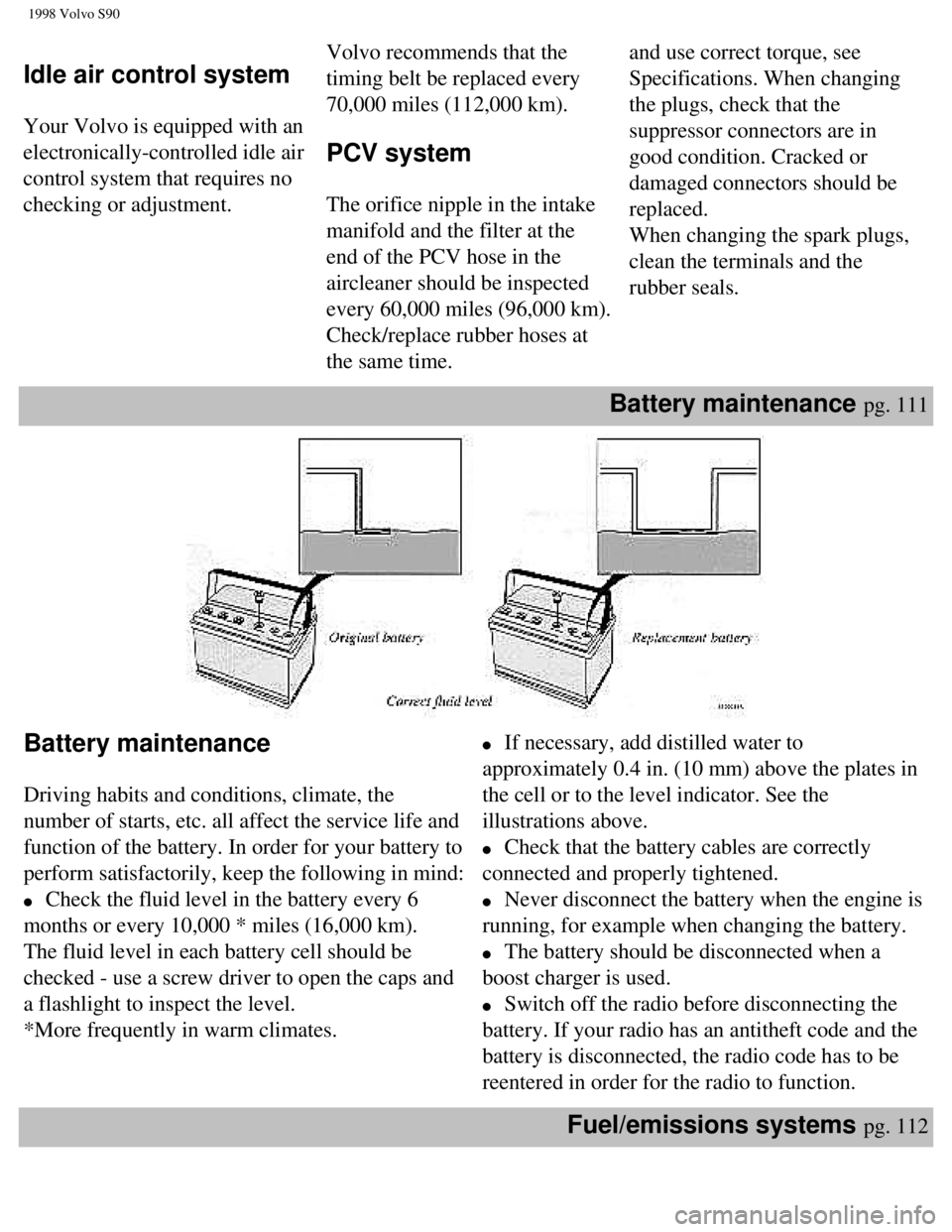
l If necessary, add distilled water to
approximately 0.4 in. (10 mm) above the plates in
the cell or to the level indicator. See the
illustrations above.
l Check that the battery cables are correctly
connected and properly tightened.
l Never disconnect the battery when the engine is
running, for example when changing the battery.
l The battery should be disconnected when a
boost charger is used.
l Switch off the radio before disconnecting the
battery. If your radio has an antitheft code and the
battery is disconnected, the radio code has to be
reentered in order for the radio to function.
Fuel/emissions systems pg. 112
file:///K|/ownersdocs/1998/1998_SV90/98S90_108.htm (4 of 6)12/30/2006 \
1:52:49 PM
Page 123 of 175
1998 Volvo S90
SFI is all-electronic and microprocessor-
controlled. It can continually compensate for
variations in engine load, speed and temperature
to give the best economy and power. An
important feature of the system is a mass air flow
sensor that measures the mass of the inducted air
instead of the volume. In this way the system can
make instantaneous adjustments for changes in air
temperature or density, thus always assuring the
best economy with the lowest possible exhaust
emissions.
Heated oxygen sensor
This is an emission control system designed to
reduce emissions and improve fuel economy. The
heated oxygen sensors monitor the composition of
the exhaust gases leaving the engine. The exhaust
gas analysis is fed into an electronic module. This
adjusts the air-fuel ratio to provide optimum
conditions for combustion and efficient reduction
of the three major pollutants (hydrocarbons,
carbon monoxide and oxides of nitrogen) by a
three-way catalytic converter.
Air pump system
During cold starts, an electric pump is activated
which directs air to the exhaust channels. This
initiates a secondary combustion of exhaust gases
which helps minimize hydrocarbon and carbon
monoxide levels and reduces warm-up time for
the three-way catalytic converter. The pump
begins to function when the engine is started. It
remains in operation until the three-way catalytic
converter has reached normal operating
temperature. A sound may be audible from the air
pump during this warm-up period. This is normal.
When idling, the air pump performs a self-
diagnosis. A soft whining noise can be heard,
which is also normal.
Emissions systems pg. 113
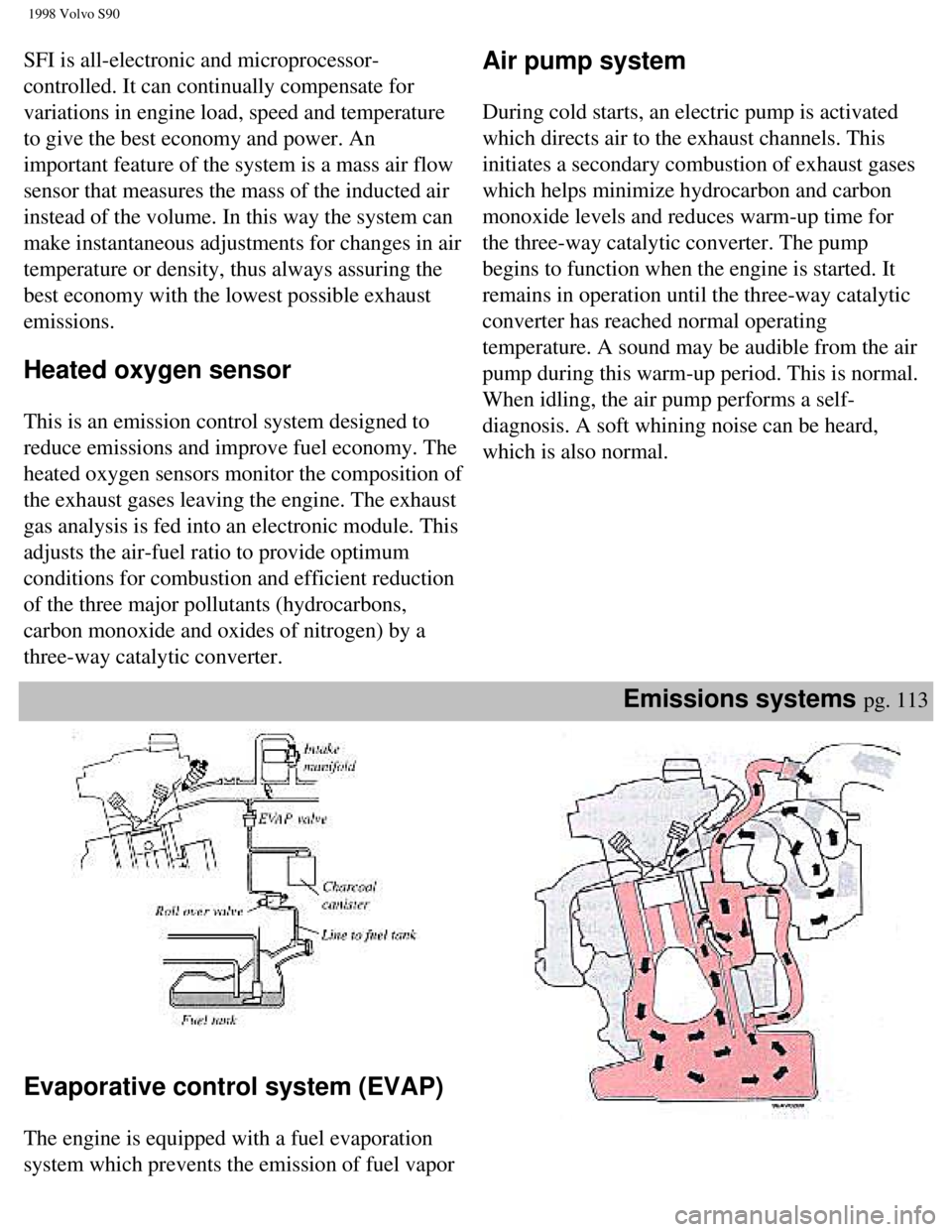
Evaporative control system (EVAP)
The engine is equipped with a fuel evaporation
system which prevents the emission of fuel vapor
file:///K|/ownersdocs/1998/1998_SV90/98S90_108.htm (5 of 6)12/30/2006 \
1:52:49 PM
Page 127 of 175
1998 Volvo S90
Check, without removing the cap, that the level is above
the "MIN" mark of the fluid reservoir.
Always entrust brake fluid changing to an authorized
Volvo retailer.
Drive belt pg. 117
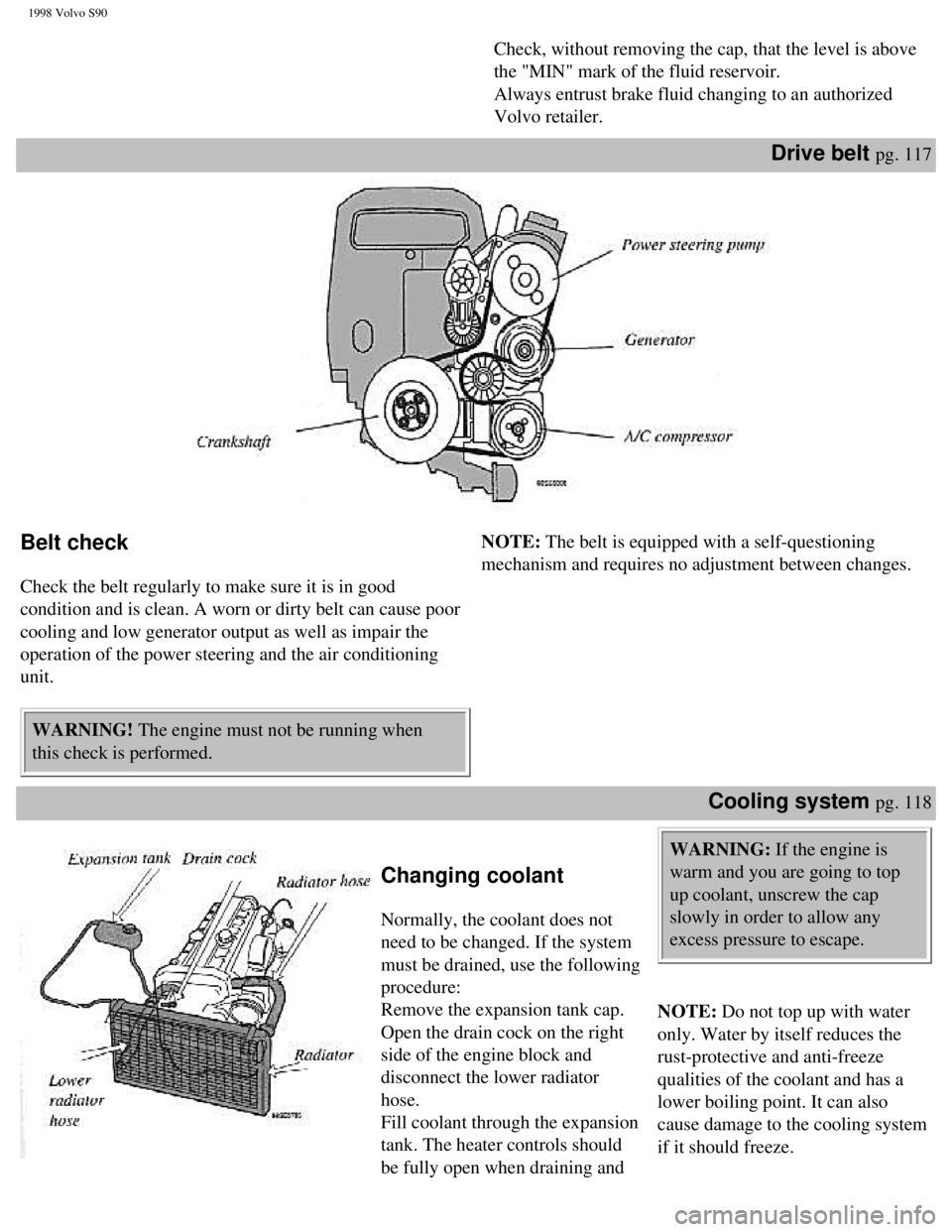
Belt check
Check the belt regularly to make sure it is in good
condition and is clean. A worn or dirty belt can cause poor
cooling and low generator output as well as impair the
operation of the power steering and the air conditioning
unit.
WARNING! The engine must not be running when
this check is performed. NOTE: The belt is equipped with a self-questioning
mechanism and requires no adjustment between changes.
Cooling system pg. 118
Changing coolant
Normally, the coolant does not
need to be changed. If the system
must be drained, use the following
procedure:
Remove the expansion tank cap.
Open the drain cock on the right
side of the engine block and
disconnect the lower radiator
hose.
Fill coolant through the expansion
tank. The heater controls should
be fully open when draining and
WARNING: If the engine is
warm and you are going to top
up coolant, unscrew the cap
slowly in order to allow any
excess pressure to escape.
NOTE: Do not top up with water
only. Water by itself reduces the
rust-protective and anti-freeze
qualities of the coolant and has a
lower boiling point. It can also
cause damage to the cooling system
if it should freeze.
file:///K|/ownersdocs/1998/1998_SV90/98S90_114.htm (3 of 5)12/30/2006 \
1:52:50 PM
Page 173 of 175
1998 Volvo S90
provides you with a better
understanding of the problems
related to car radio reception.
Reception conditions are not
always optimum and this is, of
course, beyond our control.
However, we have endeavored
to make the Volvo Audio
System of a quality that will
enable you to enjoy the best
possible reception no matter
what the reception conditions
may be. rag. Spray it again. Lower and
raise the antenna. Wipe it clean
and dry again. Lower and raise
the antenna 4-6 times. Make
sure it is dry and free from dirt
or lubricating oil.
damaged. When cleaning the
window be careful that the wires
are not scratched by rings, etc. If
they are damaged, radio
reception will be impaired.
Inside back cover
WARNING!
Detergents and solvents
Do not use gasoline containing lead or benzene as a detergent or solvent\
. Both lead and benzene are
toxic and may be hazardous to your health.
Installation of optional equipment/use of mobile telephones
Incorrectly installed optional equipment, alarm systems or the use of mo\
bile telephones which are not
connected to a suitable antenna can cause faults in the car's electronic\
control systems. Your car is
equipped with an accessory connector located under the dashboard on the \
driver's side. Please consult
your Volvo retailer if you have any questions before connecting accessor\
y or optional equipment to
the vehicle's electrical systems.
Carbon monoxide
Carbon monoxide is a poisonous, colorless and odorless gas which is pres\
ent in all exhaust gases. If
you ever smell exhaust fumes from inside the vehicle, make sure the pass\
enger compartment is
ventilated and immediately return the vehicle to your retailer for corre\
ction.
Never sit in a parked or stopped car for any extended amount of time, nor hav\
e it unattended while
the engine is running.
Never operate the engine in confined, unventilated areas.
Back cover
file:///K|/ownersdocs/1998/1998_SV90/98S90_161.htm (5 of 7)12/30/2006 \
1:52:56 PM