tow VOLVO S90 1998 User Guide
[x] Cancel search | Manufacturer: VOLVO, Model Year: 1998, Model line: S90, Model: VOLVO S90 1998Pages: 175, PDF Size: 4.45 MB
Page 43 of 175
1998 Volvo S90
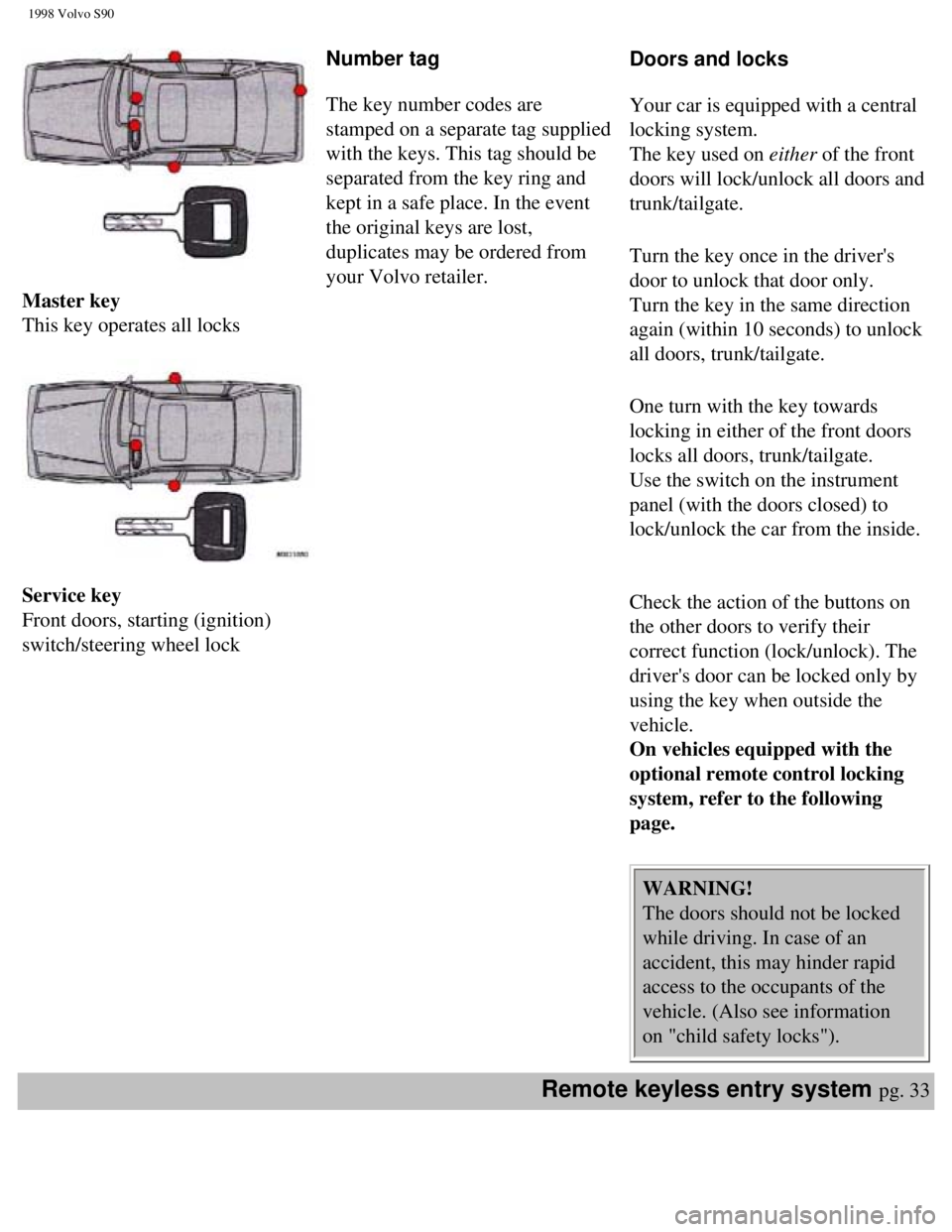
Master key
This key operates all locks
Service key
Front doors, starting (ignition)
switch/steering wheel lock Number tag
The key number codes are
stamped on a separate tag supplied
with the keys. This tag should be
separated from the key ring and
kept in a safe place. In the event
the original keys are lost,
duplicates may be ordered from
your Volvo retailer.
Doors and locks
Your car is equipped with a central
locking system.
The key used on either of the front
doors will lock/unlock all doors and
trunk/tailgate.
Turn the key once in the driver's
door to unlock that door only.
Turn the key in the same direction
again (within 10 seconds) to unlock
all doors, trunk/tailgate.
One turn with the key towards
locking in either of the front doors
locks all doors, trunk/tailgate.
Use the switch on the instrument
panel (with the doors closed) to
lock/unlock the car from the inside.
Check the action of the buttons on
the other doors to verify their
correct function (lock/unlock). The
driver's door can be locked only by
using the key when outside the
vehicle.
On vehicles equipped with the
optional remote control locking
system, refer to the following
page.
WARNING!
The doors should not be locked
while driving. In case of an
accident, this may hinder rapid
access to the occupants of the
vehicle. (Also see information
on "child safety locks").
Remote keyless entry system pg. 33
file:///K|/ownersdocs/1998/1998_SV90/98S90_031.htm (2 of 6)12/30/2006 \
1:52:39 PM
Page 53 of 175
1998 Volvo S90
swing the cushion up and toward the
back of the front seats.
Move the backrest release lever rearward
and fold the backrest down.
When the backrest is raised, the outboard
head restraints return to their normal
position and must be raised manually if
required.
The backrest must lock into place. The
red lock indicator will not be visible if
the seat has locked into place
correctly. seat is returned to normal position. WARNING! When the rear seat is
folded down, do not place heavy
objects against the backs of the front
seats. This places a severe strain on
the folded down backrest of the rear
seat. Be sure to secure cargo. Cargo
must not be stacked higher than the
top of seatbacks. This will reduce the
possibility of luggage, etc. becoming
projectiles during sudden maneuvers,
rapid braking or an accident. The red
lock indicator is visible when the
backrest is NOT locked in position
and not visible when the backrest is
correctly locked in place. When the
backrest is in the upright position, it
must always be correctly locked in
place.
Removing seat cushions, Tool box, Securing cargo (wagon) pg. 44
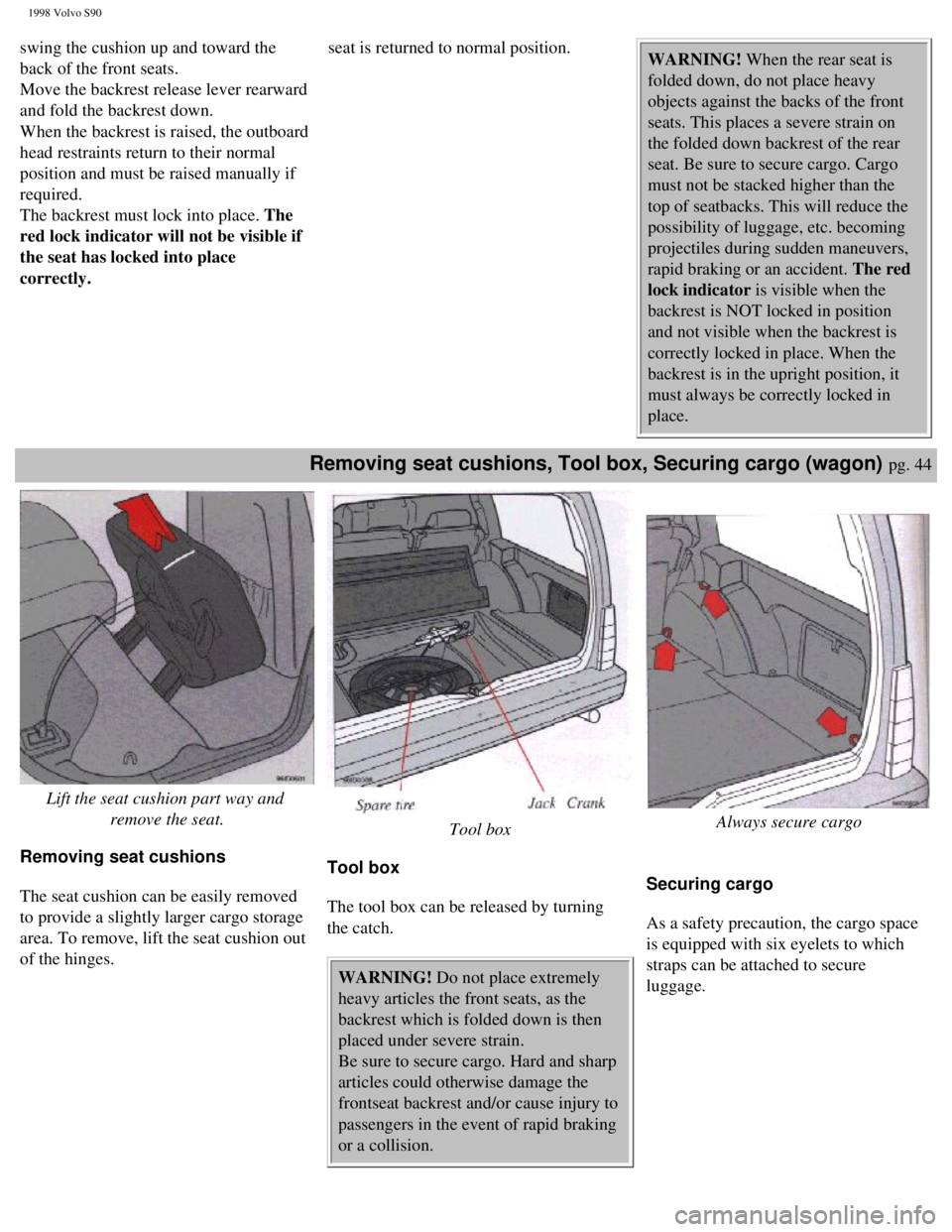
Lift the seat cushion part way and
remove the seat.
Removing seat cushions
The seat cushion can be easily removed
to provide a slightly larger cargo storage
area. To remove, lift the seat cushion out
of the hinges.
Tool box
Tool box
The tool box can be released by turning
the catch.
WARNING! Do not place extremely
heavy articles the front seats, as the
backrest which is folded down is then
placed under severe strain.
Be sure to secure cargo. Hard and sharp
articles could otherwise damage the
frontseat backrest and/or cause injury to
passengers in the event of rapid braking
or a collision.
Always secure cargo
Securing cargo
As a safety precaution, the cargo space
is equipped with six eyelets to which
straps can be attached to secure
luggage.
file:///K|/ownersdocs/1998/1998_SV90/98S90_042.htm (2 of 4)12/30/2006 \
1:52:40 PM
Page 55 of 175
1998 Volvo S90
Loading in cargo space
Seat belts and airbags help give driver and passengers good
protection, especially in head-on collisions. However, there is
also a risk of injury from behind. When loading the car,
remember that objects not properly loaded and secured may
move forward in collisions or when braking suddenly, causing
injury.
Remember that a 44 lbs object weighs the equivalent of
2,200 lbs in a head-on collision at 30 mph.
Remember the following when loading the car:
l Load the cargo against the backrest.
l Load heavy cargo as low down as possible.
l Load wide cargo on either side of the rear seat split.
l Secure the cargo with cargo straps through the eyelets in the
cargo space.
l If nobody is sitting in the rear seat reinforce the backrest by
fastening the rear seat belts.
l Never load cargo above the backrest without a cargo barrier.
Cargo barrier (Wagon) pg. 47
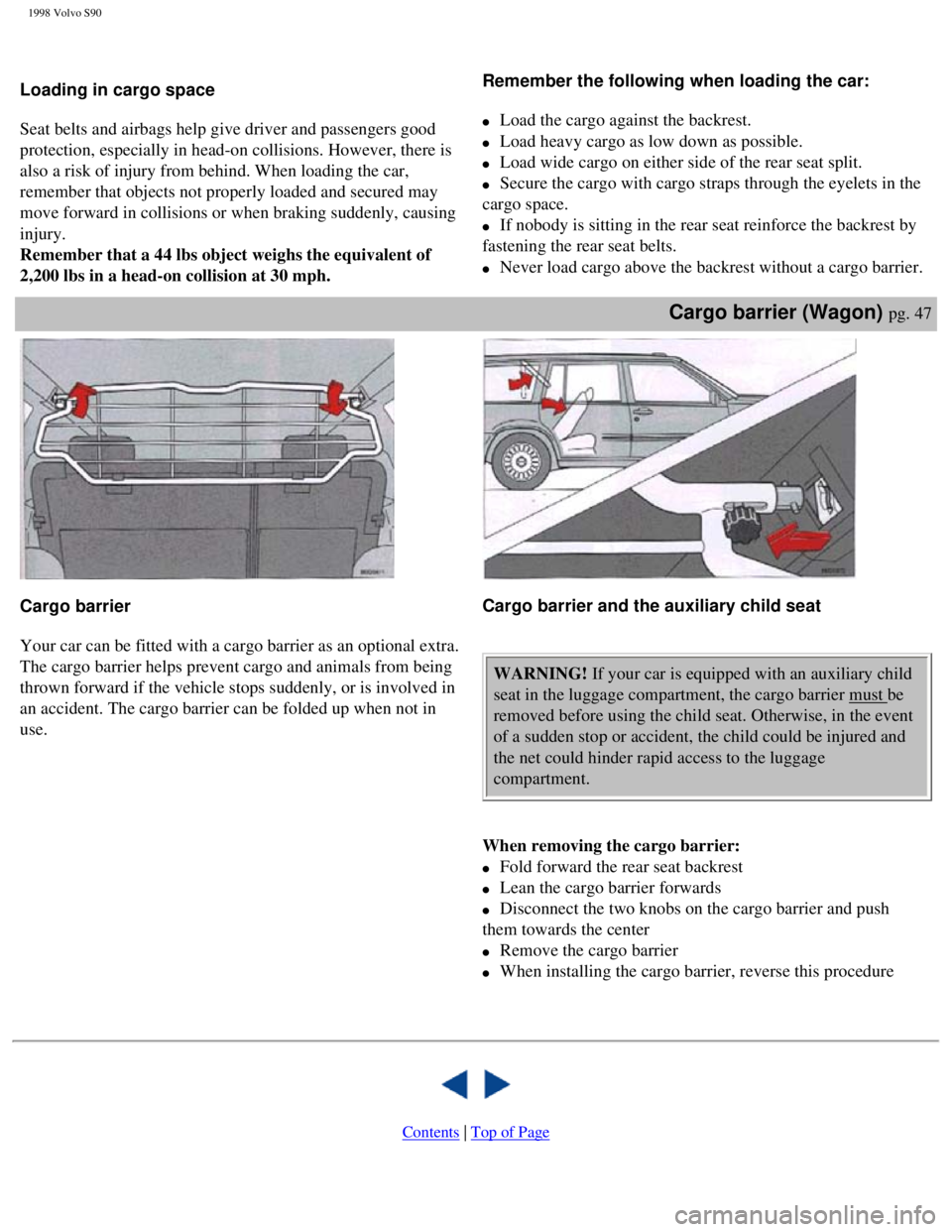
Cargo barrier
Your car can be fitted with a cargo barrier as an optional extra.
The cargo barrier helps prevent cargo and animals from being
thrown forward if the vehicle stops suddenly, or is involved in
an accident. The cargo barrier can be folded up when not in
use.
Cargo barrier and the auxiliary child seat
WARNING! If your car is equipped with an auxiliary child
seat in the luggage compartment, the cargo barrier must be
removed before using the child seat. Otherwise, in the event
of a sudden stop or accident, the child could be injured and
the net could hinder rapid access to the luggage
compartment.
When removing the cargo barrier:
l Fold forward the rear seat backrest
l Lean the cargo barrier forwards
l Disconnect the two knobs on the cargo barrier and push
them towards the center
l Remove the cargo barrier
l When installing the cargo barrier, reverse this procedure
Contents | Top of Page
file:///K|/ownersdocs/1998/1998_SV90/98S90_042.htm (4 of 4)12/30/2006 \
1:52:40 PM
Page 56 of 175
1998 Volvo S90
Chapter 3 - Body and interior (cont.)Luggage cover (wagon)
pg. 48
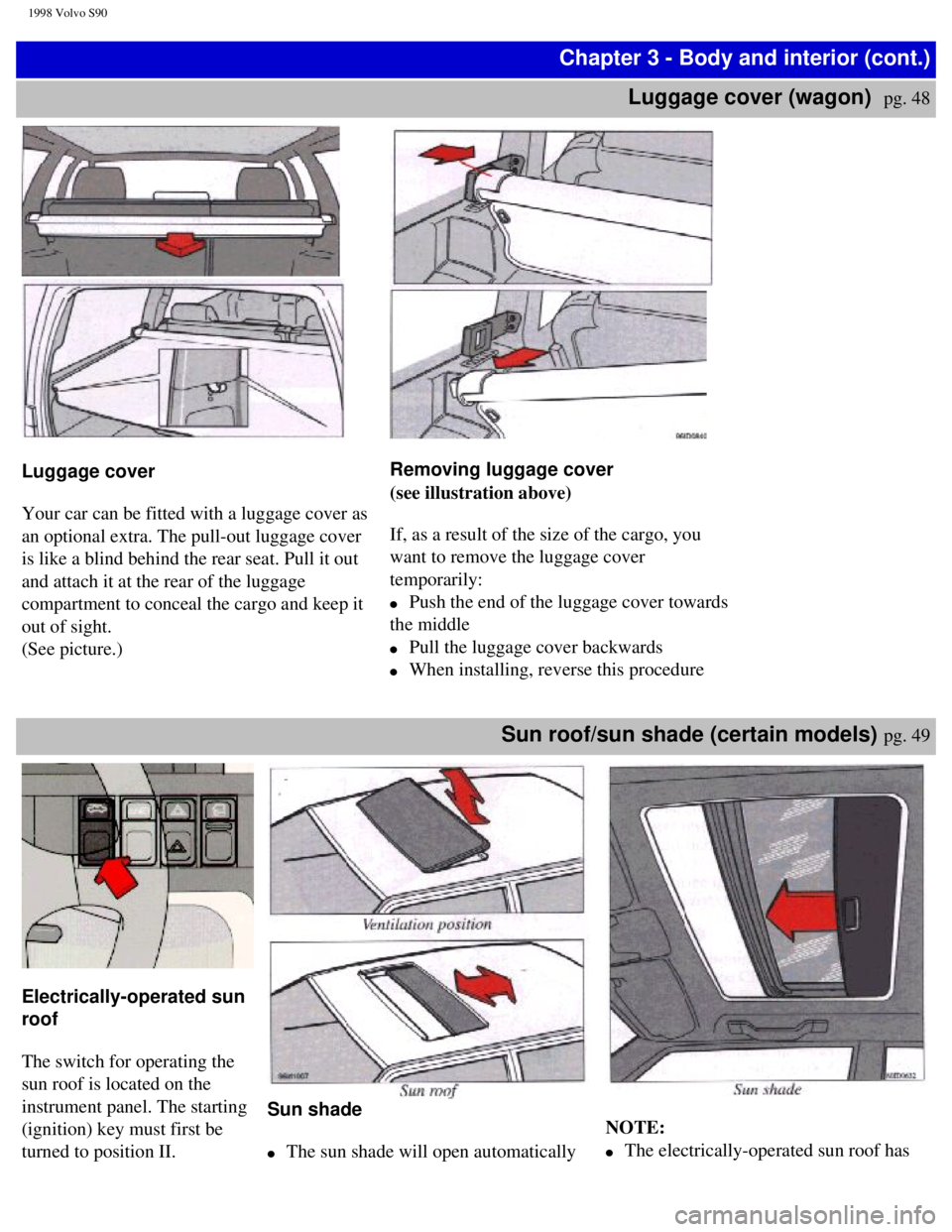
Luggage cover
Your car can be fitted with a luggage cover as
an optional extra. The pull-out luggage cover
is like a blind behind the rear seat. Pull it out
and attach it at the rear of the luggage
compartment to conceal the cargo and keep it
out of sight.
(See picture.)
Removing luggage cover
(see illustration above)
If, as a result of the size of the cargo, you
want to remove the luggage cover
temporarily:
l Push the end of the luggage cover towards
the middle
l Pull the luggage cover backwards
l When installing, reverse this procedure
Sun roof/sun shade (certain models) pg. 49
Electrically-operated sun
roof
The switch for operating the
sun roof is located on the
instrument panel. The starting
(ignition) key must first be
turned to position II.
Sun shade
l The sun shade will open automatically
NOTE:
l The electrically-operated sun roof has
file:///K|/ownersdocs/1998/1998_SV90/98S90_048.htm (1 of 4)12/30/2006 \
1:52:40 PM
Page 60 of 175
1998 Volvo S90
Chapter 4 - Starting and driving
pg. 53
Starting and driving
This section on starting and driving contains items
such as starting the engine, operating gear selector, towing, trailers.
Break-in period pg. 54
Fuel requirements, Refueling pg. 54
Driving economy pg. 56
Starting the engine pg. 57
Automatic Transmission pg. 58
Points to remember pg. 60
Emergency towing pg. 63
Vehicle Towing Information pg. 64
Jump starting pg. 65
Three-way catalytic converter pg. 66
Brake system, ABS pg. 67
Trailer towing pg. 68
Winter driving pg. 69
Before a long distance trip pg. 70
Break-in period, Fuel requirements pg. 54
file:///K|/ownersdocs/1998/1998_SV90/98S90_053.htm (1 of 6)12/30/2006 \
1:52:41 PM
Page 67 of 175
1998 Volvo S90
and third gears when in
driving modes E or S. There
is no upshift from third gear.
Position 3 can be used for
driving in hilly terrain, for
towing trailers or for
increased engine braking
power.
CAUTION: Never select P
or R while the car is in
motion. When initially
selecting positions D, 3, L
or R, your right foot should
press firmly on the brake
pedal to ensure that the car
is standing still with the
engine idling. The gear
selector should not be
downshifted to L at speeds
above 75 mph (125 km/h). -
Always observe posted
speed limits!
Automatic transmission pg. 59
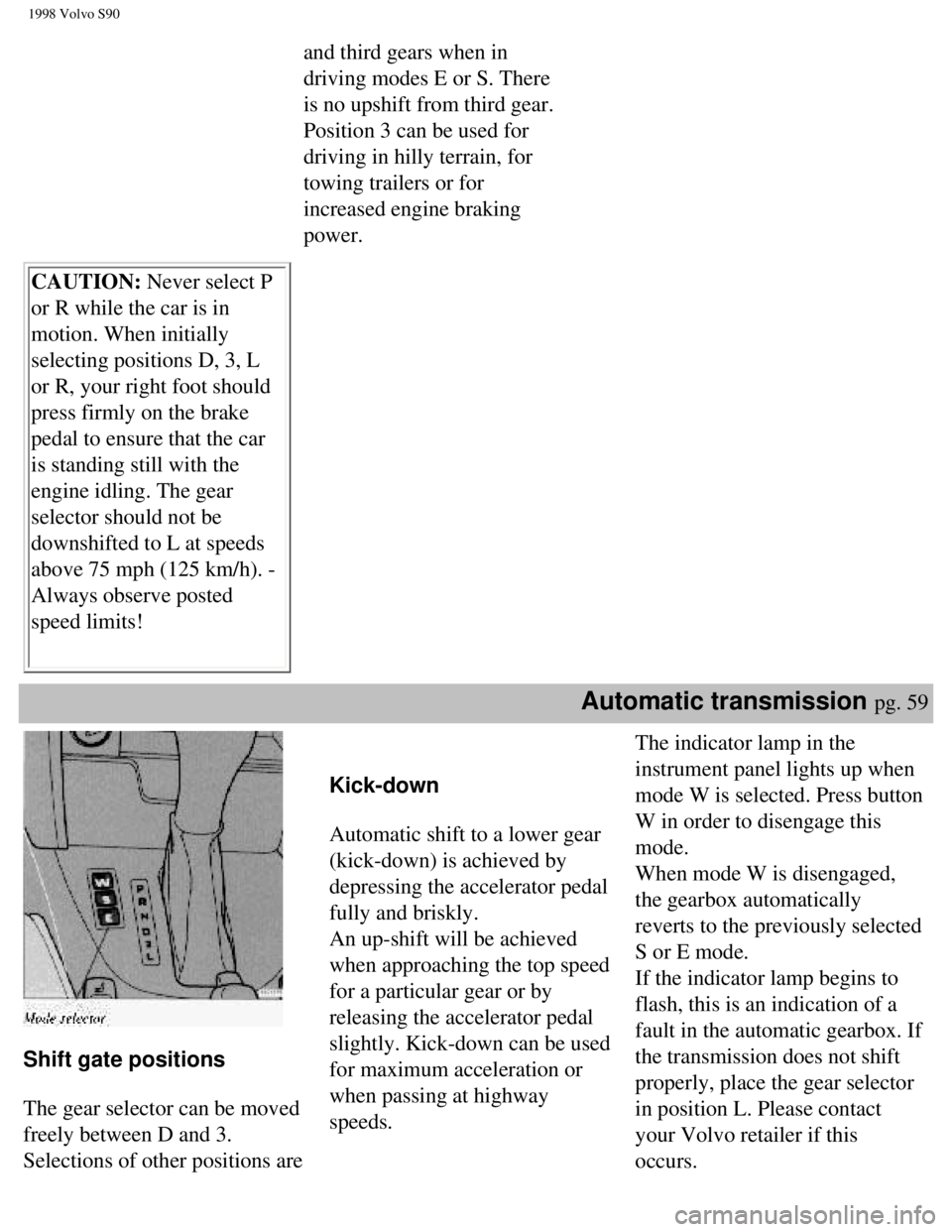
Shift gate positions
The gear selector can be moved
freely between D and 3.
Selections of other positions are
Kick-down
Automatic shift to a lower gear
(kick-down) is achieved by
depressing the accelerator pedal
fully and briskly.
An up-shift will be achieved
when approaching the top speed
for a particular gear or by
releasing the accelerator pedal
slightly. Kick-down can be used
for maximum acceleration or
when passing at highway
speeds.
The indicator lamp in the
instrument panel lights up when
mode W is selected. Press button
W in order to disengage this
mode.
When mode W is disengaged,
the gearbox automatically
reverts to the previously selected
S or E mode.
If the indicator lamp begins to
flash, this is an indication of a
fault in the automatic gearbox. If
the transmission does not shift
properly, place the gear selector
in position L. Please contact
your Volvo retailer if this
occurs.
file:///K|/ownersdocs/1998/1998_SV90/98S90_058.htm (2 of 7)12/30/2006 \
1:52:42 PM
Page 69 of 175
1998 Volvo S90
Special Tips - automatic transmission
l For driving down steep hills and when driving
for prolonged periods at low speeds, position L
should be selected. Avoid, however, repeated
changes since this can cause overheating of the
transmission oil. For driving on long continuous
uphill gradients, select position 3.
l Do not hold the car stationary on an incline by
using the accelerator pedal. Instead, apply the
hand brake (parking brake). This prevents the
transmission oil from becoming overheated.
l When towing a trailer, select shift position 3.
l The (E)conomy mode should be selected when
the cruise control is engaged.
l Never select P or R while the car is in motion.
l When initially selecting positions D, 3, L or R,
your right foot should press firmly on the brake
pedal to ensure that the car is standing still with
the engine idling.
l The gear selector should not be downshifted to
L at speeds above 75 mph (125 km/h). Always
observe posted speed limits. Cooling system
The risk for overheating is greatest, especially in
hot weather, when:
l towing a trailer up steep inclines for prolonged
periods at wide open throttle and low engine rpm.
l stopping the engine suddenly after high speed
driving (so-called "after-boiling" can occur).
To avoid overheating, the following rules should
be followed:
l Reduce speed and downshift when towing a
trailer up long, steep inclines. The risk of
overheating can be reduced by switching off the
air conditioning system for a short time.
l Do not let the engine idle unnecessarily for
prolonged periods.
l Do not mount auxiliary lamps in front of the
grill.
When the risk of overheating is imminent, or in
the event of overheating, (the temperature gauge
goes repeatedly into, or stays continually in, the
red section) the following precautions should be
taken:
l Switch off the air conditioning system.
l Pull off the road, away from traffic, stop the car
and put the gear lever into neutral. Do not stop the
engine!
l Switch the heater to full (maximum) position.
Increase the engine speed to approx. 2000 rpm
(twice idling speed) until the temperature begins
to drop.
See "Coolant" to check and top-up the coolant
level if necessary.
WARNING! Do not remove coolant expansion
tank cap. The coolant will be extremely hot.
Points to remember pg. 61
file:///K|/ownersdocs/1998/1998_SV90/98S90_058.htm (4 of 7)12/30/2006 \
1:52:42 PM
Page 73 of 175
1998 Volvo S90
Chapter 4 (cont)
Emergency towing (pulling of vehicles)
pg. 63
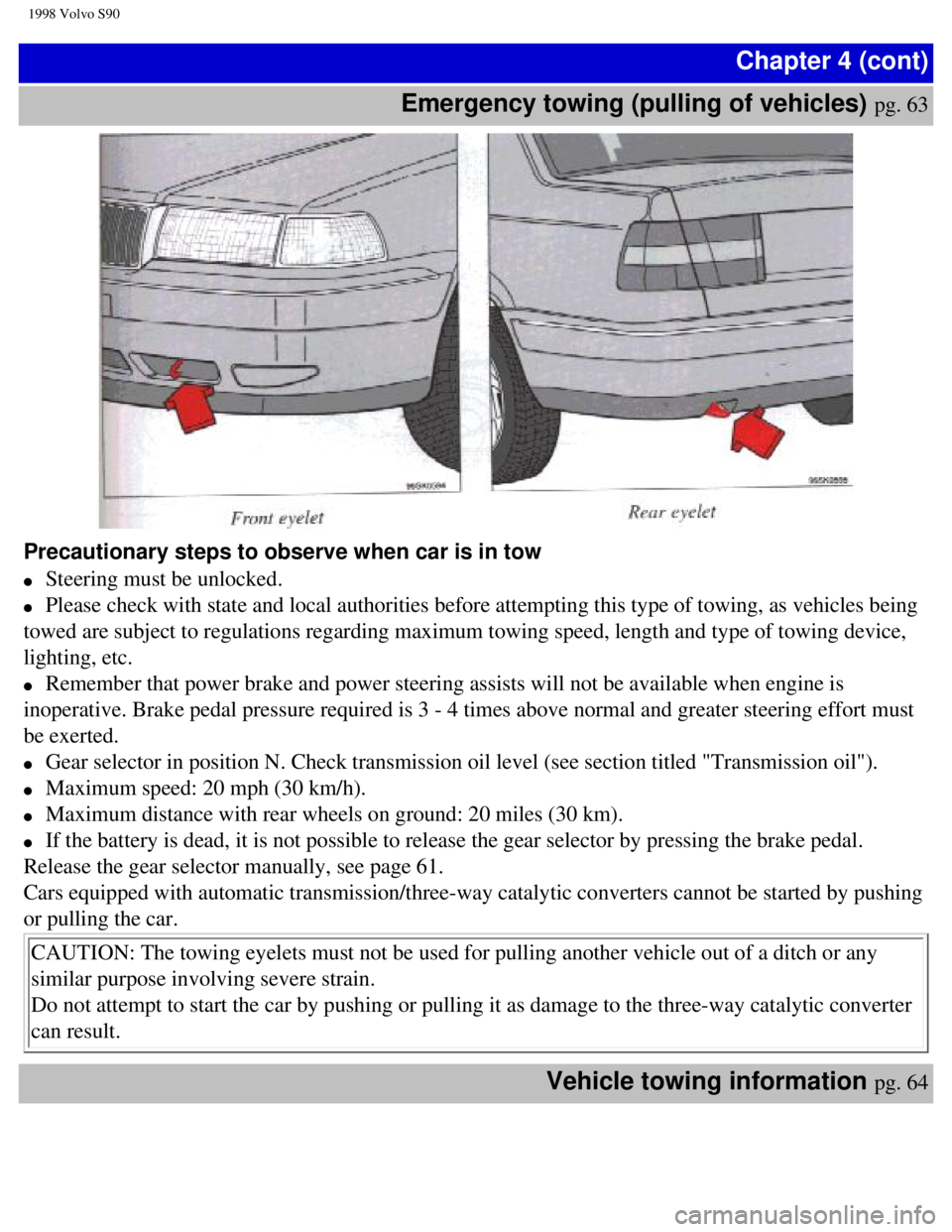
Precautionary steps to observe when car is in tow
l Steering must be unlocked.
l Please check with state and local authorities before attempting this typ\
e of towing, as vehicles being
towed are subject to regulations regarding maximum towing speed, length \
and type of towing device,
lighting, etc.
l Remember that power brake and power steering assists will not be availab\
le when engine is
inoperative. Brake pedal pressure required is 3 - 4 times above normal a\
nd greater steering effort must
be exerted.
l Gear selector in position N. Check transmission oil level (see section \
titled "Transmission oil").
l Maximum speed: 20 mph (30 km/h).
l Maximum distance with rear wheels on ground: 20 miles (30 km).
l If the battery is dead, it is not possible to release the gear selector \
by pressing the brake pedal.
Release the gear selector manually, see page 61.
Cars equipped with automatic transmission/three-way catalytic converters\
cannot be started by pushing
or pulling the car.
CAUTION: The towing eyelets must not be used for pulling another vehicle\
out of a ditch or any
similar purpose involving severe strain.
Do not attempt to start the car by pushing or pulling it as damage to th\
e three-way catalytic converter
can result.
Vehicle towing information pg. 64
file:///K|/ownersdocs/1998/1998_SV90/98S90_063.htm (1 of 4)12/30/2006 \
1:52:43 PM
Page 74 of 175
1998 Volvo S90
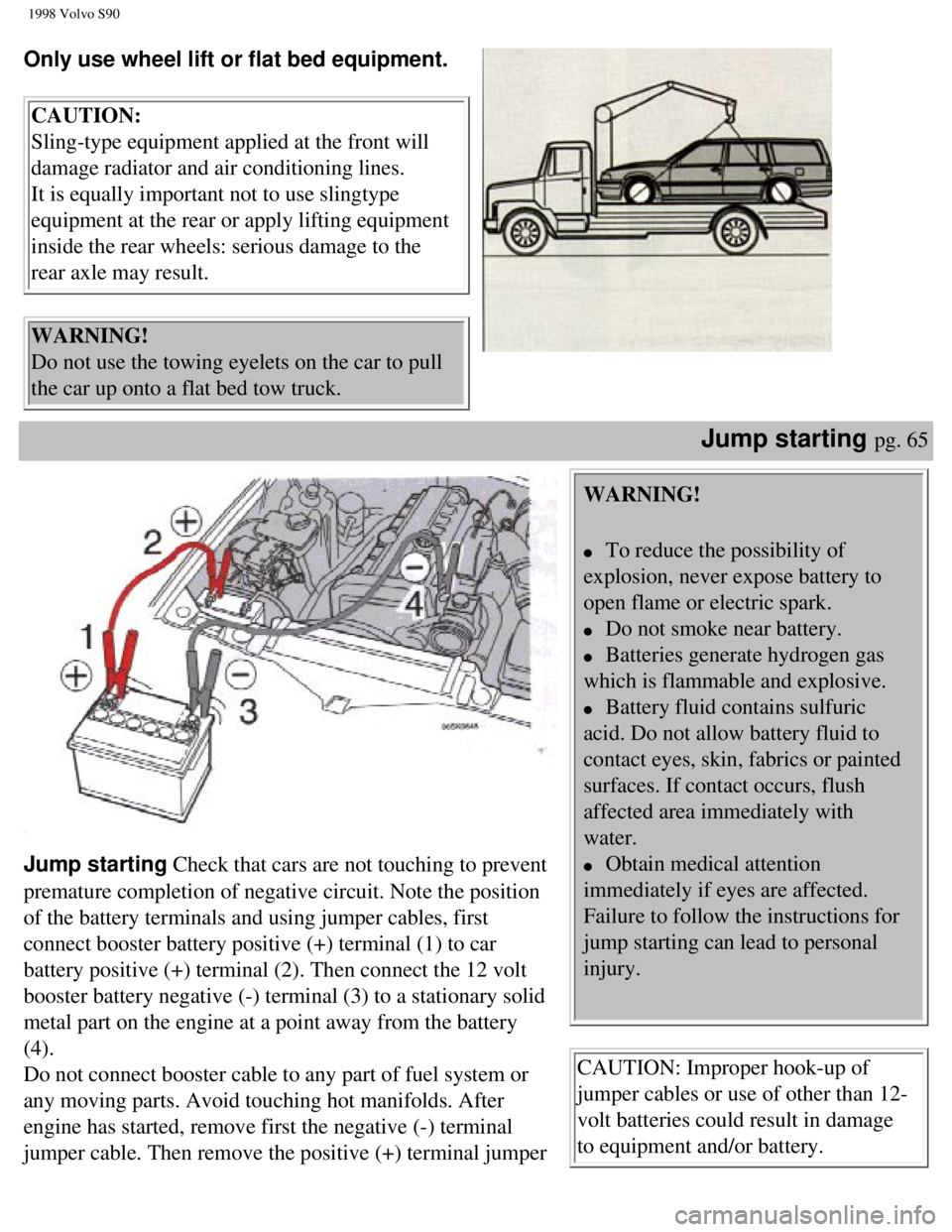
Only use wheel lift or flat bed equipment.
CAUTION:
Sling-type equipment applied at the front will
damage radiator and air conditioning lines.
It is equally important not to use slingtype
equipment at the rear or apply lifting equipment
inside the rear wheels: serious damage to the
rear axle may result.
WARNING!
Do not use the towing eyelets on the car to pull
the car up onto a flat bed tow truck.
Jump starting pg. 65
Jump starting Check that cars are not touching to prevent
premature completion of negative circuit. Note the position
of the battery terminals and using jumper cables, first
connect booster battery positive (+) terminal (1) to car
battery positive (+) terminal (2). Then connect the 12 volt
booster battery negative (-) terminal (3) to a stationary solid
metal part on the engine at a point away from the battery
(4).
Do not connect booster cable to any part of fuel system or
any moving parts. Avoid touching hot manifolds. After
engine has started, remove first the negative (-) terminal
jumper cable. Then remove the positive (+) terminal jumper
WARNING!
l To reduce the possibility of
explosion, never expose battery to
open flame or electric spark.
l Do not smoke near battery.
l Batteries generate hydrogen gas
which is flammable and explosive.
l Battery fluid contains sulfuric
acid. Do not allow battery fluid to
contact eyes, skin, fabrics or painted
surfaces. If contact occurs, flush
affected area immediately with
water.
l Obtain medical attention
immediately if eyes are affected.
Failure to follow the instructions for
jump starting can lead to personal
injury.
CAUTION: Improper hook-up of
jumper cables or use of other than 12-
volt batteries could result in damage
to equipment and/or battery.
file:///K|/ownersdocs/1998/1998_SV90/98S90_063.htm (2 of 4)12/30/2006 \
1:52:43 PM
Page 77 of 175
1998 Volvo S90
Chapter 4 (cont)
Brake system
pg. 67
If one of the brake
circuits should
malfunction, the red
warning light will come
on
The pedal stroke increases
slightly, the pedal feels softer
and extra pressure is required for
normal braking.
If the light comes on while
driving or braking, stop
immediately and check the brake
fluid level in the reservoir.
WARNING!
If the fluid level is below the
MIN mark in either section
of the reservoir: DO NOT
DRIVE. Tow the car to a
Volvo retailer and have the
brake system checked and
repaired.
Anti-lock Brake System
– ABS
If the warning lamp lights up
there is a malfunction of the
ABS system (the standard
braking system will however
The system performs a self-
diagnostic test when the vehicle
is started and at 4 mph (6 km/h).
The driver may detect one
pulsation of the brake pedal,
which is normal.
To obtain optimal effect from
the ABS system, constant
pressure should be kept on the
brake pedal while the system
is modulating the brakes. Do
not pump the brake pedal.
The switching of the ABS
modulator will be audible at this
time.
Please be aware that ABS does
not increase the absolute braking
potential of the vehicle.
While control will be enhanced,
ABS will not shorten stopping
distances on slippery surfaces.
Moisture on brake
discs and brake pads
affects braking.
Driving in rain and slush or
passing through an automatic car
wash can cause water to collect
on the brake discs and pads.
This will cause a delay in
braking effect when the pedal is
depressed. To avoid such a delay
when the brakes are needed,
depress the pedal occasionally
when driving through rain, slush
etc. This will remove the water
from the brakes. Check that
Severe strain on the
brake system
The brakes will be subject to
severe strain when driving in
mountains or hilly areas or
towing. The speed is usually low
which means that the cooling of
the brakes is less efficient than
when driving on level roads. To
reduce the strain on the brakes it
is advisable not to use the brakes
excessively. Instead, shift into a
lower gear, position 3 or in some
cases L ,and let the engine help
with the braking.
Do not forget that, if you are
towing a trailer, the brakes will
be subjected to greater load than
is normal.
If the brake power-
assist does not
function
The power assist to the brakes
functions only when the engine
is running. When the car is
moving without the engine
running the brake pedal pressure
required to stop the car is
increased by 3-4 times.
The brake pedal feels stiff and
hard.
file:///K|/ownersdocs/1998/1998_SV90/98S90_067.htm (1 of 5)12/30/2006 \
1:52:43 PM