wheel VOLVO S90 1998 User Guide
[x] Cancel search | Manufacturer: VOLVO, Model Year: 1998, Model line: S90, Model: VOLVO S90 1998Pages: 175, PDF Size: 4.45 MB
Page 40 of 175
1998 Volvo S90
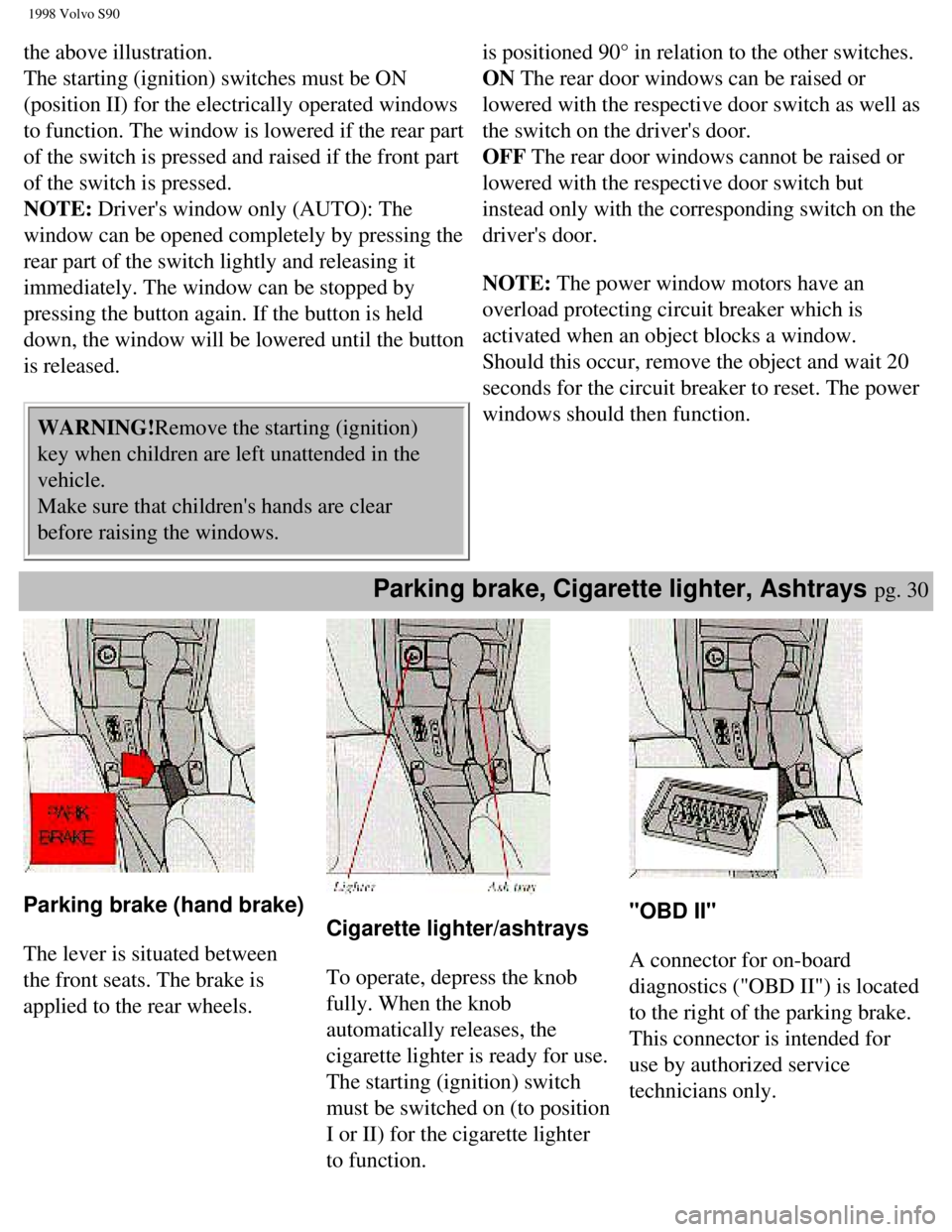
the above illustration.
The starting (ignition) switches must be ON
(position II) for the electrically operated windows
to function. The window is lowered if the rear part
of the switch is pressed and raised if the front part
of the switch is pressed.
NOTE: Driver's window only (AUTO): The
window can be opened completely by pressing the
rear part of the switch lightly and releasing it
immediately. The window can be stopped by
pressing the button again. If the button is held
down, the window will be lowered until the button
is released.
WARNING!Remove the starting (ignition)
key when children are left unattended in the
vehicle.
Make sure that children's hands are clear
before raising the windows. is positioned 90° in relation to the other switches.
ON The rear door windows can be raised or
lowered with the respective door switch as well as
the switch on the driver's door.
OFF The rear door windows cannot be raised or
lowered with the respective door switch but
instead only with the corresponding switch on the
driver's door.
NOTE: The power window motors have an
overload protecting circuit breaker which is
activated when an object blocks a window.
Should this occur, remove the object and wait 20
seconds for the circuit breaker to reset. The power
windows should then function.
Parking brake, Cigarette lighter, Ashtrays pg. 30
Parking brake (hand brake)
The lever is situated between
the front seats. The brake is
applied to the rear wheels.
Cigarette lighter/ashtrays
To operate, depress the knob
fully. When the knob
automatically releases, the
cigarette lighter is ready for use.
The starting (ignition) switch
must be switched on (to position
I or II) for the cigarette lighter
to function.
"OBD II"
A connector for on-board
diagnostics ("OBD II") is located
to the right of the parking brake.
This connector is intended for
use by authorized service
technicians only.
file:///K|/ownersdocs/1998/1998_SV90/98S90_028.htm (2 of 3)12/30/2006 \
1:52:38 PM
Page 41 of 175
1998 Volvo S90
WARNING!
Always use the parking
brake (hand brake) when
parking. On hills, also turn
the front wheels toward the
curb.
Ashtrays
To remove the ash trays depress
the center spring and remove.
Contents | Top of Page
file:///K|/ownersdocs/1998/1998_SV90/98S90_028.htm (3 of 3)12/30/2006 \
1:52:38 PM
Page 43 of 175
1998 Volvo S90
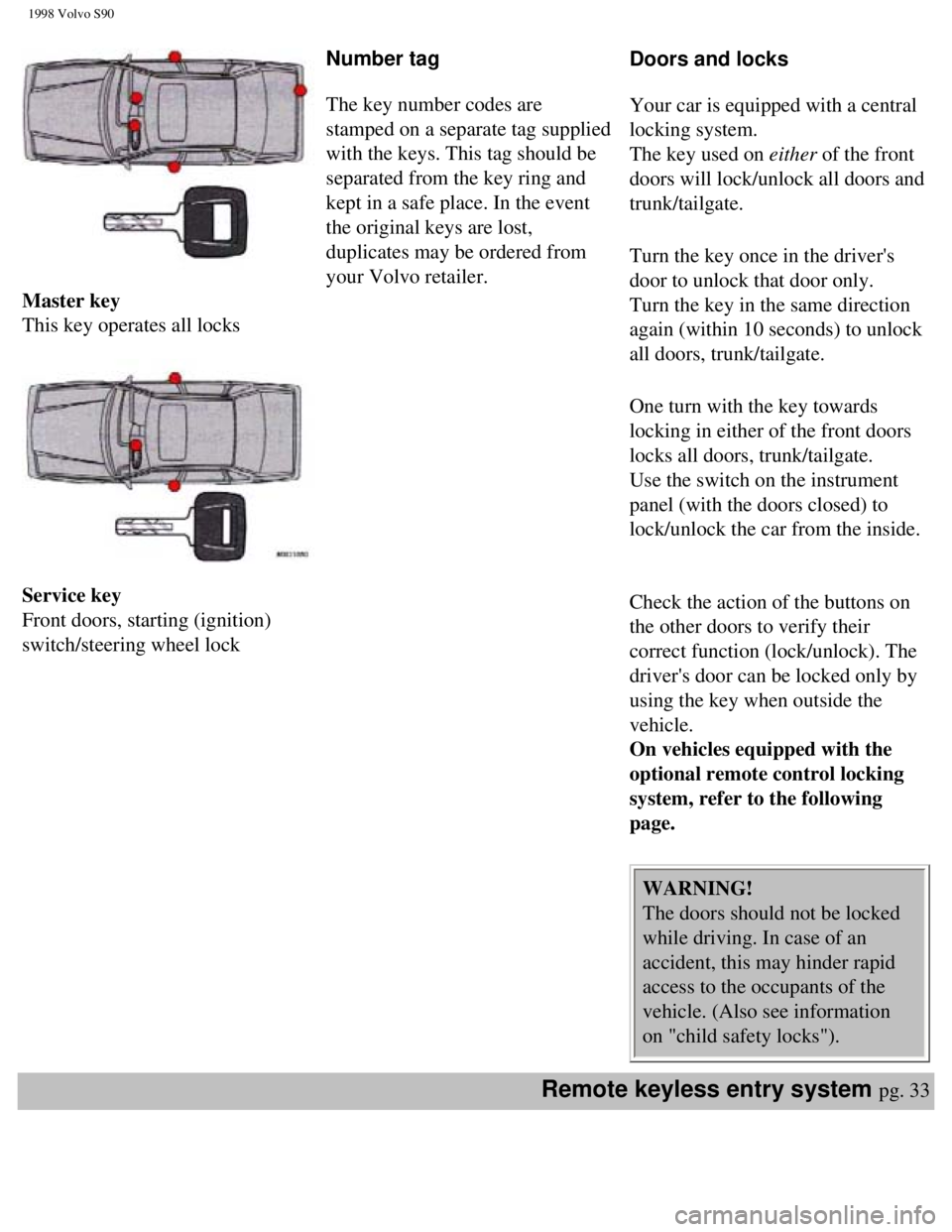
Master key
This key operates all locks
Service key
Front doors, starting (ignition)
switch/steering wheel lock Number tag
The key number codes are
stamped on a separate tag supplied
with the keys. This tag should be
separated from the key ring and
kept in a safe place. In the event
the original keys are lost,
duplicates may be ordered from
your Volvo retailer.
Doors and locks
Your car is equipped with a central
locking system.
The key used on either of the front
doors will lock/unlock all doors and
trunk/tailgate.
Turn the key once in the driver's
door to unlock that door only.
Turn the key in the same direction
again (within 10 seconds) to unlock
all doors, trunk/tailgate.
One turn with the key towards
locking in either of the front doors
locks all doors, trunk/tailgate.
Use the switch on the instrument
panel (with the doors closed) to
lock/unlock the car from the inside.
Check the action of the buttons on
the other doors to verify their
correct function (lock/unlock). The
driver's door can be locked only by
using the key when outside the
vehicle.
On vehicles equipped with the
optional remote control locking
system, refer to the following
page.
WARNING!
The doors should not be locked
while driving. In case of an
accident, this may hinder rapid
access to the occupants of the
vehicle. (Also see information
on "child safety locks").
Remote keyless entry system pg. 33
file:///K|/ownersdocs/1998/1998_SV90/98S90_031.htm (2 of 6)12/30/2006 \
1:52:39 PM
Page 71 of 175
1998 Volvo S90
disconnected, the code must
be re-entered before the radio
will function properly.
Points to remember pg. 62
Weight distribution affects
handling
At the specified curb weight
your car has a tendency to
understeer, which means that the
steering wheel has to be turned
more than might seem
appropriate for the curvature of
a bend. This ensures good
stability and reduces the risk of
rear wheel skid. Remember that
these properties can alter with
the vehicle load. The heavier the
load in the trunk, the less the
tendency to understeer.
Handling, roadholding
Vehicle load, tire design, and
inflation pressure, all affect
vehicle handling. Therefore,
check that the tires are inflated
to the recommended pressure
according to the vehicle load.
See "Tire pressure" section.
Loads should be distributed so
that capacity weight or
maximum permissible axle loads
are not exceeded.
WARNING!
An extra mat on the driver's
floor can cause the
accelerator pedal to catch.
Check that the movement of
the accelerator pedal is not
impeded. Not more than one
protective floor covering may
be used at one time.
CAUTION: Drive slowly and
carefully if going through
standing water (i.e. flooded
roadways, etc.). Damage to
engine could result if excess
water is ingested through the air
intake system. Never drive the
vehicle in water deeper than 1
foot (300 mm). See the flood
warning on page 7.
WARNING! Do not drive
with trunk lid or tailgate
open!
Poisonous exhaust gases may
enter via the trunk lid or
tailgate.
If the trunk lid/tailgate must
be kept open for any reason,
proceed as follows:
l Close the windows.
l Set the ventilation system
Roof rails/racks
Roof rails are standard
equipment on wagon models.
Load bars are available as a
retailer installed option on the
sedan models. Observe the
following points when is use:
l Avoid single-point loads.
Distribute the load evenly.
l Place heavier cargo at bottom
of load.
l Observe that center of gravity
and handling are influenced by
load weight.
l Increasing load size increases
wind resistance and, thus,
adversely affects fuel economy.
l Anchor the cargo correctly
with appropriate tie-down
equipment.
l Drive carefully. Avoid rapid
starts, fast cornering and hard
braking.
l Max. roof load is 220 lbs.
(100 kg) for removable racks.
For permanent roof racks, check
the manufacturers weight
specifications.
file:///K|/ownersdocs/1998/1998_SV90/98S90_058.htm (6 of 7)12/30/2006 \
1:52:42 PM
Page 72 of 175
1998 Volvo S90
WARNING! It is
recommended that tires of
the same make and
dimensions be used on all
four wheels (including the
use of snow tires). Do not use
bias ply tires as this will
adversely alter vehicle
handling characteristics. control to and blower
control to its highest setting.
Contents | Top of Page
file:///K|/ownersdocs/1998/1998_SV90/98S90_058.htm (7 of 7)12/30/2006 \
1:52:42 PM
Page 73 of 175
1998 Volvo S90
Chapter 4 (cont)
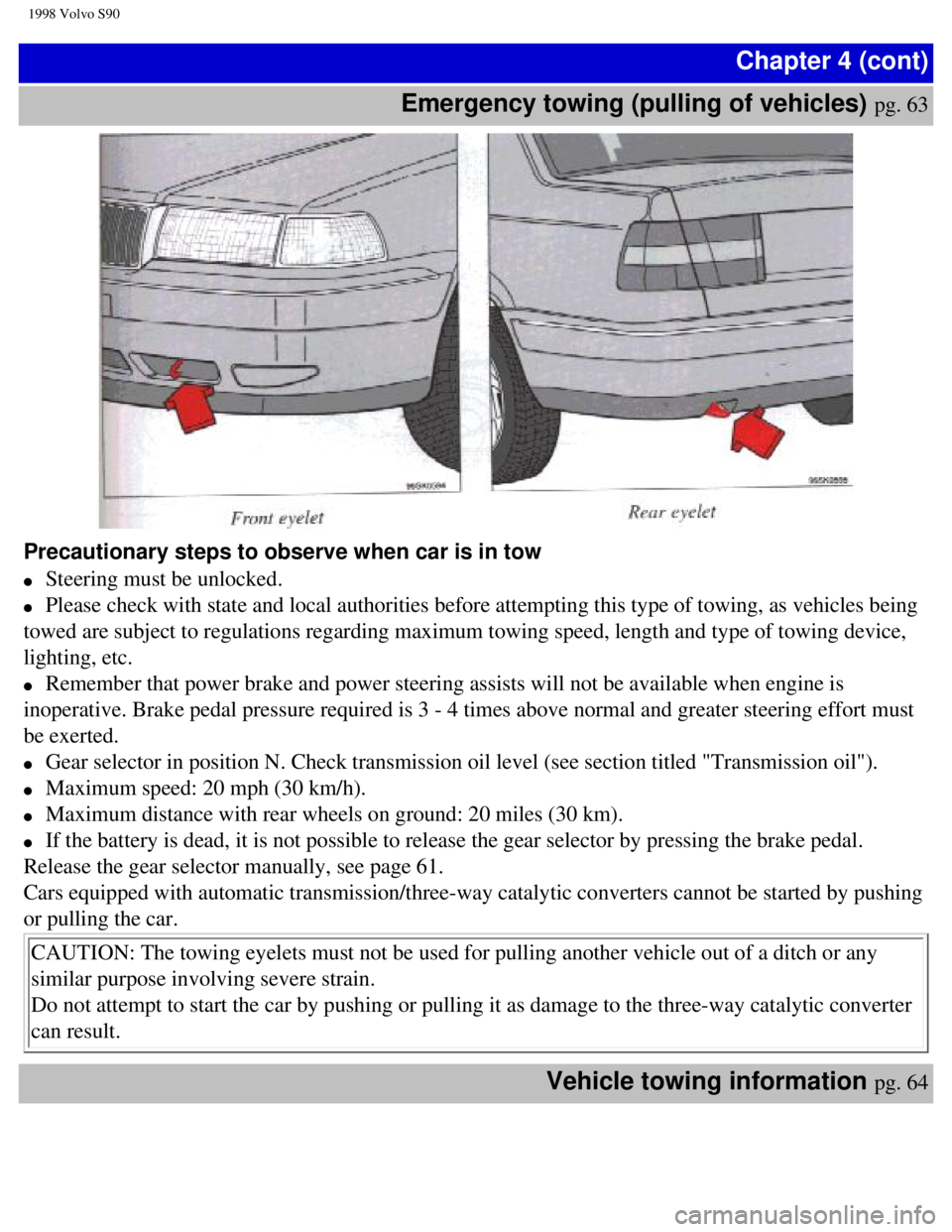
Emergency towing (pulling of vehicles)
pg. 63
Precautionary steps to observe when car is in tow
l Steering must be unlocked.
l Please check with state and local authorities before attempting this typ\
e of towing, as vehicles being
towed are subject to regulations regarding maximum towing speed, length \
and type of towing device,
lighting, etc.
l Remember that power brake and power steering assists will not be availab\
le when engine is
inoperative. Brake pedal pressure required is 3 - 4 times above normal a\
nd greater steering effort must
be exerted.
l Gear selector in position N. Check transmission oil level (see section \
titled "Transmission oil").
l Maximum speed: 20 mph (30 km/h).
l Maximum distance with rear wheels on ground: 20 miles (30 km).
l If the battery is dead, it is not possible to release the gear selector \
by pressing the brake pedal.
Release the gear selector manually, see page 61.
Cars equipped with automatic transmission/three-way catalytic converters\
cannot be started by pushing
or pulling the car.
CAUTION: The towing eyelets must not be used for pulling another vehicle\
out of a ditch or any
similar purpose involving severe strain.
Do not attempt to start the car by pushing or pulling it as damage to th\
e three-way catalytic converter
can result.
Vehicle towing information pg. 64
file:///K|/ownersdocs/1998/1998_SV90/98S90_063.htm (1 of 4)12/30/2006 \
1:52:43 PM
Page 74 of 175
1998 Volvo S90
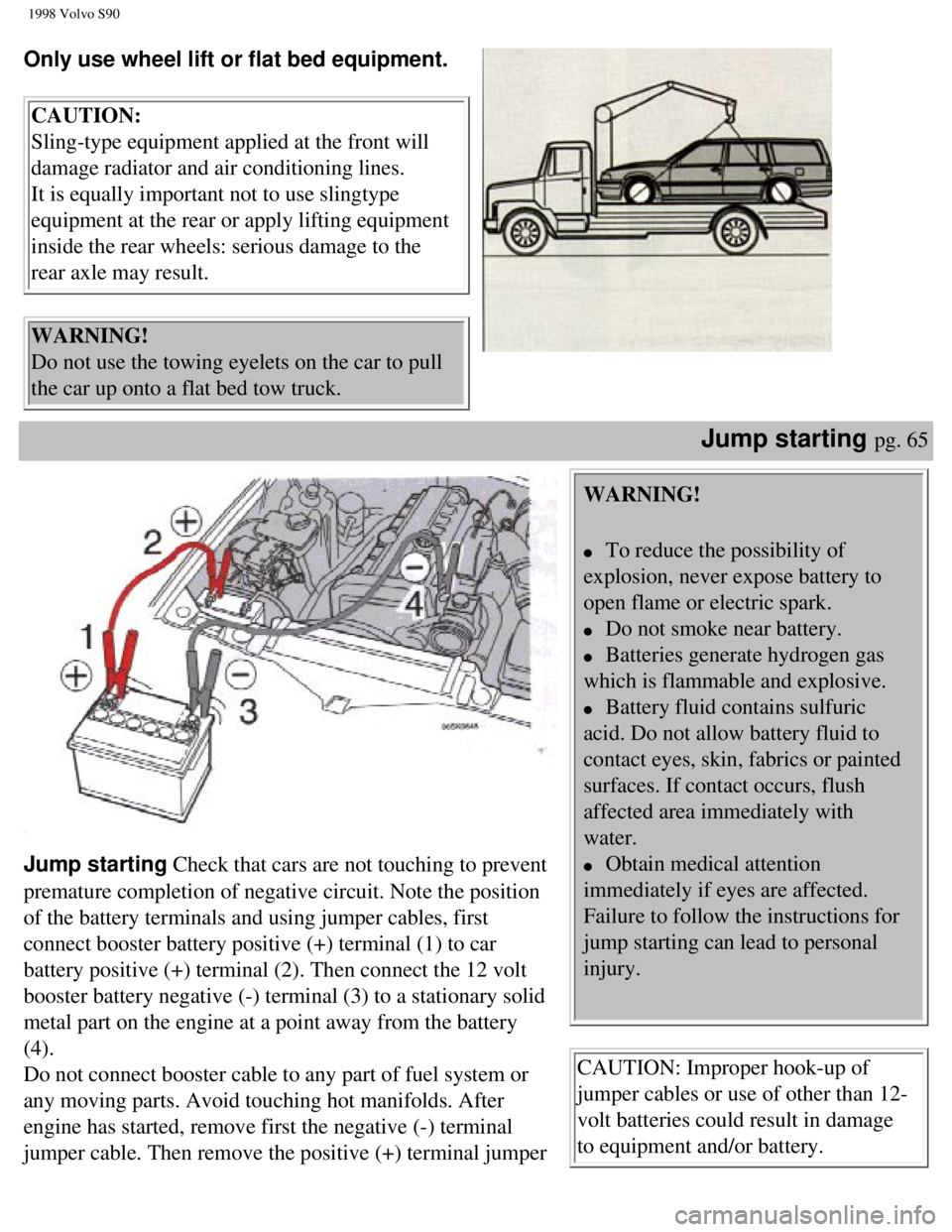
Only use wheel lift or flat bed equipment.
CAUTION:
Sling-type equipment applied at the front will
damage radiator and air conditioning lines.
It is equally important not to use slingtype
equipment at the rear or apply lifting equipment
inside the rear wheels: serious damage to the
rear axle may result.
WARNING!
Do not use the towing eyelets on the car to pull
the car up onto a flat bed tow truck.
Jump starting pg. 65
Jump starting Check that cars are not touching to prevent
premature completion of negative circuit. Note the position
of the battery terminals and using jumper cables, first
connect booster battery positive (+) terminal (1) to car
battery positive (+) terminal (2). Then connect the 12 volt
booster battery negative (-) terminal (3) to a stationary solid
metal part on the engine at a point away from the battery
(4).
Do not connect booster cable to any part of fuel system or
any moving parts. Avoid touching hot manifolds. After
engine has started, remove first the negative (-) terminal
jumper cable. Then remove the positive (+) terminal jumper
WARNING!
l To reduce the possibility of
explosion, never expose battery to
open flame or electric spark.
l Do not smoke near battery.
l Batteries generate hydrogen gas
which is flammable and explosive.
l Battery fluid contains sulfuric
acid. Do not allow battery fluid to
contact eyes, skin, fabrics or painted
surfaces. If contact occurs, flush
affected area immediately with
water.
l Obtain medical attention
immediately if eyes are affected.
Failure to follow the instructions for
jump starting can lead to personal
injury.
CAUTION: Improper hook-up of
jumper cables or use of other than 12-
volt batteries could result in damage
to equipment and/or battery.
file:///K|/ownersdocs/1998/1998_SV90/98S90_063.htm (2 of 4)12/30/2006 \
1:52:43 PM
Page 79 of 175
1998 Volvo S90
Observe legal requirements of
the state in which the vehicles
are registered.
WARNING! Bumper-
attached trailer hitches must
not be used on Volvos, nor
should safety chains be
attached to the bumper.
Trailer hitches attaching to
the vehicle rear axle must
not be used. kgs) a top speed of 50 mph (80
km/h) should never be
exceeded.
l Increase tire pressure to
recommended full-load
pressure. See section "Wheels
and tires".
l Engine and transmission are
subject to increased loads.
Therefore, engine coolant
temperature should be closely
watched when driving in hot
climates or hilly terrain. Use
lower gear and turn off air
conditioner if temperature gauge
pointer enters the red range.
towing a trailer to ensure that the
max. permissible axle load or
gross vehicle weight are not
exceeded.
NOTE: Refer to section
"Automatic transmission" for
additional trailer hauling tips.
Winter driving pg. 69
Cold weather precautions
l If you wish to check your car before the
approach of cold weather, the following advice is
worth noting:
Make sure that the engine coolant contains at least
50 percent antifreeze: that is, 5.3 qts. (5 liters)
Volvo Genuine Coolant/Antifreeze. This gives
protection against freezing down to -31°F (-35°
C). See section "Coolant".
The use of "recycled" antifreeze is not approved
by Volvo. Different types of antifreeze may not be
mixed.
l Try to keep the fuel tank well filled - this
prevents the formation of condensation in the
tank.
In addition in extremely cold weather conditions it
is worthwhile to add fuel line de-icer before
refueling.
l The viscosity of the engine oil is important. Oil
with low viscosity (thinner oil) improves cold-
weather starting as well as decreasing fuel
consumption while the engine is warming up. For
winter use, 5W-30 oil, particularly the synthetic
type, is recommended.
Be sure to use good quality oil but do not use this
l The Volvo Washer Solvent should be diluted as
follows:
Down to 14°F (-10°C): 1 part anti-freeze and 4
parts water
Down to 5°F (-15°C): 1 part anti-freeze and 3
parts water
Down to 0°F (-18°C): 1 part anti-freeze and 2
parts water
Down to -18°F (-28°): 1 part anti-freeze and 1
part water
l Use lock spray or grease in the locks.
NOTE: Avoid the use of de-icing spray as they
can cause damage to the locks.
Automatic differential lock (certain
models)
The differential automatically locks at speed
between 3 - 25 mph (5 - 40 km/h) if either of the
drive wheels begins to lose traction. The
differential lock improves power distribution to
the drive wheels in slippery conditions, shifting
power to the wheel with best traction. It also
file:///K|/ownersdocs/1998/1998_SV90/98S90_067.htm (3 of 5)12/30/2006 \
1:52:43 PM
Page 80 of 175
1998 Volvo S90
cold-weather oil for hard driving or in warm
weather. See section "Engine oil" for more
information.
l The load placed on the battery is greater during
the winter since the heater, windshield wipers,
lighting etc. are used more often. Moreover, the
capacity of the battery decreases as the
temperature drops. In very cold weather, a poorly
charged battery can freeze and be damaged. It is
therefore advisable to check the state of charge
more frequently and spray an anti-rust oil on the
battery posts.
l Volvo recommends the use of snow tires on all
four wheels for winter driving - see section
"Wheels and tires".
l To prevent the washer reservoir from freezing,
add washer solvents containing antifreeze. This is
important since dirt is often splashed on the
windshield during winter driving, thus requiring
frequent use of the washers and wipers.
functions when the transmission is in reverse.
Also see "Winter/Wet" mode on page 59.
Winter/Wet mode
Enhanced Vehicle Traction
This mode may be selected for starting/moving
off on slippery roads or to lower downshift speeds
if the transmission is in "L".
Mode W
*In position D, the gearbox starts in third gear and
changes up to fourth gear.
*In position 3, second gear is locked and there is
no change up to third gear. In position L, first gear
is locked.
*These positions always offer the kick-down
feature.
Long distance trip pg. 70
Before a long distance trip
It is always worthwhile to have your car checked at a Volvo retailer
before driving long distances. Your retailer will also be able to supply\
you with bulbs, fuses, spark plugs and wiper blades for your use in the \
event that problems occur.
If you prefer to check the car yourself, please note the following:
l Check that the engine runs smoothly and that fuel consumption is
normal.
l Check engine oil, coolant levels, and for possible fuel leakage.
l Check transmission oil level and rear axle for leakage.
l Check condition of drive belts.
l Check state of charge of battery.
l Examine tires carefully (the spare tire as well), and replace those
that are worn. Check tire pressures.
l The brakes, front wheel alignment, and steering gear should be
checked by your Volvo retailer only.
l Check all lights, including high beams.
file:///K|/ownersdocs/1998/1998_SV90/98S90_067.htm (4 of 5)12/30/2006 \
1:52:43 PM
Page 82 of 175

1998 Volvo S90
Chapter 5 - Wheels and tires
pg. 71
Wheels and tires
The handling and riding comfort of the vehicle is dependent on the infla\
tion
pressure and the type of tires fitted. Read the following pages carefull\
y.
General information, Wear indicator, Tire economy, Flat spots pg. 72
Snow chains, Winter tires pg. 73
Inflation pressure pg. 74
Uniform tire quality grading pg. 75
Wheels and tires
pg. 72
General information
Your vehicle is equipped with tires according
to the tire information label located on the rear
facing side of the right front door.
The following is an example of a tire designation
code:
195 = tire width in mm.
60 = tire profile. This is the relationship (in
percent) between the section height and the width
of the tire.
R= radial tires.
15 = diameter in inches on all four wheels.
The tires have good road holding characteristics
and offer good handling on dry and wet surfaces.
Your Volvo may be equipped with "all-season"
tires, which provide a somewhat higher degree
of winter roadholding on slippery surfaces
than tires without the "all-season" rating.
However, for optimum road holding on icy or
snow covered roads - we recommend suitable
winter tires. When replacing worn tires, it is recommended
that the tire be identical in type (radial) and size as
the one being replaced. Using a tire of the same
make (manufacturer) will prevent alteration of the
driving characteristics of the vehicle.
To improve tire economy:
l Maintain correct tire pressure.
l Drive smoothly: avoid fast starts, hard braking
and tire screeching.
l Tire wear increases with speed.
l Correct front wheel alignment is very
important. Unbalanced wheels impair tire
economy and driving comfort.
l If the wheels are rotated, they should be kept on
the same side of the car so that they revolve in the
same direction as prior to rotation.
l Hitting curbs or potholes can damage the tires
and/or wheels permanently.
Flat spots
file:///K|/ownersdocs/1998/1998_SV90/98S90_071.htm (1 of 5)12/30/2006 \
1:52:44 PM