warning VOLVO S90 1998 Workshop Manual
[x] Cancel search | Manufacturer: VOLVO, Model Year: 1998, Model line: S90, Model: VOLVO S90 1998Pages: 175, PDF Size: 4.45 MB
Page 84 of 175
1998 Volvo S90
chain information.
CAUTION:
l Check local regulations regarding the use of
snow chains before installing.
l Always follow the chains manufacturer's
installation instructions carefully. Install
chains as tightly as possible and re-tighten
periodically.
l Never exceed the chain manufacture's
specified maximum speed limit. (Under no
circumstances should that limit be higher than
30 mph (50 km/h).
l Avoid bumps, holes or sharp turns when
driving with snow chains.
l The handling of the vehicle can be adversely
affected when driving with chains. Avoid fast
or sharp turns as well as locked wheel braking.
Winter tires wear more quickly on dry roads in
warm weather. They should be removed when the
winter driving season has ended.
Studded tires should be run-in 300-600 miles
(500-1000 km) during which the car should be
driven as smoothly as possible to give the studs
the opportunity to seat properly in the tires. The
car tires should have the same rotational direction
throughout their entire lifetime. In other words, if
you wish to rotate the wheels, make sure that the
same wheels are always on the same side of the
car.
NOTE: Please consult state or local regulations
restricting the use of studded winter tires before
installing such tires.
WARNING! Special wheel rims for air dams
Only special wheel rims, tested and approved
by Volvo, are suitable for use with the air dam
installed on the S90/V90.
*Where permitted.
Wheels and tires (cont.) pg. 74
Checking and correcting tire
pressure
Check the tire pressure when refueling.
The tire pressure should be corrected only when
the tires are cold. With warm tires, correct only
when the pressure is too low. The tire temperature
rises after driving just a few miles.
Vehicle Loading
The tires on your Volvo will perform to
specifications at all normal loads when inflated as
file:///K|/ownersdocs/1998/1998_SV90/98S90_071.htm (3 of 5)12/30/2006 \
1:52:44 PM
Page 85 of 175
1998 Volvo S90
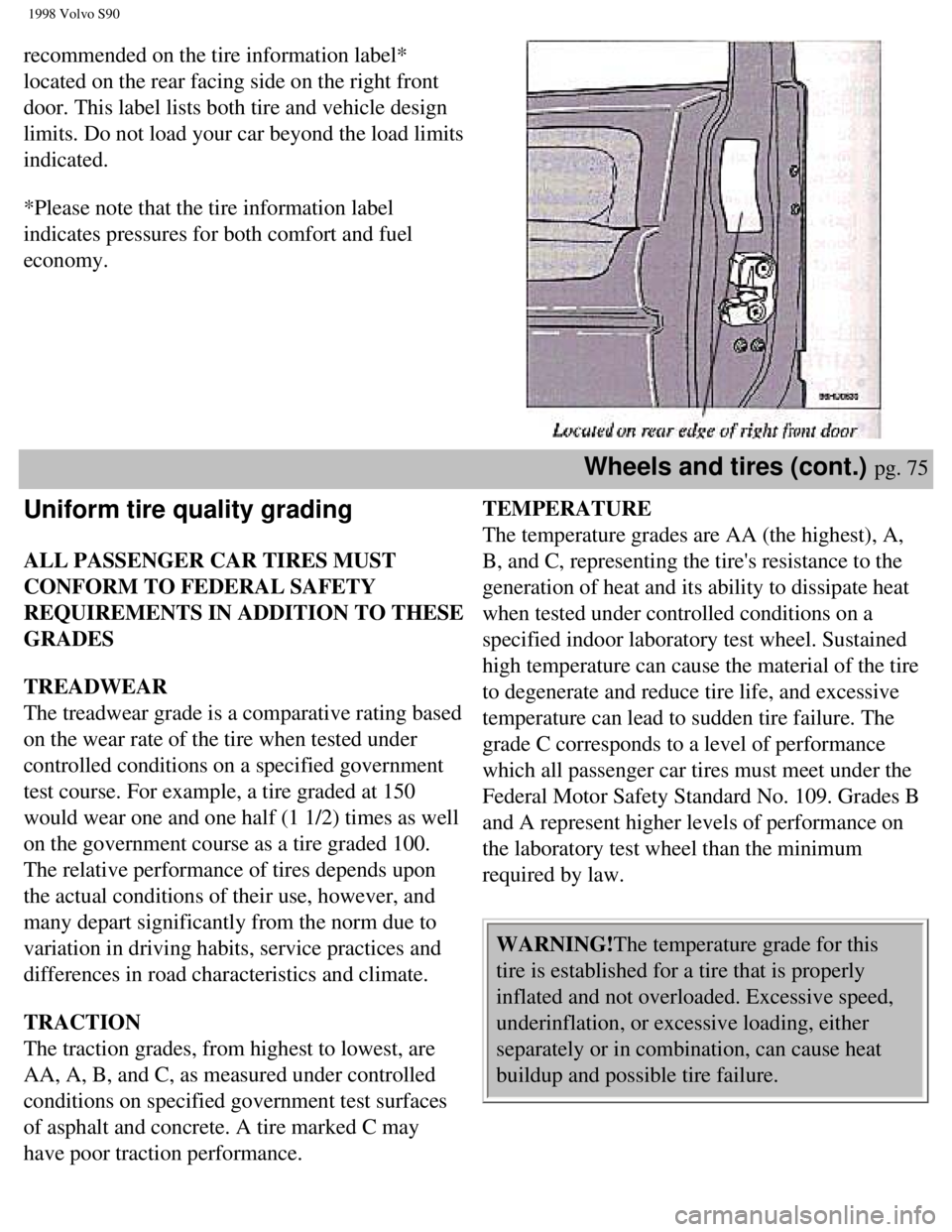
recommended on the tire information label*
located on the rear facing side on the right front
door. This label lists both tire and vehicle design
limits. Do not load your car beyond the load limits
indicated.
*Please note that the tire information label
indicates pressures for both comfort and fuel
economy.
Wheels and tires (cont.) pg. 75
Uniform tire quality grading
ALL PASSENGER CAR TIRES MUST
CONFORM TO FEDERAL SAFETY
REQUIREMENTS IN ADDITION TO THESE
GRADES
TREADWEAR
The treadwear grade is a comparative rating based
on the wear rate of the tire when tested under
controlled conditions on a specified government
test course. For example, a tire graded at 150
would wear one and one half (1 1/2) times as well
on the government course as a tire graded 100.
The relative performance of tires depends upon
the actual conditions of their use, however, and
many depart significantly from the norm due to
variation in driving habits, service practices and
differences in road characteristics and climate.
TRACTION
The traction grades, from highest to lowest, are
AA, A, B, and C, as measured under controlled
conditions on specified government test surfaces
of asphalt and concrete. A tire marked C may
have poor traction performance. TEMPERATURE
The temperature grades are AA (the highest), A,
B, and C, representing the tire's resistance to the
generation of heat and its ability to dissipate heat
when tested under controlled conditions on a
specified indoor laboratory test wheel. Sustained
high temperature can cause the material of the tire
to degenerate and reduce tire life, and excessive
temperature can lead to sudden tire failure. The
grade C corresponds to a level of performance
which all passenger car tires must meet under the
Federal Motor Safety Standard No. 109. Grades B
and A represent higher levels of performance on
the laboratory test wheel than the minimum
required by law.
WARNING!The temperature grade for this
tire is established for a tire that is properly
inflated and not overloaded. Excessive speed,
underinflation, or excessive loading, either
separately or in combination, can cause heat
buildup and possible tire failure.
file:///K|/ownersdocs/1998/1998_SV90/98S90_071.htm (4 of 5)12/30/2006 \
1:52:44 PM
Page 86 of 175
1998 Volvo S90
WARNING! The traction grade assigned to
this tire is based on braking (straight-ahead)
traction tests and does not include cornering
(turning) traction.
Contents | Top of Page
file:///K|/ownersdocs/1998/1998_SV90/98S90_071.htm (5 of 5)12/30/2006 \
1:52:44 PM
Page 88 of 175

1998 Volvo S90
Changing a wheel
On sedans the spare wheel, jack and toolbag are located in the trunk, be\
neath the carpet. The jack must be completely retracted to fit into the holder.
On wagons, the spare tire and the jack are located beneath the floor mat\
in the large storage bin. Always secure the spare tire and the jack to prevent them from rattling.
l Remove the wheel cap, using the screwdriver in the tool kit.
l With the car still on the ground, use the box wrench from the tool kit t\
o loosen the wheel nuts 1/2 - 1 turn. Turn the nuts counterclockwise to loosen.
NOTE:
To avoid excessive wear and the necessity of rebalancing, mark and reins\
tall wheels in same location and position as before removal. To lessen the chance of imbalance, each
wheel hub is equipped with a guide stud to ensure that a removed wheel c\
an be reinstalled in its original position (as when changing over to winter tires/wheels).
Wheel changing (cont.) pg. 79
WARNING!
l The jack attachment must engage the bar in the jack attachment (A). Th\
e car's weight must not rest on the jack's attachment (B).
l Be sure the jack is on a firm, level, non-slippery surface.
l Never allow any part of your body to be extended under a car supported b\
y a jack.
l Use the jack intended for the car when replacing a wheel. For any other \
job, use stands to support the end of the car being worked
on.
l Apply the parking brake, select position P (automatic transmission). \
l Block the wheels standing on the ground. Use rigid wooden blocks or larg\
e stones.
l The jack should be kept well-greased.
file:///K|/ownersdocs/1998/1998_SV90/98S90_077.htm (2 of 4)12/30/2006 \
1:52:45 PM
Page 89 of 175
1998 Volvo S90
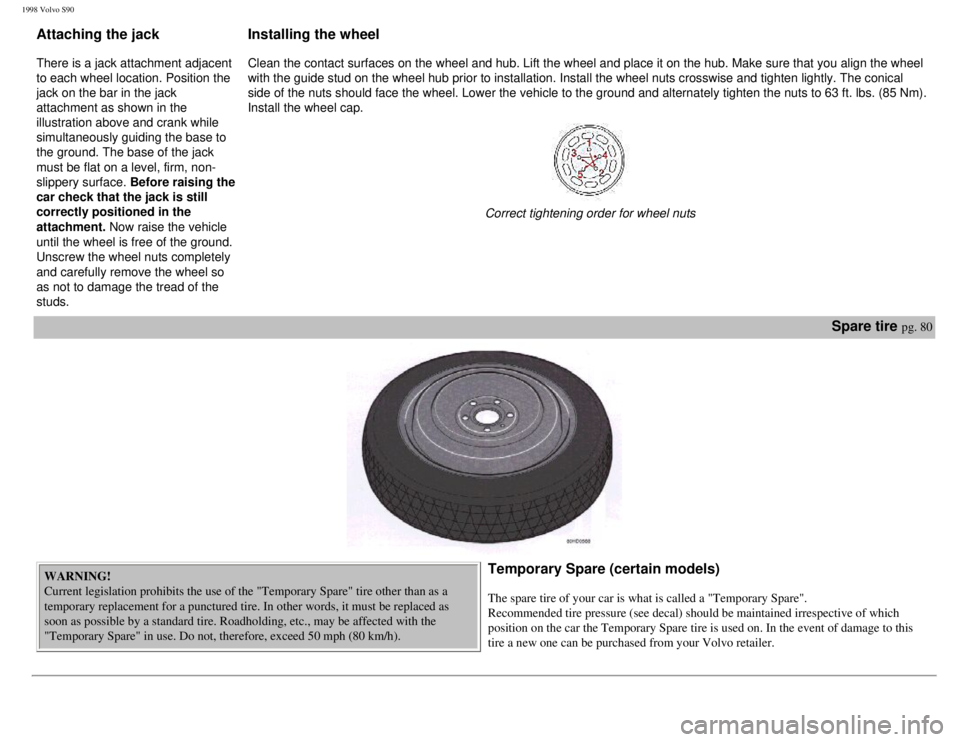
Attaching the jack
There is a jack attachment adjacent
to each wheel location. Position the
jack on the bar in the jack
attachment as shown in the
illustration above and crank while
simultaneously guiding the base to
the ground. The base of the jack
must be flat on a level, firm, non-
slippery surface. Before raising the
car check that the jack is still
correctly positioned in the
attachment. Now raise the vehicle
until the wheel is free of the ground.
Unscrew the wheel nuts completely
and carefully remove the wheel so
as not to damage the tread of the
studs. Installing the wheel
Clean the contact surfaces on the wheel and hub. Lift the wheel and plac\
e it on the hub. Make sure that you align the wheel
with the guide stud on the wheel hub prior to installation. Install the \
wheel nuts crosswise and tighten lightly. The conical
side of the nuts should face the wheel. Lower the vehicle to the ground \
and alternately tighten the nuts to 63 ft. lbs. (85 Nm).
Install the wheel cap.
Correct tightening order for wheel nuts
Spare tire pg. 80
WARNING!
Current legislation prohibits the use of the "Temporary Spare" tire othe\
r than as a
temporary replacement for a punctured tire. In other words, it must be r\
eplaced as
soon as possible by a standard tire. Roadholding, etc., may be affected \
with the
"Temporary Spare" in use. Do not, therefore, exceed 50 mph (80 km/h). \
Temporary Spare (certain models)
The spare tire of your car is what is called a "Temporary Spare".
Recommended tire pressure (see decal) should be maintained irrespectiv\
e of which
position on the car the Temporary Spare tire is used on. In the event of\
damage to this
tire a new one can be purchased from your Volvo retailer.
file:///K|/ownersdocs/1998/1998_SV90/98S90_077.htm (3 of 4)12/30/2006 \
1:52:45 PM
Page 91 of 175
1998 Volvo S90
Chapter 6 - (cont.)
Replacing bulbs
pg. 81
Replacing bulbs
The method for replacement of bulbs in
the various lighting units is shown on the
following pages. Make sure when
installing bulbs, that the guide pin on the
socket fits into its corresponding recess.
When installing Halogen bulbs, do not
touch the glass with your fingers because
grease, oil or any other impurities can be
carbonized onto the bulb and damage the
reflector.
Use bulbs of correct type and voltage.
Failure to do so could cause the bulb
failure warning light to activate.
NOTE: Turn the ignition and light
switch off before replacing any bulbs.
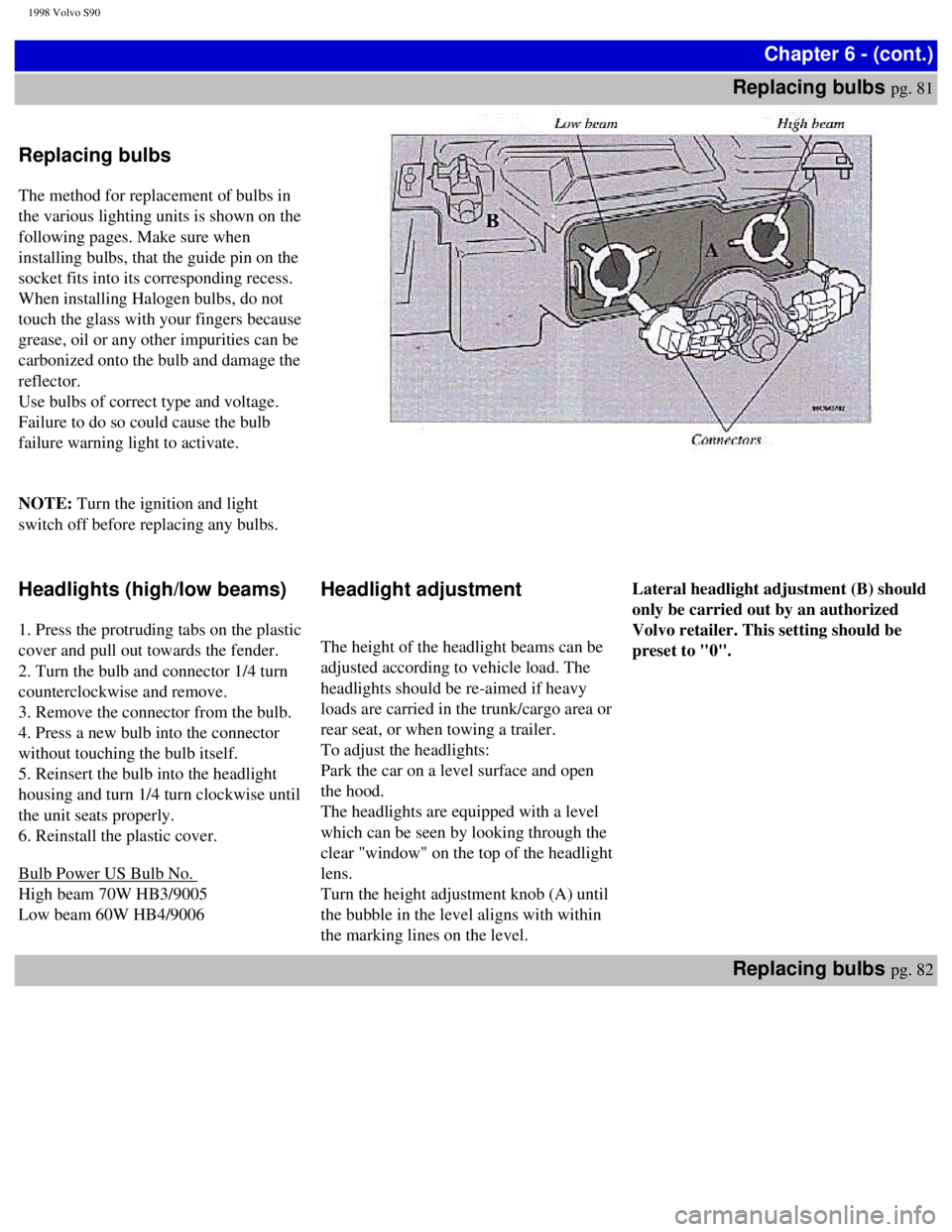
Headlights (high/low beams)
1. Press the protruding tabs on the plastic
cover and pull out towards the fender.
2. Turn the bulb and connector 1/4 turn
counterclockwise and remove.
3. Remove the connector from the bulb.
4. Press a new bulb into the connector
without touching the bulb itself.
5. Reinsert the bulb into the headlight
housing and turn 1/4 turn clockwise until
the unit seats properly.
6. Reinstall the plastic cover.
Bulb Power US Bulb No.
High beam 70W HB3/9005
Low beam 60W HB4/9006
Headlight adjustment
The height of the headlight beams can be
adjusted according to vehicle load. The
headlights should be re-aimed if heavy
loads are carried in the trunk/cargo area or
rear seat, or when towing a trailer.
To adjust the headlights:
Park the car on a level surface and open
the hood.
The headlights are equipped with a level
which can be seen by looking through the
clear "window" on the top of the headlight
lens.
Turn the height adjustment knob (A) until
the bubble in the level aligns with within
the marking lines on the level.
Lateral headlight adjustment (B) should
only be carried out by an authorized
Volvo retailer. This setting should be
preset to "0".
Replacing bulbs pg. 82
file:///K|/ownersdocs/1998/1998_SV90/98S90_081.htm (1 of 6)12/30/2006 \
1:52:45 PM
Page 94 of 175
1998 Volvo S90
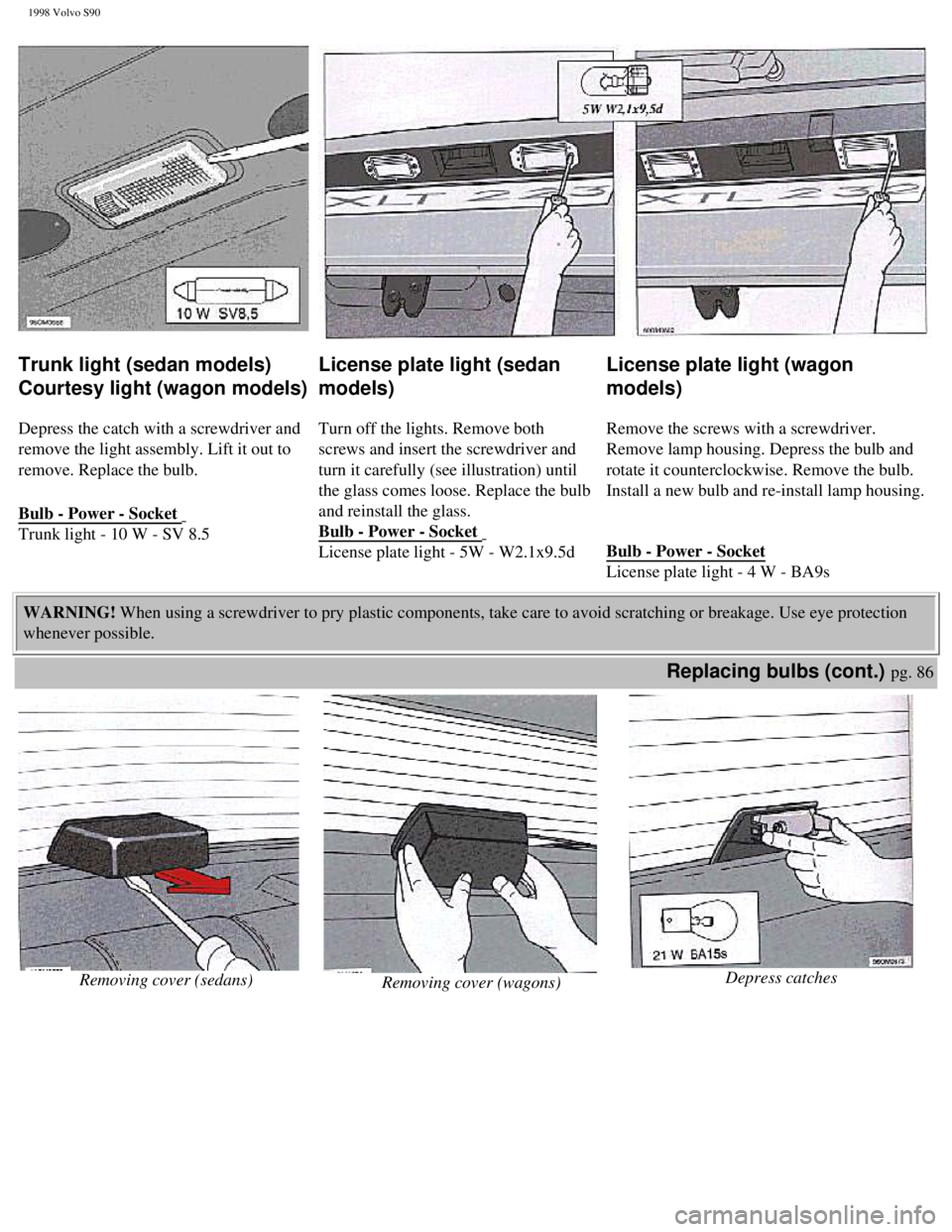
Trunk light (sedan models)
Courtesy light (wagon models)
Depress the catch with a screwdriver and
remove the light assembly. Lift it out to
remove. Replace the bulb.
Bulb - Power - Socket
Trunk light - 10 W - SV 8.5
License plate light (sedan
models)
Turn off the lights. Remove both
screws and insert the screwdriver and
turn it carefully (see illustration) until
the glass comes loose. Replace the bulb
and reinstall the glass.
Bulb - Power - Socket
License plate light - 5W - W2.1x9.5d
License plate light (wagon
models)
Remove the screws with a screwdriver.
Remove lamp housing. Depress the bulb and
rotate it counterclockwise. Remove the bulb.
Install a new bulb and re-install lamp housing.
Bulb - Power - Socket
License plate light - 4 W - BA9s
WARNING! When using a screwdriver to pry plastic components, take care to avoid \
scratching or breakage. Use eye protection
whenever possible.
Replacing bulbs (cont.) pg. 86
Removing cover (sedans)
Removing cover (wagons) Depress catches
file:///K|/ownersdocs/1998/1998_SV90/98S90_081.htm (4 of 6)12/30/2006 \
1:52:45 PM
Page 96 of 175
1998 Volvo S90
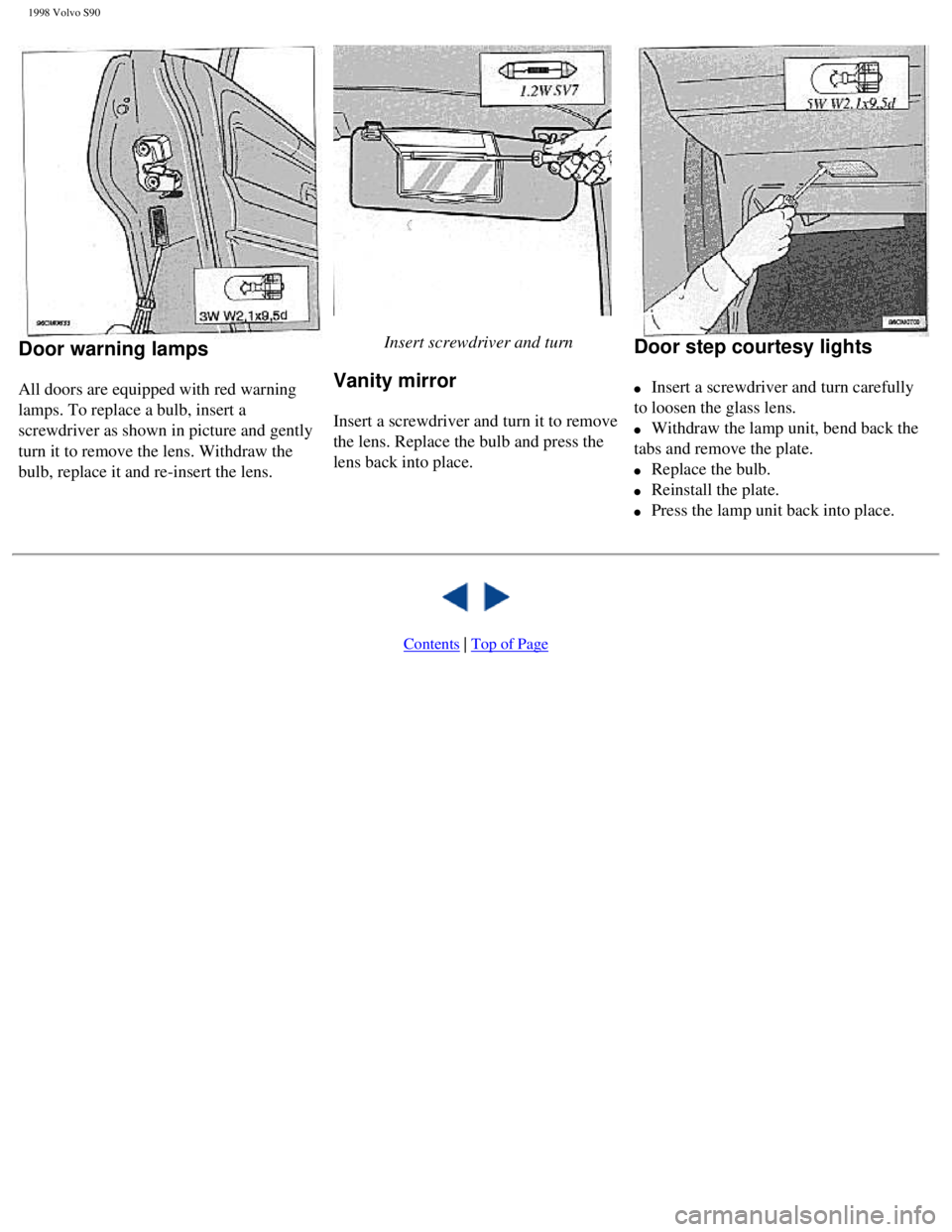
Door warning lamps
All doors are equipped with red warning
lamps. To replace a bulb, insert a
screwdriver as shown in picture and gently
turn it to remove the lens. Withdraw the
bulb, replace it and re-insert the lens.
Insert screwdriver and turn
Vanity mirror
Insert a screwdriver and turn it to remove
the lens. Replace the bulb and press the
lens back into place.
Door step courtesy lights
l Insert a screwdriver and turn carefully
to loosen the glass lens.
l Withdraw the lamp unit, bend back the
tabs and remove the plate.
l Replace the bulb.
l Reinstall the plate.
l Press the lamp unit back into place.
Contents | Top of Page
file:///K|/ownersdocs/1998/1998_SV90/98S90_081.htm (6 of 6)12/30/2006 \
1:52:45 PM
Page 99 of 175
1998 Volvo S90
2 Audio, Power seats, Hazard warning flashers,
Compartment Lights,
Power Antenna, Trailer Power, 50
3 Power Supply Relay "A" 50
4 Fuel System Relay, Ignition System Relay 50
5ABS-unit 50
6 Air pump, Starter Solenoid, Horn 50
7 Electric Cooling Fan 50
8 Pos./parking Light Relay, Headlight Relay, Fog light
relay 50
*Some of the equipment/systems listed may be
available on certain models only and/or as optional
items only.
Brake system pg. 91
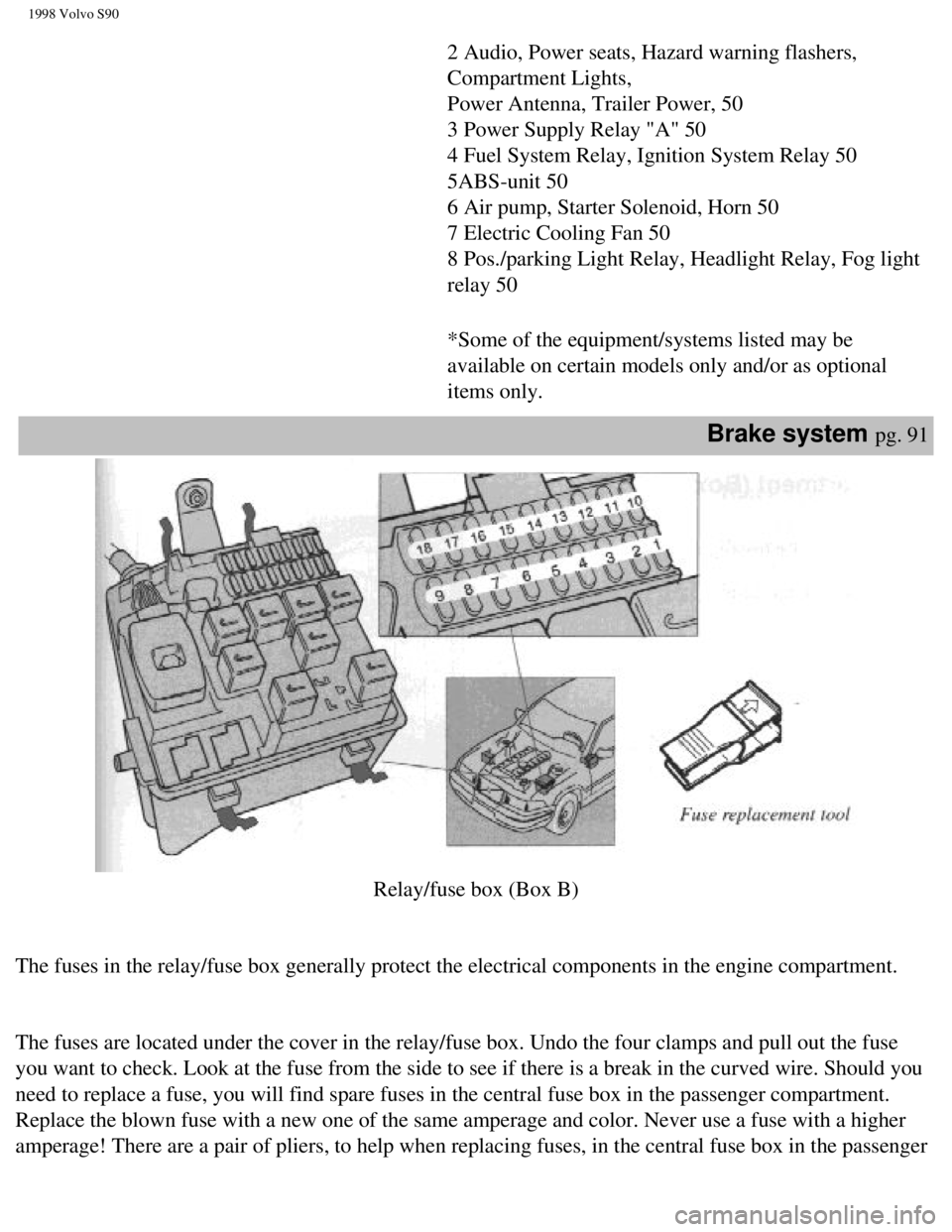
Relay/fuse box (Box B)
The fuses in the relay/fuse box generally protect the electrical compone\
nts in the engine compartment.
The fuses are located under the cover in the relay/fuse box. Undo the fo\
ur clamps and pull out the fuse
you want to check. Look at the fuse from the side to see if there is a b\
reak in the curved wire. Should you
need to replace a fuse, you will find spare fuses in the central fuse bo\
x in the passenger compartment.
Replace the blown fuse with a new one of the same amperage and color. Ne\
ver use a fuse with a higher
amperage! There are a pair of pliers, to help when replacing fuses, in t\
he central fuse box in the passenger
file:///K|/ownersdocs/1998/1998_SV90/98S90_089.htm (3 of 9)12/30/2006 \
1:52:46 PM
Page 101 of 175

1998 Volvo S90
Location ** Amperage
1 Heated rear window 25
2 Central locking 20
3 Brake light, Light switch 15
4 Ignition switch, SRS 10
5 Spare
6 Windshield wiper/washer, Headlight wiper, horn relay 25
7 Climate unit 20
8 Power pass. seat, Power side-view mirrors, Tailgate wiper/washer (wag\
ons)
Instrument lighting, Ambient temp. sensor 15
9 Audio system 15
10 Cigarette lighter/accessory socket 15
11 Transmission mode selector, Gear selector light 5
12 ABS 5
13 Clock, Interior/glove compartment lighting, Door open warning lights,\
Cargo space lighting, Vanity mirror 10
14 Horn 10
Location ** Amperage
15 Power antenna, Headlight flasher, Trailer 20
16 Accessories 20
17 Hazard warning flasher, Direction indicator, Alarm hazard indication \
20
18 Audio/amplifier, CD changer 15
file:///K|/ownersdocs/1998/1998_SV90/98S90_089.htm (5 of 9)12/30/2006 \
1:52:46 PM