heating VOLVO S90 1998 Owners Manual
[x] Cancel search | Manufacturer: VOLVO, Model Year: 1998, Model line: S90, Model: VOLVO S90 1998Pages: 175, PDF Size: 4.45 MB
Page 22 of 175
1998 Volvo S90
Chapter 2 - Instruments, switches and controlsInstruments, switches and controls
pg. 14
Instruments, switches and controls pg. 15
Shiftlock
When your car is parked, the gear selector is
locked in the (P)ark position. To release the
selector from this position, turn the ignition key
to position II (or start the engine), depress the
brake pedal, press the button on the front side of
the gear selector and move the selector from (P)
ark.
If it is necessary to manually override the
Shiftlock system:
l Turn the starting (ignition) key to position
I
l Press firmly on the OVERRIDE" button
located near the base of the gear selector.
l While holding the override button down,
move the gear selector from the (P)ark
position.
Keylock
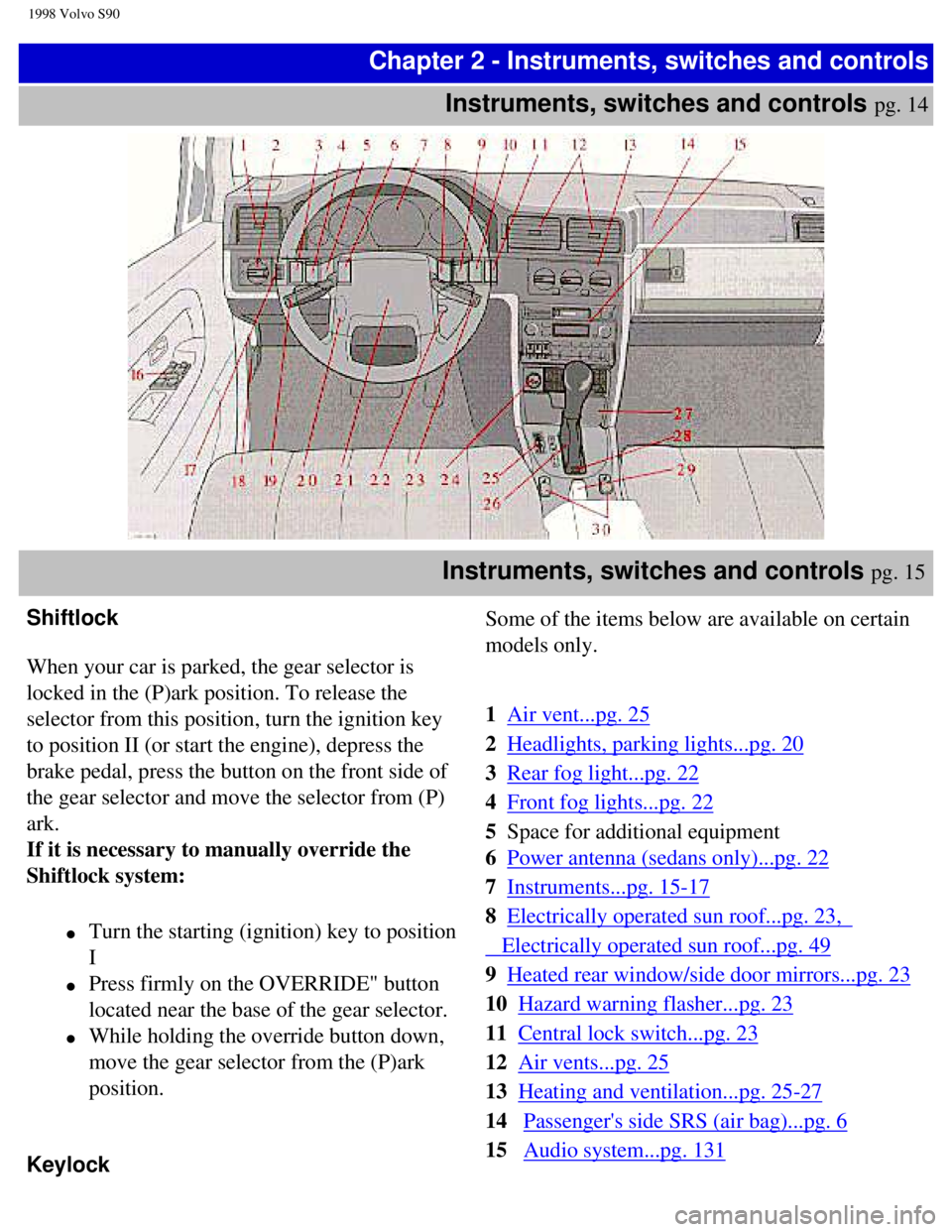
Some of the items below are available on certain
models only.
1
Air vent...pg. 25
2
Headlights, parking lights...pg. 20
3
Rear fog light...pg. 22
4
Front fog lights...pg. 22
5 Space for additional equipment
6
Power antenna (sedans only)...pg. 22
7
Instruments...pg. 15-17
8
Electrically operated sun roof...pg. 23,
Electrically operated sun roof...pg. 49
9
Heated rear window/side door mirrors...pg. 23
10
Hazard warning flasher...pg. 23
11
Central lock switch...pg. 23
12
Air vents...pg. 25
13
Heating and ventilation...pg. 25-27
14
Passenger's side SRS (air bag)...pg. 6
15
Audio system...pg. 131
file:///K|/ownersdocs/1998/1998_SV90/98S90_014.htm (1 of 3)12/30/2006 \
1:52:36 PM
Page 32 of 175
1998 Volvo S90
Chapter 2 - (cont.)
Sun roof, Hazard warning flasher, Tailgate wiper/washer, heated rear window
pg. 23
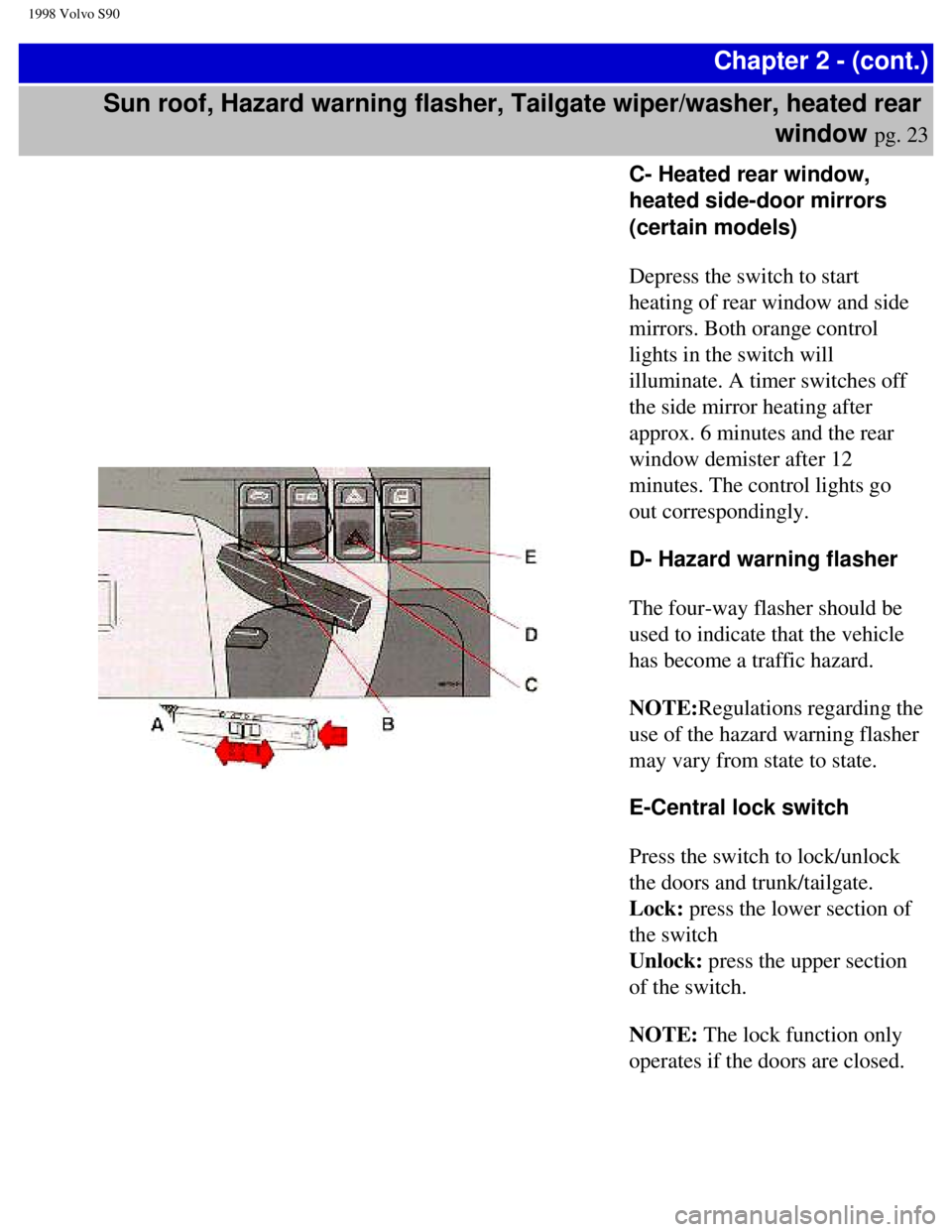
C- Heated rear window,
heated side-door mirrors
(certain models)
Depress the switch to start
heating of rear window and side
mirrors. Both orange control
lights in the switch will
illuminate. A timer switches off
the side mirror heating after
approx. 6 minutes and the rear
window demister after 12
minutes. The control lights go
out correspondingly.
D- Hazard warning flasher
The four-way flasher should be
used to indicate that the vehicle
has become a traffic hazard.
NOTE:Regulations regarding the
use of the hazard warning flasher
may vary from state to state.
E-Central lock switch
Press the switch to lock/unlock
the doors and trunk/tailgate.
Lock: press the lower section of
the switch
Unlock: press the upper section
of the switch.
NOTE: The lock function only
operates if the doors are closed.
file:///K|/ownersdocs/1998/1998_SV90/98S90_023.htm (1 of 7)12/30/2006 \
1:52:37 PM
Page 35 of 175

1998 Volvo S90
lock, the cruise control will
disengage automatically.
Heating, ventilation and air conditioning pg. 25
ECC - Electronic Climate Control
This is an automatic system that also permits
manual operation. The in-car temperature is
automatically monitored by two sensors located in
the passenger compartment.
One sensor is located on the top of the dashboard
where it can sense sunlight. The second sensor is
located on the courtesy light fixture where it can
sense the temperature in the center of the car. The
following pages describe how ECC works and
how it can be used most effectively.
Refrigerant
Volvo cares about the environment. The air
conditioning system in your car contains a CFC-
free refrigerant - R134a. This substance will not
deplete the ozone layer. The system contains 2 lbs
(0.9 kg) R134a and uses Sanden SP-20 (type
PAG) oil.
Air vents (dash)
A Open
B Closed
C Directing air flow horizontally
D Directing air flow vertically
NOTE:All maintenance on the climate control
systems should be carried out by an authorized
Volvo service technician only.
Heating, ventilation and air conditioning (cont.) pg. 26
file:///K|/ownersdocs/1998/1998_SV90/98S90_023.htm (4 of 7)12/30/2006 \
1:52:37 PM
Page 37 of 175
1998 Volvo S90
*When the function selector is in the
mode, the air conditioning
system is ON and recirculation is OFF, regardless
of button position. The light surrounding the "Snowflake" button will be\
OFF and the light surrounding the recirculation button will be OFF.
NOTE: If your windows begin to fog or mist, check that the
recirculation function is not engaged.
Heating, ventilation and air conditioning (cont.) pg. 27
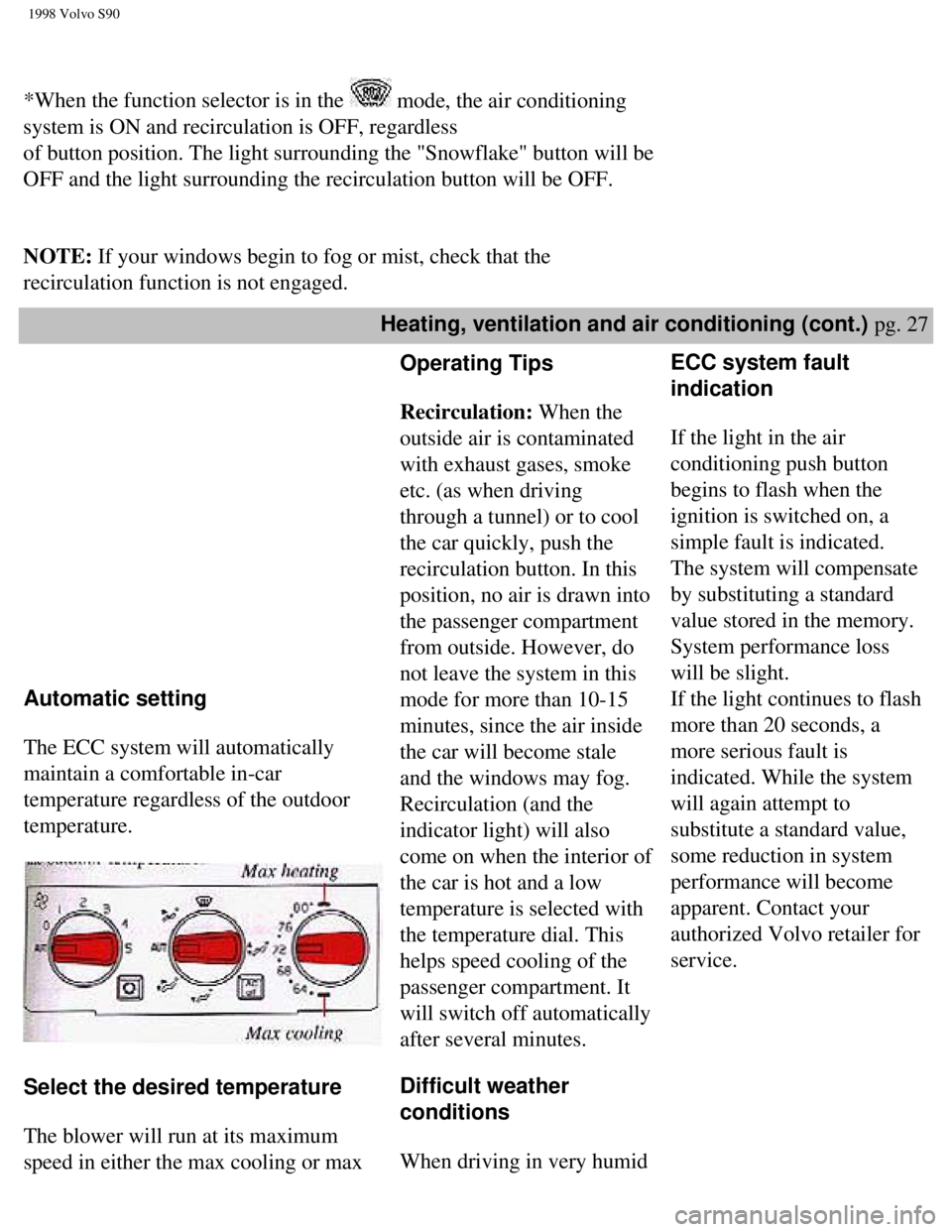
Automatic setting
The ECC system will automatically
maintain a comfortable in-car
temperature regardless of the outdoor
temperature.
Select the desired temperature
The blower will run at its maximum
speed in either the max cooling or max
Operating Tips
Recirculation: When the
outside air is contaminated
with exhaust gases, smoke
etc. (as when driving
through a tunnel) or to cool
the car quickly, push the
recirculation button. In this
position, no air is drawn into
the passenger compartment
from outside. However, do
not leave the system in this
mode for more than 10-15
minutes, since the air inside
the car will become stale
and the windows may fog.
Recirculation (and the
indicator light) will also
come on when the interior of
the car is hot and a low
temperature is selected with
the temperature dial. This
helps speed cooling of the
passenger compartment. It
will switch off automatically
after several minutes.
Difficult weather
conditions
When driving in very humid ECC system fault
indication
If the light in the air
conditioning push button
begins to flash when the
ignition is switched on, a
simple fault is indicated.
The system will compensate
by substituting a standard
value stored in the memory.
System performance loss
will be slight.
If the light continues to flash
more than 20 seconds, a
more serious fault is
indicated. While the system
will again attempt to
substitute a standard value,
some reduction in system
performance will become
apparent. Contact your
authorized Volvo retailer for
service.
file:///K|/ownersdocs/1998/1998_SV90/98S90_023.htm (6 of 7)12/30/2006 \
1:52:37 PM
Page 38 of 175
1998 Volvo S90
heating positions.
Water under the vehicle in hot weather
can be the result of condensation from
the air conditioning system.
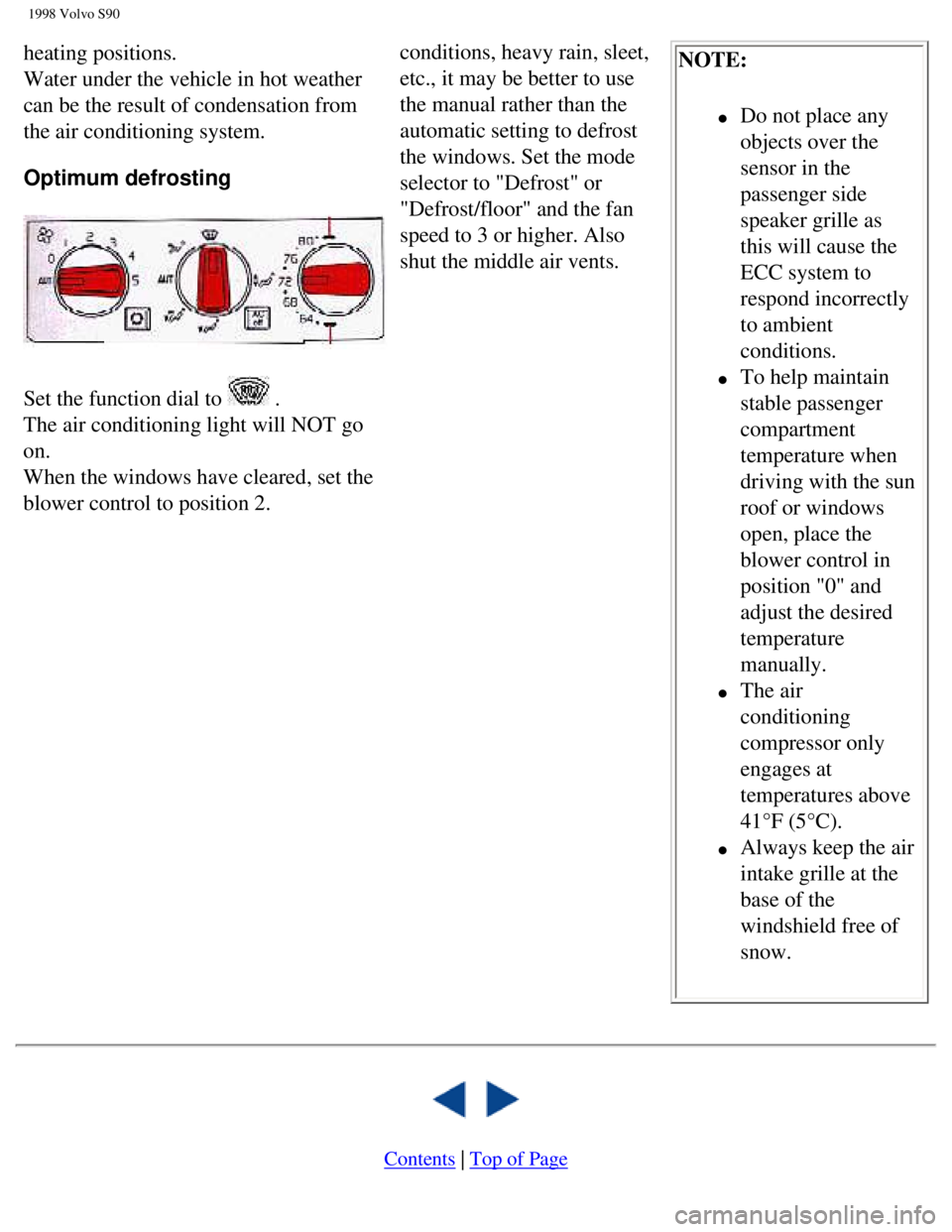
Optimum defrosting
Set the function dial to
.
The air conditioning light will NOT go
on.
When the windows have cleared, set the
blower control to position 2.
conditions, heavy rain, sleet,
etc., it may be better to use
the manual rather than the
automatic setting to defrost
the windows. Set the mode
selector to "Defrost" or
"Defrost/floor" and the fan
speed to 3 or higher. Also
shut the middle air vents. NOTE:
l Do not place any
objects over the
sensor in the
passenger side
speaker grille as
this will cause the
ECC system to
respond incorrectly
to ambient
conditions.
l To help maintain
stable passenger
compartment
temperature when
driving with the sun
roof or windows
open, place the
blower control in
position "0" and
adjust the desired
temperature
manually.
l The air
conditioning
compressor only
engages at
temperatures above
41°F (5°C).
l Always keep the air
intake grille at the
base of the
windshield free of
snow.
Contents | Top of Page
file:///K|/ownersdocs/1998/1998_SV90/98S90_023.htm (7 of 7)12/30/2006 \
1:52:37 PM
Page 39 of 175
1998 Volvo S90
Chapter 2 - (cont.)
Heated front seats
pg. 28
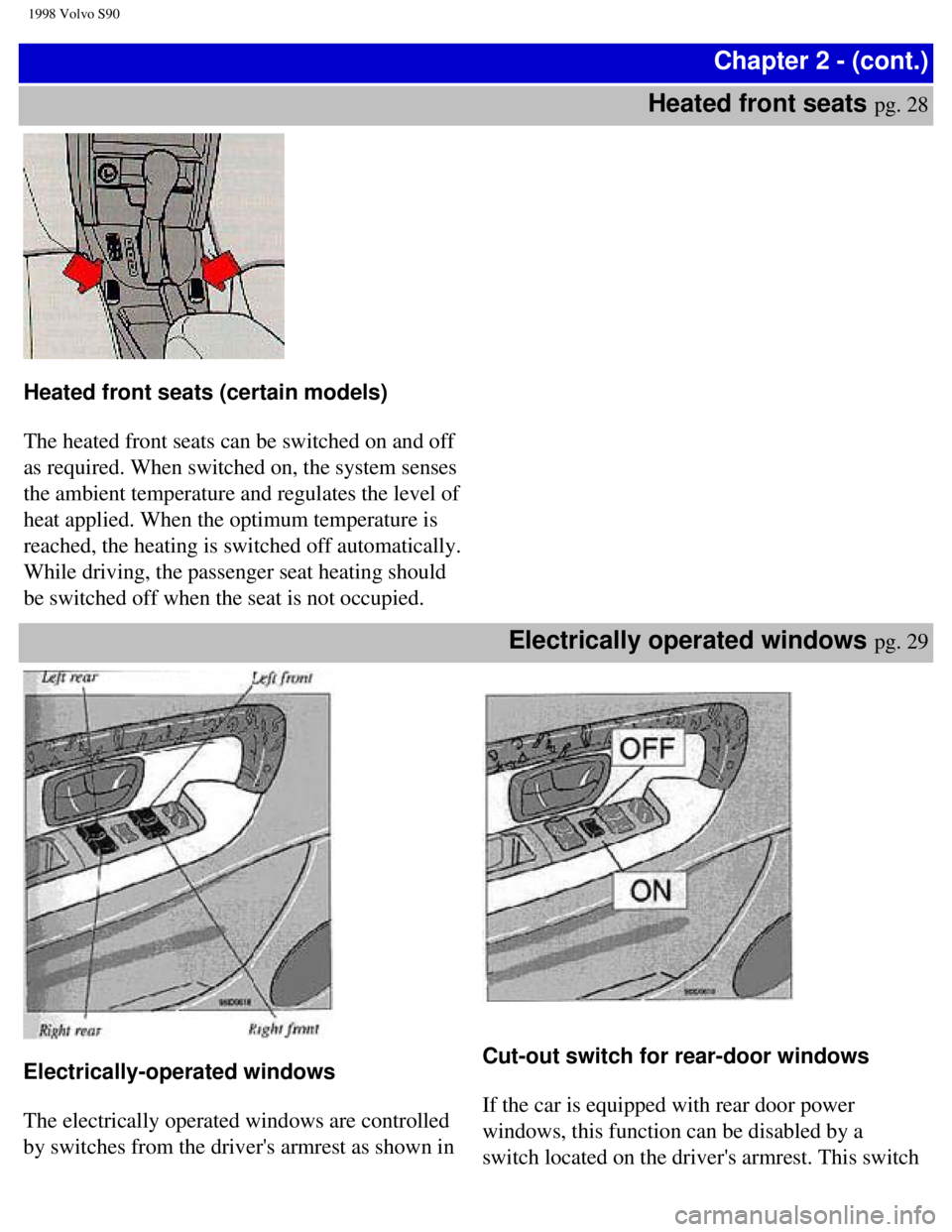
Heated front seats (certain models)
The heated front seats can be switched on and off
as required. When switched on, the system senses
the ambient temperature and regulates the level of
heat applied. When the optimum temperature is
reached, the heating is switched off automatically.
While driving, the passenger seat heating should
be switched off when the seat is not occupied.
Electrically operated windows pg. 29
Electrically-operated windows
The electrically operated windows are controlled
by switches from the driver's armrest as shown in
Cut-out switch for rear-door windows
If the car is equipped with rear door power
windows, this function can be disabled by a
switch located on the driver's armrest. This switch
file:///K|/ownersdocs/1998/1998_SV90/98S90_028.htm (1 of 3)12/30/2006 \
1:52:38 PM
Page 65 of 175
1998 Volvo S90
For cold starts at altitudes
above 6000 ft (1800 m),
depress the accelerator pedal
halfway and turn the key to the
starting position. Release the
accelerator pedal slowly when
the engine starts.
4 To release the gear selector,
depress the brake pedal .See
page 61 for instructions on
manually overriding the
SHIFTLOCK system if the
lever cannot be moved. Do not
race a cold engine immediately
after starting. Oil flow may not
reach some lubricating points
fast enough to prevent engine
damage. WARNING!
Never leave car unattended
with engine running.
Always open the garage
doors fully before starting
the engine inside a garage to
ensure adequate ventilation.
The exhaust gases contain
carbon monoxide, which is
invisible and odorless but
very poisonous.
NOTE:
l Do not exceed 3000rpm until
the ticking sound disappears.
l Selecting position P or N
when idling at a standstill for
prolonged periods of time will
help prevent overheating of the
transmission oil.
Contents | Top of Page
file:///K|/ownersdocs/1998/1998_SV90/98S90_053.htm (6 of 6)12/30/2006 \
1:52:41 PM
Page 69 of 175

1998 Volvo S90
Special Tips - automatic transmission
l For driving down steep hills and when driving
for prolonged periods at low speeds, position L
should be selected. Avoid, however, repeated
changes since this can cause overheating of the
transmission oil. For driving on long continuous
uphill gradients, select position 3.
l Do not hold the car stationary on an incline by
using the accelerator pedal. Instead, apply the
hand brake (parking brake). This prevents the
transmission oil from becoming overheated.
l When towing a trailer, select shift position 3.
l The (E)conomy mode should be selected when
the cruise control is engaged.
l Never select P or R while the car is in motion.
l When initially selecting positions D, 3, L or R,
your right foot should press firmly on the brake
pedal to ensure that the car is standing still with
the engine idling.
l The gear selector should not be downshifted to
L at speeds above 75 mph (125 km/h). Always
observe posted speed limits. Cooling system
The risk for overheating is greatest, especially in
hot weather, when:
l towing a trailer up steep inclines for prolonged
periods at wide open throttle and low engine rpm.
l stopping the engine suddenly after high speed
driving (so-called "after-boiling" can occur).
To avoid overheating, the following rules should
be followed:
l Reduce speed and downshift when towing a
trailer up long, steep inclines. The risk of
overheating can be reduced by switching off the
air conditioning system for a short time.
l Do not let the engine idle unnecessarily for
prolonged periods.
l Do not mount auxiliary lamps in front of the
grill.
When the risk of overheating is imminent, or in
the event of overheating, (the temperature gauge
goes repeatedly into, or stays continually in, the
red section) the following precautions should be
taken:
l Switch off the air conditioning system.
l Pull off the road, away from traffic, stop the car
and put the gear lever into neutral. Do not stop the
engine!
l Switch the heater to full (maximum) position.
Increase the engine speed to approx. 2000 rpm
(twice idling speed) until the temperature begins
to drop.
See "Coolant" to check and top-up the coolant
level if necessary.
WARNING! Do not remove coolant expansion
tank cap. The coolant will be extremely hot.
Points to remember pg. 61
file:///K|/ownersdocs/1998/1998_SV90/98S90_058.htm (4 of 7)12/30/2006 \
1:52:42 PM
Page 75 of 175
1998 Volvo S90
cable.
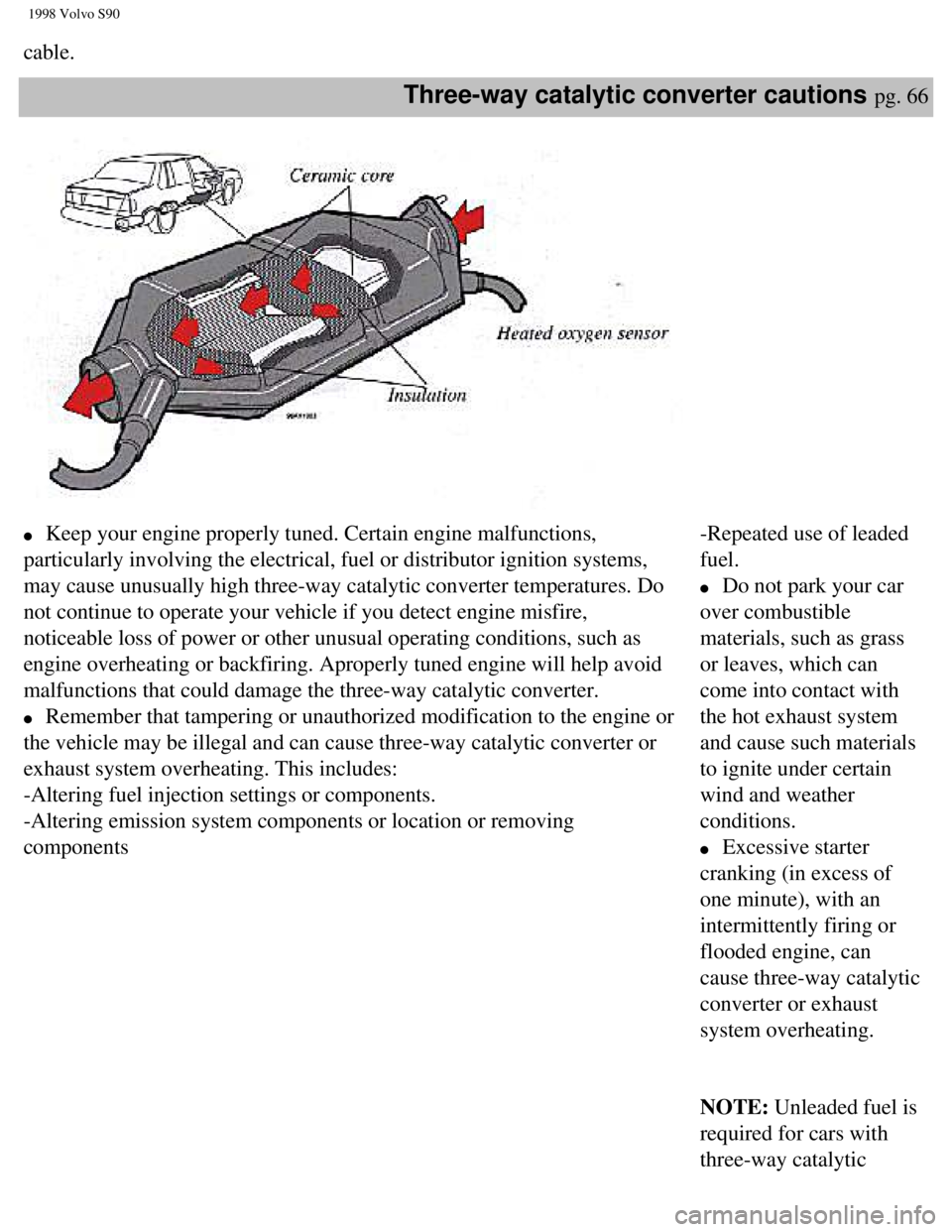
Three-way catalytic converter cautions pg. 66
l Keep your engine properly tuned. Certain engine malfunctions,
particularly involving the electrical, fuel or distributor ignition syst\
ems,
may cause unusually high three-way catalytic converter temperatures. Do \
not continue to operate your vehicle if you detect engine misfire,
noticeable loss of power or other unusual operating conditions, such as \
engine overheating or backfiring. Aproperly tuned engine will help avoid\
malfunctions that could damage the three-way catalytic converter.
l Remember that tampering or unauthorized modification to the engine or
the vehicle may be illegal and can cause three-way catalytic converter o\
r
exhaust system overheating. This includes:
-Altering fuel injection settings or components.
-Altering emission system components or location or removing
components -Repeated use of leaded
fuel.
l Do not park your car
over combustible
materials, such as grass
or leaves, which can
come into contact with
the hot exhaust system
and cause such materials
to ignite under certain
wind and weather
conditions.
l Excessive starter
cranking (in excess of
one minute), with an
intermittently firing or
flooded engine, can
cause three-way catalytic
converter or exhaust
system overheating.
NOTE: Unleaded fuel is
required for cars with
three-way catalytic
file:///K|/ownersdocs/1998/1998_SV90/98S90_063.htm (3 of 4)12/30/2006 \
1:52:43 PM
Page 78 of 175
1998 Volvo S90
function) and the vehicle should
be driven to a Volvo retailer for
inspection.
The Anti-lock Braking System
(ABS) helps to improve vehicle
control (stopping and steering)
during severe braking conditions
by limiting brake lock-up. When
the system "senses" impending
lock-up, braking pressure is
automatically modulated in
order to help prevent lockup,
which could lead to a skid. brake application feels normal.
This should also be done after
washing or starting in very damp
or cold weather.
Trailer towing pg. 68
When preparing for
trailer towing, observe
the following:
l Volvo recommends the use of
Volvo trailer hitches which are
specially designed for the car.
For trailer weights exceeding
2000 lbs. (908 kg), use only a
trailer hitch offered as a
Genuine Volvo accessory.
NOTE: Models with automatic
transmission are equipped with
a transmission oil cooler as
standard equipment. This cooler
helps prevent overheating of the
transmission during times of
increased load, as when towing
a trailer.
l Maximum trailer weight
recommended by Volvo is:
Trailers without brakes: 1100
lbs (500kg)
Trailers with brakes: 2" ball -
3300 lbs (1500 kg), 1 7/8" ball -
2000 lbs (908 kg).
WARNING! Never connect a
trailer's hydraulic brake
system directly to the vehicle
brake system, nor a trailer's
lighting system directly to the
vehicle lighting system.
Consult your nearest
authorized Volvo retailer for
correct installation.
All Volvo models are equipped
with energy-absorbing shock-
mounted bumpers. Trailer hitch
installation should not interfere
with the proper operation of this
bumper system. Trailer towing
does not normally present any
particular problems, but take
into consideration:
l Recommended hitch tongue
load is 110 lbs (50 kgs) for
trailer weights below 2,650 lbs
(1,200 kgs) and 165 lbs (75 kgs)
for trailer weights above 2,650
lbs (1,200 kgs).
l For trailer weights between
2,650-3,300 lbs (1,200-1,500
l Avoid overload and other
abusive operation.
l Hauling a trailer affects
handling, durability, and
economy.
l It is necessary to balance
trailer brakes with the towing
vehicle brakes to provide a safe
stop (check and observe State/
Local regulations).
l Do not connect the trailer's
brake system directly to the
vehicle's brake system.
l More frequent vehicle
maintenance is required.
l Remove the ball and drawbar
assembly when the hitch is not
being used.
l Volvo recommends the use of
synthetic engine oil when towing
a trailer over long distances or in
mountainous areas.
l The trailer hitch tongue load
(110/165 lbs - 50/75 kg) is part
of the vehicle's capacity weight.
It may be necessary to reduce the
trunk/cargo area load when
file:///K|/ownersdocs/1998/1998_SV90/98S90_067.htm (2 of 5)12/30/2006 \
1:52:43 PM