parking brake VOLVO S90 1998 Owners Manual
[x] Cancel search | Manufacturer: VOLVO, Model Year: 1998, Model line: S90, Model: VOLVO S90 1998Pages: 175, PDF Size: 4.45 MB
Page 22 of 175
1998 Volvo S90
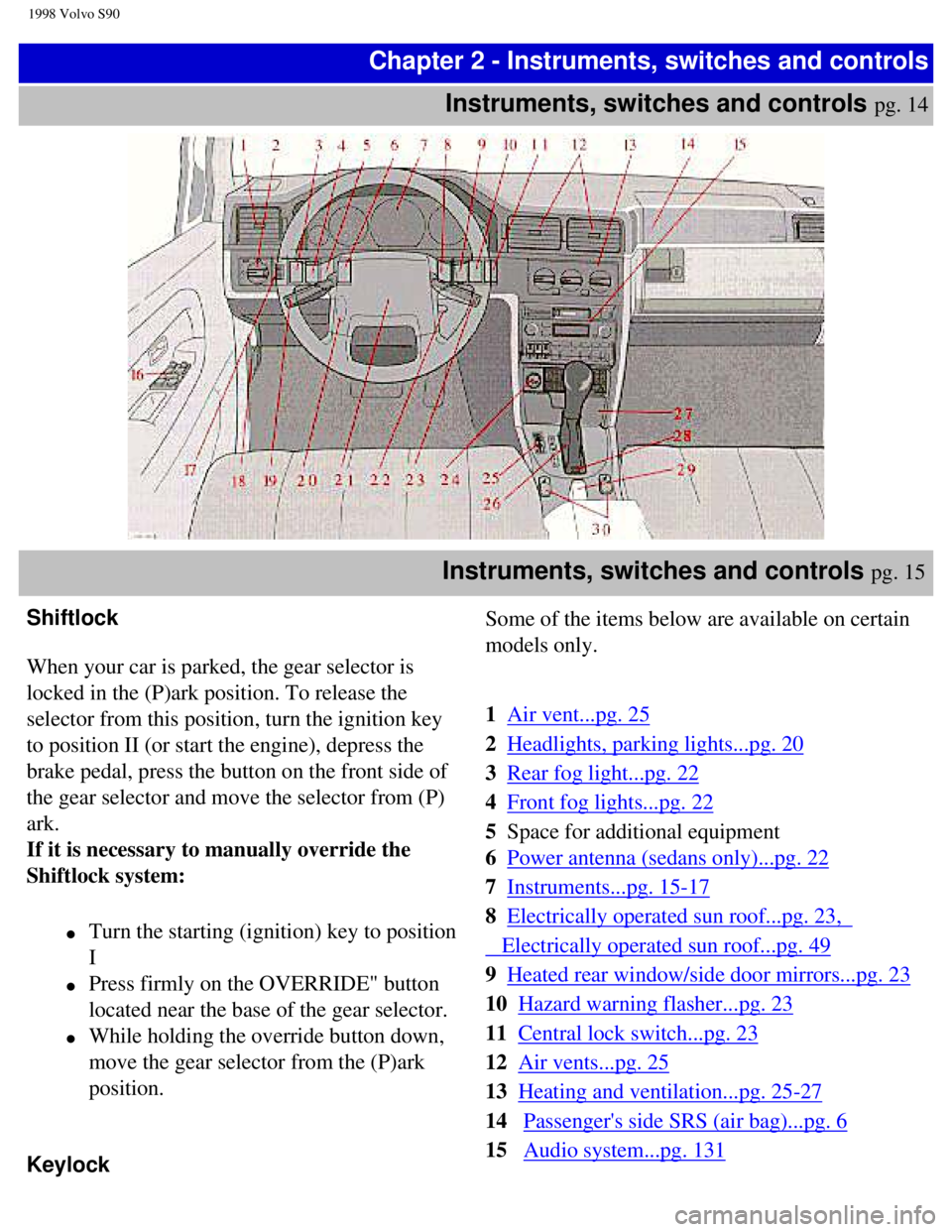
Chapter 2 - Instruments, switches and controlsInstruments, switches and controls
pg. 14
Instruments, switches and controls pg. 15
Shiftlock
When your car is parked, the gear selector is
locked in the (P)ark position. To release the
selector from this position, turn the ignition key
to position II (or start the engine), depress the
brake pedal, press the button on the front side of
the gear selector and move the selector from (P)
ark.
If it is necessary to manually override the
Shiftlock system:
l Turn the starting (ignition) key to position
I
l Press firmly on the OVERRIDE" button
located near the base of the gear selector.
l While holding the override button down,
move the gear selector from the (P)ark
position.
Keylock
Some of the items below are available on certain
models only.
1
Air vent...pg. 25
2
Headlights, parking lights...pg. 20
3
Rear fog light...pg. 22
4
Front fog lights...pg. 22
5 Space for additional equipment
6
Power antenna (sedans only)...pg. 22
7
Instruments...pg. 15-17
8
Electrically operated sun roof...pg. 23,
Electrically operated sun roof...pg. 49
9
Heated rear window/side door mirrors...pg. 23
10
Hazard warning flasher...pg. 23
11
Central lock switch...pg. 23
12
Air vents...pg. 25
13
Heating and ventilation...pg. 25-27
14
Passenger's side SRS (air bag)...pg. 6
15
Audio system...pg. 131
file:///K|/ownersdocs/1998/1998_SV90/98S90_014.htm (1 of 3)12/30/2006 \
1:52:36 PM
Page 23 of 175
1998 Volvo S90
This means that when you switch off the ignition,
the gear selector must be in the (P)ark position
before the starting (ignition) key can be removed
from the ignition switch.
Anti-Lock Brake System (ABS)
The ABS system in your car performs a self-
diagnostic test when the vehicle is started and at
4 mph (6km/h). The driver may detect one
pulsation of the brake pedal and a sound will be
audible from the ABS control module. This is
normal.
The pages in this section provide detailed
descriptions of the vehicle's instruments and
controls.
Note that vehicles may be equipped differently,
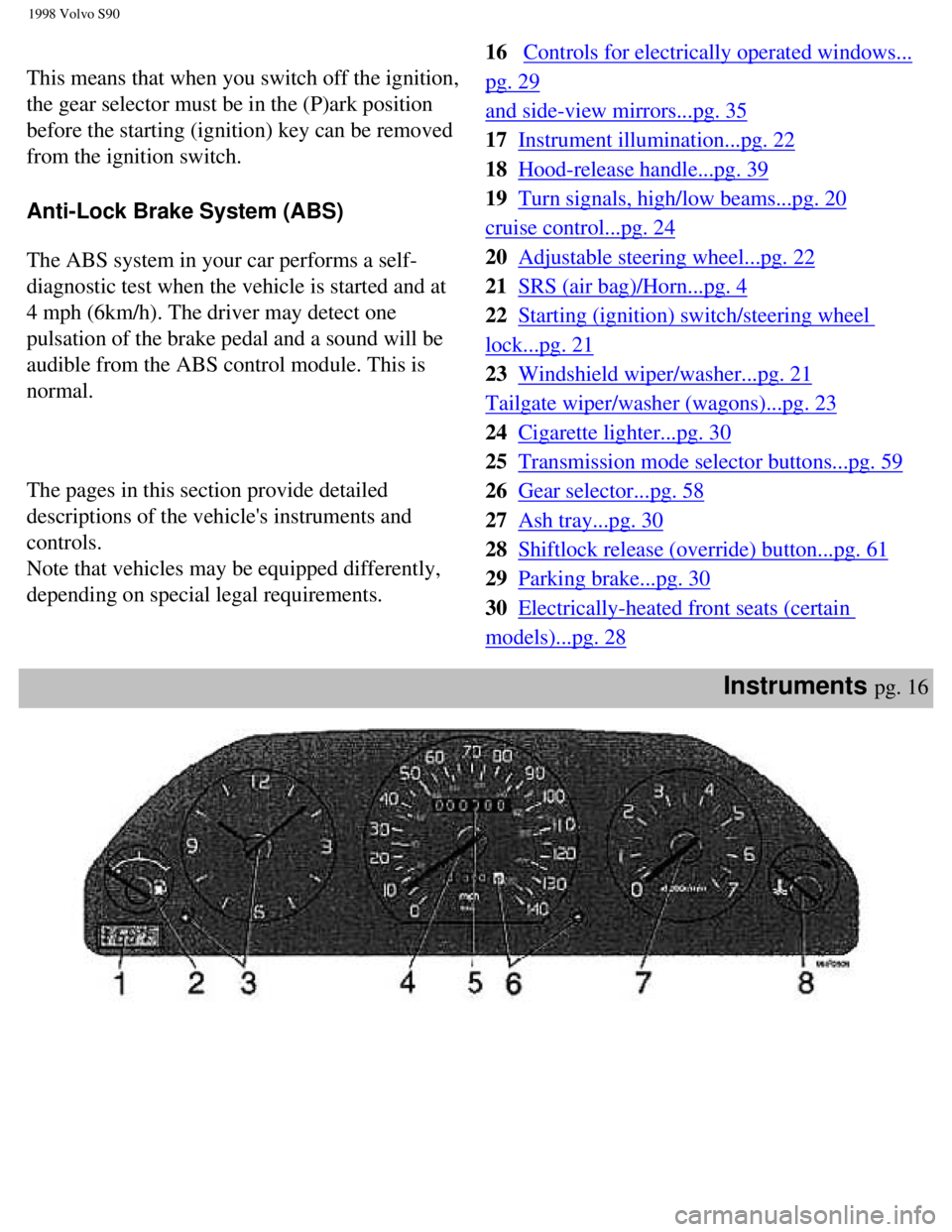
depending on special legal requirements. 16 Controls for electrically operated windows...
pg. 29
and side-view mirrors...pg. 35
17
Instrument illumination...pg. 22
18
Hood-release handle...pg. 39
19
Turn signals, high/low beams...pg. 20
cruise control...pg. 24
20
Adjustable steering wheel...pg. 22
21
SRS (air bag)/Horn...pg. 4
22
Starting (ignition) switch/steering wheel
lock...pg. 21
23
Windshield wiper/washer...pg. 21
Tailgate wiper/washer (wagons)...pg. 23
24
Cigarette lighter...pg. 30
25
Transmission mode selector buttons...pg. 59
26
Gear selector...pg. 58
27
Ash tray...pg. 30
28
Shiftlock release (override) button...pg. 61
29
Parking brake...pg. 30
30
Electrically-heated front seats (certain
models)...pg. 28
Instruments pg. 16
file:///K|/ownersdocs/1998/1998_SV90/98S90_014.htm (2 of 3)12/30/2006 \
1:52:36 PM
Page 25 of 175
1998 Volvo S90
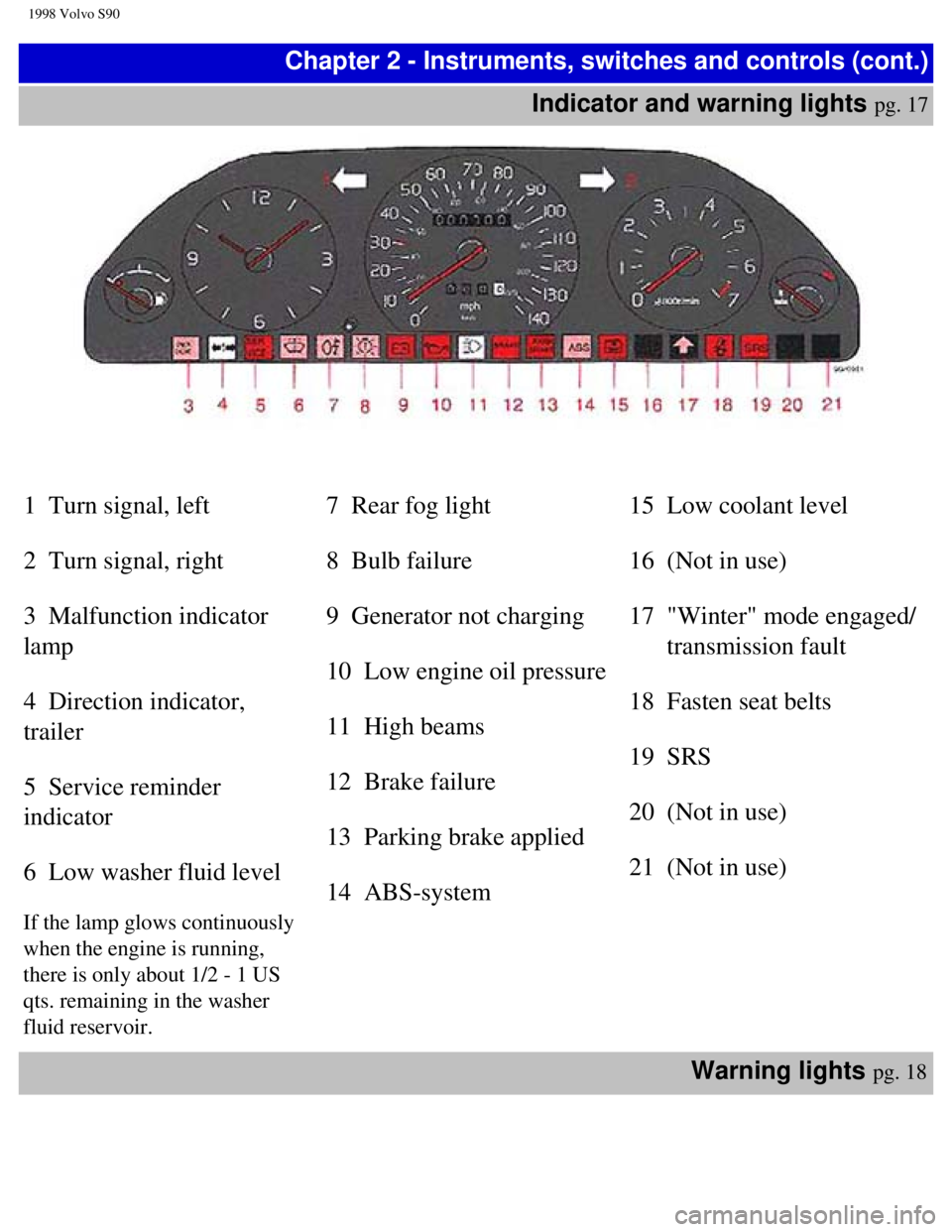
Chapter 2 - Instruments, switches and controls (cont.)Indicator and warning lights
pg. 17
1 Turn signal, left
2 Turn signal, right
3 Malfunction indicator
lamp
4 Direction indicator,
trailer
5 Service reminder
indicator
6 Low washer fluid level
If the lamp glows continuously
when the engine is running,
there is only about 1/2 - 1 US
qts. remaining in the washer
fluid reservoir.
7 Rear fog light
8 Bulb failure
9 Generator not charging
10 Low engine oil pressure
11 High beams
12 Brake failure
13 Parking brake applied
14 ABS-system
15 Low coolant level
16 (Not in use)
17 "Winter" mode engaged/
transmission fault
18 Fasten seat belts
19 SRS
20 (Not in use)
21 (Not in use)
Warning lights
pg. 18
file:///K|/ownersdocs/1998/1998_SV90/98S90_017.htm (1 of 7)12/30/2006 \
1:52:36 PM
Page 26 of 175

1998 Volvo S90
The warning lights described on pages 18 and 19 should never stay on whe\
n driving
When the ignition key is turned on, and before the engine starts, all of\
the warning lights should be on
to test the function of the bulbs. Should a light not go off after the e\
ngine has started, the system
indicated should be inspected. However, the parking brake reminder light\
will not go off until the
parking brake is fully released.
Generator warning
light
If the light comes on while the
engine is running, have the
charging system checked.
Malfunction
indicator lamp
If the lamp comes on (or stays
on after the vehicle has started),
the engine diagnostic system
has detected a possible fault in
the emission control system.
Although driveability may not
be affected, see an authorized
Volvo retailer as soon as
possible for inspection.
NOTE:If the fuel filler cap is
not closed tightly or if the
engine is running when the car
is refueled, the Malfunction
Indicator Lamp may indicate a
fault. Use only Volvo original
or approved fuel filler caps.
Oil pressure warning
light
If the light comes on while
driving, stop the car and then s
If the light stays on after restart,
have the car towed to the
nearest authorized Volvo
retailer. After hard driving, the
light may come on occasionally
when the engine is idling. This
is normal, provided it goes off
when the engine speed is
increased.
Parking brake
reminder light
This light will be on when the
parking brake (hand brake) is
applied. The parking brake
lever is situated between the
front seats. Canadian models
are equipped with this warning
light:
Brake failure
warning light
If the light comes on while
driving or braking, stop
immediately, open the hood and
check the brake fluid level in the
reservoir. See page 114 for
reservoir position.
Canadian models are equipped
with this warning light:
WARNING!
If the level is below the MIN
mark in either section of the
reservoir: DO NOT DRIVE.
Tow the car to a Volvo
retailer and have the brake
system checked and any
leakage repaired.
Warning lights (cont.) pg. 19
file:///K|/ownersdocs/1998/1998_SV90/98S90_017.htm (2 of 7)12/30/2006 \
1:52:36 PM
Page 40 of 175
1998 Volvo S90
the above illustration.
The starting (ignition) switches must be ON
(position II) for the electrically operated windows
to function. The window is lowered if the rear part
of the switch is pressed and raised if the front part
of the switch is pressed.
NOTE: Driver's window only (AUTO): The
window can be opened completely by pressing the
rear part of the switch lightly and releasing it
immediately. The window can be stopped by
pressing the button again. If the button is held
down, the window will be lowered until the button
is released.
WARNING!Remove the starting (ignition)
key when children are left unattended in the
vehicle.
Make sure that children's hands are clear
before raising the windows. is positioned 90° in relation to the other switches.
ON The rear door windows can be raised or
lowered with the respective door switch as well as
the switch on the driver's door.
OFF The rear door windows cannot be raised or
lowered with the respective door switch but
instead only with the corresponding switch on the
driver's door.
NOTE: The power window motors have an
overload protecting circuit breaker which is
activated when an object blocks a window.
Should this occur, remove the object and wait 20
seconds for the circuit breaker to reset. The power
windows should then function.
Parking brake, Cigarette lighter, Ashtrays pg. 30
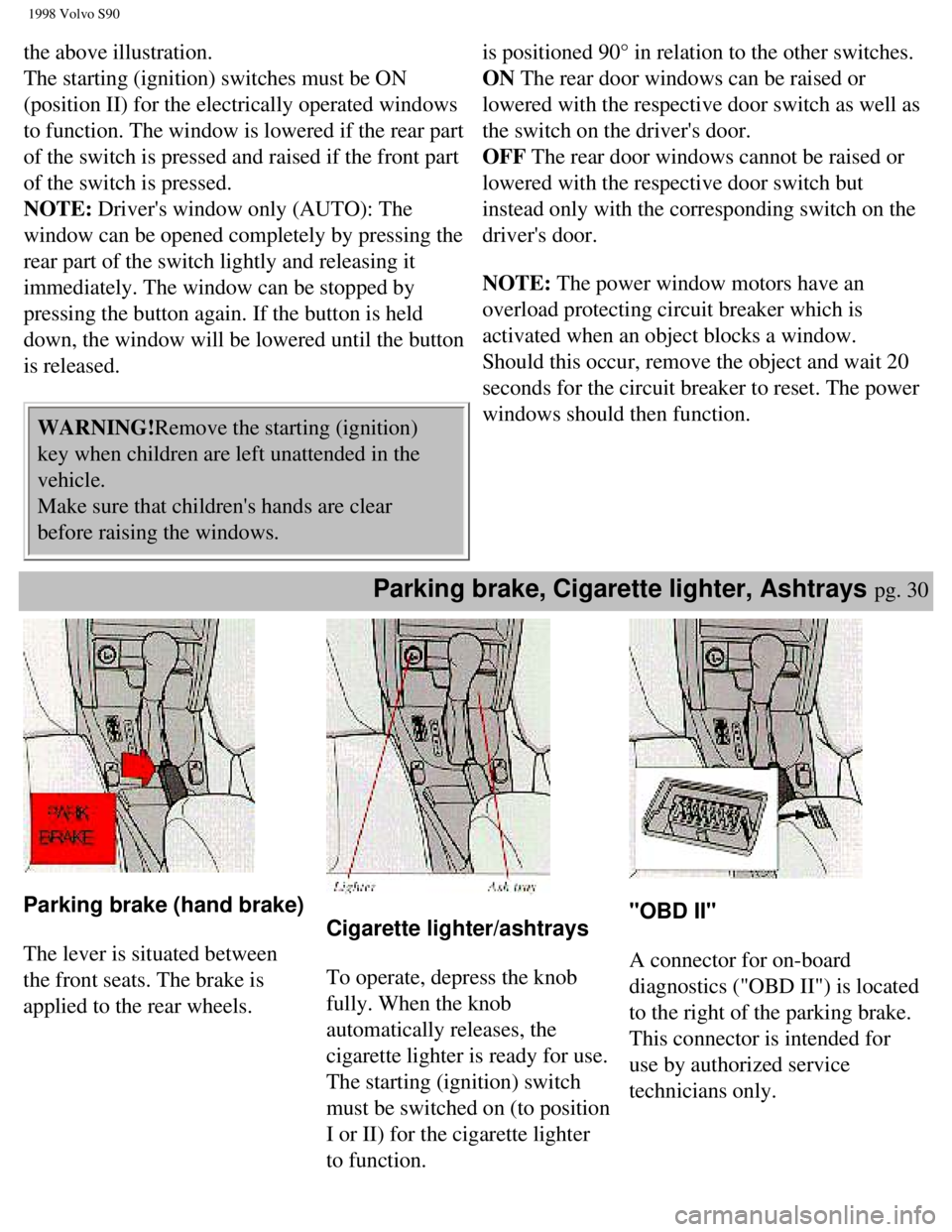
Parking brake (hand brake)
The lever is situated between
the front seats. The brake is
applied to the rear wheels.
Cigarette lighter/ashtrays
To operate, depress the knob
fully. When the knob
automatically releases, the
cigarette lighter is ready for use.
The starting (ignition) switch
must be switched on (to position
I or II) for the cigarette lighter
to function.
"OBD II"
A connector for on-board
diagnostics ("OBD II") is located
to the right of the parking brake.
This connector is intended for
use by authorized service
technicians only.
file:///K|/ownersdocs/1998/1998_SV90/98S90_028.htm (2 of 3)12/30/2006 \
1:52:38 PM
Page 41 of 175
1998 Volvo S90
WARNING!
Always use the parking
brake (hand brake) when
parking. On hills, also turn
the front wheels toward the
curb.
Ashtrays
To remove the ash trays depress
the center spring and remove.
Contents | Top of Page
file:///K|/ownersdocs/1998/1998_SV90/98S90_028.htm (3 of 3)12/30/2006 \
1:52:38 PM
Page 58 of 175
1998 Volvo S90
WARNING!
Always turn engine off and apply
parking brake when loading/
unloading the vehicle. Place
transmission selector in P (PARK)
position to help prevent
inadvertent movement of selector.
Alarm pg. 51
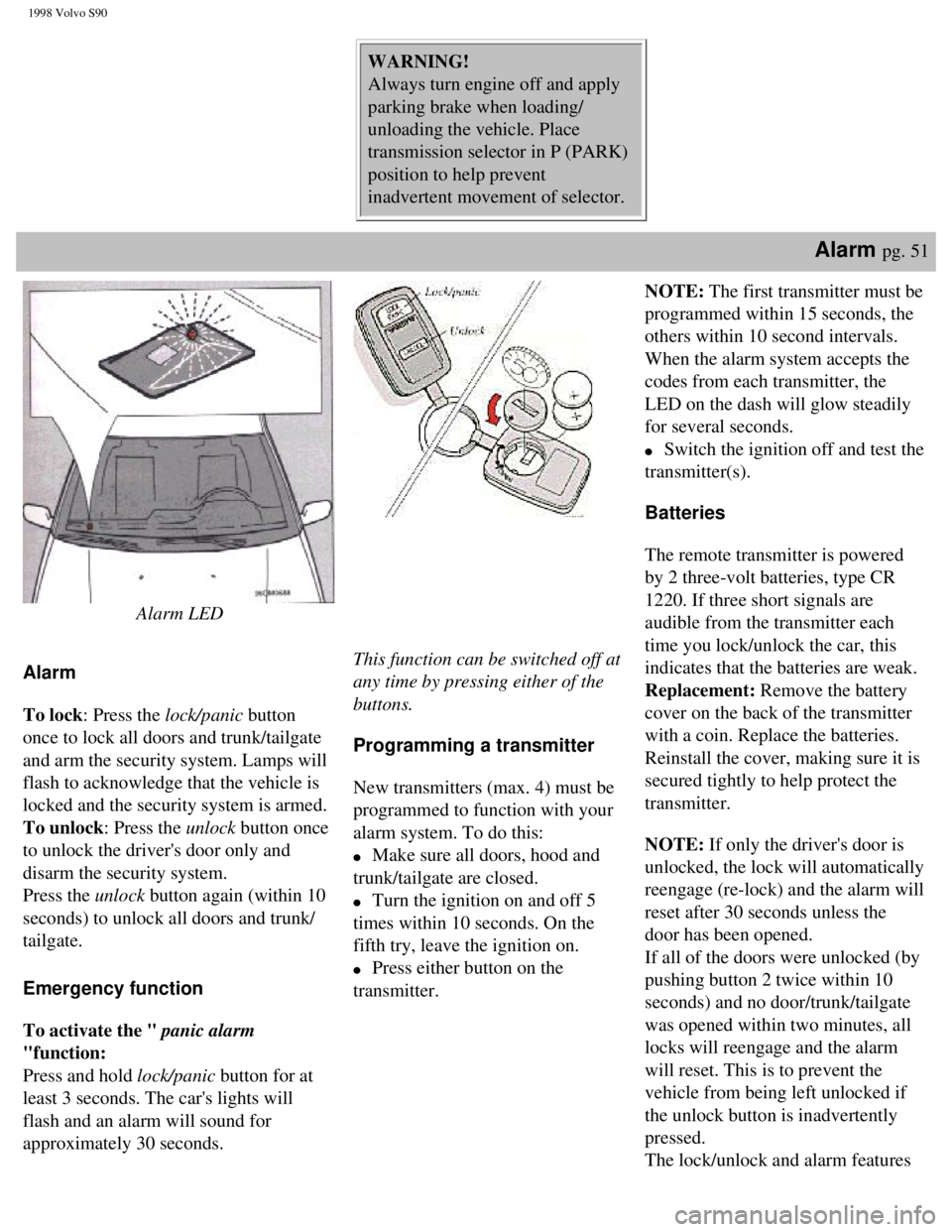
Alarm LED
Alarm
To lock: Press the lock/panic button
once to lock all doors and trunk/tailgate
and arm the security system. Lamps will
flash to acknowledge that the vehicle is
locked and the security system is armed.
To unlock: Press the unlock button once
to unlock the driver's door only and
disarm the security system.
Press the unlock button again (within 10
seconds) to unlock all doors and trunk/
tailgate.
Emergency function
To activate the " panic alarm
"function:
Press and hold lock/panic button for at
least 3 seconds. The car's lights will
flash and an alarm will sound for
approximately 30 seconds.
This function can be switched off at
any time by pressing either of the
buttons.
Programming a transmitter
New transmitters (max. 4) must be
programmed to function with your
alarm system. To do this:
l Make sure all doors, hood and
trunk/tailgate are closed.
l Turn the ignition on and off 5
times within 10 seconds. On the
fifth try, leave the ignition on.
l Press either button on the
transmitter. NOTE: The first transmitter must be
programmed within 15 seconds, the
others within 10 second intervals.
When the alarm system accepts the
codes from each transmitter, the
LED on the dash will glow steadily
for several seconds.
l Switch the ignition off and test the
transmitter(s).
Batteries
The remote transmitter is powered
by 2 three-volt batteries, type CR
1220. If three short signals are
audible from the transmitter each
time you lock/unlock the car, this
indicates that the batteries are weak.
Replacement: Remove the battery
cover on the back of the transmitter
with a coin. Replace the batteries.
Reinstall the cover, making sure it is
secured tightly to help protect the
transmitter.
NOTE: If only the driver's door is
unlocked, the lock will automatically
reengage (re-lock) and the alarm will
reset after 30 seconds unless the
door has been opened.
If all of the doors were unlocked (by
pushing button 2 twice within 10
seconds) and no door/trunk/tailgate
was opened within two minutes, all
locks will reengage and the alarm
will reset. This is to prevent the
vehicle from being left unlocked if
the unlock button is inadvertently
pressed.
The lock/unlock and alarm features
file:///K|/ownersdocs/1998/1998_SV90/98S90_048.htm (3 of 4)12/30/2006 \
1:52:40 PM
Page 64 of 175
1998 Volvo S90
(check when tires are cold). items and others are checked at
the standard Maintenance
Service intervals.
NOTE: Since using (D)rive
improves fuel economy, it
should be used as often as
possible.
Starting the engine pg. 57
Starting and stopping a
car equipped with
automatic transmission
1 Fasten the seat belt.
WARNING! Before
starting, check that the seat
is adjusted properly. Make
sure the brake pedal can be
depressed completely. Move
the seat closer if necessary.
Refer to section "Front
seats".
2 Apply the parking brake, if
not already set. The gear
selector is locked in the (P)ark
position (SHIFTLOCK).
3Without touching the
accelerator pedal ,turn the
ignition key to the starting
position. Allow the starter to
operate for 5-10 seconds.
Release the key as soon as the
engine starts. If the engine fails
to start, repeat step 3.
5 Select desired gear. The gear
engages after a slight delay,
especially noticeable when
selecting R.
CAUTION: Engine should
be idling; never accelerate
until after you feel the gear
engage! Too rapid
acceleration immediately
after selecting a gear will
cause harsh engagement and
premature transmission
wear.
NOTE:Your car is equipped
with a KEYLOCK system.
When the engine is switched
off, the gear selector must be in
the (P)ark position before the
key can be removed from the
ignition switch.
Engine warm-up - initial
driving procedure
Engines in vehicles driven short
distances are subject to
abnormally rapid wear because
the engine never reaches normal
operating temperature. It is
therefore beneficial to reach
normal operating temperature as
soon as possible. This is best
achieved by driving with a light
foot on the accelerator pedal for
a few minutes after starting,
rather than prolonged idling.
B6304 S Engine
This engine features hydraulic
valve lifters which means that
valve clearance is adjusted
automatically. It is possible that
the valve lifters will produce a
ticking sound for the first few
seconds after the engine is
started, while the oil pressure is
increasing.
If the car has not been used for a
long period of time, this ticking
sound may last for up to 15
minutes. This is entirely normal.
file:///K|/ownersdocs/1998/1998_SV90/98S90_053.htm (5 of 6)12/30/2006 \
1:52:41 PM
Page 66 of 175
1998 Volvo S90
Chapter 4 (cont)
Automatic transmission
pg. 58
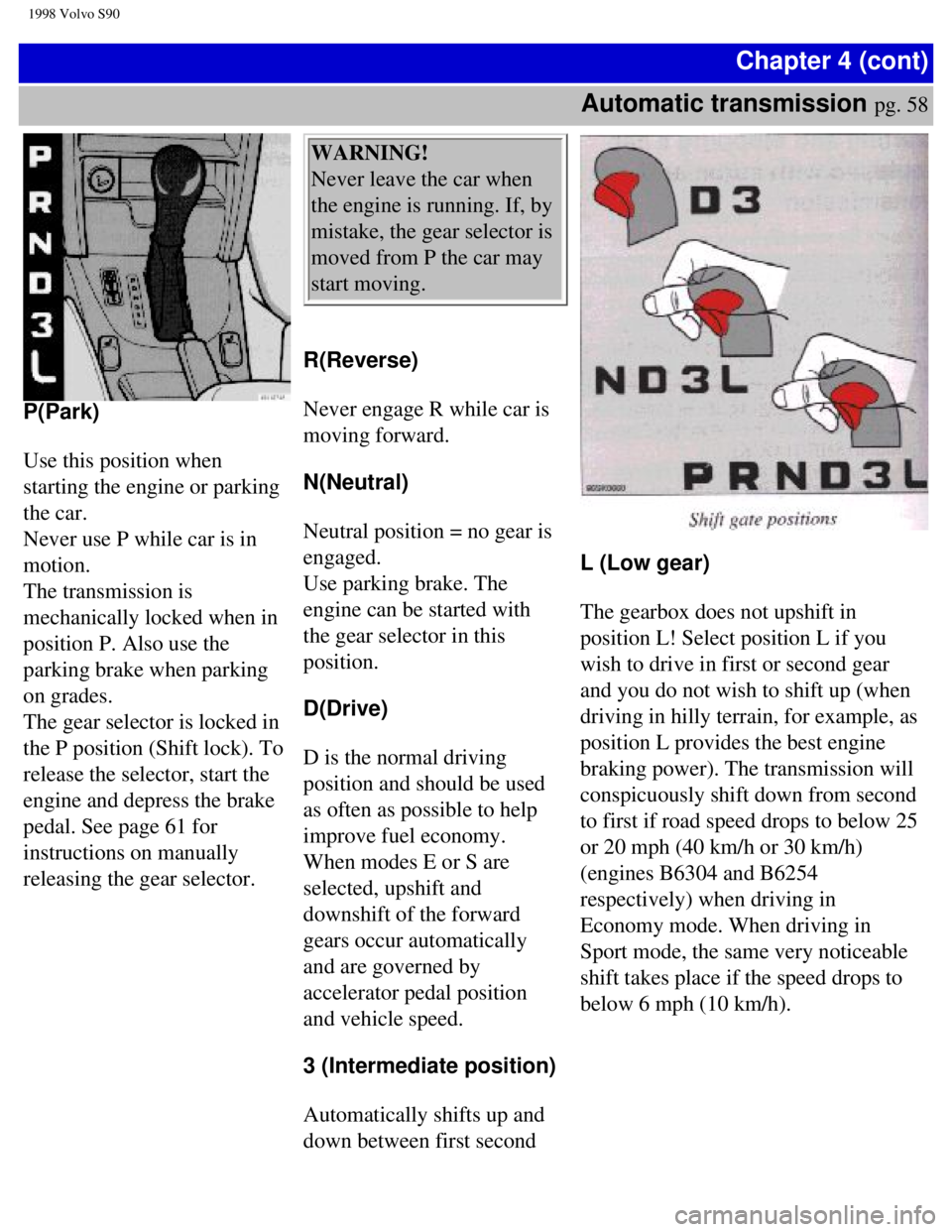
P(Park)
Use this position when
starting the engine or parking
the car.
Never use P while car is in
motion.
The transmission is
mechanically locked when in
position P. Also use the
parking brake when parking
on grades.
The gear selector is locked in
the P position (Shift lock). To
release the selector, start the
engine and depress the brake
pedal. See page 61 for
instructions on manually
releasing the gear selector. WARNING!
Never leave the car when
the engine is running. If, by
mistake, the gear selector is
moved from P the car may
start moving.
R(Reverse)
Never engage R while car is
moving forward.
N(Neutral)
Neutral position = no gear is
engaged.
Use parking brake. The
engine can be started with
the gear selector in this
position.
D(Drive)
D is the normal driving
position and should be used
as often as possible to help
improve fuel economy.
When modes E or S are
selected, upshift and
downshift of the forward
gears occur automatically
and are governed by
accelerator pedal position
and vehicle speed.
3 (Intermediate position)
Automatically shifts up and
down between first second
L (Low gear)
The gearbox does not upshift in
position L! Select position L if you
wish to drive in first or second gear
and you do not wish to shift up (when
driving in hilly terrain, for example, as
position L provides the best engine
braking power). The transmission will
conspicuously shift down from second
to first if road speed drops to below 25
or 20 mph (40 km/h or 30 km/h)
(engines B6304 and B6254
respectively) when driving in
Economy mode. When driving in
Sport mode, the same very noticeable
shift takes place if the speed drops to
below 6 mph (10 km/h).
file:///K|/ownersdocs/1998/1998_SV90/98S90_058.htm (1 of 7)12/30/2006 \
1:52:42 PM
Page 69 of 175
1998 Volvo S90
Special Tips - automatic transmission
l For driving down steep hills and when driving
for prolonged periods at low speeds, position L
should be selected. Avoid, however, repeated
changes since this can cause overheating of the
transmission oil. For driving on long continuous
uphill gradients, select position 3.
l Do not hold the car stationary on an incline by
using the accelerator pedal. Instead, apply the
hand brake (parking brake). This prevents the
transmission oil from becoming overheated.
l When towing a trailer, select shift position 3.
l The (E)conomy mode should be selected when
the cruise control is engaged.
l Never select P or R while the car is in motion.
l When initially selecting positions D, 3, L or R,
your right foot should press firmly on the brake
pedal to ensure that the car is standing still with
the engine idling.
l The gear selector should not be downshifted to
L at speeds above 75 mph (125 km/h). Always
observe posted speed limits. Cooling system
The risk for overheating is greatest, especially in
hot weather, when:
l towing a trailer up steep inclines for prolonged
periods at wide open throttle and low engine rpm.
l stopping the engine suddenly after high speed
driving (so-called "after-boiling" can occur).
To avoid overheating, the following rules should
be followed:
l Reduce speed and downshift when towing a
trailer up long, steep inclines. The risk of
overheating can be reduced by switching off the
air conditioning system for a short time.
l Do not let the engine idle unnecessarily for
prolonged periods.
l Do not mount auxiliary lamps in front of the
grill.
When the risk of overheating is imminent, or in
the event of overheating, (the temperature gauge
goes repeatedly into, or stays continually in, the
red section) the following precautions should be
taken:
l Switch off the air conditioning system.
l Pull off the road, away from traffic, stop the car
and put the gear lever into neutral. Do not stop the
engine!
l Switch the heater to full (maximum) position.
Increase the engine speed to approx. 2000 rpm
(twice idling speed) until the temperature begins
to drop.
See "Coolant" to check and top-up the coolant
level if necessary.
WARNING! Do not remove coolant expansion
tank cap. The coolant will be extremely hot.
Points to remember pg. 61
file:///K|/ownersdocs/1998/1998_SV90/98S90_058.htm (4 of 7)12/30/2006 \
1:52:42 PM