steering wheel VOLVO S90 1998 Owners Manual
[x] Cancel search | Manufacturer: VOLVO, Model Year: 1998, Model line: S90, Model: VOLVO S90 1998Pages: 175, PDF Size: 4.45 MB
Page 10 of 175
1998 Volvo S90
Chapter 1 - Occupant safety
VOLVO SRS
pg. 4
VOLVO SRS
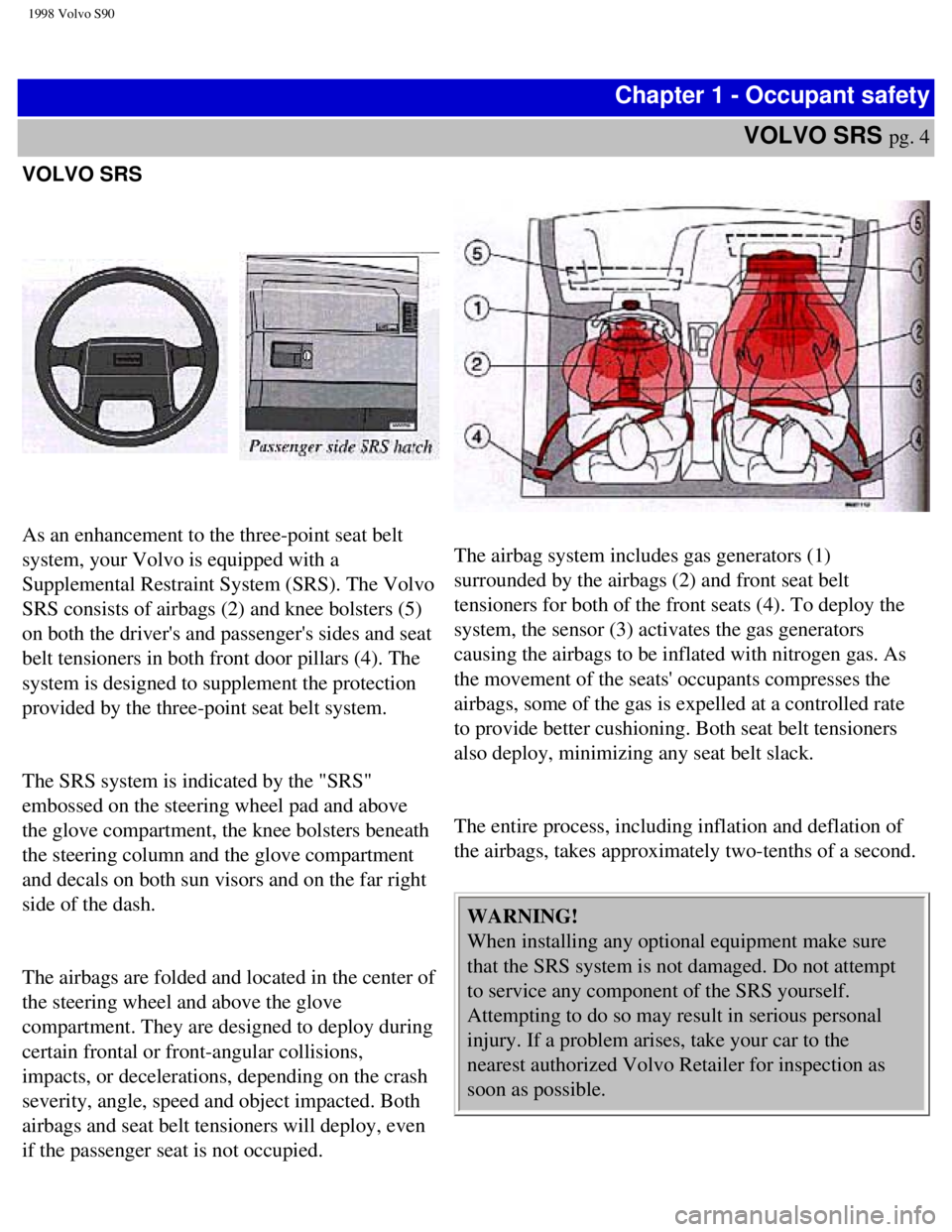
As an enhancement to the three-point seat belt
system, your Volvo is equipped with a
Supplemental Restraint System (SRS). The Volvo
SRS consists of airbags (2) and knee bolsters (5)
on both the driver's and passenger's sides and seat
belt tensioners in both front door pillars (4). The
system is designed to supplement the protection
provided by the three-point seat belt system.
The SRS system is indicated by the "SRS"
embossed on the steering wheel pad and above
the glove compartment, the knee bolsters beneath
the steering column and the glove compartment
and decals on both sun visors and on the far right
side of the dash.
The airbags are folded and located in the center of
the steering wheel and above the glove
compartment. They are designed to deploy during
certain frontal or front-angular collisions,
impacts, or decelerations, depending on the crash
severity, angle, speed and object impacted. Both
airbags and seat belt tensioners will deploy, even
if the passenger seat is not occupied.
The airbag system includes gas generators (1)
surrounded by the airbags (2) and front seat belt
tensioners for both of the front seats (4). To deploy the
system, the sensor (3) activates the gas generators
causing the airbags to be inflated with nitrogen gas. As
the movement of the seats' occupants compresses the
airbags, some of the gas is expelled at a controlled rate
to provide better cushioning. Both seat belt tensioners
also deploy, minimizing any seat belt slack.
The entire process, including inflation and deflation of
the airbags, takes approximately two-tenths of a second.
WARNING!
When installing any optional equipment make sure
that the SRS system is not damaged. Do not attempt
to service any component of the SRS yourself.
Attempting to do so may result in serious personal
injury. If a problem arises, take your car to the
nearest authorized Volvo Retailer for inspection as
soon as possible.
file:///K|/ownersdocs/1998/1998_SV90/98S90_004.htm (1 of 7)12/30/2006 \
1:52:34 PM
Page 12 of 175
1998 Volvo S90
l Gas generator ignitors
WARNING! Never drive an SRS equipped car
with your hands on the steering wheel pad/
airbag housing. No objects, accessory
equipment or stickers may be placed on,
attached to or installed near the SRS cover in the
center of the steering wheel, the SRS cover
above the glove compartment or the area
affected by the airbag deployment.
If the SRS warning light stays on after the
engine has started or if it comes on while you
are driving, drive the car to the nearest
authorized Volvo retailer for inspection as soon
as possible.
VOLVO SRS (cont.) pg. 6
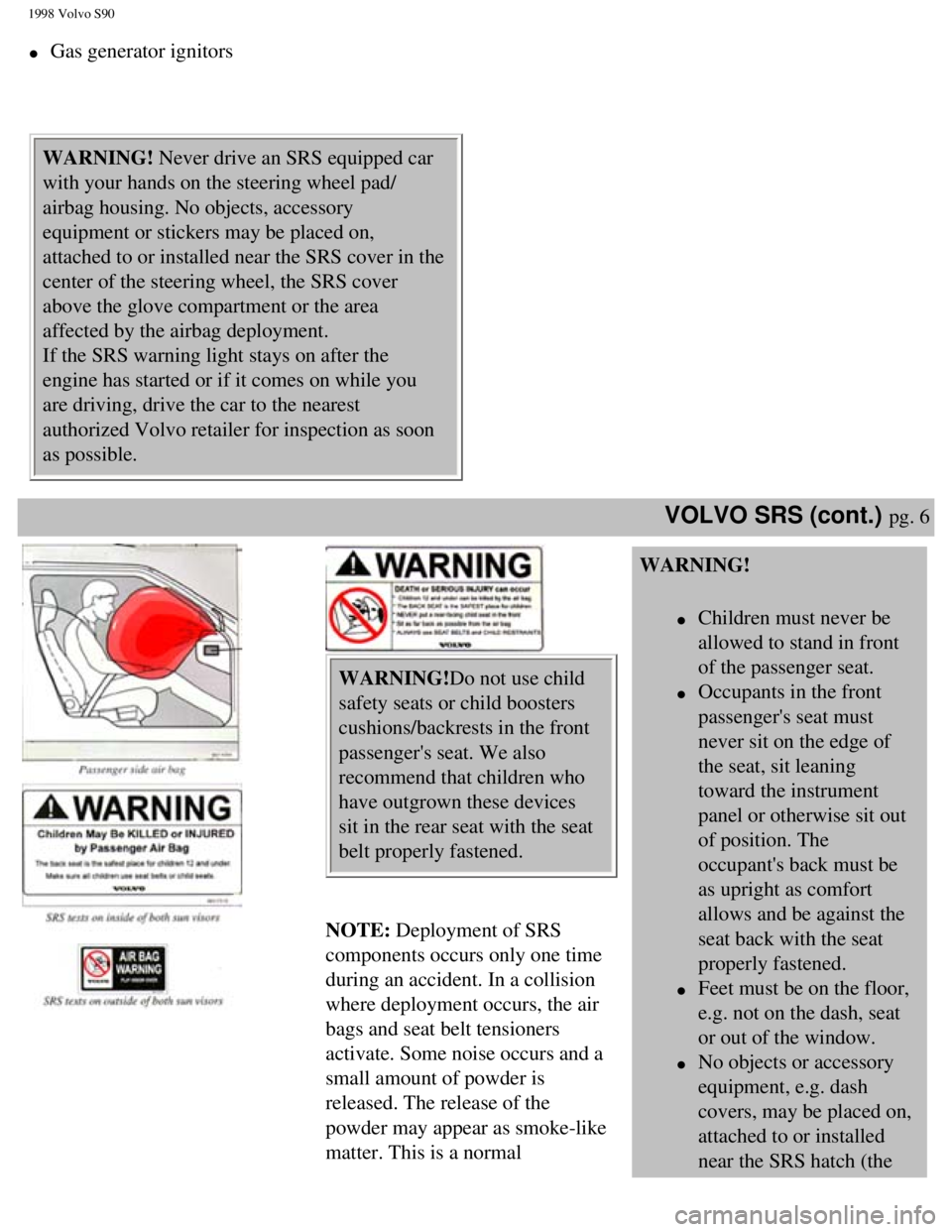
WARNING!Do not use child
safety seats or child boosters
cushions/backrests in the front
passenger's seat. We also
recommend that children who
have outgrown these devices
sit in the rear seat with the seat
belt properly fastened.
NOTE: Deployment of SRS
components occurs only one time
during an accident. In a collision
where deployment occurs, the air
bags and seat belt tensioners
activate. Some noise occurs and a
small amount of powder is
released. The release of the
powder may appear as smoke-like
matter. This is a normal
WARNING!
l Children must never be
allowed to stand in front
of the passenger seat.
l Occupants in the front
passenger's seat must
never sit on the edge of
the seat, sit leaning
toward the instrument
panel or otherwise sit out
of position. The
occupant's back must be
as upright as comfort
allows and be against the
seat back with the seat
properly fastened.
l Feet must be on the floor,
e.g. not on the dash, seat
or out of the window.
l No objects or accessory
equipment, e.g. dash
covers, may be placed on,
attached to or installed
near the SRS hatch (the
file:///K|/ownersdocs/1998/1998_SV90/98S90_004.htm (3 of 7)12/30/2006 \
1:52:34 PM
Page 13 of 175
1998 Volvo S90
characteristic and does not
indicate fire. area above the glove
compartment) or the area
affected by air bag
deployment (see
illustration).
l There should be no loose
articles, e.g. coffee cups,
on the floor, seat or dash
area.
l Never try to open the
SRS cover on the steering
wheel or the passenger
side SRS hatch. This
should only be done by
an authorized Volvo
service technician.
l Failure to follow these
instructions can result in
injury to the vehicle
occupants in an accident.
VOLVO SRS (cont.) pg. 7
NOTE:The information on this page does not pertain
to the Side Impact Protection System airbags.
When are the airbags deployed?
The SRS system is designed to deploy during certain
frontal or front-angular collisions, impacts, or
decelerations, depending in the crash severity, angle,
speed, and object impacted. The SRS sensor is
designed to react to both the impact of the collision
and the inertial forces generated by it and to
determine if the intensity of the collision is sufficient
for the airbags to be deployed.
WARNING! The SRS is designed to help prevent
serious injury. Deployment occurs very quickly
and with considerable force. During normal
deployment and depending on variables such as
seating position, one may experience abrasions,
bruises, swellings, or other injuries as a result of
airbag(s) deployment.
Seat belts - the heart of the Volvo safety
system
The heart of the Volvo safety system is the three-
point seat belt (a Volvo invention)! In order for the
SRS system to provide the protection intended, seat
belts must be worn at all times by everyone in the car.
The SRS system is a supplement to the seat belts.
WARNING! If your car has been subjected to
flood conditions (e.g. soaked carpeting/standing
water on the floor of the vehicle) or if your car has
become flood-damaged in any way, do not
attempt to start the vehicle or put the key in the
ignition before disconnecting the battery (see
below). This may cause airbag deployment which
could result in personal injury. Have the car towed
to an authorized Volvo retailer for repairs.
Automatic transmission only:
Before attempting to tow the car, use the
following procedure to override the shiftlock
file:///K|/ownersdocs/1998/1998_SV90/98S90_004.htm (4 of 7)12/30/2006 \
1:52:34 PM
Page 23 of 175
1998 Volvo S90
This means that when you switch off the ignition,
the gear selector must be in the (P)ark position
before the starting (ignition) key can be removed
from the ignition switch.
Anti-Lock Brake System (ABS)
The ABS system in your car performs a self-
diagnostic test when the vehicle is started and at
4 mph (6km/h). The driver may detect one
pulsation of the brake pedal and a sound will be
audible from the ABS control module. This is
normal.
The pages in this section provide detailed
descriptions of the vehicle's instruments and
controls.
Note that vehicles may be equipped differently,
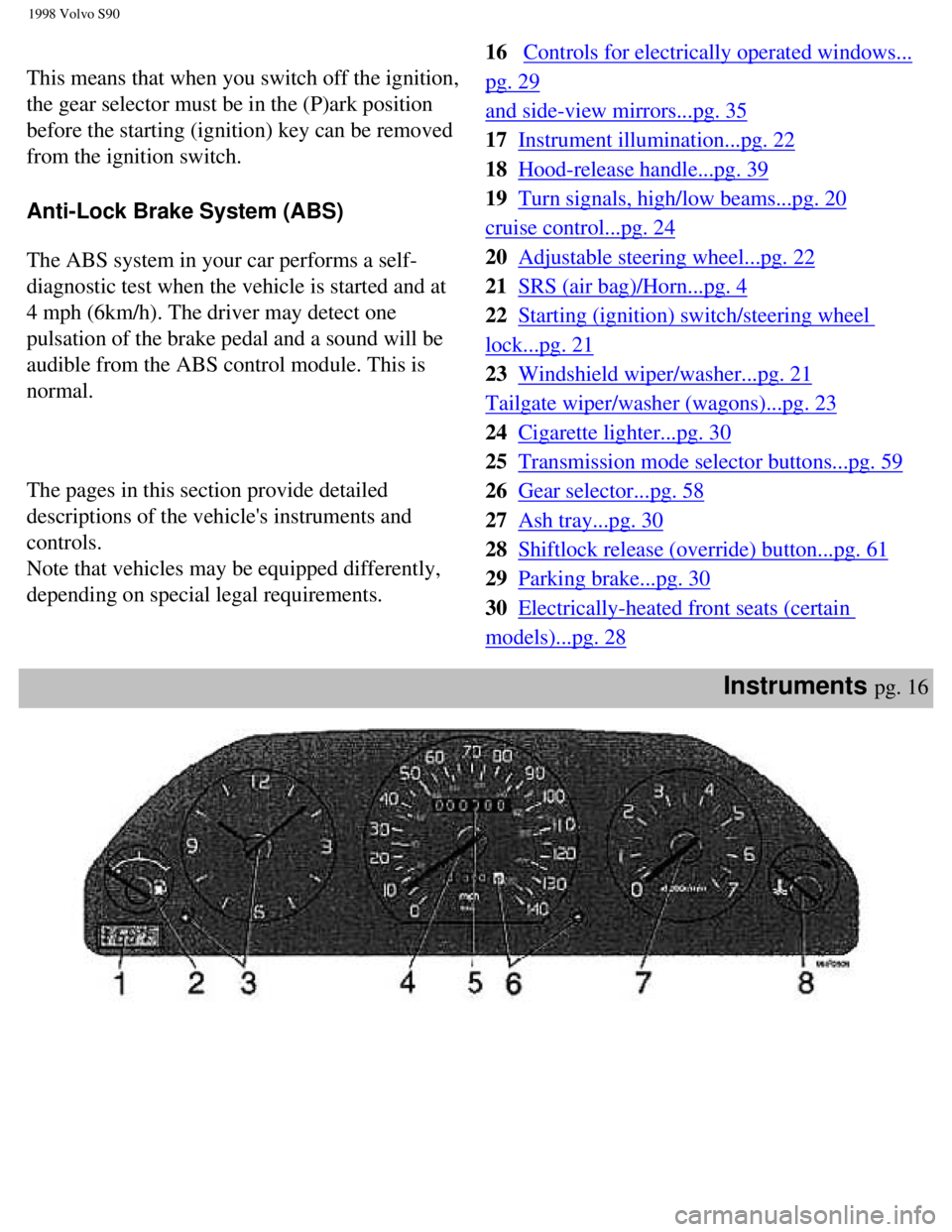
depending on special legal requirements. 16 Controls for electrically operated windows...
pg. 29
and side-view mirrors...pg. 35
17
Instrument illumination...pg. 22
18
Hood-release handle...pg. 39
19
Turn signals, high/low beams...pg. 20
cruise control...pg. 24
20
Adjustable steering wheel...pg. 22
21
SRS (air bag)/Horn...pg. 4
22
Starting (ignition) switch/steering wheel
lock...pg. 21
23
Windshield wiper/washer...pg. 21
Tailgate wiper/washer (wagons)...pg. 23
24
Cigarette lighter...pg. 30
25
Transmission mode selector buttons...pg. 59
26
Gear selector...pg. 58
27
Ash tray...pg. 30
28
Shiftlock release (override) button...pg. 61
29
Parking brake...pg. 30
30
Electrically-heated front seats (certain
models)...pg. 28
Instruments pg. 16
file:///K|/ownersdocs/1998/1998_SV90/98S90_014.htm (2 of 3)12/30/2006 \
1:52:36 PM
Page 28 of 175
1998 Volvo S90
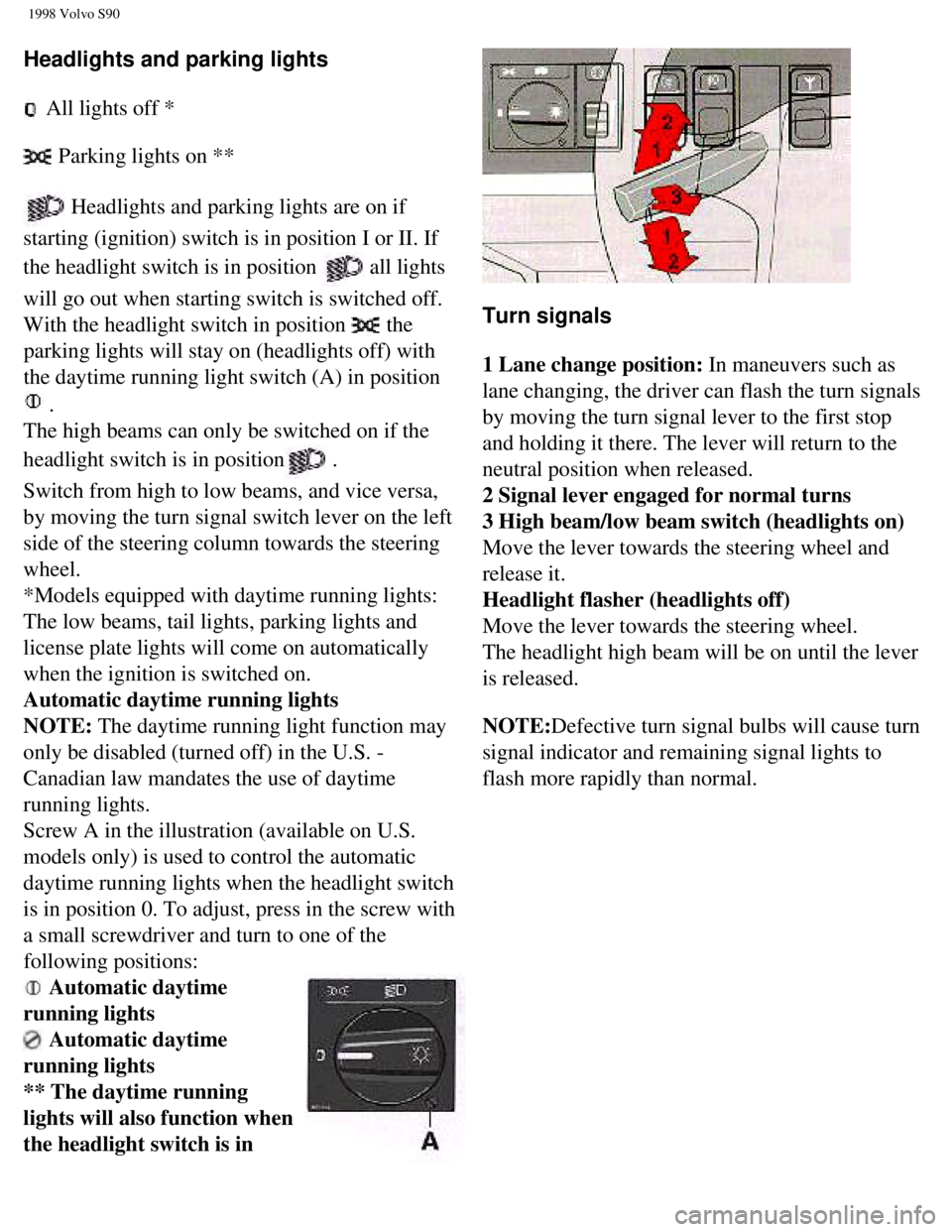
Headlights and parking lights
All lights off *
Parking lights on **
Headlights and parking lights are on if
starting (ignition) switch is in position I or II. If
the headlight switch is in position
all lights
will go out when starting switch is switched off.
With the headlight switch in position
the
parking lights will stay on (headlights off) with
the daytime running light switch (A) in position
.
The high beams can only be switched on if the
headlight switch is in position
.
Switch from high to low beams, and vice versa,
by moving the turn signal switch lever on the left
side of the steering column towards the steering
wheel.
*Models equipped with daytime running lights:
The low beams, tail lights, parking lights and
license plate lights will come on automatically
when the ignition is switched on.
Automatic daytime running lights
NOTE: The daytime running light function may
only be disabled (turned off) in the U.S. -
Canadian law mandates the use of daytime
running lights.
Screw A in the illustration (available on U.S.
models only) is used to control the automatic
daytime running lights when the headlight switch
is in position 0. To adjust, press in the screw with
a small screwdriver and turn to one of the
following positions:
Automatic daytime
running lights
Automatic daytime
running lights
** The daytime running
lights will also function when
the headlight switch is in
Turn signals
1 Lane change position: In maneuvers such as
lane changing, the driver can flash the turn signals
by moving the turn signal lever to the first stop
and holding it there. The lever will return to the
neutral position when released.
2 Signal lever engaged for normal turns
3 High beam/low beam switch (headlights on)
Move the lever towards the steering wheel and
release it.
Headlight flasher (headlights off)
Move the lever towards the steering wheel.
The headlight high beam will be on until the lever
is released.
NOTE:Defective turn signal bulbs will cause turn
signal indicator and remaining signal lights to
flash more rapidly than normal.
file:///K|/ownersdocs/1998/1998_SV90/98S90_017.htm (4 of 7)12/30/2006 \
1:52:36 PM
Page 29 of 175
1998 Volvo S90
position and switch A is in this position.
All lights off (daytime running light function
disabled)
Winshield wipers/washers, Ignition switch pg. 21
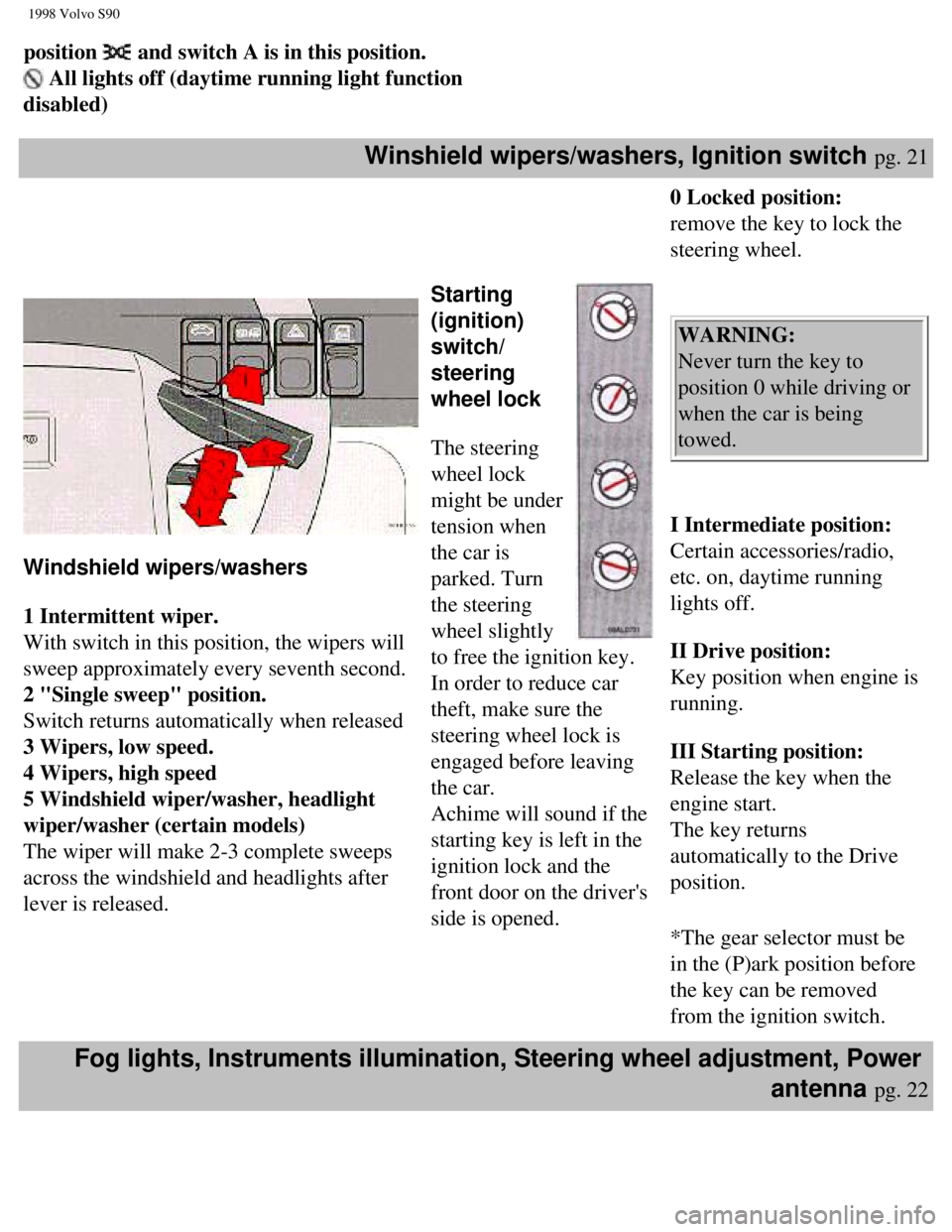
Windshield wipers/washers
1 Intermittent wiper.
With switch in this position, the wipers will
sweep approximately every seventh second.
2 "Single sweep" position.
Switch returns automatically when released
3 Wipers, low speed.
4 Wipers, high speed
5 Windshield wiper/washer, headlight
wiper/washer (certain models)
The wiper will make 2-3 complete sweeps
across the windshield and headlights after
lever is released.
Starting
(ignition)
switch/
steering
wheel lock
The steering
wheel lock
might be under
tension when
the car is
parked. Turn
the steering
wheel slightly
to free the ignition key.
In order to reduce car
theft, make sure the
steering wheel lock is
engaged before leaving
the car.
Achime will sound if the
starting key is left in the
ignition lock and the
front door on the driver's
side is opened. 0 Locked position:
remove the key to lock the
steering wheel.
WARNING:
Never turn the key to
position 0 while driving or
when the car is being
towed.
I Intermediate position:
Certain accessories/radio,
etc. on, daytime running
lights off.
II Drive position:
Key position when engine is
running.
III Starting position:
Release the key when the
engine start.
The key returns
automatically to the Drive
position.
*The gear selector must be
in the (P)ark position before
the key can be removed
from the ignition switch.
Fog lights, Instruments illumination, Steering wheel adjustment, Power antenna
pg. 22
file:///K|/ownersdocs/1998/1998_SV90/98S90_017.htm (5 of 7)12/30/2006 \
1:52:36 PM
Page 30 of 175
1998 Volvo S90
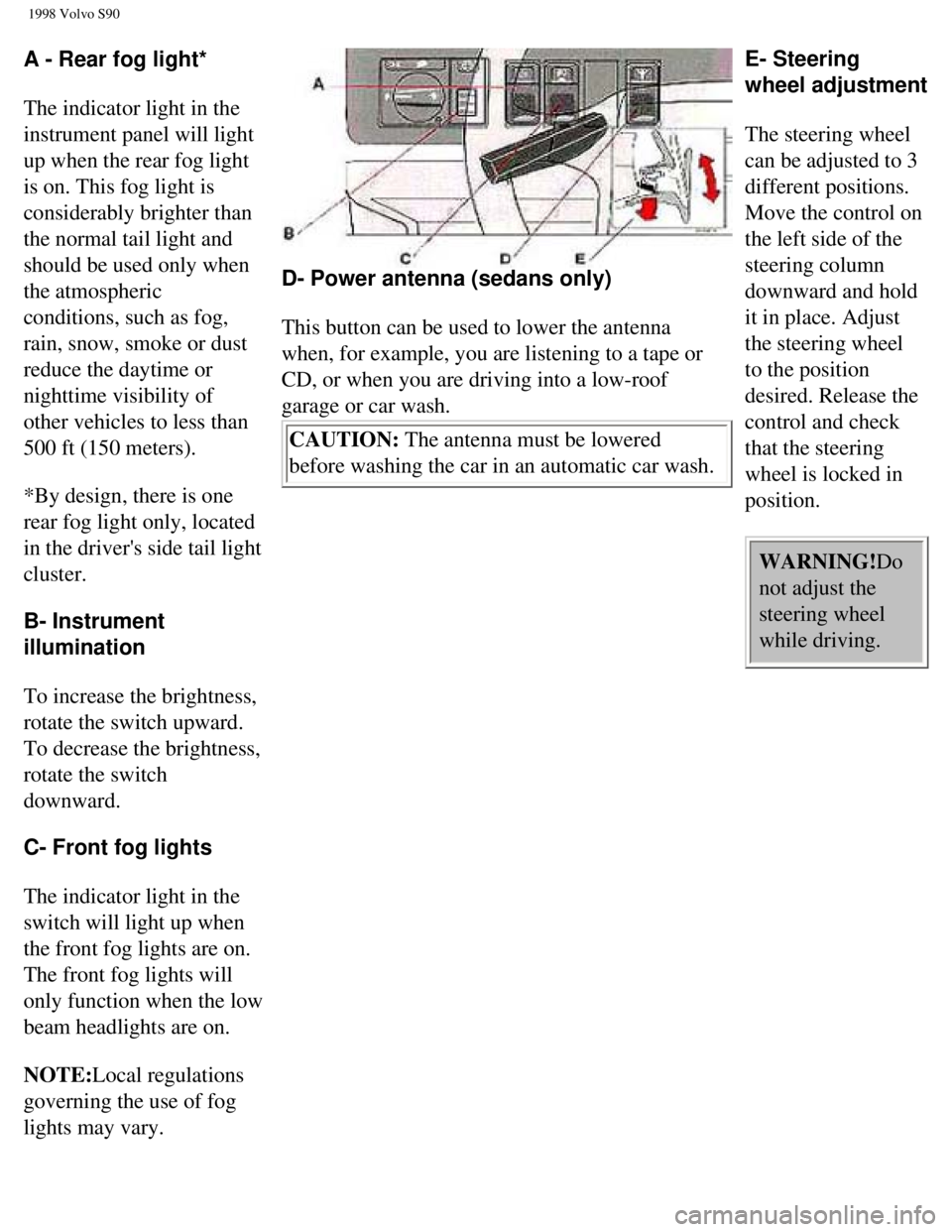
A - Rear fog light*
The indicator light in the
instrument panel will light
up when the rear fog light
is on. This fog light is
considerably brighter than
the normal tail light and
should be used only when
the atmospheric
conditions, such as fog,
rain, snow, smoke or dust
reduce the daytime or
nighttime visibility of
other vehicles to less than
500 ft (150 meters).
*By design, there is one
rear fog light only, located
in the driver's side tail light
cluster.
B- Instrument
illumination
To increase the brightness,
rotate the switch upward.
To decrease the brightness,
rotate the switch
downward.
C- Front fog lights
The indicator light in the
switch will light up when
the front fog lights are on.
The front fog lights will
only function when the low
beam headlights are on.
NOTE:Local regulations
governing the use of fog
lights may vary.
D- Power antenna (sedans only)
This button can be used to lower the antenna
when, for example, you are listening to a tape or
CD, or when you are driving into a low-roof
garage or car wash. CAUTION: The antenna must be lowered
before washing the car in an automatic car wash. E- Steering
wheel adjustment
The steering wheel
can be adjusted to 3
different positions.
Move the control on
the left side of the
steering column
downward and hold
it in place. Adjust
the steering wheel
to the position
desired. Release the
control and check
that the steering
wheel is locked in
position.
WARNING!Do
not adjust the
steering wheel
while driving.
file:///K|/ownersdocs/1998/1998_SV90/98S90_017.htm (6 of 7)12/30/2006 \
1:52:36 PM
Page 43 of 175
1998 Volvo S90
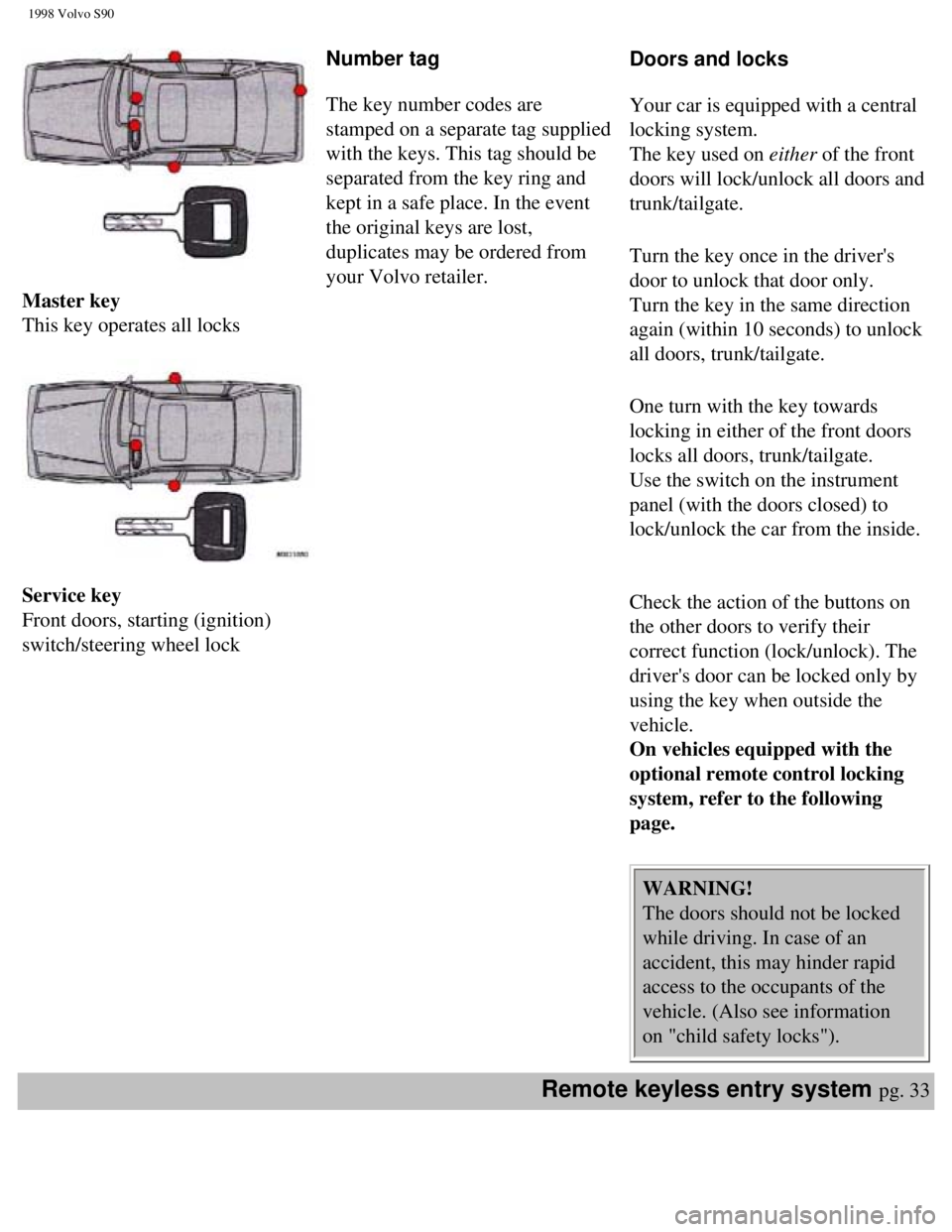
Master key
This key operates all locks
Service key
Front doors, starting (ignition)
switch/steering wheel lock Number tag
The key number codes are
stamped on a separate tag supplied
with the keys. This tag should be
separated from the key ring and
kept in a safe place. In the event
the original keys are lost,
duplicates may be ordered from
your Volvo retailer.
Doors and locks
Your car is equipped with a central
locking system.
The key used on either of the front
doors will lock/unlock all doors and
trunk/tailgate.
Turn the key once in the driver's
door to unlock that door only.
Turn the key in the same direction
again (within 10 seconds) to unlock
all doors, trunk/tailgate.
One turn with the key towards
locking in either of the front doors
locks all doors, trunk/tailgate.
Use the switch on the instrument
panel (with the doors closed) to
lock/unlock the car from the inside.
Check the action of the buttons on
the other doors to verify their
correct function (lock/unlock). The
driver's door can be locked only by
using the key when outside the
vehicle.
On vehicles equipped with the
optional remote control locking
system, refer to the following
page.
WARNING!
The doors should not be locked
while driving. In case of an
accident, this may hinder rapid
access to the occupants of the
vehicle. (Also see information
on "child safety locks").
Remote keyless entry system pg. 33
file:///K|/ownersdocs/1998/1998_SV90/98S90_031.htm (2 of 6)12/30/2006 \
1:52:39 PM
Page 71 of 175
1998 Volvo S90
disconnected, the code must
be re-entered before the radio
will function properly.
Points to remember pg. 62
Weight distribution affects
handling
At the specified curb weight
your car has a tendency to
understeer, which means that the
steering wheel has to be turned
more than might seem
appropriate for the curvature of
a bend. This ensures good
stability and reduces the risk of
rear wheel skid. Remember that
these properties can alter with
the vehicle load. The heavier the
load in the trunk, the less the
tendency to understeer.
Handling, roadholding
Vehicle load, tire design, and
inflation pressure, all affect
vehicle handling. Therefore,
check that the tires are inflated
to the recommended pressure
according to the vehicle load.
See "Tire pressure" section.
Loads should be distributed so
that capacity weight or
maximum permissible axle loads
are not exceeded.
WARNING!
An extra mat on the driver's
floor can cause the
accelerator pedal to catch.
Check that the movement of
the accelerator pedal is not
impeded. Not more than one
protective floor covering may
be used at one time.
CAUTION: Drive slowly and
carefully if going through
standing water (i.e. flooded
roadways, etc.). Damage to
engine could result if excess
water is ingested through the air
intake system. Never drive the
vehicle in water deeper than 1
foot (300 mm). See the flood
warning on page 7.
WARNING! Do not drive
with trunk lid or tailgate
open!
Poisonous exhaust gases may
enter via the trunk lid or
tailgate.
If the trunk lid/tailgate must
be kept open for any reason,
proceed as follows:
l Close the windows.
l Set the ventilation system
Roof rails/racks
Roof rails are standard
equipment on wagon models.
Load bars are available as a
retailer installed option on the
sedan models. Observe the
following points when is use:
l Avoid single-point loads.
Distribute the load evenly.
l Place heavier cargo at bottom
of load.
l Observe that center of gravity
and handling are influenced by
load weight.
l Increasing load size increases
wind resistance and, thus,
adversely affects fuel economy.
l Anchor the cargo correctly
with appropriate tie-down
equipment.
l Drive carefully. Avoid rapid
starts, fast cornering and hard
braking.
l Max. roof load is 220 lbs.
(100 kg) for removable racks.
For permanent roof racks, check
the manufacturers weight
specifications.
file:///K|/ownersdocs/1998/1998_SV90/98S90_058.htm (6 of 7)12/30/2006 \
1:52:42 PM
Page 73 of 175
1998 Volvo S90
Chapter 4 (cont)
Emergency towing (pulling of vehicles)
pg. 63
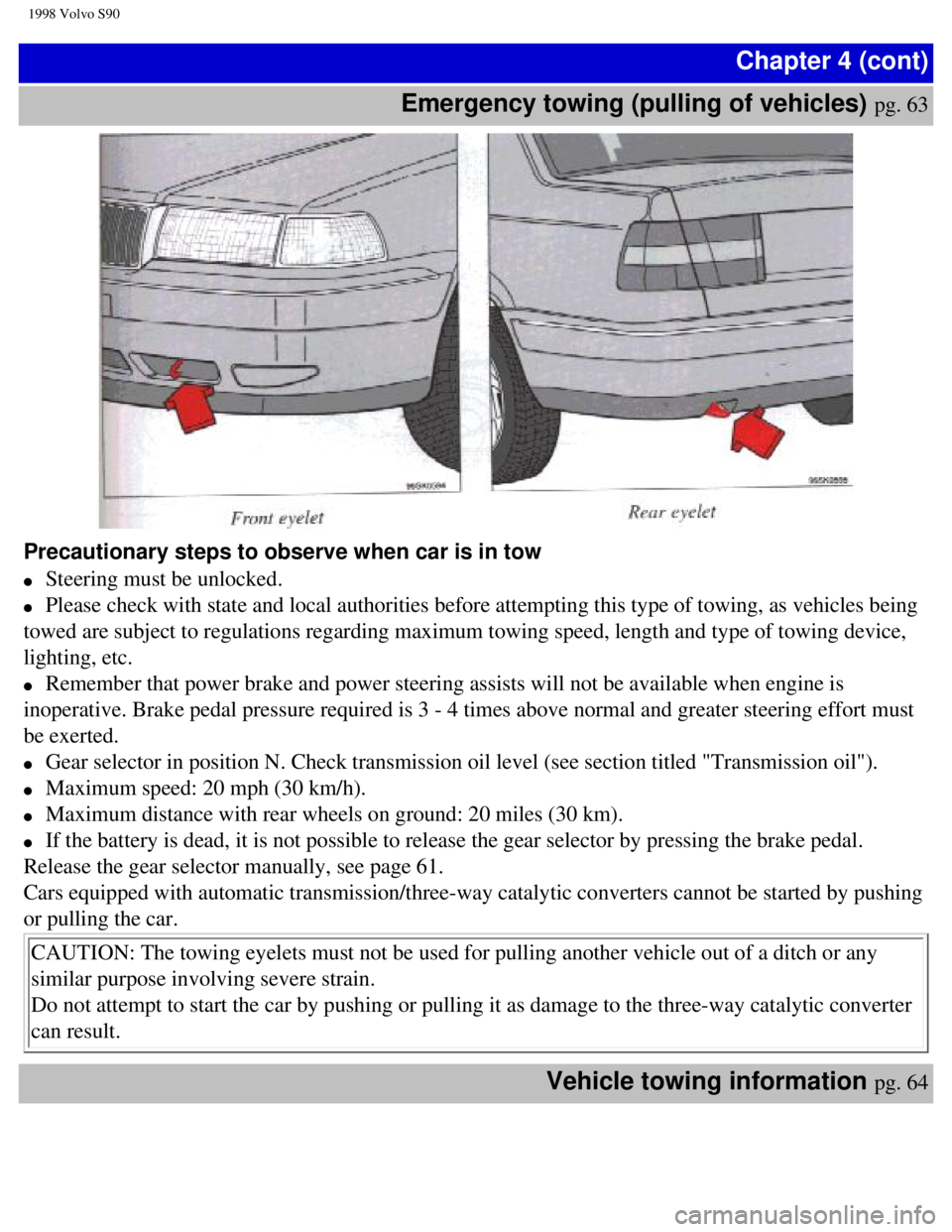
Precautionary steps to observe when car is in tow
l Steering must be unlocked.
l Please check with state and local authorities before attempting this typ\
e of towing, as vehicles being
towed are subject to regulations regarding maximum towing speed, length \
and type of towing device,
lighting, etc.
l Remember that power brake and power steering assists will not be availab\
le when engine is
inoperative. Brake pedal pressure required is 3 - 4 times above normal a\
nd greater steering effort must
be exerted.
l Gear selector in position N. Check transmission oil level (see section \
titled "Transmission oil").
l Maximum speed: 20 mph (30 km/h).
l Maximum distance with rear wheels on ground: 20 miles (30 km).
l If the battery is dead, it is not possible to release the gear selector \
by pressing the brake pedal.
Release the gear selector manually, see page 61.
Cars equipped with automatic transmission/three-way catalytic converters\
cannot be started by pushing
or pulling the car.
CAUTION: The towing eyelets must not be used for pulling another vehicle\
out of a ditch or any
similar purpose involving severe strain.
Do not attempt to start the car by pushing or pulling it as damage to th\
e three-way catalytic converter
can result.
Vehicle towing information pg. 64
file:///K|/ownersdocs/1998/1998_SV90/98S90_063.htm (1 of 4)12/30/2006 \
1:52:43 PM