airbag VOLVO S90 2017 Owner´s Manual
[x] Cancel search | Manufacturer: VOLVO, Model Year: 2017, Model line: S90, Model: VOLVO S90 2017Pages: 548, PDF Size: 11.42 MB
Page 351 of 548
STARTING AND DRIVING
349
Turn Auto-hold on or off by pressing the control in the tunnel console. The indicator light illumi-nates when the function is on. When Auto-hold is off, Hill Start Assist (HSA) will be activated to help prevent the vehicle from roll-ing backwards when starting up a hill.
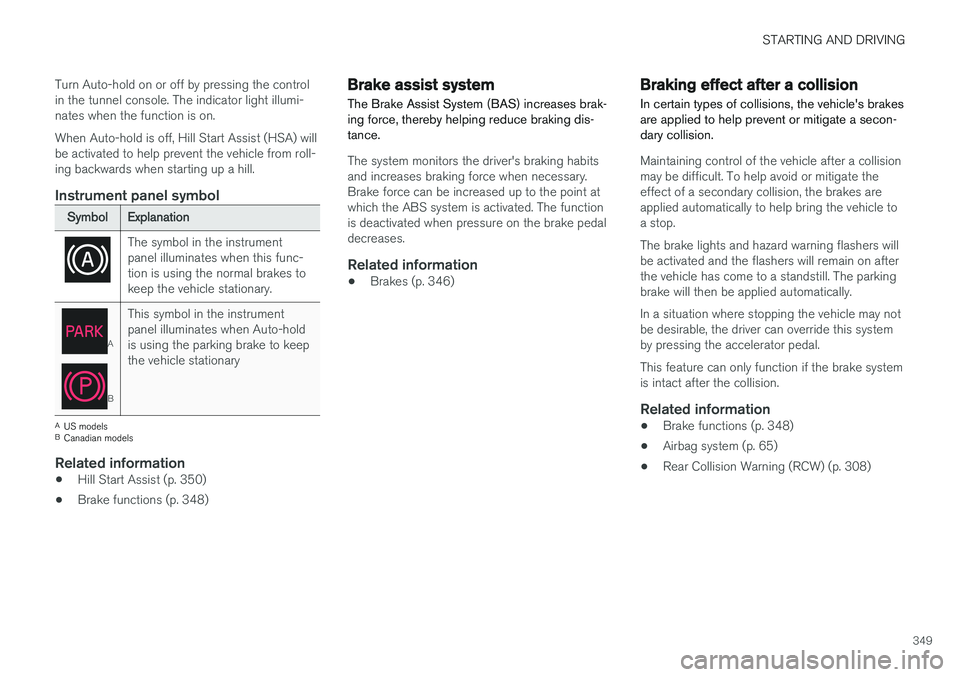
Instrument panel symbol
Symbol
Explanation
The symbol in the instrument panel illuminates when this func-tion is using the normal brakes tokeep the vehicle stationary.
A
BThis symbol in the instrument panel illuminates when Auto-holdis using the parking brake to keepthe vehicle stationary
A
US models
B Canadian models
Related information
• Hill Start Assist (p. 350)
• Brake functions (p. 348)
Brake assist system The Brake Assist System (BAS) increases brak- ing force, thereby helping reduce braking dis-tance.
The system monitors the driver's braking habits and increases braking force when necessary.Brake force can be increased up to the point atwhich the ABS system is activated. The functionis deactivated when pressure on the brake pedaldecreases.
Related information
•Brakes (p. 346)
Braking effect after a collision
In certain types of collisions, the vehicle's brakes are applied to help prevent or mitigate a secon-dary collision.
Maintaining control of the vehicle after a collision may be difficult. To help avoid or mitigate theeffect of a secondary collision, the brakes areapplied automatically to help bring the vehicle toa stop. The brake lights and hazard warning flashers will be activated and the flashers will remain on afterthe vehicle has come to a standstill. The parkingbrake will then be applied automatically. In a situation where stopping the vehicle may not be desirable, the driver can override this systemby pressing the accelerator pedal. This feature can only function if the brake system is intact after the collision.
Related information
• Brake functions (p. 348)
• Airbag system (p. 65)
• Rear Collision Warning (RCW) (p. 308)
Page 361 of 548
STARTING AND DRIVING
}}
359
Towing recommendations
Always check with state and local authorities before attempting to tow another vehiclebecause this type of towing is subject to regula-tions regarding maximum towing speed, lengthand type of towing device, lighting, etc.
Towing your vehicle behind another vehicle
1. After securely attaching the towing line to both vehicles, put the gear selector in posi- tion N and release the parking brake.
2. Put the ignition in mode II by turning the
start knob to START (without depressing
the brake pedal) and hold it in this position
for approx. 4 seconds. Release the knob.
3. Put the gear selector in position N and
release the parking brake.
4. The towing vehicle can now begin driving.
5. Keep the tow rope taut when the towing vehicle slows down by applying light pressure on the brake pedal. This will help prevent jar-ring movements of the vehicle being towed.
6. Be prepared to apply the brakes to stop the vehicle being towed.
CAUTION
General towing precautions:
• If the vehicle's battery is dead, an auxiliary battery will be necessary to provide cur-rent for releasing the electric parkingbrake and to move the gear selector from the
P position to N. If this is not possible,
use the shiftlock override procedure tomanually release the gear selector from P
and move it to N.
• Maximum speed: 50 mph (80 km/h). Do not exceed the maximum allowable tow-ing speed.
• Maximum distance with front wheels onground: 50 miles (80 km).
• The vehicle should only be towed in theforward direction.
WARNING
• When the vehicle is being towed, the igni- tion should be in mode
II (in mode I, all of
the vehicle's airbags are deactivated).
• The remote key must remain inside the vehicle.
• The power brakes and power steering willnot function when the engine is not run-ning. Approximately 5 times more pres-sure will be required on the brake pedaland the steering wheel will be considera-bly harder to turn.
• The towing eyelets must not be used forpulling the vehicle out of a ditch or forany similar purpose involving severestrain.
Page 492 of 548
MAINTENANCE AND SERVICING
* Option/accessory.
490
Fuses in the trunk The fuses in the trunk help protect electrical components such as power seats *, airbags and
seat belt tensioners.
Page 494 of 548

||
MAINTENANCE AND SERVICING
* Option/accessory.
492
Positions
• Fuses 13–17 and 21–36 are called "Micro".
• Fuses 1–12, 18–20 and 37 are called "MCase" and should only be replaced by atrained and qualified Volvo service technician.
Function
A
Heated rear window 30
– –
Pneumatic suspension* compressor 40
Lock motor, rear seat backrest - passenger's side 15
– –
Lock motor, rear seat backrest - driver's side30
– –
– –
Power trunk release
*25
Power front seat (passenger side)
*
module 20
Trailer hitch
* control module 40
Seat belt tensioner module (pas- senger side) 40
Function
A
Internal relay windings 5
– –
Foot movement detection module for opening the power trunk release* 5
– –
– –
Trailer hitch
* control module 25
Power front seat (driver seat
* mod-
ule 20
Seat belt tensioner module (driver side)
40
Parking camera
* 5
– –
– –
– –
– –
Airbag and seat belt tensioner modules 5
– –
Function
A
Heated rear seat (driver side)*15
– –
Blind Spot Information (BLIS)
*5
– –
Seat belt tensioner modules 5
Emission system actuator 5
– –
All Wheel Drive control module
*15
Heated rear seat (passenger side)
*15
– –
Related information
•Replacing fuses (p. 481)
• Fuses (p. 480)
• Fuses in the engine compartment (p. 482)
• Fuses in the passenger compartment (p. 486)
Page 537 of 548
INDEX
535
A
A/C (air conditioning) 193
Accessory installation warning 21, 24
Active high beams 142
Active yaw control 243
Adaptive brake lights 350
Adaptive cruise control 261, 264, 265,267, 268, 269, 273
passing assistance 268
pilot assist 287
Adaptive Cruise Control fault tracing 271
limitations 272
Airbags disconnecting the front passenger
Page 540 of 548
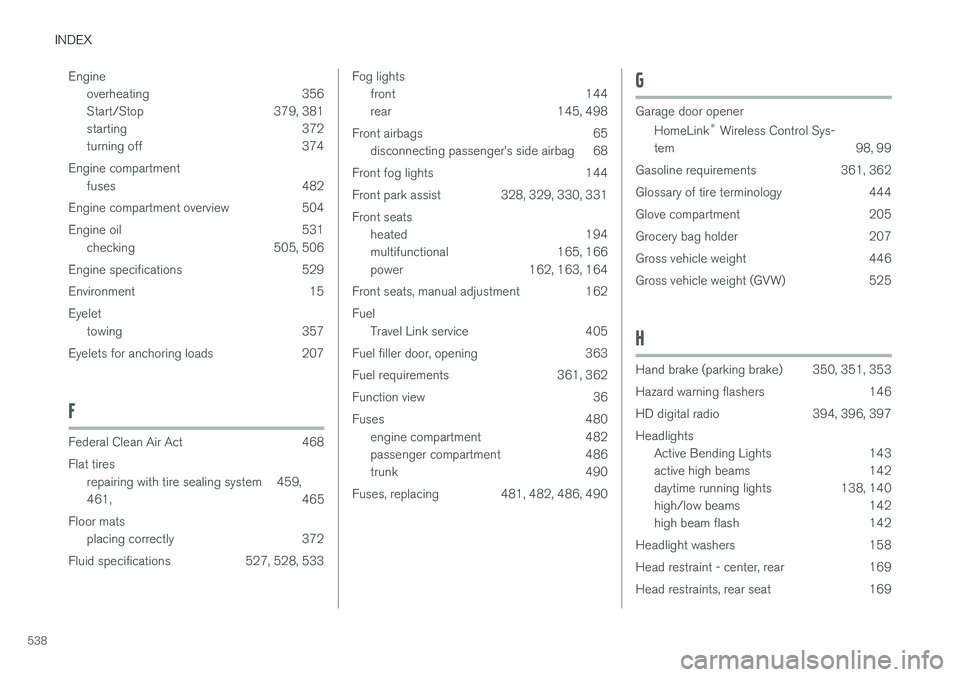
INDEX
538Engine
overheating 356
Start/Stop 379, 381
starting 372
turning off 374
Engine compartment fuses 482
Engine compartment overview 504
Engine oil 531 checking 505, 506
Engine specifications 529
Environment 15Eyelet towing 357
Eyelets for anchoring loads 207
F
Federal Clean Air Act 468 Flat tires repairing with tire sealing system 459, 461 , 465
Floor mats placing correctly 372
Fluid specifications 527, 528, 533
Fog lights front 144
rear 145, 498
Front airbags 65 disconnecting passenger
Page 544 of 548
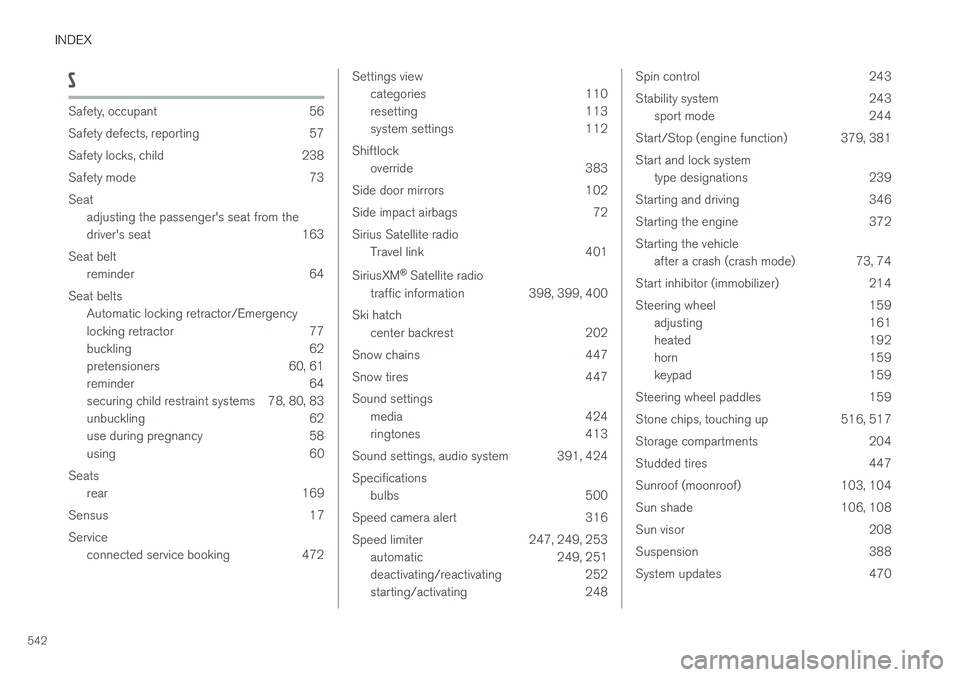
INDEX
542
S
Safety, occupant 56
Safety defects, reporting 57
Safety locks, child 238
Safety mode 73Seatadjusting the passenger's seat from the
driver's seat 163
Seat belt reminder 64
Seat belts Automatic locking retractor/Emergency
locking retractor 77
buckling 62
pretensioners 60, 61
reminder 64
securing child restraint systems 78, 80, 83
unbuckling 62
use during pregnancy 58
using 60
Seats rear 169
Sensus 17 Service connected service booking 472
Settings view
categories 110
resetting 113
system settings 112
Shiftlock override 383
Side door mirrors 102
Side impact airbags 72Sirius Satellite radio Travel link 401
SiriusXM ®
Satellite radio
traffic information 398, 399, 400
Ski hatch center backrest 202
Snow chains 447
Snow tires 447Sound settings media 424
ringtones 413
Sound settings, audio system 391, 424 Specifications bulbs 500
Speed camera alert 316
Speed limiter 247, 249, 253 automatic 249, 251
deactivating/reactivating 252
starting/activating 248Spin control 243
Stability system 243sport mode 244
Start/Stop (engine function) 379, 381Start and lock system type designations 239
Starting and driving 346
Starting the engine 372Starting the vehicle after a crash (crash mode) 73, 74
Start inhibitor (immobilizer) 214
Steering wheel 159 adjusting 161
heated 192
horn 159
keypad 159
Steering wheel paddles 159
Stone chips, touching up 516, 517
Storage compartments 204
Studded tires 447
Sunroof (moonroof) 103, 104
Sun shade 106, 108
Sun visor 208
Suspension 388
System updates 470