inflation pressure VOLVO S90 2018 Owner´s Manual
[x] Cancel search | Manufacturer: VOLVO, Model Year: 2018, Model line: S90, Model: VOLVO S90 2018Pages: 640, PDF Size: 11.37 MB
Page 535 of 640
WHEELS AND TIRES
}}
533
7. Connect the electrical cable to the nearest
12 V outlet and start the vehicle.
NOTE
Make sure that none of the vehicle's other 12 V sockets are used while the compressoris running.
WARNING
Never leave children unattended in the vehicle while the engine is running. 8. Start the compressor by moving the switch to
the I (On) position.
WARNING
Never stand next to a tire being inflated with the compressor. If cracks, bulges, etc. form onthe tire, switch off the compressor immedi-ately. The vehicle should not be driven. Callroadside assistance to have the vehicle towedto a workshop for inspection/replacement ofthe tire. Volvo recommends an authorizedworkshop.
NOTE
When the compressor first starts, air pressure may temporarily increase up to 6 bar (88 psi)but should decrease again after approxi-mately 30 seconds.
9. Inflate the tire for 7 minutes.
CAUTION
To help avoid overheating, the compressor should never be used for more than10 minutes at a time.
10. Switch off the compressor and check the
inflation pressure using the air pressure gauge. The inflation pressure should bebetween 1.8 bar (22 psi) and 3.5 bar(51 psi). If the inflation pressure is too high,use the air release valve to release air.
WARNING
If the bottle is not removed in the correct order, sealant could spill out.
WARNING
If pressure falls below 1.8 bar (22 psi), the hole in the tire may be too large. The vehicleshould not be driven. Call roadside assistanceto have the vehicle towed to a workshop forinspection/replacement of the tire. Volvo rec-ommends an authorized workshop.
11. Switch off the compressor and remove the electrical cable.
12. Unscrew the hose from the tire's valve and screw the valve cap back on.
13. Put the protective hose cover onto the hose to help prevent leakage of any residual seal- ing compound. Return the equipment to thecargo compartment.
Page 536 of 640
||
WHEELS AND TIRES
53414. Immediately drive the vehicle at least 3 km
(2 miles) at a maximum speed of 80 km/h (50 mph) to allow the sealing compound toseal the tire, and then recheck the inflationpressure.
NOTE
During the tire's first revolution, some sealing compound may spray out of the puncturehole.
WARNING
Before driving away, make sure that no one is near the vehicle who could be sprayed withsealing compound. Make sure no one iswithin 2 meters(7 feet) of the vehicle.
15. Rechecking the inflation pressure Connect the hose to the tire's valve and screw the hose connector onto the valve asfar as possible. The compressor must beswitched off. 16. Check the inflation pressure on the air pres-
sure gauge.
• If the pressure is under 1.3 bar (19 psi),the tire is not sufficiently sealed. The vehi-cle should not be driven. Call roadsideassistance to have the vehicle towed.
• If the inflation pressure is higher than1.3 bar (19 psi), the tire must be inflatedto the inflation pressure specified on thetire pressure decal on the driver's sidedoor pillar (1 bar = 100 kPa = 14.5 psi). Ifthe inflation pressure is too high, use theair release valve to release air.
NOTE
Replace the sealing compound bottle and hose after use. Volvo recommends havingthese replaced by an authorized Volvo work-shop.
WARNING
Check inflation pressure regularly.
Volvo recommends driving to the nearest author- ized Volvo workshop to have the tire replaced/repaired. Inform the workshop that the tire con-tains sealing compound.
WARNING
After using the tire sealing system, the vehicle should not be driven farther than approxi-mately 200 km (120 miles).
NOTE
The compressor is an electric device. Follow local regulations for disposal.
Related information
• Recommended tire pressure (p. 517)
• Tire sealing system (p. 530)
• Inflate tires with the compressor included in the tire sealing system (p. 535)
Page 537 of 640
WHEELS AND TIRES
535
Inflate tires with the compressorincluded in the tire sealing system The vehicle's original tires can be inflated using the compressor in the tire sealing system.
1. The compressor must be switched off. Makesure that the switch is in the 0 (Off) position
and take out the electrical cable and the hose.
2. Unscrew the tire's valve cap and screw the hose's valve connector as far as possibleonto the valve. Be sure the air release valve on the com- pressor's hose is completely closed.
3. Connect the electrical cable to the nearest 12 V outlet and start the vehicle.
WARNING
Inhaling exhaust fumes could lead to serious injury. Never leave the engine running in anenclosed space or a space without sufficientventilation.
WARNING
Never leave children unattended in the vehicle while the engine is running.
4. Start the compressor by moving the switch to the I (On) position.
CAUTION
Risk of overheating. The compressor should not be running for longer than 10 minutes ata time.
5. Inflate the tire to the pressure specified on
the tire pressure decal on the driver's side door pillar. If the inflation pressure is toohigh, use the air release valve to release air.
6. Switch off the compressor. Remove the hose and the electrical cable.
7. Screw the valve cap back onto the tire.
NOTE
• After inflating a tire, always replace the valve cap to help prevent valve damagecaused by gravel, dirt, etc.
• Use plastic valve caps only. Metal capscould corrode and become difficult toremove.
NOTE
The compressor is an electric device. Follow local regulations for disposal.
Related information
• Recommended tire pressure (p. 517)
• Using the tire sealing system (p. 531)
• Tire sealing system (p. 530)
Page 554 of 640
||
MAINTENANCE AND SERVICE
* Option/accessory.
552
Canceling software download
–Tap the checkbox in the activity indicator that replaced the Install button when the down-
load began.
Note that only a download can be cancelled. An installation cannot be cancelled once it hasbegun.
Deactivating the background search for software update
Automatic background searching for softwareupdates is activated as the default factory setting,but the function can be deactivated. 1. Tap
Settings in the center display's Top
view.
2. Tap
SystemDownload Center.
3. Tap to deselect
Auto Software Update.
Related information
• Download Center (p. 551)
• Internet-connected vehicle
* (p. 487)
• Navigating in the center display's views (p. 113)
Vehicle status
The vehicle's general status can be displayed in the center display along with the option to schedule service 3
.
The Car status app is started
from the center display's App view and has four tabs:
•Messages - status messages
•
Status - engine oil level check
•
TPMS - tire inflation pressure check
•
Appointments - appointment information
and vehicle information 3
.
Related information
• Handling messages saved from the instru- ment panel (p. 105)
• Checking and filling engine oil (p. 560)
• Tire pressure monitoring system
* (p. 517)
• Scheduling service and repairs (p. 552)
• Sending vehicle information to the workshop(p. 554)
• Navigating in the center display's views(p. 113)
Scheduling service and repairs4
This service offers a convenient way to schedule service and workshop appoints directly from thevehicle.
When it is time for service, and in certain cases if the vehicle requires repairs, a message will bedisplayed in the instrument panel and at the topof the center display. The time for service isdetermined by how much time has elapsed, thenumber of hours the engine has run, or the dis-tance driven since the last service.
To use the service
• Create a Volvo ID and register the Volvo IDto the vehicle.
• To select a Volvo retailer you would like tocontact, go to www.volvocars.com and log in.
• To send and receive appointment informa-tion, the vehicle must be connected to the Internet 5
.
Book serviceWhen you schedule service from your vehicle, theinformation is sent via your Internet connection 5
.
Submit an appointment request whenever you need service or when a message regarding theneed for service or repairs has been displayed in
3 Certain markets only.
4 Certain markets only.
5 There may be a charge for transmitting data over the Internet, depending on your service plan.
Page 613 of 640
SPECIFICATIONS
}}
611
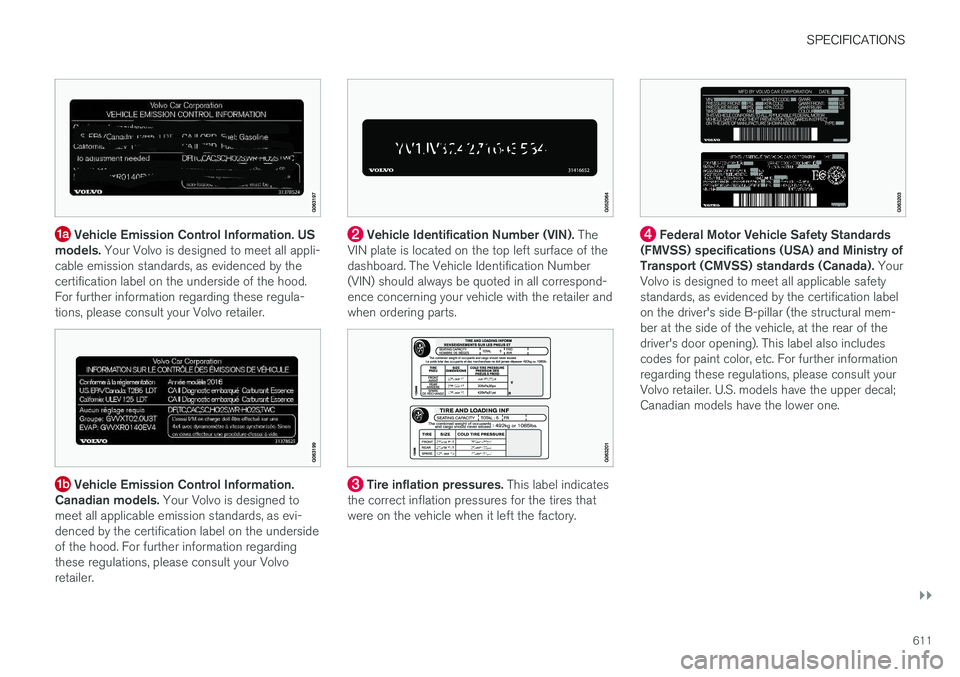
Vehicle Emission Control Information. US
models. Your Volvo is designed to meet all appli-
cable emission standards, as evidenced by the certification label on the underside of the hood.For further information regarding these regula-tions, please consult your Volvo retailer.
Vehicle Emission Control Information.
Canadian models. Your Volvo is designed to
meet all applicable emission standards, as evi- denced by the certification label on the undersideof the hood. For further information regardingthese regulations, please consult your Volvoretailer.
Vehicle Identification Number (VIN). The
VIN plate is located on the top left surface of the dashboard. The Vehicle Identification Number(VIN) should always be quoted in all correspond-ence concerning your vehicle with the retailer andwhen ordering parts.
Tire inflation pressures. This label indicates
the correct inflation pressures for the tires that were on the vehicle when it left the factory.
Federal Motor Vehicle Safety Standards
(FMVSS) specifications (USA) and Ministry of Transport (CMVSS) standards (Canada). Your
Volvo is designed to meet all applicable safetystandards, as evidenced by the certification labelon the driver's side B-pillar (the structural mem-ber at the side of the vehicle, at the rear of thedriver's door opening). This label also includescodes for paint color, etc. For further informationregarding these regulations, please consult yourVolvo retailer. U.S. models have the upper decal;Canadian models have the lower one.
Page 630 of 640
INDEX
628Hill Start Assist 406
Hill Start Assist (HSA) 406
Hoisting the vehicle 555 HomeLink ® 437
programming 438
use 439
HomeLink ® remote control
programmable 437
Home safe lighting 160
Honk 192
Hood, opening 557
Horn 192
I
IAQS (Interior Air Quality System) 200
IC (Inflatable Curtain) 60
ID, Volvo 26
Identification number 38
Ignition mode 397, 398
Immobilizer 242 Electronic immobilizer 242
Indicator symbols 91
Individual drive mode 413
Infant seats 67
Inflatable curtain 60
Inflatable Curtain 60
Inflating tires 535Inflation pressure adjusting 516
Checking 515
recommended 517
Inflation pressure monitoring 517 action 521
Status 520
Inflation pressure table 621
Information display 80, 84
Infotainment (Audio and media) 444
Instrument cluster 80 settings 84
Instrument illumination 162
Instrument lighting 162Instrument panel App menu 100, 101
messages 102
Instruments and controls 78 Instruments overview left-hand drive vehicle 78
IntelliSafe driver support 28
Interior Air Quality System 200Intermittent wiping 179
Internet, see Internet-connected vehicle 487
Internet-connected vehicle 487 book service and repair 552
No connection or poor connection 492
send car data 554
system updates 551
iPod ®, connecting 472
ISOFIX/LATCH anchors 74
J
Jack 523
Jump-start 433
K
Key 229
Keyboard 124, 127 change language 127
Keyless locking/unlocking 244
settings 246
touch-sensitive surfaces 243
Key tag 229
Page 636 of 640

INDEX
634
T
Technician certification 37 Temperatureadjusting 222, 223, 224
perceived 197
Temporary spare spare tire 527
Temporary tire sealing system execution, checking 531
Inflating tires 535
location 530
overview 530
sealing compound 530
Terms and conditions services 34
users 494
Tire dimensions 512, 522
Tire pressure decal 517Tire pressure monitoring calibrating 519
Tires 508 direction of rotation 510
glossary of terms 511
inflation pressure table 621
mounting 526
pressure 621
removal 524
rotation 509
specifications 512, 621
storage 508
tire pressure monitoring 517
tire sealing 530
Tread depth 529
tread wear indicator 511
winter tires 529
Tire sealing system 531
Tire tread 511
Tools 522 Top tether anchors (child restraint sys- tems) 72
Total airing function 229, 247
Towing 434
Towing capacity and towball load 616
Towing eyelet 435
TPMS - Tire Pressure Monitoring System 517
Traction control 264
Traffic information 451
Transmission 407 automatic 408
Transmission fluid grade 619
Travel Link 460 Fuel 463
Notifications 462Sports 464
weather 461
Tread depth 511, 529
Tread wear indicator 511
Trip computer 85, 87
Trip odometer 85
Trip odometer resetting 88
Trip statistics 88Troubleshooting Adaptive Cruise Control 295
Troubleshooting the camera sensor 321 Trunk electrical outlet 539, 540
Lighting 162
Trunk lid emergency opening 249
locking/unlocking 233, 246
open/close with foot movement 254
power-operated 251
unlocking from inside 249
Tunnel detection 153
Turn off engine 396
Turn signals 156Type approval radar system 319
Page 637 of 640
INDEX
635
U
Uniform Tire Quality Grading 514
Units 130
Unknown vehicle component 259Unlockingsettings 232
with key blade 241
USB socket for connecting media 472
V
Vehicle care 595, 596, 598, 599, 600, 601leather upholstery 593
Vehicle Event Data 33 Vehicle functions in the center display 120
Vehicle key bat. low 234Vehicle modem connecting vehicle to Internet 490
settings 491
Vehicle recovery 437
Vehicle status 552 inflation pressure 520
Vehicle upholstery 590, 592, 593, 594, 595
Vehicle weight 615
Ventilation 201, 202, 203 Seats 212, 213
Video 470, 472 settings 471
Voice control 143 climate 198
phone 145
radio and media 146
settings 146
VOL mark 508
Volvo ID 26 create and register 27
W
Warning light
Adaptive Cruise Control 287
stability and traction control system 264
Warning lights airbags SRS 93
alternator does not charge 93
brake system error 93
low oil pressure 93
parking brake applied 93
seat belt reminder 93
starter battery not charging 93
WARNING 93
Warning soundparking brake 404
warning symbols 93 Warning symbols safety 42
Warranties 548Washer Headlights 182
washer fluid, filling 606
Windshield 182
Washer fluid 606
Washer nozzles, heated 180
Waxing 596 Weights Curb weight 615
Wheel bolts 523 locking 523
Wheels cleaning 601
mounting 526
removal 524
Snow chains 529
Wheels and tires Load index and speed symbol 512
Whiplash protection 46
Whiplash Protection System 46
WHIPS (Whiplash Protection System) 46