cruise control VOLVO S90 2018 Owner´s Manual
[x] Cancel search | Manufacturer: VOLVO, Model Year: 2018, Model line: S90, Model: VOLVO S90 2018Pages: 640, PDF Size: 11.37 MB
Page 310 of 640
DRIVER SUPPORT
308
Deactivating/reactivating PilotAssist
Pilot Assist can be temporarily put into standby mode and then reactivated.
Deactivating and putting Pilot Assist in standby mode
Note: This illustration is general and details may vary depending on model.
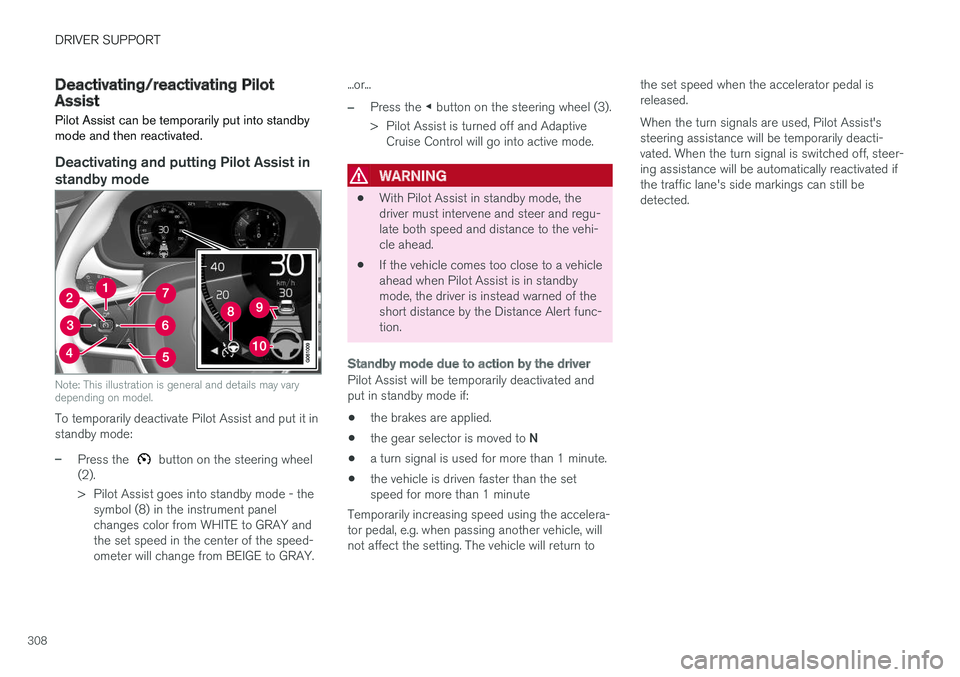
To temporarily deactivate Pilot Assist and put it in standby mode:
–Press the button on the steering wheel
(2).
> Pilot Assist goes into standby mode - the symbol (8) in the instrument panel changes color from WHITE to GRAY andthe set speed in the center of the speed-ometer will change from BEIGE to GRAY. ...or...
–Press the
◀ button on the steering wheel (3).
> Pilot Assist is turned off and Adaptive Cruise Control will go into active mode.
WARNING
• With Pilot Assist in standby mode, the driver must intervene and steer and regu-late both speed and distance to the vehi-cle ahead.
• If the vehicle comes too close to a vehicleahead when Pilot Assist is in standbymode, the driver is instead warned of theshort distance by the Distance Alert func-tion.
Standby mode due to action by the driver
Pilot Assist will be temporarily deactivated and put in standby mode if:
• the brakes are applied.
• the gear selector is moved to
N
• a turn signal is used for more than 1 minute.
• the vehicle is driven faster than the setspeed for more than 1 minute
Temporarily increasing speed using the accelera-tor pedal, e.g. when passing another vehicle, willnot affect the setting. The vehicle will return to the set speed when the accelerator pedal isreleased. When the turn signals are used, Pilot Assist's steering assistance will be temporarily deacti-vated. When the turn signal is switched off, steer-ing assistance will be automatically reactivated ifthe traffic lane's side markings can still bedetected.
Page 311 of 640
DRIVER SUPPORT
309
Automatic standby mode
Pilot Assist is dependent on other systems, such as Electronic Stability Control (ESC62
). If any of
these other systems stops working, Pilot Assist will automatically switch off.
WARNING
With automatic standby mode, the driver is warned by an acoustic signal and a messageon the instrument panel. • The driver must then regulate vehicle speed, apply the brakes if necessary, andmaintain a safe distance to other vehicles.
Adaptive Cruise Control may go into standbymode if, e.g.: • the driver opens the door.
• the brake temperature is high.
• the driver's hands are not on the steering wheel.
• the parking brake is applied.
• the engine speed (rpm) is too low/high.
• the driver unbuckles the seat belt.
• one or more of the wheels lose traction.
• the camera/radar sensor is covered by snowor heavy rain (the camera lens/radar wavesare blocked) •
your vehicle's speed goes below 5 km/h(3 mph) and Pilot Assist cannot determine ifthe vehicle ahead is stationary or if it isanother object, e.g. a speed bump.
• your vehicle's speed goes under 5 km/h(3 mph) and the vehicle ahead turns so thatPilot Assist no longer has a vehicle to follow.Reactivating Pilot Assist from standby
mode
Note: This illustration is general and details may vary depending on model.
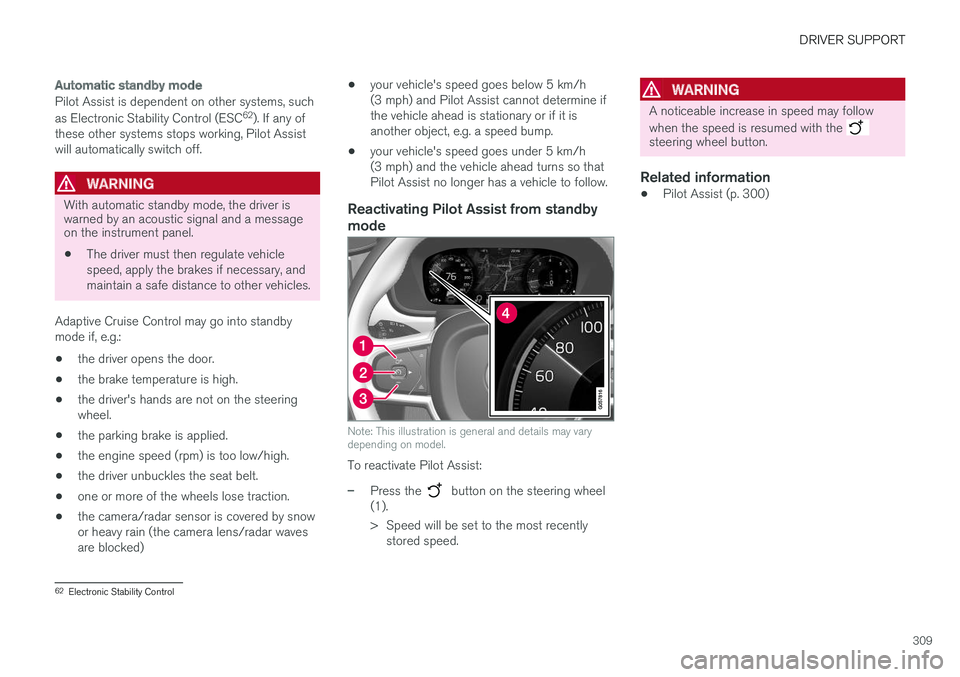
To reactivate Pilot Assist:
–Press the button on the steering wheel
(1).
> Speed will be set to the most recently stored speed.
WARNING
A noticeable increase in speed may follow when the speed is resumed with the
steering wheel button.
Related information
• Pilot Assist (p. 300)
62
Electronic Stability Control
Page 317 of 640
DRIVER SUPPORT
* Option/accessory.315
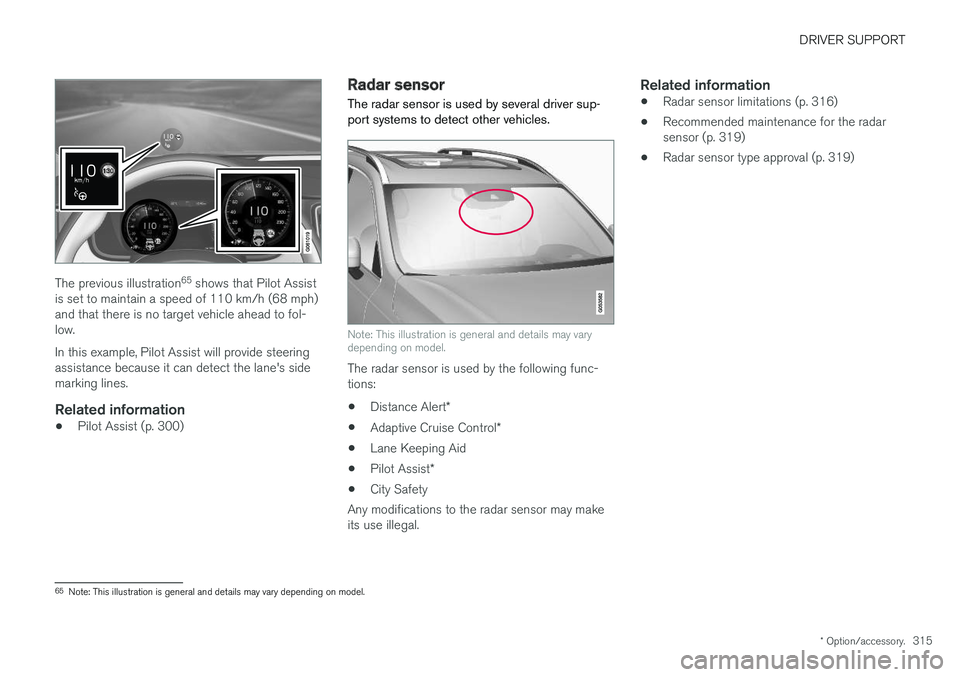
The previous illustration 65
shows that Pilot Assist
is set to maintain a speed of 110 km/h (68 mph) and that there is no target vehicle ahead to fol-low. In this example, Pilot Assist will provide steering assistance because it can detect the lane's sidemarking lines.
Related information
• Pilot Assist (p. 300)
Radar sensor
The radar sensor is used by several driver sup- port systems to detect other vehicles.
Note: This illustration is general and details may vary depending on model.
The radar sensor is used by the following func- tions:
• Distance Alert
*
• Adaptive Cruise Control
*
• Lane Keeping Aid
• Pilot Assist
*
• City Safety
Any modifications to the radar sensor may makeits use illegal.
Related information
• Radar sensor limitations (p. 316)
• Recommended maintenance for the radarsensor (p. 319)
• Radar sensor type approval (p. 319)
65
Note: This illustration is general and details may vary depending on model.
Page 319 of 640
DRIVER SUPPORT
}}
317
CauseAction
Water or snow is spraying/swirling up and blocking the radar signals or the camera's range of visibility. No action. Very wet or snow-covered roads may sometimes prevent the cam-era/radar sensor from functioning.
There is dirt between the inside of the windshield and the camera/radarsensor. Consult a workshop to have the area of the windshield on the inside of the cam-era's casing cleaned. An authorized Volvo workshop is recommended.
NOTE
Keep the windshield in front of the camera and radar unit clean.
Vehicle speedThe radar sensor's ability to detect a vehicle ahead is significantly reduced if:
• the speed of the vehicle ahead differs greatlyfrom your vehicle's speed
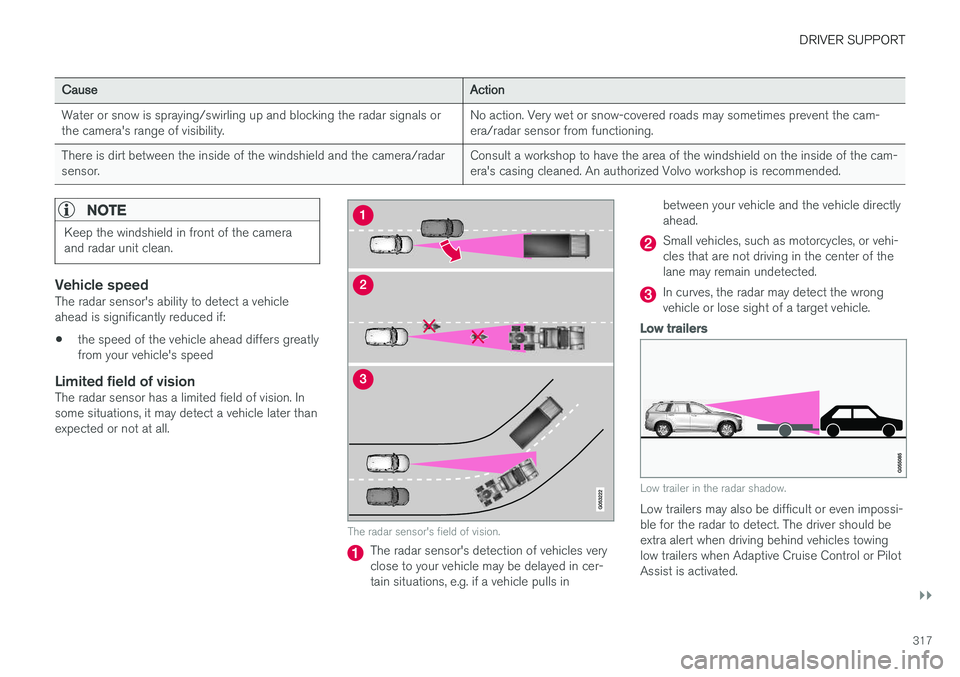
Limited field of visionThe radar sensor has a limited field of vision. Insome situations, it may detect a vehicle later thanexpected or not at all.
The radar sensor's field of vision.
The radar sensor's detection of vehicles very close to your vehicle may be delayed in cer-tain situations, e.g. if a vehicle pulls in between your vehicle and the vehicle directlyahead.
Small vehicles, such as motorcycles, or vehi- cles that are not driving in the center of thelane may remain undetected.
In curves, the radar may detect the wrong vehicle or lose sight of a target vehicle.
Low trailers
Low trailer in the radar shadow.
Low trailers may also be difficult or even impossi- ble for the radar to detect. The driver should beextra alert when driving behind vehicles towing low trailers when Adaptive Cruise Control or Pilot Assist is activated.
Page 322 of 640
DRIVER SUPPORT
* Option/accessory.
320
Camera
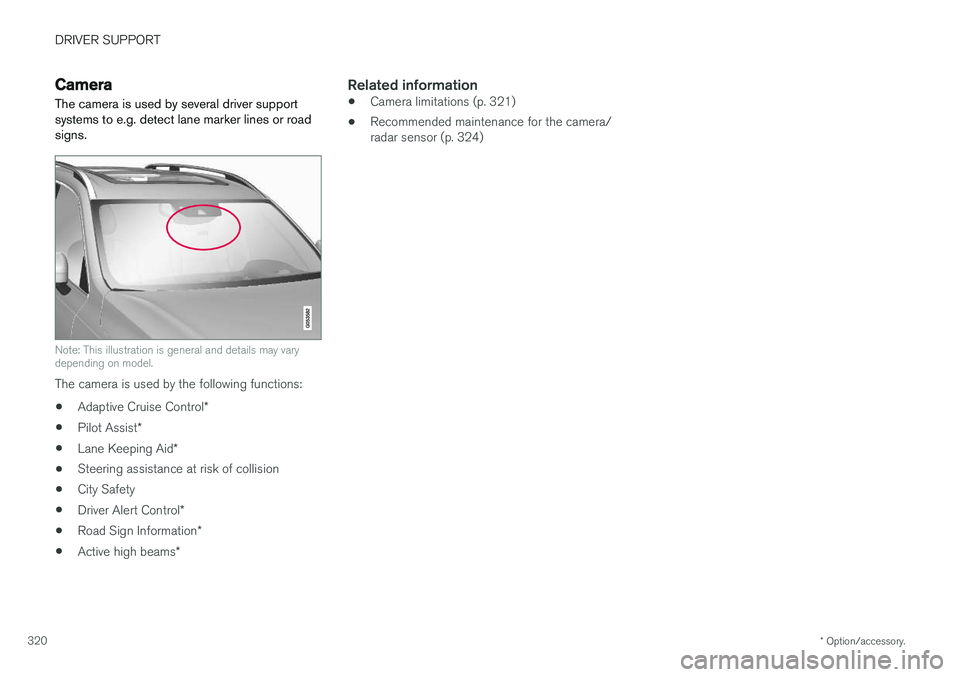
The camera is used by several driver support systems to e.g. detect lane marker lines or roadsigns.
Note: This illustration is general and details may vary depending on model.
The camera is used by the following functions:
• Adaptive Cruise Control
*
• Pilot Assist
*
• Lane Keeping Aid
*
• Steering assistance at risk of collision
• City Safety
• Driver Alert Control
*
• Road Sign Information
*
• Active high beams
*
Related information
•Camera limitations (p. 321)
• Recommended maintenance for the camera/ radar sensor (p. 324)
Page 418 of 640
||
STARTING AND DRIVING
* Option/accessory.
416 This function is most effective in driving situa- tions where the vehicle can roll freely for a longdistance, e.g. on roads with slight downgrades orwhen a decrease in speed is anticipated, such aswhen approaching an area with a lower speedlimit.
Activating Eco Coast
The function is activated when the accelerator pedal is fully released and the following condi-tions are met:
• Eco drive mode is activated.
• The gear selector is in
D.
• The vehicle's speed is approximately65-140 km/h (40-87 mph).
• The gradient of the downgrade is less thanapproximately 6%.
COASTING will be displayed in the instrument
panel when Eco Coast is being used.
Limitations
Eco Coast is not available if:
• The engine and/or transmission are not at normal working temperatures.
• The gear selector is moved from
D to manual
shifting mode.
• The vehicle's speed is not within the65-140 km/h (40-87 mph) range.
• The gradient of the downgrade is more thanapproximately 6%. •
The steering wheel paddles
* are being used
for manual shifting.
Deactivating and turning off Eco Coast
In certain situations, it may be advisable to deac- tivate or turn off Eco Coast so that engine brak-ing can be used. These situations might includedriving down steep hills or before passinganother vehicle to help ensure this can be doneas safely as possible. Deactivate Eco Coast by:
• Pressing the accelerator or brake pedal.
• Moving the gear selector to manual mode.
• Using the steering wheel paddles
* to shift.
Turn off Eco Coast by:
• Switching drive mode
* or switching off drive
mode Eco in Function view.
It is possible to roll short distances even without Eco Coast in order to help conserve fuel. How-ever, for the best fuel economy, Eco Coast shouldbe activated and used to roll longer distances.
Cruise control Eco CruiseWhen cruise control is activated in the Eco drivemode, the vehicle's acceleration and decelerationwill be slower than in other drive modes to helpfurther conserve fuel. Because of this, the vehi-cle's actual speed may be slightly above or belowthe set speed. •
On a level road, the vehicle's actual speedmay differ from the set speed when cruisecontrol is active and the vehicle is coasting.
• On a steep uphill gradient, the vehicle'sspeed is reduced until the transmissiondownshifts. Reduced acceleration is then ini-tiated in order to reach the set speed.
• On a downhill gradient in which the vehicle iscoasting, the vehicle's actual speed may beslightly above or below the set speed. Thefunction uses engine braking to keep the setspeed. If necessary, the normal brakes arealso applied.
ECO gauge in the instrument panelThe ECO gauge indicates how economical cur-rent driving is:
• A low reading in the green area of the gaugeindicates economical driving.
• A high reading is shown when driving is noteconomical, e.g. heavy braking or rapid accel-eration.
The ECO gauge also has an indicator showinghow a reference driver would drive in the samedriving situation. This is shown by the shortpointer in the gauge.
Page 420 of 640
STARTING AND DRIVING
* Option/accessory.
418
Start/Stop function
Start/Stop is a function that temporarily switches off the engine when the vehicle has stopped,e.g. at a traffic light or in heavy traffic, and thenstarts it again automatically when the brakepedal is released.
The Start/Stop function reduces fuel consump- tion, which helps to reduce exhaust emissions. The system makes it possible to drive more eco- nomically and climate-smart by letting the engineauto-stop when appropriate.
Related information
• Driving with the Start/Stop function (p. 418)
• Conditions for the Start/Stop function(p. 420)
• Drive modes
* (p. 413)
Driving with the Start/Stop function
Start/Stop is a function that temporarily turns off the engine when the vehicle is stationary andthen automatically starts it again when the vehi-cle starts moving.
The Start/Stop function is available when the engine is started and can be activated if certainconditions are met. The instrument panel indi-cates if the function is available, active or notavailable. All of the vehicle's ordinary systems, such as lighting, radio, etc. function normally when theengine has been auto-stopped. Certain functionsmay be temporarily reduced, however, such asthe climate system's blower speed or extremelyhigh audio system volume.
Auto-stopTo auto-stop the engine:
• Stop the vehicle by applying the brakes andkeep the brake pedal depressed. The enginewill auto-stop.
In Eco or Comfort 5
drive mode, the engine may
auto-stop before the vehicle has completely stop-ped. With Adaptive Cruise Control or Pilot Assist acti- vated, the engine will auto-stop after approxi-mately three seconds.
Auto-startThe following conditions must be met for theengine to auto-start. • Release the brake pedal. The engine will auto-start and the vehicle can be driven. Onan uphill gradient, Hill Start Assist (HSA) willactivate to help prevent the vehicle from roll-ing backward.
• When Auto-hold is activated, auto-start willbe delayed until the accelerator is pressed.
• When Adaptive Cruise Control or Pilot Assistare activated, the engine will auto-start whenthe accelerator pedal is depressed or the
button on the left-side steering wheel
keypad is pressed.
• Maintain pressure on the brake pedal and press the accelerator pedal. The engine willauto-start.
• On a downhill gradient: Release the brakepedal slightly so that the vehicle begins toroll. The engine will auto-start after a slightincrease in speed.
5
Normal start mode.
Page 625 of 640
INDEX
623
1, 2, 3 ...
4WD 413
A
ABSanti-lock brakes 399
AC (Air conditioning) 224
ACC - Adaptive Cruise Control 284, 287, 288, 289, 290, 291, 293, 294, 295, 296, 298
Accessories and extra equipment 35 installation 36
Accessory installation warning 36
Active Bending Lights 157
Adapting driving characteristics 262, 413
Adaptive Cruise Control 284, 287, 288, 289, 290, 291, 293, 294, 295, 296, 298
change cruise control functionality 296
function 284
manage speed 288, 289
pass 293
radar sensor 315
set time interval 290, 291
troubleshooting 295
Adjusting the steering wheel 193
Airbag 52 activation/deactivation 56
driver's side 53
passenger side 53, 56
Air bag, see Airbag 52
Air conditioning 224Air conditioning, fluid volume and grade 620
Air distribution 201 air vents 201, 203
changing 202
defrosting 217
recirculation 216
table showing options 205
Air quality 199, 200 allergy and asthma 200
passenger compartment filter 201
Air recirculation 216
Alarm 257 deactivating 258
Allergy and asthma-inducing substances 200
All Wheel Drive, AWD 413
All Wheel Drive (AWD) 413
All Wheel Drive (four-wheel drive) 413
Android Auto 476, 478 Antenna location 247Apple CarPlay 473, 475
Approach lighting 160
Apps 445
Assistance at risk of collision 361, 362, 363, 364, 365, 366, 367, 369
Audio and media 444Audio system HD digital radio 455 SiriusXM ® Satellite radio 456, 457, 458
Auto-climate 215
Auto hold 405
Auto-hold brakes 405 activate and deactivate 406
after collision 407
Automatic car wash 598 Automatic engine stop auto-stop 418
Automatic high beam 155
Automatic locking 251
Automatic relocking 231, 244
Automatic Speed Limiter 271, 273, 274
Automatic transmission 408 kickdown 412
oil 619
INDEX
Page 627 of 640
INDEX
625
recalls and registration 65
top tether anchors 72
Child safety 63
Child safety locks 250
City Safety 324, 325, 327, 328, 333, 335
City Safety in crossing traffic 330, 331City Safety when evasive maneuver preven- ted 332
Cleaning 592, 594, 595 automatic car wash 598
car wash 595, 596, 598, 599, 600, 601
center display 590
Seat belts 592
textile upholstery 590, 592, 593
upholstery 590, 592, 593, 594, 595
wheels 601
Cleaning wheels 601
Cleaning wiper blades 599
Clean Zone 199
Clean Zone Interior Package 200
Climate 196 auto-regulation 215
blower control 220, 221
perceived temperature 197
Sensors 197
temperature control 222, 223, 224
voice control 198
zones 196
Climate controls 208 center display 208
rear seat 208
Climate system 196, 208 Refrigerant 620
repairs 558
Clock, setting 90
Collision 42, 47, 52, 61 Collision warner detection of pedestrians 328
radar sensor 315
Collision warning 324, 336
Color code, paintwork 603
Color codes 603
Compass 441 calibration 441
Condensation in headlights 596, 598, 599, 600
Connecting vehicle to Internet No connection or poor connection 492
via a mobile device (WiFi) 489
via mobile device (Bluetooth) 489
via vehicle's modem 490
Connect phone 479
Contact information 26Convertible seats 69
coolant 619
Coolant, filling 562Cooling system overheating 431
Cornering illumination 158
Corner Traction Control 264
Corrosion protection 601
Crash, see Collision 42
Crash event data 33
Cross Traffic Alert – CTA 342, 343, 344, 345
Cruise control 275, 276 manage speed 276, 277
temporary deactivation 278, 279
turn off 279
CTA – Cross Traffic Alert 342, 343, 344, 345
Curb weight 615
CZIP (Clean Zone Interior Package) 200
D
Data recording 33 transferring between vehicle and work-
shop 550
Data sharing 494
Page 628 of 640
INDEX
626Daytime running lights 152 Decals
location of 610
Defrosting 217
Detection of cyclist 328
Dimensions 613
Dipstick, electronic 560
Direction of rotation 510
Disengaging the shiftlock 411
Display lighting 162
Distance Alert 280, 281, 282 limitations 283
DivX ®
470
Door mirrors 171, 173 compass 441
dimming 172
outer 171, 173
power folding 173
resetting 173
Driveline transmission 407
Drive mode 413 changing 415
Driver Alert Control 351 operation 352, 353
Driver Alert Control limitations 353
Driver performance 88, 89
Driver profile 135 edit 137
select 136
Driver support system 262 Driving cooling system 431
Driving economy 424
Driving through standing water 426 driving with a trailer towball load 616
towing capacity 616
E
ECO climate 415
ECO mode 415activate with function button 417
Economical driving 415, 424
Electrical outlet 539 use 540
Electrical system 573
Electric parking brake 401
Electronic immobilizer 242
emergency brake lights 159
Emission inspection readiness 548
Engine overheating 431
start 394
Start/Stop 418
turn off 396
Engine compartment coolant 562
engine oil 559
overview 559
Engine drag control 264
Engine oil 559 filling 560
filter 559
grade and volume 618
Engine shutdown 396
Engine specifications 617 Engine temperature high 431
Environment 27Error messages Adaptive Cruise Control 298
see Messages and symbols 298, 313
Error messages in BLIS 341 Ethanol content max. 10% by volume 428
Exterior dimensions 613