battery location VOLVO S90 2018 Owner´s Manual
[x] Cancel search | Manufacturer: VOLVO, Model Year: 2018, Model line: S90, Model: VOLVO S90 2018Pages: 640, PDF Size: 11.37 MB
Page 8 of 640
6
Activating and deactivating air condi- tioning224
KEY, LOCKS AND ALARM
Lock indication
228
Lock confirmation settings 229
Remote key 229
Locking and unlocking using the remote key 231
Settings for remote and inside doorunlock 232
Unlocking the trunk lid using theremote key 233
Remote key range 233
Replacing the remote key's battery 234
Ordering additional remote keys 238
Red Key - restricted remote key *
238
Red Key * settings
239
Detachable key blade 240
Locking and unlocking with detacha-ble key blade 241
Electronic immobilizer 242
Start and lock system type designations 242
Keyless and touch-sensitive surfaces *
243
Keyless locking and unlocking *
244
Keyless unlock settings *
246
Keyless trunk lid unlock *
246
Antenna locations for the start andlock system 247
Locking and unlocking from inside the vehicle247
Unlocking the trunk lid from insidethe vehicle 249
Opening the trunk lid from inside thetrunk 249
Activating and deactivating childsafety locks 250
Automatic locking when driving 251
Opening and closing the power trunk lid *
251
Opening and closing the trunk lid with foot movement * 254
Private Locking 255
Activating and deactivating private locking 255
Alarm 257
Arming and disarming the alarm 258
Foreign Component Detection *
259
Page 15 of 640
13
MAINTENANCE AND SERVICE
Volvo's service program548
Data transfer between vehicle and workshop over Wi-Fi 550
Download Center 551
Handling system updates via Down-load Center 551
Vehicle status 552
Scheduling service and repairs 552
Sending vehicle information to theworkshop 554
Hoisting the vehicle 555
Opening and closing the hood 557
Climate control system service 558
Replacing a windshield with head-up display * 558
Engine compartment overview 559
Engine oil 559
Checking and filling engine oil 560
Refilling coolant 562
Replacing bulbs 563
Removing the plastic cover to replace bulbs 564
Location of exterior lights 565
Replacing the low beam headlight bulbs 566
Replacing the high beam headlight bulbs 567
Replacing daytime running lights/ front parking light bulbs567
Replacing front turn signal bulbs 568
Replacing the rear fog light bulb 569
Bulb specifications 572
Start battery 573
Support battery 576
Battery symbols 577
Fuses and fuseboxes 578
Replacing fuses 579
Fuses in the engine compartment 580
Fuses under the glove compartment 583
Fuses in the trunk 586
Cleaning the interior 590
Cleaning the center display 590
Cleaning the head-up display *
591
Cleaning fabric upholstery and ceil-ing liner 592
Cleaning the seat belt 592
Cleaning floor mats and inlay mats 592
Cleaning leather upholstery 593
Cleaning the leather steering wheel 594
Cleaning interior plastic, metal andwood surfaces 595
Cleaning the exterior 595
Polishing and waxing596
Hand washing 596
Automatic car washes 598
High-pressure washing 599
Cleaning the wiper blades 599
Cleaning exterior plastic, rubber and trim components 600
Cleaning rims 601
Corrosion protection 601
Paintwork 602
Touching up minor paint damage 602
Color codes 603
Replacing windshield wiper blades 604
Windshield wipers in the service position 605
Filling washer fluid 606
Page 236 of 640
||
KEY, LOCKS AND ALARM
* Option/accessory.
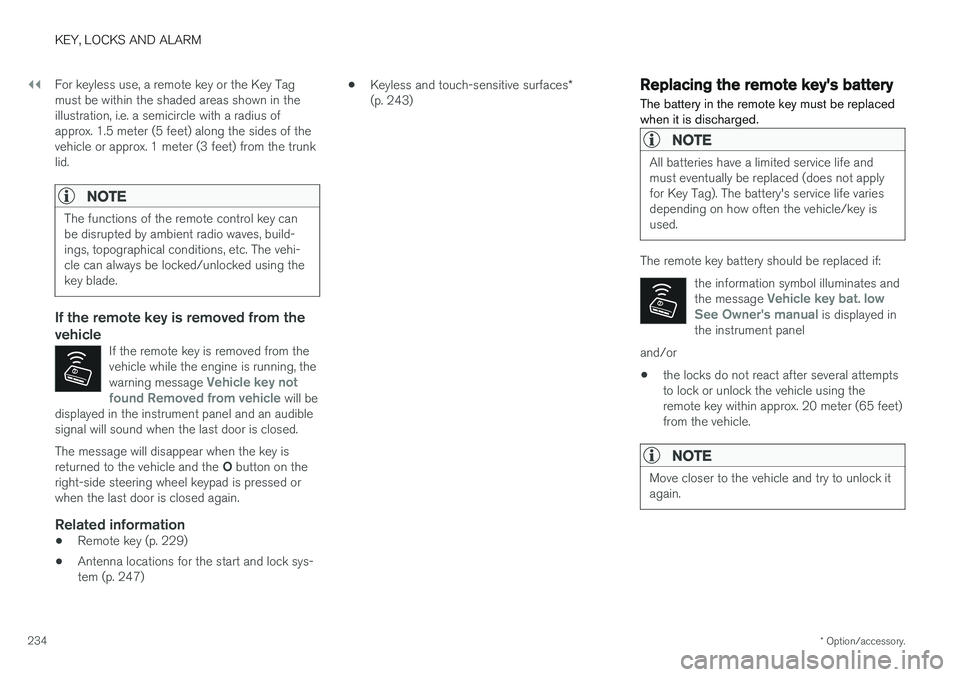
234 For keyless use, a remote key or the Key Tag must be within the shaded areas shown in theillustration, i.e. a semicircle with a radius ofapprox. 1.5 meter (5 feet) along the sides of thevehicle or approx. 1 meter (3 feet) from the trunklid.
NOTE
The functions of the remote control key can be disrupted by ambient radio waves, build-ings, topographical conditions, etc. The vehi-cle can always be locked/unlocked using thekey blade.
If the remote key is removed from the vehicle
If the remote key is removed from the vehicle while the engine is running, the warning message
Vehicle key not
found Removed from vehicle will be
displayed in the instrument panel and an audible signal will sound when the last door is closed.
The message will disappear when the key is returned to the vehicle and the O button on the
right-side steering wheel keypad is pressed or when the last door is closed again.
Related information
• Remote key (p. 229)
• Antenna locations for the start and lock sys-tem (p. 247) •
Keyless and touch-sensitive surfaces
*
(p. 243)
Replacing the remote key's battery
The battery in the remote key must be replaced when it is discharged.
NOTE
All batteries have a limited service life and must eventually be replaced (does not applyfor Key Tag). The battery's service life variesdepending on how often the vehicle/key isused.
The remote key battery should be replaced if:
the information symbol illuminates and the message
Vehicle key bat. low
See Owner's manual is displayed in
the instrument panel
and/or
• the locks do not react after several attempts to lock or unlock the vehicle using theremote key within approx. 20 meter (65 feet)from the vehicle.
NOTE
Move closer to the vehicle and try to unlock it again.
Page 243 of 640
KEY, LOCKS AND ALARM
}}
241
Locking and unlocking withdetachable key blade
The detachable key blade can be used to unlock the vehicle from the outside, e.g. if the battery inthe remote key is discharged.
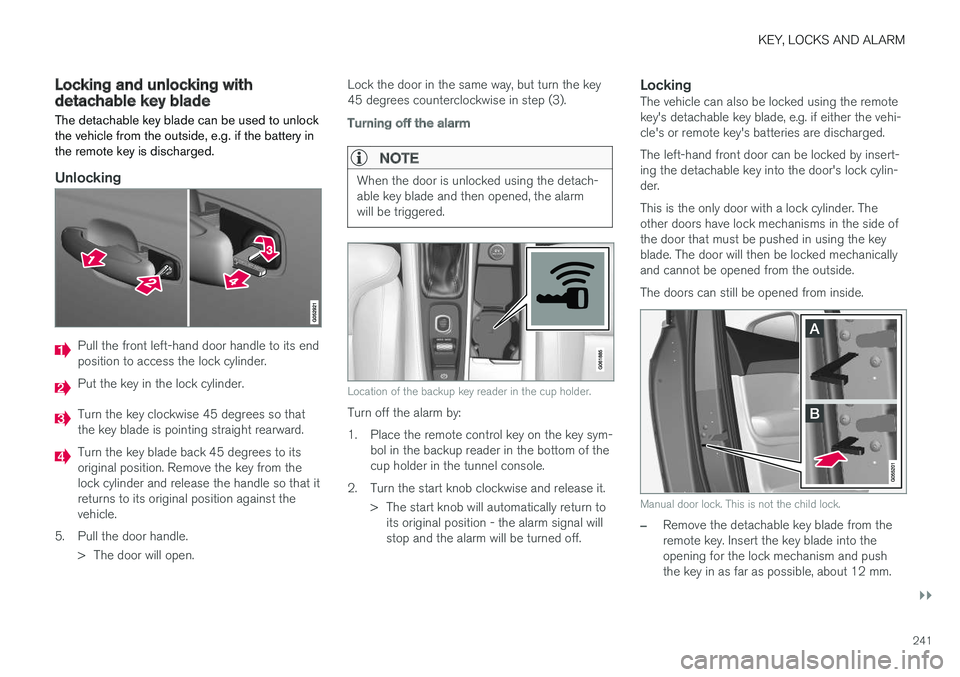
Unlocking
Pull the front left-hand door handle to its end position to access the lock cylinder.
Put the key in the lock cylinder.
Turn the key clockwise 45 degrees so that the key blade is pointing straight rearward.
Turn the key blade back 45 degrees to its original position. Remove the key from thelock cylinder and release the handle so that itreturns to its original position against thevehicle.
5. Pull the door handle. > The door will open. Lock the door in the same way, but turn the key45 degrees counterclockwise in step (3).
Turning off the alarm
NOTE
When the door is unlocked using the detach- able key blade and then opened, the alarmwill be triggered.
Location of the backup key reader in the cup holder.
Turn off the alarm by:
1. Place the remote control key on the key sym-
bol in the backup reader in the bottom of the cup holder in the tunnel console.
2. Turn the start knob clockwise and release it. > The start knob will automatically return toits original position - the alarm signal willstop and the alarm will be turned off.
LockingThe vehicle can also be locked using the remotekey's detachable key blade, e.g. if either the vehi-cle's or remote key's batteries are discharged. The left-hand front door can be locked by insert- ing the detachable key into the door's lock cylin-der. This is the only door with a lock cylinder. The other doors have lock mechanisms in the side ofthe door that must be pushed in using the keyblade. The door will then be locked mechanicallyand cannot be opened from the outside. The doors can still be opened from inside.
Manual door lock. This is not the child lock.
–Remove the detachable key blade from the remote key. Insert the key blade into theopening for the lock mechanism and pushthe key in as far as possible, about 12 mm.
Page 260 of 640

KEY, LOCKS AND ALARM
* Option/accessory.
258
Arming and disarming the alarm
The alarm is armed when the vehicle is locked.
Arming the alarmLock and arm the vehicle by:
• pressing the lock button on the remote key
• touch the marked surface on the outside of the door handle or the rubberized pressure plate on the trunk lid 21
.
If the vehicle is equipped with both keyless lock- ing/unlocking * and power trunk lid, the button
on the lower edge of the trunk lid can also
be used to lock and arm the vehicle.
A red LED light on the dashboard will flash every other second when the vehicle is locked and the alarm isarmed.
Disarming the alarmUnlock and disarm the vehicle alarm by:
• pressing the unlock button on the remote key
•
grip a door handle or press the trunk lid's rubberized pressure plate 21
.
Disarming the alarm without a functioning
remote key
The vehicle can be unlocked and disarmed even if the remote key is not functioning, e.g. if thebattery is discharged.
1. Open the driver's door using the detachable
key blade.
> This will trigger the alarm.
Location of the backup key reader in the cup holder.
2. Place the remote key on the key symbol inthe backup reader in the tunnel console's cup holder. 3. Turn the start knob clockwise and release.
> The alarm will be disarmed.
Turning off a triggered alarm
–Press the unlock button on the remote key or put the ignition into mode I by turning the
start knob clockwise and then releasing it.
NOTE
• Remember that the alarm is armed when the vehicle is locked.
• The alarm will be triggered if any of thedoors is opened from the inside.
Automatically arming and disarming the alarm
Automatically arming the alarm helps prevent inadvertently leaving the vehicle without alarmprotection. If the vehicle is unlocked using the remote key (and the alarm is disarmed) but none of thedoors or trunk lid is opened within two minutes,the alarm will be automatically rearmed. The vehi-cle will also re-lock. On some markets, the alarm will be automatically armed following a slight delay after the driver'sdoor has been opened and closed without beinglocked.
21
Only vehicles with keyless locking and unlocking * (Passive Entry).
Page 397 of 640
STARTING AND DRIVING
}}
395
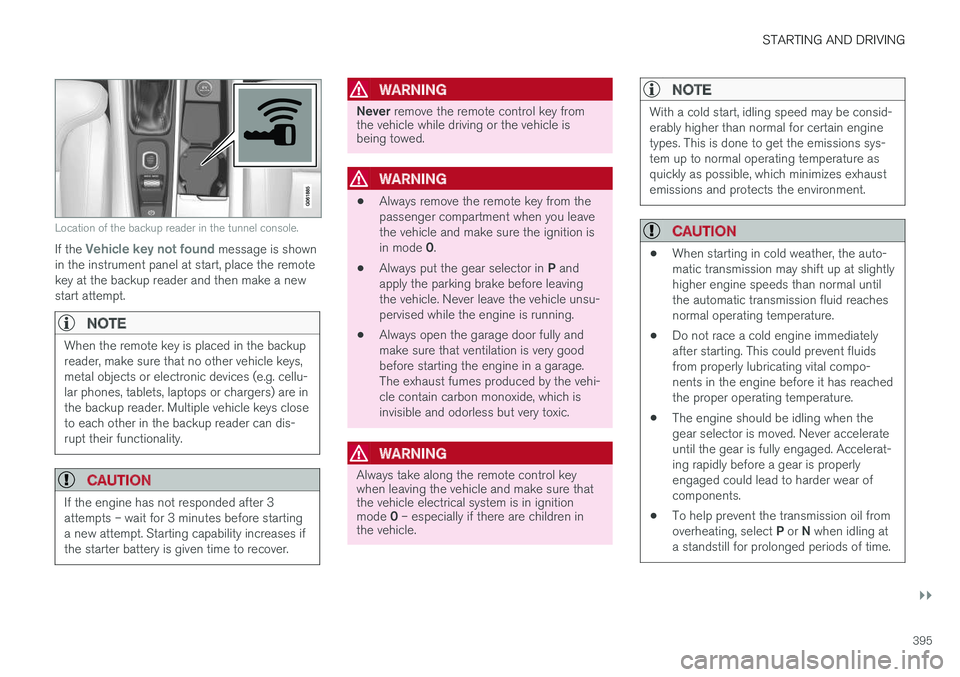
Location of the backup reader in the tunnel console.
If the Vehicle key not found message is shown
in the instrument panel at start, place the remote key at the backup reader and then make a newstart attempt.
NOTE
When the remote key is placed in the backup reader, make sure that no other vehicle keys,metal objects or electronic devices (e.g. cellu-lar phones, tablets, laptops or chargers) are inthe backup reader. Multiple vehicle keys closeto each other in the backup reader can dis-rupt their functionality.
CAUTION
If the engine has not responded after 3 attempts – wait for 3 minutes before startinga new attempt. Starting capability increases ifthe starter battery is given time to recover.
WARNING
Never remove the remote control key from
the vehicle while driving or the vehicle is being towed.
WARNING
• Always remove the remote key from the passenger compartment when you leavethe vehicle and make sure the ignition is in mode
0.
• Always put the gear selector in
P and
apply the parking brake before leaving the vehicle. Never leave the vehicle unsu-pervised while the engine is running.
• Always open the garage door fully andmake sure that ventilation is very goodbefore starting the engine in a garage.The exhaust fumes produced by the vehi-cle contain carbon monoxide, which isinvisible and odorless but very toxic.
WARNING
Always take along the remote control key when leaving the vehicle and make sure thatthe vehicle electrical system is in ignition mode
0 – especially if there are children in
the vehicle.
NOTE
With a cold start, idling speed may be consid- erably higher than normal for certain enginetypes. This is done to get the emissions sys-tem up to normal operating temperature asquickly as possible, which minimizes exhaustemissions and protects the environment.
CAUTION
• When starting in cold weather, the auto- matic transmission may shift up at slightlyhigher engine speeds than normal untilthe automatic transmission fluid reachesnormal operating temperature.
• Do not race a cold engine immediatelyafter starting. This could prevent fluidsfrom properly lubricating vital compo-nents in the engine before it has reachedthe proper operating temperature.
• The engine should be idling when thegear selector is moved. Never accelerateuntil the gear is fully engaged. Accelerat-ing rapidly before a gear is properlyengaged could lead to harder wear ofcomponents.
• To help prevent the transmission oil from overheating, select
P or N when idling at
a standstill for prolonged periods of time.
Page 576 of 640
||
MAINTENANCE AND SERVICE
574
CAUTION
Only a modern battery charger with controlled charge voltage should be used to charge thestarter battery and support battery. The rapidcharging function should not be used as thiscould damage the battery.
CAUTION
Failure to observe the following could cause the infotainment energy save mode to tempo-rarily stop working and/or a message in thedriver's display regarding the state of chargeof the starter battery may be temporarilyincorrect after an external starter battery orbattery charger has been connected:
• The negative battery terminal of the vehi- cle's starter battery must
never be used
to connect an external starter battery orbattery charger – only the vehicle's neg-
ative charging point should be used as
a grounding point.
NOTE
If the starter battery becomes discharged too many times, it will shorten its service life. The service life of the starter battery is affec- ted by several factors, such as driving condi-tions and climate. The starting capacity of thebattery reduces gradually over time. The bat-tery must therefore be recharged if the vehi-cle is not used or a long period of time or if itis only driven short distances. Severe cold fur-ther limits the starting capacity. To keep the starter battery in a good condi- tion, the vehicle should be driven at least15 minutes per week or the battery should beconnected to a battery charger with automatictrickle charging. A starter battery that is always kept fully charged has the maximum service life.
Location
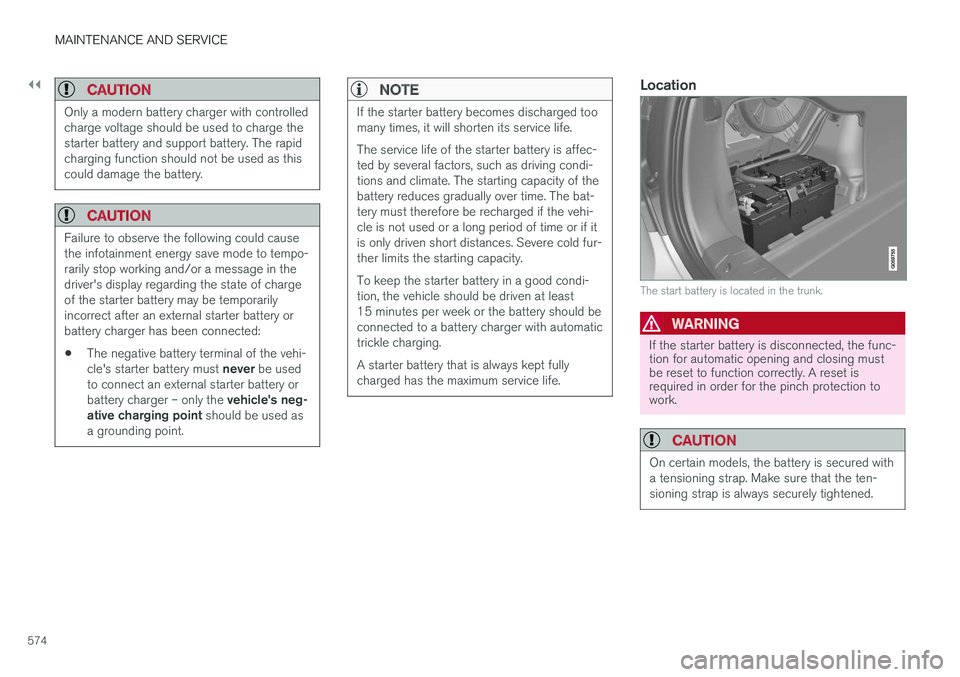
The start battery is located in the trunk.
WARNING
If the starter battery is disconnected, the func- tion for automatic opening and closing mustbe reset to function correctly. A reset isrequired in order for the pinch protection towork.
CAUTION
On certain models, the battery is secured with a tensioning strap. Make sure that the ten-sioning strap is always securely tightened.
Page 580 of 640
||
MAINTENANCE AND SERVICE
578
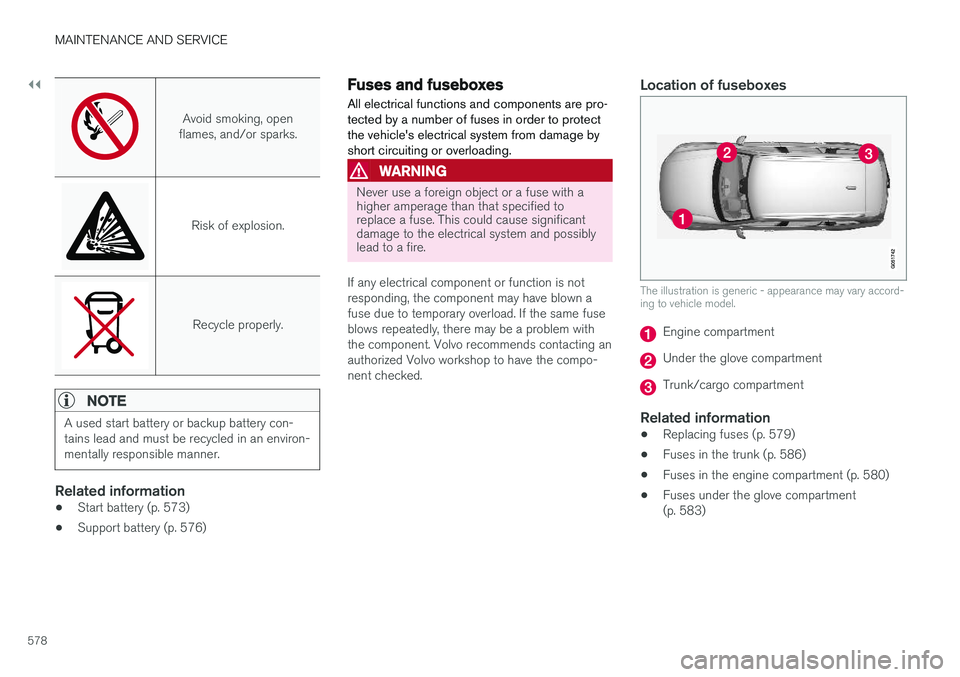
Avoid smoking, open
flames, and/or sparks.
Risk of explosion.
Recycle properly.
NOTE
A used start battery or backup battery con- tains lead and must be recycled in an environ-mentally responsible manner.
Related information
• Start battery (p. 573)
• Support battery (p. 576)
Fuses and fuseboxes
All electrical functions and components are pro- tected by a number of fuses in order to protectthe vehicle's electrical system from damage byshort circuiting or overloading.
WARNING
Never use a foreign object or a fuse with a higher amperage than that specified toreplace a fuse. This could cause significantdamage to the electrical system and possiblylead to a fire.
If any electrical component or function is not responding, the component may have blown afuse due to temporary overload. If the same fuseblows repeatedly, there may be a problem withthe component. Volvo recommends contacting anauthorized Volvo workshop to have the compo-nent checked.
Location of fuseboxes
The illustration is generic - appearance may vary accord- ing to vehicle model.
Engine compartment
Under the glove compartment
Trunk/cargo compartment
Related information
• Replacing fuses (p. 579)
• Fuses in the trunk (p. 586)
• Fuses in the engine compartment (p. 580)
• Fuses under the glove compartment (p. 583)
Page 631 of 640
INDEX
629
L
Labelslocation of 610
Laminated glass 166 Lamps changing 563
location 565
specifications 572
Lane Keeping Aid operation 356
Lane Keeping Aid (LKA) 353, 355, 356, 358, 360
Language 130
Leather upholstery, cleaning instructions 593
Leveling control 422 settings 424
License agreement 94, 497
Lifting tools 523
Light bulbs, specifications 572
Light control 150, 162 Lighting Active Bending Lights 157
approach lighting 160
automatic high beam 155 automatic lighting controls, passenger
compartment 161
brake lights 159
controls 150, 161, 162
cornering illumination 158
daytime running lights 152
display lighting 162
emergency brake lights 159
front fog lights 157
Hazard warning flashers 160
high beams 154, 155
home safe lighting 160
in passenger compartment 161, 162
instrument illumination 162
instrument lighting 162
light bulbs, specifications 572
light locations 565
low beams 153
position lights 152
rear fog light 158
settings 151
Turn signals 156
Lighting, replacing bulbs 563 daytime running lights/front parking
lights 567
front turn signals 568
high beams 567
low beams 566
rear fog light 569
remove plastic cover 564
Limp home 407Load anchoring eyelets cargo compartment 545
Load anchoring hooks 544
Load carriers 544
Load index 512Loading general 543
load anchoring eyelets 545
long load 544
Lock indication 228 setting 229
Locking/unlocking trunk lid 233, 246
Locking wheel bolts 523 Locks Locking 231
unlocking 231
Low battery charge level start battery 432
Low beams 153
Low oil level 560