light VOLVO S90 TWIN ENGINE 2019 Owners Manual
[x] Cancel search | Manufacturer: VOLVO, Model Year: 2019, Model line: S90 TWIN ENGINE, Model: VOLVO S90 TWIN ENGINE 2019Pages: 669, PDF Size: 14.33 MB
Page 627 of 669
MAINTENANCE AND SERVICE
}}
625
Polishing and waxing
Polish and wax the vehicle when the paint ismatte or to provide extra protection. The vehicledoes not need to be polished until it is at least ayear old. However, it can be waxed during thefirst year. Do not polish or wax the vehicle indirect sunlight. The surface of the vehicle shouldnot be warmer than 45 °C (113 °F).
Wash and dry the vehicle very carefullybefore polishing or waxing. Remove asphaltand tar stains with asphalt remover or paintthinner. More stubborn stains can beremoved with a grinding paste designed forvehicle paint.
Use polish first and then liquid or paste wax.Follow the instructions on the package care-fully. Many products contain both polish andwax.
A wide range of polymer-based waxes canbe purchased today. These waxes are easy touse and produce a long-lasting, high-glossfinish that protects the bodywork against oxi-dation, road dirt and fading.
CAUTION
Avoid waxing and polishing plastic and rubber.
If using degreaser on plastic and rubber, onlyrub (if necessary) with slight pressure. Use asoft sponge.
Polishing glossy trim moldings can wear awayor damage the glossy surface layer.
Polish containing abrasives must not be used.
CAUTION
Only use paintwork treatments recommendedby Volvo. Other treatments, such as preserva-tion, sealing, protection, luster sealing or simi-lar, could damage the paintwork. Paintworkdamage caused by such treatments are notcovered by Volvo's warranty.
Related information
Cleaning the exterior (p. 624)
Hand washing (p. 625)
Automatic car washes (p. 627)
High-pressure washing (p. 628)
Cleaning the wiper blades (p. 628)
Cleaning exterior plastic, rubber and trimcomponents (p. 629)
Cleaning rims (p. 630)
Corrosion protection (p. 630)
Hand washing
The vehicle should be washed as soon as itbecomes dirty. This makes the vehicle easier toclean because dirt does not attach as strongly. Italso reduces the risk of scratches and keeps thevehicle looking new. Wash the vehicle in a carwash or garage with an oil separator and use carwashing detergent.
Hand washing
Keep the following points in mind when washingthe vehicle:
Avoid washing the vehicle in direct sunlight.This could cause the detergent or wax to dryout and become abrasive.
Remove bird droppings from paintwork assoon as possible. It contains chemicals thataffect and discolor paintwork very quickly.Use e.g. soft paper or a sponge soaked inlots of water. Consult an authorized Volvoworkshop for assistance removing discolora-tion.
Hose down the underbody, including thewheel housings and bumper.
Hose down the entire vehicle and removeany loose dirt, droppings etc. to reduce therisk of scratches from washing. Do not spraydirectly onto locks.
If necessary, use cold degreaser on heavilysoiled surfaces. Note that in such cases thesurfaces must not be hot from the sun.
Page 628 of 669

||
MAINTENANCE AND SERVICE
626
Wash using a sponge, car washing detergentand plenty of lukewarm water.
Clean the wiper blades with lukewarm soapsolution or car washing detergent.
Dry the vehicle using a clean, soft chamois ora squeegee. Try not to let drops of water dryin strong sunlight. This could cause waterdrying stains that may need to be polishedout.
In areas with heavy industrial emissions,more frequent washing of the vehicle's exte-rior is recommended.
Tar spots from asphalt may remain even afterwashing. Use a tar remover to remove thesespots after washing the vehicle.
WARNING
Always entrust engine washing to a workshop.If the engine is hot, there is a risk of fire.
CAUTION
Dirty headlights do not work as well. Cleanthem regularly, e.g. when refueling.
Do not use corrosive cleaners. Use water anda non-abrasive sponge.
NOTE
Exterior lighting such as headlights and tail-lights may develop temporary condensationon the inside of the lens. This is normal. Allexterior lighting is designed to resist this.Condensation is normally vented out of thelamp housing once the light has been lit forsome period of time.
CAUTION
Make sure that the panoramic roof andsun shade are closed before washing thevehicle.
Never use abrasive polishing agents onthe panoramic roof.
Never use wax on the rubber sealsaround the panoramic roof.
CAUTION
Remember to remove dirt from the drainholes in the doors and sills after washing thevehicle.
Related information
Cleaning the exterior (p. 624)
Polishing and waxing (p. 625)
Automatic car washes (p. 627)
High-pressure washing (p. 628)
Cleaning the wiper blades (p. 628)
Cleaning exterior plastic, rubber and trimcomponents (p. 629)
Cleaning rims (p. 630)
Corrosion protection (p. 630)
Settings for automatically activating the park-ing brake (p. 436)
Page 629 of 669

MAINTENANCE AND SERVICE
627
Automatic car washes
The vehicle should be washed as soon as itbecomes dirty. This makes the vehicle easier toclean because dirt does not attach as strongly. Italso reduces the risk of scratches and keeps thevehicle looking new.
An automatic car wash is a fast and easy way tokeep your vehicle clean, but it does not reach allareas of the vehicle. For best results, Volvo rec-ommends hand washing your vehicle or supple-menting automatic car washes with a hand wash.
NOTE
Volvo recommends not washing the vehicle inan automatic car wash during the first fewmonths; the paintwork on new vehicles takessome time to fully harden.
CAUTION
Before driving the vehicle into a car wash,deactivate the Automatic Braking when Sta-tionary and Automatic Parking Brake Applica-tion functions. If the functions are not deacti-vated, the brake system will seize when thevehicle is stationary and the vehicle will not beable to roll.
CAUTION
For automatic car washes in which the vehicleis pulled forward on rolling wheels:
1. Before washing the vehicle, make surethat the automatic rain sensor is deacti-vated. If it is not deactivated and inadver-tently starts, the wiper arms could bedamaged.
2.To help prevent damage from the auto-matic car wash machinery, make surethat the door mirrors are folded in, anten-nas retracted or removed, and any auxili-ary lights secured.
3. Drive into the automatic car wash.
4. Turn off the "Automatic Braking when
Stationary" function using the buttonin the tunnel console.
5. Turn off the "Automatic Parking BrakeApplication" function in the center dis-play's Top view.
6.Turn off the engine by turning the startknob in the tunnel console clockwise.Hold the knob in position for at least2 seconds.
The vehicle is now ready for the automatic carwash.
CAUTION
The system will automatically change to Pmode if the above steps are not followed. In Pmode, the wheels are locked, which theyshould not be when the vehicle is beingwashed in a car wash.
Related information
Cleaning the exterior (p. 624)
Polishing and waxing (p. 625)
Hand washing (p. 625)
High-pressure washing (p. 628)
Cleaning the wiper blades (p. 628)
Cleaning exterior plastic, rubber and trimcomponents (p. 629)
Cleaning rims (p. 630)
Corrosion protection (p. 630)
Page 631 of 669
MAINTENANCE AND SERVICE
* Option/accessory.629
Cleaning exterior plastic, rubber andtrim components
The vehicle should be washed as soon as itbecomes dirty. This makes the vehicle easier toclean because dirt does not attach as strongly. Italso reduces the risk of scratches and keeps thevehicle looking new. Wash the vehicle in a carwash or garage with an oil separator and use carwashing detergent.
Exterior plastic, rubber and trim
components
A special cleaning agent available from Volvoretailers is recommended for the cleaning andcare of colored plastic parts, rubber and trimcomponents, e.g. glossy trim. Follow the usageinstructions for the cleaning agent carefully.
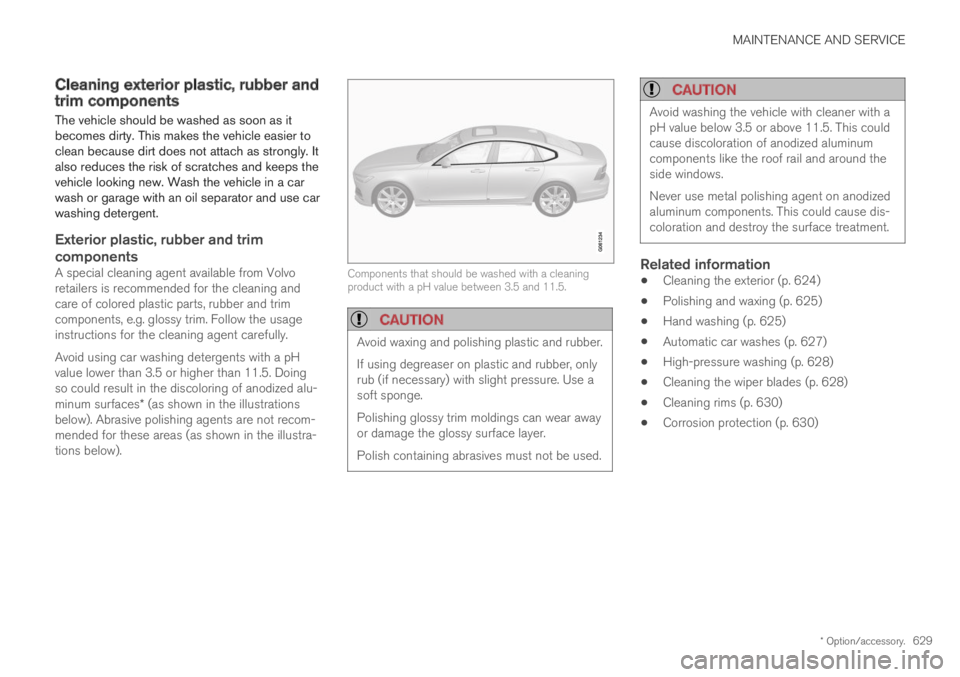
Avoid using car washing detergents with a pHvalue lower than 3.5 or higher than 11.5. Doingso could result in the discoloring of anodized alu-minum surfaces* (as shown in the illustrationsbelow). Abrasive polishing agents are not recom-mended for these areas (as shown in the illustra-tions below).
Components that should be washed with a cleaningproduct with a pH value between 3.5 and 11.5.
CAUTION
Avoid waxing and polishing plastic and rubber.
If using degreaser on plastic and rubber, onlyrub (if necessary) with slight pressure. Use asoft sponge.
Polishing glossy trim moldings can wear awayor damage the glossy surface layer.
Polish containing abrasives must not be used.
CAUTION
Avoid washing the vehicle with cleaner with apH value below 3.5 or above 11.5. This couldcause discoloration of anodized aluminumcomponents like the roof rail and around theside windows.
Never use metal polishing agent on anodizedaluminum components. This could cause dis-coloration and destroy the surface treatment.
Related information
Cleaning the exterior (p. 624)
Polishing and waxing (p. 625)
Hand washing (p. 625)
Automatic car washes (p. 627)
High-pressure washing (p. 628)
Cleaning the wiper blades (p. 628)
Cleaning rims (p. 630)
Corrosion protection (p. 630)
Page 633 of 669
MAINTENANCE AND SERVICE
}}
631
Paintwork
The paintwork consists of multiple layers. It is animportant part of the vehicle's corrosion protec-tion and therefore needs to be checked regu-larly.
The most common types of paint damage areminor stone chips, scratches and damage to e.g.the edges of fenders, doors and bumpers. Tohelp prevent corrosion, paint damage should berectified immediately.
Related information
Touching up minor paint damage (p. 631)
Color codes (p. 632)
Touching up minor paint damage
The paintwork is an important part of the vehi-cle's corrosion protection and therefore needsto be checked regularly. The most commontypes of paint damage are minor stone chips,scratches and damage to e.g. the edges offenders, doors and bumpers.
Touching up paint damage
To help prevent corrosion, paint damage shouldbe rectified immediately.
NOTE
Make sure the surface is clean and dry beforeperforming any touch-ups to the paint. Thesurface temperature should be at least 15°C (59 °F).
Materials that might be needed
Primer19 ‒ special adhesive primer is availa-ble in a spray can for e.g. plastic-coveredbumpers.
Base coat and clear coat ‒ available in spray
cans or as a touch-up pen/stick20.
Masking tape.
Fine-grain sandpaper19.
If the damage has not reached all the way downto the metal, then touch-up paint can be appliedimmediately after the surface has been cleaned.
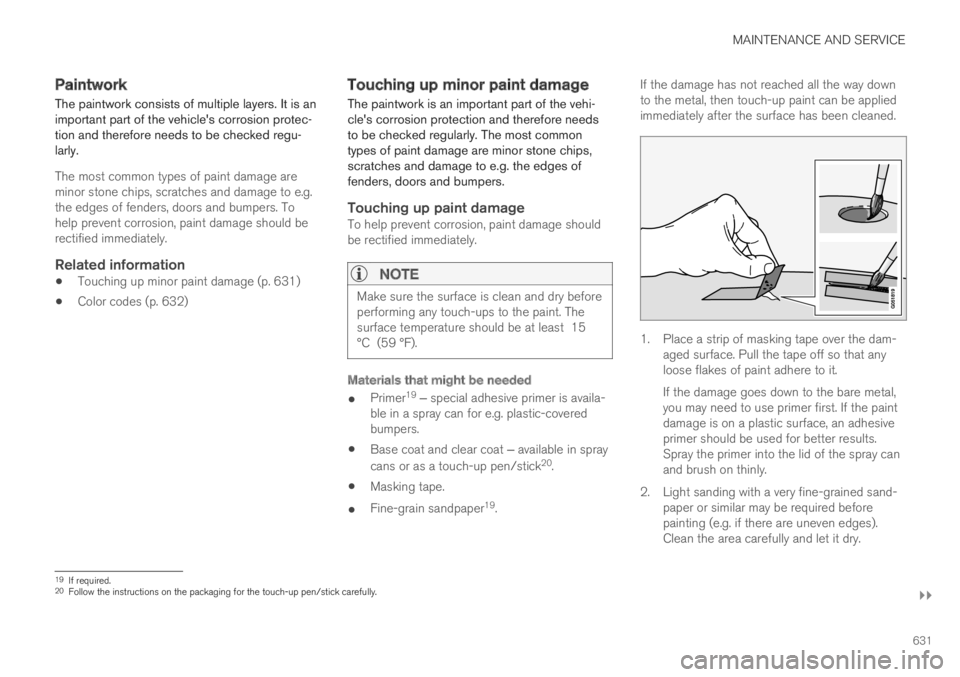
1. Place a strip of masking tape over the dam-aged surface. Pull the tape off so that anyloose flakes of paint adhere to it.
If the damage goes down to the bare metal,you may need to use primer first. If the paintdamage is on a plastic surface, an adhesiveprimer should be used for better results.Spray the primer into the lid of the spray canand brush on thinly.
2. Light sanding with a very fine-grained sand-paper or similar may be required beforepainting (e.g. if there are uneven edges).Clean the area carefully and let it dry.
19If required.20Follow the instructions on the packaging for the touch-up pen/stick carefully.
Page 635 of 669
MAINTENANCE AND SERVICE
633
Replacing windshield wiper blades
The wiper blades help remove water from thewindshield. Along with the washer fluid, theyclean the glass and help improve visibility whiledriving. The wiper blades can be replaced.
Replacing wiper blades
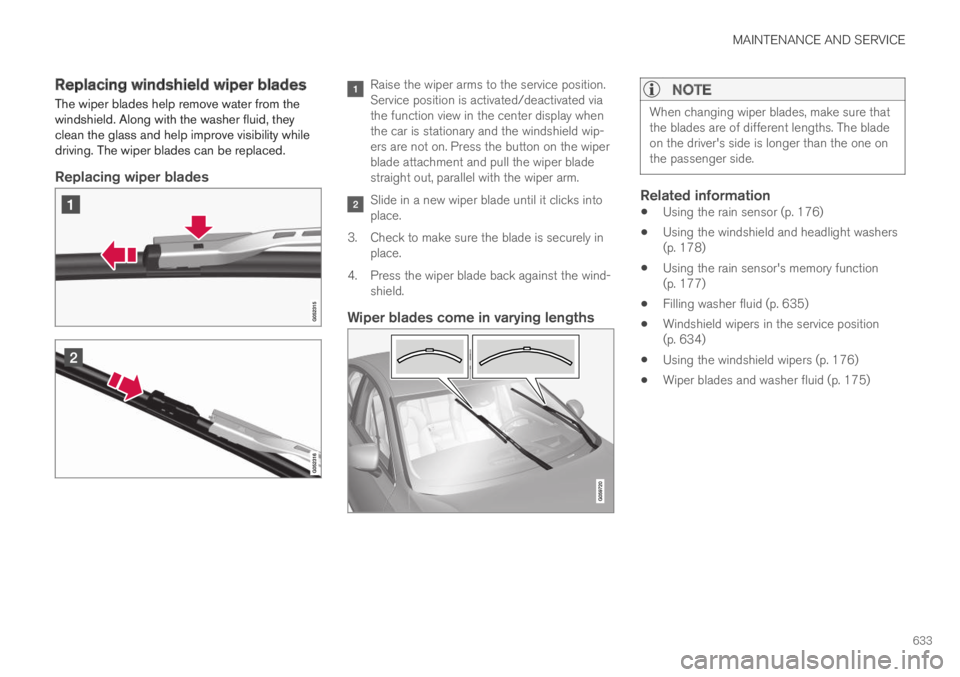
Raise the wiper arms to the service position.Service position is activated/deactivated viathe function view in the center display whenthe car is stationary and the windshield wip-ers are not on. Press the button on the wiperblade attachment and pull the wiper bladestraight out, parallel with the wiper arm.
Slide in a new wiper blade until it clicks intoplace.
3. Check to make sure the blade is securely inplace.
4.Press the wiper blade back against the wind-shield.
Wiper blades come in varying lengths NOTE
When changing wiper blades, make sure thatthe blades are of different lengths. The bladeon the driver's side is longer than the one onthe passenger side.
Related information
Using the rain sensor (p. 176)
Using the windshield and headlight washers(p. 178)
Using the rain sensor's memory function(p. 177)
Filling washer fluid (p. 635)
Windshield wipers in the service position(p. 634)
Using the windshield wipers (p. 176)
Wiper blades and washer fluid (p. 175)
Page 636 of 669

MAINTENANCE AND SERVICE
634
Windshield wipers in the serviceposition
The windshield wiper blades must be in the serv-ice (vertical) position for certain operations, e.g.replacing the blades.
Windshield wipers in the service position.
The windshield wipers must be in the serviceposition when replacing, washing or lifting theblades (e.g. to scrape ice or snow from the wind-shield).
CAUTION
Before placing the wipers in service position,ensure that they have not frozen to the wind-shield.
Activating/deactivating service position
The service position can be activated/deactivatedwhen the vehicle is stationary and the windshieldwipers are switched off. Service position is acti-vated/deactivated via Function view in the centerdisplay:
Tap the Wiper ServicePosition button. The indicatorlight in the button will illuminatewhen service position is acti-vated. The windshield wiperswill move to the vertical posi-tion when service position isactivated. To deactivate the service position, tapWiper Service Position once. The indicator lightin the button will go out when service position isdeactivated.
The wiper blades will also move out of serviceposition if:
The windshield wipers are turned on.
The windshield washers are turned on.
The rain sensor is activated.
The vehicle begins moving.
CAUTION
If the wiper arms in service position are raisedfrom the windshield, they must be folded backagainst the windscreen before activating wip-ing, washing or rain sensor as well as beforedeparture. This is to prevent scratching thepaint on the hood.
Related information
Using the rain sensor (p. 176)
Using the windshield and headlight washers(p. 178)
Using the rain sensor's memory function(p. 177)
Filling washer fluid (p. 635)
Replacing windshield wiper blades (p. 633)
Using the windshield wipers (p. 176)
Wiper blades and washer fluid (p. 175)
Page 637 of 669

MAINTENANCE AND SERVICE
* Option/accessory.635
Filling washer fluid
Washer fluid is used to help keep the headlightsand windshield clean. Washer fluid containinganti-freeze should be used in very cold weather(below-freezing temperatures).
Fill washer fluid into the reservoir with the bluecover. The reservoir is used for both the wind-shield washer and the headlight washer*
NOTE
When there is approximately 1 liter (1 qt) ofwasher fluid remaining, the message Washer
fluid Level low, refill and the symbolwill be displayed in the instrument panel.
Recommended grade: Washer fluid recom-mended by Volvo, with frost protection during
cold weather and temperatures below the freez-ing point.
CAUTION
Use Volvo's original washer fluid or an equiva-lent fluid with the recommended pH valuebetween 6 and 8, diluted as recommended,e.g. in a 1:1 solution with pH-neutral water.
CAUTION
Use washer fluid with anti-freeze when tem-peratures are below the freezing point to helpkeep the pump, reservoir and hoses fromfreezing.
Volume:
The washer fluid reservoir has a volume of 5.5 lit-ers (5.8 qts).
Related information
Using the rain sensor (p. 176)
Using the windshield and headlight washers(p. 178)
Using the rain sensor's memory function(p. 177)
Windshield wipers in the service position(p. 634)
Replacing windshield wiper blades (p. 633)
Using the windshield wipers (p. 176)
Wiper blades and washer fluid (p. 175)
Page 644 of 669

||
SPECIFICATIONS
642
Dimensionsmm inches
L Width incl. rearviewmirrors201979.5
M Width incl. folded rear-view mirrors1895 74.6
AAt curb weight + 2 people. (Varies slightly depending on tiredimensions, chassis, etc.)BDoes not apply to vehicles with 3 or 4 seats.CIncluding roof antenna, at curb weight.DVehicles with 17/18-inch wheels.EVehicles with 19-inch wheels.FVehicles with 20-inch wheels.GChassis width.HAt door moldings.
Related information
Weights (p. 643)
Page 653 of 669

INDEX
651
1, 2, 3 ...
4WD444
A
ABS
anti-lock brakes431
AC (Air conditioning)223
ACC - Adaptive Cruise Control 292, 295,
296, 297, 298, 299, 301, 302, 303, 304,
305, 306
Accessories and extra equipment 35
installation36
Accessory installation warning 36, 37
Active Bending Lights155
Adapting driving characteristics 270, 446
Adaptive Cruise Control 292, 295, 296,
297, 298, 299, 301, 302, 303, 304, 305, 306
change cruise control functionality 305
function292
manage speed296, 297
pass301, 302
radar sensor324
set time interval298, 299
troubleshooting304
Adjusting the steering wheel193
Airbag52
activation/deactivation56
driver's side53
passenger side53, 56
Air bag, see Airbag52
Air conditioning223
Air conditioning, fluid
volume and grade648
Air distribution201
air vents201, 202
changing202
defrosting215
recirculation214
table showing options204
Air quality198, 200
allergy and asthma199
passenger compartment filter201
Air recirculation214
Alarm266
deactivating267
Allergy and asthma-inducing substances 199
All Wheel Drive, AWD444
All Wheel Drive (AWD)444
All Wheel Drive (four-wheel drive) 444
Android Auto512, 514
Antenna
location255
Apple CarPlay509, 511
Approach lighting157
Apps480
Assistance at risk of collision372, 373,
374, 375, 376, 377, 378, 379, 381
Audio and media478
Audio system
HD digital radio490
SiriusXM® Satellite radio 490, 491, 493
Auto-climate214
Auto hold437
Auto-hold brakes437
activate and deactivate438
after collision439
Automatic car wash627
Automatic high beam153
Automatic locking260
Automatic relocking240, 253
Automatic Speed Limiter 279, 281, 282, 283
Automatic transmission440
kickdown444
oil647
Auxiliary heater232
INDEX