oil VOLVO S90 TWIN ENGINE 2019 Owner's Manual
[x] Cancel search | Manufacturer: VOLVO, Model Year: 2019, Model line: S90 TWIN ENGINE, Model: VOLVO S90 TWIN ENGINE 2019Pages: 669, PDF Size: 14.33 MB
Page 623 of 669
MAINTENANCE AND SERVICE
}}
621
Cleaning fabric upholstery andceiling liner
Only use cleaning agents and car care productsrecommended by Volvo. Clean regularly andtreat stains immediately for best results. It isimportant to vacuum before using a cleaningagent.
Fabric upholstery and ceiling liner
Never scrape or rub a stain, as this could damagethe upholstery. Never use strong stain removers,as this could change the color of the upholstery.
Use soapy water or a similar detergent. For moredifficult stains caused by oil, ice cream, shoe pol-ish, etc., use a stain remover. Consult with yourVolvo retailer.
Related information
Cleaning the interior (p. 619)
Cleaning the center display (p. 619)
Cleaning the seat belt (p. 621)
Cleaning floor mats and inlay mats (p. 621)
Cleaning leather upholstery (p. 622)
Cleaning the leather steering wheel(p. 623)
Cleaning interior plastic, metal and wood sur-faces (p. 624)
Cleaning the seat belt
Only use cleaning agents and car care productsrecommended by Volvo. Clean regularly andtreat stains immediately for best results. It isimportant to vacuum before using a cleaningagent.
Seat belts
Use water and a synthetic soap solution. Spe-cially designed textile cleaning agents are availa-ble for purchase at Volvo retailers. Make sure thebelt is dry before it is retracted.
Related information
Cleaning the interior (p. 619)
Cleaning the center display (p. 619)
Cleaning fabric upholstery and ceiling liner(p. 621)
Cleaning floor mats and inlay mats (p. 621)
Cleaning leather upholstery (p. 622)
Cleaning the leather steering wheel(p. 623)
Cleaning interior plastic, metal and wood sur-faces (p. 624)
Cleaning floor mats and inlay mats
Only use cleaning agents and car care productsrecommended by Volvo. Clean regularly andtreat stains immediately for best results. It isimportant to vacuum before using a cleaningagent.
Inlay mats and floor mats
Remove the inlay mats to clean the floor matsand inlay mats separately. Use a vacuum toremove dust and dirt. Each inlay mat is securedinto place with pins.
Remove the inlay mat by grasping the inlay matat each pin and lifting the mat straight up.
Put the inlay mat back into place by pressing it inat each pin.
Page 625 of 669
MAINTENANCE AND SERVICE
623
Cleaning the leather upholstery
1. Apply the leather cleaner to a damp spongeand squeeze it until the cleaner foams.
2. Move the sponge in circular motions to applythe foam to the stain.
3. Dampen the stain thoroughly with thesponge. Let the sponge absorb the stain anddo not rub.
4. Dry the stain using a soft towel and let theleather dry completely.
Protecting the leather upholstery
1. Apply a small amount of leather protector toa cloth and then apply the protector to theleather using light circular movements.
2. Let it dry for approximately 20 minutes.
Protecting the leather upholstery makes it betterable to withstand sunlight's harmful UV rays.
Related information
Cleaning the interior (p. 619)
Cleaning the center display (p. 619)
Cleaning fabric upholstery and ceiling liner(p. 621)
Cleaning the seat belt (p. 621)
Cleaning floor mats and inlay mats (p. 621)
Cleaning the leather steering wheel(p. 623)
Cleaning interior plastic, metal and wood sur-faces (p. 624)
Cleaning the leather steering wheel
Only use cleaning agents and car care productsrecommended by Volvo. Clean regularly andtreat stains immediately for best results. It isimportant to vacuum before using a cleaningagent.
Leather steering wheel
Leather needs to breathe. Never cover theleather steering wheel with a plastic protector.Volvo Leather Care Kit 951 0251 and LeatherSoftener 943 7429 are recommended for clean-ing the leather steering wheel. First, remove dirt,dust, etc. with a damp sponge or cloth.
CAUTION
Sharp objects such as rings could damagethe leather on the steering wheel.
If there are stains on the steering wheel:
Type 1(ink, wine, coffee, milk, sweat or blood)
–Use a soft cloth or sponge. Wipe the steeringwheel using a solution of 5% ammonia. Forblood stains, mix approximately 2 dl(1 cup) ofwater with 25 g (one ounce) of salt and wipethe stain.
Type 2(grease, oil, sauces or chocolate)
1. Same procedure as for Type 1 stains.
2.Finish by wiping the wheel with an absorbentpaper or towel.
Type 3(dry dirt or dust)
1. Remove the dirt/dust using a soft brush.
2. Same procedure as for Type 1 stains.
Related information
Cleaning the interior (p. 619)
Cleaning the center display (p. 619)
Cleaning fabric upholstery and ceiling liner(p. 621)
Cleaning the seat belt (p. 621)
Cleaning floor mats and inlay mats (p. 621)
Cleaning leather upholstery (p. 622)
Cleaning interior plastic, metal and wood sur-faces (p. 624)
Page 626 of 669
MAINTENANCE AND SERVICE
624
Cleaning interior plastic, metal andwood surfaces
Only use cleaning agents and car care productsrecommended by Volvo. Clean regularly andtreat stains immediately for best results.
Interior plastic, metal and wood
surfaces
A lightly dampened microfiber cloth is recom-mended for cleaning interior details and surfaces.These cloths are available for purchase at Volvoretailers.
Never scrape or rub a stain. Never use strongstain removers.
CAUTION
Do not use solvent containing alcohol toclean the instrument panel glass.
CAUTION
Keep in mind that glossy surfaces can beeasily scratched. Wipe these surfaces with aclean and dry microfiber cloth using small, cir-cular motions. If necessary, moisten the clothlightly with clean water.
Related information
Cleaning the interior (p. 619)
Cleaning the center display (p. 619)
Cleaning fabric upholstery and ceiling liner(p. 621)
Cleaning the seat belt (p. 621)
Cleaning floor mats and inlay mats (p. 621)
Cleaning leather upholstery (p. 622)
Cleaning the leather steering wheel (p. 623)
Cleaning the exterior
The vehicle should be washed as soon as itbecomes dirty. This makes the vehicle easier toclean because dirt does not attach as strongly. Italso reduces the risk of scratches and keeps thevehicle looking new. Wash the vehicle in a carwash or garage with an oil separator and use carwashing detergent.
Related information
Cleaning the exterior (p. 624)
Polishing and waxing (p. 625)
Hand washing (p. 625)
Automatic car washes (p. 627)
High-pressure washing (p. 628)
Cleaning the wiper blades (p. 628)
Cleaning exterior plastic, rubber and trimcomponents (p. 629)
Cleaning rims (p. 630)
Corrosion protection (p. 630)
Page 627 of 669
MAINTENANCE AND SERVICE
}}
625
Polishing and waxing
Polish and wax the vehicle when the paint ismatte or to provide extra protection. The vehicledoes not need to be polished until it is at least ayear old. However, it can be waxed during thefirst year. Do not polish or wax the vehicle indirect sunlight. The surface of the vehicle shouldnot be warmer than 45 °C (113 °F).
Wash and dry the vehicle very carefullybefore polishing or waxing. Remove asphaltand tar stains with asphalt remover or paintthinner. More stubborn stains can beremoved with a grinding paste designed forvehicle paint.
Use polish first and then liquid or paste wax.Follow the instructions on the package care-fully. Many products contain both polish andwax.
A wide range of polymer-based waxes canbe purchased today. These waxes are easy touse and produce a long-lasting, high-glossfinish that protects the bodywork against oxi-dation, road dirt and fading.
CAUTION
Avoid waxing and polishing plastic and rubber.
If using degreaser on plastic and rubber, onlyrub (if necessary) with slight pressure. Use asoft sponge.
Polishing glossy trim moldings can wear awayor damage the glossy surface layer.
Polish containing abrasives must not be used.
CAUTION
Only use paintwork treatments recommendedby Volvo. Other treatments, such as preserva-tion, sealing, protection, luster sealing or simi-lar, could damage the paintwork. Paintworkdamage caused by such treatments are notcovered by Volvo's warranty.
Related information
Cleaning the exterior (p. 624)
Hand washing (p. 625)
Automatic car washes (p. 627)
High-pressure washing (p. 628)
Cleaning the wiper blades (p. 628)
Cleaning exterior plastic, rubber and trimcomponents (p. 629)
Cleaning rims (p. 630)
Corrosion protection (p. 630)
Hand washing
The vehicle should be washed as soon as itbecomes dirty. This makes the vehicle easier toclean because dirt does not attach as strongly. Italso reduces the risk of scratches and keeps thevehicle looking new. Wash the vehicle in a carwash or garage with an oil separator and use carwashing detergent.
Hand washing
Keep the following points in mind when washingthe vehicle:
Avoid washing the vehicle in direct sunlight.This could cause the detergent or wax to dryout and become abrasive.
Remove bird droppings from paintwork assoon as possible. It contains chemicals thataffect and discolor paintwork very quickly.Use e.g. soft paper or a sponge soaked inlots of water. Consult an authorized Volvoworkshop for assistance removing discolora-tion.
Hose down the underbody, including thewheel housings and bumper.
Hose down the entire vehicle and removeany loose dirt, droppings etc. to reduce therisk of scratches from washing. Do not spraydirectly onto locks.
If necessary, use cold degreaser on heavilysoiled surfaces. Note that in such cases thesurfaces must not be hot from the sun.
Page 630 of 669
MAINTENANCE AND SERVICE
628
High-pressure washing
The vehicle should be washed as soon as itbecomes dirty. This makes the vehicle easier toclean because dirt does not attach as strongly. Italso reduces the risk of scratches and keeps thevehicle looking new. Wash the vehicle in a carwash or garage with an oil separator. Use a carwashing detergent.
High-pressure washing
If washing the vehicle with a high-pressure wash,use sweeping movements and keep the nozzle atleast 30 cm (13 in.) from the vehicle. Do notspray directly onto locks.
Related information
Cleaning the exterior (p. 624)
Polishing and waxing (p. 625)
Hand washing (p. 625)
Automatic car washes (p. 627)
Cleaning the wiper blades (p. 628)
Cleaning exterior plastic, rubber and trimcomponents (p. 629)
Cleaning rims (p. 630)
Corrosion protection (p. 630)
Cleaning the wiper blades
The vehicle should be washed as soon as itbecomes dirty. This makes the vehicle easier toclean because dirt does not attach as strongly. Italso reduces the risk of scratches and keeps thevehicle looking new. Wash the vehicle in a carwash or garage with an oil separator. Use a carwashing detergent.
Wiper blades
Asphalt, dust and salt residue on wiper blades, aswell as insects, ice etc. on the windshield, shortenthe service life of wiper blades.
When cleaning, put the wiper blades in the serv-ice position.
NOTE
Wash the wiper blades and windshield regu-larly with a lukewarm soap solution or vehicleshampoo. Do not use strong solvents.
Related information
Cleaning the exterior (p. 624)
Polishing and waxing (p. 625)
Hand washing (p. 625)
Automatic car washes (p. 627)
High-pressure washing (p. 628)
Cleaning exterior plastic, rubber and trimcomponents (p. 629)
Cleaning rims (p. 630)
Corrosion protection (p. 630)
Page 631 of 669
MAINTENANCE AND SERVICE
* Option/accessory.629
Cleaning exterior plastic, rubber andtrim components
The vehicle should be washed as soon as itbecomes dirty. This makes the vehicle easier toclean because dirt does not attach as strongly. Italso reduces the risk of scratches and keeps thevehicle looking new. Wash the vehicle in a carwash or garage with an oil separator and use carwashing detergent.
Exterior plastic, rubber and trim
components
A special cleaning agent available from Volvoretailers is recommended for the cleaning andcare of colored plastic parts, rubber and trimcomponents, e.g. glossy trim. Follow the usageinstructions for the cleaning agent carefully.
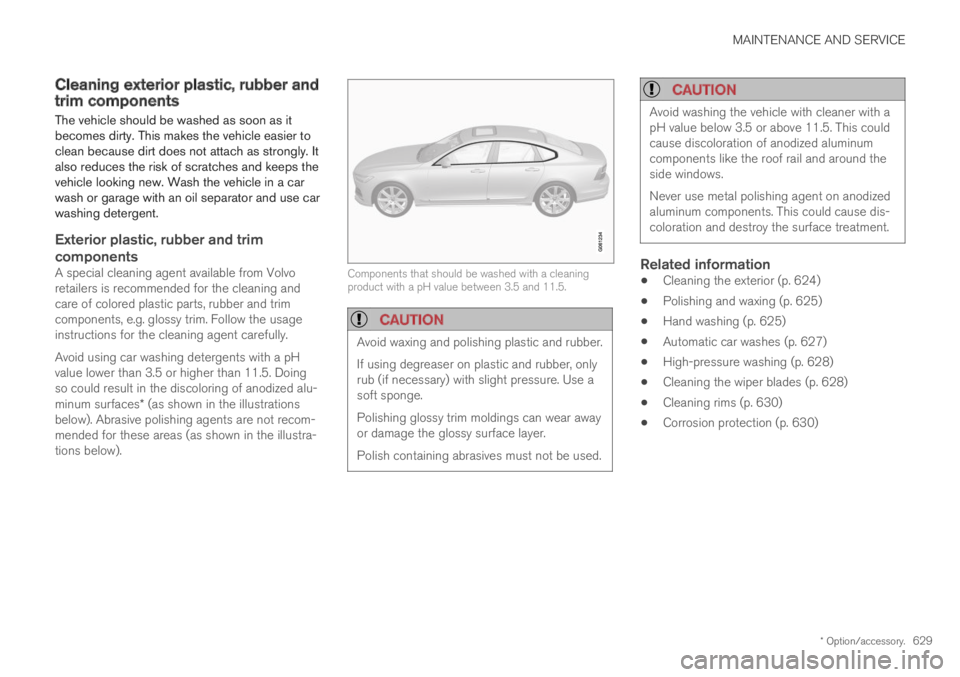
Avoid using car washing detergents with a pHvalue lower than 3.5 or higher than 11.5. Doingso could result in the discoloring of anodized alu-minum surfaces* (as shown in the illustrationsbelow). Abrasive polishing agents are not recom-mended for these areas (as shown in the illustra-tions below).
Components that should be washed with a cleaningproduct with a pH value between 3.5 and 11.5.
CAUTION
Avoid waxing and polishing plastic and rubber.
If using degreaser on plastic and rubber, onlyrub (if necessary) with slight pressure. Use asoft sponge.
Polishing glossy trim moldings can wear awayor damage the glossy surface layer.
Polish containing abrasives must not be used.
CAUTION
Avoid washing the vehicle with cleaner with apH value below 3.5 or above 11.5. This couldcause discoloration of anodized aluminumcomponents like the roof rail and around theside windows.
Never use metal polishing agent on anodizedaluminum components. This could cause dis-coloration and destroy the surface treatment.
Related information
Cleaning the exterior (p. 624)
Polishing and waxing (p. 625)
Hand washing (p. 625)
Automatic car washes (p. 627)
High-pressure washing (p. 628)
Cleaning the wiper blades (p. 628)
Cleaning rims (p. 630)
Corrosion protection (p. 630)
Page 632 of 669
MAINTENANCE AND SERVICE
630
Cleaning rims
The vehicle should be washed as soon as itbecomes dirty. This makes the vehicle easier toclean because dirt does not attach as strongly. Italso reduces the risk of scratches and keeps thevehicle looking new. Wash the vehicle in a carwash or garage with an oil separator and use carwashing detergent.
Rims
Only use rim cleaning products recommended byVolvo.
Strong rim cleaning agents could damage thesurface and stain the chromed aluminum rims.
Related information
Cleaning the exterior (p. 624)
Polishing and waxing (p. 625)
Hand washing (p. 625)
Automatic car washes (p. 627)
High-pressure washing (p. 628)
Cleaning exterior plastic, rubber and trimcomponents (p. 629)
Cleaning rims (p. 630)
Corrosion protection (p. 630)
Corrosion protection
Your vehicle is constructed with effective protec-tion against corrosion.
Corrosion protection for the body consists ofmodern metallic protective coatings on the sheetmetal, a high-quality painting process, corrosion-protected and minimized metal overlap, andshielding plastic components, abrasion protectionand supplemental rust inhibitor in exposed areas.In the chassis, exposed components of the wheelsuspension are made of corrosion-resistant castaluminum.
Inspection and maintenance
The corrosion protection does not normallyrequire maintenance but keeping the vehicleclean is always a good way to further reduce therisk of corrosion. The use of strong alkaline oracidic cleaning fluids should always be avoidedon shiny body components. Any stone chips inthe paint should be touched up as soon as theyare discovered.
Related information
Cleaning the exterior (p. 624)
Polishing and waxing (p. 625)
Hand washing (p. 625)
Automatic car washes (p. 627)
High-pressure washing (p. 628)
Cleaning the wiper blades (p. 628)
Cleaning exterior plastic, rubber and trimcomponents (p. 629)
Cleaning rims (p. 630)
Page 642 of 669

||
SPECIFICATIONS
640
Engine oil. This label contains the recom-mended engine oil specifications.
Decal A/C. Refrigerant R134a.
NOTE
The decals shown in the Owner's Manual donot claim to be exact reproductions of thosefound in the vehicle. The purpose is to showapproximately how they look and about wherethey are located on the vehicle. The informa-tion that applies for your vehicle in particularis found on the decal on the vehicle.
Related information
Air conditioning specifications (p. 648)
Page 647 of 669

SPECIFICATIONS
645
Engine specifications
Engine specifications (output, etc.) for eachengine variant are shown in the table below. Thespecifications for Special Edition vehicles mayvary.
Twin Engine vehicles are powered by both agasoline engine and an electric motor (ERAD –Electric Rear Axle Drive).
NOTE
Not all engines are available on all markets.
EngineEngine codeAOutput
(kW/rps)
Output
(hp/rpm)
Torque
(Nm/rps)
Torque
(ft. lbs./rpm)
Number of cylinders
T8 Twin EngineB4204T28233/100 313/6000 400/37–90 295/2200–54004
AThe engine code, component and manufacturer serial numbers can be found on the engine.
Electric motor
Max. output: 65 kW (87 hp).
Torque: 240 Nm.
Related information
Type designations (p. 638)
Engine oil specifications (p. 646)
Coolant specifications (p. 647)
Page 648 of 669

SPECIFICATIONS
646
Engine oil specifications
Fully synthetic engine oil of at leastACEA A5/B5 must be used. Lower oil gradesmay not offer the same fuel economy, engineperformance or engine protection.
Volvo recommends:
General
See the Service and warranty booklet for infor-mation about oil change intervals.
NOTE
This vehicle is delivered from the factory withsynthetic oil.
Do not use oil additives.
Oil viscosity
The wrong oil viscosity can shorten engine serv-ice life during normal use. SAE 5W-30 providesgood fuel economy and engine protection. Seethe viscosity chart.
Viscosity chart
Extreme driving conditions
Volvo's VCC RBS0-2AE/SAE 0W20 oil is recom-mended for extreme conditions.
Oil volume
The oil volume for the engine is:
Liter (approx)5.6
US qts (approx)5.9
Related information
Type designations (p. 638)
Checking and filling engine oil (p. 598)
Engine oil (p. 597)