lights VOLVO S90 TWIN ENGINE 2019 Workshop Manual
[x] Cancel search | Manufacturer: VOLVO, Model Year: 2019, Model line: S90 TWIN ENGINE, Model: VOLVO S90 TWIN ENGINE 2019Pages: 669, PDF Size: 14.33 MB
Page 467 of 669
STARTING AND DRIVING
465
Overheating of engine andtransmission
In demanding driving conditions, such as drivingin mountainous areas or hot weather, there is arisk of the engine or transmission overheating,especially when carrying heavy loads.
Engine power may be temporarily limited.
Remove any auxiliary lights mounted in frontof the grille when driving in hot weather.
If the temperature in the engine's coolingsystem becomes too high, a warning symbolwill appear in the instrument panel along withthe message Engine temperature Hightemperature Stop safely. Pull over to asafe location and let the engine idle for a fewminutes to cool down.
If the message Engine temperature Hightemperature Turn off engine or Enginecoolant Level low, turn off engine is dis-played, stop the vehicle and turn off theengine.
If the transmission begins to overheat, analternative gear shifting program will beselected. An integrated protective functionwill also be activated, the warning symbol willilluminate and the message Transmissionwarm Reduce speed to lowertemperature or Transmission hot Stopsafely, wait for cooling will be displayed inthe instrument panel. Follow the recommen-dations given by reducing speed or stopping
the vehicle safely and letting the engine idlefor a few minutes to let the transmissioncool.
If the vehicle begins to overheat, the air con-ditioning may be temporarily switched off.
After a prolonged period of driving indemanding conditions, do not turn off theengine immediately after stopping.
NOTE
It is normal for the engine's cooling fan tooperate for a short time after the engine isswitched off.
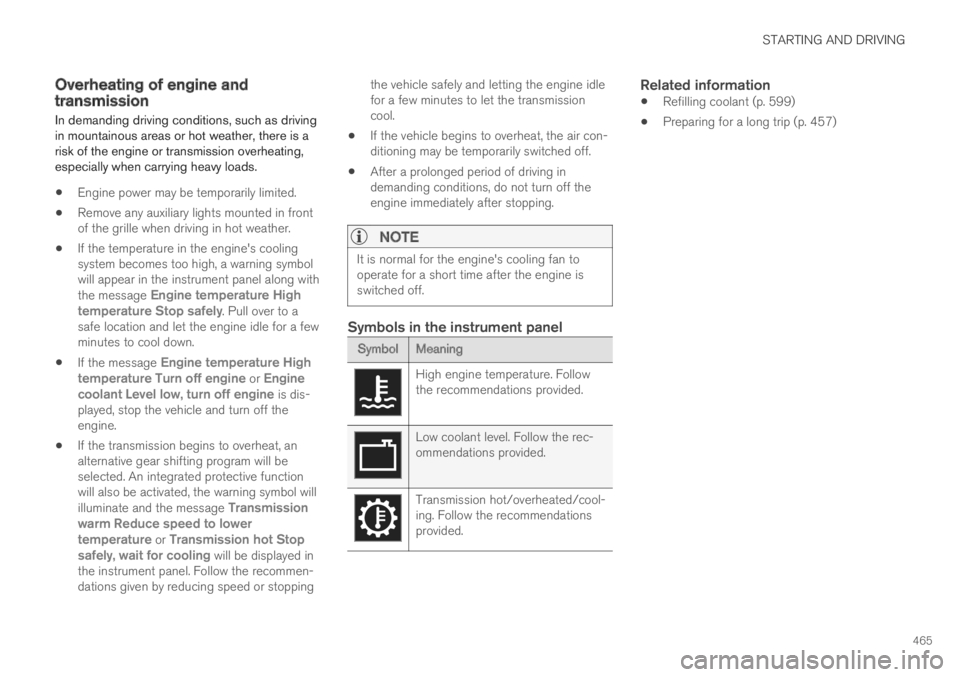
Symbols in the instrument panel
Symbol Meaning
High engine temperature. Followthe recommendations provided.
Low coolant level. Follow the rec-ommendations provided.
Transmission hot/overheated/cool-ing. Follow the recommendationsprovided.
Related information
Refilling coolant (p. 599)
Preparing for a long trip (p. 457)
Page 468 of 669

STARTING AND DRIVING
466
Battery drain
The electrical functions in the vehicle drain thebattery to varying degrees. Avoid using ignitionmode II when the engine is switched off. Useignition mode I instead, as this uses less electri-cal current.
Note that certain accessories may also drainpower from the electrical system. Do not usefunctions that use a lot of electrical current whenthe engine is turned off. Examples of such func-tions are:
blower
headlights
windshield wipers
audio system (especially at high volume).
If the starter battery voltage is low, a message isshown in the driver display. The vehicle's energy-saving function will then turn off or reduce certainfunctions, such as the blower and/or the audiosystem.
–Charge the battery by starting the engineand let it run for at least 15 minutes (drivingcharges the battery faster than letting theengine idle).
Related information
Start battery (p. 601)
Ignition modes (p. 429)
Jump starting using another battery
If the start battery is discharged, current fromanother battery can be used to start the vehicle.
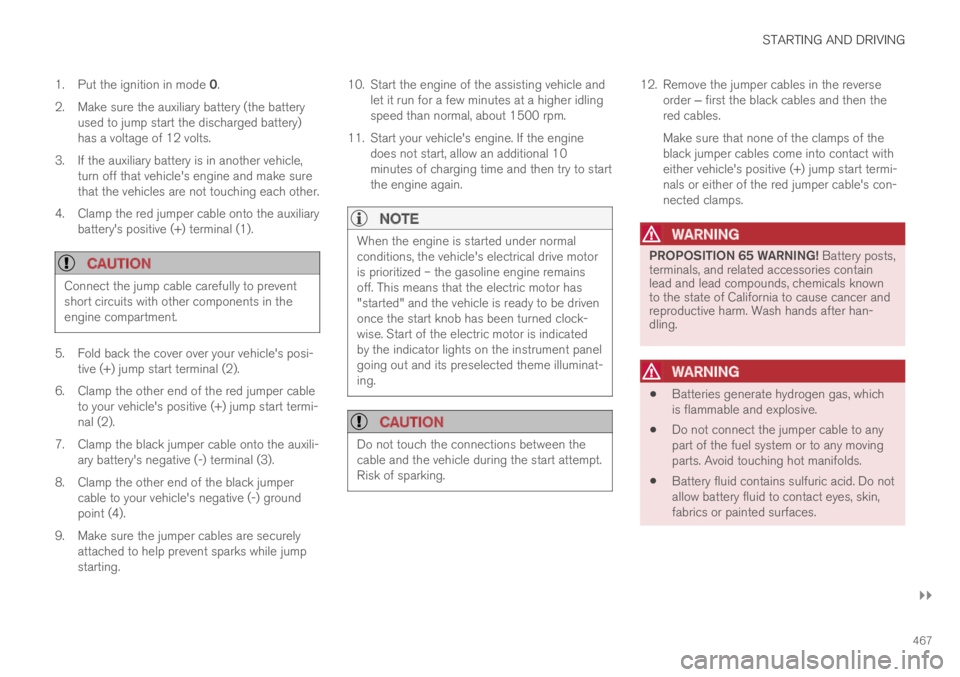
Jumper cable connecting points.
CAUTION
The charging point of the vehicle is onlyintended for jump starting the vehicle in ques-tion. The charging point is not intended forjump-starting another vehicle. Using thecharging point to start another vehicle couldcause a fuse to blow, which would cause thecharging point to stop working.
If a fuse has blown, 12 V Battery Fuse failureService required will be displayed in the instru-ment panel. Volvo recommends contacting anauthorized Volvo workshop.
To avoid short circuits or other damage, the fol-lowing steps are recommended when jump star-ting the battery:
Page 469 of 669
STARTING AND DRIVING
}}}}
467
1.Put the ignition in mode 0.
2.Make sure the auxiliary battery (the batteryused to jump start the discharged battery)has a voltage of 12 volts.
3.If the auxiliary battery is in another vehicle,turn off that vehicle's engine and make surethat the vehicles are not touching each other.
4. Clamp the red jumper cable onto the auxiliarybattery's positive (+) terminal (1).
CAUTION
Connect the jump cable carefully to preventshort circuits with other components in theengine compartment.
5. Fold back the cover over your vehicle's posi-tive (+) jump start terminal (2).
6. Clamp the other end of the red jumper cableto your vehicle's positive (+) jump start termi-nal (2).
7.Clamp the black jumper cable onto the auxili-ary battery's negative (-) terminal (3).
8. Clamp the other end of the black jumpercable to your vehicle's negative (-) groundpoint (4).
9. Make sure the jumper cables are securelyattached to help prevent sparks while jumpstarting.
10. Start the engine of the assisting vehicle andlet it run for a few minutes at a higher idlingspeed than normal, about 1500 rpm.
11. Start your vehicle's engine. If the enginedoes not start, allow an additional 10minutes of charging time and then try to startthe engine again.
NOTE
When the engine is started under normalconditions, the vehicle's electrical drive motoris prioritized – the gasoline engine remainsoff. This means that the electric motor has"started" and the vehicle is ready to be drivenonce the start knob has been turned clock-wise. Start of the electric motor is indicatedby the indicator lights on the instrument panelgoing out and its preselected theme illuminat-ing.
CAUTION
Do not touch the connections between thecable and the vehicle during the start attempt.Risk of sparking.
12. Remove the jumper cables in the reverseorder ‒ first the black cables and then thered cables.
Make sure that none of the clamps of theblack jumper cables come into contact witheither vehicle's positive (+) jump start termi-nals or either of the red jumper cable's con-nected clamps.
WARNING
PROPOSITION 65 WARNING! Battery posts,terminals, and related accessories containlead and lead compounds, chemicals knownto the state of California to cause cancer andreproductive harm. Wash hands after han-dling.
WARNING
Batteries generate hydrogen gas, whichis flammable and explosive.
Do not connect the jumper cable to anypart of the fuel system or to any movingparts. Avoid touching hot manifolds.
Battery fluid contains sulfuric acid. Do notallow battery fluid to contact eyes, skin,fabrics or painted surfaces.
Page 587 of 669

MAINTENANCE AND SERVICE
}}
585
Periodic maintenance helps minimize
emissions
NOTE
Refer to your Service and Warranty Book-let for a comprehensive service and main-tenance schedule up to 240,000 km(150,000 miles). This program containsinspections and services necessary forthe proper function of your vehicle andincludes components that affect vehicleemissions.
The Warranty and Service Records Infor-mation booklet also contains detailedinformation concerning the warrantiesthat apply to your vehicle.
On-board Diagnostic System
OBD II is part of your vehicle's computerizedengine management system. It stores diagnosticinformation about your vehicle's emission con-trols. It can light the Check Engine light (MIL) if itdetects an emission control "fault." A "fault" is acomponent or system that is not performingwithin an expected range. A fault may be perma-nent or temporary. OBD II will store a messageabout any fault.
Emission inspection readiness
How do states use OBD II for emission
inspections?
Many states connect a computer directly to avehicle's OBD II system. The inspector can thenread "faults." In some states, this type of inspec-tion has replaced the tailpipe emission test.
How can my vehicle fail OBD II emission
inspection?
Your vehicle can fail OBD II emission inspectionfor any of the following reasons:
If your Check Engine (MIL) light is lit, yourvehicle may fail inspection.
If your vehicle's Check Engine light was lit,but went out without any action on your part,OBD II will still have a recorded fault. Yourvehicle may pass or fail, depending on theinspection practices in your area.
If you had recent service that required dis-connecting the battery, OBD II diagnosticinformation may be incomplete and "notready" for inspection. A vehicle that is notready may fail inspection.
How can I prepare for my next OBD II
emission inspection?
If your Check Engine (MIL) light is lit or waslit but went out without service, have your
vehicle diagnosed and, if necessary, servicedby a qualified Volvo technician.
If you recently had service for a lit CheckEngine light, or if you had service thatrequired disconnecting the battery, a periodof driving is necessary to bring the OBD IIsystem to "ready" for inspection. Two half-hour trips of mixed stop-and-go/highwaydriving are typically needed to allow OBD II toreach readiness. Your Volvo retailer can pro-vide you with more information on planning atrip.
Maintain your vehicle in accordance with yourvehicle's maintenance schedule.
Owner maintenance
Periodic maintenance requirements and intervalsare described in your vehicle's Warranty andService Records Information booklet.
The following points can be carried out betweenthe normally scheduled maintenance services.
Each time the car is refueled:
Check the engine oil level.
Clean the windshield, windshield wipers,headlights, and taillights.
Page 602 of 669

||
MAINTENANCE AND SERVICE
* Option/accessory.600
Unscrew the cover in the plastic covering.
Unscrew the expansion tank cap and fillcoolant as needed. The level should notexceed the yellow MAX mark inside theexpansion tank.
Put the components back in place in the reverseorder.
CAUTION
Do not ingest the contents. May causedamage to organs (kidneys).
Use premixed coolant according to Vol-vo's recommendations. If concentratedcoolant is used, make sure that the cool-ant mixture is 50% coolant and 50%water of acceptable quality.
Do not mix different types of coolant.
To help ensure sufficient corrosion pro-tection in the system, only use new cool-ant when replacing larger components inthe cooling system.
Never run the engine unless the coolingsystem is properly filled. An improperlyfilled cooling system could lead to hightemperatures and cracks in the cylinderheads.
High levels of chlorine, chlorides andother salts may cause corrosion in thecooling system.
Related information
Engine compartment overview (p. 596)
Coolant specifications (p. 647)
Replacing bulbs
Halogen headlights are not available on all mod-els and markets. Contact a Volvo retailer formore information.
LED14 bulbs must be replaced by a workshop.An authorized Volvo workshop is recommended.
NOTE
For information on lights not mentioned inthis article, contact a Volvo dealer or a certi-fied Volvo service technician.
NOTE
Exterior lighting such as headlights and tail-lights may develop temporary condensationon the inside of the lens. This is normal. Allexterior lighting is designed to resist this.Condensation is normally vented out of thelamp housing once the light has been lit forsome period of time.
NOTE
Bulbs for active curve lighting* contain tracesof mercury and should therefore always besubmitted to a certified Volvo service techni-cian.
Page 615 of 669

MAINTENANCE AND SERVICE
}}
* Option/accessory.613
Fuse pliers are provided on the inside of the fusebox cover to assist in removing and insertingfuses.
There are also spaces for several extra fuses inthe distribution box in the engine compart-ment.
Positions
Fuses 1, 3-21, 23-36, 39-53 and 55-59 are"Micro" fuses.
Fuses 2-22, 37-38 and 54 are "MCase"fuses and should only be replaced by a work-
shop17.
FunctionAmpere
––
––
––
Movement sensor*5
Instrument panel5
Center console buttons5
Sun sensor5
FunctionAmpere
Sensus control module20
––
Steering wheel module5
Module for start knob andparking brake controls5
Heated steering wheel* mod-ule15
––
––
––
––
Climate system control mod-ule10
––
Data link connector OBD-II 10
Center display5
Climate system blower module(front)40
FunctionAmpere
USB HUB5
Instrument lighting; Interiorlighting; Rearview mirror auto-dim function*; Rain and lightsensors*; Rear tunnel consolekeypad, rear seat*; Power frontseats*; Rear door control pan-els; Climate system blowermodule left/right
7.5
Control module for driver sup-port functions5
Panoramic roof with sun cur-tain*20
Head-up display*5
Passenger compartment light-ing5
––
Ceiling console display (seatbelt reminder/front passengerside airbag indicator)
5
––
Humidity sensor5
17An authorized Volvo workshop is recommended.
Page 628 of 669

||
MAINTENANCE AND SERVICE
626
Wash using a sponge, car washing detergentand plenty of lukewarm water.
Clean the wiper blades with lukewarm soapsolution or car washing detergent.
Dry the vehicle using a clean, soft chamois ora squeegee. Try not to let drops of water dryin strong sunlight. This could cause waterdrying stains that may need to be polishedout.
In areas with heavy industrial emissions,more frequent washing of the vehicle's exte-rior is recommended.
Tar spots from asphalt may remain even afterwashing. Use a tar remover to remove thesespots after washing the vehicle.
WARNING
Always entrust engine washing to a workshop.If the engine is hot, there is a risk of fire.
CAUTION
Dirty headlights do not work as well. Cleanthem regularly, e.g. when refueling.
Do not use corrosive cleaners. Use water anda non-abrasive sponge.
NOTE
Exterior lighting such as headlights and tail-lights may develop temporary condensationon the inside of the lens. This is normal. Allexterior lighting is designed to resist this.Condensation is normally vented out of thelamp housing once the light has been lit forsome period of time.
CAUTION
Make sure that the panoramic roof andsun shade are closed before washing thevehicle.
Never use abrasive polishing agents onthe panoramic roof.
Never use wax on the rubber sealsaround the panoramic roof.
CAUTION
Remember to remove dirt from the drainholes in the doors and sills after washing thevehicle.
Related information
Cleaning the exterior (p. 624)
Polishing and waxing (p. 625)
Automatic car washes (p. 627)
High-pressure washing (p. 628)
Cleaning the wiper blades (p. 628)
Cleaning exterior plastic, rubber and trimcomponents (p. 629)
Cleaning rims (p. 630)
Corrosion protection (p. 630)
Settings for automatically activating the park-ing brake (p. 436)
Page 629 of 669

MAINTENANCE AND SERVICE
627
Automatic car washes
The vehicle should be washed as soon as itbecomes dirty. This makes the vehicle easier toclean because dirt does not attach as strongly. Italso reduces the risk of scratches and keeps thevehicle looking new.
An automatic car wash is a fast and easy way tokeep your vehicle clean, but it does not reach allareas of the vehicle. For best results, Volvo rec-ommends hand washing your vehicle or supple-menting automatic car washes with a hand wash.
NOTE
Volvo recommends not washing the vehicle inan automatic car wash during the first fewmonths; the paintwork on new vehicles takessome time to fully harden.
CAUTION
Before driving the vehicle into a car wash,deactivate the Automatic Braking when Sta-tionary and Automatic Parking Brake Applica-tion functions. If the functions are not deacti-vated, the brake system will seize when thevehicle is stationary and the vehicle will not beable to roll.
CAUTION
For automatic car washes in which the vehicleis pulled forward on rolling wheels:
1. Before washing the vehicle, make surethat the automatic rain sensor is deacti-vated. If it is not deactivated and inadver-tently starts, the wiper arms could bedamaged.
2.To help prevent damage from the auto-matic car wash machinery, make surethat the door mirrors are folded in, anten-nas retracted or removed, and any auxili-ary lights secured.
3. Drive into the automatic car wash.
4. Turn off the "Automatic Braking when
Stationary" function using the buttonin the tunnel console.
5. Turn off the "Automatic Parking BrakeApplication" function in the center dis-play's Top view.
6.Turn off the engine by turning the startknob in the tunnel console clockwise.Hold the knob in position for at least2 seconds.
The vehicle is now ready for the automatic carwash.
CAUTION
The system will automatically change to Pmode if the above steps are not followed. In Pmode, the wheels are locked, which theyshould not be when the vehicle is beingwashed in a car wash.
Related information
Cleaning the exterior (p. 624)
Polishing and waxing (p. 625)
Hand washing (p. 625)
High-pressure washing (p. 628)
Cleaning the wiper blades (p. 628)
Cleaning exterior plastic, rubber and trimcomponents (p. 629)
Cleaning rims (p. 630)
Corrosion protection (p. 630)
Page 637 of 669

MAINTENANCE AND SERVICE
* Option/accessory.635
Filling washer fluid
Washer fluid is used to help keep the headlightsand windshield clean. Washer fluid containinganti-freeze should be used in very cold weather(below-freezing temperatures).
Fill washer fluid into the reservoir with the bluecover. The reservoir is used for both the wind-shield washer and the headlight washer*
NOTE
When there is approximately 1 liter (1 qt) ofwasher fluid remaining, the message Washer
fluid Level low, refill and the symbolwill be displayed in the instrument panel.
Recommended grade: Washer fluid recom-mended by Volvo, with frost protection during
cold weather and temperatures below the freez-ing point.
CAUTION
Use Volvo's original washer fluid or an equiva-lent fluid with the recommended pH valuebetween 6 and 8, diluted as recommended,e.g. in a 1:1 solution with pH-neutral water.
CAUTION
Use washer fluid with anti-freeze when tem-peratures are below the freezing point to helpkeep the pump, reservoir and hoses fromfreezing.
Volume:
The washer fluid reservoir has a volume of 5.5 lit-ers (5.8 qts).
Related information
Using the rain sensor (p. 176)
Using the windshield and headlight washers(p. 178)
Using the rain sensor's memory function(p. 177)
Windshield wipers in the service position(p. 634)
Replacing windshield wiper blades (p. 633)
Using the windshield wipers (p. 176)
Wiper blades and washer fluid (p. 175)
Page 653 of 669

INDEX
651
1, 2, 3 ...
4WD444
A
ABS
anti-lock brakes431
AC (Air conditioning)223
ACC - Adaptive Cruise Control 292, 295,
296, 297, 298, 299, 301, 302, 303, 304,
305, 306
Accessories and extra equipment 35
installation36
Accessory installation warning 36, 37
Active Bending Lights155
Adapting driving characteristics 270, 446
Adaptive Cruise Control 292, 295, 296,
297, 298, 299, 301, 302, 303, 304, 305, 306
change cruise control functionality 305
function292
manage speed296, 297
pass301, 302
radar sensor324
set time interval298, 299
troubleshooting304
Adjusting the steering wheel193
Airbag52
activation/deactivation56
driver's side53
passenger side53, 56
Air bag, see Airbag52
Air conditioning223
Air conditioning, fluid
volume and grade648
Air distribution201
air vents201, 202
changing202
defrosting215
recirculation214
table showing options204
Air quality198, 200
allergy and asthma199
passenger compartment filter201
Air recirculation214
Alarm266
deactivating267
Allergy and asthma-inducing substances 199
All Wheel Drive, AWD444
All Wheel Drive (AWD)444
All Wheel Drive (four-wheel drive) 444
Android Auto512, 514
Antenna
location255
Apple CarPlay509, 511
Approach lighting157
Apps480
Assistance at risk of collision372, 373,
374, 375, 376, 377, 378, 379, 381
Audio and media478
Audio system
HD digital radio490
SiriusXM® Satellite radio 490, 491, 493
Auto-climate214
Auto hold437
Auto-hold brakes437
activate and deactivate438
after collision439
Automatic car wash627
Automatic high beam153
Automatic locking260
Automatic relocking240, 253
Automatic Speed Limiter 279, 281, 282, 283
Automatic transmission440
kickdown444
oil647
Auxiliary heater232
INDEX